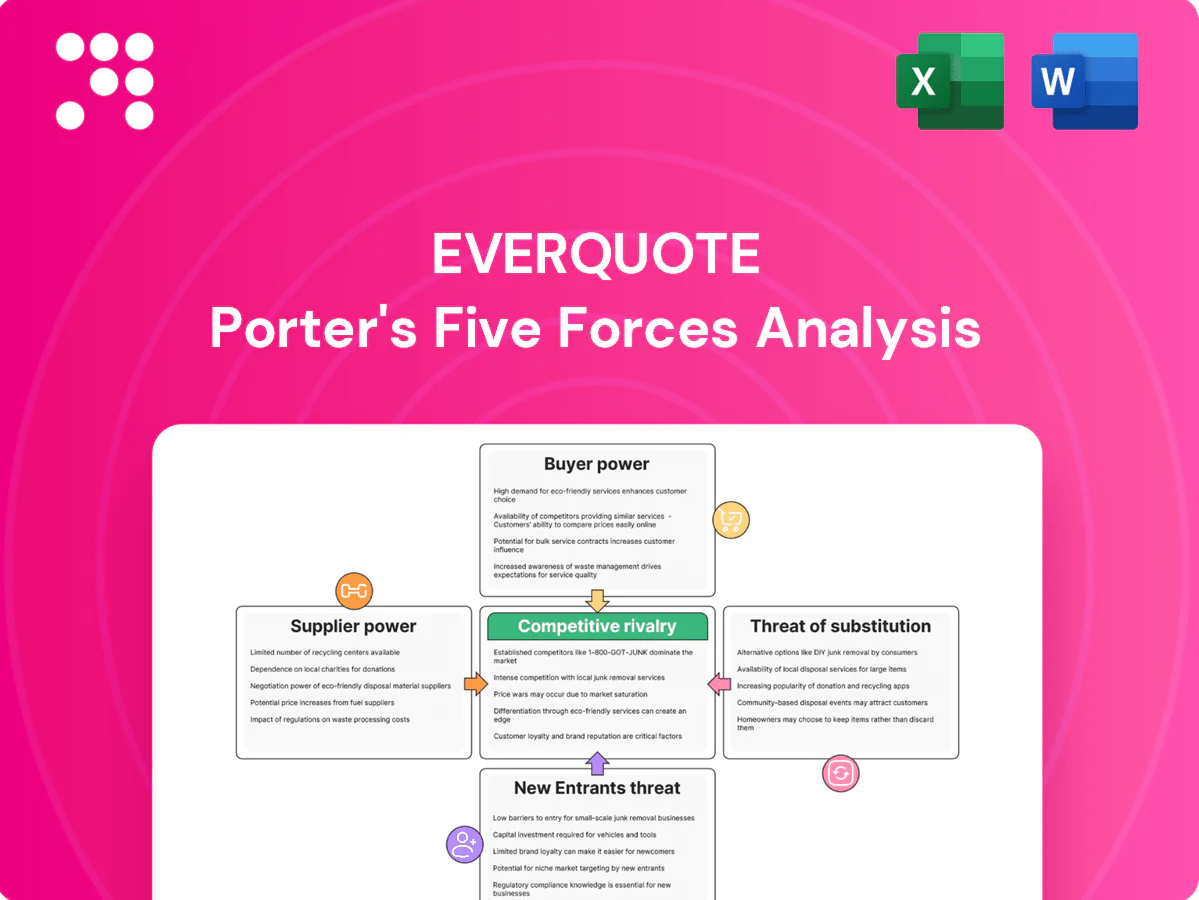
EverQuote Porter's Five Forces Analysis

A Must-Have Tool for Decision-Makers
EverQuote's Porter’s Five Forces snapshot highlights strong buyer bargaining, moderate supplier power, intense rivalry, low threat of substitutes, and medium threat of new entrants. This summary pinpoints competitive pressures affecting growth, margins and strategic priorities. This preview only scratches the surface—unlock the full Porter’s Five Forces Analysis for force-by-force ratings, visuals, and actionable insights to inform investment or strategy.
Suppliers Bargaining Power

Concentrated traffic sources
EverQuote depends on high-intent traffic from search engines and social platforms; Google and Meta together accounted for roughly half of US digital ad spend in 2024, giving them outsized pricing power. A few gatekeepers can raise CPCs or alter algorithms, compressing lead margins and increasing supplier leverage over acquisition costs. Diversification into affiliates and SEO reduces but does not eliminate this exposure.
Data and verification vendors
Identity, telephony and enrichment vendors provide critical lead-quality and routing services for EverQuote; the global identity verification market reached about USD 11B in 2024 with ~16% CAGR 2019–24, making vendor entrenchment valuable. Switching vendors is feasible but incurs integration and quality risks that can reduce conversion rates by several percentage points. When vendors are embedded in workflows they can pass through price increases; multi-sourcing and in-house tooling mitigate but do not eliminate supplier leverage.

Cloud and martech infrastructure
Hosting, analytics and marketing automation are largely commoditized yet sticky, with hyperscalers dominant (Gartner 2024: AWS 32.7%, Microsoft 22.6%, Google 10.2%), giving suppliers moderate leverage. Migration costs and integration with martech stacks raise switching friction, constraining buyer power. Usage-based pricing exposes EverQuote to cost variability during volume spikes. Committed discounts and savings plans (up to about 72% on compute) help counteract unit pricing pressure.

Publisher and affiliate networks
Independent publishers supply incremental traffic to EverQuote but often demand rev-share or floor CPAs, with 2024 performance-marketing benchmarks showing CPA floors up ~12% YoY and rev-share splits commonly ranging 15–35%, giving top affiliates negotiating leverage; variable quality increases reject rates and conversion volatility. Compliance and brand-safety oversight raised management costs in 2024, and exclusive placements can lock in higher rates and longer-term commitments.
- CPA floors up ~12% YoY (2024 benchmark)
- Rev-share commonly 15–35%
- Top affiliates exert leverage via volume/exclusivity
- Compliance/brand-safety increases ops costs
Carrier data/API access
Carrier data/API access boosts UX and conversion where exposed, with 2024 industry estimates showing digital quote APIs driving ~30% of online personal auto leads; carriers retain power by throttling or reprioritizing third-party integrations, creating latency and availability risk. Limited alternative sources for niche lines or states concentrates supplier leverage, while normalization layers and caching cut single-partner dependence and failure impact.
Half of US digital ad spend and hyperscaler dominance deepen lead-supply risks
EverQuote faces strong supplier power from ad gatekeepers (Google+Meta ≈ half US digital ad spend in 2024), identity vendors (global ID verification ≈ USD 11B in 2024, ~16% CAGR 2019–24) and hyperscalers (Gartner 2024: AWS 32.7%, Microsoft 22.6%, Google 10.2%), while affiliates (CPA floors +12% YoY; rev-share 15–35%) and carrier APIs (~30% of online auto leads) add concentration and availability risks.
| Metric | 2024 Value |
|---|---|
| Google+Meta share | ~50% US digital ad spend |
| ID verification market | USD 11B; ~16% CAGR |
| Hyperscalers (Gartner) | AWS 32.7% MSFT 22.6% GCP 10.2% |
| CPA floors | +12% YoY |
| API-driven leads | ~30% |
What is included in the product
 Detailed Word Document
Comprehensive Porter's Five Forces review tailored to EverQuote, assessing competitive rivalry, buyer and supplier power, threat of substitutes and new entrants, and identifying disruptive forces and strategic levers to protect market share.

 Customizable Excel Spreadsheet
One-sheet Porter's Five Forces for EverQuote that instantly highlights competitive pressures and buyer/supplier leverage—perfect for fast, boardroom-ready decisions. Swap in your own data, toggle scenarios, and export a clean chart to relieve analysis bottlenecks without any complex setup.
Customers Bargaining Power

Concentrated carrier and agent spend
Insurers and large agency groups control significant marketing budgets and can demand pricing concessions; in 2024 US auto-insurance ad spend exceeded $10 billion, concentrating buying power among major carriers. They reallocate spend across channels rapidly based on ROI, heightening sensitivity to lead quality and conversion metrics. Volume-based deals and guaranteed-delivery arrangements further strengthen buyer leverage over providers like EverQuote.
Low switching costs for buyers
Carriers commonly multihome across 3+ lead marketplaces, making switching trivial; shared CRM and bidding tools standardize integration and budget reallocation. If performance dips, spend can shift within days, squeezing EverQuote's ability to defend take rates. This fluid allocation drives sharper price competition and shorter-term contracting, pressuring margins and terms for lead providers.

Performance transparency
In 2024 buyers at EverQuote track CPL, CPA and LTV closely and demand granular targeting and cohort-level splits. Transparent funnel metrics let buyers press for discounts or credits when specific cohorts underperform. Return policies and crediting increase platform obligations, and the rise of outcome-based pricing further shifts negotiating leverage to buyers.

Regulatory and compliance demands
Carriers demand strict consent, TCPA and state-level compliance, raising EverQuote’s cost-to-serve and narrowing acceptable lead inventory; TCPA statutory damages stand at $500 per violation, up to $1,500 for willful breaches. Buyers can withhold spend for any compliance lapse, creating powerful downstream leverage that forces EverQuote to maintain higher operational controls and verification processes.
- Compliance scope: consent, TCPA ($500–$1,500/violation)
- Impact: higher cost-to-serve, tighter inventory
- Buyer leverage: spend withheld on lapses
Value of high-intent, matched leads
When EverQuote delivers higher intent and match rates buyer dependency rises, allowing improved close rates that support premium pricing and longer contracts; differentiated data science products like propensity scoring partially offset buyer bargaining power while consistent cohort ROI remains the primary lever to retain pricing leverage and reduce churn.
- Higher intent = increased buyer dependency
- Better close rates justify premiums
- Proprietary data reduces bargaining power
- Consistent cohort ROI sustains leverage
Carriers set auto-insurance pricing as multihoming compresses margins
Large carriers drive pricing: US auto-insurance ad spend exceeded $10B in 2024, concentrating leverage; buyers commonly multihome across 3+ lead marketplaces so switching is trivial. Strict TCPA/consent rules (damages $500–$1,500) let buyers withhold spend on lapses, squeezing margins; proprietary propensity scoring can restore some pricing power by boosting cohort ROI.
| Metric | Value |
|---|---|
| 2024 US auto ad spend | $10B+ |
| Marketplaces per buyer | 3+ |
| TCPA statutory damages | $500–$1,500 |
| Key KPIs | CPL, CPA, LTV |
Full Version Awaits
EverQuote Porter's Five Forces Analysis
This preview shows the exact EverQuote Porter's Five Forces Analysis you'll receive immediately after purchase—no placeholders or mockups. The file is the fully formatted, professionally written deliverable ready for download and use the moment you buy. It contains the complete assessment of competitive rivalry, supplier and buyer power, threat of substitution, and barriers to entry.

A Must-Have Tool for Decision-Makers
EverQuote's Porter’s Five Forces snapshot highlights strong buyer bargaining, moderate supplier power, intense rivalry, low threat of substitutes, and medium threat of new entrants. This summary pinpoints competitive pressures affecting growth, margins and strategic priorities. This preview only scratches the surface—unlock the full Porter’s Five Forces Analysis for force-by-force ratings, visuals, and actionable insights to inform investment or strategy.
Suppliers Bargaining Power
Concentrated traffic sources
EverQuote depends on high-intent traffic from search engines and social platforms; Google and Meta together accounted for roughly half of US digital ad spend in 2024, giving them outsized pricing power. A few gatekeepers can raise CPCs or alter algorithms, compressing lead margins and increasing supplier leverage over acquisition costs. Diversification into affiliates and SEO reduces but does not eliminate this exposure.
Data and verification vendors
Identity, telephony and enrichment vendors provide critical lead-quality and routing services for EverQuote; the global identity verification market reached about USD 11B in 2024 with ~16% CAGR 2019–24, making vendor entrenchment valuable. Switching vendors is feasible but incurs integration and quality risks that can reduce conversion rates by several percentage points. When vendors are embedded in workflows they can pass through price increases; multi-sourcing and in-house tooling mitigate but do not eliminate supplier leverage.
Cloud and martech infrastructure
Hosting, analytics and marketing automation are largely commoditized yet sticky, with hyperscalers dominant (Gartner 2024: AWS 32.7%, Microsoft 22.6%, Google 10.2%), giving suppliers moderate leverage. Migration costs and integration with martech stacks raise switching friction, constraining buyer power. Usage-based pricing exposes EverQuote to cost variability during volume spikes. Committed discounts and savings plans (up to about 72% on compute) help counteract unit pricing pressure.
Publisher and affiliate networks
Independent publishers supply incremental traffic to EverQuote but often demand rev-share or floor CPAs, with 2024 performance-marketing benchmarks showing CPA floors up ~12% YoY and rev-share splits commonly ranging 15–35%, giving top affiliates negotiating leverage; variable quality increases reject rates and conversion volatility. Compliance and brand-safety oversight raised management costs in 2024, and exclusive placements can lock in higher rates and longer-term commitments.
- CPA floors up ~12% YoY (2024 benchmark)
- Rev-share commonly 15–35%
- Top affiliates exert leverage via volume/exclusivity
- Compliance/brand-safety increases ops costs
Carrier data/API access
Carrier data/API access boosts UX and conversion where exposed, with 2024 industry estimates showing digital quote APIs driving ~30% of online personal auto leads; carriers retain power by throttling or reprioritizing third-party integrations, creating latency and availability risk. Limited alternative sources for niche lines or states concentrates supplier leverage, while normalization layers and caching cut single-partner dependence and failure impact.
Half of US digital ad spend and hyperscaler dominance deepen lead-supply risks
EverQuote faces strong supplier power from ad gatekeepers (Google+Meta ≈ half US digital ad spend in 2024), identity vendors (global ID verification ≈ USD 11B in 2024, ~16% CAGR 2019–24) and hyperscalers (Gartner 2024: AWS 32.7%, Microsoft 22.6%, Google 10.2%), while affiliates (CPA floors +12% YoY; rev-share 15–35%) and carrier APIs (~30% of online auto leads) add concentration and availability risks.
| Metric | 2024 Value |
|---|---|
| Google+Meta share | ~50% US digital ad spend |
| ID verification market | USD 11B; ~16% CAGR |
| Hyperscalers (Gartner) | AWS 32.7% MSFT 22.6% GCP 10.2% |
| CPA floors | +12% YoY |
| API-driven leads | ~30% |
What is included in the product
Detailed Word Document
Comprehensive Porter's Five Forces review tailored to EverQuote, assessing competitive rivalry, buyer and supplier power, threat of substitutes and new entrants, and identifying disruptive forces and strategic levers to protect market share.
Customizable Excel Spreadsheet
One-sheet Porter's Five Forces for EverQuote that instantly highlights competitive pressures and buyer/supplier leverage—perfect for fast, boardroom-ready decisions. Swap in your own data, toggle scenarios, and export a clean chart to relieve analysis bottlenecks without any complex setup.
Customers Bargaining Power
Concentrated carrier and agent spend
Insurers and large agency groups control significant marketing budgets and can demand pricing concessions; in 2024 US auto-insurance ad spend exceeded $10 billion, concentrating buying power among major carriers. They reallocate spend across channels rapidly based on ROI, heightening sensitivity to lead quality and conversion metrics. Volume-based deals and guaranteed-delivery arrangements further strengthen buyer leverage over providers like EverQuote.
Low switching costs for buyers
Carriers commonly multihome across 3+ lead marketplaces, making switching trivial; shared CRM and bidding tools standardize integration and budget reallocation. If performance dips, spend can shift within days, squeezing EverQuote's ability to defend take rates. This fluid allocation drives sharper price competition and shorter-term contracting, pressuring margins and terms for lead providers.
Performance transparency
In 2024 buyers at EverQuote track CPL, CPA and LTV closely and demand granular targeting and cohort-level splits. Transparent funnel metrics let buyers press for discounts or credits when specific cohorts underperform. Return policies and crediting increase platform obligations, and the rise of outcome-based pricing further shifts negotiating leverage to buyers.
Regulatory and compliance demands
Carriers demand strict consent, TCPA and state-level compliance, raising EverQuote’s cost-to-serve and narrowing acceptable lead inventory; TCPA statutory damages stand at $500 per violation, up to $1,500 for willful breaches. Buyers can withhold spend for any compliance lapse, creating powerful downstream leverage that forces EverQuote to maintain higher operational controls and verification processes.
- Compliance scope: consent, TCPA ($500–$1,500/violation)
- Impact: higher cost-to-serve, tighter inventory
- Buyer leverage: spend withheld on lapses
Value of high-intent, matched leads
When EverQuote delivers higher intent and match rates buyer dependency rises, allowing improved close rates that support premium pricing and longer contracts; differentiated data science products like propensity scoring partially offset buyer bargaining power while consistent cohort ROI remains the primary lever to retain pricing leverage and reduce churn.
- Higher intent = increased buyer dependency
- Better close rates justify premiums
- Proprietary data reduces bargaining power
- Consistent cohort ROI sustains leverage
Carriers set auto-insurance pricing as multihoming compresses margins
Large carriers drive pricing: US auto-insurance ad spend exceeded $10B in 2024, concentrating leverage; buyers commonly multihome across 3+ lead marketplaces so switching is trivial. Strict TCPA/consent rules (damages $500–$1,500) let buyers withhold spend on lapses, squeezing margins; proprietary propensity scoring can restore some pricing power by boosting cohort ROI.
| Metric | Value |
|---|---|
| 2024 US auto ad spend | $10B+ |
| Marketplaces per buyer | 3+ |
| TCPA statutory damages | $500–$1,500 |
| Key KPIs | CPL, CPA, LTV |
Full Version Awaits
EverQuote Porter's Five Forces Analysis
This preview shows the exact EverQuote Porter's Five Forces Analysis you'll receive immediately after purchase—no placeholders or mockups. The file is the fully formatted, professionally written deliverable ready for download and use the moment you buy. It contains the complete assessment of competitive rivalry, supplier and buyer power, threat of substitution, and barriers to entry.
Description
A Must-Have Tool for Decision-Makers
EverQuote's Porter’s Five Forces snapshot highlights strong buyer bargaining, moderate supplier power, intense rivalry, low threat of substitutes, and medium threat of new entrants. This summary pinpoints competitive pressures affecting growth, margins and strategic priorities. This preview only scratches the surface—unlock the full Porter’s Five Forces Analysis for force-by-force ratings, visuals, and actionable insights to inform investment or strategy.
Suppliers Bargaining Power
Concentrated traffic sources
EverQuote depends on high-intent traffic from search engines and social platforms; Google and Meta together accounted for roughly half of US digital ad spend in 2024, giving them outsized pricing power. A few gatekeepers can raise CPCs or alter algorithms, compressing lead margins and increasing supplier leverage over acquisition costs. Diversification into affiliates and SEO reduces but does not eliminate this exposure.
Data and verification vendors
Identity, telephony and enrichment vendors provide critical lead-quality and routing services for EverQuote; the global identity verification market reached about USD 11B in 2024 with ~16% CAGR 2019–24, making vendor entrenchment valuable. Switching vendors is feasible but incurs integration and quality risks that can reduce conversion rates by several percentage points. When vendors are embedded in workflows they can pass through price increases; multi-sourcing and in-house tooling mitigate but do not eliminate supplier leverage.
Cloud and martech infrastructure
Hosting, analytics and marketing automation are largely commoditized yet sticky, with hyperscalers dominant (Gartner 2024: AWS 32.7%, Microsoft 22.6%, Google 10.2%), giving suppliers moderate leverage. Migration costs and integration with martech stacks raise switching friction, constraining buyer power. Usage-based pricing exposes EverQuote to cost variability during volume spikes. Committed discounts and savings plans (up to about 72% on compute) help counteract unit pricing pressure.
Publisher and affiliate networks
Independent publishers supply incremental traffic to EverQuote but often demand rev-share or floor CPAs, with 2024 performance-marketing benchmarks showing CPA floors up ~12% YoY and rev-share splits commonly ranging 15–35%, giving top affiliates negotiating leverage; variable quality increases reject rates and conversion volatility. Compliance and brand-safety oversight raised management costs in 2024, and exclusive placements can lock in higher rates and longer-term commitments.
- CPA floors up ~12% YoY (2024 benchmark)
- Rev-share commonly 15–35%
- Top affiliates exert leverage via volume/exclusivity
- Compliance/brand-safety increases ops costs
Carrier data/API access
Carrier data/API access boosts UX and conversion where exposed, with 2024 industry estimates showing digital quote APIs driving ~30% of online personal auto leads; carriers retain power by throttling or reprioritizing third-party integrations, creating latency and availability risk. Limited alternative sources for niche lines or states concentrates supplier leverage, while normalization layers and caching cut single-partner dependence and failure impact.
Half of US digital ad spend and hyperscaler dominance deepen lead-supply risks
EverQuote faces strong supplier power from ad gatekeepers (Google+Meta ≈ half US digital ad spend in 2024), identity vendors (global ID verification ≈ USD 11B in 2024, ~16% CAGR 2019–24) and hyperscalers (Gartner 2024: AWS 32.7%, Microsoft 22.6%, Google 10.2%), while affiliates (CPA floors +12% YoY; rev-share 15–35%) and carrier APIs (~30% of online auto leads) add concentration and availability risks.
| Metric | 2024 Value |
|---|---|
| Google+Meta share | ~50% US digital ad spend |
| ID verification market | USD 11B; ~16% CAGR |
| Hyperscalers (Gartner) | AWS 32.7% MSFT 22.6% GCP 10.2% |
| CPA floors | +12% YoY |
| API-driven leads | ~30% |
What is included in the product
Detailed Word Document
Comprehensive Porter's Five Forces review tailored to EverQuote, assessing competitive rivalry, buyer and supplier power, threat of substitutes and new entrants, and identifying disruptive forces and strategic levers to protect market share.
Customizable Excel Spreadsheet
One-sheet Porter's Five Forces for EverQuote that instantly highlights competitive pressures and buyer/supplier leverage—perfect for fast, boardroom-ready decisions. Swap in your own data, toggle scenarios, and export a clean chart to relieve analysis bottlenecks without any complex setup.
Customers Bargaining Power
Concentrated carrier and agent spend
Insurers and large agency groups control significant marketing budgets and can demand pricing concessions; in 2024 US auto-insurance ad spend exceeded $10 billion, concentrating buying power among major carriers. They reallocate spend across channels rapidly based on ROI, heightening sensitivity to lead quality and conversion metrics. Volume-based deals and guaranteed-delivery arrangements further strengthen buyer leverage over providers like EverQuote.
Low switching costs for buyers
Carriers commonly multihome across 3+ lead marketplaces, making switching trivial; shared CRM and bidding tools standardize integration and budget reallocation. If performance dips, spend can shift within days, squeezing EverQuote's ability to defend take rates. This fluid allocation drives sharper price competition and shorter-term contracting, pressuring margins and terms for lead providers.
Performance transparency
In 2024 buyers at EverQuote track CPL, CPA and LTV closely and demand granular targeting and cohort-level splits. Transparent funnel metrics let buyers press for discounts or credits when specific cohorts underperform. Return policies and crediting increase platform obligations, and the rise of outcome-based pricing further shifts negotiating leverage to buyers.
Regulatory and compliance demands
Carriers demand strict consent, TCPA and state-level compliance, raising EverQuote’s cost-to-serve and narrowing acceptable lead inventory; TCPA statutory damages stand at $500 per violation, up to $1,500 for willful breaches. Buyers can withhold spend for any compliance lapse, creating powerful downstream leverage that forces EverQuote to maintain higher operational controls and verification processes.
- Compliance scope: consent, TCPA ($500–$1,500/violation)
- Impact: higher cost-to-serve, tighter inventory
- Buyer leverage: spend withheld on lapses
Value of high-intent, matched leads
When EverQuote delivers higher intent and match rates buyer dependency rises, allowing improved close rates that support premium pricing and longer contracts; differentiated data science products like propensity scoring partially offset buyer bargaining power while consistent cohort ROI remains the primary lever to retain pricing leverage and reduce churn.
- Higher intent = increased buyer dependency
- Better close rates justify premiums
- Proprietary data reduces bargaining power
- Consistent cohort ROI sustains leverage
Carriers set auto-insurance pricing as multihoming compresses margins
Large carriers drive pricing: US auto-insurance ad spend exceeded $10B in 2024, concentrating leverage; buyers commonly multihome across 3+ lead marketplaces so switching is trivial. Strict TCPA/consent rules (damages $500–$1,500) let buyers withhold spend on lapses, squeezing margins; proprietary propensity scoring can restore some pricing power by boosting cohort ROI.
| Metric | Value |
|---|---|
| 2024 US auto ad spend | $10B+ |
| Marketplaces per buyer | 3+ |
| TCPA statutory damages | $500–$1,500 |
| Key KPIs | CPL, CPA, LTV |
Full Version Awaits
EverQuote Porter's Five Forces Analysis
This preview shows the exact EverQuote Porter's Five Forces Analysis you'll receive immediately after purchase—no placeholders or mockups. The file is the fully formatted, professionally written deliverable ready for download and use the moment you buy. It contains the complete assessment of competitive rivalry, supplier and buyer power, threat of substitution, and barriers to entry.











