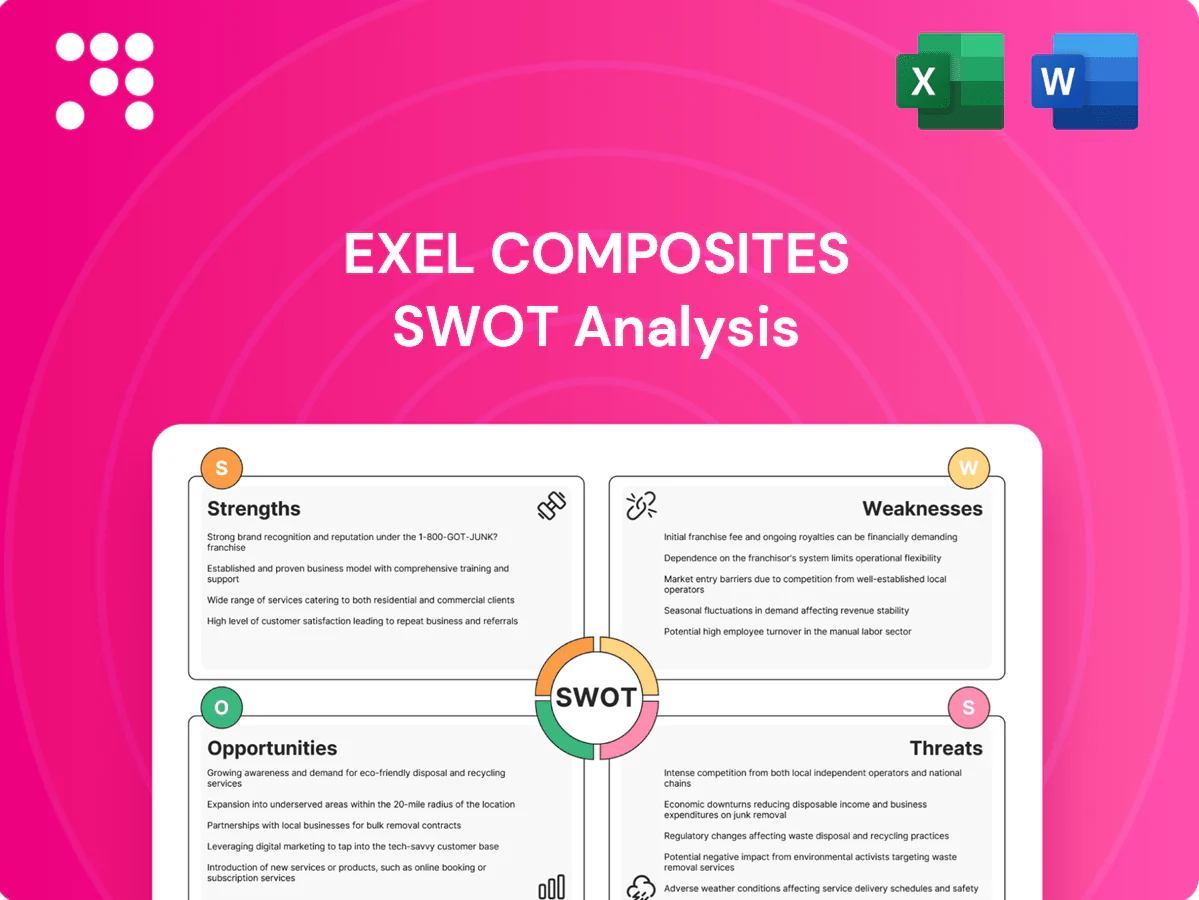
Exel Composites SWOT Analysis

Go Beyond the Preview—Access the Full Strategic Report
Discover Exel Composites' strategic position with our concise SWOT snapshot—highlighting innovation in composite pultrusion, strong OEM partnerships, and exposure to raw-material price volatility and cyclical end markets. Want deeper, actionable insights and financial context? Purchase the full SWOT analysis for a professionally written, editable Word and Excel package to support investment, strategy, or pitch readiness.
Strengths

Pultrusion process leadership
Recognized expertise in pultrusion and continuous lamination gives Exel Composites repeatable quality and cost efficiency at scale, with process-driven tight tolerances and low scrap rates. The know-how is hard to replicate and underpins defensible differentiation in markets requiring stability. Pultrusion supports high fiber volume fractions (typically 50–70%), delivering strong strength-to-weight advantages valued for mission-critical applications.
Custom-engineered solutions
Custom-engineered solutions enable co-development with clients to tailor profiles and tubes to precise performance specs, embedding Exel early in design cycles and raising switching costs; this specialization supports higher margins versus commoditized stock parts and aligns product development with sustainability and lifecycle targets through optimized material use and longer service life.

Lightweight, durable performance
Composite profiles offer superior strength-to-weight — often 40–60% lighter than metals — with markedly better corrosion resistance and fatigue life, reducing replacement and maintenance cycles in harsh environments. In aerospace, composite use (eg Boeing 787) enabled roughly 20% fuel efficiency gains versus earlier models, translating to lower emissions. These attributes improve payload and energy efficiency, driving measurable TCO savings for customers.

Diversified end-market exposure
Exel Composites' presence across transportation, construction, energy, telecom and sports smooths single-sector volatility and accelerates solution reuse and platforming, tapping a global composites market valued around $90–100bn in 2023 with ~5–6% CAGR to 2030 to open multi-application revenue from a common technology base.
- Cross-industry learnings accelerate platforming
- Common tech base unlocks multi-application sales
- Portfolio balance enhances cycle resilience
Process IP and quality systems
Accumulated formulations, dies and tooling expertise form tacit process IP that raises barriers to entry and preserves margin. Mature QA and testing protocols support safety-critical OEM approvals and sustain customer trust. Standardized processes lower scrap and shorten lead times, enabling consistent global OEM qualification and repeat business.
- Tacit IP
- QA & testing
- Reduced scrap
- Shorter lead times
- Global OEM consistency
Low-scrap pultrusion: 50-70% FVF drives OEM approvals, higher margins
Deep pultrusion expertise yields repeatable low-scrap production and high fiber-volume parts (50–70%), enabling strong strength-to-weight and OEM approvals. Custom-engineered, co-developed profiles raise switching costs and support higher margins. Diversified end-markets tap a global composites market ≈$95bn (2023) with ~5.5% CAGR to 2030.
| Strength | Metric | Impact |
|---|---|---|
| Pulptrusion & tacit IP | 50–70% FVF | Lower scrap, higher TCO savings |
What is included in the product
 Detailed Word Document
Delivers a strategic overview of Exel Composites’s internal and external business factors, outlining strengths, weaknesses, opportunities and threats to assess its competitive position, key growth drivers and risks shaping future performance.

 Customizable Excel Spreadsheet
Provides a clear, Exel Composites–focused SWOT matrix for rapid alignment on material, market, and operational risks; ideal for pinpointing pain points and strategic gaps. Editable, visual format speeds stakeholder buy-in and enables quick updates as priorities shift.
Weaknesses

Industrial cyclicality exposure
Exposure to cyclical end markets such as construction and transportation means demand can swing sharply with macro conditions. Order timing and project deferrals pressure factory utilization and working capital. Revenue visibility is limited by customer capex cycles, complicating forecasting across quarters. During downturns this dynamic can compress gross margins and operating leverage.
Raw material volatility
Carbon fibers, glass fibers and resin systems are exposed to pronounced price swings and supply concentration, with major producers including Toray, Mitsubishi Chemical and Hexcel, creating single-sourcing risk for Exel Composites. Pass-through mechanisms to customers often lag market moves, compressing gross margins. To mitigate shortages Exel historically builds inventory buffers, which tie up working capital and reduce liquidity.

Complex, long sales cycles
Custom engineering, prototyping and certification routinely extend time-to-revenue, with qualification in safety-regulated applications often taking 3–9 months or more. Engineering bandwidth becomes a bottleneck as bespoke projects consume senior resources, delaying new orders and scaling. Project-based demand increases forecasting difficulty, commonly producing quarter-to-quarter revenue variability exceeding 15–20%.

Capital and tooling intensity
Exel Composites faces high capital and tooling intensity as pultrusion lines, dies and downstream finishing demand continuous capex and maintenance, with tooling customization creating upfront cost and payback risk if volumes underdeliver; line changeovers further reduce throughput and the asset-heavy model raises break-even utilization, a structural weakness for a Nasdaq Helsinki–listed specialist.
- High capex: pultrusion lines and dies
- Tooling customization → upfront cost & payback risk
- Line changeovers lower throughput
- Asset intensity increases break-even utilization
Customer concentration risk
Large OEM programs often represent a significant share of Exel Composites sales, so program loss or redesign can trigger steep volume step-downs and revenue volatility. Anchor clients may hold stronger negotiating power on pricing and terms, compressing margins. While diversification across programs is desirable to mitigate concentration, it is not always feasible given program-specific tooling and certification cycles.
- Customer concentration
- Volume step-down risk
- Anchor-client leverage
Cyclic demand and certification lag compress margins; 15-20% quarterly revenue swings
Cyclic end-market exposure and project-driven orders create quarter-to-quarter revenue swings often exceeding 15–20%, compressing margins in downturns. Supply concentration (Toray, Mitsubishi Chemical, Hexcel) and volatile fiber/resin pricing force inventory buffers and margin lag. Custom engineering and certifications typically add 3–9 months to time-to-revenue, while high capex and tooling raise break-even utilization.
| Weakness | Fact |
|---|---|
| Revenue volatility | Quarterly swings >15–20% |
| Certification lag | 3–9 months |
| Supplier concentration | Major suppliers: Toray, Mitsubishi Chemical, Hexcel |
| Asset intensity | High capex & tooling → higher break-even |
Full Version Awaits
Exel Composites SWOT Analysis
This is a real excerpt from the complete Exel Composites SWOT analysis you'll receive upon purchase—no surprises, just professional quality. The preview below is taken directly from the full report and reflects the final, editable document. Buy now to unlock the entire in‑depth version immediately after checkout.

Go Beyond the Preview—Access the Full Strategic Report
Discover Exel Composites' strategic position with our concise SWOT snapshot—highlighting innovation in composite pultrusion, strong OEM partnerships, and exposure to raw-material price volatility and cyclical end markets. Want deeper, actionable insights and financial context? Purchase the full SWOT analysis for a professionally written, editable Word and Excel package to support investment, strategy, or pitch readiness.
Strengths
Pultrusion process leadership
Recognized expertise in pultrusion and continuous lamination gives Exel Composites repeatable quality and cost efficiency at scale, with process-driven tight tolerances and low scrap rates. The know-how is hard to replicate and underpins defensible differentiation in markets requiring stability. Pultrusion supports high fiber volume fractions (typically 50–70%), delivering strong strength-to-weight advantages valued for mission-critical applications.
Custom-engineered solutions
Custom-engineered solutions enable co-development with clients to tailor profiles and tubes to precise performance specs, embedding Exel early in design cycles and raising switching costs; this specialization supports higher margins versus commoditized stock parts and aligns product development with sustainability and lifecycle targets through optimized material use and longer service life.
Lightweight, durable performance
Composite profiles offer superior strength-to-weight — often 40–60% lighter than metals — with markedly better corrosion resistance and fatigue life, reducing replacement and maintenance cycles in harsh environments. In aerospace, composite use (eg Boeing 787) enabled roughly 20% fuel efficiency gains versus earlier models, translating to lower emissions. These attributes improve payload and energy efficiency, driving measurable TCO savings for customers.
Diversified end-market exposure
Exel Composites' presence across transportation, construction, energy, telecom and sports smooths single-sector volatility and accelerates solution reuse and platforming, tapping a global composites market valued around $90–100bn in 2023 with ~5–6% CAGR to 2030 to open multi-application revenue from a common technology base.
- Cross-industry learnings accelerate platforming
- Common tech base unlocks multi-application sales
- Portfolio balance enhances cycle resilience
Process IP and quality systems
Accumulated formulations, dies and tooling expertise form tacit process IP that raises barriers to entry and preserves margin. Mature QA and testing protocols support safety-critical OEM approvals and sustain customer trust. Standardized processes lower scrap and shorten lead times, enabling consistent global OEM qualification and repeat business.
- Tacit IP
- QA & testing
- Reduced scrap
- Shorter lead times
- Global OEM consistency
Low-scrap pultrusion: 50-70% FVF drives OEM approvals, higher margins
Deep pultrusion expertise yields repeatable low-scrap production and high fiber-volume parts (50–70%), enabling strong strength-to-weight and OEM approvals. Custom-engineered, co-developed profiles raise switching costs and support higher margins. Diversified end-markets tap a global composites market ≈$95bn (2023) with ~5.5% CAGR to 2030.
| Strength | Metric | Impact |
|---|---|---|
| Pulptrusion & tacit IP | 50–70% FVF | Lower scrap, higher TCO savings |
What is included in the product
Detailed Word Document
Delivers a strategic overview of Exel Composites’s internal and external business factors, outlining strengths, weaknesses, opportunities and threats to assess its competitive position, key growth drivers and risks shaping future performance.
Customizable Excel Spreadsheet
Provides a clear, Exel Composites–focused SWOT matrix for rapid alignment on material, market, and operational risks; ideal for pinpointing pain points and strategic gaps. Editable, visual format speeds stakeholder buy-in and enables quick updates as priorities shift.
Weaknesses
Industrial cyclicality exposure
Exposure to cyclical end markets such as construction and transportation means demand can swing sharply with macro conditions. Order timing and project deferrals pressure factory utilization and working capital. Revenue visibility is limited by customer capex cycles, complicating forecasting across quarters. During downturns this dynamic can compress gross margins and operating leverage.
Raw material volatility
Carbon fibers, glass fibers and resin systems are exposed to pronounced price swings and supply concentration, with major producers including Toray, Mitsubishi Chemical and Hexcel, creating single-sourcing risk for Exel Composites. Pass-through mechanisms to customers often lag market moves, compressing gross margins. To mitigate shortages Exel historically builds inventory buffers, which tie up working capital and reduce liquidity.
Complex, long sales cycles
Custom engineering, prototyping and certification routinely extend time-to-revenue, with qualification in safety-regulated applications often taking 3–9 months or more. Engineering bandwidth becomes a bottleneck as bespoke projects consume senior resources, delaying new orders and scaling. Project-based demand increases forecasting difficulty, commonly producing quarter-to-quarter revenue variability exceeding 15–20%.
Capital and tooling intensity
Exel Composites faces high capital and tooling intensity as pultrusion lines, dies and downstream finishing demand continuous capex and maintenance, with tooling customization creating upfront cost and payback risk if volumes underdeliver; line changeovers further reduce throughput and the asset-heavy model raises break-even utilization, a structural weakness for a Nasdaq Helsinki–listed specialist.
- High capex: pultrusion lines and dies
- Tooling customization → upfront cost & payback risk
- Line changeovers lower throughput
- Asset intensity increases break-even utilization
Customer concentration risk
Large OEM programs often represent a significant share of Exel Composites sales, so program loss or redesign can trigger steep volume step-downs and revenue volatility. Anchor clients may hold stronger negotiating power on pricing and terms, compressing margins. While diversification across programs is desirable to mitigate concentration, it is not always feasible given program-specific tooling and certification cycles.
- Customer concentration
- Volume step-down risk
- Anchor-client leverage
Cyclic demand and certification lag compress margins; 15-20% quarterly revenue swings
Cyclic end-market exposure and project-driven orders create quarter-to-quarter revenue swings often exceeding 15–20%, compressing margins in downturns. Supply concentration (Toray, Mitsubishi Chemical, Hexcel) and volatile fiber/resin pricing force inventory buffers and margin lag. Custom engineering and certifications typically add 3–9 months to time-to-revenue, while high capex and tooling raise break-even utilization.
| Weakness | Fact |
|---|---|
| Revenue volatility | Quarterly swings >15–20% |
| Certification lag | 3–9 months |
| Supplier concentration | Major suppliers: Toray, Mitsubishi Chemical, Hexcel |
| Asset intensity | High capex & tooling → higher break-even |
Full Version Awaits
Exel Composites SWOT Analysis
This is a real excerpt from the complete Exel Composites SWOT analysis you'll receive upon purchase—no surprises, just professional quality. The preview below is taken directly from the full report and reflects the final, editable document. Buy now to unlock the entire in‑depth version immediately after checkout.
Description
Go Beyond the Preview—Access the Full Strategic Report
Discover Exel Composites' strategic position with our concise SWOT snapshot—highlighting innovation in composite pultrusion, strong OEM partnerships, and exposure to raw-material price volatility and cyclical end markets. Want deeper, actionable insights and financial context? Purchase the full SWOT analysis for a professionally written, editable Word and Excel package to support investment, strategy, or pitch readiness.
Strengths
Pultrusion process leadership
Recognized expertise in pultrusion and continuous lamination gives Exel Composites repeatable quality and cost efficiency at scale, with process-driven tight tolerances and low scrap rates. The know-how is hard to replicate and underpins defensible differentiation in markets requiring stability. Pultrusion supports high fiber volume fractions (typically 50–70%), delivering strong strength-to-weight advantages valued for mission-critical applications.
Custom-engineered solutions
Custom-engineered solutions enable co-development with clients to tailor profiles and tubes to precise performance specs, embedding Exel early in design cycles and raising switching costs; this specialization supports higher margins versus commoditized stock parts and aligns product development with sustainability and lifecycle targets through optimized material use and longer service life.
Lightweight, durable performance
Composite profiles offer superior strength-to-weight — often 40–60% lighter than metals — with markedly better corrosion resistance and fatigue life, reducing replacement and maintenance cycles in harsh environments. In aerospace, composite use (eg Boeing 787) enabled roughly 20% fuel efficiency gains versus earlier models, translating to lower emissions. These attributes improve payload and energy efficiency, driving measurable TCO savings for customers.
Diversified end-market exposure
Exel Composites' presence across transportation, construction, energy, telecom and sports smooths single-sector volatility and accelerates solution reuse and platforming, tapping a global composites market valued around $90–100bn in 2023 with ~5–6% CAGR to 2030 to open multi-application revenue from a common technology base.
- Cross-industry learnings accelerate platforming
- Common tech base unlocks multi-application sales
- Portfolio balance enhances cycle resilience
Process IP and quality systems
Accumulated formulations, dies and tooling expertise form tacit process IP that raises barriers to entry and preserves margin. Mature QA and testing protocols support safety-critical OEM approvals and sustain customer trust. Standardized processes lower scrap and shorten lead times, enabling consistent global OEM qualification and repeat business.
- Tacit IP
- QA & testing
- Reduced scrap
- Shorter lead times
- Global OEM consistency
Low-scrap pultrusion: 50-70% FVF drives OEM approvals, higher margins
Deep pultrusion expertise yields repeatable low-scrap production and high fiber-volume parts (50–70%), enabling strong strength-to-weight and OEM approvals. Custom-engineered, co-developed profiles raise switching costs and support higher margins. Diversified end-markets tap a global composites market ≈$95bn (2023) with ~5.5% CAGR to 2030.
| Strength | Metric | Impact |
|---|---|---|
| Pulptrusion & tacit IP | 50–70% FVF | Lower scrap, higher TCO savings |
What is included in the product
Detailed Word Document
Delivers a strategic overview of Exel Composites’s internal and external business factors, outlining strengths, weaknesses, opportunities and threats to assess its competitive position, key growth drivers and risks shaping future performance.
Customizable Excel Spreadsheet
Provides a clear, Exel Composites–focused SWOT matrix for rapid alignment on material, market, and operational risks; ideal for pinpointing pain points and strategic gaps. Editable, visual format speeds stakeholder buy-in and enables quick updates as priorities shift.
Weaknesses
Industrial cyclicality exposure
Exposure to cyclical end markets such as construction and transportation means demand can swing sharply with macro conditions. Order timing and project deferrals pressure factory utilization and working capital. Revenue visibility is limited by customer capex cycles, complicating forecasting across quarters. During downturns this dynamic can compress gross margins and operating leverage.
Raw material volatility
Carbon fibers, glass fibers and resin systems are exposed to pronounced price swings and supply concentration, with major producers including Toray, Mitsubishi Chemical and Hexcel, creating single-sourcing risk for Exel Composites. Pass-through mechanisms to customers often lag market moves, compressing gross margins. To mitigate shortages Exel historically builds inventory buffers, which tie up working capital and reduce liquidity.
Complex, long sales cycles
Custom engineering, prototyping and certification routinely extend time-to-revenue, with qualification in safety-regulated applications often taking 3–9 months or more. Engineering bandwidth becomes a bottleneck as bespoke projects consume senior resources, delaying new orders and scaling. Project-based demand increases forecasting difficulty, commonly producing quarter-to-quarter revenue variability exceeding 15–20%.
Capital and tooling intensity
Exel Composites faces high capital and tooling intensity as pultrusion lines, dies and downstream finishing demand continuous capex and maintenance, with tooling customization creating upfront cost and payback risk if volumes underdeliver; line changeovers further reduce throughput and the asset-heavy model raises break-even utilization, a structural weakness for a Nasdaq Helsinki–listed specialist.
- High capex: pultrusion lines and dies
- Tooling customization → upfront cost & payback risk
- Line changeovers lower throughput
- Asset intensity increases break-even utilization
Customer concentration risk
Large OEM programs often represent a significant share of Exel Composites sales, so program loss or redesign can trigger steep volume step-downs and revenue volatility. Anchor clients may hold stronger negotiating power on pricing and terms, compressing margins. While diversification across programs is desirable to mitigate concentration, it is not always feasible given program-specific tooling and certification cycles.
- Customer concentration
- Volume step-down risk
- Anchor-client leverage
Cyclic demand and certification lag compress margins; 15-20% quarterly revenue swings
Cyclic end-market exposure and project-driven orders create quarter-to-quarter revenue swings often exceeding 15–20%, compressing margins in downturns. Supply concentration (Toray, Mitsubishi Chemical, Hexcel) and volatile fiber/resin pricing force inventory buffers and margin lag. Custom engineering and certifications typically add 3–9 months to time-to-revenue, while high capex and tooling raise break-even utilization.
| Weakness | Fact |
|---|---|
| Revenue volatility | Quarterly swings >15–20% |
| Certification lag | 3–9 months |
| Supplier concentration | Major suppliers: Toray, Mitsubishi Chemical, Hexcel |
| Asset intensity | High capex & tooling → higher break-even |
Full Version Awaits
Exel Composites SWOT Analysis
This is a real excerpt from the complete Exel Composites SWOT analysis you'll receive upon purchase—no surprises, just professional quality. The preview below is taken directly from the full report and reflects the final, editable document. Buy now to unlock the entire in‑depth version immediately after checkout.











