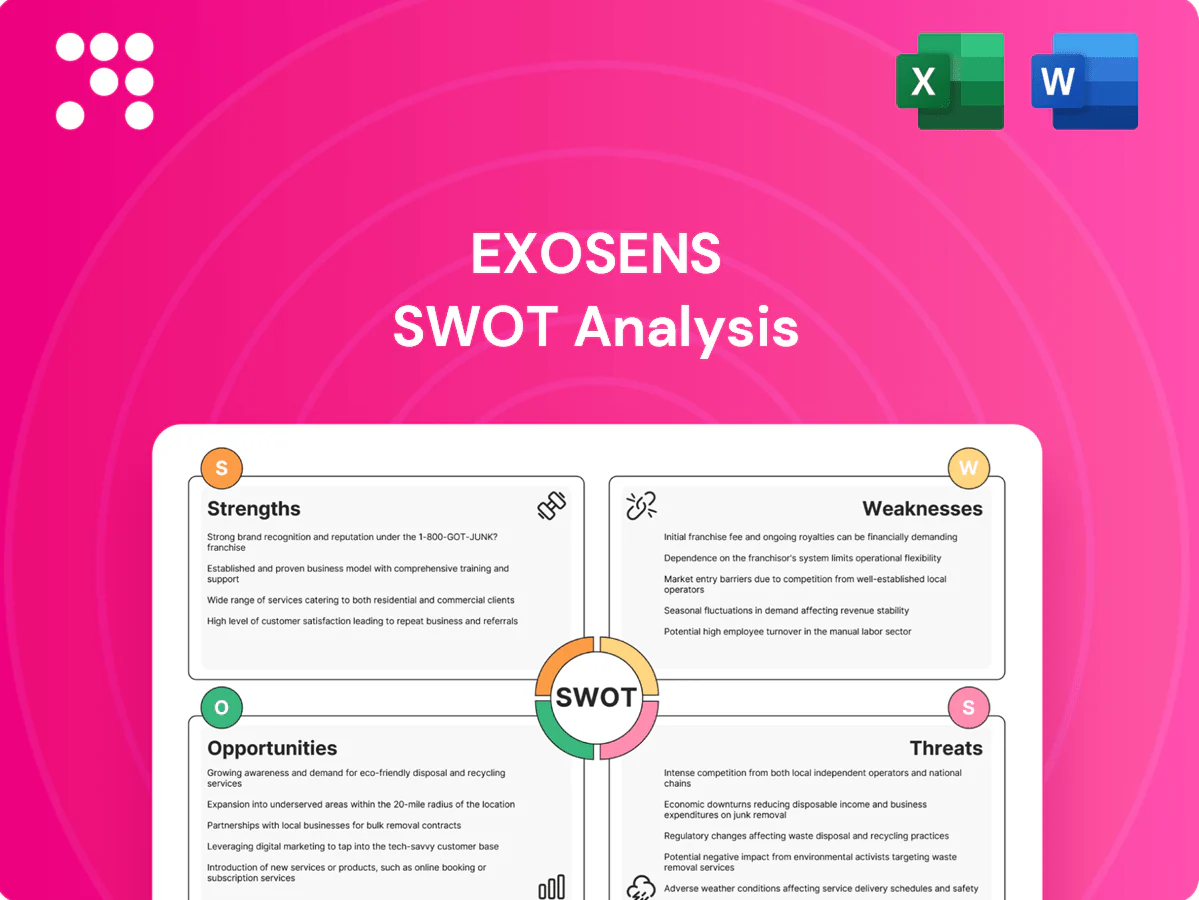
Exosens SWOT Analysis

Your Strategic Toolkit Starts Here
Exosens’s SWOT highlights innovative sensor tech and niche market traction, balanced by commercialization and regulatory risks, plus clear growth drivers in healthcare diagnostics. Want the full strategic picture and actionable insights? Purchase the complete SWOT for a research-backed, investor-ready Word report and editable Excel matrix to plan, pitch, or invest with confidence.
Strengths

Deep photonics and detection expertise
Decades of know-how in light detection, low-light imaging and radiation sensing underpin Exosens performance, enabling designs that achieve single-photon and near-single-photon sensitivity in laboratory and field devices. This expertise yields tight control over noise, gain and sensitivity parameters, supports premium pricing in niche markets and shortens innovation cycles across product families.
High-performance, mission-critical reputation
Products such as photomultiplier tubes and image intensifiers are trusted across medical, scientific, industrial and defense applications, underpinning Exosens's high-performance, mission-critical reputation.
Proven reliability in harsh environments creates significant switching costs for customers and supports recurring procurement.
Reference wins in critical programs bolster credibility and facilitate long-term contracts and framework agreements.

Diversified end-market exposure
Serving medical, scientific, industrial and defense customers reduces revenue volatility by tapping markets such as the ~600 billion USD global medical device market (2024) and the ~2.3 trillion USD global defense budget (2024), hedging cyclical downturns in any single vertical. Cross-sector demand stabilizes order flow while knowledge transfer across domains accelerates product improvements, broadening funding sources and project pipelines.

Proprietary IP and specialized manufacturing
Proprietary IP in complex vacuum, photon multiplication and electronics integration creates high technical and capital barriers to entry and sustains product differentiation. Protected designs and process know-how lock in manufacturing advantages while yield optimization and rigorous quality systems protect gross margins. Together these factors limit commoditization and support premium positioning.
- Proprietary IP
- Manufacturing barriers
- Yield & quality protection
- Reduced commoditization
Systems integration and solution breadth
Combining sensors, electronics and modules lets Exosens deliver systems that outperform standalone components, reducing integration time for customers and improving performance matching across subsystems.
Broad solution breadth creates upsell and cross-sell pathways and positions Exosens as a strategic partner rather than a commodity supplier.
Single-photon imaging expertise unlocks premium medical and defense system wins
Decades of low-light, photon-sensing expertise enables single-photon performance, supporting premium pricing and faster innovation.
Trusted photomultiplier and intensifier products in medical, scientific, industrial and defense create switching costs, recurring procurement and reference wins.
Proprietary IP, manufacturing barriers and system-level integration drive upsell into the ~600B USD medical and ~2.3T USD defense markets (2024).
| Metric | 2024 Value |
|---|---|
| Global medical device market | ~600B USD |
| Global defense budget | ~2.3T USD |
What is included in the product
 Detailed Word Document
Provides a concise SWOT analysis of Exosens, highlighting internal strengths and weaknesses alongside external opportunities and threats to assess competitive positioning and strategic risks.

 Customizable Excel Spreadsheet
Provides a concise, visual SWOT matrix tailored to Exosens for rapid strategy alignment and stakeholder-ready summaries, enabling quick edits to reflect shifting priorities and streamline decision-making.
Weaknesses

Capital- and process-intensive production
Exosens production relies on specialized equipment and cleanroom/vacuum technologies with single tools often costing over $1M, creating high upfront capex. Large fixed overheads mean low-volume runs can compress gross margins sharply. Expanding capacity typically requires 12–36 months and significant capital, limiting rapid scaling and making Exosens less agile than fabless or lighter-asset competitors.
Long sales cycles and customization
Mission-critical buyers require validation, trials and certifications, stretching industrial-tech sales cycles to 12–24 months and multiple pilot stages. Complex integration and custom engineering extend decision timelines, tie up R&D and working capital, and can push DSO and inventory holding significantly higher. Forecasting becomes harder, increasing cash-flow volatility and margin pressure.

Exposure to regulated and defense procurement
Exposure to regulated defense and medical markets forces strict compliance, audits and export controls, with the US defense budget near $858B (FY2024) and the global medical device market ~520B (2023), increasing regulatory scrutiny and program risk. Budget timing and approvals can delay revenue recognition and cash flow. Program cancellations or scope changes create revenue lumpiness and quarter-to-quarter volatility. Compliance and audit costs disproportionately burden smaller programs, squeezing margins.

Specialty supply chain vulnerabilities
Reliance on niche materials and components creates bottlenecks, as a small pool of qualified suppliers increases lead-time risk and exposure to single-source failures. Quality excursions in these specialized inputs can sharply reduce yields and escalate rework costs, while establishing dual-sourcing is often costly and technically challenging given tight spec requirements.
- High single-source exposure
- Long lead-time risk
- Yield sensitivity to quality excursions
- Dual-sourcing costly/complex
Brand visibility versus larger conglomerates
Exosens struggles with brand visibility versus larger conglomerates that dominate mindshare in the roughly $500B global medtech market (2024), so limited marketing reach can slow OEM penetration and lengthen sales cycles.
Procurement teams often default to incumbents; industry data show top global players hold a disproportionate share of OEM contracts, meaning Exosens must invest extra commercial effort to win preferred-supplier status.
- High market concentration: top players dominate OEM mindshare
- Limited marketing reach slows penetration
- Procurement inertia favors incumbents
- Requires increased sales/partnership spend to convert
High capex (>$1M), 12–36 mo buildouts and 12–24 mo sales cycles squeeze margins
High-capex manufacturing (single tools >$1M) and 12–36 month capacity buildouts constrain scaling and compress margins at low volumes. Long 12–24 month sales cycles plus heavy compliance (US defense $858B FY2024; global medtech ~$500B 2024) create revenue volatility and cash-flow risk. Single-source suppliers raise lead-time and yield risk, making dual-sourcing costly and slow.
| Metric | Value |
|---|---|
| Single tool cost | >$1M |
| Capacity lead time | 12–36 months |
| Sales cycle | 12–24 months |
| US defense budget | $858B (FY2024) |
| Global medtech market | ~$500B (2024) |
Preview Before You Purchase
Exosens SWOT Analysis
This is the actual Exosens SWOT analysis document you’ll receive upon purchase—no surprises, just professional quality. The preview below is taken directly from the full report; buying unlocks the complete, editable version with in-depth findings and actionable insights.

Your Strategic Toolkit Starts Here
Exosens’s SWOT highlights innovative sensor tech and niche market traction, balanced by commercialization and regulatory risks, plus clear growth drivers in healthcare diagnostics. Want the full strategic picture and actionable insights? Purchase the complete SWOT for a research-backed, investor-ready Word report and editable Excel matrix to plan, pitch, or invest with confidence.
Strengths
Deep photonics and detection expertise
Decades of know-how in light detection, low-light imaging and radiation sensing underpin Exosens performance, enabling designs that achieve single-photon and near-single-photon sensitivity in laboratory and field devices. This expertise yields tight control over noise, gain and sensitivity parameters, supports premium pricing in niche markets and shortens innovation cycles across product families.
High-performance, mission-critical reputation
Products such as photomultiplier tubes and image intensifiers are trusted across medical, scientific, industrial and defense applications, underpinning Exosens's high-performance, mission-critical reputation.
Proven reliability in harsh environments creates significant switching costs for customers and supports recurring procurement.
Reference wins in critical programs bolster credibility and facilitate long-term contracts and framework agreements.
Diversified end-market exposure
Serving medical, scientific, industrial and defense customers reduces revenue volatility by tapping markets such as the ~600 billion USD global medical device market (2024) and the ~2.3 trillion USD global defense budget (2024), hedging cyclical downturns in any single vertical. Cross-sector demand stabilizes order flow while knowledge transfer across domains accelerates product improvements, broadening funding sources and project pipelines.
Proprietary IP and specialized manufacturing
Proprietary IP in complex vacuum, photon multiplication and electronics integration creates high technical and capital barriers to entry and sustains product differentiation. Protected designs and process know-how lock in manufacturing advantages while yield optimization and rigorous quality systems protect gross margins. Together these factors limit commoditization and support premium positioning.
- Proprietary IP
- Manufacturing barriers
- Yield & quality protection
- Reduced commoditization
Systems integration and solution breadth
Combining sensors, electronics and modules lets Exosens deliver systems that outperform standalone components, reducing integration time for customers and improving performance matching across subsystems.
Broad solution breadth creates upsell and cross-sell pathways and positions Exosens as a strategic partner rather than a commodity supplier.
Single-photon imaging expertise unlocks premium medical and defense system wins
Decades of low-light, photon-sensing expertise enables single-photon performance, supporting premium pricing and faster innovation.
Trusted photomultiplier and intensifier products in medical, scientific, industrial and defense create switching costs, recurring procurement and reference wins.
Proprietary IP, manufacturing barriers and system-level integration drive upsell into the ~600B USD medical and ~2.3T USD defense markets (2024).
| Metric | 2024 Value |
|---|---|
| Global medical device market | ~600B USD |
| Global defense budget | ~2.3T USD |
What is included in the product
Detailed Word Document
Provides a concise SWOT analysis of Exosens, highlighting internal strengths and weaknesses alongside external opportunities and threats to assess competitive positioning and strategic risks.
Customizable Excel Spreadsheet
Provides a concise, visual SWOT matrix tailored to Exosens for rapid strategy alignment and stakeholder-ready summaries, enabling quick edits to reflect shifting priorities and streamline decision-making.
Weaknesses
Capital- and process-intensive production
Exosens production relies on specialized equipment and cleanroom/vacuum technologies with single tools often costing over $1M, creating high upfront capex. Large fixed overheads mean low-volume runs can compress gross margins sharply. Expanding capacity typically requires 12–36 months and significant capital, limiting rapid scaling and making Exosens less agile than fabless or lighter-asset competitors.
Long sales cycles and customization
Mission-critical buyers require validation, trials and certifications, stretching industrial-tech sales cycles to 12–24 months and multiple pilot stages. Complex integration and custom engineering extend decision timelines, tie up R&D and working capital, and can push DSO and inventory holding significantly higher. Forecasting becomes harder, increasing cash-flow volatility and margin pressure.
Exposure to regulated and defense procurement
Exposure to regulated defense and medical markets forces strict compliance, audits and export controls, with the US defense budget near $858B (FY2024) and the global medical device market ~520B (2023), increasing regulatory scrutiny and program risk. Budget timing and approvals can delay revenue recognition and cash flow. Program cancellations or scope changes create revenue lumpiness and quarter-to-quarter volatility. Compliance and audit costs disproportionately burden smaller programs, squeezing margins.
Specialty supply chain vulnerabilities
Reliance on niche materials and components creates bottlenecks, as a small pool of qualified suppliers increases lead-time risk and exposure to single-source failures. Quality excursions in these specialized inputs can sharply reduce yields and escalate rework costs, while establishing dual-sourcing is often costly and technically challenging given tight spec requirements.
- High single-source exposure
- Long lead-time risk
- Yield sensitivity to quality excursions
- Dual-sourcing costly/complex
Brand visibility versus larger conglomerates
Exosens struggles with brand visibility versus larger conglomerates that dominate mindshare in the roughly $500B global medtech market (2024), so limited marketing reach can slow OEM penetration and lengthen sales cycles.
Procurement teams often default to incumbents; industry data show top global players hold a disproportionate share of OEM contracts, meaning Exosens must invest extra commercial effort to win preferred-supplier status.
- High market concentration: top players dominate OEM mindshare
- Limited marketing reach slows penetration
- Procurement inertia favors incumbents
- Requires increased sales/partnership spend to convert
High capex (>$1M), 12–36 mo buildouts and 12–24 mo sales cycles squeeze margins
High-capex manufacturing (single tools >$1M) and 12–36 month capacity buildouts constrain scaling and compress margins at low volumes. Long 12–24 month sales cycles plus heavy compliance (US defense $858B FY2024; global medtech ~$500B 2024) create revenue volatility and cash-flow risk. Single-source suppliers raise lead-time and yield risk, making dual-sourcing costly and slow.
| Metric | Value |
|---|---|
| Single tool cost | >$1M |
| Capacity lead time | 12–36 months |
| Sales cycle | 12–24 months |
| US defense budget | $858B (FY2024) |
| Global medtech market | ~$500B (2024) |
Preview Before You Purchase
Exosens SWOT Analysis
This is the actual Exosens SWOT analysis document you’ll receive upon purchase—no surprises, just professional quality. The preview below is taken directly from the full report; buying unlocks the complete, editable version with in-depth findings and actionable insights.
Description
Your Strategic Toolkit Starts Here
Exosens’s SWOT highlights innovative sensor tech and niche market traction, balanced by commercialization and regulatory risks, plus clear growth drivers in healthcare diagnostics. Want the full strategic picture and actionable insights? Purchase the complete SWOT for a research-backed, investor-ready Word report and editable Excel matrix to plan, pitch, or invest with confidence.
Strengths
Deep photonics and detection expertise
Decades of know-how in light detection, low-light imaging and radiation sensing underpin Exosens performance, enabling designs that achieve single-photon and near-single-photon sensitivity in laboratory and field devices. This expertise yields tight control over noise, gain and sensitivity parameters, supports premium pricing in niche markets and shortens innovation cycles across product families.
High-performance, mission-critical reputation
Products such as photomultiplier tubes and image intensifiers are trusted across medical, scientific, industrial and defense applications, underpinning Exosens's high-performance, mission-critical reputation.
Proven reliability in harsh environments creates significant switching costs for customers and supports recurring procurement.
Reference wins in critical programs bolster credibility and facilitate long-term contracts and framework agreements.
Diversified end-market exposure
Serving medical, scientific, industrial and defense customers reduces revenue volatility by tapping markets such as the ~600 billion USD global medical device market (2024) and the ~2.3 trillion USD global defense budget (2024), hedging cyclical downturns in any single vertical. Cross-sector demand stabilizes order flow while knowledge transfer across domains accelerates product improvements, broadening funding sources and project pipelines.
Proprietary IP and specialized manufacturing
Proprietary IP in complex vacuum, photon multiplication and electronics integration creates high technical and capital barriers to entry and sustains product differentiation. Protected designs and process know-how lock in manufacturing advantages while yield optimization and rigorous quality systems protect gross margins. Together these factors limit commoditization and support premium positioning.
- Proprietary IP
- Manufacturing barriers
- Yield & quality protection
- Reduced commoditization
Systems integration and solution breadth
Combining sensors, electronics and modules lets Exosens deliver systems that outperform standalone components, reducing integration time for customers and improving performance matching across subsystems.
Broad solution breadth creates upsell and cross-sell pathways and positions Exosens as a strategic partner rather than a commodity supplier.
Single-photon imaging expertise unlocks premium medical and defense system wins
Decades of low-light, photon-sensing expertise enables single-photon performance, supporting premium pricing and faster innovation.
Trusted photomultiplier and intensifier products in medical, scientific, industrial and defense create switching costs, recurring procurement and reference wins.
Proprietary IP, manufacturing barriers and system-level integration drive upsell into the ~600B USD medical and ~2.3T USD defense markets (2024).
| Metric | 2024 Value |
|---|---|
| Global medical device market | ~600B USD |
| Global defense budget | ~2.3T USD |
What is included in the product
Detailed Word Document
Provides a concise SWOT analysis of Exosens, highlighting internal strengths and weaknesses alongside external opportunities and threats to assess competitive positioning and strategic risks.
Customizable Excel Spreadsheet
Provides a concise, visual SWOT matrix tailored to Exosens for rapid strategy alignment and stakeholder-ready summaries, enabling quick edits to reflect shifting priorities and streamline decision-making.
Weaknesses
Capital- and process-intensive production
Exosens production relies on specialized equipment and cleanroom/vacuum technologies with single tools often costing over $1M, creating high upfront capex. Large fixed overheads mean low-volume runs can compress gross margins sharply. Expanding capacity typically requires 12–36 months and significant capital, limiting rapid scaling and making Exosens less agile than fabless or lighter-asset competitors.
Long sales cycles and customization
Mission-critical buyers require validation, trials and certifications, stretching industrial-tech sales cycles to 12–24 months and multiple pilot stages. Complex integration and custom engineering extend decision timelines, tie up R&D and working capital, and can push DSO and inventory holding significantly higher. Forecasting becomes harder, increasing cash-flow volatility and margin pressure.
Exposure to regulated and defense procurement
Exposure to regulated defense and medical markets forces strict compliance, audits and export controls, with the US defense budget near $858B (FY2024) and the global medical device market ~520B (2023), increasing regulatory scrutiny and program risk. Budget timing and approvals can delay revenue recognition and cash flow. Program cancellations or scope changes create revenue lumpiness and quarter-to-quarter volatility. Compliance and audit costs disproportionately burden smaller programs, squeezing margins.
Specialty supply chain vulnerabilities
Reliance on niche materials and components creates bottlenecks, as a small pool of qualified suppliers increases lead-time risk and exposure to single-source failures. Quality excursions in these specialized inputs can sharply reduce yields and escalate rework costs, while establishing dual-sourcing is often costly and technically challenging given tight spec requirements.
- High single-source exposure
- Long lead-time risk
- Yield sensitivity to quality excursions
- Dual-sourcing costly/complex
Brand visibility versus larger conglomerates
Exosens struggles with brand visibility versus larger conglomerates that dominate mindshare in the roughly $500B global medtech market (2024), so limited marketing reach can slow OEM penetration and lengthen sales cycles.
Procurement teams often default to incumbents; industry data show top global players hold a disproportionate share of OEM contracts, meaning Exosens must invest extra commercial effort to win preferred-supplier status.
- High market concentration: top players dominate OEM mindshare
- Limited marketing reach slows penetration
- Procurement inertia favors incumbents
- Requires increased sales/partnership spend to convert
High capex (>$1M), 12–36 mo buildouts and 12–24 mo sales cycles squeeze margins
High-capex manufacturing (single tools >$1M) and 12–36 month capacity buildouts constrain scaling and compress margins at low volumes. Long 12–24 month sales cycles plus heavy compliance (US defense $858B FY2024; global medtech ~$500B 2024) create revenue volatility and cash-flow risk. Single-source suppliers raise lead-time and yield risk, making dual-sourcing costly and slow.
| Metric | Value |
|---|---|
| Single tool cost | >$1M |
| Capacity lead time | 12–36 months |
| Sales cycle | 12–24 months |
| US defense budget | $858B (FY2024) |
| Global medtech market | ~$500B (2024) |
Preview Before You Purchase
Exosens SWOT Analysis
This is the actual Exosens SWOT analysis document you’ll receive upon purchase—no surprises, just professional quality. The preview below is taken directly from the full report; buying unlocks the complete, editable version with in-depth findings and actionable insights.











