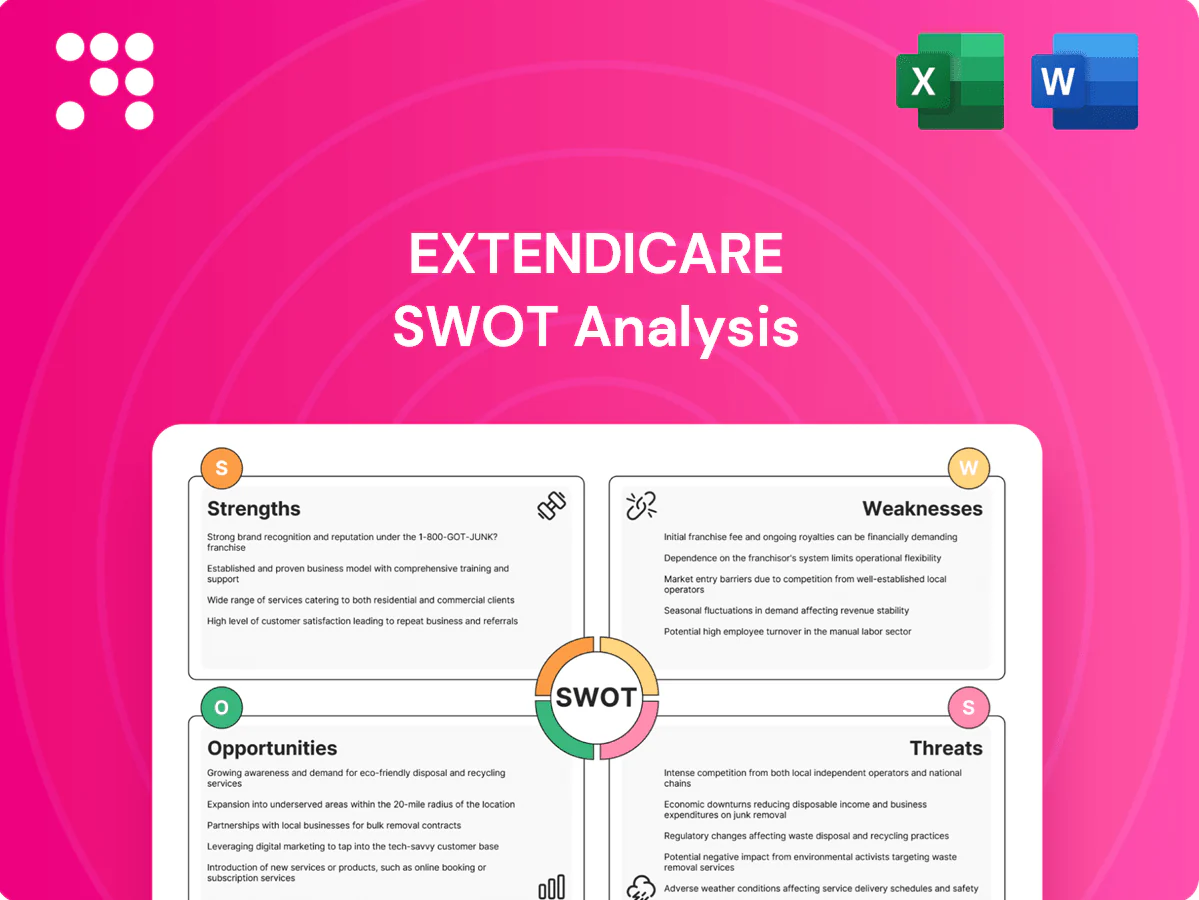
Extendicare SWOT Analysis

Go Beyond the Preview—Access the Full Strategic Report
Extendicare’s SWOT highlights resilient market demand, operational scale in long-term care, and regulatory exposure that can pressure margins; strategic gaps include capital intensity and aging workforce risks. Want the full story behind strengths, risks, and growth drivers? Purchase the complete SWOT analysis for a professionally written, editable report ideal for investors and strategists.
Strengths

Established national footprint
Extendicare’s established national footprint — operating over 100 long‑term care and retirement residences across multiple Canadian provinces — delivers operational scale and steady referral flows. The recognized brand fosters trust with families and healthcare partners, while geographic diversification reduces region‑specific regulatory or demand shocks and strengthens bargaining power with vendors and payors.
Continuum of care offerings
Operating both long-term care homes and home health services enables seamless patient transitions across settings and captures multiple revenue streams per client journey. This integrated model supports stronger occupancy stability and higher retention, aligning with an aging-population tailwind as Statistics Canada projects seniors will comprise about 23% of the population by 2036. Cross-selling care pathways reduce acquisition costs and can improve clinical outcomes through continuity of care.

Clinical expertise and personalized care
Extendicare’s clinical expertise and personalized care—delivered across over 100 long‑term care and retirement residences—uses individualized care plans that improve outcomes and satisfaction. Multidisciplinary teams manage daily living and complex medical needs, aligning with Ontario’s 4.0 hours‑per‑resident‑day staffing standard by 2025. Standardized care protocols enhance consistency and safety, differentiating Extendicare from single‑service providers.

Regulated quality and safety systems
Operating in a highly regulated environment institutionalizes strict safety and compliance processes, with regular audits and accreditation driving continuous improvement and operational consistency. Documented quality metrics enhance credibility with families and payors and the governance infrastructure enables scaling best practices across sites.
- Regulatory audits → continuous improvement
- Quality metrics → payor/family trust
- Governance → scalable best practices
Stable, government-backed revenue
Stable government-backed revenue gives Extendicare predictable cash flow—2024 consolidated revenue was about CAD 1.05 billion with roughly 80–85% funded by provincial programs—reducing cyclicality versus discretionary care and smoothing demand volatility. Predictable payments support multi-year planning and debt service, and underpin ongoing investments in staff recruitment and facility capital upgrades.
- Provincial program funding: ~80–85% of operating revenue
- 2024 consolidated revenue: ~CAD 1.05B
- Enables predictable debt servicing and capital/staffing investment
Senior care scale: >100 homes, ~CAD 1.05B, ~80-85% provincial funding
Extendicare operates >100 long‑term care and retirement residences, delivering scale, steady referrals and vendor/payor leverage. Integrated long‑term care and home health capture multiple revenue streams and higher retention amid an aging population (Seniors ~23% by 2036). 2024 consolidated revenue ~CAD 1.05B with ~80–85% provincially funded, supporting predictable cash flow and capital investment.
| Metric | Value |
|---|---|
| Residences | >100 |
| 2024 Revenue | ~CAD 1.05B |
| Provincial funding | ~80–85% |
| Seniors share (2036) | ~23% |
What is included in the product
 Detailed Word Document
Provides a concise strategic overview of Extendicare’s internal strengths and weaknesses and external opportunities and threats, highlighting competitive position, operational challenges, growth drivers and regulatory and market risks shaping its future.

 Customizable Excel Spreadsheet
Provides a clear SWOT matrix highlighting Extendicare’s operational strengths, regulatory and staffing risks, and market opportunities for rapid strategy alignment and concise stakeholder briefings.
Weaknesses

High labor intensity
Care delivery at Extendicare depends heavily on nurses, PSWs and allied staff, making staffing a critical bottleneck for operations in 2024. Overtime, agency reliance and staff burnout have increased labour costs and pressured quality metrics. Recruiting and retention remain persistent challenges across multiple provinces. Service disruptions and capacity constraints have occurred due to shortages and absenteeism.
Regulatory dependence
Operations are tightly bound to provincial standards, inspections and licences, so regulatory shifts can force rapid, costly operational changes. Non-compliance risks fines, admissions freezes or reputational harm that directly impact occupancy and revenues. Ongoing compliance and reporting create an administrative burden that diverts managerial bandwidth from care quality and strategic growth.

Aging infrastructure needs
Legacy Extendicare facilities may require redevelopment to meet modern design and infection-control standards, a widespread issue given CIHI reported about 43% of Canadian long-term care beds were in homes older than 30 years (2019).
Redevelopment is capital intensive and can strain free cash flow, while construction timelines and municipal approvals add 18–36 months of execution risk.
Deferred maintenance risks resident experience and regulatory ratings, potentially affecting occupancy and reimbursements.

Compressed margins
Compressed margins at Extendicare stem from government rate-setting that caps pricing flexibility, while wage inflation and rising consumables costs have periodically outpaced funding increases, narrowing operating margins; home health services exhibit thinner unit economics than institutional care, limiting profitability and capital available for reinvestment and shock absorption.
- Limited pricing power
- Wage and consumable cost pressure
- Thin home-health unit economics
- Constrained investment buffer
Reputation sensitivity
Incidents, outbreaks, or inspection findings can rapidly erode trust; over 80% of early Canadian COVID-19 deaths were linked to long-term care, underlining sensitivity. Intense media scrutiny amplifies negative coverage, driving double-digit occupancy declines, fewer referrals and lower staff morale. Recovery from adverse events can take years and require substantial legal, remediation and reputational spend.
- Incident risk
- Media exposure
- Occupancy & referral decline
- Prolonged recovery costs
Long-term care operator hit by staffing crisis, costly redevelopments and regulatory risk
Extendicare faces acute staffing constraints—overtime, agency use and burnout raise labour costs and pressure care quality. Regulatory dependency and compliance burden create operational inflexibility and risk of fines or admissions freezes. Aging estate requires capital‑heavy redevelopment with 18–36 month project timelines and strained cash flow. Reputation risk from incidents remains high given early COVID links to long‑term care.
| Metric | Value |
|---|---|
| Beds >30 years (CIHI 2019) | 43% |
| Redevelopment timeline | 18–36 months |
| Early COVID LTC deaths share | >80% |
What You See Is What You Get
Extendicare SWOT Analysis
This is the actual Extendicare SWOT analysis document you’ll receive upon purchase—no surprises, just professional quality. The preview below is taken directly from the full report and reflects the complete structure and findings. Buy now to unlock the full, editable version immediately after checkout.

Go Beyond the Preview—Access the Full Strategic Report
Extendicare’s SWOT highlights resilient market demand, operational scale in long-term care, and regulatory exposure that can pressure margins; strategic gaps include capital intensity and aging workforce risks. Want the full story behind strengths, risks, and growth drivers? Purchase the complete SWOT analysis for a professionally written, editable report ideal for investors and strategists.
Strengths
Established national footprint
Extendicare’s established national footprint — operating over 100 long‑term care and retirement residences across multiple Canadian provinces — delivers operational scale and steady referral flows. The recognized brand fosters trust with families and healthcare partners, while geographic diversification reduces region‑specific regulatory or demand shocks and strengthens bargaining power with vendors and payors.
Continuum of care offerings
Operating both long-term care homes and home health services enables seamless patient transitions across settings and captures multiple revenue streams per client journey. This integrated model supports stronger occupancy stability and higher retention, aligning with an aging-population tailwind as Statistics Canada projects seniors will comprise about 23% of the population by 2036. Cross-selling care pathways reduce acquisition costs and can improve clinical outcomes through continuity of care.
Clinical expertise and personalized care
Extendicare’s clinical expertise and personalized care—delivered across over 100 long‑term care and retirement residences—uses individualized care plans that improve outcomes and satisfaction. Multidisciplinary teams manage daily living and complex medical needs, aligning with Ontario’s 4.0 hours‑per‑resident‑day staffing standard by 2025. Standardized care protocols enhance consistency and safety, differentiating Extendicare from single‑service providers.
Regulated quality and safety systems
Operating in a highly regulated environment institutionalizes strict safety and compliance processes, with regular audits and accreditation driving continuous improvement and operational consistency. Documented quality metrics enhance credibility with families and payors and the governance infrastructure enables scaling best practices across sites.
- Regulatory audits → continuous improvement
- Quality metrics → payor/family trust
- Governance → scalable best practices
Stable, government-backed revenue
Stable government-backed revenue gives Extendicare predictable cash flow—2024 consolidated revenue was about CAD 1.05 billion with roughly 80–85% funded by provincial programs—reducing cyclicality versus discretionary care and smoothing demand volatility. Predictable payments support multi-year planning and debt service, and underpin ongoing investments in staff recruitment and facility capital upgrades.
- Provincial program funding: ~80–85% of operating revenue
- 2024 consolidated revenue: ~CAD 1.05B
- Enables predictable debt servicing and capital/staffing investment
Senior care scale: >100 homes, ~CAD 1.05B, ~80-85% provincial funding
Extendicare operates >100 long‑term care and retirement residences, delivering scale, steady referrals and vendor/payor leverage. Integrated long‑term care and home health capture multiple revenue streams and higher retention amid an aging population (Seniors ~23% by 2036). 2024 consolidated revenue ~CAD 1.05B with ~80–85% provincially funded, supporting predictable cash flow and capital investment.
| Metric | Value |
|---|---|
| Residences | >100 |
| 2024 Revenue | ~CAD 1.05B |
| Provincial funding | ~80–85% |
| Seniors share (2036) | ~23% |
What is included in the product
Detailed Word Document
Provides a concise strategic overview of Extendicare’s internal strengths and weaknesses and external opportunities and threats, highlighting competitive position, operational challenges, growth drivers and regulatory and market risks shaping its future.
Customizable Excel Spreadsheet
Provides a clear SWOT matrix highlighting Extendicare’s operational strengths, regulatory and staffing risks, and market opportunities for rapid strategy alignment and concise stakeholder briefings.
Weaknesses
High labor intensity
Care delivery at Extendicare depends heavily on nurses, PSWs and allied staff, making staffing a critical bottleneck for operations in 2024. Overtime, agency reliance and staff burnout have increased labour costs and pressured quality metrics. Recruiting and retention remain persistent challenges across multiple provinces. Service disruptions and capacity constraints have occurred due to shortages and absenteeism.
Regulatory dependence
Operations are tightly bound to provincial standards, inspections and licences, so regulatory shifts can force rapid, costly operational changes. Non-compliance risks fines, admissions freezes or reputational harm that directly impact occupancy and revenues. Ongoing compliance and reporting create an administrative burden that diverts managerial bandwidth from care quality and strategic growth.
Aging infrastructure needs
Legacy Extendicare facilities may require redevelopment to meet modern design and infection-control standards, a widespread issue given CIHI reported about 43% of Canadian long-term care beds were in homes older than 30 years (2019).
Redevelopment is capital intensive and can strain free cash flow, while construction timelines and municipal approvals add 18–36 months of execution risk.
Deferred maintenance risks resident experience and regulatory ratings, potentially affecting occupancy and reimbursements.
Compressed margins
Compressed margins at Extendicare stem from government rate-setting that caps pricing flexibility, while wage inflation and rising consumables costs have periodically outpaced funding increases, narrowing operating margins; home health services exhibit thinner unit economics than institutional care, limiting profitability and capital available for reinvestment and shock absorption.
- Limited pricing power
- Wage and consumable cost pressure
- Thin home-health unit economics
- Constrained investment buffer
Reputation sensitivity
Incidents, outbreaks, or inspection findings can rapidly erode trust; over 80% of early Canadian COVID-19 deaths were linked to long-term care, underlining sensitivity. Intense media scrutiny amplifies negative coverage, driving double-digit occupancy declines, fewer referrals and lower staff morale. Recovery from adverse events can take years and require substantial legal, remediation and reputational spend.
- Incident risk
- Media exposure
- Occupancy & referral decline
- Prolonged recovery costs
Long-term care operator hit by staffing crisis, costly redevelopments and regulatory risk
Extendicare faces acute staffing constraints—overtime, agency use and burnout raise labour costs and pressure care quality. Regulatory dependency and compliance burden create operational inflexibility and risk of fines or admissions freezes. Aging estate requires capital‑heavy redevelopment with 18–36 month project timelines and strained cash flow. Reputation risk from incidents remains high given early COVID links to long‑term care.
| Metric | Value |
|---|---|
| Beds >30 years (CIHI 2019) | 43% |
| Redevelopment timeline | 18–36 months |
| Early COVID LTC deaths share | >80% |
What You See Is What You Get
Extendicare SWOT Analysis
This is the actual Extendicare SWOT analysis document you’ll receive upon purchase—no surprises, just professional quality. The preview below is taken directly from the full report and reflects the complete structure and findings. Buy now to unlock the full, editable version immediately after checkout.
Original: $10.00
-65%$10.00
$3.50Description
Go Beyond the Preview—Access the Full Strategic Report
Extendicare’s SWOT highlights resilient market demand, operational scale in long-term care, and regulatory exposure that can pressure margins; strategic gaps include capital intensity and aging workforce risks. Want the full story behind strengths, risks, and growth drivers? Purchase the complete SWOT analysis for a professionally written, editable report ideal for investors and strategists.
Strengths
Established national footprint
Extendicare’s established national footprint — operating over 100 long‑term care and retirement residences across multiple Canadian provinces — delivers operational scale and steady referral flows. The recognized brand fosters trust with families and healthcare partners, while geographic diversification reduces region‑specific regulatory or demand shocks and strengthens bargaining power with vendors and payors.
Continuum of care offerings
Operating both long-term care homes and home health services enables seamless patient transitions across settings and captures multiple revenue streams per client journey. This integrated model supports stronger occupancy stability and higher retention, aligning with an aging-population tailwind as Statistics Canada projects seniors will comprise about 23% of the population by 2036. Cross-selling care pathways reduce acquisition costs and can improve clinical outcomes through continuity of care.
Clinical expertise and personalized care
Extendicare’s clinical expertise and personalized care—delivered across over 100 long‑term care and retirement residences—uses individualized care plans that improve outcomes and satisfaction. Multidisciplinary teams manage daily living and complex medical needs, aligning with Ontario’s 4.0 hours‑per‑resident‑day staffing standard by 2025. Standardized care protocols enhance consistency and safety, differentiating Extendicare from single‑service providers.
Regulated quality and safety systems
Operating in a highly regulated environment institutionalizes strict safety and compliance processes, with regular audits and accreditation driving continuous improvement and operational consistency. Documented quality metrics enhance credibility with families and payors and the governance infrastructure enables scaling best practices across sites.
- Regulatory audits → continuous improvement
- Quality metrics → payor/family trust
- Governance → scalable best practices
Stable, government-backed revenue
Stable government-backed revenue gives Extendicare predictable cash flow—2024 consolidated revenue was about CAD 1.05 billion with roughly 80–85% funded by provincial programs—reducing cyclicality versus discretionary care and smoothing demand volatility. Predictable payments support multi-year planning and debt service, and underpin ongoing investments in staff recruitment and facility capital upgrades.
- Provincial program funding: ~80–85% of operating revenue
- 2024 consolidated revenue: ~CAD 1.05B
- Enables predictable debt servicing and capital/staffing investment
Senior care scale: >100 homes, ~CAD 1.05B, ~80-85% provincial funding
Extendicare operates >100 long‑term care and retirement residences, delivering scale, steady referrals and vendor/payor leverage. Integrated long‑term care and home health capture multiple revenue streams and higher retention amid an aging population (Seniors ~23% by 2036). 2024 consolidated revenue ~CAD 1.05B with ~80–85% provincially funded, supporting predictable cash flow and capital investment.
| Metric | Value |
|---|---|
| Residences | >100 |
| 2024 Revenue | ~CAD 1.05B |
| Provincial funding | ~80–85% |
| Seniors share (2036) | ~23% |
What is included in the product
Detailed Word Document
Provides a concise strategic overview of Extendicare’s internal strengths and weaknesses and external opportunities and threats, highlighting competitive position, operational challenges, growth drivers and regulatory and market risks shaping its future.
Customizable Excel Spreadsheet
Provides a clear SWOT matrix highlighting Extendicare’s operational strengths, regulatory and staffing risks, and market opportunities for rapid strategy alignment and concise stakeholder briefings.
Weaknesses
High labor intensity
Care delivery at Extendicare depends heavily on nurses, PSWs and allied staff, making staffing a critical bottleneck for operations in 2024. Overtime, agency reliance and staff burnout have increased labour costs and pressured quality metrics. Recruiting and retention remain persistent challenges across multiple provinces. Service disruptions and capacity constraints have occurred due to shortages and absenteeism.
Regulatory dependence
Operations are tightly bound to provincial standards, inspections and licences, so regulatory shifts can force rapid, costly operational changes. Non-compliance risks fines, admissions freezes or reputational harm that directly impact occupancy and revenues. Ongoing compliance and reporting create an administrative burden that diverts managerial bandwidth from care quality and strategic growth.
Aging infrastructure needs
Legacy Extendicare facilities may require redevelopment to meet modern design and infection-control standards, a widespread issue given CIHI reported about 43% of Canadian long-term care beds were in homes older than 30 years (2019).
Redevelopment is capital intensive and can strain free cash flow, while construction timelines and municipal approvals add 18–36 months of execution risk.
Deferred maintenance risks resident experience and regulatory ratings, potentially affecting occupancy and reimbursements.
Compressed margins
Compressed margins at Extendicare stem from government rate-setting that caps pricing flexibility, while wage inflation and rising consumables costs have periodically outpaced funding increases, narrowing operating margins; home health services exhibit thinner unit economics than institutional care, limiting profitability and capital available for reinvestment and shock absorption.
- Limited pricing power
- Wage and consumable cost pressure
- Thin home-health unit economics
- Constrained investment buffer
Reputation sensitivity
Incidents, outbreaks, or inspection findings can rapidly erode trust; over 80% of early Canadian COVID-19 deaths were linked to long-term care, underlining sensitivity. Intense media scrutiny amplifies negative coverage, driving double-digit occupancy declines, fewer referrals and lower staff morale. Recovery from adverse events can take years and require substantial legal, remediation and reputational spend.
- Incident risk
- Media exposure
- Occupancy & referral decline
- Prolonged recovery costs
Long-term care operator hit by staffing crisis, costly redevelopments and regulatory risk
Extendicare faces acute staffing constraints—overtime, agency use and burnout raise labour costs and pressure care quality. Regulatory dependency and compliance burden create operational inflexibility and risk of fines or admissions freezes. Aging estate requires capital‑heavy redevelopment with 18–36 month project timelines and strained cash flow. Reputation risk from incidents remains high given early COVID links to long‑term care.
| Metric | Value |
|---|---|
| Beds >30 years (CIHI 2019) | 43% |
| Redevelopment timeline | 18–36 months |
| Early COVID LTC deaths share | >80% |
What You See Is What You Get
Extendicare SWOT Analysis
This is the actual Extendicare SWOT analysis document you’ll receive upon purchase—no surprises, just professional quality. The preview below is taken directly from the full report and reflects the complete structure and findings. Buy now to unlock the full, editable version immediately after checkout.











