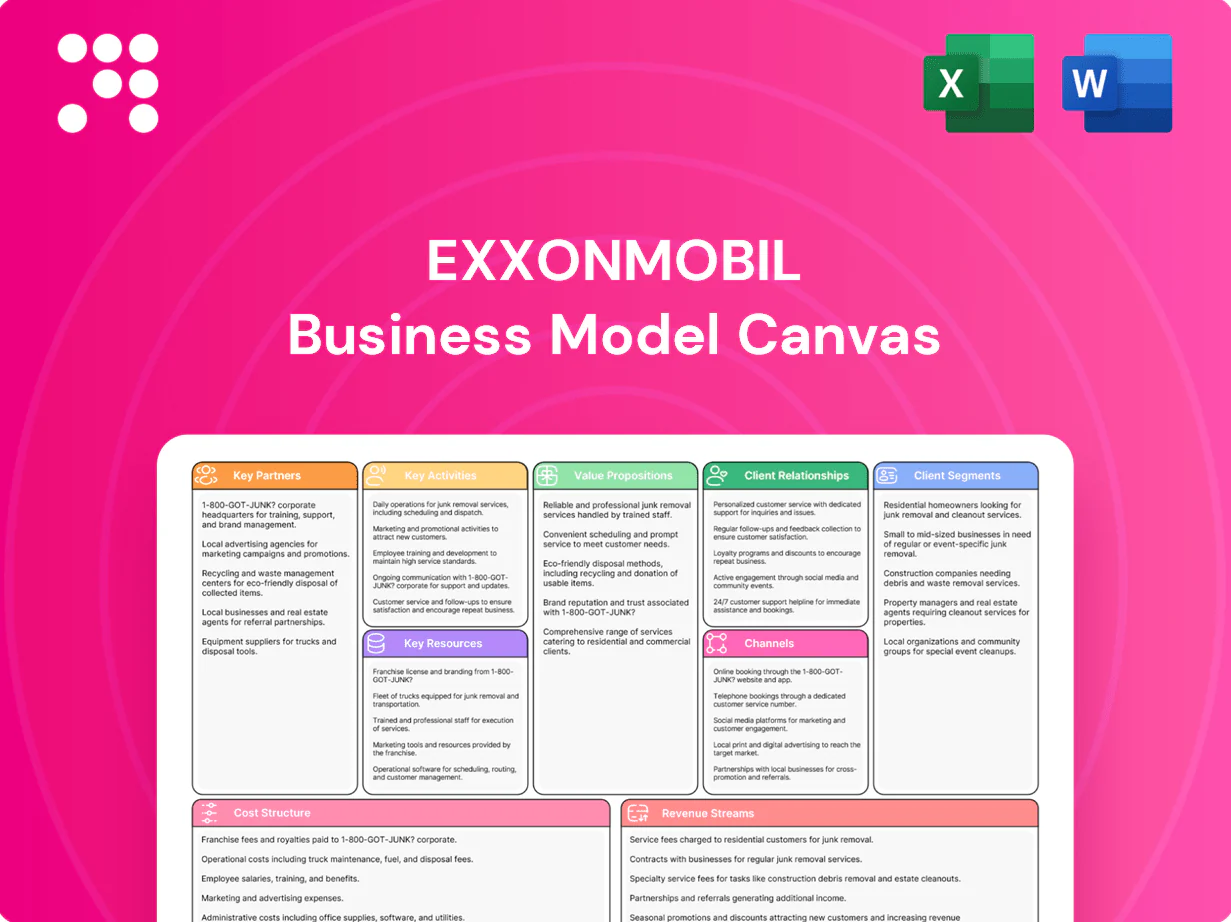
ExxonMobil Business Model Canvas

Business Model Canvas for a Leading Global Energy Company
Unlock the full strategic blueprint behind ExxonMobil’s business model in one concise canvas. This detailed Business Model Canvas maps value propositions, key partners, revenue streams and cost drivers. Ideal for investors, consultants and founders seeking actionable insights. Purchase the complete Word and Excel files to benchmark and adapt proven strategies.
Partnerships

Host Governments & National Oil Companies
Access and stability for ExxonMobil upstream hinge on licenses, PSCs and long-term NOC agreements—evident in Guyana’s Stabroek block (now >11 billion boe) where Exxon and partner NOC terms underpin phased development. These partnerships align on field development, local content and fiscal terms, enable multi-billion-dollar project investments and reserve replacement, and joint governance helps mitigate geopolitical and regulatory risks.
Upstream JVs & Co-venturers
Upstream JVs and co-venturers let ExxonMobil share capital and technical expertise to reduce exploration and development risk, exemplified by its 30% stake in the Golden Pass LNG project. Partners co-own assets across deepwater, LNG and unconventional plays, enabling pooled investment and specialist skills. Joint ventures compress timelines and lower unit costs, while risk-sharing facilitates entry into complex basins.

Oilfield Services, EPC & Technology Vendors
Drilling, seismic, subsea and EPC partners deliver critical capabilities at scale, underpinning ExxonMobil’s project portfolio as it executes a roughly $22 billion 2024 capital plan. Vendor ecosystems accelerate execution and cut costs through standardized supply chains and modular EPC contracts. Technology partners boost recovery factors and reliability via advanced reservoirs tools and digital twins. Collaborative innovation shortens cycle times, speeding sanction-to-first-oil.

Academia & Low-Carbon Technology Alliances
Universities and consortia support ExxonMobil R&D in CCS, hydrogen, advanced materials and process intensification, de‑risking pilots and scale‑up pathways. Joint IP and co‑development strengthen competitive differentiation and attract grants; by 2024 global operational CCS capacity exceeded 50 MtCO2/yr, increasing demand for scalable solutions. Grants and co‑funding leverage external capital to accelerate commercialization.
- R&D consortia: de‑risk pilots
- Joint IP: differentiation
- Grants/co‑funding: leverage capital
Logistics, Traders & Retail Franchisees
Pipeline, marine, rail and terminal partners sustain >1 million barrels/day throughput in 2024, ensuring reliable product flow and lowering delivered cost to customers. Trading relationships in 2024 optimized arbitrage and hedging to support strong price realization and working-capital efficiency. Over 20,000 retail franchisees worldwide in 2024 extend last-mile reach and amplify brand presence.
- Logistics: >1M bbl/day throughput (2024)
- Trading: optimized arbitrage & hedging (2024)
- Retail: >20,000 franchise sites (2024)
- Impact: lower delivered cost, stronger price realization
Energy major leverages NOC JVs, $22bn capex and CCS to scale supply
ExxonMobil leverages NOC/licence deals and JVs to secure access and share capital risk (Stabroek >11bn boe; 30% Golden Pass stake). Vendor, EPC and tech partners enable a ~$22bn 2024 capex program and >1M bbl/day logistics throughput. R&D consortia and CCS partners scale low‑carbon tech (global CCS >50 MtCO2/yr; >20,000 retail sites).
| Partnership | Role | 2024 metric |
|---|---|---|
| NOCs/JVs | Access & risk share | Stabroek >11bn boe |
| Vendors/EPC | Execution | $22bn capex |
| R&D/CCS | Decarbonization | CCS >50 MtCO2/yr |
What is included in the product
 Detailed Word Document
A concise, investor-ready Business Model Canvas for ExxonMobil detailing customer segments, channels, value propositions, key resources, activities, partners, cost structure and revenue streams, with SWOT-linked insights and strategic implications for stakeholders.

 Customizable Excel Spreadsheet
Condenses ExxonMobil’s strategy into a digestible one-page Business Model Canvas with editable cells, saving hours of formatting and ideal for boardrooms, teaching, or team collaboration.
Activities

Exploration & Production
Prospect generation, appraisal and field development sustain reserves and output, supported by ExxonMobil's 2024 upstream capex of about $21 billion. Operations span offshore, onshore, LNG and unconventional assets, with integrated project execution driving scale. Production optimization focuses on maximizing recovery and uptime while proactive HSSE management underpins the license to operate.
Refining & Petrochemical Manufacturing
Crude conversion and upgrading across ExxonMobil’s global refining network produce fuels, lubricants and petrochemical feedstocks, processing about 5 million barrels per day of crude in 2024 to meet transport and industrial demand. Steam crackers and downstream derivative units convert naphtha and ethane into olefins, polyolefins and aromatics, supporting chemical sales in the tens of millions of tonnes annually. Rigorous turnarounds and reliability programs protect throughput and enabled utilization rates above 90% in 2024, while targeted energy-efficiency projects cut operating costs and reduced site CO2 intensity year-over-year.

Marketing, Trading & Supply Optimization
Global trading balances crude slates, product placement and chemical flows to optimize margins, supporting ExxonMobil’s ~4.0 million boe/d production scale in 2024. Contracts, hedging and arbitrage capture price differentials and reduce volatility on earnings. Supply chain planning focuses on minimizing demurrage and inventory days to lower costs. Customer service guarantees on-spec, on-time deliveries to major refiners and distributors.

R&D and Low-Emission Technology Development
Capital Allocation, Risk & Compliance
Portfolio management prioritizes high-return, low-cost-of-supply projects, guided by 2024 capital expenditure guidance of $21–25 billion; investments target advantaged upstream and chemicals assets. Risk frameworks quantify price, operational, and political exposures across scenarios. Compliance covers environmental, safety, trade, and financial regulations, while continuous improvement drives productivity and cost discipline.
- 2024 capex: $21–25B
- Focus: high-return, low-cost-of-supply projects
- Risks: price, operational, political
- Compliance: enviro, safety, trade, financial
- Priority: continuous productivity improvement
Capex ~21B USD backs 4.0M boe/d output, refining >90%
Prospect generation, appraisal and field development sustain reserves with 2024 upstream capex ~21B USD. Refining and conversion processed ~5.0M bpd crude in 2024 with >90% utilization. Global trading balances ~4.0M boe/d production scale and optimizes margins. R&D and pilots target CCS, hydrogen and biofuels supported by a ~$15B lower-emission commitment through 2027.
| Key Activity | 2024 Metric |
|---|---|
| Upstream capex | ~21B USD |
| Production scale | ~4.0M boe/d |
| Refining throughput | ~5.0M bpd |
| Refinery utilization | >90% |
| Lower‑emission commitment | ~15B USD (to 2027) |
Full Version Awaits
Business Model Canvas
The ExxonMobil Business Model Canvas you see here is the actual deliverable, not a mockup or sample; it’s a direct excerpt from the file you’ll receive after purchase. Upon ordering, you’ll get the complete document—structured and formatted exactly as previewed—in editable Word and Excel formats. No surprises, just the same professional file ready to use.

Business Model Canvas for a Leading Global Energy Company
Unlock the full strategic blueprint behind ExxonMobil’s business model in one concise canvas. This detailed Business Model Canvas maps value propositions, key partners, revenue streams and cost drivers. Ideal for investors, consultants and founders seeking actionable insights. Purchase the complete Word and Excel files to benchmark and adapt proven strategies.
Partnerships
Host Governments & National Oil Companies
Access and stability for ExxonMobil upstream hinge on licenses, PSCs and long-term NOC agreements—evident in Guyana’s Stabroek block (now >11 billion boe) where Exxon and partner NOC terms underpin phased development. These partnerships align on field development, local content and fiscal terms, enable multi-billion-dollar project investments and reserve replacement, and joint governance helps mitigate geopolitical and regulatory risks.
Upstream JVs & Co-venturers
Upstream JVs and co-venturers let ExxonMobil share capital and technical expertise to reduce exploration and development risk, exemplified by its 30% stake in the Golden Pass LNG project. Partners co-own assets across deepwater, LNG and unconventional plays, enabling pooled investment and specialist skills. Joint ventures compress timelines and lower unit costs, while risk-sharing facilitates entry into complex basins.
Oilfield Services, EPC & Technology Vendors
Drilling, seismic, subsea and EPC partners deliver critical capabilities at scale, underpinning ExxonMobil’s project portfolio as it executes a roughly $22 billion 2024 capital plan. Vendor ecosystems accelerate execution and cut costs through standardized supply chains and modular EPC contracts. Technology partners boost recovery factors and reliability via advanced reservoirs tools and digital twins. Collaborative innovation shortens cycle times, speeding sanction-to-first-oil.
Academia & Low-Carbon Technology Alliances
Universities and consortia support ExxonMobil R&D in CCS, hydrogen, advanced materials and process intensification, de‑risking pilots and scale‑up pathways. Joint IP and co‑development strengthen competitive differentiation and attract grants; by 2024 global operational CCS capacity exceeded 50 MtCO2/yr, increasing demand for scalable solutions. Grants and co‑funding leverage external capital to accelerate commercialization.
- R&D consortia: de‑risk pilots
- Joint IP: differentiation
- Grants/co‑funding: leverage capital
Logistics, Traders & Retail Franchisees
Pipeline, marine, rail and terminal partners sustain >1 million barrels/day throughput in 2024, ensuring reliable product flow and lowering delivered cost to customers. Trading relationships in 2024 optimized arbitrage and hedging to support strong price realization and working-capital efficiency. Over 20,000 retail franchisees worldwide in 2024 extend last-mile reach and amplify brand presence.
- Logistics: >1M bbl/day throughput (2024)
- Trading: optimized arbitrage & hedging (2024)
- Retail: >20,000 franchise sites (2024)
- Impact: lower delivered cost, stronger price realization
Energy major leverages NOC JVs, $22bn capex and CCS to scale supply
ExxonMobil leverages NOC/licence deals and JVs to secure access and share capital risk (Stabroek >11bn boe; 30% Golden Pass stake). Vendor, EPC and tech partners enable a ~$22bn 2024 capex program and >1M bbl/day logistics throughput. R&D consortia and CCS partners scale low‑carbon tech (global CCS >50 MtCO2/yr; >20,000 retail sites).
| Partnership | Role | 2024 metric |
|---|---|---|
| NOCs/JVs | Access & risk share | Stabroek >11bn boe |
| Vendors/EPC | Execution | $22bn capex |
| R&D/CCS | Decarbonization | CCS >50 MtCO2/yr |
What is included in the product
Detailed Word Document
A concise, investor-ready Business Model Canvas for ExxonMobil detailing customer segments, channels, value propositions, key resources, activities, partners, cost structure and revenue streams, with SWOT-linked insights and strategic implications for stakeholders.
Customizable Excel Spreadsheet
Condenses ExxonMobil’s strategy into a digestible one-page Business Model Canvas with editable cells, saving hours of formatting and ideal for boardrooms, teaching, or team collaboration.
Activities
Exploration & Production
Prospect generation, appraisal and field development sustain reserves and output, supported by ExxonMobil's 2024 upstream capex of about $21 billion. Operations span offshore, onshore, LNG and unconventional assets, with integrated project execution driving scale. Production optimization focuses on maximizing recovery and uptime while proactive HSSE management underpins the license to operate.
Refining & Petrochemical Manufacturing
Crude conversion and upgrading across ExxonMobil’s global refining network produce fuels, lubricants and petrochemical feedstocks, processing about 5 million barrels per day of crude in 2024 to meet transport and industrial demand. Steam crackers and downstream derivative units convert naphtha and ethane into olefins, polyolefins and aromatics, supporting chemical sales in the tens of millions of tonnes annually. Rigorous turnarounds and reliability programs protect throughput and enabled utilization rates above 90% in 2024, while targeted energy-efficiency projects cut operating costs and reduced site CO2 intensity year-over-year.
Marketing, Trading & Supply Optimization
Global trading balances crude slates, product placement and chemical flows to optimize margins, supporting ExxonMobil’s ~4.0 million boe/d production scale in 2024. Contracts, hedging and arbitrage capture price differentials and reduce volatility on earnings. Supply chain planning focuses on minimizing demurrage and inventory days to lower costs. Customer service guarantees on-spec, on-time deliveries to major refiners and distributors.
R&D and Low-Emission Technology Development
Capital Allocation, Risk & Compliance
Portfolio management prioritizes high-return, low-cost-of-supply projects, guided by 2024 capital expenditure guidance of $21–25 billion; investments target advantaged upstream and chemicals assets. Risk frameworks quantify price, operational, and political exposures across scenarios. Compliance covers environmental, safety, trade, and financial regulations, while continuous improvement drives productivity and cost discipline.
- 2024 capex: $21–25B
- Focus: high-return, low-cost-of-supply projects
- Risks: price, operational, political
- Compliance: enviro, safety, trade, financial
- Priority: continuous productivity improvement
Capex ~21B USD backs 4.0M boe/d output, refining >90%
Prospect generation, appraisal and field development sustain reserves with 2024 upstream capex ~21B USD. Refining and conversion processed ~5.0M bpd crude in 2024 with >90% utilization. Global trading balances ~4.0M boe/d production scale and optimizes margins. R&D and pilots target CCS, hydrogen and biofuels supported by a ~$15B lower-emission commitment through 2027.
| Key Activity | 2024 Metric |
|---|---|
| Upstream capex | ~21B USD |
| Production scale | ~4.0M boe/d |
| Refining throughput | ~5.0M bpd |
| Refinery utilization | >90% |
| Lower‑emission commitment | ~15B USD (to 2027) |
Full Version Awaits
Business Model Canvas
The ExxonMobil Business Model Canvas you see here is the actual deliverable, not a mockup or sample; it’s a direct excerpt from the file you’ll receive after purchase. Upon ordering, you’ll get the complete document—structured and formatted exactly as previewed—in editable Word and Excel formats. No surprises, just the same professional file ready to use.
Original: $10.00
-65%$10.00
$3.50Description
Business Model Canvas for a Leading Global Energy Company
Unlock the full strategic blueprint behind ExxonMobil’s business model in one concise canvas. This detailed Business Model Canvas maps value propositions, key partners, revenue streams and cost drivers. Ideal for investors, consultants and founders seeking actionable insights. Purchase the complete Word and Excel files to benchmark and adapt proven strategies.
Partnerships
Host Governments & National Oil Companies
Access and stability for ExxonMobil upstream hinge on licenses, PSCs and long-term NOC agreements—evident in Guyana’s Stabroek block (now >11 billion boe) where Exxon and partner NOC terms underpin phased development. These partnerships align on field development, local content and fiscal terms, enable multi-billion-dollar project investments and reserve replacement, and joint governance helps mitigate geopolitical and regulatory risks.
Upstream JVs & Co-venturers
Upstream JVs and co-venturers let ExxonMobil share capital and technical expertise to reduce exploration and development risk, exemplified by its 30% stake in the Golden Pass LNG project. Partners co-own assets across deepwater, LNG and unconventional plays, enabling pooled investment and specialist skills. Joint ventures compress timelines and lower unit costs, while risk-sharing facilitates entry into complex basins.
Oilfield Services, EPC & Technology Vendors
Drilling, seismic, subsea and EPC partners deliver critical capabilities at scale, underpinning ExxonMobil’s project portfolio as it executes a roughly $22 billion 2024 capital plan. Vendor ecosystems accelerate execution and cut costs through standardized supply chains and modular EPC contracts. Technology partners boost recovery factors and reliability via advanced reservoirs tools and digital twins. Collaborative innovation shortens cycle times, speeding sanction-to-first-oil.
Academia & Low-Carbon Technology Alliances
Universities and consortia support ExxonMobil R&D in CCS, hydrogen, advanced materials and process intensification, de‑risking pilots and scale‑up pathways. Joint IP and co‑development strengthen competitive differentiation and attract grants; by 2024 global operational CCS capacity exceeded 50 MtCO2/yr, increasing demand for scalable solutions. Grants and co‑funding leverage external capital to accelerate commercialization.
- R&D consortia: de‑risk pilots
- Joint IP: differentiation
- Grants/co‑funding: leverage capital
Logistics, Traders & Retail Franchisees
Pipeline, marine, rail and terminal partners sustain >1 million barrels/day throughput in 2024, ensuring reliable product flow and lowering delivered cost to customers. Trading relationships in 2024 optimized arbitrage and hedging to support strong price realization and working-capital efficiency. Over 20,000 retail franchisees worldwide in 2024 extend last-mile reach and amplify brand presence.
- Logistics: >1M bbl/day throughput (2024)
- Trading: optimized arbitrage & hedging (2024)
- Retail: >20,000 franchise sites (2024)
- Impact: lower delivered cost, stronger price realization
Energy major leverages NOC JVs, $22bn capex and CCS to scale supply
ExxonMobil leverages NOC/licence deals and JVs to secure access and share capital risk (Stabroek >11bn boe; 30% Golden Pass stake). Vendor, EPC and tech partners enable a ~$22bn 2024 capex program and >1M bbl/day logistics throughput. R&D consortia and CCS partners scale low‑carbon tech (global CCS >50 MtCO2/yr; >20,000 retail sites).
| Partnership | Role | 2024 metric |
|---|---|---|
| NOCs/JVs | Access & risk share | Stabroek >11bn boe |
| Vendors/EPC | Execution | $22bn capex |
| R&D/CCS | Decarbonization | CCS >50 MtCO2/yr |
What is included in the product
Detailed Word Document
A concise, investor-ready Business Model Canvas for ExxonMobil detailing customer segments, channels, value propositions, key resources, activities, partners, cost structure and revenue streams, with SWOT-linked insights and strategic implications for stakeholders.
Customizable Excel Spreadsheet
Condenses ExxonMobil’s strategy into a digestible one-page Business Model Canvas with editable cells, saving hours of formatting and ideal for boardrooms, teaching, or team collaboration.
Activities
Exploration & Production
Prospect generation, appraisal and field development sustain reserves and output, supported by ExxonMobil's 2024 upstream capex of about $21 billion. Operations span offshore, onshore, LNG and unconventional assets, with integrated project execution driving scale. Production optimization focuses on maximizing recovery and uptime while proactive HSSE management underpins the license to operate.
Refining & Petrochemical Manufacturing
Crude conversion and upgrading across ExxonMobil’s global refining network produce fuels, lubricants and petrochemical feedstocks, processing about 5 million barrels per day of crude in 2024 to meet transport and industrial demand. Steam crackers and downstream derivative units convert naphtha and ethane into olefins, polyolefins and aromatics, supporting chemical sales in the tens of millions of tonnes annually. Rigorous turnarounds and reliability programs protect throughput and enabled utilization rates above 90% in 2024, while targeted energy-efficiency projects cut operating costs and reduced site CO2 intensity year-over-year.
Marketing, Trading & Supply Optimization
Global trading balances crude slates, product placement and chemical flows to optimize margins, supporting ExxonMobil’s ~4.0 million boe/d production scale in 2024. Contracts, hedging and arbitrage capture price differentials and reduce volatility on earnings. Supply chain planning focuses on minimizing demurrage and inventory days to lower costs. Customer service guarantees on-spec, on-time deliveries to major refiners and distributors.
R&D and Low-Emission Technology Development
Capital Allocation, Risk & Compliance
Portfolio management prioritizes high-return, low-cost-of-supply projects, guided by 2024 capital expenditure guidance of $21–25 billion; investments target advantaged upstream and chemicals assets. Risk frameworks quantify price, operational, and political exposures across scenarios. Compliance covers environmental, safety, trade, and financial regulations, while continuous improvement drives productivity and cost discipline.
- 2024 capex: $21–25B
- Focus: high-return, low-cost-of-supply projects
- Risks: price, operational, political
- Compliance: enviro, safety, trade, financial
- Priority: continuous productivity improvement
Capex ~21B USD backs 4.0M boe/d output, refining >90%
Prospect generation, appraisal and field development sustain reserves with 2024 upstream capex ~21B USD. Refining and conversion processed ~5.0M bpd crude in 2024 with >90% utilization. Global trading balances ~4.0M boe/d production scale and optimizes margins. R&D and pilots target CCS, hydrogen and biofuels supported by a ~$15B lower-emission commitment through 2027.
| Key Activity | 2024 Metric |
|---|---|
| Upstream capex | ~21B USD |
| Production scale | ~4.0M boe/d |
| Refining throughput | ~5.0M bpd |
| Refinery utilization | >90% |
| Lower‑emission commitment | ~15B USD (to 2027) |
Full Version Awaits
Business Model Canvas
The ExxonMobil Business Model Canvas you see here is the actual deliverable, not a mockup or sample; it’s a direct excerpt from the file you’ll receive after purchase. Upon ordering, you’ll get the complete document—structured and formatted exactly as previewed—in editable Word and Excel formats. No surprises, just the same professional file ready to use.











