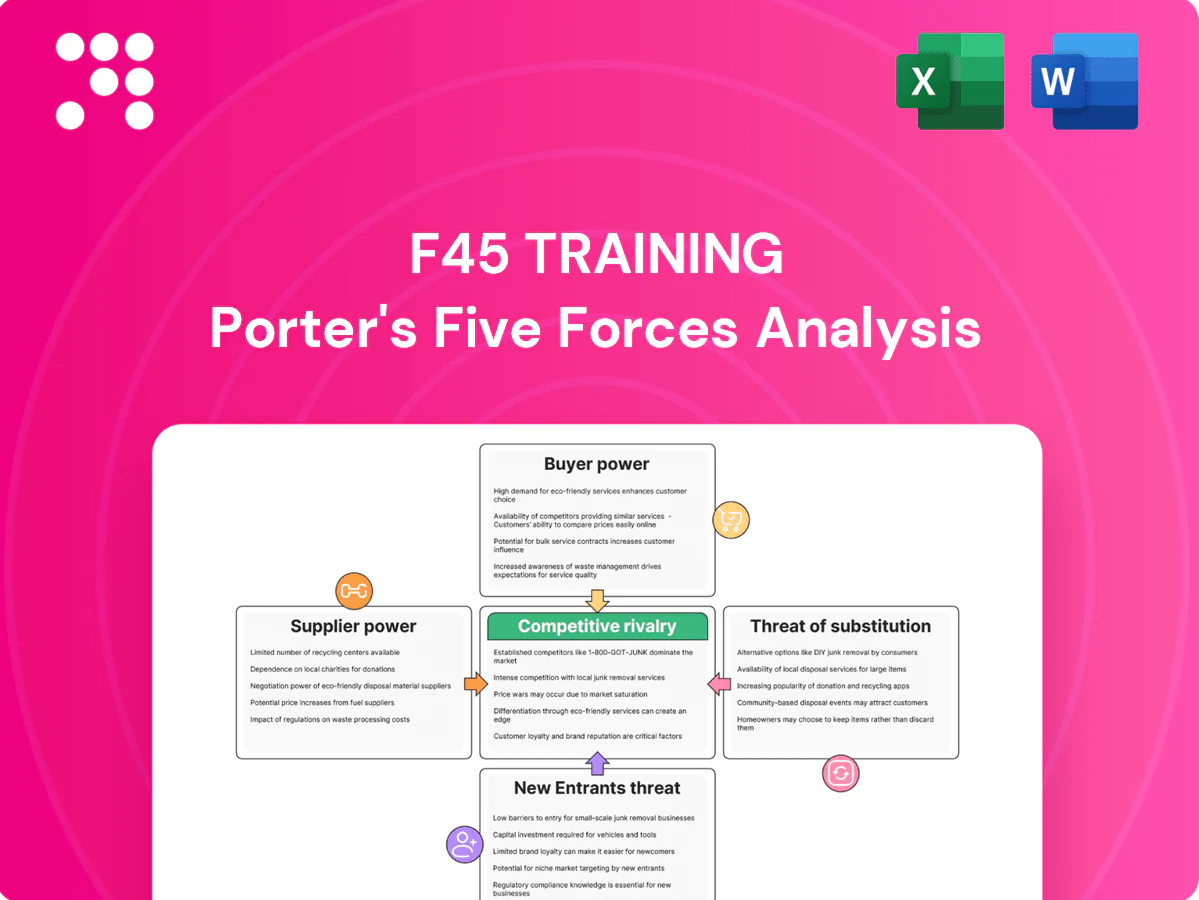
F45 Training Porter's Five Forces Analysis

From Overview to Strategy Blueprint
F45 Training faces intense rivalry from boutique studios and large gym chains, while its franchise model moderates expansion risk but raises quality-control and supplier-dependence concerns. Buyer bargaining is rising as consumers demand flexibility and lower costs. Threats from digital fitness substitutes and new entrants remain material. This snapshot only scratches the surface—unlock the full Porter's Five Forces Analysis for detailed force ratings, visuals, and strategic implications.
Suppliers Bargaining Power

Limited differentiation in fitness equipment
Most core hardware (racks, dumbbells, flooring) is commoditized, enabling multi-sourcing and easy price benchmarking; F45 operates over 1,800 studios globally as of 2024, amplifying buying options. Switching vendors for standard SKUs incurs modest costs, while custom or branded rigs create limited dependency but remain replicable, moderating supplier leverage overall.
Dependence on proprietary programming and content
Workout IP and video content are core to F45’s format, with a library of hundreds of workout videos distributed across 60+ countries, concentrating creative power in internal teams and select partners. If third-party creators or tech platforms are used, they can influence timelines and costs, especially for updates rolled out to 2,000+ studios worldwide. In-house production mitigates supplier risk but requires ongoing CAPEX and staffing; any disruption can ripple across the global timetable.

Technology platforms and payments
Booking, CRM and payment processors are semi-concentrated—major providers such as Stripe, PayPal and Block dominate, creating meaningful switching frictions. Typical card fees (around 2.9% + $0.30 per transaction) and service outages or fee hikes can compress franchisee margins and franchisor royalties. Negotiated enterprise contracts can lower fees to roughly 1.5–2.0% and secure SLAs (commonly 99.9% uptime). Deep integrations across booking, CRM and POS increase supplier stickiness and exit costs.

Real estate landlords as critical inputs
Real estate landlords control key locations and lease terms for F45, especially in dense urban markets where proximity drives member retention; in 2024 tight submarket conditions pushed higher TI allowances and steeper rent escalations, increasing landlord leverage. Conversely, rising vacancies or macro softness in 2024 shifted negotiating power back to tenants, while franchise site selection optionality moderates landlord influence over time.
- Landlord control: key urban locations
- 2024: tighter submarkets → higher TI/rent escalation
- Vacancies/macroeconomy shift leverage to tenants
- Site selection optionality reduces long-term supplier power
Equipment lead times and logistics
Moderate supplier power: 1,800+ studios; 18–24wk rigs; cards 2.9%/1.5–2.0%
Supplier power is moderate: commoditized equipment and 1,800+ studios (2024) enable multi-sourcing and bulk discounts, but 18–24 week rig lead times and branded rigs raise dependence. In-house IP (hundreds of videos) reduces creative supplier leverage, while dominant payment processors (card fees ~2.9% retail; 1.5–2.0% enterprise) create switching frictions. Real estate landlords remain a localized power factor.
| Metric | 2024 |
|---|---|
| Studios | 1,800+ |
| Rig lead time | 18–24 weeks |
| Card fees | 2.9% retail / 1.5–2.0% enterprise |
What is included in the product
 Detailed Word Document
Tailored Porter's Five Forces analysis for F45 Training that uncovers competitive intensity, buyer and supplier power, threat of substitutes and entrants, and strategic vulnerabilities—offering concise insights to inform pricing, expansion, and differentiation decisions.

 Customizable Excel Spreadsheet
Clear one-sheet Porter's Five Forces for F45 Training—quickly pinpoint competitive pressures and relieve analysis bottlenecks; customizable pressure levels and instant radar visualization make it presentation-ready and easy to adapt to market shifts.
Customers Bargaining Power

Dual customers: franchisees and members
F45 operates dual customer channels—franchisees (B2B) and members (B2C)—which splits bargaining dynamics across its ~1,600 global studios and roughly 400,000 members as of 2024. Franchisees hold meaningful leverage at sale and renewal through site approvals, royalty negotiations and resale value; members exert power via churn and price sensitivity, with average monthly churn rates often exceeding industry benchmarks. Maintaining alignment between franchise economics and member value is critical to system health; misalignment amplifies buyer leverage and compresses margins.
High member price sensitivity with alternatives
High member price sensitivity lets customers switch to low-cost chains (plans from about $10–30/month), other boutique studios, or at-home options like Peloton and HYROX. Month-to-month plans and class packs enable rapid churn, with boutique segments often reporting annual churn above 30%. Local promotions and price-matching intensify comparisons. Loyalty therefore depends heavily on coaching quality and community engagement.

Franchisee sensitivity to unit economics
Franchisee sensitivity to unit economics intensifies when royalties (typically 6–8%) and marketing fees (around 2–3%) bite into studio margins; mandated purchases also face pushback if EBITDA falls toward single digits. Coordinated franchise councils can leverage scale to demand concessions or renegotiation. Transparent KPI dashboards and cost-saving programs (bulk equipment, supplier agreements) reduce pressure, while poor territory performance raises bargaining demands and risk of legal challenges.

Low switching costs for consumers
Low switching costs persist as minimal contractual lock-ins and ubiquitous boutique and app-based alternatives keep members fluid; F45 operated over 2,000 studios globally in 2024, intensifying rival availability. Rivals use trial offers to attract price-sensitive members, while F45’s strong habit formation and measurable results help retain users. Personalized coaching and studio engagement reduce churn risk.
- Minimal contracts
- 2,000+ studios (2024)
- Trial-led defections
- High retention via personalization
Information transparency
- Online reviews drive reputation transparency
- 5.07B social users amplify feedback
- Item 19 comparisons sharpen franchise bargaining
- Benchmarking increases discount pressure
Split customer power: ~1,600 studios vs ~400k members drive royalties, churn, discounts
F45 faces split customer power: ~1,600 studios and ~400,000 members (2024), giving franchisees leverage on royalties (6–8%) while members exert pressure via churn and price sensitivity. Low switching costs and trial offers push boutique churn >30%, increasing discount demands. Transparent Item 19s and 5.07B social users amplify benchmarking and concessions.
| Metric | Value |
|---|---|
| Studios (2024) | ~1,600 |
| Members (2024) | ~400,000 |
| Royalties | 6–8% |
| Churn (boutique) | >30% |
| Social reach | 5.07B users |
Preview Before You Purchase
F45 Training Porter's Five Forces Analysis
This preview presents a comprehensive Porter's Five Forces analysis of F45 Training — covering competitive rivalry, supplier power, buyer power, threat of substitution, and barriers to entry — and is the same professionally formatted document you’ll receive after purchase. No placeholders or samples: the file shown is the exact deliverable. You’ll have instant access to this ready-to-use report once you buy.

From Overview to Strategy Blueprint
F45 Training faces intense rivalry from boutique studios and large gym chains, while its franchise model moderates expansion risk but raises quality-control and supplier-dependence concerns. Buyer bargaining is rising as consumers demand flexibility and lower costs. Threats from digital fitness substitutes and new entrants remain material. This snapshot only scratches the surface—unlock the full Porter's Five Forces Analysis for detailed force ratings, visuals, and strategic implications.
Suppliers Bargaining Power
Limited differentiation in fitness equipment
Most core hardware (racks, dumbbells, flooring) is commoditized, enabling multi-sourcing and easy price benchmarking; F45 operates over 1,800 studios globally as of 2024, amplifying buying options. Switching vendors for standard SKUs incurs modest costs, while custom or branded rigs create limited dependency but remain replicable, moderating supplier leverage overall.
Dependence on proprietary programming and content
Workout IP and video content are core to F45’s format, with a library of hundreds of workout videos distributed across 60+ countries, concentrating creative power in internal teams and select partners. If third-party creators or tech platforms are used, they can influence timelines and costs, especially for updates rolled out to 2,000+ studios worldwide. In-house production mitigates supplier risk but requires ongoing CAPEX and staffing; any disruption can ripple across the global timetable.
Technology platforms and payments
Booking, CRM and payment processors are semi-concentrated—major providers such as Stripe, PayPal and Block dominate, creating meaningful switching frictions. Typical card fees (around 2.9% + $0.30 per transaction) and service outages or fee hikes can compress franchisee margins and franchisor royalties. Negotiated enterprise contracts can lower fees to roughly 1.5–2.0% and secure SLAs (commonly 99.9% uptime). Deep integrations across booking, CRM and POS increase supplier stickiness and exit costs.
Real estate landlords as critical inputs
Real estate landlords control key locations and lease terms for F45, especially in dense urban markets where proximity drives member retention; in 2024 tight submarket conditions pushed higher TI allowances and steeper rent escalations, increasing landlord leverage. Conversely, rising vacancies or macro softness in 2024 shifted negotiating power back to tenants, while franchise site selection optionality moderates landlord influence over time.
- Landlord control: key urban locations
- 2024: tighter submarkets → higher TI/rent escalation
- Vacancies/macroeconomy shift leverage to tenants
- Site selection optionality reduces long-term supplier power
Equipment lead times and logistics
Moderate supplier power: 1,800+ studios; 18–24wk rigs; cards 2.9%/1.5–2.0%
Supplier power is moderate: commoditized equipment and 1,800+ studios (2024) enable multi-sourcing and bulk discounts, but 18–24 week rig lead times and branded rigs raise dependence. In-house IP (hundreds of videos) reduces creative supplier leverage, while dominant payment processors (card fees ~2.9% retail; 1.5–2.0% enterprise) create switching frictions. Real estate landlords remain a localized power factor.
| Metric | 2024 |
|---|---|
| Studios | 1,800+ |
| Rig lead time | 18–24 weeks |
| Card fees | 2.9% retail / 1.5–2.0% enterprise |
What is included in the product
Detailed Word Document
Tailored Porter's Five Forces analysis for F45 Training that uncovers competitive intensity, buyer and supplier power, threat of substitutes and entrants, and strategic vulnerabilities—offering concise insights to inform pricing, expansion, and differentiation decisions.
Customizable Excel Spreadsheet
Clear one-sheet Porter's Five Forces for F45 Training—quickly pinpoint competitive pressures and relieve analysis bottlenecks; customizable pressure levels and instant radar visualization make it presentation-ready and easy to adapt to market shifts.
Customers Bargaining Power
Dual customers: franchisees and members
F45 operates dual customer channels—franchisees (B2B) and members (B2C)—which splits bargaining dynamics across its ~1,600 global studios and roughly 400,000 members as of 2024. Franchisees hold meaningful leverage at sale and renewal through site approvals, royalty negotiations and resale value; members exert power via churn and price sensitivity, with average monthly churn rates often exceeding industry benchmarks. Maintaining alignment between franchise economics and member value is critical to system health; misalignment amplifies buyer leverage and compresses margins.
High member price sensitivity with alternatives
High member price sensitivity lets customers switch to low-cost chains (plans from about $10–30/month), other boutique studios, or at-home options like Peloton and HYROX. Month-to-month plans and class packs enable rapid churn, with boutique segments often reporting annual churn above 30%. Local promotions and price-matching intensify comparisons. Loyalty therefore depends heavily on coaching quality and community engagement.
Franchisee sensitivity to unit economics
Franchisee sensitivity to unit economics intensifies when royalties (typically 6–8%) and marketing fees (around 2–3%) bite into studio margins; mandated purchases also face pushback if EBITDA falls toward single digits. Coordinated franchise councils can leverage scale to demand concessions or renegotiation. Transparent KPI dashboards and cost-saving programs (bulk equipment, supplier agreements) reduce pressure, while poor territory performance raises bargaining demands and risk of legal challenges.
Low switching costs for consumers
Low switching costs persist as minimal contractual lock-ins and ubiquitous boutique and app-based alternatives keep members fluid; F45 operated over 2,000 studios globally in 2024, intensifying rival availability. Rivals use trial offers to attract price-sensitive members, while F45’s strong habit formation and measurable results help retain users. Personalized coaching and studio engagement reduce churn risk.
- Minimal contracts
- 2,000+ studios (2024)
- Trial-led defections
- High retention via personalization
Information transparency
- Online reviews drive reputation transparency
- 5.07B social users amplify feedback
- Item 19 comparisons sharpen franchise bargaining
- Benchmarking increases discount pressure
Split customer power: ~1,600 studios vs ~400k members drive royalties, churn, discounts
F45 faces split customer power: ~1,600 studios and ~400,000 members (2024), giving franchisees leverage on royalties (6–8%) while members exert pressure via churn and price sensitivity. Low switching costs and trial offers push boutique churn >30%, increasing discount demands. Transparent Item 19s and 5.07B social users amplify benchmarking and concessions.
| Metric | Value |
|---|---|
| Studios (2024) | ~1,600 |
| Members (2024) | ~400,000 |
| Royalties | 6–8% |
| Churn (boutique) | >30% |
| Social reach | 5.07B users |
Preview Before You Purchase
F45 Training Porter's Five Forces Analysis
This preview presents a comprehensive Porter's Five Forces analysis of F45 Training — covering competitive rivalry, supplier power, buyer power, threat of substitution, and barriers to entry — and is the same professionally formatted document you’ll receive after purchase. No placeholders or samples: the file shown is the exact deliverable. You’ll have instant access to this ready-to-use report once you buy.
Original: $10.00
-65%$10.00
$3.50Description
From Overview to Strategy Blueprint
F45 Training faces intense rivalry from boutique studios and large gym chains, while its franchise model moderates expansion risk but raises quality-control and supplier-dependence concerns. Buyer bargaining is rising as consumers demand flexibility and lower costs. Threats from digital fitness substitutes and new entrants remain material. This snapshot only scratches the surface—unlock the full Porter's Five Forces Analysis for detailed force ratings, visuals, and strategic implications.
Suppliers Bargaining Power
Limited differentiation in fitness equipment
Most core hardware (racks, dumbbells, flooring) is commoditized, enabling multi-sourcing and easy price benchmarking; F45 operates over 1,800 studios globally as of 2024, amplifying buying options. Switching vendors for standard SKUs incurs modest costs, while custom or branded rigs create limited dependency but remain replicable, moderating supplier leverage overall.
Dependence on proprietary programming and content
Workout IP and video content are core to F45’s format, with a library of hundreds of workout videos distributed across 60+ countries, concentrating creative power in internal teams and select partners. If third-party creators or tech platforms are used, they can influence timelines and costs, especially for updates rolled out to 2,000+ studios worldwide. In-house production mitigates supplier risk but requires ongoing CAPEX and staffing; any disruption can ripple across the global timetable.
Technology platforms and payments
Booking, CRM and payment processors are semi-concentrated—major providers such as Stripe, PayPal and Block dominate, creating meaningful switching frictions. Typical card fees (around 2.9% + $0.30 per transaction) and service outages or fee hikes can compress franchisee margins and franchisor royalties. Negotiated enterprise contracts can lower fees to roughly 1.5–2.0% and secure SLAs (commonly 99.9% uptime). Deep integrations across booking, CRM and POS increase supplier stickiness and exit costs.
Real estate landlords as critical inputs
Real estate landlords control key locations and lease terms for F45, especially in dense urban markets where proximity drives member retention; in 2024 tight submarket conditions pushed higher TI allowances and steeper rent escalations, increasing landlord leverage. Conversely, rising vacancies or macro softness in 2024 shifted negotiating power back to tenants, while franchise site selection optionality moderates landlord influence over time.
- Landlord control: key urban locations
- 2024: tighter submarkets → higher TI/rent escalation
- Vacancies/macroeconomy shift leverage to tenants
- Site selection optionality reduces long-term supplier power
Equipment lead times and logistics
Moderate supplier power: 1,800+ studios; 18–24wk rigs; cards 2.9%/1.5–2.0%
Supplier power is moderate: commoditized equipment and 1,800+ studios (2024) enable multi-sourcing and bulk discounts, but 18–24 week rig lead times and branded rigs raise dependence. In-house IP (hundreds of videos) reduces creative supplier leverage, while dominant payment processors (card fees ~2.9% retail; 1.5–2.0% enterprise) create switching frictions. Real estate landlords remain a localized power factor.
| Metric | 2024 |
|---|---|
| Studios | 1,800+ |
| Rig lead time | 18–24 weeks |
| Card fees | 2.9% retail / 1.5–2.0% enterprise |
What is included in the product
Detailed Word Document
Tailored Porter's Five Forces analysis for F45 Training that uncovers competitive intensity, buyer and supplier power, threat of substitutes and entrants, and strategic vulnerabilities—offering concise insights to inform pricing, expansion, and differentiation decisions.
Customizable Excel Spreadsheet
Clear one-sheet Porter's Five Forces for F45 Training—quickly pinpoint competitive pressures and relieve analysis bottlenecks; customizable pressure levels and instant radar visualization make it presentation-ready and easy to adapt to market shifts.
Customers Bargaining Power
Dual customers: franchisees and members
F45 operates dual customer channels—franchisees (B2B) and members (B2C)—which splits bargaining dynamics across its ~1,600 global studios and roughly 400,000 members as of 2024. Franchisees hold meaningful leverage at sale and renewal through site approvals, royalty negotiations and resale value; members exert power via churn and price sensitivity, with average monthly churn rates often exceeding industry benchmarks. Maintaining alignment between franchise economics and member value is critical to system health; misalignment amplifies buyer leverage and compresses margins.
High member price sensitivity with alternatives
High member price sensitivity lets customers switch to low-cost chains (plans from about $10–30/month), other boutique studios, or at-home options like Peloton and HYROX. Month-to-month plans and class packs enable rapid churn, with boutique segments often reporting annual churn above 30%. Local promotions and price-matching intensify comparisons. Loyalty therefore depends heavily on coaching quality and community engagement.
Franchisee sensitivity to unit economics
Franchisee sensitivity to unit economics intensifies when royalties (typically 6–8%) and marketing fees (around 2–3%) bite into studio margins; mandated purchases also face pushback if EBITDA falls toward single digits. Coordinated franchise councils can leverage scale to demand concessions or renegotiation. Transparent KPI dashboards and cost-saving programs (bulk equipment, supplier agreements) reduce pressure, while poor territory performance raises bargaining demands and risk of legal challenges.
Low switching costs for consumers
Low switching costs persist as minimal contractual lock-ins and ubiquitous boutique and app-based alternatives keep members fluid; F45 operated over 2,000 studios globally in 2024, intensifying rival availability. Rivals use trial offers to attract price-sensitive members, while F45’s strong habit formation and measurable results help retain users. Personalized coaching and studio engagement reduce churn risk.
- Minimal contracts
- 2,000+ studios (2024)
- Trial-led defections
- High retention via personalization
Information transparency
- Online reviews drive reputation transparency
- 5.07B social users amplify feedback
- Item 19 comparisons sharpen franchise bargaining
- Benchmarking increases discount pressure
Split customer power: ~1,600 studios vs ~400k members drive royalties, churn, discounts
F45 faces split customer power: ~1,600 studios and ~400,000 members (2024), giving franchisees leverage on royalties (6–8%) while members exert pressure via churn and price sensitivity. Low switching costs and trial offers push boutique churn >30%, increasing discount demands. Transparent Item 19s and 5.07B social users amplify benchmarking and concessions.
| Metric | Value |
|---|---|
| Studios (2024) | ~1,600 |
| Members (2024) | ~400,000 |
| Royalties | 6–8% |
| Churn (boutique) | >30% |
| Social reach | 5.07B users |
Preview Before You Purchase
F45 Training Porter's Five Forces Analysis
This preview presents a comprehensive Porter's Five Forces analysis of F45 Training — covering competitive rivalry, supplier power, buyer power, threat of substitution, and barriers to entry — and is the same professionally formatted document you’ll receive after purchase. No placeholders or samples: the file shown is the exact deliverable. You’ll have instant access to this ready-to-use report once you buy.











