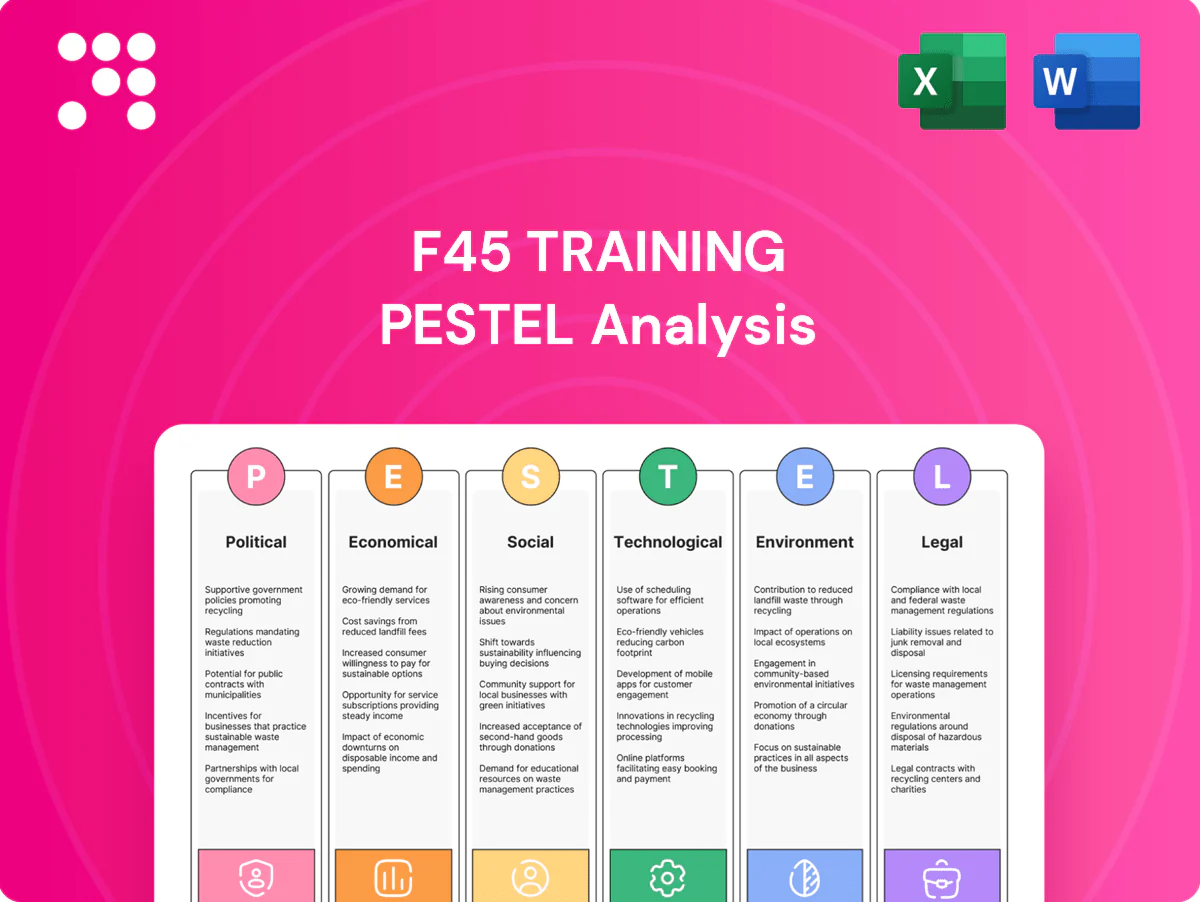
F45 Training PESTLE Analysis

Skip the Research. Get the Strategy.
Discover how political shifts, economic cycles, social trends, technological advances, legal changes, and environmental pressures are shaping F45 Training's future in our concise PESTLE overview. This snapshot highlights risks and growth levers to inform investment and strategy decisions. Buy the full PESTLE analysis for the complete, actionable breakdown and ready-to-use deliverables.
Political factors

Public health policies
Government initiatives against obesity (US adult obesity 41.9% in 2017–2020, CDC) and preventive-care drives can raise demand for structured programs like F45; the global corporate wellness market was estimated at $57.2B in 2021 (Grand View Research), indicating subsidy potential. Subsidies or tax incentives for wellness may boost corporate memberships and ARPU. Conversely, mandates such as capacity limits reduce class throughput and hurt unit economics, so city/country policy monitoring is critical.
Local permitting and zoning
Zoning rules determine allowable locations and hours for F45 studios, with typical parking ratios of 1 space per 200–500 sq ft and noise limits often set near 55–65 dB in mixed-use zones. Permit timelines vary from weeks to 6+ months and fees commonly span $500–$10,000, affecting franchise launch speed and costs. Proactive municipal engagement reduces approval delays and compliance risk.

Trade and tariffs on equipment
Tariffs such as US Section 301 measures (rates broadly 7.5–25%) raise fit-out costs for new F45 franchises by increasing prices on imported equipment. Extended lead times from trade-policy shifts can delay standardized gear delivery and affect opening dates. Diversifying suppliers reduces exposure to trade tensions, and predictable capex/delivery are critical to franchisee ROI given F45’s reported 2024 initial investment range of $316,200–$485,200.

Political stability and security
Macro instability erodes consumer confidence and can cut gym attendance; the World Bank shows governance scores vary widely across markets, correlating with service-sector demand volatility. Civil unrest and election cycles frequently disrupt operations and local marketing windows, as seen in multiple 2024 regional disturbances. Robust insurance and contingency planning limit losses; market selection should weight governance indicators and political risk premiums.
Public funding for sport infrastructure
Public funding and government grants for community sport, with the global fitness market estimated at about USD 106.3 billion in 2024 (Statista), boost F45 brand awareness and local partnerships by expanding grassroots programs. Access to public facilities for pop-ups cuts studio acquisition and operating costs. Policy-driven school and workplace wellness mandates create B2B revenue channels and alignment with national fitness goals improves credibility.
- Grants increase community reach
- Public facilities lower capex
- School/workplace policies enable B2B sales
- Alignment with national goals strengthens positioning
Rising obesity and $106.3B fitness market fuel demand as tariffs raise fit-out costs
Rising obesity (US adult 41.9% 2017–2020, CDC) and a $106.3B global fitness market (2024, Statista) increase demand for structured programs like F45. Government wellness subsidies and school/workplace mandates boost B2B sales and ARPU; grants/public facilities cut capex. Trade tariffs (US Section 301 ~7.5–25%) raise fit-out costs vs 2024 F45 initial investment $316,200–$485,200. Governance/political risk correlate with attendance volatility.
| Factor | Metric |
|---|---|
| Obesity (US) | 41.9% |
| Global fitness market | $106.3B (2024) |
| F45 initial investment | $316,200–$485,200 (2024) |
| Tariffs | ~7.5–25% |
What is included in the product
 Detailed Word Document
Explores how macro-environmental factors uniquely affect F45 Training across Political, Economic, Social, Technological, Environmental, and Legal dimensions, with data-backed trends and region-specific examples; designed for executives, consultants, and investors, the analysis delivers forward-looking insights and clean, report-ready formatting to inform strategy, risk mitigation, and funding decisions.

 Customizable Excel Spreadsheet
Provides a concise, visually segmented PESTLE summary of F45 Training that’s easy to drop into presentations, share across teams, and annotate with region- or business-specific notes to streamline planning and risk discussions.
Economic factors

Consumer spending cycles
Discretionary income swings drive F45 membership churn and acquisition; with the global fitness market projected at about 147.1 billion USD by 2025, demand remains sizable but sensitive to income shocks. During downturns price sensitivity rises and class-pack sales often outpace subscriptions; premium positioning must be balanced with targeted promotions to protect volume. Economic recoveries present rapid reactivation opportunities as spending rebounds.
Interest rates and franchise financing
Higher interest rates (federal funds 5.25–5.50% in July 2025) raise debt service for new and existing F45 franchisees, delaying openings as build-out loans and equipment leases become costlier and stretch payback periods. Corporate may need to provide financing support or extended vendor terms to preserve unit economics. Pipeline health is closely tied to credit availability and borrowing costs have slowed rollout velocity.

Labor costs and availability
Wage inflation for coaches and managers rose roughly 4–6% in 2024, compressing four-wall margins as hourly pay and benefits account for a larger share of studio revenue.
Competition from boutique studios and big-box chains—many offering higher hourly rates or benefits—pushes talent pricing upward and increases retention costs.
Flexible staffing (part-time coaches, peak-only schedules) and class density optimization (target 20–30 attendees) protect profitability by spreading labor across more revenue-generating spots.
Standardized training systems and tech-enabled programming boost productivity per coach, often increasing class throughput and utilization by double-digit percentages versus ad hoc training models.

Commercial rents and real estate
Rent escalations and CAM charges in 2024 (market rents rose mid-single digits in many US metros) can shave several percentage points off studio EBITDA, while high-traffic sites lift lead flow but push occupancy from lease into 15–25% of operating costs for urban locations. Negotiating tenant improvements and rent holidays materially improves opening economics; portfolio performance data should drive lease renewals and relocations.
- Prioritise high-traffic vs cost trade-off
- Negotiate TI and rent-free periods
- Use portfolio KPIs for renewals
- Track CAM escalation impact on EBITDA
FX and cross-border royalties
Currency volatility drives variability in F45 franchise fees, royalties and equipment import costs — AUD traded roughly 0.615–0.72 USD in 2024 (~14% range), amplifying P&L swings for cross-border units.
- 2024 AUD range 0.615–0.72 USD (~14%)
- Initial franchise fee ~USD 50,000
- Ongoing royalties ~7% of revenue
- Hedging and localized pricing stabilize unit economics
- Clear FX clauses build franchisee trust
Rising obesity and $106.3B fitness market fuel demand as tariffs raise fit-out costs
Discretionary income volatility drives F45 churn; global fitness market ~147.1B USD by 2025 but demand is income-sensitive. Higher rates (fed funds 5.25–5.50% Jul 2025) and tighter credit slow franchise rollout and raise debt service. Wage inflation ~4–6% in 2024 and rent/CAM pressures compress EBITDA; flexible staffing and tech lift throughput. FX (AUD 0.615–0.72 USD in 2024) adds cross-border P&L risk.
| Metric | Value |
|---|---|
| Global market | 147.1B USD (2025) |
| Fed funds | 5.25–5.50% (Jul 2025) |
| Wage inflation | 4–6% (2024) |
| AUD range | 0.615–0.72 USD (2024) |
| Initial fee / royalty | ~50,000 USD / ~7% |
What You See Is What You Get
F45 Training PESTLE Analysis
The preview shown here is the exact F45 Training PESTLE Analysis document you’ll receive after purchase—fully formatted and ready to use. The content, layout, and strategic insights visible in this sample are the final version with no placeholders or edits required. After checkout you’ll be able to download this identical file instantly.

Skip the Research. Get the Strategy.
Discover how political shifts, economic cycles, social trends, technological advances, legal changes, and environmental pressures are shaping F45 Training's future in our concise PESTLE overview. This snapshot highlights risks and growth levers to inform investment and strategy decisions. Buy the full PESTLE analysis for the complete, actionable breakdown and ready-to-use deliverables.
Political factors
Public health policies
Government initiatives against obesity (US adult obesity 41.9% in 2017–2020, CDC) and preventive-care drives can raise demand for structured programs like F45; the global corporate wellness market was estimated at $57.2B in 2021 (Grand View Research), indicating subsidy potential. Subsidies or tax incentives for wellness may boost corporate memberships and ARPU. Conversely, mandates such as capacity limits reduce class throughput and hurt unit economics, so city/country policy monitoring is critical.
Local permitting and zoning
Zoning rules determine allowable locations and hours for F45 studios, with typical parking ratios of 1 space per 200–500 sq ft and noise limits often set near 55–65 dB in mixed-use zones. Permit timelines vary from weeks to 6+ months and fees commonly span $500–$10,000, affecting franchise launch speed and costs. Proactive municipal engagement reduces approval delays and compliance risk.
Trade and tariffs on equipment
Tariffs such as US Section 301 measures (rates broadly 7.5–25%) raise fit-out costs for new F45 franchises by increasing prices on imported equipment. Extended lead times from trade-policy shifts can delay standardized gear delivery and affect opening dates. Diversifying suppliers reduces exposure to trade tensions, and predictable capex/delivery are critical to franchisee ROI given F45’s reported 2024 initial investment range of $316,200–$485,200.
Political stability and security
Macro instability erodes consumer confidence and can cut gym attendance; the World Bank shows governance scores vary widely across markets, correlating with service-sector demand volatility. Civil unrest and election cycles frequently disrupt operations and local marketing windows, as seen in multiple 2024 regional disturbances. Robust insurance and contingency planning limit losses; market selection should weight governance indicators and political risk premiums.
Public funding for sport infrastructure
Public funding and government grants for community sport, with the global fitness market estimated at about USD 106.3 billion in 2024 (Statista), boost F45 brand awareness and local partnerships by expanding grassroots programs. Access to public facilities for pop-ups cuts studio acquisition and operating costs. Policy-driven school and workplace wellness mandates create B2B revenue channels and alignment with national fitness goals improves credibility.
- Grants increase community reach
- Public facilities lower capex
- School/workplace policies enable B2B sales
- Alignment with national goals strengthens positioning
Rising obesity and $106.3B fitness market fuel demand as tariffs raise fit-out costs
Rising obesity (US adult 41.9% 2017–2020, CDC) and a $106.3B global fitness market (2024, Statista) increase demand for structured programs like F45. Government wellness subsidies and school/workplace mandates boost B2B sales and ARPU; grants/public facilities cut capex. Trade tariffs (US Section 301 ~7.5–25%) raise fit-out costs vs 2024 F45 initial investment $316,200–$485,200. Governance/political risk correlate with attendance volatility.
| Factor | Metric |
|---|---|
| Obesity (US) | 41.9% |
| Global fitness market | $106.3B (2024) |
| F45 initial investment | $316,200–$485,200 (2024) |
| Tariffs | ~7.5–25% |
What is included in the product
Detailed Word Document
Explores how macro-environmental factors uniquely affect F45 Training across Political, Economic, Social, Technological, Environmental, and Legal dimensions, with data-backed trends and region-specific examples; designed for executives, consultants, and investors, the analysis delivers forward-looking insights and clean, report-ready formatting to inform strategy, risk mitigation, and funding decisions.
Customizable Excel Spreadsheet
Provides a concise, visually segmented PESTLE summary of F45 Training that’s easy to drop into presentations, share across teams, and annotate with region- or business-specific notes to streamline planning and risk discussions.
Economic factors
Consumer spending cycles
Discretionary income swings drive F45 membership churn and acquisition; with the global fitness market projected at about 147.1 billion USD by 2025, demand remains sizable but sensitive to income shocks. During downturns price sensitivity rises and class-pack sales often outpace subscriptions; premium positioning must be balanced with targeted promotions to protect volume. Economic recoveries present rapid reactivation opportunities as spending rebounds.
Interest rates and franchise financing
Higher interest rates (federal funds 5.25–5.50% in July 2025) raise debt service for new and existing F45 franchisees, delaying openings as build-out loans and equipment leases become costlier and stretch payback periods. Corporate may need to provide financing support or extended vendor terms to preserve unit economics. Pipeline health is closely tied to credit availability and borrowing costs have slowed rollout velocity.
Labor costs and availability
Wage inflation for coaches and managers rose roughly 4–6% in 2024, compressing four-wall margins as hourly pay and benefits account for a larger share of studio revenue.
Competition from boutique studios and big-box chains—many offering higher hourly rates or benefits—pushes talent pricing upward and increases retention costs.
Flexible staffing (part-time coaches, peak-only schedules) and class density optimization (target 20–30 attendees) protect profitability by spreading labor across more revenue-generating spots.
Standardized training systems and tech-enabled programming boost productivity per coach, often increasing class throughput and utilization by double-digit percentages versus ad hoc training models.
Commercial rents and real estate
Rent escalations and CAM charges in 2024 (market rents rose mid-single digits in many US metros) can shave several percentage points off studio EBITDA, while high-traffic sites lift lead flow but push occupancy from lease into 15–25% of operating costs for urban locations. Negotiating tenant improvements and rent holidays materially improves opening economics; portfolio performance data should drive lease renewals and relocations.
- Prioritise high-traffic vs cost trade-off
- Negotiate TI and rent-free periods
- Use portfolio KPIs for renewals
- Track CAM escalation impact on EBITDA
FX and cross-border royalties
Currency volatility drives variability in F45 franchise fees, royalties and equipment import costs — AUD traded roughly 0.615–0.72 USD in 2024 (~14% range), amplifying P&L swings for cross-border units.
- 2024 AUD range 0.615–0.72 USD (~14%)
- Initial franchise fee ~USD 50,000
- Ongoing royalties ~7% of revenue
- Hedging and localized pricing stabilize unit economics
- Clear FX clauses build franchisee trust
Rising obesity and $106.3B fitness market fuel demand as tariffs raise fit-out costs
Discretionary income volatility drives F45 churn; global fitness market ~147.1B USD by 2025 but demand is income-sensitive. Higher rates (fed funds 5.25–5.50% Jul 2025) and tighter credit slow franchise rollout and raise debt service. Wage inflation ~4–6% in 2024 and rent/CAM pressures compress EBITDA; flexible staffing and tech lift throughput. FX (AUD 0.615–0.72 USD in 2024) adds cross-border P&L risk.
| Metric | Value |
|---|---|
| Global market | 147.1B USD (2025) |
| Fed funds | 5.25–5.50% (Jul 2025) |
| Wage inflation | 4–6% (2024) |
| AUD range | 0.615–0.72 USD (2024) |
| Initial fee / royalty | ~50,000 USD / ~7% |
What You See Is What You Get
F45 Training PESTLE Analysis
The preview shown here is the exact F45 Training PESTLE Analysis document you’ll receive after purchase—fully formatted and ready to use. The content, layout, and strategic insights visible in this sample are the final version with no placeholders or edits required. After checkout you’ll be able to download this identical file instantly.
Description
Skip the Research. Get the Strategy.
Discover how political shifts, economic cycles, social trends, technological advances, legal changes, and environmental pressures are shaping F45 Training's future in our concise PESTLE overview. This snapshot highlights risks and growth levers to inform investment and strategy decisions. Buy the full PESTLE analysis for the complete, actionable breakdown and ready-to-use deliverables.
Political factors
Public health policies
Government initiatives against obesity (US adult obesity 41.9% in 2017–2020, CDC) and preventive-care drives can raise demand for structured programs like F45; the global corporate wellness market was estimated at $57.2B in 2021 (Grand View Research), indicating subsidy potential. Subsidies or tax incentives for wellness may boost corporate memberships and ARPU. Conversely, mandates such as capacity limits reduce class throughput and hurt unit economics, so city/country policy monitoring is critical.
Local permitting and zoning
Zoning rules determine allowable locations and hours for F45 studios, with typical parking ratios of 1 space per 200–500 sq ft and noise limits often set near 55–65 dB in mixed-use zones. Permit timelines vary from weeks to 6+ months and fees commonly span $500–$10,000, affecting franchise launch speed and costs. Proactive municipal engagement reduces approval delays and compliance risk.
Trade and tariffs on equipment
Tariffs such as US Section 301 measures (rates broadly 7.5–25%) raise fit-out costs for new F45 franchises by increasing prices on imported equipment. Extended lead times from trade-policy shifts can delay standardized gear delivery and affect opening dates. Diversifying suppliers reduces exposure to trade tensions, and predictable capex/delivery are critical to franchisee ROI given F45’s reported 2024 initial investment range of $316,200–$485,200.
Political stability and security
Macro instability erodes consumer confidence and can cut gym attendance; the World Bank shows governance scores vary widely across markets, correlating with service-sector demand volatility. Civil unrest and election cycles frequently disrupt operations and local marketing windows, as seen in multiple 2024 regional disturbances. Robust insurance and contingency planning limit losses; market selection should weight governance indicators and political risk premiums.
Public funding for sport infrastructure
Public funding and government grants for community sport, with the global fitness market estimated at about USD 106.3 billion in 2024 (Statista), boost F45 brand awareness and local partnerships by expanding grassroots programs. Access to public facilities for pop-ups cuts studio acquisition and operating costs. Policy-driven school and workplace wellness mandates create B2B revenue channels and alignment with national fitness goals improves credibility.
- Grants increase community reach
- Public facilities lower capex
- School/workplace policies enable B2B sales
- Alignment with national goals strengthens positioning
Rising obesity and $106.3B fitness market fuel demand as tariffs raise fit-out costs
Rising obesity (US adult 41.9% 2017–2020, CDC) and a $106.3B global fitness market (2024, Statista) increase demand for structured programs like F45. Government wellness subsidies and school/workplace mandates boost B2B sales and ARPU; grants/public facilities cut capex. Trade tariffs (US Section 301 ~7.5–25%) raise fit-out costs vs 2024 F45 initial investment $316,200–$485,200. Governance/political risk correlate with attendance volatility.
| Factor | Metric |
|---|---|
| Obesity (US) | 41.9% |
| Global fitness market | $106.3B (2024) |
| F45 initial investment | $316,200–$485,200 (2024) |
| Tariffs | ~7.5–25% |
What is included in the product
Detailed Word Document
Explores how macro-environmental factors uniquely affect F45 Training across Political, Economic, Social, Technological, Environmental, and Legal dimensions, with data-backed trends and region-specific examples; designed for executives, consultants, and investors, the analysis delivers forward-looking insights and clean, report-ready formatting to inform strategy, risk mitigation, and funding decisions.
Customizable Excel Spreadsheet
Provides a concise, visually segmented PESTLE summary of F45 Training that’s easy to drop into presentations, share across teams, and annotate with region- or business-specific notes to streamline planning and risk discussions.
Economic factors
Consumer spending cycles
Discretionary income swings drive F45 membership churn and acquisition; with the global fitness market projected at about 147.1 billion USD by 2025, demand remains sizable but sensitive to income shocks. During downturns price sensitivity rises and class-pack sales often outpace subscriptions; premium positioning must be balanced with targeted promotions to protect volume. Economic recoveries present rapid reactivation opportunities as spending rebounds.
Interest rates and franchise financing
Higher interest rates (federal funds 5.25–5.50% in July 2025) raise debt service for new and existing F45 franchisees, delaying openings as build-out loans and equipment leases become costlier and stretch payback periods. Corporate may need to provide financing support or extended vendor terms to preserve unit economics. Pipeline health is closely tied to credit availability and borrowing costs have slowed rollout velocity.
Labor costs and availability
Wage inflation for coaches and managers rose roughly 4–6% in 2024, compressing four-wall margins as hourly pay and benefits account for a larger share of studio revenue.
Competition from boutique studios and big-box chains—many offering higher hourly rates or benefits—pushes talent pricing upward and increases retention costs.
Flexible staffing (part-time coaches, peak-only schedules) and class density optimization (target 20–30 attendees) protect profitability by spreading labor across more revenue-generating spots.
Standardized training systems and tech-enabled programming boost productivity per coach, often increasing class throughput and utilization by double-digit percentages versus ad hoc training models.
Commercial rents and real estate
Rent escalations and CAM charges in 2024 (market rents rose mid-single digits in many US metros) can shave several percentage points off studio EBITDA, while high-traffic sites lift lead flow but push occupancy from lease into 15–25% of operating costs for urban locations. Negotiating tenant improvements and rent holidays materially improves opening economics; portfolio performance data should drive lease renewals and relocations.
- Prioritise high-traffic vs cost trade-off
- Negotiate TI and rent-free periods
- Use portfolio KPIs for renewals
- Track CAM escalation impact on EBITDA
FX and cross-border royalties
Currency volatility drives variability in F45 franchise fees, royalties and equipment import costs — AUD traded roughly 0.615–0.72 USD in 2024 (~14% range), amplifying P&L swings for cross-border units.
- 2024 AUD range 0.615–0.72 USD (~14%)
- Initial franchise fee ~USD 50,000
- Ongoing royalties ~7% of revenue
- Hedging and localized pricing stabilize unit economics
- Clear FX clauses build franchisee trust
Rising obesity and $106.3B fitness market fuel demand as tariffs raise fit-out costs
Discretionary income volatility drives F45 churn; global fitness market ~147.1B USD by 2025 but demand is income-sensitive. Higher rates (fed funds 5.25–5.50% Jul 2025) and tighter credit slow franchise rollout and raise debt service. Wage inflation ~4–6% in 2024 and rent/CAM pressures compress EBITDA; flexible staffing and tech lift throughput. FX (AUD 0.615–0.72 USD in 2024) adds cross-border P&L risk.
| Metric | Value |
|---|---|
| Global market | 147.1B USD (2025) |
| Fed funds | 5.25–5.50% (Jul 2025) |
| Wage inflation | 4–6% (2024) |
| AUD range | 0.615–0.72 USD (2024) |
| Initial fee / royalty | ~50,000 USD / ~7% |
What You See Is What You Get
F45 Training PESTLE Analysis
The preview shown here is the exact F45 Training PESTLE Analysis document you’ll receive after purchase—fully formatted and ready to use. The content, layout, and strategic insights visible in this sample are the final version with no placeholders or edits required. After checkout you’ll be able to download this identical file instantly.











