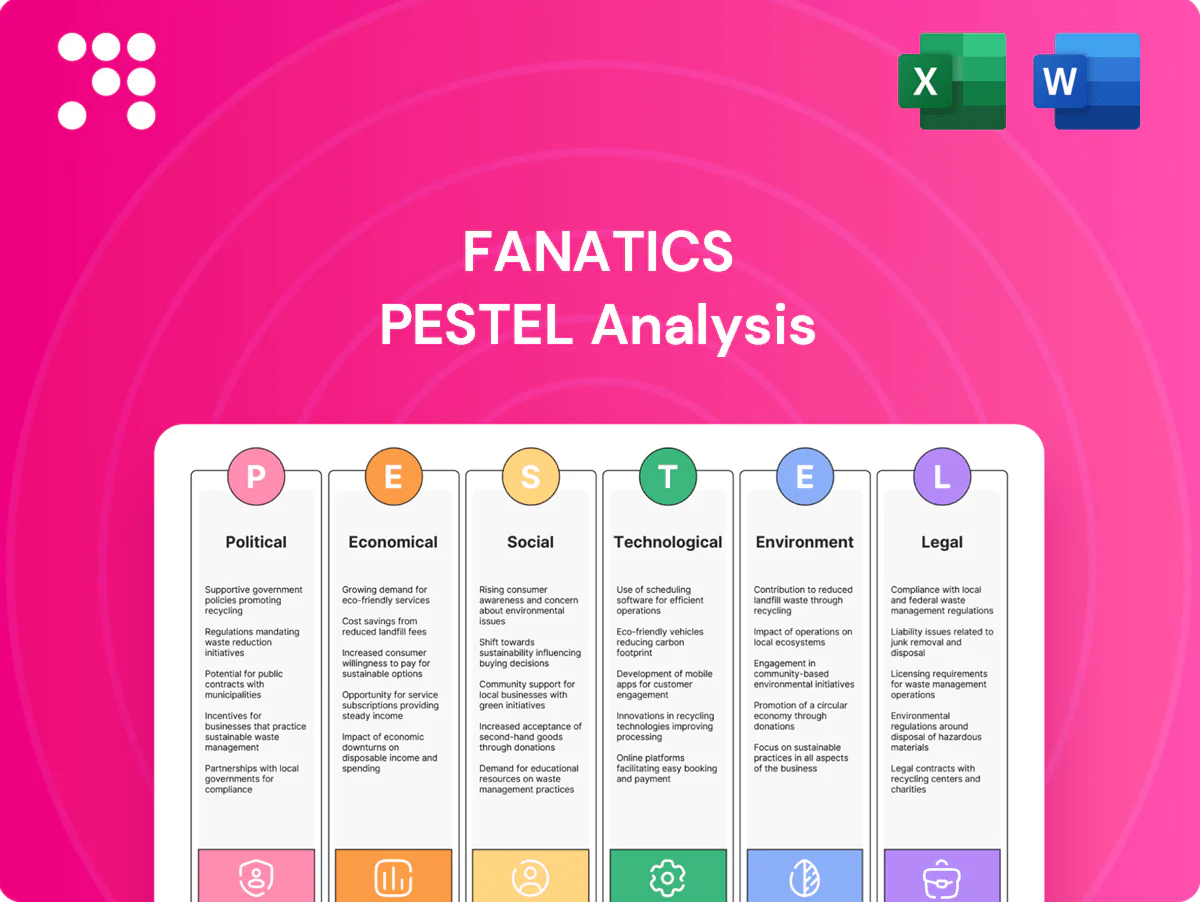
Fanatics PESTLE Analysis

Skip the Research. Get the Strategy.
Gain a competitive edge with our targeted PESTLE analysis of Fanatics, revealing how political, economic, social, technological, legal and environmental forces shape its strategy. This concise, expert report highlights regulatory risks, market opportunities, and tech-driven disruption to inform investment and strategic decisions. Purchase the full analysis for an immediately downloadable, editable report with actionable insights for boardrooms and investor decks.
Political factors

Government licensing and league relations
Exclusive rights depend on stable relationships with leagues, teams and national sports bodies; Fanatics holds merchandising and licensing agreements with five major U.S. leagues (NFL, MLB, NBA, NHL, MLS) and multiple international federations. Political shifts in sports governance can alter licensing priorities or fees, while changes in public funding or oversight affect partnership dynamics. Maintaining bipartisan and cross-border goodwill mitigates renegotiation risk.
Trade policy, tariffs, and import/export controls
Apparel and collectibles supply chains face tariff volatility across the US, EU, China and emerging markets, with US Section 301 duties on many Chinese goods still reaching up to 25% and similar retaliatory measures possible elsewhere. New trade agreements or retaliatory duties can compress margins or force price adjustments equal to tariff levels, eroding gross margins. Customs delays and export controls around major events shift release timelines and inventory turns. Diversifying origin countries hedges policy shocks and reduces single‑market tariff exposure.

Geopolitical risk and market stability
Regional conflicts and sanctions can disrupt manufacturing hubs and logistics corridors, with the Suez Canal accounting for about 12% of global shipping and chokepoints like the Strait of Hormuz handling roughly 20% of seaborne oil, raising transit risk for Fanatics' inventory flows. Political instability may constrain market access for betting and retail in specific jurisdictions, while currency controls and capital restrictions complicate settlements with licensors and suppliers. Scenario planning and diversified supply routes ensure continuity of marquee product drops and protect topline revenue streams.

Regulation of sports betting and gaming
Policy direction on gambling varies widely by jurisdiction and election cycle, driving uncertainty for Fanatics; as of 2024, 37 US states plus DC have legalized sports betting, illustrating fragmented markets. Liberalization in new states and countries opens direct retail and digital revenue streams, while regulatory crackdowns curtail market expansion and EBITDA upside. Advertising and sponsorship rules tied to betting face increasing political scrutiny and possible tightening. Proactive compliance and transparent controls support license approvals and long-term positioning.
- Regulatory fragmentation: varying rules by state/country
- Revenue impact: liberalization drives market entry; crackdowns reduce TAM
- Marketing risk: tighter sponsorship/ads possible under political pressure
- Compliance advantage: aids licensing and sustainable growth
Public policy on labor and industrial relations
Federal minimum wage remains $7.25/hr and FLSA overtime pays 1.5x after 40 hours, so hikes or stricter overtime enforcement would raise Fanatics fulfillment and customer service costs; union drives in logistics and retail increase recurring labor premiums.
Political scrutiny of gig and warehouse practices has prompted local mandates and high visibility for strikes at ports or carriers, elevating operational risk; transparent labor standards cut reputational exposure and supply disruptions—Teamsters represent ~1.3 million workers, underscoring bargaining leverage.
- Minimum wage: $7.25 federal; overtime: 1.5x after 40
- Union leverage: Teamsters ~1.3M members
- Strikes/mandates heighten operational and reputational risk
Exclusive sports rights, betting expansion, tariffs, shipping and labor risks reshape TAM
Exclusive licenses with five major U.S. leagues and global federations make Fanatics sensitive to governance shifts; 37 US states+DC have legalized sports betting (2024), altering TAM. Tariff volatility (Section 301 up to 25%), chokepoints (Suez ~12% trade) and labor pressures (federal min $7.25, Teamsters ~1.3M) raise cost and access risks; regulatory fragmentation demands diversified supply and compliance.
| Risk | Key metric |
|---|---|
| Betting legalization | 37 states+DC (2024) |
| Tariffs | Section 301 up to 25% |
| Shipping chokepoints | Suez ~12% global trade |
| Labor | Min wage $7.25; Teamsters ~1.3M |
What is included in the product
 Detailed Word Document
Explores how macro-environmental factors uniquely affect Fanatics across Political, Economic, Social, Technological, Environmental and Legal dimensions, with data-driven insights and forward-looking implications to help executives, investors and strategists identify risks, opportunities and actionable responses for decks and plans.

 Customizable Excel Spreadsheet
A concise, visually segmented PESTLE summary tailored to Fanatics that streamlines external risk assessment and market positioning for meetings or presentations, with editable notes for region- or business-line specifics to speed team alignment and decision-making.
Economic factors

Consumer discretionary cycles
Merchandise and collectibles are highly cyclical and tied to income, employment and confidence; the global licensed sports merchandise market was estimated at about $30 billion in 2023 and typically contracts in recessions as jersey upgrades decline. Championships and major tournaments can offset cyclicality with spikes in demand. US legal sports betting handle exceeded $80 billion in 2023, correlating with disposable income; Fanatics uses flexible pricing and drop pacing to smooth demand volatility.
Inflation, input costs, and shipping
Yarn, dyes, energy and packaging costs flow directly through Fanatics’ COGS, with raw-material and energy-driven input inflation lifting apparel COGS materially in 2022–24. Ocean freight, which peaked near USD 10,000/FEU in 2021 and averaged ~USD 2,000/FEU by 2023, and air rates swing with fuel — Brent averaged about USD 84/bbl in 2024 — driving volatility. Peak-season surcharges can trim release profitability around playoffs as carriers add 10–30% premiums, while hedging and nearshoring have been adopted to improve cost visibility and reduce lead-time risk.

FX exposure and global settlement
Fanatics earns revenue in multiple currencies while key licensing agreements are typically USD- or EUR-denominated, so FX swings directly alter reported growth and the effective royalty margin. Sudden rate moves can create regional price misalignment in collectibles, pressuring demand and secondary-market spreads. The company uses natural hedges from diversified sales and layered forward contracts to stabilize margins and protect royalty economics.

Sponsorship and media-rights ecosystems
League media and sponsorship revenues—exemplified by the NFLs roughly $110 billion 11-year rights cycle—underpin merchandising demand, tying Fanatics sales to broadcast-driven fan interest. Rights renewals and cord-cutting shift peak sales windows as streaming deals change live-viewing cadence. Betting integrations with broadcasters raise in-play conversion, and aligning product launches to marquee media moments maximizes ROI.
- Media rights: NFL ~$110B 11-year cycle
- Cord-cutting shifts peak sales timing
- Betting-broadcast integrations boost conversion
- Launches timed to media moments maximize ROI
Secondary market dynamics for collectibles
Resale prices strongly feed back into primary demand for trading cards and limited drops, with the global collectibles market estimated at about 370 billion USD (Statista 2022) showing price-driven demand cycles. Elevated Fed funds (around 5.25–5.50% in 2024–25) tightens liquidity and can create boom‑bust patterns; faster grading/authentication raises velocity while data‑led release sizing cuts overhang risk.
- Resale prices → primary demand
- Rates (5.25–5.50%) → liquidity cycles
- Grading/authentication → market velocity
- Data-led sizing → lower overhang
Exclusive sports rights, betting expansion, tariffs, shipping and labor risks reshape TAM
Merchandise demand is cyclical—global licensed market ~$30B (2023) and collectibles ~$370B (2022)—spiking around championships; US sports-betting handle exceeded ~$80B (2023) aiding engagement. Input inflation (yarn, dyes, energy) lifted apparel COGS in 2022–24; Brent averaged ~$84/bbl (2024) and ocean freight ~USD2,000/FEU (2023). Higher rates (Fed 5.25–5.50% 2024–25) tighten liquidity, FX swings affect reported growth and royalties.
| Metric | Value |
|---|---|
| Licensed market (2023) | $30B |
| Collectibles (2022) | $370B |
| US betting handle (2023) | $80B+ |
| Brent (avg 2024) | $84/bbl |
| Ocean freight (2023) | $2,000/FEU |
| Fed funds (2024–25) | 5.25–5.50% |
What You See Is What You Get
Fanatics PESTLE Analysis
The Fanatics PESTLE Analysis preview shown here is the exact document you’ll receive after purchase—fully formatted and ready to use. The layout, content, and structure visible are exactly what you’ll download immediately after buying. No placeholders, no surprises.

Skip the Research. Get the Strategy.
Gain a competitive edge with our targeted PESTLE analysis of Fanatics, revealing how political, economic, social, technological, legal and environmental forces shape its strategy. This concise, expert report highlights regulatory risks, market opportunities, and tech-driven disruption to inform investment and strategic decisions. Purchase the full analysis for an immediately downloadable, editable report with actionable insights for boardrooms and investor decks.
Political factors
Government licensing and league relations
Exclusive rights depend on stable relationships with leagues, teams and national sports bodies; Fanatics holds merchandising and licensing agreements with five major U.S. leagues (NFL, MLB, NBA, NHL, MLS) and multiple international federations. Political shifts in sports governance can alter licensing priorities or fees, while changes in public funding or oversight affect partnership dynamics. Maintaining bipartisan and cross-border goodwill mitigates renegotiation risk.
Trade policy, tariffs, and import/export controls
Apparel and collectibles supply chains face tariff volatility across the US, EU, China and emerging markets, with US Section 301 duties on many Chinese goods still reaching up to 25% and similar retaliatory measures possible elsewhere. New trade agreements or retaliatory duties can compress margins or force price adjustments equal to tariff levels, eroding gross margins. Customs delays and export controls around major events shift release timelines and inventory turns. Diversifying origin countries hedges policy shocks and reduces single‑market tariff exposure.
Geopolitical risk and market stability
Regional conflicts and sanctions can disrupt manufacturing hubs and logistics corridors, with the Suez Canal accounting for about 12% of global shipping and chokepoints like the Strait of Hormuz handling roughly 20% of seaborne oil, raising transit risk for Fanatics' inventory flows. Political instability may constrain market access for betting and retail in specific jurisdictions, while currency controls and capital restrictions complicate settlements with licensors and suppliers. Scenario planning and diversified supply routes ensure continuity of marquee product drops and protect topline revenue streams.
Regulation of sports betting and gaming
Policy direction on gambling varies widely by jurisdiction and election cycle, driving uncertainty for Fanatics; as of 2024, 37 US states plus DC have legalized sports betting, illustrating fragmented markets. Liberalization in new states and countries opens direct retail and digital revenue streams, while regulatory crackdowns curtail market expansion and EBITDA upside. Advertising and sponsorship rules tied to betting face increasing political scrutiny and possible tightening. Proactive compliance and transparent controls support license approvals and long-term positioning.
- Regulatory fragmentation: varying rules by state/country
- Revenue impact: liberalization drives market entry; crackdowns reduce TAM
- Marketing risk: tighter sponsorship/ads possible under political pressure
- Compliance advantage: aids licensing and sustainable growth
Public policy on labor and industrial relations
Federal minimum wage remains $7.25/hr and FLSA overtime pays 1.5x after 40 hours, so hikes or stricter overtime enforcement would raise Fanatics fulfillment and customer service costs; union drives in logistics and retail increase recurring labor premiums.
Political scrutiny of gig and warehouse practices has prompted local mandates and high visibility for strikes at ports or carriers, elevating operational risk; transparent labor standards cut reputational exposure and supply disruptions—Teamsters represent ~1.3 million workers, underscoring bargaining leverage.
- Minimum wage: $7.25 federal; overtime: 1.5x after 40
- Union leverage: Teamsters ~1.3M members
- Strikes/mandates heighten operational and reputational risk
Exclusive sports rights, betting expansion, tariffs, shipping and labor risks reshape TAM
Exclusive licenses with five major U.S. leagues and global federations make Fanatics sensitive to governance shifts; 37 US states+DC have legalized sports betting (2024), altering TAM. Tariff volatility (Section 301 up to 25%), chokepoints (Suez ~12% trade) and labor pressures (federal min $7.25, Teamsters ~1.3M) raise cost and access risks; regulatory fragmentation demands diversified supply and compliance.
| Risk | Key metric |
|---|---|
| Betting legalization | 37 states+DC (2024) |
| Tariffs | Section 301 up to 25% |
| Shipping chokepoints | Suez ~12% global trade |
| Labor | Min wage $7.25; Teamsters ~1.3M |
What is included in the product
Detailed Word Document
Explores how macro-environmental factors uniquely affect Fanatics across Political, Economic, Social, Technological, Environmental and Legal dimensions, with data-driven insights and forward-looking implications to help executives, investors and strategists identify risks, opportunities and actionable responses for decks and plans.
Customizable Excel Spreadsheet
A concise, visually segmented PESTLE summary tailored to Fanatics that streamlines external risk assessment and market positioning for meetings or presentations, with editable notes for region- or business-line specifics to speed team alignment and decision-making.
Economic factors
Consumer discretionary cycles
Merchandise and collectibles are highly cyclical and tied to income, employment and confidence; the global licensed sports merchandise market was estimated at about $30 billion in 2023 and typically contracts in recessions as jersey upgrades decline. Championships and major tournaments can offset cyclicality with spikes in demand. US legal sports betting handle exceeded $80 billion in 2023, correlating with disposable income; Fanatics uses flexible pricing and drop pacing to smooth demand volatility.
Inflation, input costs, and shipping
Yarn, dyes, energy and packaging costs flow directly through Fanatics’ COGS, with raw-material and energy-driven input inflation lifting apparel COGS materially in 2022–24. Ocean freight, which peaked near USD 10,000/FEU in 2021 and averaged ~USD 2,000/FEU by 2023, and air rates swing with fuel — Brent averaged about USD 84/bbl in 2024 — driving volatility. Peak-season surcharges can trim release profitability around playoffs as carriers add 10–30% premiums, while hedging and nearshoring have been adopted to improve cost visibility and reduce lead-time risk.
FX exposure and global settlement
Fanatics earns revenue in multiple currencies while key licensing agreements are typically USD- or EUR-denominated, so FX swings directly alter reported growth and the effective royalty margin. Sudden rate moves can create regional price misalignment in collectibles, pressuring demand and secondary-market spreads. The company uses natural hedges from diversified sales and layered forward contracts to stabilize margins and protect royalty economics.
Sponsorship and media-rights ecosystems
League media and sponsorship revenues—exemplified by the NFLs roughly $110 billion 11-year rights cycle—underpin merchandising demand, tying Fanatics sales to broadcast-driven fan interest. Rights renewals and cord-cutting shift peak sales windows as streaming deals change live-viewing cadence. Betting integrations with broadcasters raise in-play conversion, and aligning product launches to marquee media moments maximizes ROI.
- Media rights: NFL ~$110B 11-year cycle
- Cord-cutting shifts peak sales timing
- Betting-broadcast integrations boost conversion
- Launches timed to media moments maximize ROI
Secondary market dynamics for collectibles
Resale prices strongly feed back into primary demand for trading cards and limited drops, with the global collectibles market estimated at about 370 billion USD (Statista 2022) showing price-driven demand cycles. Elevated Fed funds (around 5.25–5.50% in 2024–25) tightens liquidity and can create boom‑bust patterns; faster grading/authentication raises velocity while data‑led release sizing cuts overhang risk.
- Resale prices → primary demand
- Rates (5.25–5.50%) → liquidity cycles
- Grading/authentication → market velocity
- Data-led sizing → lower overhang
Exclusive sports rights, betting expansion, tariffs, shipping and labor risks reshape TAM
Merchandise demand is cyclical—global licensed market ~$30B (2023) and collectibles ~$370B (2022)—spiking around championships; US sports-betting handle exceeded ~$80B (2023) aiding engagement. Input inflation (yarn, dyes, energy) lifted apparel COGS in 2022–24; Brent averaged ~$84/bbl (2024) and ocean freight ~USD2,000/FEU (2023). Higher rates (Fed 5.25–5.50% 2024–25) tighten liquidity, FX swings affect reported growth and royalties.
| Metric | Value |
|---|---|
| Licensed market (2023) | $30B |
| Collectibles (2022) | $370B |
| US betting handle (2023) | $80B+ |
| Brent (avg 2024) | $84/bbl |
| Ocean freight (2023) | $2,000/FEU |
| Fed funds (2024–25) | 5.25–5.50% |
What You See Is What You Get
Fanatics PESTLE Analysis
The Fanatics PESTLE Analysis preview shown here is the exact document you’ll receive after purchase—fully formatted and ready to use. The layout, content, and structure visible are exactly what you’ll download immediately after buying. No placeholders, no surprises.
Original: $10.00
-65%$10.00
$3.50Description
Skip the Research. Get the Strategy.
Gain a competitive edge with our targeted PESTLE analysis of Fanatics, revealing how political, economic, social, technological, legal and environmental forces shape its strategy. This concise, expert report highlights regulatory risks, market opportunities, and tech-driven disruption to inform investment and strategic decisions. Purchase the full analysis for an immediately downloadable, editable report with actionable insights for boardrooms and investor decks.
Political factors
Government licensing and league relations
Exclusive rights depend on stable relationships with leagues, teams and national sports bodies; Fanatics holds merchandising and licensing agreements with five major U.S. leagues (NFL, MLB, NBA, NHL, MLS) and multiple international federations. Political shifts in sports governance can alter licensing priorities or fees, while changes in public funding or oversight affect partnership dynamics. Maintaining bipartisan and cross-border goodwill mitigates renegotiation risk.
Trade policy, tariffs, and import/export controls
Apparel and collectibles supply chains face tariff volatility across the US, EU, China and emerging markets, with US Section 301 duties on many Chinese goods still reaching up to 25% and similar retaliatory measures possible elsewhere. New trade agreements or retaliatory duties can compress margins or force price adjustments equal to tariff levels, eroding gross margins. Customs delays and export controls around major events shift release timelines and inventory turns. Diversifying origin countries hedges policy shocks and reduces single‑market tariff exposure.
Geopolitical risk and market stability
Regional conflicts and sanctions can disrupt manufacturing hubs and logistics corridors, with the Suez Canal accounting for about 12% of global shipping and chokepoints like the Strait of Hormuz handling roughly 20% of seaborne oil, raising transit risk for Fanatics' inventory flows. Political instability may constrain market access for betting and retail in specific jurisdictions, while currency controls and capital restrictions complicate settlements with licensors and suppliers. Scenario planning and diversified supply routes ensure continuity of marquee product drops and protect topline revenue streams.
Regulation of sports betting and gaming
Policy direction on gambling varies widely by jurisdiction and election cycle, driving uncertainty for Fanatics; as of 2024, 37 US states plus DC have legalized sports betting, illustrating fragmented markets. Liberalization in new states and countries opens direct retail and digital revenue streams, while regulatory crackdowns curtail market expansion and EBITDA upside. Advertising and sponsorship rules tied to betting face increasing political scrutiny and possible tightening. Proactive compliance and transparent controls support license approvals and long-term positioning.
- Regulatory fragmentation: varying rules by state/country
- Revenue impact: liberalization drives market entry; crackdowns reduce TAM
- Marketing risk: tighter sponsorship/ads possible under political pressure
- Compliance advantage: aids licensing and sustainable growth
Public policy on labor and industrial relations
Federal minimum wage remains $7.25/hr and FLSA overtime pays 1.5x after 40 hours, so hikes or stricter overtime enforcement would raise Fanatics fulfillment and customer service costs; union drives in logistics and retail increase recurring labor premiums.
Political scrutiny of gig and warehouse practices has prompted local mandates and high visibility for strikes at ports or carriers, elevating operational risk; transparent labor standards cut reputational exposure and supply disruptions—Teamsters represent ~1.3 million workers, underscoring bargaining leverage.
- Minimum wage: $7.25 federal; overtime: 1.5x after 40
- Union leverage: Teamsters ~1.3M members
- Strikes/mandates heighten operational and reputational risk
Exclusive sports rights, betting expansion, tariffs, shipping and labor risks reshape TAM
Exclusive licenses with five major U.S. leagues and global federations make Fanatics sensitive to governance shifts; 37 US states+DC have legalized sports betting (2024), altering TAM. Tariff volatility (Section 301 up to 25%), chokepoints (Suez ~12% trade) and labor pressures (federal min $7.25, Teamsters ~1.3M) raise cost and access risks; regulatory fragmentation demands diversified supply and compliance.
| Risk | Key metric |
|---|---|
| Betting legalization | 37 states+DC (2024) |
| Tariffs | Section 301 up to 25% |
| Shipping chokepoints | Suez ~12% global trade |
| Labor | Min wage $7.25; Teamsters ~1.3M |
What is included in the product
Detailed Word Document
Explores how macro-environmental factors uniquely affect Fanatics across Political, Economic, Social, Technological, Environmental and Legal dimensions, with data-driven insights and forward-looking implications to help executives, investors and strategists identify risks, opportunities and actionable responses for decks and plans.
Customizable Excel Spreadsheet
A concise, visually segmented PESTLE summary tailored to Fanatics that streamlines external risk assessment and market positioning for meetings or presentations, with editable notes for region- or business-line specifics to speed team alignment and decision-making.
Economic factors
Consumer discretionary cycles
Merchandise and collectibles are highly cyclical and tied to income, employment and confidence; the global licensed sports merchandise market was estimated at about $30 billion in 2023 and typically contracts in recessions as jersey upgrades decline. Championships and major tournaments can offset cyclicality with spikes in demand. US legal sports betting handle exceeded $80 billion in 2023, correlating with disposable income; Fanatics uses flexible pricing and drop pacing to smooth demand volatility.
Inflation, input costs, and shipping
Yarn, dyes, energy and packaging costs flow directly through Fanatics’ COGS, with raw-material and energy-driven input inflation lifting apparel COGS materially in 2022–24. Ocean freight, which peaked near USD 10,000/FEU in 2021 and averaged ~USD 2,000/FEU by 2023, and air rates swing with fuel — Brent averaged about USD 84/bbl in 2024 — driving volatility. Peak-season surcharges can trim release profitability around playoffs as carriers add 10–30% premiums, while hedging and nearshoring have been adopted to improve cost visibility and reduce lead-time risk.
FX exposure and global settlement
Fanatics earns revenue in multiple currencies while key licensing agreements are typically USD- or EUR-denominated, so FX swings directly alter reported growth and the effective royalty margin. Sudden rate moves can create regional price misalignment in collectibles, pressuring demand and secondary-market spreads. The company uses natural hedges from diversified sales and layered forward contracts to stabilize margins and protect royalty economics.
Sponsorship and media-rights ecosystems
League media and sponsorship revenues—exemplified by the NFLs roughly $110 billion 11-year rights cycle—underpin merchandising demand, tying Fanatics sales to broadcast-driven fan interest. Rights renewals and cord-cutting shift peak sales windows as streaming deals change live-viewing cadence. Betting integrations with broadcasters raise in-play conversion, and aligning product launches to marquee media moments maximizes ROI.
- Media rights: NFL ~$110B 11-year cycle
- Cord-cutting shifts peak sales timing
- Betting-broadcast integrations boost conversion
- Launches timed to media moments maximize ROI
Secondary market dynamics for collectibles
Resale prices strongly feed back into primary demand for trading cards and limited drops, with the global collectibles market estimated at about 370 billion USD (Statista 2022) showing price-driven demand cycles. Elevated Fed funds (around 5.25–5.50% in 2024–25) tightens liquidity and can create boom‑bust patterns; faster grading/authentication raises velocity while data‑led release sizing cuts overhang risk.
- Resale prices → primary demand
- Rates (5.25–5.50%) → liquidity cycles
- Grading/authentication → market velocity
- Data-led sizing → lower overhang
Exclusive sports rights, betting expansion, tariffs, shipping and labor risks reshape TAM
Merchandise demand is cyclical—global licensed market ~$30B (2023) and collectibles ~$370B (2022)—spiking around championships; US sports-betting handle exceeded ~$80B (2023) aiding engagement. Input inflation (yarn, dyes, energy) lifted apparel COGS in 2022–24; Brent averaged ~$84/bbl (2024) and ocean freight ~USD2,000/FEU (2023). Higher rates (Fed 5.25–5.50% 2024–25) tighten liquidity, FX swings affect reported growth and royalties.
| Metric | Value |
|---|---|
| Licensed market (2023) | $30B |
| Collectibles (2022) | $370B |
| US betting handle (2023) | $80B+ |
| Brent (avg 2024) | $84/bbl |
| Ocean freight (2023) | $2,000/FEU |
| Fed funds (2024–25) | 5.25–5.50% |
What You See Is What You Get
Fanatics PESTLE Analysis
The Fanatics PESTLE Analysis preview shown here is the exact document you’ll receive after purchase—fully formatted and ready to use. The layout, content, and structure visible are exactly what you’ll download immediately after buying. No placeholders, no surprises.











