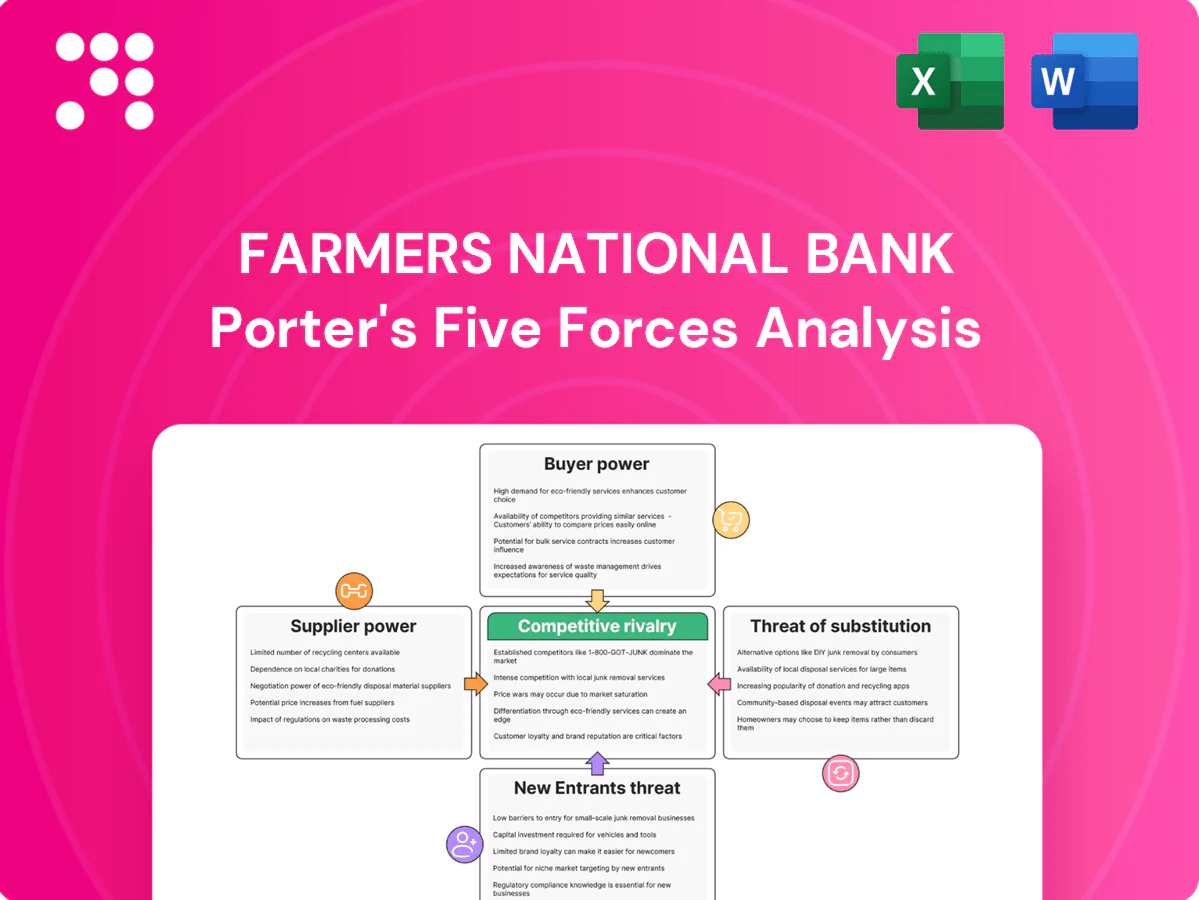
Farmers National Bank Porter's Five Forces Analysis

A Must-Have Tool for Decision-Makers
Farmers National Bank’s Porter's Five Forces snapshot highlights moderate buyer power, high regulatory barriers, intense rivalry among regional banks, limited supplier leverage, and a modest threat from fintech substitutes. This concise view frames where strategic risks and opportunities lie. Unlock the full Porter's Five Forces Analysis to get force-by-force ratings, visuals, and actionable recommendations for investment or strategy.
Suppliers Bargaining Power

Concentrated core tech vendors
Core processing and digital platforms are dominated by a few vendors — FIS, Fiserv and Jack Henry account for over 70% of the US core market in 2024 — boosting switching costs and supplier pricing power. Vendor roadmap control, hefty integration fees and migration risks can lock Farmers into long contracts. Farmers must negotiate multi-year deals with favorable exit clauses and diversify modules and fintech integrations to reduce dependency.
Funding from deposits and wholesale
Depositors supply low-cost funding for Farmers National Bank but remain rate-sensitive after the Federal Reserve's 2024 policy stance with the target federal funds rate near 5.25–5.50%, pushing banks to raise retail rates. In tight liquidity cycles, deposit brokers and FHLB advances gain leverage through higher costs and tighter covenants, forcing reliance on wholesale funding. Competition for core deposits elevates interest expense and compresses margins. Managing deposit mix and deepening customer relationships reduces supplier power.

Skilled labor and compliance talent
Skilled credit, risk, tech and compliance talent is scarce regionally, tightening supplier power as U.S. unemployment averaged about 3.9% in 2024 and remote hiring widens labor markets. Wage inflation and broader remote recruiting have increased staff bargaining leverage, making loss of key producers or risk experts a tangible threat to growth and controls. Robust training pipelines and targeted retention incentives are critical to counterbalance this supplier power.

Payment networks and correspondents
Farmers National Bank faces strong supplier power from Visa and Mastercard (together handling roughly 80%+ of US card volume) and ACH rails (NACHA processed over 30 billion ACH payments in 2023), while correspondent banks dictate fees and rules.
Limited alternatives amplify supplier influence on economics and service standards, with network mandates adding costs and chargeback exposure; volume-based pricing and strategic partnerships can soften these impacts.
- Visa/Mastercard concentration: ~80%+ US card volume
- ACH scale: NACHA >30 billion payments (2023)
- Correspondent banks set fees/rules, limited alternatives
- Risks: network mandates, chargebacks
- Mitigation: volume pricing, partnerships
Data, credit bureaus, and cloud providers
Data from the three national credit bureaus, AML/KYC vendors, and major cloud providers are critical to Farmers National Bank: their pricing, uptime and ML/model access directly affect underwriting speed and loss rates; cloud firms publish SLAs of roughly 99.9–99.99% as of 2024. Switching vendors requires model revalidation and invites regulatory scrutiny, so multi-vendor strategies and strong SLAs are used to mitigate concentration risk.
- Three national credit bureaus dominate US credit files
- Cloud SLAs ~99.9–99.99% (2024)
- Vendor-switch = model revalidation + regulatory review
- Multi-vendor + SLAs reduce concentration risk
Payments supply concentrated, deposits rate-sensitive, >70% core share, 5.25–5.50% fed funds
Suppliers exert high power: core vendors FIS/Fiserv/Jack Henry >70% US core market (2024), card rails Visa/Mastercard ~80%+ volume and NACHA processed >30bn ACH (2023). Depositors remain rate-sensitive with fed funds ~5.25–5.50% (2024), raising funding costs; skilled labor tight with U.S. unemployment ~3.9% (2024). Multi-vendor, contract clauses and partnerships reduce risk.
| Supplier | Metric | 2023–24 |
|---|---|---|
| Core processors | Market share | >70% |
| Card networks | Volume share | ~80%+ |
| ACH | Transactions | >30bn (2023) |
| Fed funds | Rate | 5.25–5.50% |
| Cloud SLAs | Uptime | 99.9–99.99% |
What is included in the product
 Detailed Word Document
Provides a tailored Porter's Five Forces assessment of Farmers National Bank, uncovering competitive drivers, customer bargaining power, supplier influence, threat of substitutes and entry barriers. Highlights disruptive forces, emerging threats, and strategic implications for pricing, market share, and profitability.

 Customizable Excel Spreadsheet
A clear, one-sheet Porter's Five Forces summary for Farmers National Bank—instantly visualizes competitive pressure and is ready to copy into pitch decks or boardroom slides to speed strategic decisions.
Customers Bargaining Power

Rate-sensitive depositors
Consumers and businesses can shop rates instantly via apps, and in 2024 top online banks offered savings APYs above 4%, raising price transparency and pressuring Farmers National Bank to increase funding costs. High-rate competitors force use of promotional CDs and money-market specials to retain balances. Loyalty programs and bundled services have proven to reduce churn by improving retention.
Large commercial clients negotiate
Large commercial clients—often the top 20% of relationships that generate roughly 80% of revenue—secure custom pricing, with volumes materially influencing loan spreads, fee waivers and collateral concessions. Cross-sell opportunities (treasury, deposits, cards) can offset tighter margins but are frequently traded for price or credit concessions. Relationship banking strengthens retention while concentrating bargaining power in a few key accounts.

Low switching costs digitally
Low switching costs digitally mean account opening, ACH redirects and e-bill migration take minutes not days, and with 75% of customers using mobile banking in 2024 this lowers stickiness and raises buyer leverage on fees and service levels. Negative service events can trigger rapid exits—digital churn spikes after outages. Superior UX and streamlined onboarding can rebuild friction and loyalty, reducing attrition.

Wealth and trust clients are discerning
Creditworthy borrowers have options
Creditworthy borrowers can turn to national banks, credit unions and fintechs; the bank prime rate held at 8.50% in 2024, keeping competition for prime business intense. Competing term sheets compress spreads and tighten covenants, while speed to close and certainty of funding are often decisive; differentiated underwriting and sector expertise help sustain margin.
Customers Hold the Leverage: >4% APY, 75% Mobile, Top 20% → 80% Revenue
Customers wield strong bargaining power: retails chase >4% APYs online (2024) and 75% used mobile banking, lowering switching costs; top 20% commercial clients drive ~80% revenue and secure bespoke pricing; advisory fees averaged 0.75% AUM (2024) while prime was 8.50% (2024), compressing spreads and raising price sensitivity.
| Metric | 2024 |
|---|---|
| Online savings APY | >4% |
| Mobile users | 75% |
| Top client revenue | 20% → 80% |
| Advisory fee | 0.75% AUM |
| Prime rate | 8.50% |
Preview Before You Purchase
Farmers National Bank Porter's Five Forces Analysis
This preview shows the exact Farmers National Bank Porter's Five Forces analysis you'll receive immediately after purchase—no mockups or placeholders. The document is fully formatted and ready for download, covering supplier and buyer power, threat of entry and substitutes, and competitive rivalry with actionable insights. You'll get this same complete file instantly after payment.

A Must-Have Tool for Decision-Makers
Farmers National Bank’s Porter's Five Forces snapshot highlights moderate buyer power, high regulatory barriers, intense rivalry among regional banks, limited supplier leverage, and a modest threat from fintech substitutes. This concise view frames where strategic risks and opportunities lie. Unlock the full Porter's Five Forces Analysis to get force-by-force ratings, visuals, and actionable recommendations for investment or strategy.
Suppliers Bargaining Power
Concentrated core tech vendors
Core processing and digital platforms are dominated by a few vendors — FIS, Fiserv and Jack Henry account for over 70% of the US core market in 2024 — boosting switching costs and supplier pricing power. Vendor roadmap control, hefty integration fees and migration risks can lock Farmers into long contracts. Farmers must negotiate multi-year deals with favorable exit clauses and diversify modules and fintech integrations to reduce dependency.
Funding from deposits and wholesale
Depositors supply low-cost funding for Farmers National Bank but remain rate-sensitive after the Federal Reserve's 2024 policy stance with the target federal funds rate near 5.25–5.50%, pushing banks to raise retail rates. In tight liquidity cycles, deposit brokers and FHLB advances gain leverage through higher costs and tighter covenants, forcing reliance on wholesale funding. Competition for core deposits elevates interest expense and compresses margins. Managing deposit mix and deepening customer relationships reduces supplier power.
Skilled labor and compliance talent
Skilled credit, risk, tech and compliance talent is scarce regionally, tightening supplier power as U.S. unemployment averaged about 3.9% in 2024 and remote hiring widens labor markets. Wage inflation and broader remote recruiting have increased staff bargaining leverage, making loss of key producers or risk experts a tangible threat to growth and controls. Robust training pipelines and targeted retention incentives are critical to counterbalance this supplier power.
Payment networks and correspondents
Farmers National Bank faces strong supplier power from Visa and Mastercard (together handling roughly 80%+ of US card volume) and ACH rails (NACHA processed over 30 billion ACH payments in 2023), while correspondent banks dictate fees and rules.
Limited alternatives amplify supplier influence on economics and service standards, with network mandates adding costs and chargeback exposure; volume-based pricing and strategic partnerships can soften these impacts.
- Visa/Mastercard concentration: ~80%+ US card volume
- ACH scale: NACHA >30 billion payments (2023)
- Correspondent banks set fees/rules, limited alternatives
- Risks: network mandates, chargebacks
- Mitigation: volume pricing, partnerships
Data, credit bureaus, and cloud providers
Data from the three national credit bureaus, AML/KYC vendors, and major cloud providers are critical to Farmers National Bank: their pricing, uptime and ML/model access directly affect underwriting speed and loss rates; cloud firms publish SLAs of roughly 99.9–99.99% as of 2024. Switching vendors requires model revalidation and invites regulatory scrutiny, so multi-vendor strategies and strong SLAs are used to mitigate concentration risk.
- Three national credit bureaus dominate US credit files
- Cloud SLAs ~99.9–99.99% (2024)
- Vendor-switch = model revalidation + regulatory review
- Multi-vendor + SLAs reduce concentration risk
Payments supply concentrated, deposits rate-sensitive, >70% core share, 5.25–5.50% fed funds
Suppliers exert high power: core vendors FIS/Fiserv/Jack Henry >70% US core market (2024), card rails Visa/Mastercard ~80%+ volume and NACHA processed >30bn ACH (2023). Depositors remain rate-sensitive with fed funds ~5.25–5.50% (2024), raising funding costs; skilled labor tight with U.S. unemployment ~3.9% (2024). Multi-vendor, contract clauses and partnerships reduce risk.
| Supplier | Metric | 2023–24 |
|---|---|---|
| Core processors | Market share | >70% |
| Card networks | Volume share | ~80%+ |
| ACH | Transactions | >30bn (2023) |
| Fed funds | Rate | 5.25–5.50% |
| Cloud SLAs | Uptime | 99.9–99.99% |
What is included in the product
Detailed Word Document
Provides a tailored Porter's Five Forces assessment of Farmers National Bank, uncovering competitive drivers, customer bargaining power, supplier influence, threat of substitutes and entry barriers. Highlights disruptive forces, emerging threats, and strategic implications for pricing, market share, and profitability.
Customizable Excel Spreadsheet
A clear, one-sheet Porter's Five Forces summary for Farmers National Bank—instantly visualizes competitive pressure and is ready to copy into pitch decks or boardroom slides to speed strategic decisions.
Customers Bargaining Power
Rate-sensitive depositors
Consumers and businesses can shop rates instantly via apps, and in 2024 top online banks offered savings APYs above 4%, raising price transparency and pressuring Farmers National Bank to increase funding costs. High-rate competitors force use of promotional CDs and money-market specials to retain balances. Loyalty programs and bundled services have proven to reduce churn by improving retention.
Large commercial clients negotiate
Large commercial clients—often the top 20% of relationships that generate roughly 80% of revenue—secure custom pricing, with volumes materially influencing loan spreads, fee waivers and collateral concessions. Cross-sell opportunities (treasury, deposits, cards) can offset tighter margins but are frequently traded for price or credit concessions. Relationship banking strengthens retention while concentrating bargaining power in a few key accounts.
Low switching costs digitally
Low switching costs digitally mean account opening, ACH redirects and e-bill migration take minutes not days, and with 75% of customers using mobile banking in 2024 this lowers stickiness and raises buyer leverage on fees and service levels. Negative service events can trigger rapid exits—digital churn spikes after outages. Superior UX and streamlined onboarding can rebuild friction and loyalty, reducing attrition.
Wealth and trust clients are discerning
Creditworthy borrowers have options
Creditworthy borrowers can turn to national banks, credit unions and fintechs; the bank prime rate held at 8.50% in 2024, keeping competition for prime business intense. Competing term sheets compress spreads and tighten covenants, while speed to close and certainty of funding are often decisive; differentiated underwriting and sector expertise help sustain margin.
Customers Hold the Leverage: >4% APY, 75% Mobile, Top 20% → 80% Revenue
Customers wield strong bargaining power: retails chase >4% APYs online (2024) and 75% used mobile banking, lowering switching costs; top 20% commercial clients drive ~80% revenue and secure bespoke pricing; advisory fees averaged 0.75% AUM (2024) while prime was 8.50% (2024), compressing spreads and raising price sensitivity.
| Metric | 2024 |
|---|---|
| Online savings APY | >4% |
| Mobile users | 75% |
| Top client revenue | 20% → 80% |
| Advisory fee | 0.75% AUM |
| Prime rate | 8.50% |
Preview Before You Purchase
Farmers National Bank Porter's Five Forces Analysis
This preview shows the exact Farmers National Bank Porter's Five Forces analysis you'll receive immediately after purchase—no mockups or placeholders. The document is fully formatted and ready for download, covering supplier and buyer power, threat of entry and substitutes, and competitive rivalry with actionable insights. You'll get this same complete file instantly after payment.
Original: $10.00
-65%$10.00
$3.50Description
A Must-Have Tool for Decision-Makers
Farmers National Bank’s Porter's Five Forces snapshot highlights moderate buyer power, high regulatory barriers, intense rivalry among regional banks, limited supplier leverage, and a modest threat from fintech substitutes. This concise view frames where strategic risks and opportunities lie. Unlock the full Porter's Five Forces Analysis to get force-by-force ratings, visuals, and actionable recommendations for investment or strategy.
Suppliers Bargaining Power
Concentrated core tech vendors
Core processing and digital platforms are dominated by a few vendors — FIS, Fiserv and Jack Henry account for over 70% of the US core market in 2024 — boosting switching costs and supplier pricing power. Vendor roadmap control, hefty integration fees and migration risks can lock Farmers into long contracts. Farmers must negotiate multi-year deals with favorable exit clauses and diversify modules and fintech integrations to reduce dependency.
Funding from deposits and wholesale
Depositors supply low-cost funding for Farmers National Bank but remain rate-sensitive after the Federal Reserve's 2024 policy stance with the target federal funds rate near 5.25–5.50%, pushing banks to raise retail rates. In tight liquidity cycles, deposit brokers and FHLB advances gain leverage through higher costs and tighter covenants, forcing reliance on wholesale funding. Competition for core deposits elevates interest expense and compresses margins. Managing deposit mix and deepening customer relationships reduces supplier power.
Skilled labor and compliance talent
Skilled credit, risk, tech and compliance talent is scarce regionally, tightening supplier power as U.S. unemployment averaged about 3.9% in 2024 and remote hiring widens labor markets. Wage inflation and broader remote recruiting have increased staff bargaining leverage, making loss of key producers or risk experts a tangible threat to growth and controls. Robust training pipelines and targeted retention incentives are critical to counterbalance this supplier power.
Payment networks and correspondents
Farmers National Bank faces strong supplier power from Visa and Mastercard (together handling roughly 80%+ of US card volume) and ACH rails (NACHA processed over 30 billion ACH payments in 2023), while correspondent banks dictate fees and rules.
Limited alternatives amplify supplier influence on economics and service standards, with network mandates adding costs and chargeback exposure; volume-based pricing and strategic partnerships can soften these impacts.
- Visa/Mastercard concentration: ~80%+ US card volume
- ACH scale: NACHA >30 billion payments (2023)
- Correspondent banks set fees/rules, limited alternatives
- Risks: network mandates, chargebacks
- Mitigation: volume pricing, partnerships
Data, credit bureaus, and cloud providers
Data from the three national credit bureaus, AML/KYC vendors, and major cloud providers are critical to Farmers National Bank: their pricing, uptime and ML/model access directly affect underwriting speed and loss rates; cloud firms publish SLAs of roughly 99.9–99.99% as of 2024. Switching vendors requires model revalidation and invites regulatory scrutiny, so multi-vendor strategies and strong SLAs are used to mitigate concentration risk.
- Three national credit bureaus dominate US credit files
- Cloud SLAs ~99.9–99.99% (2024)
- Vendor-switch = model revalidation + regulatory review
- Multi-vendor + SLAs reduce concentration risk
Payments supply concentrated, deposits rate-sensitive, >70% core share, 5.25–5.50% fed funds
Suppliers exert high power: core vendors FIS/Fiserv/Jack Henry >70% US core market (2024), card rails Visa/Mastercard ~80%+ volume and NACHA processed >30bn ACH (2023). Depositors remain rate-sensitive with fed funds ~5.25–5.50% (2024), raising funding costs; skilled labor tight with U.S. unemployment ~3.9% (2024). Multi-vendor, contract clauses and partnerships reduce risk.
| Supplier | Metric | 2023–24 |
|---|---|---|
| Core processors | Market share | >70% |
| Card networks | Volume share | ~80%+ |
| ACH | Transactions | >30bn (2023) |
| Fed funds | Rate | 5.25–5.50% |
| Cloud SLAs | Uptime | 99.9–99.99% |
What is included in the product
Detailed Word Document
Provides a tailored Porter's Five Forces assessment of Farmers National Bank, uncovering competitive drivers, customer bargaining power, supplier influence, threat of substitutes and entry barriers. Highlights disruptive forces, emerging threats, and strategic implications for pricing, market share, and profitability.
Customizable Excel Spreadsheet
A clear, one-sheet Porter's Five Forces summary for Farmers National Bank—instantly visualizes competitive pressure and is ready to copy into pitch decks or boardroom slides to speed strategic decisions.
Customers Bargaining Power
Rate-sensitive depositors
Consumers and businesses can shop rates instantly via apps, and in 2024 top online banks offered savings APYs above 4%, raising price transparency and pressuring Farmers National Bank to increase funding costs. High-rate competitors force use of promotional CDs and money-market specials to retain balances. Loyalty programs and bundled services have proven to reduce churn by improving retention.
Large commercial clients negotiate
Large commercial clients—often the top 20% of relationships that generate roughly 80% of revenue—secure custom pricing, with volumes materially influencing loan spreads, fee waivers and collateral concessions. Cross-sell opportunities (treasury, deposits, cards) can offset tighter margins but are frequently traded for price or credit concessions. Relationship banking strengthens retention while concentrating bargaining power in a few key accounts.
Low switching costs digitally
Low switching costs digitally mean account opening, ACH redirects and e-bill migration take minutes not days, and with 75% of customers using mobile banking in 2024 this lowers stickiness and raises buyer leverage on fees and service levels. Negative service events can trigger rapid exits—digital churn spikes after outages. Superior UX and streamlined onboarding can rebuild friction and loyalty, reducing attrition.
Wealth and trust clients are discerning
Creditworthy borrowers have options
Creditworthy borrowers can turn to national banks, credit unions and fintechs; the bank prime rate held at 8.50% in 2024, keeping competition for prime business intense. Competing term sheets compress spreads and tighten covenants, while speed to close and certainty of funding are often decisive; differentiated underwriting and sector expertise help sustain margin.
Customers Hold the Leverage: >4% APY, 75% Mobile, Top 20% → 80% Revenue
Customers wield strong bargaining power: retails chase >4% APYs online (2024) and 75% used mobile banking, lowering switching costs; top 20% commercial clients drive ~80% revenue and secure bespoke pricing; advisory fees averaged 0.75% AUM (2024) while prime was 8.50% (2024), compressing spreads and raising price sensitivity.
| Metric | 2024 |
|---|---|
| Online savings APY | >4% |
| Mobile users | 75% |
| Top client revenue | 20% → 80% |
| Advisory fee | 0.75% AUM |
| Prime rate | 8.50% |
Preview Before You Purchase
Farmers National Bank Porter's Five Forces Analysis
This preview shows the exact Farmers National Bank Porter's Five Forces analysis you'll receive immediately after purchase—no mockups or placeholders. The document is fully formatted and ready for download, covering supplier and buyer power, threat of entry and substitutes, and competitive rivalry with actionable insights. You'll get this same complete file instantly after payment.











