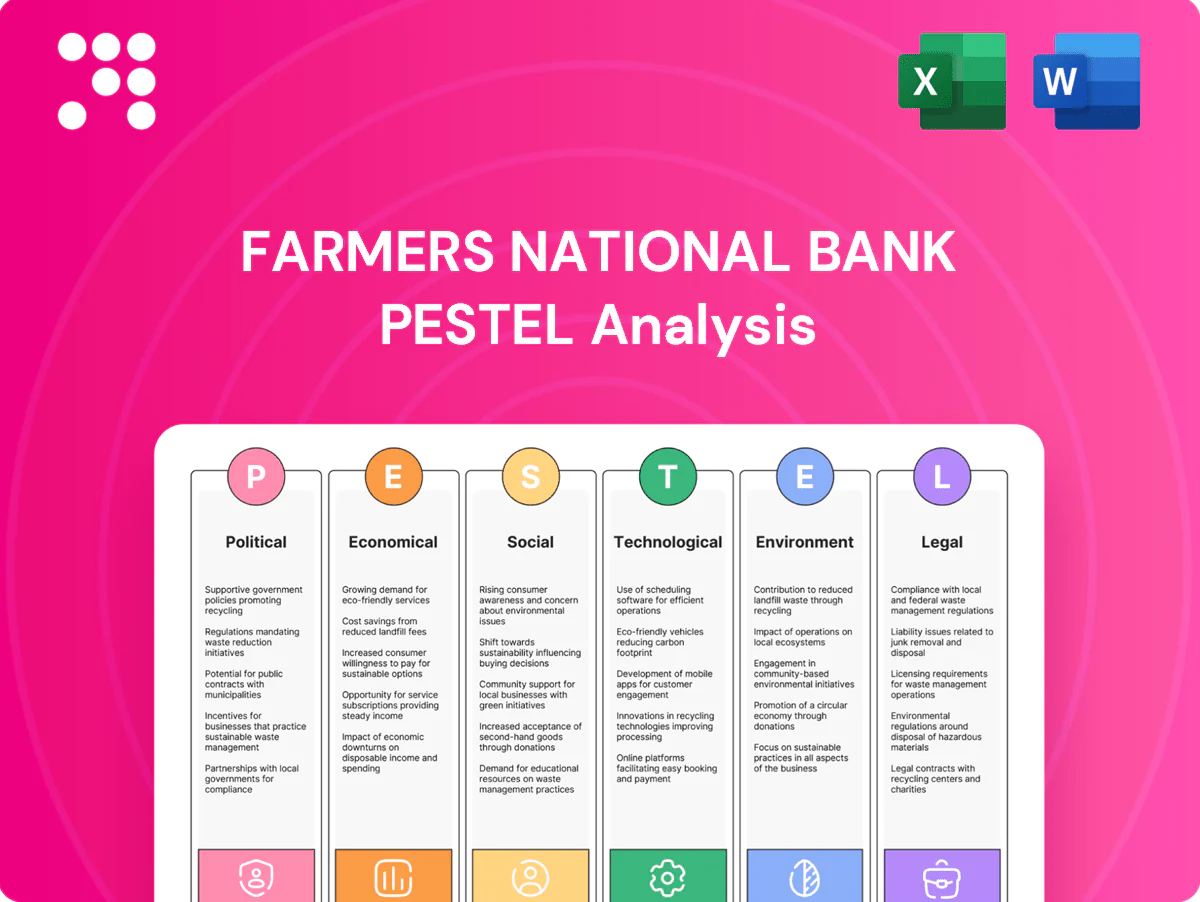
Farmers National Bank PESTLE Analysis

Skip the Research. Get the Strategy.
Discover how political, economic, social, technological, legal and environmental forces are reshaping Farmers National Bank’s competitive position and risk profile. Our concise PESTLE highlights key external trends, regulatory pressures, and growth opportunities to inform smarter strategy and investment decisions. Purchase the full, ready-to-use report for an actionable, downloadable deep dive.
Political factors

Bank regulatory posture
OCC supervision of national charters and Federal Reserve oversight at the holding-company level set capital, liquidity and governance expectations for Farmers National Bank; regulators tightened scrutiny after the March 2023 SVB/Signature/First Republic failures and the Fed’s BTFP liquidity response. Changes to capital and liquidity rules or stress-test regimes can raise funding costs, shift product mix and constrain growth; engage early in comment periods and update ALM, policy and compliance playbooks.
Monetary-fiscal policy alignment
Alignment of fiscal deficits (above $1.5 trillion in FY2024) and heavy Treasury issuance has kept term premia elevated, pushing the 10-year near 4.2% in mid‑2025, widening securities marks and lifting deposit betas toward ~30% for many regionals. Steeper or inverted curves materially shifted NIM and loan pricing decisions. Ongoing public investment from the $1.2 trillion Bipartisan Infrastructure Law supports local loan demand. Scenario‑plan multiple rate paths to shield earnings and capital.

Community banking priorities
Farmers National Bank can leverage bipartisan support for community bank relevance as these banks hold about 14% of U.S. deposits and remain central to local credit formation. Recent CRA modernization talks and small-business lending initiatives expand opportunity to serve SMEs without scaling credit risk. Federal and state programs, notably SBA 7(a) guarantees (up to 85% on some loans), de-risk lending and preserve capital. Maintain active policymaker dialogue to highlight local economic impact and access program funds to expand reach sustainably.

Rural and agricultural policy
- Assess USDA programs: ARC/PLC, crop insurance (≈$130B liability)
- Align lending with subsidy cycles and equipment financing demand
- Enhance servicing to manage policy-driven repayment volatility
- Offer advisory to streamline client access to grants and insurance
Geopolitical and election volatility
Election-driven uncertainty can push rates and regulation swings that dent consumer confidence; with the federal funds target near 5.25–5.50% (mid-2025), Farmers National Bank should anticipate rate- and policy-driven deposit flight and margin pressure. Geopolitical shocks can tighten funding markets and raise credit costs, so maintain LCRs above 100% and diversified funding. Clear client communication preserves trust during volatility.
- Prepare for election rate/reg risk
- Monitor funding spreads and liquidity
- Keep LCR >100% and diversify funding
- Proactive, transparent client communication
Tighter OCC/Fed oversight lifts funding costs; FF 5.25–5.50%, 10‑yr ≈4.2%
OCC/Fed oversight tightened after 2023 failures; capital, liquidity and stress-test changes can raise funding costs. Rates remain elevated (FF target 5.25–5.50% mid‑2025; 10‑yr ≈4.2%), pressuring NIM and deposit betas. USDA crop‑insurance liability ≈$130B stabilizes ag collateral; community banks hold ~14% of U.S. deposits, keeping local lending central.
| Metric | Value |
|---|---|
| Federal funds target | 5.25–5.50% |
| 10‑yr Treasury | ≈4.2% |
| USDA crop‑insurance liability | ≈$130B |
| Community bank deposit share | ~14% |
| LCR target | >100% |
What is included in the product
 Detailed Word Document
Explores how external macro-environmental factors uniquely affect Farmers National Bank across Political, Economic, Social, Technological, Environmental, and Legal dimensions, with data-backed trends and region-specific examples. Designed to help executives and investors identify threats, opportunities, and forward-looking strategic actions.

 Customizable Excel Spreadsheet
A concise, visually segmented PESTLE summary for Farmers National Bank that eases strategic meetings, supports risk discussions, and is shareable for quick team alignment.
Economic factors

Interest rate cycle and NIM
Manage exposure to rate moves that compress net interest margin and lift deposit costs and securities AOCI as the federal funds target remained at 5.25–5.50% into mid‑2025; balance‑sheet hedging, pricing discipline and asset/liability mix shifts are critical. Model deposit stickiness and beta across stress/softening rate scenarios (e.g., 25–75% beta ranges) and prioritize core deposit growth to lower funding costs and preserve NIM.
Regional economic health
Track employment, housing, and small-business trends in Ohio and neighboring markets: Ohio unemployment averaged about 4.0% in 2024 and home prices rose roughly 3% YoY, while small-business loan demand remained steady. Local manufacturing, healthcare and energy cycles shape credit demand and losses, so tailor underwriting and concentration limits to regional exposure and keep sector/geography early-warning indicators (delinquencies, payrolls, permits).

Credit quality and underwriting
Monitor rising consumer 30+ day delinquencies (4.2% Q1 2025), CRE office vacancy (~18% Q4 2024) and ag commodity moves (USDA 2024–25 season-average corn ~$5.10/bu, soy ~$12.40/bu) to assess borrower stress. Tighten or loosen credit boxes dynamically using delinquency and migration metrics and run stress tests on CRE office, construction and ag equipment portfolios under 20–40% revenue shocks. Strengthen workout teams and playbooks to target recovery rates of 60–80% and preserve collateral value through cycles.

Deposit competition and liquidity
Farmers National Bank faces deposit competition from fintechs, large banks and money market funds, which held roughly 5–6 trillion USD in assets in 2024, pressuring retail rates and digital convenience expectations. The bank should bundle value-added services and seamless mobile features to retain core balances, optimize wholesale funding as a costed backstop, and build contingency plans.
- Segment and price deposits using analytics
- Bundle digital + advisory to retain customers
- Use wholesale funding sparingly with contingency plans
Inflation and cost discipline
Inflation (CPI up 3.4% in 2024) elevates noninterest expense and compresses borrower affordability, forcing Farmers National Bank to reprice fees and streamline operations to protect its efficiency ratio. Prioritize productivity gains via automation and vendor optimization—McKinsey finds back-office automation can cut costs up to 30%—and offer clients inflation-cushioning products such as indexed loans and tailored deposit solutions.
- Inflation: CPI +3.4% (2024)
- Protect margin: fee repricing, efficiency focus
- Productivity: automation/vendor optimization (up to 30% savings)
- Client support: inflation-indexed loans, deposit hedges
Tighter OCC/Fed oversight lifts funding costs; FF 5.25–5.50%, 10‑yr ≈4.2%
Manage NIM pressure from Fed funds 5.25–5.50% into mid‑2025 via hedging, pricing and A/L mix; push core deposit growth. Track Ohio 4.0% unemployment and housing +3% (2024) plus rising 30+ delinquencies 4.2% Q1‑2025 to adjust underwriting. Counter CPI +3.4% (2024) with fee repricing, automation and inflation‑linked products.
| Metric | Value |
|---|---|
| Fed funds | 5.25–5.50% |
| CPI (2024) | +3.4% |
| Ohio unemployment (2024) | 4.0% |
| 30+ delinq (Q1 2025) | 4.2% |
| CRE office vac (Q4 2024) | ~18% |
What You See Is What You Get
Farmers National Bank PESTLE Analysis
The preview shown here is the exact Farmers National Bank PESTLE Analysis you’ll receive after purchase—fully formatted and ready to use. This is the real, finished document with complete PESTLE insights and structured findings. No placeholders or teasers—what you see is what you’ll download immediately after checkout.

Skip the Research. Get the Strategy.
Discover how political, economic, social, technological, legal and environmental forces are reshaping Farmers National Bank’s competitive position and risk profile. Our concise PESTLE highlights key external trends, regulatory pressures, and growth opportunities to inform smarter strategy and investment decisions. Purchase the full, ready-to-use report for an actionable, downloadable deep dive.
Political factors
Bank regulatory posture
OCC supervision of national charters and Federal Reserve oversight at the holding-company level set capital, liquidity and governance expectations for Farmers National Bank; regulators tightened scrutiny after the March 2023 SVB/Signature/First Republic failures and the Fed’s BTFP liquidity response. Changes to capital and liquidity rules or stress-test regimes can raise funding costs, shift product mix and constrain growth; engage early in comment periods and update ALM, policy and compliance playbooks.
Monetary-fiscal policy alignment
Alignment of fiscal deficits (above $1.5 trillion in FY2024) and heavy Treasury issuance has kept term premia elevated, pushing the 10-year near 4.2% in mid‑2025, widening securities marks and lifting deposit betas toward ~30% for many regionals. Steeper or inverted curves materially shifted NIM and loan pricing decisions. Ongoing public investment from the $1.2 trillion Bipartisan Infrastructure Law supports local loan demand. Scenario‑plan multiple rate paths to shield earnings and capital.
Community banking priorities
Farmers National Bank can leverage bipartisan support for community bank relevance as these banks hold about 14% of U.S. deposits and remain central to local credit formation. Recent CRA modernization talks and small-business lending initiatives expand opportunity to serve SMEs without scaling credit risk. Federal and state programs, notably SBA 7(a) guarantees (up to 85% on some loans), de-risk lending and preserve capital. Maintain active policymaker dialogue to highlight local economic impact and access program funds to expand reach sustainably.
Rural and agricultural policy
- Assess USDA programs: ARC/PLC, crop insurance (≈$130B liability)
- Align lending with subsidy cycles and equipment financing demand
- Enhance servicing to manage policy-driven repayment volatility
- Offer advisory to streamline client access to grants and insurance
Geopolitical and election volatility
Election-driven uncertainty can push rates and regulation swings that dent consumer confidence; with the federal funds target near 5.25–5.50% (mid-2025), Farmers National Bank should anticipate rate- and policy-driven deposit flight and margin pressure. Geopolitical shocks can tighten funding markets and raise credit costs, so maintain LCRs above 100% and diversified funding. Clear client communication preserves trust during volatility.
- Prepare for election rate/reg risk
- Monitor funding spreads and liquidity
- Keep LCR >100% and diversify funding
- Proactive, transparent client communication
Tighter OCC/Fed oversight lifts funding costs; FF 5.25–5.50%, 10‑yr ≈4.2%
OCC/Fed oversight tightened after 2023 failures; capital, liquidity and stress-test changes can raise funding costs. Rates remain elevated (FF target 5.25–5.50% mid‑2025; 10‑yr ≈4.2%), pressuring NIM and deposit betas. USDA crop‑insurance liability ≈$130B stabilizes ag collateral; community banks hold ~14% of U.S. deposits, keeping local lending central.
| Metric | Value |
|---|---|
| Federal funds target | 5.25–5.50% |
| 10‑yr Treasury | ≈4.2% |
| USDA crop‑insurance liability | ≈$130B |
| Community bank deposit share | ~14% |
| LCR target | >100% |
What is included in the product
Detailed Word Document
Explores how external macro-environmental factors uniquely affect Farmers National Bank across Political, Economic, Social, Technological, Environmental, and Legal dimensions, with data-backed trends and region-specific examples. Designed to help executives and investors identify threats, opportunities, and forward-looking strategic actions.
Customizable Excel Spreadsheet
A concise, visually segmented PESTLE summary for Farmers National Bank that eases strategic meetings, supports risk discussions, and is shareable for quick team alignment.
Economic factors
Interest rate cycle and NIM
Manage exposure to rate moves that compress net interest margin and lift deposit costs and securities AOCI as the federal funds target remained at 5.25–5.50% into mid‑2025; balance‑sheet hedging, pricing discipline and asset/liability mix shifts are critical. Model deposit stickiness and beta across stress/softening rate scenarios (e.g., 25–75% beta ranges) and prioritize core deposit growth to lower funding costs and preserve NIM.
Regional economic health
Track employment, housing, and small-business trends in Ohio and neighboring markets: Ohio unemployment averaged about 4.0% in 2024 and home prices rose roughly 3% YoY, while small-business loan demand remained steady. Local manufacturing, healthcare and energy cycles shape credit demand and losses, so tailor underwriting and concentration limits to regional exposure and keep sector/geography early-warning indicators (delinquencies, payrolls, permits).
Credit quality and underwriting
Monitor rising consumer 30+ day delinquencies (4.2% Q1 2025), CRE office vacancy (~18% Q4 2024) and ag commodity moves (USDA 2024–25 season-average corn ~$5.10/bu, soy ~$12.40/bu) to assess borrower stress. Tighten or loosen credit boxes dynamically using delinquency and migration metrics and run stress tests on CRE office, construction and ag equipment portfolios under 20–40% revenue shocks. Strengthen workout teams and playbooks to target recovery rates of 60–80% and preserve collateral value through cycles.
Deposit competition and liquidity
Farmers National Bank faces deposit competition from fintechs, large banks and money market funds, which held roughly 5–6 trillion USD in assets in 2024, pressuring retail rates and digital convenience expectations. The bank should bundle value-added services and seamless mobile features to retain core balances, optimize wholesale funding as a costed backstop, and build contingency plans.
- Segment and price deposits using analytics
- Bundle digital + advisory to retain customers
- Use wholesale funding sparingly with contingency plans
Inflation and cost discipline
Inflation (CPI up 3.4% in 2024) elevates noninterest expense and compresses borrower affordability, forcing Farmers National Bank to reprice fees and streamline operations to protect its efficiency ratio. Prioritize productivity gains via automation and vendor optimization—McKinsey finds back-office automation can cut costs up to 30%—and offer clients inflation-cushioning products such as indexed loans and tailored deposit solutions.
- Inflation: CPI +3.4% (2024)
- Protect margin: fee repricing, efficiency focus
- Productivity: automation/vendor optimization (up to 30% savings)
- Client support: inflation-indexed loans, deposit hedges
Tighter OCC/Fed oversight lifts funding costs; FF 5.25–5.50%, 10‑yr ≈4.2%
Manage NIM pressure from Fed funds 5.25–5.50% into mid‑2025 via hedging, pricing and A/L mix; push core deposit growth. Track Ohio 4.0% unemployment and housing +3% (2024) plus rising 30+ delinquencies 4.2% Q1‑2025 to adjust underwriting. Counter CPI +3.4% (2024) with fee repricing, automation and inflation‑linked products.
| Metric | Value |
|---|---|
| Fed funds | 5.25–5.50% |
| CPI (2024) | +3.4% |
| Ohio unemployment (2024) | 4.0% |
| 30+ delinq (Q1 2025) | 4.2% |
| CRE office vac (Q4 2024) | ~18% |
What You See Is What You Get
Farmers National Bank PESTLE Analysis
The preview shown here is the exact Farmers National Bank PESTLE Analysis you’ll receive after purchase—fully formatted and ready to use. This is the real, finished document with complete PESTLE insights and structured findings. No placeholders or teasers—what you see is what you’ll download immediately after checkout.
Original: $10.00
-65%$10.00
$3.50Description
Skip the Research. Get the Strategy.
Discover how political, economic, social, technological, legal and environmental forces are reshaping Farmers National Bank’s competitive position and risk profile. Our concise PESTLE highlights key external trends, regulatory pressures, and growth opportunities to inform smarter strategy and investment decisions. Purchase the full, ready-to-use report for an actionable, downloadable deep dive.
Political factors
Bank regulatory posture
OCC supervision of national charters and Federal Reserve oversight at the holding-company level set capital, liquidity and governance expectations for Farmers National Bank; regulators tightened scrutiny after the March 2023 SVB/Signature/First Republic failures and the Fed’s BTFP liquidity response. Changes to capital and liquidity rules or stress-test regimes can raise funding costs, shift product mix and constrain growth; engage early in comment periods and update ALM, policy and compliance playbooks.
Monetary-fiscal policy alignment
Alignment of fiscal deficits (above $1.5 trillion in FY2024) and heavy Treasury issuance has kept term premia elevated, pushing the 10-year near 4.2% in mid‑2025, widening securities marks and lifting deposit betas toward ~30% for many regionals. Steeper or inverted curves materially shifted NIM and loan pricing decisions. Ongoing public investment from the $1.2 trillion Bipartisan Infrastructure Law supports local loan demand. Scenario‑plan multiple rate paths to shield earnings and capital.
Community banking priorities
Farmers National Bank can leverage bipartisan support for community bank relevance as these banks hold about 14% of U.S. deposits and remain central to local credit formation. Recent CRA modernization talks and small-business lending initiatives expand opportunity to serve SMEs without scaling credit risk. Federal and state programs, notably SBA 7(a) guarantees (up to 85% on some loans), de-risk lending and preserve capital. Maintain active policymaker dialogue to highlight local economic impact and access program funds to expand reach sustainably.
Rural and agricultural policy
- Assess USDA programs: ARC/PLC, crop insurance (≈$130B liability)
- Align lending with subsidy cycles and equipment financing demand
- Enhance servicing to manage policy-driven repayment volatility
- Offer advisory to streamline client access to grants and insurance
Geopolitical and election volatility
Election-driven uncertainty can push rates and regulation swings that dent consumer confidence; with the federal funds target near 5.25–5.50% (mid-2025), Farmers National Bank should anticipate rate- and policy-driven deposit flight and margin pressure. Geopolitical shocks can tighten funding markets and raise credit costs, so maintain LCRs above 100% and diversified funding. Clear client communication preserves trust during volatility.
- Prepare for election rate/reg risk
- Monitor funding spreads and liquidity
- Keep LCR >100% and diversify funding
- Proactive, transparent client communication
Tighter OCC/Fed oversight lifts funding costs; FF 5.25–5.50%, 10‑yr ≈4.2%
OCC/Fed oversight tightened after 2023 failures; capital, liquidity and stress-test changes can raise funding costs. Rates remain elevated (FF target 5.25–5.50% mid‑2025; 10‑yr ≈4.2%), pressuring NIM and deposit betas. USDA crop‑insurance liability ≈$130B stabilizes ag collateral; community banks hold ~14% of U.S. deposits, keeping local lending central.
| Metric | Value |
|---|---|
| Federal funds target | 5.25–5.50% |
| 10‑yr Treasury | ≈4.2% |
| USDA crop‑insurance liability | ≈$130B |
| Community bank deposit share | ~14% |
| LCR target | >100% |
What is included in the product
Detailed Word Document
Explores how external macro-environmental factors uniquely affect Farmers National Bank across Political, Economic, Social, Technological, Environmental, and Legal dimensions, with data-backed trends and region-specific examples. Designed to help executives and investors identify threats, opportunities, and forward-looking strategic actions.
Customizable Excel Spreadsheet
A concise, visually segmented PESTLE summary for Farmers National Bank that eases strategic meetings, supports risk discussions, and is shareable for quick team alignment.
Economic factors
Interest rate cycle and NIM
Manage exposure to rate moves that compress net interest margin and lift deposit costs and securities AOCI as the federal funds target remained at 5.25–5.50% into mid‑2025; balance‑sheet hedging, pricing discipline and asset/liability mix shifts are critical. Model deposit stickiness and beta across stress/softening rate scenarios (e.g., 25–75% beta ranges) and prioritize core deposit growth to lower funding costs and preserve NIM.
Regional economic health
Track employment, housing, and small-business trends in Ohio and neighboring markets: Ohio unemployment averaged about 4.0% in 2024 and home prices rose roughly 3% YoY, while small-business loan demand remained steady. Local manufacturing, healthcare and energy cycles shape credit demand and losses, so tailor underwriting and concentration limits to regional exposure and keep sector/geography early-warning indicators (delinquencies, payrolls, permits).
Credit quality and underwriting
Monitor rising consumer 30+ day delinquencies (4.2% Q1 2025), CRE office vacancy (~18% Q4 2024) and ag commodity moves (USDA 2024–25 season-average corn ~$5.10/bu, soy ~$12.40/bu) to assess borrower stress. Tighten or loosen credit boxes dynamically using delinquency and migration metrics and run stress tests on CRE office, construction and ag equipment portfolios under 20–40% revenue shocks. Strengthen workout teams and playbooks to target recovery rates of 60–80% and preserve collateral value through cycles.
Deposit competition and liquidity
Farmers National Bank faces deposit competition from fintechs, large banks and money market funds, which held roughly 5–6 trillion USD in assets in 2024, pressuring retail rates and digital convenience expectations. The bank should bundle value-added services and seamless mobile features to retain core balances, optimize wholesale funding as a costed backstop, and build contingency plans.
- Segment and price deposits using analytics
- Bundle digital + advisory to retain customers
- Use wholesale funding sparingly with contingency plans
Inflation and cost discipline
Inflation (CPI up 3.4% in 2024) elevates noninterest expense and compresses borrower affordability, forcing Farmers National Bank to reprice fees and streamline operations to protect its efficiency ratio. Prioritize productivity gains via automation and vendor optimization—McKinsey finds back-office automation can cut costs up to 30%—and offer clients inflation-cushioning products such as indexed loans and tailored deposit solutions.
- Inflation: CPI +3.4% (2024)
- Protect margin: fee repricing, efficiency focus
- Productivity: automation/vendor optimization (up to 30% savings)
- Client support: inflation-indexed loans, deposit hedges
Tighter OCC/Fed oversight lifts funding costs; FF 5.25–5.50%, 10‑yr ≈4.2%
Manage NIM pressure from Fed funds 5.25–5.50% into mid‑2025 via hedging, pricing and A/L mix; push core deposit growth. Track Ohio 4.0% unemployment and housing +3% (2024) plus rising 30+ delinquencies 4.2% Q1‑2025 to adjust underwriting. Counter CPI +3.4% (2024) with fee repricing, automation and inflation‑linked products.
| Metric | Value |
|---|---|
| Fed funds | 5.25–5.50% |
| CPI (2024) | +3.4% |
| Ohio unemployment (2024) | 4.0% |
| 30+ delinq (Q1 2025) | 4.2% |
| CRE office vac (Q4 2024) | ~18% |
What You See Is What You Get
Farmers National Bank PESTLE Analysis
The preview shown here is the exact Farmers National Bank PESTLE Analysis you’ll receive after purchase—fully formatted and ready to use. This is the real, finished document with complete PESTLE insights and structured findings. No placeholders or teasers—what you see is what you’ll download immediately after checkout.











