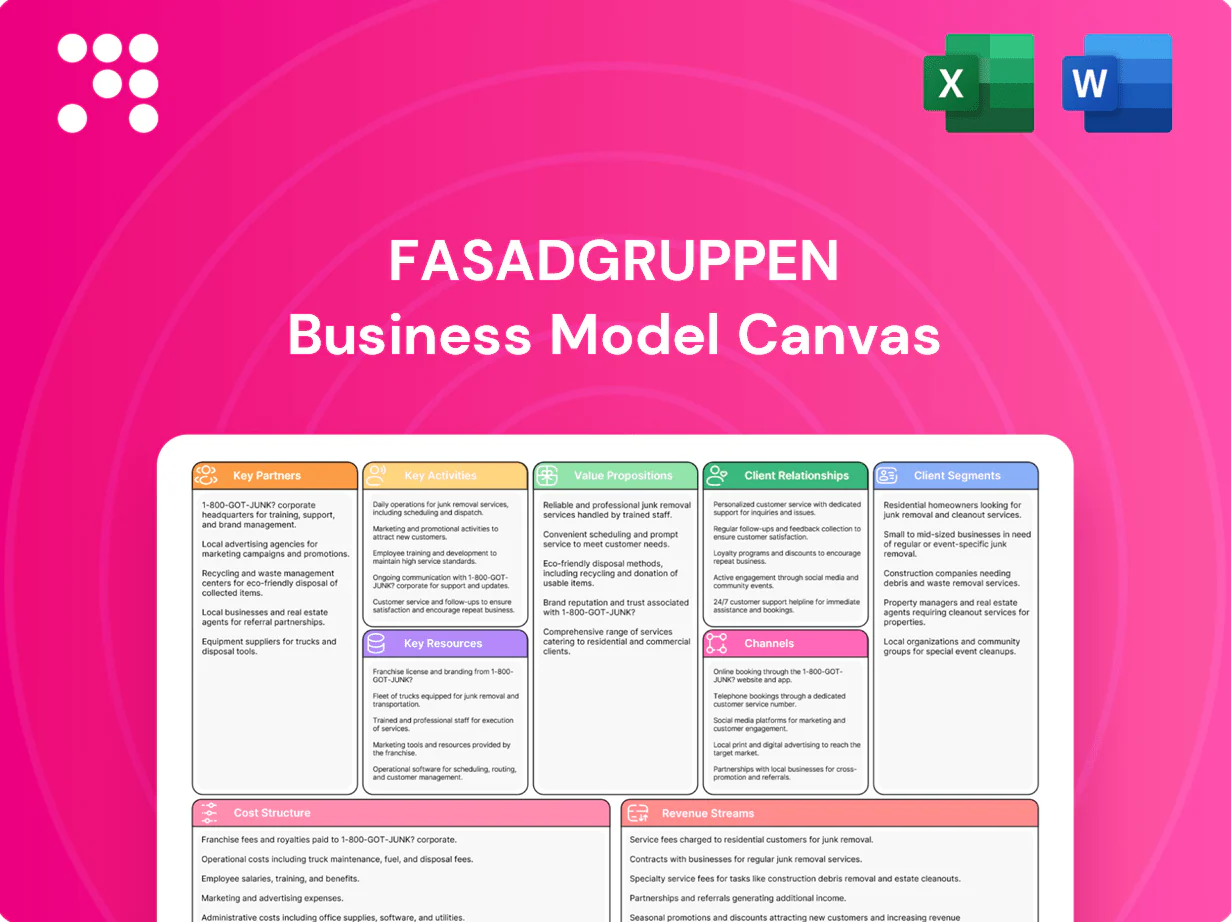
Fasadgruppen Business Model Canvas

Unlock the strategic Business Model Canvas to scale your facade & construction business
Unlock the strategic blueprint behind Fasadgruppen with our full Business Model Canvas. This in-depth, editable document maps value propositions, customer segments, key partners and revenue streams in one ready-to-use file. Ideal for investors, consultants and founders—download the full canvas to benchmark and scale faster.
Partnerships

Material manufacturers
Partnerships with brick, render, cladding, insulation and coating manufacturers secure quality and availability, supporting Fasadgruppen projects where materials typically represent the majority of external envelope costs. Co-development of energy-efficient, durable solutions can deliver up to 40% lower heating demand in retrofits, aligning with 2030 sustainability targets. Preferential pricing and priority supply commonly cut material-related schedule delays and cost volatility by ~20%, while joint warranties of 10 years+ strengthen lifecycle guarantees.
General contractors & developers
Collaborations with general contractors and developers integrate facade works into overall construction timelines, enabling early tender involvement and design-build input that improves constructability and cost accuracy and reduces change orders. Coordinated scheduling minimizes site conflicts and rework, while long-term framework agreements secure a steady pipeline and repeat business; Fasadgruppen reported sales of about SEK 4.6bn and ~2,200 employees (2023).

Architects & engineering consultancies
Design partners optimize aesthetics, thermal performance and structural integrity, with collaborative facade projects in 2024 reporting up to 10% higher energy performance in measured buildings. BIM coordination reduces clashes and improves precision, cutting on-site rework by over 50% in many European projects. Shared R&D on modular facade systems accelerates innovation and helps meet local standards; specification influence from architects drives pull-through demand and higher-margin orders.

Energy & sustainability advisors
Alliances with energy auditors and green-certification experts provide quantified savings (buildings account for ~40% of EU energy use and ~36% CO2 emissions) and show deep renovation can cut energy use by 50–60% (IEA/EC), strengthening Fasadgruppen’s proposals. Joint audits and retrofit programs unlock EU and national subsidy streams and tax incentives while producing measurable KPIs for customer ESG reporting, boosting long-term maintenance and renovation contract uptake.
- Energy saving: 50–60% evidence-backed
- Sector impact: ~40% energy, ~36% CO2 (EU)
- Value: measurable KPIs for ESG reporting
- Commercial: unlocks subsidies/tax incentives, increases contract conversion
Municipalities & housing associations
Municipalities and housing associations enable large-scale renovation of aging stock, allowing Fasadgruppen to scale projects across entire portfolios; in 2024 these public-sector collaborations prioritize energy and accessibility upgrades. Framework agreements streamline procurement and standardize quality, while joint safety and environmental protocols de-risk delivery and reduce compliance costs. Community engagement secures long-term maintenance agreements and tenant acceptance.
- Public-scale reach
- Framework efficiency
- Regulatory de-risking
- Maintenance continuity
Strategic partnerships reduce material delays ~20%, cut rework >50% and enable 50–60% energy savings
Strategic supplier, contractor, design and public-sector partnerships secure materials, pipeline and compliance, reducing material delays/cost volatility by ~20% and cutting on-site rework >50%. Collaborative R&D and audits deliver 50–60% retrofit energy savings and support subsidy capture. Fasadgruppen reported sales ~SEK 4.6bn and ~2,200 employees (2023).
| Metric | Value |
|---|---|
| Material delay reduction | ~20% |
| On-site rework | >50% |
| Energy saving | 50–60% |
What is included in the product
 Detailed Word Document
A tailored Business Model Canvas for Fasadgruppen detailing customer segments, channels, value propositions and revenue streams across the 9 BMC blocks, aligned with real-world operations, competitive advantages and SWOT insights—ideal for presentations, investor discussions and strategic decision-making.

 Customizable Excel Spreadsheet
High-level view of Fasadgruppen’s business model with editable cells, relieving pain by condensing strategy into a single, shareable canvas that saves hours of structuring and aligns teams quickly for faster decisions.
Activities

Facade design & engineering
Thermal, moisture and structural analysis drive facade solutions that meet Nordic performance expectations, targeting exterior wall U-values around 0.18 W/m2K. Detailing integrates insulation, continuous air barriers and durable finishes to control condensation and heat loss. BIM modelling ensures millimetre-level coordination and prefabrication readiness. Compliance checks reference EU nZEB requirements (in force for new buildings since 2018) and national Nordic codes.
Installation & project execution
On-site façade construction—cladding, rendering and insulation—represents over 70% of project labor hours; skilled crews handle scaffolding, safety and logistics across varied climates. Lean planning and quality controls cut waste by ~30% and rework/defects by ~40%. Commissioning verifies performance and, with detailed handover documentation, can halve post-completion issues.

Renovation & retrofit programs
Energy-efficiency upgrades replace or enhance existing facades to cut heating and cooling demand; envelope measures can reduce space‑heating needs by as much as 50% (IEA). Envelope repairs address moisture, cracking and durability to extend service life and lower lifecycle costs. Occupied-building methods minimize tenant disruption with phased works and temporary enclosures. Measurement and verification validate savings post-renovation per IPMVP best practices.

Maintenance & lifecycle services
Planned inspections and preventive maintenance (annual or biannual) extend facade life and reduce unexpected renewals; routine cleaning, sealant renewal and minor repairs preserve thermal and watertight performance. Service contracts (commonly 3–5 year terms) provide predictable owner budgets, while structured site-visit data drives prioritized upgrades and risk mitigation decisions.
- Inspections: annual/biannual
- Contracts: 3–5 year fixed budgets
- Works: cleaning, sealant, minor repairs
- Data: site records for upgrades & risk
Sustainability & compliance management
Material traceability and on-site recycling lower environmental impact while compliance with health, safety and environmental rules is embedded across projects. Carbon reporting aligned with the GHG Protocol and CSRD reporting obligations effective 2024 support client ESG targets and tender requirements. Regular crew training enforces consistent application of best practices.
- Traceability & recycling
- HSE compliance embedded
- GHG Protocol carbon reporting
- CSRD compliance (2024)
- Ongoing crew training
nZEB facade U≈0.18 W/m2K; BIM cuts waste ~30%
Thermal, moisture and structural design target façade U≈0.18 W/m2K and nZEB compliance; BIM enables prefab coordination. On-site works consume >70% labour; lean planning cuts waste ~30% and rework ~40%. Retrofit measures can halve space‑heating demand; CSRD-aligned GHG reporting required from 2024.
| Metric | Value |
|---|---|
| On-site labour | >70% |
| Waste reduction | ~30% |
| Rework reduction | ~40% |
| Heating cut | up to 50% |
What You See Is What You Get
Business Model Canvas
The document you’re previewing is the actual Fasadgruppen Business Model Canvas, not a mockup—what you see is a direct extract from the final file. After purchase you’ll receive this exact, fully editable document in Word and Excel formats, complete and ready to use. No placeholders, no hidden pages, just the same professional deliverable shown here.

Unlock the strategic Business Model Canvas to scale your facade & construction business
Unlock the strategic blueprint behind Fasadgruppen with our full Business Model Canvas. This in-depth, editable document maps value propositions, customer segments, key partners and revenue streams in one ready-to-use file. Ideal for investors, consultants and founders—download the full canvas to benchmark and scale faster.
Partnerships
Material manufacturers
Partnerships with brick, render, cladding, insulation and coating manufacturers secure quality and availability, supporting Fasadgruppen projects where materials typically represent the majority of external envelope costs. Co-development of energy-efficient, durable solutions can deliver up to 40% lower heating demand in retrofits, aligning with 2030 sustainability targets. Preferential pricing and priority supply commonly cut material-related schedule delays and cost volatility by ~20%, while joint warranties of 10 years+ strengthen lifecycle guarantees.
General contractors & developers
Collaborations with general contractors and developers integrate facade works into overall construction timelines, enabling early tender involvement and design-build input that improves constructability and cost accuracy and reduces change orders. Coordinated scheduling minimizes site conflicts and rework, while long-term framework agreements secure a steady pipeline and repeat business; Fasadgruppen reported sales of about SEK 4.6bn and ~2,200 employees (2023).
Architects & engineering consultancies
Design partners optimize aesthetics, thermal performance and structural integrity, with collaborative facade projects in 2024 reporting up to 10% higher energy performance in measured buildings. BIM coordination reduces clashes and improves precision, cutting on-site rework by over 50% in many European projects. Shared R&D on modular facade systems accelerates innovation and helps meet local standards; specification influence from architects drives pull-through demand and higher-margin orders.
Energy & sustainability advisors
Alliances with energy auditors and green-certification experts provide quantified savings (buildings account for ~40% of EU energy use and ~36% CO2 emissions) and show deep renovation can cut energy use by 50–60% (IEA/EC), strengthening Fasadgruppen’s proposals. Joint audits and retrofit programs unlock EU and national subsidy streams and tax incentives while producing measurable KPIs for customer ESG reporting, boosting long-term maintenance and renovation contract uptake.
- Energy saving: 50–60% evidence-backed
- Sector impact: ~40% energy, ~36% CO2 (EU)
- Value: measurable KPIs for ESG reporting
- Commercial: unlocks subsidies/tax incentives, increases contract conversion
Municipalities & housing associations
Municipalities and housing associations enable large-scale renovation of aging stock, allowing Fasadgruppen to scale projects across entire portfolios; in 2024 these public-sector collaborations prioritize energy and accessibility upgrades. Framework agreements streamline procurement and standardize quality, while joint safety and environmental protocols de-risk delivery and reduce compliance costs. Community engagement secures long-term maintenance agreements and tenant acceptance.
- Public-scale reach
- Framework efficiency
- Regulatory de-risking
- Maintenance continuity
Strategic partnerships reduce material delays ~20%, cut rework >50% and enable 50–60% energy savings
Strategic supplier, contractor, design and public-sector partnerships secure materials, pipeline and compliance, reducing material delays/cost volatility by ~20% and cutting on-site rework >50%. Collaborative R&D and audits deliver 50–60% retrofit energy savings and support subsidy capture. Fasadgruppen reported sales ~SEK 4.6bn and ~2,200 employees (2023).
| Metric | Value |
|---|---|
| Material delay reduction | ~20% |
| On-site rework | >50% |
| Energy saving | 50–60% |
What is included in the product
Detailed Word Document
A tailored Business Model Canvas for Fasadgruppen detailing customer segments, channels, value propositions and revenue streams across the 9 BMC blocks, aligned with real-world operations, competitive advantages and SWOT insights—ideal for presentations, investor discussions and strategic decision-making.
Customizable Excel Spreadsheet
High-level view of Fasadgruppen’s business model with editable cells, relieving pain by condensing strategy into a single, shareable canvas that saves hours of structuring and aligns teams quickly for faster decisions.
Activities
Facade design & engineering
Thermal, moisture and structural analysis drive facade solutions that meet Nordic performance expectations, targeting exterior wall U-values around 0.18 W/m2K. Detailing integrates insulation, continuous air barriers and durable finishes to control condensation and heat loss. BIM modelling ensures millimetre-level coordination and prefabrication readiness. Compliance checks reference EU nZEB requirements (in force for new buildings since 2018) and national Nordic codes.
Installation & project execution
On-site façade construction—cladding, rendering and insulation—represents over 70% of project labor hours; skilled crews handle scaffolding, safety and logistics across varied climates. Lean planning and quality controls cut waste by ~30% and rework/defects by ~40%. Commissioning verifies performance and, with detailed handover documentation, can halve post-completion issues.
Renovation & retrofit programs
Energy-efficiency upgrades replace or enhance existing facades to cut heating and cooling demand; envelope measures can reduce space‑heating needs by as much as 50% (IEA). Envelope repairs address moisture, cracking and durability to extend service life and lower lifecycle costs. Occupied-building methods minimize tenant disruption with phased works and temporary enclosures. Measurement and verification validate savings post-renovation per IPMVP best practices.
Maintenance & lifecycle services
Planned inspections and preventive maintenance (annual or biannual) extend facade life and reduce unexpected renewals; routine cleaning, sealant renewal and minor repairs preserve thermal and watertight performance. Service contracts (commonly 3–5 year terms) provide predictable owner budgets, while structured site-visit data drives prioritized upgrades and risk mitigation decisions.
- Inspections: annual/biannual
- Contracts: 3–5 year fixed budgets
- Works: cleaning, sealant, minor repairs
- Data: site records for upgrades & risk
Sustainability & compliance management
Material traceability and on-site recycling lower environmental impact while compliance with health, safety and environmental rules is embedded across projects. Carbon reporting aligned with the GHG Protocol and CSRD reporting obligations effective 2024 support client ESG targets and tender requirements. Regular crew training enforces consistent application of best practices.
- Traceability & recycling
- HSE compliance embedded
- GHG Protocol carbon reporting
- CSRD compliance (2024)
- Ongoing crew training
nZEB facade U≈0.18 W/m2K; BIM cuts waste ~30%
Thermal, moisture and structural design target façade U≈0.18 W/m2K and nZEB compliance; BIM enables prefab coordination. On-site works consume >70% labour; lean planning cuts waste ~30% and rework ~40%. Retrofit measures can halve space‑heating demand; CSRD-aligned GHG reporting required from 2024.
| Metric | Value |
|---|---|
| On-site labour | >70% |
| Waste reduction | ~30% |
| Rework reduction | ~40% |
| Heating cut | up to 50% |
What You See Is What You Get
Business Model Canvas
The document you’re previewing is the actual Fasadgruppen Business Model Canvas, not a mockup—what you see is a direct extract from the final file. After purchase you’ll receive this exact, fully editable document in Word and Excel formats, complete and ready to use. No placeholders, no hidden pages, just the same professional deliverable shown here.
Original: $10.00
-65%$10.00
$3.50Description
Unlock the strategic Business Model Canvas to scale your facade & construction business
Unlock the strategic blueprint behind Fasadgruppen with our full Business Model Canvas. This in-depth, editable document maps value propositions, customer segments, key partners and revenue streams in one ready-to-use file. Ideal for investors, consultants and founders—download the full canvas to benchmark and scale faster.
Partnerships
Material manufacturers
Partnerships with brick, render, cladding, insulation and coating manufacturers secure quality and availability, supporting Fasadgruppen projects where materials typically represent the majority of external envelope costs. Co-development of energy-efficient, durable solutions can deliver up to 40% lower heating demand in retrofits, aligning with 2030 sustainability targets. Preferential pricing and priority supply commonly cut material-related schedule delays and cost volatility by ~20%, while joint warranties of 10 years+ strengthen lifecycle guarantees.
General contractors & developers
Collaborations with general contractors and developers integrate facade works into overall construction timelines, enabling early tender involvement and design-build input that improves constructability and cost accuracy and reduces change orders. Coordinated scheduling minimizes site conflicts and rework, while long-term framework agreements secure a steady pipeline and repeat business; Fasadgruppen reported sales of about SEK 4.6bn and ~2,200 employees (2023).
Architects & engineering consultancies
Design partners optimize aesthetics, thermal performance and structural integrity, with collaborative facade projects in 2024 reporting up to 10% higher energy performance in measured buildings. BIM coordination reduces clashes and improves precision, cutting on-site rework by over 50% in many European projects. Shared R&D on modular facade systems accelerates innovation and helps meet local standards; specification influence from architects drives pull-through demand and higher-margin orders.
Energy & sustainability advisors
Alliances with energy auditors and green-certification experts provide quantified savings (buildings account for ~40% of EU energy use and ~36% CO2 emissions) and show deep renovation can cut energy use by 50–60% (IEA/EC), strengthening Fasadgruppen’s proposals. Joint audits and retrofit programs unlock EU and national subsidy streams and tax incentives while producing measurable KPIs for customer ESG reporting, boosting long-term maintenance and renovation contract uptake.
- Energy saving: 50–60% evidence-backed
- Sector impact: ~40% energy, ~36% CO2 (EU)
- Value: measurable KPIs for ESG reporting
- Commercial: unlocks subsidies/tax incentives, increases contract conversion
Municipalities & housing associations
Municipalities and housing associations enable large-scale renovation of aging stock, allowing Fasadgruppen to scale projects across entire portfolios; in 2024 these public-sector collaborations prioritize energy and accessibility upgrades. Framework agreements streamline procurement and standardize quality, while joint safety and environmental protocols de-risk delivery and reduce compliance costs. Community engagement secures long-term maintenance agreements and tenant acceptance.
- Public-scale reach
- Framework efficiency
- Regulatory de-risking
- Maintenance continuity
Strategic partnerships reduce material delays ~20%, cut rework >50% and enable 50–60% energy savings
Strategic supplier, contractor, design and public-sector partnerships secure materials, pipeline and compliance, reducing material delays/cost volatility by ~20% and cutting on-site rework >50%. Collaborative R&D and audits deliver 50–60% retrofit energy savings and support subsidy capture. Fasadgruppen reported sales ~SEK 4.6bn and ~2,200 employees (2023).
| Metric | Value |
|---|---|
| Material delay reduction | ~20% |
| On-site rework | >50% |
| Energy saving | 50–60% |
What is included in the product
Detailed Word Document
A tailored Business Model Canvas for Fasadgruppen detailing customer segments, channels, value propositions and revenue streams across the 9 BMC blocks, aligned with real-world operations, competitive advantages and SWOT insights—ideal for presentations, investor discussions and strategic decision-making.
Customizable Excel Spreadsheet
High-level view of Fasadgruppen’s business model with editable cells, relieving pain by condensing strategy into a single, shareable canvas that saves hours of structuring and aligns teams quickly for faster decisions.
Activities
Facade design & engineering
Thermal, moisture and structural analysis drive facade solutions that meet Nordic performance expectations, targeting exterior wall U-values around 0.18 W/m2K. Detailing integrates insulation, continuous air barriers and durable finishes to control condensation and heat loss. BIM modelling ensures millimetre-level coordination and prefabrication readiness. Compliance checks reference EU nZEB requirements (in force for new buildings since 2018) and national Nordic codes.
Installation & project execution
On-site façade construction—cladding, rendering and insulation—represents over 70% of project labor hours; skilled crews handle scaffolding, safety and logistics across varied climates. Lean planning and quality controls cut waste by ~30% and rework/defects by ~40%. Commissioning verifies performance and, with detailed handover documentation, can halve post-completion issues.
Renovation & retrofit programs
Energy-efficiency upgrades replace or enhance existing facades to cut heating and cooling demand; envelope measures can reduce space‑heating needs by as much as 50% (IEA). Envelope repairs address moisture, cracking and durability to extend service life and lower lifecycle costs. Occupied-building methods minimize tenant disruption with phased works and temporary enclosures. Measurement and verification validate savings post-renovation per IPMVP best practices.
Maintenance & lifecycle services
Planned inspections and preventive maintenance (annual or biannual) extend facade life and reduce unexpected renewals; routine cleaning, sealant renewal and minor repairs preserve thermal and watertight performance. Service contracts (commonly 3–5 year terms) provide predictable owner budgets, while structured site-visit data drives prioritized upgrades and risk mitigation decisions.
- Inspections: annual/biannual
- Contracts: 3–5 year fixed budgets
- Works: cleaning, sealant, minor repairs
- Data: site records for upgrades & risk
Sustainability & compliance management
Material traceability and on-site recycling lower environmental impact while compliance with health, safety and environmental rules is embedded across projects. Carbon reporting aligned with the GHG Protocol and CSRD reporting obligations effective 2024 support client ESG targets and tender requirements. Regular crew training enforces consistent application of best practices.
- Traceability & recycling
- HSE compliance embedded
- GHG Protocol carbon reporting
- CSRD compliance (2024)
- Ongoing crew training
nZEB facade U≈0.18 W/m2K; BIM cuts waste ~30%
Thermal, moisture and structural design target façade U≈0.18 W/m2K and nZEB compliance; BIM enables prefab coordination. On-site works consume >70% labour; lean planning cuts waste ~30% and rework ~40%. Retrofit measures can halve space‑heating demand; CSRD-aligned GHG reporting required from 2024.
| Metric | Value |
|---|---|
| On-site labour | >70% |
| Waste reduction | ~30% |
| Rework reduction | ~40% |
| Heating cut | up to 50% |
What You See Is What You Get
Business Model Canvas
The document you’re previewing is the actual Fasadgruppen Business Model Canvas, not a mockup—what you see is a direct extract from the final file. After purchase you’ll receive this exact, fully editable document in Word and Excel formats, complete and ready to use. No placeholders, no hidden pages, just the same professional deliverable shown here.











