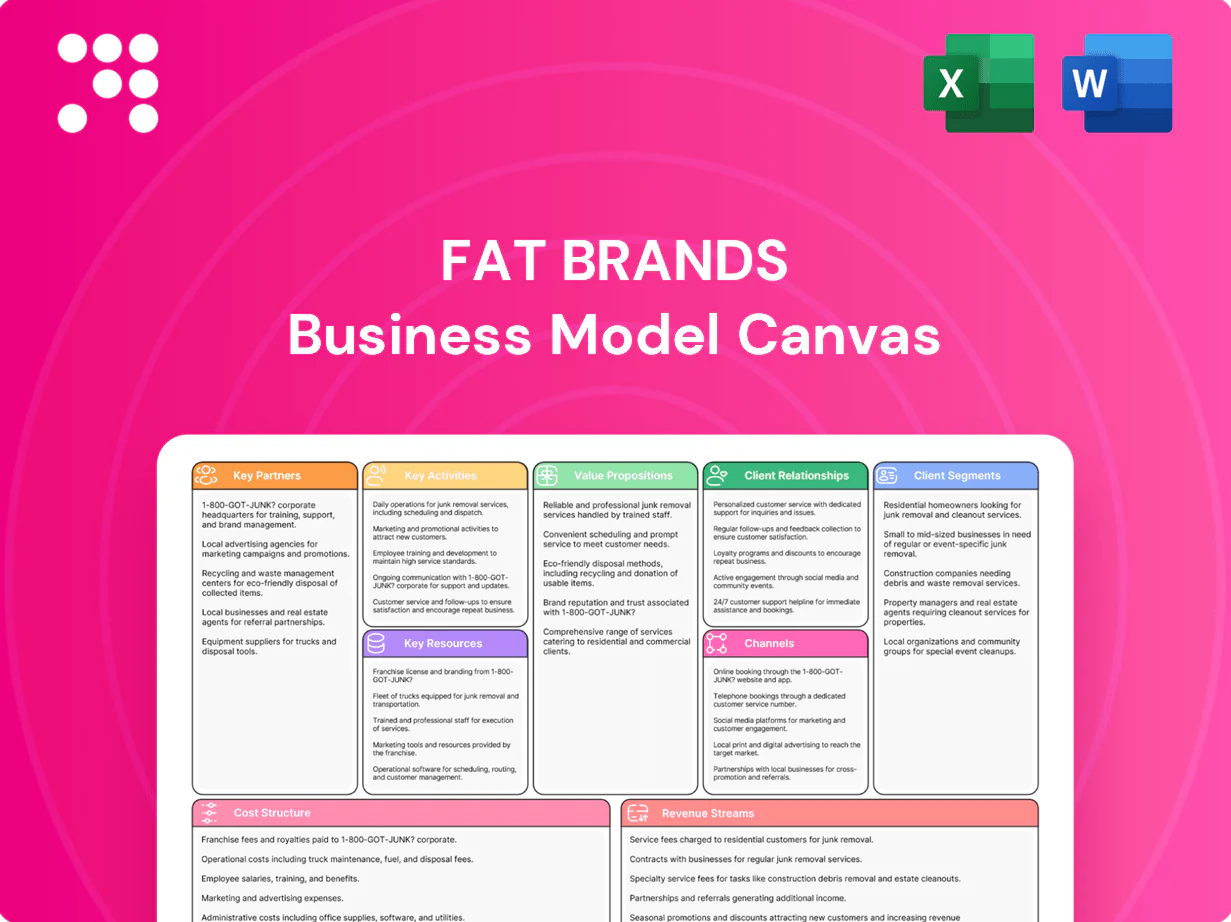
FAT Brands Business Model Canvas

Business Model Canvas for a multi-brand franchisor: franchising, shared services, revenue drivers
Unlock the strategic blueprint behind FAT Brands with our Business Model Canvas, revealing how franchising, brand portfolio management and shared services drive growth and margins. This concise snapshot highlights customer segments, revenue streams, partnerships and cost structure—perfect for investors, consultants, and founders. Purchase the full Word/Excel canvas for a section-by-section, ready-to-use strategic tool.
Partnerships

Franchisee operators
Independent and multi-unit franchisees operate the majority of FAT Brands' portfolio—over 4,000 restaurants globally—driving systemwide sales of roughly $2.2 billion in 2024 and delivering recurring royalty income. FAT Brands supports franchisees with standardized training, operational standards, and national marketing to protect brand equity and margins. Strong franchisee unit economics underpin scalable growth, making careful selection, onboarding, and continuous engagement critical to cash flow and expansion.
Food and packaging suppliers
Approved vendors ensure consistent quality, pricing, and availability across FAT Brands' multi-brand, multi-geography system, maintaining specification control that protects brand standards and franchisee margins. Aggregated purchasing leverages scale to reduce unit costs—industry benchmarks show centralized procurement can lower input costs by around 10%—boosting EBITDA. Supply assurance and strategic sourcing enable menu innovation and limited-time offers by securing specialty ingredients and packaging.

Real estate developers and landlords
Real estate developers and landlords secure site access, favorable lease terms and co-tenancy that drive foot traffic and profitability; FAT Brands reported over 2,700 global locations across 20+ brands in 2024, underscoring scale benefits for landlords. Strong broker and landlord relationships accelerate market entry and relocations, shortening time-to-revenue. Prototyping enables footprints from inline to end-cap and nontraditional venues, while data-driven site selection cuts location risk for franchisees.

Delivery and digital platforms
Aggregators and last-mile partners expand FAT Brands reach, driving off-premise sales as the global online food delivery market topped $300B in 2024 and DoorDash held roughly 55% US share, increasing digital order volume for franchisees.
API integrations ensure menu accuracy, dynamic pricing, and promotions at scale, reducing errors and speed-to-market for updates across platforms.
Platform data feeds demand planning and targeted marketing, while delivery partnerships boost customer convenience and brand visibility for fat-brands portfolios.
- off-premise expansion
- api-driven accuracy
- data-informed planning
- visibility & convenience
Banks and capital providers
FAT Brands leverages credit facilities and securitizations to fund acquisitions and growth, with 2024 U.S. policy rates at 5.25–5.50% shaping borrowing costs; strong lender relationships smooth refinancing cycles and reduce interest expense volatility. Access to capital enables brand investment and franchisee lending, while prudent covenant management preserves strategic flexibility.
- Credit facilities: growth financing
- Securitizations: acquisition funding
- Lender ties: refinance risk control
- Capital access: brand & franchisee support
- Covenants: preserve flexibility
4,000+ Franchise Units, $2.2B System Sales; 10% Cost Savings & Delivery Market Tailwinds
Independent franchisees operate 4,000+ FAT Brands restaurants, driving roughly $2.2B systemwide sales in 2024 and producing recurring royalties. Approved vendors and centralized procurement (≈10% cost saving) protect standards and margins while enabling menu innovation. Delivery and aggregator partners expand off‑premise reach as the global delivery market hit ~$300B in 2024 (DoorDash ~55% US share); credit facilities at 5.25–5.50% support M&A and franchise lending.
| Partner | Metric | 2024 |
|---|---|---|
| Franchisees | Units / Sales | 4,000+ / $2.2B |
| Procurement | Input cost saving | ≈10% |
| Delivery | Market / US share | $300B / 55% |
| Capital | Policy rate | 5.25–5.50% |
What is included in the product
 Detailed Word Document
A comprehensive Business Model Canvas for FAT Brands capturing its franchising-led value propositions, multi-brand portfolio, franchisee/customer segments, omnichannel channels, revenue streams, key partnerships and scaled operations. Organized into the 9 BMC blocks with competitive analysis, SWOT-linked insights and investor-ready narrative for strategic decisions.

 Customizable Excel Spreadsheet
Streamlines FAT Brands’ complex multi-brand franchise strategy into a single editable canvas, saving hours of analysis and formatting. Perfect for teams and investors to quickly compare brand economics, franchise models, and growth levers in a shareable one-page snapshot.
Activities

Brand acquisition and integration
Identify, diligence and acquire restaurant concepts that fit FAT Brands’ portfolio—leveraging a 2024 footprint of 60+ brands and 3,000+ global locations to target scalable units. Integrate systems, supply and marketing while preserving brand identity through playbooks and centralized tech. Realize synergies in G&A and procurement and prioritize rapid post-close execution to protect AUV and same-store sales.
Franchise sales and development
Recruit qualified operators for multi-unit and area development deals, leveraging FAT Brands 2024 systemwide scale of over 3,000 locations to structure high-potential partnerships; manage pipeline, territory mapping and unit opening cadence to hit targeted growth rates. Provide end-to-end development support from design to construction and enforce milestones to protect market potential and brand density.

Marketing and brand management
Centralize campaigns, LTO calendars and a unified brand voice across FAT Brands' 50+ brands and roughly 2,700 global locations to ensure consistency and scale. Optimize media mix across digital and traditional channels using channel-level ROI metrics and programmatic buying to improve efficiency. Support local store marketing and grand openings with co-op funding and templated kits. Monitor KPIs (AOV, traffic, conversion) to refine spend and drive incremental visits.

Menu innovation and ops support
Menu innovation and ops support focus on testing and rolling out high-margin items to lift visit frequency and check averages across FAT Brands’ ~2,400 restaurants (2024). Standardizing SOPs, franchisor-led training and QA audits reduce variability and improve labor efficiency. Data analytics drive throughput and guest satisfaction, while iterative equipment and kitchen-layout refinements cut service times and costs.
- Test-to-roll: high-margin SKUs
- SOPs + QA audits
- Data-driven throughput
- Kitchen/equipment iterate
Supply chain and vendor management
Supply chain and vendor management secures pricing, locks product specifications and continuity to support FAT Brands operations across 2,800+ restaurants (2024), balancing centralized purchasing with franchisee needs and logistics KPIs to improve fill rates and on-time delivery.
- Negotiate pricing & lock specs
- Manage distribution & logistics performance
- Monitor commodity risk & hedge
- Enable scalable, reliable inputs
Scale 60+ restaurant brands: centralize ops, supply and marketing to protect AUV & SSS
Source, acquire and integrate scalable restaurant brands (2024 footprint: 60+ brands, 3,000+ systemwide locations), centralize ops, supply and marketing playbooks, and drive rapid post-close execution to protect AUV and SSS. Recruit multi-unit operators and manage development pipeline, real estate and openings. Standardize menus, SOPs, QA and data analytics to lift check, frequency and labor efficiency.
| Metric | 2024 |
|---|---|
| Brands | 60+ |
| Systemwide locations | 3,000+ |
| Marketing reach | ~2,700 locations |
| Company restaurants (ops) | ~2,400 |
| Supply coverage | ~2,800 |
Preview Before You Purchase
Business Model Canvas
This preview is the actual FAT Brands Business Model Canvas, not a sample or mockup. When you purchase, you’ll receive this exact document—complete, formatted, and ready to edit—in Word and Excel formats. No surprises; what you see is what you’ll download.

Business Model Canvas for a multi-brand franchisor: franchising, shared services, revenue drivers
Unlock the strategic blueprint behind FAT Brands with our Business Model Canvas, revealing how franchising, brand portfolio management and shared services drive growth and margins. This concise snapshot highlights customer segments, revenue streams, partnerships and cost structure—perfect for investors, consultants, and founders. Purchase the full Word/Excel canvas for a section-by-section, ready-to-use strategic tool.
Partnerships
Franchisee operators
Independent and multi-unit franchisees operate the majority of FAT Brands' portfolio—over 4,000 restaurants globally—driving systemwide sales of roughly $2.2 billion in 2024 and delivering recurring royalty income. FAT Brands supports franchisees with standardized training, operational standards, and national marketing to protect brand equity and margins. Strong franchisee unit economics underpin scalable growth, making careful selection, onboarding, and continuous engagement critical to cash flow and expansion.
Food and packaging suppliers
Approved vendors ensure consistent quality, pricing, and availability across FAT Brands' multi-brand, multi-geography system, maintaining specification control that protects brand standards and franchisee margins. Aggregated purchasing leverages scale to reduce unit costs—industry benchmarks show centralized procurement can lower input costs by around 10%—boosting EBITDA. Supply assurance and strategic sourcing enable menu innovation and limited-time offers by securing specialty ingredients and packaging.
Real estate developers and landlords
Real estate developers and landlords secure site access, favorable lease terms and co-tenancy that drive foot traffic and profitability; FAT Brands reported over 2,700 global locations across 20+ brands in 2024, underscoring scale benefits for landlords. Strong broker and landlord relationships accelerate market entry and relocations, shortening time-to-revenue. Prototyping enables footprints from inline to end-cap and nontraditional venues, while data-driven site selection cuts location risk for franchisees.
Delivery and digital platforms
Aggregators and last-mile partners expand FAT Brands reach, driving off-premise sales as the global online food delivery market topped $300B in 2024 and DoorDash held roughly 55% US share, increasing digital order volume for franchisees.
API integrations ensure menu accuracy, dynamic pricing, and promotions at scale, reducing errors and speed-to-market for updates across platforms.
Platform data feeds demand planning and targeted marketing, while delivery partnerships boost customer convenience and brand visibility for fat-brands portfolios.
- off-premise expansion
- api-driven accuracy
- data-informed planning
- visibility & convenience
Banks and capital providers
FAT Brands leverages credit facilities and securitizations to fund acquisitions and growth, with 2024 U.S. policy rates at 5.25–5.50% shaping borrowing costs; strong lender relationships smooth refinancing cycles and reduce interest expense volatility. Access to capital enables brand investment and franchisee lending, while prudent covenant management preserves strategic flexibility.
- Credit facilities: growth financing
- Securitizations: acquisition funding
- Lender ties: refinance risk control
- Capital access: brand & franchisee support
- Covenants: preserve flexibility
4,000+ Franchise Units, $2.2B System Sales; 10% Cost Savings & Delivery Market Tailwinds
Independent franchisees operate 4,000+ FAT Brands restaurants, driving roughly $2.2B systemwide sales in 2024 and producing recurring royalties. Approved vendors and centralized procurement (≈10% cost saving) protect standards and margins while enabling menu innovation. Delivery and aggregator partners expand off‑premise reach as the global delivery market hit ~$300B in 2024 (DoorDash ~55% US share); credit facilities at 5.25–5.50% support M&A and franchise lending.
| Partner | Metric | 2024 |
|---|---|---|
| Franchisees | Units / Sales | 4,000+ / $2.2B |
| Procurement | Input cost saving | ≈10% |
| Delivery | Market / US share | $300B / 55% |
| Capital | Policy rate | 5.25–5.50% |
What is included in the product
Detailed Word Document
A comprehensive Business Model Canvas for FAT Brands capturing its franchising-led value propositions, multi-brand portfolio, franchisee/customer segments, omnichannel channels, revenue streams, key partnerships and scaled operations. Organized into the 9 BMC blocks with competitive analysis, SWOT-linked insights and investor-ready narrative for strategic decisions.
Customizable Excel Spreadsheet
Streamlines FAT Brands’ complex multi-brand franchise strategy into a single editable canvas, saving hours of analysis and formatting. Perfect for teams and investors to quickly compare brand economics, franchise models, and growth levers in a shareable one-page snapshot.
Activities
Brand acquisition and integration
Identify, diligence and acquire restaurant concepts that fit FAT Brands’ portfolio—leveraging a 2024 footprint of 60+ brands and 3,000+ global locations to target scalable units. Integrate systems, supply and marketing while preserving brand identity through playbooks and centralized tech. Realize synergies in G&A and procurement and prioritize rapid post-close execution to protect AUV and same-store sales.
Franchise sales and development
Recruit qualified operators for multi-unit and area development deals, leveraging FAT Brands 2024 systemwide scale of over 3,000 locations to structure high-potential partnerships; manage pipeline, territory mapping and unit opening cadence to hit targeted growth rates. Provide end-to-end development support from design to construction and enforce milestones to protect market potential and brand density.
Marketing and brand management
Centralize campaigns, LTO calendars and a unified brand voice across FAT Brands' 50+ brands and roughly 2,700 global locations to ensure consistency and scale. Optimize media mix across digital and traditional channels using channel-level ROI metrics and programmatic buying to improve efficiency. Support local store marketing and grand openings with co-op funding and templated kits. Monitor KPIs (AOV, traffic, conversion) to refine spend and drive incremental visits.
Menu innovation and ops support
Menu innovation and ops support focus on testing and rolling out high-margin items to lift visit frequency and check averages across FAT Brands’ ~2,400 restaurants (2024). Standardizing SOPs, franchisor-led training and QA audits reduce variability and improve labor efficiency. Data analytics drive throughput and guest satisfaction, while iterative equipment and kitchen-layout refinements cut service times and costs.
- Test-to-roll: high-margin SKUs
- SOPs + QA audits
- Data-driven throughput
- Kitchen/equipment iterate
Supply chain and vendor management
Supply chain and vendor management secures pricing, locks product specifications and continuity to support FAT Brands operations across 2,800+ restaurants (2024), balancing centralized purchasing with franchisee needs and logistics KPIs to improve fill rates and on-time delivery.
- Negotiate pricing & lock specs
- Manage distribution & logistics performance
- Monitor commodity risk & hedge
- Enable scalable, reliable inputs
Scale 60+ restaurant brands: centralize ops, supply and marketing to protect AUV & SSS
Source, acquire and integrate scalable restaurant brands (2024 footprint: 60+ brands, 3,000+ systemwide locations), centralize ops, supply and marketing playbooks, and drive rapid post-close execution to protect AUV and SSS. Recruit multi-unit operators and manage development pipeline, real estate and openings. Standardize menus, SOPs, QA and data analytics to lift check, frequency and labor efficiency.
| Metric | 2024 |
|---|---|
| Brands | 60+ |
| Systemwide locations | 3,000+ |
| Marketing reach | ~2,700 locations |
| Company restaurants (ops) | ~2,400 |
| Supply coverage | ~2,800 |
Preview Before You Purchase
Business Model Canvas
This preview is the actual FAT Brands Business Model Canvas, not a sample or mockup. When you purchase, you’ll receive this exact document—complete, formatted, and ready to edit—in Word and Excel formats. No surprises; what you see is what you’ll download.
Description
Business Model Canvas for a multi-brand franchisor: franchising, shared services, revenue drivers
Unlock the strategic blueprint behind FAT Brands with our Business Model Canvas, revealing how franchising, brand portfolio management and shared services drive growth and margins. This concise snapshot highlights customer segments, revenue streams, partnerships and cost structure—perfect for investors, consultants, and founders. Purchase the full Word/Excel canvas for a section-by-section, ready-to-use strategic tool.
Partnerships
Franchisee operators
Independent and multi-unit franchisees operate the majority of FAT Brands' portfolio—over 4,000 restaurants globally—driving systemwide sales of roughly $2.2 billion in 2024 and delivering recurring royalty income. FAT Brands supports franchisees with standardized training, operational standards, and national marketing to protect brand equity and margins. Strong franchisee unit economics underpin scalable growth, making careful selection, onboarding, and continuous engagement critical to cash flow and expansion.
Food and packaging suppliers
Approved vendors ensure consistent quality, pricing, and availability across FAT Brands' multi-brand, multi-geography system, maintaining specification control that protects brand standards and franchisee margins. Aggregated purchasing leverages scale to reduce unit costs—industry benchmarks show centralized procurement can lower input costs by around 10%—boosting EBITDA. Supply assurance and strategic sourcing enable menu innovation and limited-time offers by securing specialty ingredients and packaging.
Real estate developers and landlords
Real estate developers and landlords secure site access, favorable lease terms and co-tenancy that drive foot traffic and profitability; FAT Brands reported over 2,700 global locations across 20+ brands in 2024, underscoring scale benefits for landlords. Strong broker and landlord relationships accelerate market entry and relocations, shortening time-to-revenue. Prototyping enables footprints from inline to end-cap and nontraditional venues, while data-driven site selection cuts location risk for franchisees.
Delivery and digital platforms
Aggregators and last-mile partners expand FAT Brands reach, driving off-premise sales as the global online food delivery market topped $300B in 2024 and DoorDash held roughly 55% US share, increasing digital order volume for franchisees.
API integrations ensure menu accuracy, dynamic pricing, and promotions at scale, reducing errors and speed-to-market for updates across platforms.
Platform data feeds demand planning and targeted marketing, while delivery partnerships boost customer convenience and brand visibility for fat-brands portfolios.
- off-premise expansion
- api-driven accuracy
- data-informed planning
- visibility & convenience
Banks and capital providers
FAT Brands leverages credit facilities and securitizations to fund acquisitions and growth, with 2024 U.S. policy rates at 5.25–5.50% shaping borrowing costs; strong lender relationships smooth refinancing cycles and reduce interest expense volatility. Access to capital enables brand investment and franchisee lending, while prudent covenant management preserves strategic flexibility.
- Credit facilities: growth financing
- Securitizations: acquisition funding
- Lender ties: refinance risk control
- Capital access: brand & franchisee support
- Covenants: preserve flexibility
4,000+ Franchise Units, $2.2B System Sales; 10% Cost Savings & Delivery Market Tailwinds
Independent franchisees operate 4,000+ FAT Brands restaurants, driving roughly $2.2B systemwide sales in 2024 and producing recurring royalties. Approved vendors and centralized procurement (≈10% cost saving) protect standards and margins while enabling menu innovation. Delivery and aggregator partners expand off‑premise reach as the global delivery market hit ~$300B in 2024 (DoorDash ~55% US share); credit facilities at 5.25–5.50% support M&A and franchise lending.
| Partner | Metric | 2024 |
|---|---|---|
| Franchisees | Units / Sales | 4,000+ / $2.2B |
| Procurement | Input cost saving | ≈10% |
| Delivery | Market / US share | $300B / 55% |
| Capital | Policy rate | 5.25–5.50% |
What is included in the product
Detailed Word Document
A comprehensive Business Model Canvas for FAT Brands capturing its franchising-led value propositions, multi-brand portfolio, franchisee/customer segments, omnichannel channels, revenue streams, key partnerships and scaled operations. Organized into the 9 BMC blocks with competitive analysis, SWOT-linked insights and investor-ready narrative for strategic decisions.
Customizable Excel Spreadsheet
Streamlines FAT Brands’ complex multi-brand franchise strategy into a single editable canvas, saving hours of analysis and formatting. Perfect for teams and investors to quickly compare brand economics, franchise models, and growth levers in a shareable one-page snapshot.
Activities
Brand acquisition and integration
Identify, diligence and acquire restaurant concepts that fit FAT Brands’ portfolio—leveraging a 2024 footprint of 60+ brands and 3,000+ global locations to target scalable units. Integrate systems, supply and marketing while preserving brand identity through playbooks and centralized tech. Realize synergies in G&A and procurement and prioritize rapid post-close execution to protect AUV and same-store sales.
Franchise sales and development
Recruit qualified operators for multi-unit and area development deals, leveraging FAT Brands 2024 systemwide scale of over 3,000 locations to structure high-potential partnerships; manage pipeline, territory mapping and unit opening cadence to hit targeted growth rates. Provide end-to-end development support from design to construction and enforce milestones to protect market potential and brand density.
Marketing and brand management
Centralize campaigns, LTO calendars and a unified brand voice across FAT Brands' 50+ brands and roughly 2,700 global locations to ensure consistency and scale. Optimize media mix across digital and traditional channels using channel-level ROI metrics and programmatic buying to improve efficiency. Support local store marketing and grand openings with co-op funding and templated kits. Monitor KPIs (AOV, traffic, conversion) to refine spend and drive incremental visits.
Menu innovation and ops support
Menu innovation and ops support focus on testing and rolling out high-margin items to lift visit frequency and check averages across FAT Brands’ ~2,400 restaurants (2024). Standardizing SOPs, franchisor-led training and QA audits reduce variability and improve labor efficiency. Data analytics drive throughput and guest satisfaction, while iterative equipment and kitchen-layout refinements cut service times and costs.
- Test-to-roll: high-margin SKUs
- SOPs + QA audits
- Data-driven throughput
- Kitchen/equipment iterate
Supply chain and vendor management
Supply chain and vendor management secures pricing, locks product specifications and continuity to support FAT Brands operations across 2,800+ restaurants (2024), balancing centralized purchasing with franchisee needs and logistics KPIs to improve fill rates and on-time delivery.
- Negotiate pricing & lock specs
- Manage distribution & logistics performance
- Monitor commodity risk & hedge
- Enable scalable, reliable inputs
Scale 60+ restaurant brands: centralize ops, supply and marketing to protect AUV & SSS
Source, acquire and integrate scalable restaurant brands (2024 footprint: 60+ brands, 3,000+ systemwide locations), centralize ops, supply and marketing playbooks, and drive rapid post-close execution to protect AUV and SSS. Recruit multi-unit operators and manage development pipeline, real estate and openings. Standardize menus, SOPs, QA and data analytics to lift check, frequency and labor efficiency.
| Metric | 2024 |
|---|---|
| Brands | 60+ |
| Systemwide locations | 3,000+ |
| Marketing reach | ~2,700 locations |
| Company restaurants (ops) | ~2,400 |
| Supply coverage | ~2,800 |
Preview Before You Purchase
Business Model Canvas
This preview is the actual FAT Brands Business Model Canvas, not a sample or mockup. When you purchase, you’ll receive this exact document—complete, formatted, and ready to edit—in Word and Excel formats. No surprises; what you see is what you’ll download.











