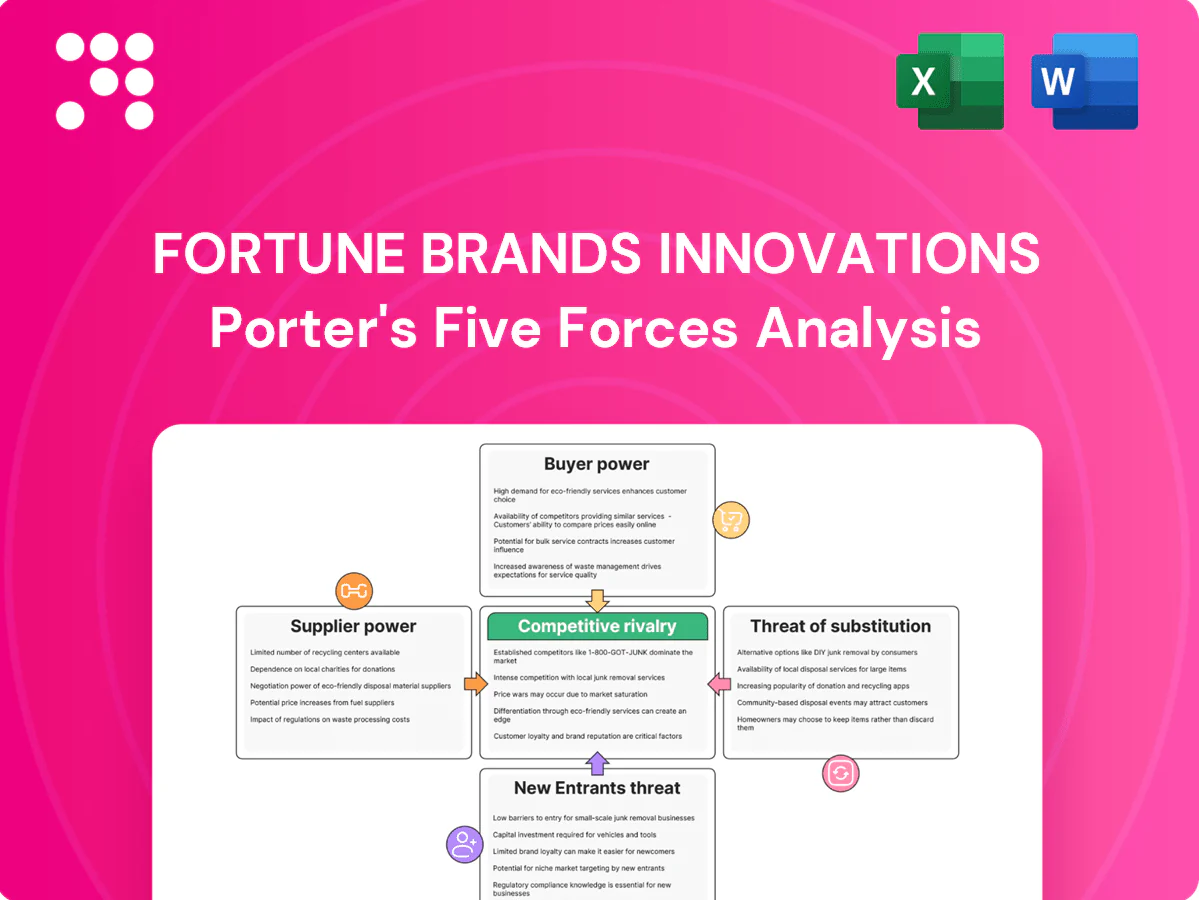
Fortune Brands Innovations Porter's Five Forces Analysis

A Must-Have Tool for Decision-Makers
Fortune Brands Innovations faces moderate supplier leverage, strong buyer expectations for quality and price, and intense rivalry from established home-furnishing players, while new entrants and substitutes pose variable threats depending on channels and product segments. This brief snapshot only scratches the surface. Unlock the full Porter's Five Forces Analysis to explore Fortune Brands Innovations’s competitive dynamics, market pressures, and strategic advantages in detail.
Suppliers Bargaining Power

Input commodities
FBIN sources five primary input commodities in 2024—brass, copper, steel, resins and packaging—whose broad availability tempers supplier leverage.
Commodity price swings in 2024 can still compress margins during inflationary cycles, so FBIN uses hedging, VA/VE and redesign to offset spikes.
Long-term contracts and multisourcing further reduce single-supplier risk.
Specialized components
In 2024 FBIN faced supplier leverage for specialized IoT chips, valves, finishes and electronics, where long lead times and strict qualification processes raise switching costs; FBIN mitigates this through dual sourcing and platform standardization, and by securing strategic supplier partnerships to obtain allocations during shortages.

Global supply footprint
International suppliers expose Fortune Brands to logistics, tariff and FX risk that can amplify supplier power in tight markets; spot container rates fell roughly 70% from 2022 peaks by 2024 but remain volatile. Nearshoring and 60–90 day inventory buffers have reduced disruption exposure and shortened lead times. Supplier development programs have improved reliability and lowered landed costs. Regional supplier diversification balances bargaining dynamics.

Brand quality requirements
Premium brand standards narrow acceptable suppliers, modestly increasing supplier power while tight tolerances and compliance testing (e.g., extended qualification cycles) limit rapid switching for Fortune Brands Innovations, which reported FY2024 net sales of $2.9 billion.
FBIN’s scale and predictable volumes remain attractive to vendors, and performance scorecards (delivery, quality, cost metrics) sustain buyer leverage through accountability.
- Supplier pool narrowed — raises supplier power
- Qualification/testing — switching constrained
- FY2024 net sales $2.9B — volume leverage
- Scorecards — sustain accountability
Backward integration barriers
Backward integration into metals, resins, or semiconductors is capital-intensive and, as of 2024, remains unlikely for Fortune Brands Innovations, preserving supplier relevance.
FBIN emphasizes design, branding, and assembly differentiation while selectively insourcing critical subassemblies to reduce exposure to key suppliers.
Overall supplier power is moderate and situational, influenced by component specificity and occasional supply-chain constraints in 2024.
- vertical-barrier: high capex for upstream materials (as of 2024)
- strategic-focus: design/brand/assembly differentiation
- insourcing: targeted subassemblies reduce risk
- supplier-power: moderate, situational in 2024
Moderate supplier power 2024: $2.9B, 60–90 days
FBIN’s supplier power in 2024 is moderate: broad availability of brass, copper, steel, resins and packaging limits leverage, but specialized IoT chips, valves and finishes raise switching costs.
FY2024 net sales $2.9B give volume leverage; hedging, dual sourcing and 60–90 day inventory buffers mitigate price/lead-time risk.
Nearshoring and supplier scorecards sustain buyer influence despite premium-spec supplier constraints.
| Metric | 2024 |
|---|---|
| Net sales | $2.9B |
| Inventory buffer | 60–90 days |
| Container rates vs 2022 | -70% |
| Supplier power | Moderate (situational) |
What is included in the product
 Detailed Word Document
Tailored Porter's Five Forces analysis for Fortune Brands Innovations that uncovers competitive intensity, buyer and supplier power, threat of new entrants and substitutes, and highlights disruptive forces and strategic levers affecting its pricing, margins, and market positioning.

 Customizable Excel Spreadsheet
A clear one-sheet Porter's Five Forces summary for Fortune Brands Innovations that delivers instant strategic insight with customizable pressure levels and an integrated radar chart—ready to drop into pitch decks, Excel dashboards, or boardroom slides.
Customers Bargaining Power

Channel concentration
Big-box retailers concentrate buying: Home Depot (≈36%) and Lowe's (≈24%) together control about 60% of US home improvement sales in 2024, giving them leverage to demand pricing, promotions and service levels.
Fortune Brands Innovations offsets this by owning must-have brands and category leadership, preserving shelf share and margin negotiation power.
Diversified channels and a strong pro-trade presence reduce dependence on any single account.
Product differentiation
Strong brands across faucets, locks and decking reduce customer price sensitivity and supported Fortune Brands Innovations' fiscal 2024 net sales of about $4.0 billion, with innovation driving premium positioning. Design, reliability and extended warranties create stickiness with professional installers and homeowners, raising repeat purchase rates. Differentiation limits private-label pressure, while feature-led upsells (e.g., smart faucets, advanced finishes) help preserve margins.

Switching costs
Installers face training, parts compatibility and call-back risk when switching vendors, raising effective switching costs and slowing defections. Project specifications and code compliance add friction, and as of 2024 accelerating smart-lock and connected water-solution adoption (≈20% y/y growth in smart-home installs) deepens digital ecosystem lock-in. Nonetheless steep discounting on commoditized SKUs can still trigger defection.

Price transparency
E-commerce and omnichannel pricing make product comparability easier, increasing buyer leverage and driving expectations for promotions and seasonal deals; FBIN enforces MAP policies and tiered portfolios to protect value perception while wholesalers still face price pressure. Value-added services for professional customers shift negotiations away from pure price toward service and reliability.
- MAP policies preserve brand pricing
- Tiered portfolios protect margins
- Pros-focused services reduce price-only buying
- Omnichannel transparency raises buyer leverage
Demand cyclicality
R&R is steadier than new construction but still macro-sensitive; JCHS reports replacement and remodeling account for roughly two-thirds of U.S. home improvement spending. In downturns buyers press harder on price and terms, increasing rebates and extended payment programs. Fortune Brands uses rebate structures and mix management to protect margins. In upcycles capacity and service outcompete price as differentiators.
- R&R share ~66%
- Downturns: higher rebate use
- Upcycles: capacity/service key
Big-box 60% share squeezes margins; pros brands preserve pricing, fuel ≈20% smart-install growth
Big-box concentration (Home Depot ≈36%, Lowe's ≈24%) gives buyers strong leverage over price and promotions, pressuring margins. FBIN's must-have brands, fiscal 2024 net sales ≈$4.0B, pros-focused services and MAP/tiered portfolios limit defections and preserve pricing. R&R share ≈66% and ≈20% y/y smart-home install growth bolster stickiness, though commoditized SKUs remain vulnerable.
| Metric | Value |
|---|---|
| HD+Lowe's share | ≈60% |
| FBIN sales 2024 | $4.0B |
| R&R share | ≈66% |
| Smart installs growth | ≈20% y/y |
Full Version Awaits
Fortune Brands Innovations Porter's Five Forces Analysis
This preview shows the exact Fortune Brands Innovations Porter’s Five Forces analysis you'll receive after purchase—fully formatted, complete and ready to use. No samples or placeholders; the file available immediately upon payment is this identical document. Use it for strategic decisions, valuations, and competitive insight right away.

A Must-Have Tool for Decision-Makers
Fortune Brands Innovations faces moderate supplier leverage, strong buyer expectations for quality and price, and intense rivalry from established home-furnishing players, while new entrants and substitutes pose variable threats depending on channels and product segments. This brief snapshot only scratches the surface. Unlock the full Porter's Five Forces Analysis to explore Fortune Brands Innovations’s competitive dynamics, market pressures, and strategic advantages in detail.
Suppliers Bargaining Power
Input commodities
FBIN sources five primary input commodities in 2024—brass, copper, steel, resins and packaging—whose broad availability tempers supplier leverage.
Commodity price swings in 2024 can still compress margins during inflationary cycles, so FBIN uses hedging, VA/VE and redesign to offset spikes.
Long-term contracts and multisourcing further reduce single-supplier risk.
Specialized components
In 2024 FBIN faced supplier leverage for specialized IoT chips, valves, finishes and electronics, where long lead times and strict qualification processes raise switching costs; FBIN mitigates this through dual sourcing and platform standardization, and by securing strategic supplier partnerships to obtain allocations during shortages.
Global supply footprint
International suppliers expose Fortune Brands to logistics, tariff and FX risk that can amplify supplier power in tight markets; spot container rates fell roughly 70% from 2022 peaks by 2024 but remain volatile. Nearshoring and 60–90 day inventory buffers have reduced disruption exposure and shortened lead times. Supplier development programs have improved reliability and lowered landed costs. Regional supplier diversification balances bargaining dynamics.
Brand quality requirements
Premium brand standards narrow acceptable suppliers, modestly increasing supplier power while tight tolerances and compliance testing (e.g., extended qualification cycles) limit rapid switching for Fortune Brands Innovations, which reported FY2024 net sales of $2.9 billion.
FBIN’s scale and predictable volumes remain attractive to vendors, and performance scorecards (delivery, quality, cost metrics) sustain buyer leverage through accountability.
- Supplier pool narrowed — raises supplier power
- Qualification/testing — switching constrained
- FY2024 net sales $2.9B — volume leverage
- Scorecards — sustain accountability
Backward integration barriers
Backward integration into metals, resins, or semiconductors is capital-intensive and, as of 2024, remains unlikely for Fortune Brands Innovations, preserving supplier relevance.
FBIN emphasizes design, branding, and assembly differentiation while selectively insourcing critical subassemblies to reduce exposure to key suppliers.
Overall supplier power is moderate and situational, influenced by component specificity and occasional supply-chain constraints in 2024.
- vertical-barrier: high capex for upstream materials (as of 2024)
- strategic-focus: design/brand/assembly differentiation
- insourcing: targeted subassemblies reduce risk
- supplier-power: moderate, situational in 2024
Moderate supplier power 2024: $2.9B, 60–90 days
FBIN’s supplier power in 2024 is moderate: broad availability of brass, copper, steel, resins and packaging limits leverage, but specialized IoT chips, valves and finishes raise switching costs.
FY2024 net sales $2.9B give volume leverage; hedging, dual sourcing and 60–90 day inventory buffers mitigate price/lead-time risk.
Nearshoring and supplier scorecards sustain buyer influence despite premium-spec supplier constraints.
| Metric | 2024 |
|---|---|
| Net sales | $2.9B |
| Inventory buffer | 60–90 days |
| Container rates vs 2022 | -70% |
| Supplier power | Moderate (situational) |
What is included in the product
Detailed Word Document
Tailored Porter's Five Forces analysis for Fortune Brands Innovations that uncovers competitive intensity, buyer and supplier power, threat of new entrants and substitutes, and highlights disruptive forces and strategic levers affecting its pricing, margins, and market positioning.
Customizable Excel Spreadsheet
A clear one-sheet Porter's Five Forces summary for Fortune Brands Innovations that delivers instant strategic insight with customizable pressure levels and an integrated radar chart—ready to drop into pitch decks, Excel dashboards, or boardroom slides.
Customers Bargaining Power
Channel concentration
Big-box retailers concentrate buying: Home Depot (≈36%) and Lowe's (≈24%) together control about 60% of US home improvement sales in 2024, giving them leverage to demand pricing, promotions and service levels.
Fortune Brands Innovations offsets this by owning must-have brands and category leadership, preserving shelf share and margin negotiation power.
Diversified channels and a strong pro-trade presence reduce dependence on any single account.
Product differentiation
Strong brands across faucets, locks and decking reduce customer price sensitivity and supported Fortune Brands Innovations' fiscal 2024 net sales of about $4.0 billion, with innovation driving premium positioning. Design, reliability and extended warranties create stickiness with professional installers and homeowners, raising repeat purchase rates. Differentiation limits private-label pressure, while feature-led upsells (e.g., smart faucets, advanced finishes) help preserve margins.
Switching costs
Installers face training, parts compatibility and call-back risk when switching vendors, raising effective switching costs and slowing defections. Project specifications and code compliance add friction, and as of 2024 accelerating smart-lock and connected water-solution adoption (≈20% y/y growth in smart-home installs) deepens digital ecosystem lock-in. Nonetheless steep discounting on commoditized SKUs can still trigger defection.
Price transparency
E-commerce and omnichannel pricing make product comparability easier, increasing buyer leverage and driving expectations for promotions and seasonal deals; FBIN enforces MAP policies and tiered portfolios to protect value perception while wholesalers still face price pressure. Value-added services for professional customers shift negotiations away from pure price toward service and reliability.
- MAP policies preserve brand pricing
- Tiered portfolios protect margins
- Pros-focused services reduce price-only buying
- Omnichannel transparency raises buyer leverage
Demand cyclicality
R&R is steadier than new construction but still macro-sensitive; JCHS reports replacement and remodeling account for roughly two-thirds of U.S. home improvement spending. In downturns buyers press harder on price and terms, increasing rebates and extended payment programs. Fortune Brands uses rebate structures and mix management to protect margins. In upcycles capacity and service outcompete price as differentiators.
- R&R share ~66%
- Downturns: higher rebate use
- Upcycles: capacity/service key
Big-box 60% share squeezes margins; pros brands preserve pricing, fuel ≈20% smart-install growth
Big-box concentration (Home Depot ≈36%, Lowe's ≈24%) gives buyers strong leverage over price and promotions, pressuring margins. FBIN's must-have brands, fiscal 2024 net sales ≈$4.0B, pros-focused services and MAP/tiered portfolios limit defections and preserve pricing. R&R share ≈66% and ≈20% y/y smart-home install growth bolster stickiness, though commoditized SKUs remain vulnerable.
| Metric | Value |
|---|---|
| HD+Lowe's share | ≈60% |
| FBIN sales 2024 | $4.0B |
| R&R share | ≈66% |
| Smart installs growth | ≈20% y/y |
Full Version Awaits
Fortune Brands Innovations Porter's Five Forces Analysis
This preview shows the exact Fortune Brands Innovations Porter’s Five Forces analysis you'll receive after purchase—fully formatted, complete and ready to use. No samples or placeholders; the file available immediately upon payment is this identical document. Use it for strategic decisions, valuations, and competitive insight right away.
Description
A Must-Have Tool for Decision-Makers
Fortune Brands Innovations faces moderate supplier leverage, strong buyer expectations for quality and price, and intense rivalry from established home-furnishing players, while new entrants and substitutes pose variable threats depending on channels and product segments. This brief snapshot only scratches the surface. Unlock the full Porter's Five Forces Analysis to explore Fortune Brands Innovations’s competitive dynamics, market pressures, and strategic advantages in detail.
Suppliers Bargaining Power
Input commodities
FBIN sources five primary input commodities in 2024—brass, copper, steel, resins and packaging—whose broad availability tempers supplier leverage.
Commodity price swings in 2024 can still compress margins during inflationary cycles, so FBIN uses hedging, VA/VE and redesign to offset spikes.
Long-term contracts and multisourcing further reduce single-supplier risk.
Specialized components
In 2024 FBIN faced supplier leverage for specialized IoT chips, valves, finishes and electronics, where long lead times and strict qualification processes raise switching costs; FBIN mitigates this through dual sourcing and platform standardization, and by securing strategic supplier partnerships to obtain allocations during shortages.
Global supply footprint
International suppliers expose Fortune Brands to logistics, tariff and FX risk that can amplify supplier power in tight markets; spot container rates fell roughly 70% from 2022 peaks by 2024 but remain volatile. Nearshoring and 60–90 day inventory buffers have reduced disruption exposure and shortened lead times. Supplier development programs have improved reliability and lowered landed costs. Regional supplier diversification balances bargaining dynamics.
Brand quality requirements
Premium brand standards narrow acceptable suppliers, modestly increasing supplier power while tight tolerances and compliance testing (e.g., extended qualification cycles) limit rapid switching for Fortune Brands Innovations, which reported FY2024 net sales of $2.9 billion.
FBIN’s scale and predictable volumes remain attractive to vendors, and performance scorecards (delivery, quality, cost metrics) sustain buyer leverage through accountability.
- Supplier pool narrowed — raises supplier power
- Qualification/testing — switching constrained
- FY2024 net sales $2.9B — volume leverage
- Scorecards — sustain accountability
Backward integration barriers
Backward integration into metals, resins, or semiconductors is capital-intensive and, as of 2024, remains unlikely for Fortune Brands Innovations, preserving supplier relevance.
FBIN emphasizes design, branding, and assembly differentiation while selectively insourcing critical subassemblies to reduce exposure to key suppliers.
Overall supplier power is moderate and situational, influenced by component specificity and occasional supply-chain constraints in 2024.
- vertical-barrier: high capex for upstream materials (as of 2024)
- strategic-focus: design/brand/assembly differentiation
- insourcing: targeted subassemblies reduce risk
- supplier-power: moderate, situational in 2024
Moderate supplier power 2024: $2.9B, 60–90 days
FBIN’s supplier power in 2024 is moderate: broad availability of brass, copper, steel, resins and packaging limits leverage, but specialized IoT chips, valves and finishes raise switching costs.
FY2024 net sales $2.9B give volume leverage; hedging, dual sourcing and 60–90 day inventory buffers mitigate price/lead-time risk.
Nearshoring and supplier scorecards sustain buyer influence despite premium-spec supplier constraints.
| Metric | 2024 |
|---|---|
| Net sales | $2.9B |
| Inventory buffer | 60–90 days |
| Container rates vs 2022 | -70% |
| Supplier power | Moderate (situational) |
What is included in the product
Detailed Word Document
Tailored Porter's Five Forces analysis for Fortune Brands Innovations that uncovers competitive intensity, buyer and supplier power, threat of new entrants and substitutes, and highlights disruptive forces and strategic levers affecting its pricing, margins, and market positioning.
Customizable Excel Spreadsheet
A clear one-sheet Porter's Five Forces summary for Fortune Brands Innovations that delivers instant strategic insight with customizable pressure levels and an integrated radar chart—ready to drop into pitch decks, Excel dashboards, or boardroom slides.
Customers Bargaining Power
Channel concentration
Big-box retailers concentrate buying: Home Depot (≈36%) and Lowe's (≈24%) together control about 60% of US home improvement sales in 2024, giving them leverage to demand pricing, promotions and service levels.
Fortune Brands Innovations offsets this by owning must-have brands and category leadership, preserving shelf share and margin negotiation power.
Diversified channels and a strong pro-trade presence reduce dependence on any single account.
Product differentiation
Strong brands across faucets, locks and decking reduce customer price sensitivity and supported Fortune Brands Innovations' fiscal 2024 net sales of about $4.0 billion, with innovation driving premium positioning. Design, reliability and extended warranties create stickiness with professional installers and homeowners, raising repeat purchase rates. Differentiation limits private-label pressure, while feature-led upsells (e.g., smart faucets, advanced finishes) help preserve margins.
Switching costs
Installers face training, parts compatibility and call-back risk when switching vendors, raising effective switching costs and slowing defections. Project specifications and code compliance add friction, and as of 2024 accelerating smart-lock and connected water-solution adoption (≈20% y/y growth in smart-home installs) deepens digital ecosystem lock-in. Nonetheless steep discounting on commoditized SKUs can still trigger defection.
Price transparency
E-commerce and omnichannel pricing make product comparability easier, increasing buyer leverage and driving expectations for promotions and seasonal deals; FBIN enforces MAP policies and tiered portfolios to protect value perception while wholesalers still face price pressure. Value-added services for professional customers shift negotiations away from pure price toward service and reliability.
- MAP policies preserve brand pricing
- Tiered portfolios protect margins
- Pros-focused services reduce price-only buying
- Omnichannel transparency raises buyer leverage
Demand cyclicality
R&R is steadier than new construction but still macro-sensitive; JCHS reports replacement and remodeling account for roughly two-thirds of U.S. home improvement spending. In downturns buyers press harder on price and terms, increasing rebates and extended payment programs. Fortune Brands uses rebate structures and mix management to protect margins. In upcycles capacity and service outcompete price as differentiators.
- R&R share ~66%
- Downturns: higher rebate use
- Upcycles: capacity/service key
Big-box 60% share squeezes margins; pros brands preserve pricing, fuel ≈20% smart-install growth
Big-box concentration (Home Depot ≈36%, Lowe's ≈24%) gives buyers strong leverage over price and promotions, pressuring margins. FBIN's must-have brands, fiscal 2024 net sales ≈$4.0B, pros-focused services and MAP/tiered portfolios limit defections and preserve pricing. R&R share ≈66% and ≈20% y/y smart-home install growth bolster stickiness, though commoditized SKUs remain vulnerable.
| Metric | Value |
|---|---|
| HD+Lowe's share | ≈60% |
| FBIN sales 2024 | $4.0B |
| R&R share | ≈66% |
| Smart installs growth | ≈20% y/y |
Full Version Awaits
Fortune Brands Innovations Porter's Five Forces Analysis
This preview shows the exact Fortune Brands Innovations Porter’s Five Forces analysis you'll receive after purchase—fully formatted, complete and ready to use. No samples or placeholders; the file available immediately upon payment is this identical document. Use it for strategic decisions, valuations, and competitive insight right away.











