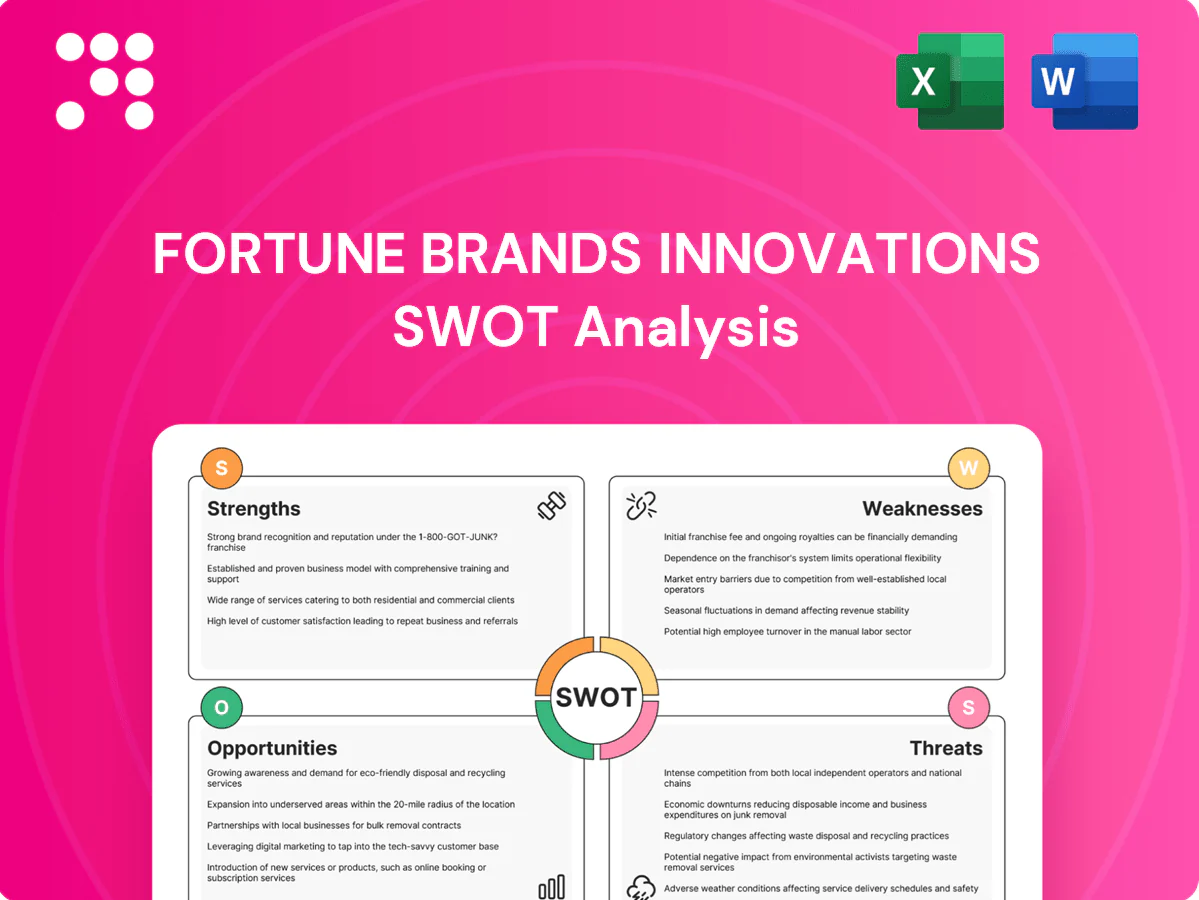
Fortune Brands Innovations SWOT Analysis

Elevate Your Analysis with the Complete SWOT Report
Fortune Brands Innovations shows resilient category leadership and a diversified portfolio, but faces margin pressure from raw material costs and intense retail competition. Our full SWOT unpacks strategic risks, growth levers, and financial context to inform decisions. Purchase the complete, editable Word+Excel report to plan, pitch, or invest with confidence.
Strengths

Portfolio of leading brands
Fortune Brands Innovations owns household names such as Moen, Master Lock, Therma-Tru and SimpliSafe, giving it clear pricing power and preferred shelf space across water, outdoor living and security categories. Brand equity lowers customer acquisition costs and strengthens retailer partnerships. Strong brand architecture enables cross-selling across channels and supports consistent market share in core segments.
Innovation-driven product pipeline
Focus on regular design and technology refreshes keeps Fortune Brands Innovations assortments relevant, supporting a premium product mix and helping margins remain resilient. Continuous innovation in water and security categories introduces features that accelerate replacement cycles and recurring revenue. These differentiated features strengthen positioning versus private label and low-cost imports, preserving brand pricing power.

Diversified channel partnerships
Diversified channel partnerships span big-box retail, wholesale, pro and e-commerce, enabling Fortune Brands Innovations to reach both DIY consumers and professional contractors. Strategic retailer alliances improve merchandising, data sharing and in‑store traffic, accelerating new product adoption across segments. Channel breadth reduces exposure to single-point demand shocks and smooths revenue volatility.

Scale in core categories
Scale in core categories drives lower unit costs and improved fill rates—Fortune Brands Innovations leveraged centralized manufacturing and sourcing to reduce COGS and sustain national fill performance during FY2024 when net sales exceeded $4.0 billion, supporting margin resilience.
- Nationwide footprint strengthens retailer negotiation leverage
- Scale boosts marketing ROI and category leadership
- Enables rapid rollouts across geographies
Exposure to repair/remodel demand
Exposure to repair and remodel demand cushions Fortune Brands Innovations because R&R spending is typically steadier than new construction across cycles; the company’s large installed base in faucets, hardware and decking fuels recurring replacements and upgrade purchases, while an aging U.S. housing stock—about 44% built before 1980—supports ongoing retrofit activity, providing a buffer when housing starts slow.
Pricing power and tech refreshes drive recurring revenue; FY2024 sales > $4.0B
Fortune Brands Innovations owns Moen, Master Lock, Therma-Tru and SimpliSafe, giving pricing power and retail preference. Regular product and tech refreshes sustain premium mix and recurring revenue. FY2024 net sales exceeded $4.0 billion and an aging housing stock (~44% built pre-1980) supports steady R&R demand.
| Metric | Value |
|---|---|
| FY2024 net sales | > $4.0B |
| Homes pre-1980 | ~44% |
| Key brands | Moen, Master Lock, Therma-Tru, SimpliSafe |
What is included in the product
 Detailed Word Document
Provides a concise SWOT overview of Fortune Brands Innovations’ internal capabilities and external market factors, highlighting strengths, weaknesses, opportunities, and threats that shape its competitive positioning and growth prospects.

 Customizable Excel Spreadsheet
Provides a concise SWOT matrix tailored to Fortune Brands Innovations for rapid strategic alignment and quick stakeholder briefings.
Weaknesses

Housing-cycle sensitivity
End-market demand for Fortune Brands Innovations closely tracks home turnover, mortgage rates and consumer confidence; with US mortgage rates averaging near 7% in 2024 and existing‑home sales around 4.0M annualized, slowdowns can compress volumes and force discounting. Channel partners often destock in downturns, and this volatility complicates capacity and inventory planning, raising working capital and margin pressure.
Retailer concentration risk
Post-April 2024 spin-off, Fortune Brands Innovations remains highly dependent on major home centers like Home Depot and Lowe’s, concentrating external bargaining power. Sudden assortment or planogram changes by those retailers can cause abrupt sales volatility. Aggressive promotional cadence at channel level pressures gross margins, while vendor scorecard downgrades risk loss of shelf space and category placement.

Commodity and freight exposure
Input costs for metals, resins and packaging can materially swing Fortune Brands Innovations margins, as the company has noted volatility in raw-material markets. Freight and logistics disruptions raise cost-to-serve and can harm service levels across retail and contractor channels. Hedging programs provide partial protection but do not eliminate short-term spikes, and price realization in some channels can lag rapid cost inflation.

Complex SKU and product mix
Complex SKU and product mix at Fortune Brands Innovations raises forecasting difficulty and obsolescence risk, challenging inventory given FY2024 net sales of about $3.6 billion and multi-category SKUs across plumbing, cabinetry and hardware. The assortment complexity increases working capital and operational overhead, with inventory turns pressured by variable pro versus DIY demand patterns. This variability complicates supply planning and can slow innovation cycles and line refreshes.
- Higher forecasting error — multi-category SKUs
- Increased working capital and overhead
- Pro vs DIY variability complicates supply planning
- Slower innovation and line refresh cadence
Limited international penetration
Fortune Brands Innovations remains heavily dependent on North American demand, with the majority of FY2024 revenue generated in the region, limiting diversification opportunities. Currency fluctuations and differing regulatory regimes increase the cost and complexity of overseas expansion. Underexposure to faster-growing emerging markets and concentrated U.S. revenue heighten sensitivity to U.S. macro shocks.
- North America concentration
- Currency & regulatory headwinds
- Low emerging-market exposure
- High U.S. macro sensitivity
Housing-driven sales risk: 7% mortgages, 4.0M homes, $3.6B revenue
Revenue and volumes remain tightly linked to U.S. housing cycles—US mortgage rates ~7% in 2024 and existing‑home sales ~4.0M annualized, amplifying demand sensitivity and discounting risk.
Post‑spin dependence on major home centers concentrates buyer power, making sales vulnerable to assortment or promotional shifts and vendor scorecard actions.
Input-cost volatility for metals, resins and freight compresses margins; FY2024 net sales were about $3.6 billion, while complex SKUs raise inventory and working-capital pressure.
| Weakness | Metric | 2024 datapoint |
|---|---|---|
| Housing sensitivity | Mortgage rate / Existing-home sales | ~7% / 4.0M |
| Retail concentration | Channel exposure | High dependence on Home Depot/Lowe’s |
| Cost & inventory | Net sales / SKU complexity | $3.6B / multi-category SKUs |
What You See Is What You Get
Fortune Brands Innovations SWOT Analysis
This is a real excerpt from the complete Fortune Brands Innovations SWOT analysis you’ll receive upon purchase—professional, structured, and ready to use. The preview below is taken directly from the full report; buy now to unlock the entire, editable document with in-depth strengths, weaknesses, opportunities, and threats.

Elevate Your Analysis with the Complete SWOT Report
Fortune Brands Innovations shows resilient category leadership and a diversified portfolio, but faces margin pressure from raw material costs and intense retail competition. Our full SWOT unpacks strategic risks, growth levers, and financial context to inform decisions. Purchase the complete, editable Word+Excel report to plan, pitch, or invest with confidence.
Strengths
Portfolio of leading brands
Fortune Brands Innovations owns household names such as Moen, Master Lock, Therma-Tru and SimpliSafe, giving it clear pricing power and preferred shelf space across water, outdoor living and security categories. Brand equity lowers customer acquisition costs and strengthens retailer partnerships. Strong brand architecture enables cross-selling across channels and supports consistent market share in core segments.
Innovation-driven product pipeline
Focus on regular design and technology refreshes keeps Fortune Brands Innovations assortments relevant, supporting a premium product mix and helping margins remain resilient. Continuous innovation in water and security categories introduces features that accelerate replacement cycles and recurring revenue. These differentiated features strengthen positioning versus private label and low-cost imports, preserving brand pricing power.
Diversified channel partnerships
Diversified channel partnerships span big-box retail, wholesale, pro and e-commerce, enabling Fortune Brands Innovations to reach both DIY consumers and professional contractors. Strategic retailer alliances improve merchandising, data sharing and in‑store traffic, accelerating new product adoption across segments. Channel breadth reduces exposure to single-point demand shocks and smooths revenue volatility.
Scale in core categories
Scale in core categories drives lower unit costs and improved fill rates—Fortune Brands Innovations leveraged centralized manufacturing and sourcing to reduce COGS and sustain national fill performance during FY2024 when net sales exceeded $4.0 billion, supporting margin resilience.
- Nationwide footprint strengthens retailer negotiation leverage
- Scale boosts marketing ROI and category leadership
- Enables rapid rollouts across geographies
Exposure to repair/remodel demand
Exposure to repair and remodel demand cushions Fortune Brands Innovations because R&R spending is typically steadier than new construction across cycles; the company’s large installed base in faucets, hardware and decking fuels recurring replacements and upgrade purchases, while an aging U.S. housing stock—about 44% built before 1980—supports ongoing retrofit activity, providing a buffer when housing starts slow.
Pricing power and tech refreshes drive recurring revenue; FY2024 sales > $4.0B
Fortune Brands Innovations owns Moen, Master Lock, Therma-Tru and SimpliSafe, giving pricing power and retail preference. Regular product and tech refreshes sustain premium mix and recurring revenue. FY2024 net sales exceeded $4.0 billion and an aging housing stock (~44% built pre-1980) supports steady R&R demand.
| Metric | Value |
|---|---|
| FY2024 net sales | > $4.0B |
| Homes pre-1980 | ~44% |
| Key brands | Moen, Master Lock, Therma-Tru, SimpliSafe |
What is included in the product
Detailed Word Document
Provides a concise SWOT overview of Fortune Brands Innovations’ internal capabilities and external market factors, highlighting strengths, weaknesses, opportunities, and threats that shape its competitive positioning and growth prospects.
Customizable Excel Spreadsheet
Provides a concise SWOT matrix tailored to Fortune Brands Innovations for rapid strategic alignment and quick stakeholder briefings.
Weaknesses
Housing-cycle sensitivity
End-market demand for Fortune Brands Innovations closely tracks home turnover, mortgage rates and consumer confidence; with US mortgage rates averaging near 7% in 2024 and existing‑home sales around 4.0M annualized, slowdowns can compress volumes and force discounting. Channel partners often destock in downturns, and this volatility complicates capacity and inventory planning, raising working capital and margin pressure.
Retailer concentration risk
Post-April 2024 spin-off, Fortune Brands Innovations remains highly dependent on major home centers like Home Depot and Lowe’s, concentrating external bargaining power. Sudden assortment or planogram changes by those retailers can cause abrupt sales volatility. Aggressive promotional cadence at channel level pressures gross margins, while vendor scorecard downgrades risk loss of shelf space and category placement.
Commodity and freight exposure
Input costs for metals, resins and packaging can materially swing Fortune Brands Innovations margins, as the company has noted volatility in raw-material markets. Freight and logistics disruptions raise cost-to-serve and can harm service levels across retail and contractor channels. Hedging programs provide partial protection but do not eliminate short-term spikes, and price realization in some channels can lag rapid cost inflation.
Complex SKU and product mix
Complex SKU and product mix at Fortune Brands Innovations raises forecasting difficulty and obsolescence risk, challenging inventory given FY2024 net sales of about $3.6 billion and multi-category SKUs across plumbing, cabinetry and hardware. The assortment complexity increases working capital and operational overhead, with inventory turns pressured by variable pro versus DIY demand patterns. This variability complicates supply planning and can slow innovation cycles and line refreshes.
- Higher forecasting error — multi-category SKUs
- Increased working capital and overhead
- Pro vs DIY variability complicates supply planning
- Slower innovation and line refresh cadence
Limited international penetration
Fortune Brands Innovations remains heavily dependent on North American demand, with the majority of FY2024 revenue generated in the region, limiting diversification opportunities. Currency fluctuations and differing regulatory regimes increase the cost and complexity of overseas expansion. Underexposure to faster-growing emerging markets and concentrated U.S. revenue heighten sensitivity to U.S. macro shocks.
- North America concentration
- Currency & regulatory headwinds
- Low emerging-market exposure
- High U.S. macro sensitivity
Housing-driven sales risk: 7% mortgages, 4.0M homes, $3.6B revenue
Revenue and volumes remain tightly linked to U.S. housing cycles—US mortgage rates ~7% in 2024 and existing‑home sales ~4.0M annualized, amplifying demand sensitivity and discounting risk.
Post‑spin dependence on major home centers concentrates buyer power, making sales vulnerable to assortment or promotional shifts and vendor scorecard actions.
Input-cost volatility for metals, resins and freight compresses margins; FY2024 net sales were about $3.6 billion, while complex SKUs raise inventory and working-capital pressure.
| Weakness | Metric | 2024 datapoint |
|---|---|---|
| Housing sensitivity | Mortgage rate / Existing-home sales | ~7% / 4.0M |
| Retail concentration | Channel exposure | High dependence on Home Depot/Lowe’s |
| Cost & inventory | Net sales / SKU complexity | $3.6B / multi-category SKUs |
What You See Is What You Get
Fortune Brands Innovations SWOT Analysis
This is a real excerpt from the complete Fortune Brands Innovations SWOT analysis you’ll receive upon purchase—professional, structured, and ready to use. The preview below is taken directly from the full report; buy now to unlock the entire, editable document with in-depth strengths, weaknesses, opportunities, and threats.
Original: $10.00
-65%$10.00
$3.50Description
Elevate Your Analysis with the Complete SWOT Report
Fortune Brands Innovations shows resilient category leadership and a diversified portfolio, but faces margin pressure from raw material costs and intense retail competition. Our full SWOT unpacks strategic risks, growth levers, and financial context to inform decisions. Purchase the complete, editable Word+Excel report to plan, pitch, or invest with confidence.
Strengths
Portfolio of leading brands
Fortune Brands Innovations owns household names such as Moen, Master Lock, Therma-Tru and SimpliSafe, giving it clear pricing power and preferred shelf space across water, outdoor living and security categories. Brand equity lowers customer acquisition costs and strengthens retailer partnerships. Strong brand architecture enables cross-selling across channels and supports consistent market share in core segments.
Innovation-driven product pipeline
Focus on regular design and technology refreshes keeps Fortune Brands Innovations assortments relevant, supporting a premium product mix and helping margins remain resilient. Continuous innovation in water and security categories introduces features that accelerate replacement cycles and recurring revenue. These differentiated features strengthen positioning versus private label and low-cost imports, preserving brand pricing power.
Diversified channel partnerships
Diversified channel partnerships span big-box retail, wholesale, pro and e-commerce, enabling Fortune Brands Innovations to reach both DIY consumers and professional contractors. Strategic retailer alliances improve merchandising, data sharing and in‑store traffic, accelerating new product adoption across segments. Channel breadth reduces exposure to single-point demand shocks and smooths revenue volatility.
Scale in core categories
Scale in core categories drives lower unit costs and improved fill rates—Fortune Brands Innovations leveraged centralized manufacturing and sourcing to reduce COGS and sustain national fill performance during FY2024 when net sales exceeded $4.0 billion, supporting margin resilience.
- Nationwide footprint strengthens retailer negotiation leverage
- Scale boosts marketing ROI and category leadership
- Enables rapid rollouts across geographies
Exposure to repair/remodel demand
Exposure to repair and remodel demand cushions Fortune Brands Innovations because R&R spending is typically steadier than new construction across cycles; the company’s large installed base in faucets, hardware and decking fuels recurring replacements and upgrade purchases, while an aging U.S. housing stock—about 44% built before 1980—supports ongoing retrofit activity, providing a buffer when housing starts slow.
Pricing power and tech refreshes drive recurring revenue; FY2024 sales > $4.0B
Fortune Brands Innovations owns Moen, Master Lock, Therma-Tru and SimpliSafe, giving pricing power and retail preference. Regular product and tech refreshes sustain premium mix and recurring revenue. FY2024 net sales exceeded $4.0 billion and an aging housing stock (~44% built pre-1980) supports steady R&R demand.
| Metric | Value |
|---|---|
| FY2024 net sales | > $4.0B |
| Homes pre-1980 | ~44% |
| Key brands | Moen, Master Lock, Therma-Tru, SimpliSafe |
What is included in the product
Detailed Word Document
Provides a concise SWOT overview of Fortune Brands Innovations’ internal capabilities and external market factors, highlighting strengths, weaknesses, opportunities, and threats that shape its competitive positioning and growth prospects.
Customizable Excel Spreadsheet
Provides a concise SWOT matrix tailored to Fortune Brands Innovations for rapid strategic alignment and quick stakeholder briefings.
Weaknesses
Housing-cycle sensitivity
End-market demand for Fortune Brands Innovations closely tracks home turnover, mortgage rates and consumer confidence; with US mortgage rates averaging near 7% in 2024 and existing‑home sales around 4.0M annualized, slowdowns can compress volumes and force discounting. Channel partners often destock in downturns, and this volatility complicates capacity and inventory planning, raising working capital and margin pressure.
Retailer concentration risk
Post-April 2024 spin-off, Fortune Brands Innovations remains highly dependent on major home centers like Home Depot and Lowe’s, concentrating external bargaining power. Sudden assortment or planogram changes by those retailers can cause abrupt sales volatility. Aggressive promotional cadence at channel level pressures gross margins, while vendor scorecard downgrades risk loss of shelf space and category placement.
Commodity and freight exposure
Input costs for metals, resins and packaging can materially swing Fortune Brands Innovations margins, as the company has noted volatility in raw-material markets. Freight and logistics disruptions raise cost-to-serve and can harm service levels across retail and contractor channels. Hedging programs provide partial protection but do not eliminate short-term spikes, and price realization in some channels can lag rapid cost inflation.
Complex SKU and product mix
Complex SKU and product mix at Fortune Brands Innovations raises forecasting difficulty and obsolescence risk, challenging inventory given FY2024 net sales of about $3.6 billion and multi-category SKUs across plumbing, cabinetry and hardware. The assortment complexity increases working capital and operational overhead, with inventory turns pressured by variable pro versus DIY demand patterns. This variability complicates supply planning and can slow innovation cycles and line refreshes.
- Higher forecasting error — multi-category SKUs
- Increased working capital and overhead
- Pro vs DIY variability complicates supply planning
- Slower innovation and line refresh cadence
Limited international penetration
Fortune Brands Innovations remains heavily dependent on North American demand, with the majority of FY2024 revenue generated in the region, limiting diversification opportunities. Currency fluctuations and differing regulatory regimes increase the cost and complexity of overseas expansion. Underexposure to faster-growing emerging markets and concentrated U.S. revenue heighten sensitivity to U.S. macro shocks.
- North America concentration
- Currency & regulatory headwinds
- Low emerging-market exposure
- High U.S. macro sensitivity
Housing-driven sales risk: 7% mortgages, 4.0M homes, $3.6B revenue
Revenue and volumes remain tightly linked to U.S. housing cycles—US mortgage rates ~7% in 2024 and existing‑home sales ~4.0M annualized, amplifying demand sensitivity and discounting risk.
Post‑spin dependence on major home centers concentrates buyer power, making sales vulnerable to assortment or promotional shifts and vendor scorecard actions.
Input-cost volatility for metals, resins and freight compresses margins; FY2024 net sales were about $3.6 billion, while complex SKUs raise inventory and working-capital pressure.
| Weakness | Metric | 2024 datapoint |
|---|---|---|
| Housing sensitivity | Mortgage rate / Existing-home sales | ~7% / 4.0M |
| Retail concentration | Channel exposure | High dependence on Home Depot/Lowe’s |
| Cost & inventory | Net sales / SKU complexity | $3.6B / multi-category SKUs |
What You See Is What You Get
Fortune Brands Innovations SWOT Analysis
This is a real excerpt from the complete Fortune Brands Innovations SWOT analysis you’ll receive upon purchase—professional, structured, and ready to use. The preview below is taken directly from the full report; buy now to unlock the entire, editable document with in-depth strengths, weaknesses, opportunities, and threats.











