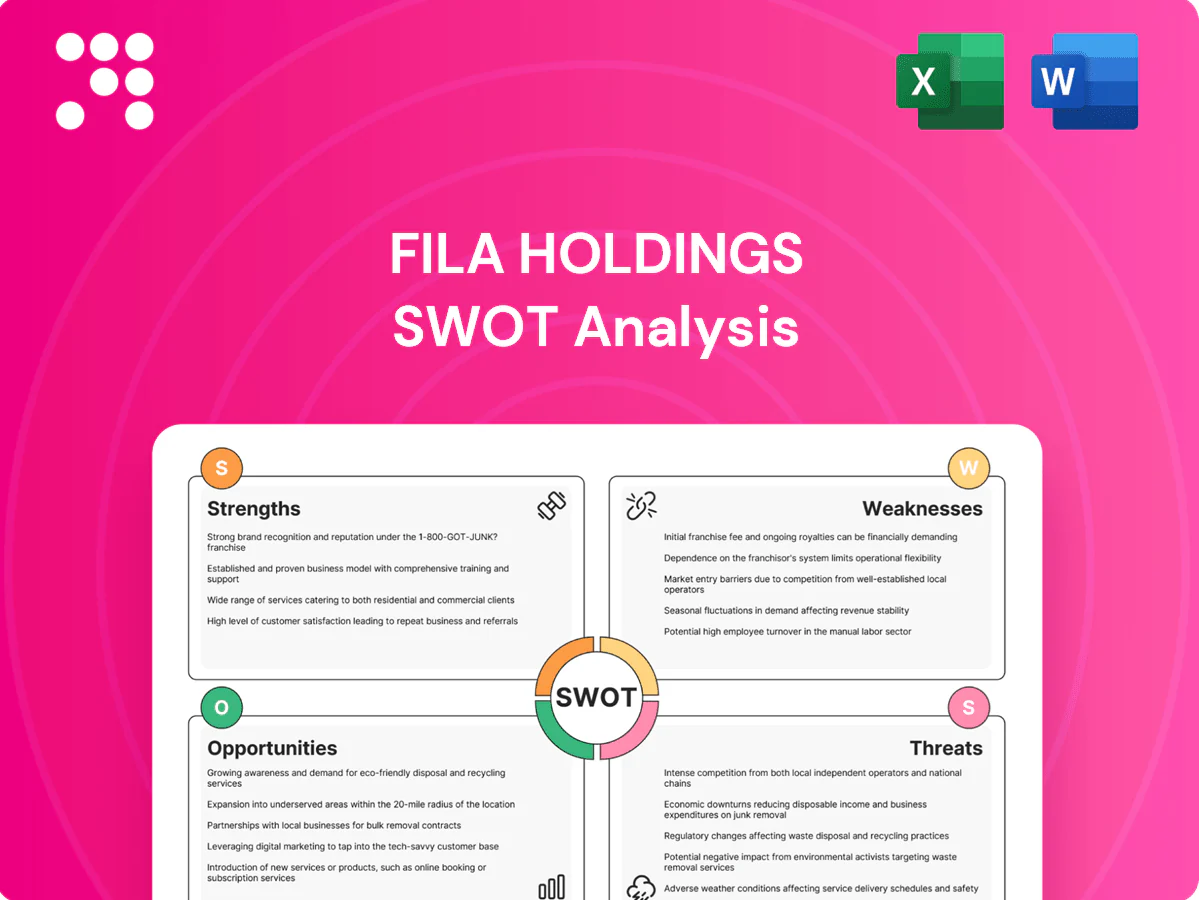
FILA Holdings SWOT Analysis

Make Insightful Decisions Backed by Expert Research
FILA Holdings shows strong brand equity and global retail reach but faces supply-chain exposure and intense athleisure competition. Our full SWOT analysis uncovers actionable strengths, risks, and growth levers with financial context and strategic recommendations. Purchase the complete, editable report (Word + Excel) to plan, pitch, or invest with confidence.
Strengths

Global brand footprint
FILA Holdings manages the FILA brand across Asia, Europe and North America, operating in over 70 markets, enabling scale and consistent global positioning. This wide geographic presence diversifies demand and reduces single-market risk for revenue streams. Coordinated marketing and synchronized product launches across regions accelerate trend capture and market responsiveness.
Diversified product portfolio
FILA spans footwear, apparel and accessories across athletic and casual segments, supporting revenues from over 14,000 retail points worldwide. This breadth smooths seasonality and fashion cycles, reducing volatility in quarterly sales. A consistent cross-category design language boosts brand identity and average basket size, enabling more efficient merchandising and channel optimization.

Licensing and partnership model
Licensing expands FILA Holdings product reach and local relevance without heavy capital outlay, helping drive FY2023 revenue of KRW 2.24 trillion. It accelerates market entry and brand monetization, while partners tailor assortments to regional tastes. The model enhances margin flexibility and scalability, supporting an operating margin near 16.5% in 2023.

Acushnet majority stake
Ownership of Acushnet (majority stake acquired by FILA Holdings in 2011) gives FILA exposure to premium golf brands Titleist and FootJoy, adding a resilient, higher-margin equipment channel alongside lifestyle apparel and footwear.
- Diversifies revenue beyond apparel/footwear
- Access to Titleist/FootJoy brand equity
- Synergies in marketing, athletes, retail channels
- Golf cash flows can damp apparel-footwear cyclicality
Omnichannel distribution
FILA operates across wholesale, retail and e-commerce, increasing consumer touchpoints and first-party data capture to improve pricing, inventory management and product launch cadence. Integrated channels enable faster DTC ramp and scope for margin improvement through higher full-price sell-through and lower channel conflicts.
- Omnichannel reach across wholesale/retail/e-comm
- Boosts first-party data and touchpoints
- Improves pricing, inventory, launch cadence
- Supports DTC growth and margin upside
70+ markets • KRW 2.24T revenue • 16.5%
Global footprint in 70+ markets drives scale; FY2023 revenue KRW 2.24 trillion and operating margin ~16.5% underpin financial strength. Ownership of Acushnet (Titleist/FootJoy) diversifies into higher-margin golf equipment. Omnichannel reach with 14,000+ retail points and rising DTC/e-commerce enhances margins and first-party data.
| Metric | Value |
|---|---|
| Markets | 70+ |
| FY2023 Revenue | KRW 2.24T |
| Operating margin 2023 | ~16.5% |
| Retail points | 14,000+ |
What is included in the product
 Detailed Word Document
Provides a concise SWOT analysis of FILA Holdings, highlighting internal strengths and weaknesses and external opportunities and threats to map its competitive position and strategic risks.

 Customizable Excel Spreadsheet
Provides a concise SWOT matrix for FILA Holdings to quickly pinpoint strengths, weaknesses, opportunities and threats, relieving analysis bottlenecks and enabling faster strategic decisions.
Weaknesses

Mid-tier brand positioning
FILA often competes in value and mid-price tiers rather than premium segments, with FILA Korea reporting consolidated revenue of about 1.49 trillion KRW in 2023, which limits pricing power versus premium peers. This positioning can cap gross margins compared with leaders like Nike (gross margin ~45% in FY2024). Premiumization needs sustained design credibility and higher investment, and FILA’s brand heat can be more volatile than top-tier rivals.
Fashion-cycle volatility
Lifestyle-driven demand causes swings tied to trends, with fashion product life cycles often as short as 12–16 weeks, raising the risk of missed design seasons and forced markdowns up to ~30% that compress gross margins. Forecasting errors rise in fast-moving categories as trend half-lives fall below a season, requiring continuous marketing spend to maintain relevance.

Licensee control limits
Dependence on licensees can dilute FILA Holdings control over quality, pricing and brand messaging, especially given the global licensing market generated roughly USD 300 billion in retail sales (Licensing International, 2023).
Variability in execution across regions causes uneven consumer experiences and risks short-term sales volatility. Monitoring and enforcement raise overhead through audits, legal costs and training. Misalignment with key licensees can erode long-term brand equity.

Outsourced manufacturing exposure
FILA Holdings' reliance on third-party factories concentrates operational and geopolitical risk in supplier regions, limiting visibility into capacity and quality controls. Rigid lead times constrain rapid response to demand shifts, while rising input costs often cannot be passed to retailers quickly. Partner compliance lapses have previously triggered reputational scrutiny in the sportswear sector.
- Supplier concentration risk
- Lead-time inflexibility
- Slow cost pass-through
- Reputational exposure from partner lapses
Regional concentration risks
Regional concentration leaves FILA Holdings' performance dependent on core markets such as China and South Korea, making results vulnerable to local macro slowdowns or regulatory shifts that can disproportionately reduce revenue and margins. Limited localization in underpenetrated regions constrains growth outside these hubs, while exchange-rate volatility between KRW, CNY and USD amplifies earnings variability.
- Market dependence: core Asian markets
- Regulatory exposure: high impact on sales
- Localization gaps: weak penetration elsewhere
- Currency risk: KRW/CNY/USD volatility
Korean value-tier apparel: 12-16 week cycles fuel up to ~30% markdowns and margin pressure
FILA sits in value/mid tiers; FILA Korea revenue ~1.49T KRW (2023) limits pricing vs premium peers (Nike GM ~45% FY2024). Short 12–16 week cycles raise markdowns up to ~30% and forecasting risk. High licensing exposure (licensed retail ~USD300B 2023), supplier concentration and China/South Korea dependence increase operational, brand and FX risks.
| Metric | Value |
|---|---|
| FILA Korea rev (2023) | ~1.49T KRW |
| Nike gross margin | ~45% (FY2024) |
| Licensed retail market (2023) | ~USD 300B |
Full Version Awaits
FILA Holdings SWOT Analysis
This FILA Holdings SWOT Analysis is a real excerpt from the complete document you’ll receive upon purchase—no surprises, just professional quality. The preview below is taken directly from the full SWOT report you'll get, structured and ready to use. Buy now to unlock the complete, editable version with in-depth insights and supporting details.

Make Insightful Decisions Backed by Expert Research
FILA Holdings shows strong brand equity and global retail reach but faces supply-chain exposure and intense athleisure competition. Our full SWOT analysis uncovers actionable strengths, risks, and growth levers with financial context and strategic recommendations. Purchase the complete, editable report (Word + Excel) to plan, pitch, or invest with confidence.
Strengths
Global brand footprint
FILA Holdings manages the FILA brand across Asia, Europe and North America, operating in over 70 markets, enabling scale and consistent global positioning. This wide geographic presence diversifies demand and reduces single-market risk for revenue streams. Coordinated marketing and synchronized product launches across regions accelerate trend capture and market responsiveness.
Diversified product portfolio
FILA spans footwear, apparel and accessories across athletic and casual segments, supporting revenues from over 14,000 retail points worldwide. This breadth smooths seasonality and fashion cycles, reducing volatility in quarterly sales. A consistent cross-category design language boosts brand identity and average basket size, enabling more efficient merchandising and channel optimization.
Licensing and partnership model
Licensing expands FILA Holdings product reach and local relevance without heavy capital outlay, helping drive FY2023 revenue of KRW 2.24 trillion. It accelerates market entry and brand monetization, while partners tailor assortments to regional tastes. The model enhances margin flexibility and scalability, supporting an operating margin near 16.5% in 2023.
Acushnet majority stake
Ownership of Acushnet (majority stake acquired by FILA Holdings in 2011) gives FILA exposure to premium golf brands Titleist and FootJoy, adding a resilient, higher-margin equipment channel alongside lifestyle apparel and footwear.
- Diversifies revenue beyond apparel/footwear
- Access to Titleist/FootJoy brand equity
- Synergies in marketing, athletes, retail channels
- Golf cash flows can damp apparel-footwear cyclicality
Omnichannel distribution
FILA operates across wholesale, retail and e-commerce, increasing consumer touchpoints and first-party data capture to improve pricing, inventory management and product launch cadence. Integrated channels enable faster DTC ramp and scope for margin improvement through higher full-price sell-through and lower channel conflicts.
- Omnichannel reach across wholesale/retail/e-comm
- Boosts first-party data and touchpoints
- Improves pricing, inventory, launch cadence
- Supports DTC growth and margin upside
70+ markets • KRW 2.24T revenue • 16.5%
Global footprint in 70+ markets drives scale; FY2023 revenue KRW 2.24 trillion and operating margin ~16.5% underpin financial strength. Ownership of Acushnet (Titleist/FootJoy) diversifies into higher-margin golf equipment. Omnichannel reach with 14,000+ retail points and rising DTC/e-commerce enhances margins and first-party data.
| Metric | Value |
|---|---|
| Markets | 70+ |
| FY2023 Revenue | KRW 2.24T |
| Operating margin 2023 | ~16.5% |
| Retail points | 14,000+ |
What is included in the product
Detailed Word Document
Provides a concise SWOT analysis of FILA Holdings, highlighting internal strengths and weaknesses and external opportunities and threats to map its competitive position and strategic risks.
Customizable Excel Spreadsheet
Provides a concise SWOT matrix for FILA Holdings to quickly pinpoint strengths, weaknesses, opportunities and threats, relieving analysis bottlenecks and enabling faster strategic decisions.
Weaknesses
Mid-tier brand positioning
FILA often competes in value and mid-price tiers rather than premium segments, with FILA Korea reporting consolidated revenue of about 1.49 trillion KRW in 2023, which limits pricing power versus premium peers. This positioning can cap gross margins compared with leaders like Nike (gross margin ~45% in FY2024). Premiumization needs sustained design credibility and higher investment, and FILA’s brand heat can be more volatile than top-tier rivals.
Fashion-cycle volatility
Lifestyle-driven demand causes swings tied to trends, with fashion product life cycles often as short as 12–16 weeks, raising the risk of missed design seasons and forced markdowns up to ~30% that compress gross margins. Forecasting errors rise in fast-moving categories as trend half-lives fall below a season, requiring continuous marketing spend to maintain relevance.
Licensee control limits
Dependence on licensees can dilute FILA Holdings control over quality, pricing and brand messaging, especially given the global licensing market generated roughly USD 300 billion in retail sales (Licensing International, 2023).
Variability in execution across regions causes uneven consumer experiences and risks short-term sales volatility. Monitoring and enforcement raise overhead through audits, legal costs and training. Misalignment with key licensees can erode long-term brand equity.
Outsourced manufacturing exposure
FILA Holdings' reliance on third-party factories concentrates operational and geopolitical risk in supplier regions, limiting visibility into capacity and quality controls. Rigid lead times constrain rapid response to demand shifts, while rising input costs often cannot be passed to retailers quickly. Partner compliance lapses have previously triggered reputational scrutiny in the sportswear sector.
- Supplier concentration risk
- Lead-time inflexibility
- Slow cost pass-through
- Reputational exposure from partner lapses
Regional concentration risks
Regional concentration leaves FILA Holdings' performance dependent on core markets such as China and South Korea, making results vulnerable to local macro slowdowns or regulatory shifts that can disproportionately reduce revenue and margins. Limited localization in underpenetrated regions constrains growth outside these hubs, while exchange-rate volatility between KRW, CNY and USD amplifies earnings variability.
- Market dependence: core Asian markets
- Regulatory exposure: high impact on sales
- Localization gaps: weak penetration elsewhere
- Currency risk: KRW/CNY/USD volatility
Korean value-tier apparel: 12-16 week cycles fuel up to ~30% markdowns and margin pressure
FILA sits in value/mid tiers; FILA Korea revenue ~1.49T KRW (2023) limits pricing vs premium peers (Nike GM ~45% FY2024). Short 12–16 week cycles raise markdowns up to ~30% and forecasting risk. High licensing exposure (licensed retail ~USD300B 2023), supplier concentration and China/South Korea dependence increase operational, brand and FX risks.
| Metric | Value |
|---|---|
| FILA Korea rev (2023) | ~1.49T KRW |
| Nike gross margin | ~45% (FY2024) |
| Licensed retail market (2023) | ~USD 300B |
Full Version Awaits
FILA Holdings SWOT Analysis
This FILA Holdings SWOT Analysis is a real excerpt from the complete document you’ll receive upon purchase—no surprises, just professional quality. The preview below is taken directly from the full SWOT report you'll get, structured and ready to use. Buy now to unlock the complete, editable version with in-depth insights and supporting details.
Description
Make Insightful Decisions Backed by Expert Research
FILA Holdings shows strong brand equity and global retail reach but faces supply-chain exposure and intense athleisure competition. Our full SWOT analysis uncovers actionable strengths, risks, and growth levers with financial context and strategic recommendations. Purchase the complete, editable report (Word + Excel) to plan, pitch, or invest with confidence.
Strengths
Global brand footprint
FILA Holdings manages the FILA brand across Asia, Europe and North America, operating in over 70 markets, enabling scale and consistent global positioning. This wide geographic presence diversifies demand and reduces single-market risk for revenue streams. Coordinated marketing and synchronized product launches across regions accelerate trend capture and market responsiveness.
Diversified product portfolio
FILA spans footwear, apparel and accessories across athletic and casual segments, supporting revenues from over 14,000 retail points worldwide. This breadth smooths seasonality and fashion cycles, reducing volatility in quarterly sales. A consistent cross-category design language boosts brand identity and average basket size, enabling more efficient merchandising and channel optimization.
Licensing and partnership model
Licensing expands FILA Holdings product reach and local relevance without heavy capital outlay, helping drive FY2023 revenue of KRW 2.24 trillion. It accelerates market entry and brand monetization, while partners tailor assortments to regional tastes. The model enhances margin flexibility and scalability, supporting an operating margin near 16.5% in 2023.
Acushnet majority stake
Ownership of Acushnet (majority stake acquired by FILA Holdings in 2011) gives FILA exposure to premium golf brands Titleist and FootJoy, adding a resilient, higher-margin equipment channel alongside lifestyle apparel and footwear.
- Diversifies revenue beyond apparel/footwear
- Access to Titleist/FootJoy brand equity
- Synergies in marketing, athletes, retail channels
- Golf cash flows can damp apparel-footwear cyclicality
Omnichannel distribution
FILA operates across wholesale, retail and e-commerce, increasing consumer touchpoints and first-party data capture to improve pricing, inventory management and product launch cadence. Integrated channels enable faster DTC ramp and scope for margin improvement through higher full-price sell-through and lower channel conflicts.
- Omnichannel reach across wholesale/retail/e-comm
- Boosts first-party data and touchpoints
- Improves pricing, inventory, launch cadence
- Supports DTC growth and margin upside
70+ markets • KRW 2.24T revenue • 16.5%
Global footprint in 70+ markets drives scale; FY2023 revenue KRW 2.24 trillion and operating margin ~16.5% underpin financial strength. Ownership of Acushnet (Titleist/FootJoy) diversifies into higher-margin golf equipment. Omnichannel reach with 14,000+ retail points and rising DTC/e-commerce enhances margins and first-party data.
| Metric | Value |
|---|---|
| Markets | 70+ |
| FY2023 Revenue | KRW 2.24T |
| Operating margin 2023 | ~16.5% |
| Retail points | 14,000+ |
What is included in the product
Detailed Word Document
Provides a concise SWOT analysis of FILA Holdings, highlighting internal strengths and weaknesses and external opportunities and threats to map its competitive position and strategic risks.
Customizable Excel Spreadsheet
Provides a concise SWOT matrix for FILA Holdings to quickly pinpoint strengths, weaknesses, opportunities and threats, relieving analysis bottlenecks and enabling faster strategic decisions.
Weaknesses
Mid-tier brand positioning
FILA often competes in value and mid-price tiers rather than premium segments, with FILA Korea reporting consolidated revenue of about 1.49 trillion KRW in 2023, which limits pricing power versus premium peers. This positioning can cap gross margins compared with leaders like Nike (gross margin ~45% in FY2024). Premiumization needs sustained design credibility and higher investment, and FILA’s brand heat can be more volatile than top-tier rivals.
Fashion-cycle volatility
Lifestyle-driven demand causes swings tied to trends, with fashion product life cycles often as short as 12–16 weeks, raising the risk of missed design seasons and forced markdowns up to ~30% that compress gross margins. Forecasting errors rise in fast-moving categories as trend half-lives fall below a season, requiring continuous marketing spend to maintain relevance.
Licensee control limits
Dependence on licensees can dilute FILA Holdings control over quality, pricing and brand messaging, especially given the global licensing market generated roughly USD 300 billion in retail sales (Licensing International, 2023).
Variability in execution across regions causes uneven consumer experiences and risks short-term sales volatility. Monitoring and enforcement raise overhead through audits, legal costs and training. Misalignment with key licensees can erode long-term brand equity.
Outsourced manufacturing exposure
FILA Holdings' reliance on third-party factories concentrates operational and geopolitical risk in supplier regions, limiting visibility into capacity and quality controls. Rigid lead times constrain rapid response to demand shifts, while rising input costs often cannot be passed to retailers quickly. Partner compliance lapses have previously triggered reputational scrutiny in the sportswear sector.
- Supplier concentration risk
- Lead-time inflexibility
- Slow cost pass-through
- Reputational exposure from partner lapses
Regional concentration risks
Regional concentration leaves FILA Holdings' performance dependent on core markets such as China and South Korea, making results vulnerable to local macro slowdowns or regulatory shifts that can disproportionately reduce revenue and margins. Limited localization in underpenetrated regions constrains growth outside these hubs, while exchange-rate volatility between KRW, CNY and USD amplifies earnings variability.
- Market dependence: core Asian markets
- Regulatory exposure: high impact on sales
- Localization gaps: weak penetration elsewhere
- Currency risk: KRW/CNY/USD volatility
Korean value-tier apparel: 12-16 week cycles fuel up to ~30% markdowns and margin pressure
FILA sits in value/mid tiers; FILA Korea revenue ~1.49T KRW (2023) limits pricing vs premium peers (Nike GM ~45% FY2024). Short 12–16 week cycles raise markdowns up to ~30% and forecasting risk. High licensing exposure (licensed retail ~USD300B 2023), supplier concentration and China/South Korea dependence increase operational, brand and FX risks.
| Metric | Value |
|---|---|
| FILA Korea rev (2023) | ~1.49T KRW |
| Nike gross margin | ~45% (FY2024) |
| Licensed retail market (2023) | ~USD 300B |
Full Version Awaits
FILA Holdings SWOT Analysis
This FILA Holdings SWOT Analysis is a real excerpt from the complete document you’ll receive upon purchase—no surprises, just professional quality. The preview below is taken directly from the full SWOT report you'll get, structured and ready to use. Buy now to unlock the complete, editable version with in-depth insights and supporting details.











