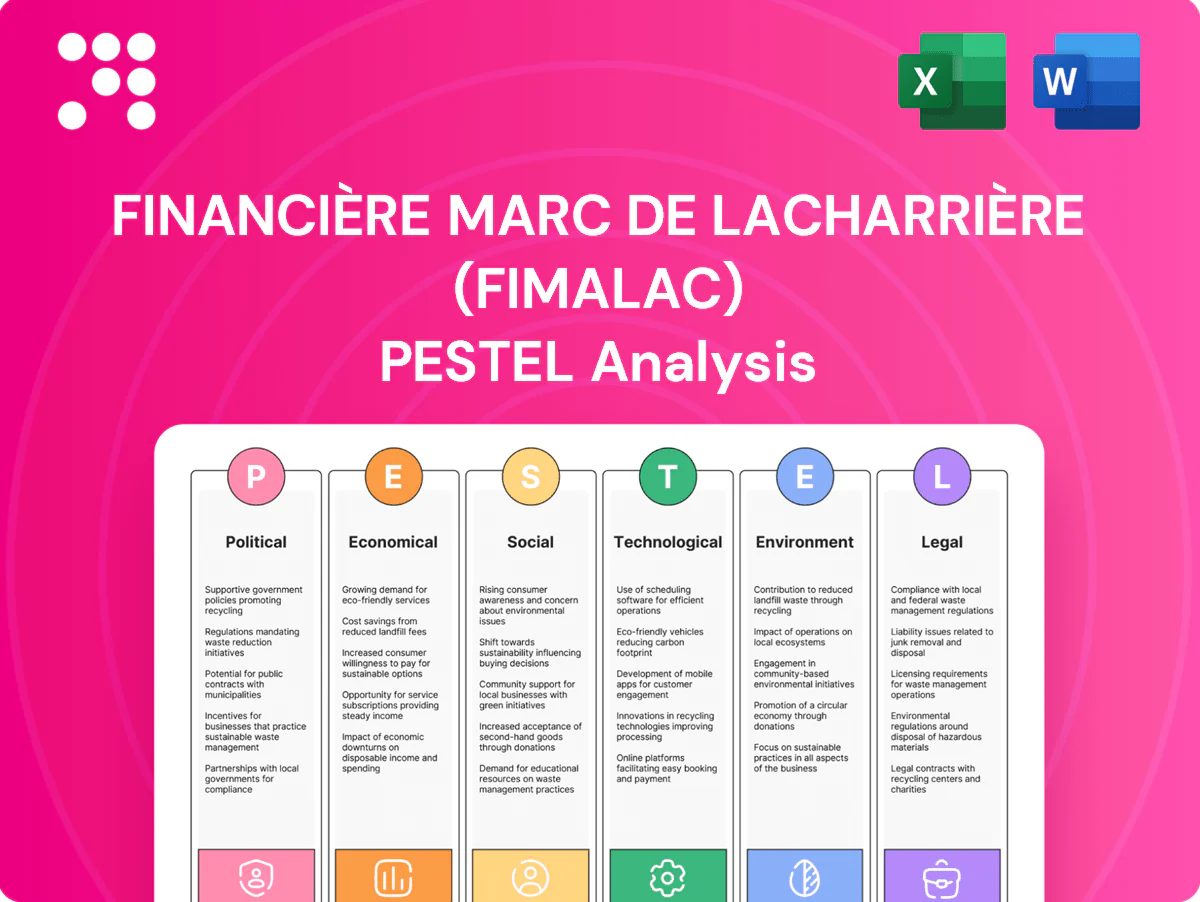
Financière Marc de Lacharrière (Fimalac) PESTLE Analysis

Plan Smarter. Present Sharper. Compete Stronger.
Discover how political shifts, economic cycles, social trends, technological change, legal pressures, and environmental risks shape Financière Marc de Lacharrière (Fimalac)'s strategic path in our concise PESTLE snapshot. Gain actionable insights to fortify investments and strategy. Purchase the full PESTLE analysis for a complete, ready-to-use briefing.
Political factors

EU cultural and creative industry support
EU and French cultural policies offer grants, tax incentives and venue support that directly benefit Fimalac’s event production and entertainment assets; EU Creative Europe allocates EUR 2.4bn for 2021–27. Accessing these programs can lower project risk and unlock co‑financing (often up to c.50%), but policy shifts or budget cuts could reduce support. Proactive alignment with cultural agendas improves eligibility and visibility.
Regulation of digital platforms and advertising
European rules such as the Digital Services Act, which entered into application in February 2024, and the Digital Markets Act (with 22 gatekeepers designated) increase transparency and content-moderation obligations across platforms where Fimalac’s Webedia and digital services operate. These rules raise compliance overheads and campaign costs while potentially leveling competition with big tech, and ongoing policy uncertainty can delay client ad spending.

Tourism and hospitality public policy
National tourism strategies and visa regimes shape hotel demand as UNWTO reported 2024 international arrivals at about 85% of 2019 levels, pressuring chains like Fimalac-owned assets to adapt pricing and distribution. City-level caps—Paris 120-day short-term rental limit—plus local bans on event permits can dent occupancy and festival traffic. Regional development incentives are driving new hotel pipelines, while public health contingencies still influence event approvals.

Geopolitical stability and security
Security alerts, protests or geopolitical tensions can sharply suppress travel and event attendance, raising cancellation rates and lowering forward bookings; insurance premiums and contingency planning costs climb as perceived risk rises. Stable geopolitical environments restore bookings and revenue predictability, while geographic diversification mitigates localized shocks to Fimalac's exhibitions and hospitality exposures.
- Higher security risk: increased insurance & contingency spend
- Stable regions: stronger forward bookings
- Diversification: reduces country-specific revenue volatility
Public funding and municipal relations for venues
Entertainment venues rely on municipal partnerships for permits, noise ordinances and infrastructure; local authorities account for over 50% of public cultural expenditure in France (Ministry of Culture 2022). Political turnover can change fees and permit terms, so active stakeholder engagement is critical to retain favorable operating conditions. Long-term contracts (multi-year concessions) reduce renegotiation risk and revenue volatility.
- Municipal dependence: permits, noise, infra
- Political turnover: alters fees/terms
- Engagement: preserves operating conditions
- Long-term contracts: lower renegotiation risk
EU cultural funding reduces project risk; DSA/DMA and tourism rebound reshape costs
EU cultural funds (Creative Europe EUR 2.4bn 2021–27) and municipal grants lower project risk but budget cuts threaten co‑financing; DSA (in force Feb 2024) and DMA (22 gatekeepers) raise compliance costs for Webedia. 2024 international arrivals at c.85% of 2019 (UNWTO) press hotel demand; local short‑term rental caps (Paris 120 days) and security risks raise insurance and contingency spending.
| Risk | Impact | Metric | Value |
|---|---|---|---|
| Funding | Co‑finance | Creative Europe | EUR 2.4bn |
| Regulation | Compliance cost | DMA gatekeepers | 22 |
| Demand | Arrivals | UNWTO 2024 | ~85% of 2019 |
What is included in the product
 Detailed Word Document
Explores how external macro-environmental factors uniquely affect Financière Marc de Lacharrière (Fimalac) across Political, Economic, Social, Technological, Environmental and Legal dimensions, with data-driven insights and trend analysis. Designed for executives and investors to identify risks, opportunities and inform scenario-based strategy.

 Customizable Excel Spreadsheet
A compact, visually segmented PESTLE summary tailored to Financière Marc de Lacharrière (Fimalac) that distills regulatory, economic and technological risks for quick meeting use; editable notes and slide‑ready format simplify team alignment, client reporting and strategic planning.
Economic factors

Consumer discretionary cycles
Leisure, live events and hotel stays closely track real income and sentiment; downturns compress ticket sales, ADR and digital ad budgets, while recoveries restore pricing power and load factors. Post‑COVID rebounds raised occupancy and ADR in 2022–24, and global digital ad spend reached about $638bn in 2024, making dynamic cost control essential for Fimalac resilience.
Interest rates and real estate valuations
Rising policy rates (ECB deposit rate ~4.00% and US Fed funds 5.25–5.50% in mid-2024) pushed cap rates higher, compressing hotel and commercial property valuations and slowing transactions. Higher debt service costs delay acquisitions and refurbishment timing, while lower rates unlock refinancing gains and accretive deals. Fimalac’s hedging policies stabilize cash flows against rate volatility.

Advertising demand elasticity
Digital advertising, which accounted for about two-thirds of global ad spend in 2023, tracks SME and corporate budgets closely, so economic slowdowns compress demand for Fimalac’s digital revenues. Budget cuts typically hit performance channels first, squeezing margins as CPA and CPC fall then rebound. Diversifying into analytics and managed services increases client stickiness and recurring revenue. Outcome-based pricing meets rising client ROI demands and can protect margins.

Inflation and wage pressures
Event operations and hospitality face higher labor, energy and food costs, with euro-area inflation easing to about 2.5% in 2024 while unit labor costs rose roughly 3–4%, squeezing margins; pricing power varies by venue, season and brand strength, so cost pass-through requires clear value propositions and customer segmentation; productivity tech and centralized procurement scale can materially offset input inflation.
- Higher input costs: energy, food, wages (unit labor costs +3–4% 2024)
- Pricing variability: by venue, season, brand
- Need clear value proposition for pass-through
- Mitigants: productivity tech, procurement scale
FX and international exposure
Fimalac faces translation and transaction risk as revenues and costs span EUR, GBP and USD; EUR/USD averaged about 1.08 in 2024, amplifying reported results when converted to euros. Tourism-sensitive assets saw 2024 inbound flows near 90% of 2019 levels, buoying revenue when currencies favor inbound spend. Natural hedges across assets and matching currency revenues, plus active treasury hedging, smooth quarterly volatility.
- FX exposure: EUR/GBP/USD mix
- EUR/USD 2024 avg ~1.08
- Tourism recovery ~90% of 2019 in 2024
- Treasury hedging and natural hedges mitigate swings
EU cultural funding reduces project risk; DSA/DMA and tourism rebound reshape costs
La sensibilité aux revenus réels et à la confiance resta élevée: tourisme ~90% de 2019 en 2024; digital ad spend ~$638bn (2024). Taux d’intérêt plus hauts (ECB ~4.00%, Fed 5.25–5.50 mid‑2024) compressent valeurs immobilières et retardent investissements; couvertures de taux réduisent le risque. Inflation euro ~2.5% et unit labor costs +3–4% en 2024 pèsent sur marges; productivité et achats centralisés atténuent.
| Indicateur | Valeur 2024 |
|---|---|
| Digital ad spend | $638bn |
| EUR/USD avg | 1.08 |
| Tourism vs 2019 | ~90% |
| Euro inflation | ~2.5% |
| Unit labor costs | +3–4% |
| ECB depo rate | ~4.00% |
Preview the Actual Deliverable
Financière Marc de Lacharrière (Fimalac) PESTLE Analysis
The Financière Marc de Lacharrière (Fimalac) PESTLE Analysis shown here is the exact document you’ll receive after purchase—fully formatted and ready to use. This preview is a real screenshot of the product with no placeholders. The content, layout, and structure match the final downloadable file.

Plan Smarter. Present Sharper. Compete Stronger.
Discover how political shifts, economic cycles, social trends, technological change, legal pressures, and environmental risks shape Financière Marc de Lacharrière (Fimalac)'s strategic path in our concise PESTLE snapshot. Gain actionable insights to fortify investments and strategy. Purchase the full PESTLE analysis for a complete, ready-to-use briefing.
Political factors
EU cultural and creative industry support
EU and French cultural policies offer grants, tax incentives and venue support that directly benefit Fimalac’s event production and entertainment assets; EU Creative Europe allocates EUR 2.4bn for 2021–27. Accessing these programs can lower project risk and unlock co‑financing (often up to c.50%), but policy shifts or budget cuts could reduce support. Proactive alignment with cultural agendas improves eligibility and visibility.
Regulation of digital platforms and advertising
European rules such as the Digital Services Act, which entered into application in February 2024, and the Digital Markets Act (with 22 gatekeepers designated) increase transparency and content-moderation obligations across platforms where Fimalac’s Webedia and digital services operate. These rules raise compliance overheads and campaign costs while potentially leveling competition with big tech, and ongoing policy uncertainty can delay client ad spending.
Tourism and hospitality public policy
National tourism strategies and visa regimes shape hotel demand as UNWTO reported 2024 international arrivals at about 85% of 2019 levels, pressuring chains like Fimalac-owned assets to adapt pricing and distribution. City-level caps—Paris 120-day short-term rental limit—plus local bans on event permits can dent occupancy and festival traffic. Regional development incentives are driving new hotel pipelines, while public health contingencies still influence event approvals.
Geopolitical stability and security
Security alerts, protests or geopolitical tensions can sharply suppress travel and event attendance, raising cancellation rates and lowering forward bookings; insurance premiums and contingency planning costs climb as perceived risk rises. Stable geopolitical environments restore bookings and revenue predictability, while geographic diversification mitigates localized shocks to Fimalac's exhibitions and hospitality exposures.
- Higher security risk: increased insurance & contingency spend
- Stable regions: stronger forward bookings
- Diversification: reduces country-specific revenue volatility
Public funding and municipal relations for venues
Entertainment venues rely on municipal partnerships for permits, noise ordinances and infrastructure; local authorities account for over 50% of public cultural expenditure in France (Ministry of Culture 2022). Political turnover can change fees and permit terms, so active stakeholder engagement is critical to retain favorable operating conditions. Long-term contracts (multi-year concessions) reduce renegotiation risk and revenue volatility.
- Municipal dependence: permits, noise, infra
- Political turnover: alters fees/terms
- Engagement: preserves operating conditions
- Long-term contracts: lower renegotiation risk
EU cultural funding reduces project risk; DSA/DMA and tourism rebound reshape costs
EU cultural funds (Creative Europe EUR 2.4bn 2021–27) and municipal grants lower project risk but budget cuts threaten co‑financing; DSA (in force Feb 2024) and DMA (22 gatekeepers) raise compliance costs for Webedia. 2024 international arrivals at c.85% of 2019 (UNWTO) press hotel demand; local short‑term rental caps (Paris 120 days) and security risks raise insurance and contingency spending.
| Risk | Impact | Metric | Value |
|---|---|---|---|
| Funding | Co‑finance | Creative Europe | EUR 2.4bn |
| Regulation | Compliance cost | DMA gatekeepers | 22 |
| Demand | Arrivals | UNWTO 2024 | ~85% of 2019 |
What is included in the product
Detailed Word Document
Explores how external macro-environmental factors uniquely affect Financière Marc de Lacharrière (Fimalac) across Political, Economic, Social, Technological, Environmental and Legal dimensions, with data-driven insights and trend analysis. Designed for executives and investors to identify risks, opportunities and inform scenario-based strategy.
Customizable Excel Spreadsheet
A compact, visually segmented PESTLE summary tailored to Financière Marc de Lacharrière (Fimalac) that distills regulatory, economic and technological risks for quick meeting use; editable notes and slide‑ready format simplify team alignment, client reporting and strategic planning.
Economic factors
Consumer discretionary cycles
Leisure, live events and hotel stays closely track real income and sentiment; downturns compress ticket sales, ADR and digital ad budgets, while recoveries restore pricing power and load factors. Post‑COVID rebounds raised occupancy and ADR in 2022–24, and global digital ad spend reached about $638bn in 2024, making dynamic cost control essential for Fimalac resilience.
Interest rates and real estate valuations
Rising policy rates (ECB deposit rate ~4.00% and US Fed funds 5.25–5.50% in mid-2024) pushed cap rates higher, compressing hotel and commercial property valuations and slowing transactions. Higher debt service costs delay acquisitions and refurbishment timing, while lower rates unlock refinancing gains and accretive deals. Fimalac’s hedging policies stabilize cash flows against rate volatility.
Advertising demand elasticity
Digital advertising, which accounted for about two-thirds of global ad spend in 2023, tracks SME and corporate budgets closely, so economic slowdowns compress demand for Fimalac’s digital revenues. Budget cuts typically hit performance channels first, squeezing margins as CPA and CPC fall then rebound. Diversifying into analytics and managed services increases client stickiness and recurring revenue. Outcome-based pricing meets rising client ROI demands and can protect margins.
Inflation and wage pressures
Event operations and hospitality face higher labor, energy and food costs, with euro-area inflation easing to about 2.5% in 2024 while unit labor costs rose roughly 3–4%, squeezing margins; pricing power varies by venue, season and brand strength, so cost pass-through requires clear value propositions and customer segmentation; productivity tech and centralized procurement scale can materially offset input inflation.
- Higher input costs: energy, food, wages (unit labor costs +3–4% 2024)
- Pricing variability: by venue, season, brand
- Need clear value proposition for pass-through
- Mitigants: productivity tech, procurement scale
FX and international exposure
Fimalac faces translation and transaction risk as revenues and costs span EUR, GBP and USD; EUR/USD averaged about 1.08 in 2024, amplifying reported results when converted to euros. Tourism-sensitive assets saw 2024 inbound flows near 90% of 2019 levels, buoying revenue when currencies favor inbound spend. Natural hedges across assets and matching currency revenues, plus active treasury hedging, smooth quarterly volatility.
- FX exposure: EUR/GBP/USD mix
- EUR/USD 2024 avg ~1.08
- Tourism recovery ~90% of 2019 in 2024
- Treasury hedging and natural hedges mitigate swings
EU cultural funding reduces project risk; DSA/DMA and tourism rebound reshape costs
La sensibilité aux revenus réels et à la confiance resta élevée: tourisme ~90% de 2019 en 2024; digital ad spend ~$638bn (2024). Taux d’intérêt plus hauts (ECB ~4.00%, Fed 5.25–5.50 mid‑2024) compressent valeurs immobilières et retardent investissements; couvertures de taux réduisent le risque. Inflation euro ~2.5% et unit labor costs +3–4% en 2024 pèsent sur marges; productivité et achats centralisés atténuent.
| Indicateur | Valeur 2024 |
|---|---|
| Digital ad spend | $638bn |
| EUR/USD avg | 1.08 |
| Tourism vs 2019 | ~90% |
| Euro inflation | ~2.5% |
| Unit labor costs | +3–4% |
| ECB depo rate | ~4.00% |
Preview the Actual Deliverable
Financière Marc de Lacharrière (Fimalac) PESTLE Analysis
The Financière Marc de Lacharrière (Fimalac) PESTLE Analysis shown here is the exact document you’ll receive after purchase—fully formatted and ready to use. This preview is a real screenshot of the product with no placeholders. The content, layout, and structure match the final downloadable file.
Original: $10.00
-65%$10.00
$3.50Description
Plan Smarter. Present Sharper. Compete Stronger.
Discover how political shifts, economic cycles, social trends, technological change, legal pressures, and environmental risks shape Financière Marc de Lacharrière (Fimalac)'s strategic path in our concise PESTLE snapshot. Gain actionable insights to fortify investments and strategy. Purchase the full PESTLE analysis for a complete, ready-to-use briefing.
Political factors
EU cultural and creative industry support
EU and French cultural policies offer grants, tax incentives and venue support that directly benefit Fimalac’s event production and entertainment assets; EU Creative Europe allocates EUR 2.4bn for 2021–27. Accessing these programs can lower project risk and unlock co‑financing (often up to c.50%), but policy shifts or budget cuts could reduce support. Proactive alignment with cultural agendas improves eligibility and visibility.
Regulation of digital platforms and advertising
European rules such as the Digital Services Act, which entered into application in February 2024, and the Digital Markets Act (with 22 gatekeepers designated) increase transparency and content-moderation obligations across platforms where Fimalac’s Webedia and digital services operate. These rules raise compliance overheads and campaign costs while potentially leveling competition with big tech, and ongoing policy uncertainty can delay client ad spending.
Tourism and hospitality public policy
National tourism strategies and visa regimes shape hotel demand as UNWTO reported 2024 international arrivals at about 85% of 2019 levels, pressuring chains like Fimalac-owned assets to adapt pricing and distribution. City-level caps—Paris 120-day short-term rental limit—plus local bans on event permits can dent occupancy and festival traffic. Regional development incentives are driving new hotel pipelines, while public health contingencies still influence event approvals.
Geopolitical stability and security
Security alerts, protests or geopolitical tensions can sharply suppress travel and event attendance, raising cancellation rates and lowering forward bookings; insurance premiums and contingency planning costs climb as perceived risk rises. Stable geopolitical environments restore bookings and revenue predictability, while geographic diversification mitigates localized shocks to Fimalac's exhibitions and hospitality exposures.
- Higher security risk: increased insurance & contingency spend
- Stable regions: stronger forward bookings
- Diversification: reduces country-specific revenue volatility
Public funding and municipal relations for venues
Entertainment venues rely on municipal partnerships for permits, noise ordinances and infrastructure; local authorities account for over 50% of public cultural expenditure in France (Ministry of Culture 2022). Political turnover can change fees and permit terms, so active stakeholder engagement is critical to retain favorable operating conditions. Long-term contracts (multi-year concessions) reduce renegotiation risk and revenue volatility.
- Municipal dependence: permits, noise, infra
- Political turnover: alters fees/terms
- Engagement: preserves operating conditions
- Long-term contracts: lower renegotiation risk
EU cultural funding reduces project risk; DSA/DMA and tourism rebound reshape costs
EU cultural funds (Creative Europe EUR 2.4bn 2021–27) and municipal grants lower project risk but budget cuts threaten co‑financing; DSA (in force Feb 2024) and DMA (22 gatekeepers) raise compliance costs for Webedia. 2024 international arrivals at c.85% of 2019 (UNWTO) press hotel demand; local short‑term rental caps (Paris 120 days) and security risks raise insurance and contingency spending.
| Risk | Impact | Metric | Value |
|---|---|---|---|
| Funding | Co‑finance | Creative Europe | EUR 2.4bn |
| Regulation | Compliance cost | DMA gatekeepers | 22 |
| Demand | Arrivals | UNWTO 2024 | ~85% of 2019 |
What is included in the product
Detailed Word Document
Explores how external macro-environmental factors uniquely affect Financière Marc de Lacharrière (Fimalac) across Political, Economic, Social, Technological, Environmental and Legal dimensions, with data-driven insights and trend analysis. Designed for executives and investors to identify risks, opportunities and inform scenario-based strategy.
Customizable Excel Spreadsheet
A compact, visually segmented PESTLE summary tailored to Financière Marc de Lacharrière (Fimalac) that distills regulatory, economic and technological risks for quick meeting use; editable notes and slide‑ready format simplify team alignment, client reporting and strategic planning.
Economic factors
Consumer discretionary cycles
Leisure, live events and hotel stays closely track real income and sentiment; downturns compress ticket sales, ADR and digital ad budgets, while recoveries restore pricing power and load factors. Post‑COVID rebounds raised occupancy and ADR in 2022–24, and global digital ad spend reached about $638bn in 2024, making dynamic cost control essential for Fimalac resilience.
Interest rates and real estate valuations
Rising policy rates (ECB deposit rate ~4.00% and US Fed funds 5.25–5.50% in mid-2024) pushed cap rates higher, compressing hotel and commercial property valuations and slowing transactions. Higher debt service costs delay acquisitions and refurbishment timing, while lower rates unlock refinancing gains and accretive deals. Fimalac’s hedging policies stabilize cash flows against rate volatility.
Advertising demand elasticity
Digital advertising, which accounted for about two-thirds of global ad spend in 2023, tracks SME and corporate budgets closely, so economic slowdowns compress demand for Fimalac’s digital revenues. Budget cuts typically hit performance channels first, squeezing margins as CPA and CPC fall then rebound. Diversifying into analytics and managed services increases client stickiness and recurring revenue. Outcome-based pricing meets rising client ROI demands and can protect margins.
Inflation and wage pressures
Event operations and hospitality face higher labor, energy and food costs, with euro-area inflation easing to about 2.5% in 2024 while unit labor costs rose roughly 3–4%, squeezing margins; pricing power varies by venue, season and brand strength, so cost pass-through requires clear value propositions and customer segmentation; productivity tech and centralized procurement scale can materially offset input inflation.
- Higher input costs: energy, food, wages (unit labor costs +3–4% 2024)
- Pricing variability: by venue, season, brand
- Need clear value proposition for pass-through
- Mitigants: productivity tech, procurement scale
FX and international exposure
Fimalac faces translation and transaction risk as revenues and costs span EUR, GBP and USD; EUR/USD averaged about 1.08 in 2024, amplifying reported results when converted to euros. Tourism-sensitive assets saw 2024 inbound flows near 90% of 2019 levels, buoying revenue when currencies favor inbound spend. Natural hedges across assets and matching currency revenues, plus active treasury hedging, smooth quarterly volatility.
- FX exposure: EUR/GBP/USD mix
- EUR/USD 2024 avg ~1.08
- Tourism recovery ~90% of 2019 in 2024
- Treasury hedging and natural hedges mitigate swings
EU cultural funding reduces project risk; DSA/DMA and tourism rebound reshape costs
La sensibilité aux revenus réels et à la confiance resta élevée: tourisme ~90% de 2019 en 2024; digital ad spend ~$638bn (2024). Taux d’intérêt plus hauts (ECB ~4.00%, Fed 5.25–5.50 mid‑2024) compressent valeurs immobilières et retardent investissements; couvertures de taux réduisent le risque. Inflation euro ~2.5% et unit labor costs +3–4% en 2024 pèsent sur marges; productivité et achats centralisés atténuent.
| Indicateur | Valeur 2024 |
|---|---|
| Digital ad spend | $638bn |
| EUR/USD avg | 1.08 |
| Tourism vs 2019 | ~90% |
| Euro inflation | ~2.5% |
| Unit labor costs | +3–4% |
| ECB depo rate | ~4.00% |
Preview the Actual Deliverable
Financière Marc de Lacharrière (Fimalac) PESTLE Analysis
The Financière Marc de Lacharrière (Fimalac) PESTLE Analysis shown here is the exact document you’ll receive after purchase—fully formatted and ready to use. This preview is a real screenshot of the product with no placeholders. The content, layout, and structure match the final downloadable file.











