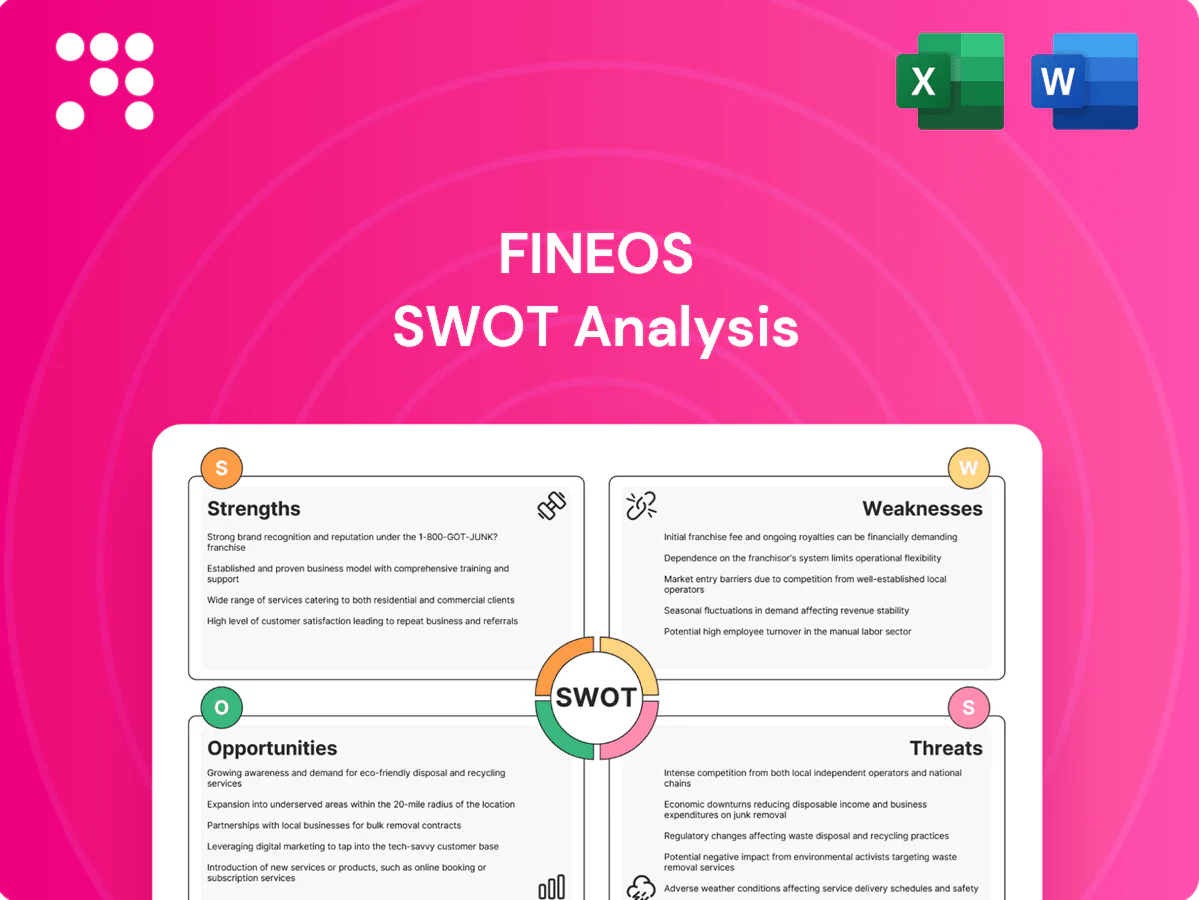
FINEOS SWOT Analysis

Elevate Your Analysis with the Complete SWOT Report
FINEOS’ SWOT analysis highlights its core strengths in insurance-focused SaaS, competitive product suite, and recurring revenue, alongside challenges from market consolidation and implementation complexity. Discover growth opportunities and key risks mapped to financial context. Purchase the full, editable SWOT (Word + Excel) for actionable strategy, investor-ready insights, and planning tools.
Strengths

End-to-end core suite
AdminSuite spans policy, billing, claims and absence, cutting vendor sprawl by consolidating point solutions. Insurers get a unified data model and consistent workflows across the policy-to-claim lifecycle, improving data quality and customer experience. Industry studies show platform consolidation can reduce integration points by up to 50% and lower IT operating costs ~20–30%, while simplifying upgrades and governance.
Deep life, accident, health focus
Deep life, accident and health focus aligns Fineos product design with industry rules and products, improving fit for group, voluntary and individual lines and supporting customers across 20+ countries; domain depth accelerates deployments with relevant features out of the box, often cutting configuration time by ~30%, which can boost win rates in target segments and drive recurring revenue growth.

Lifecycle coverage
Lifecycle coverage across group, voluntary and individual lets carriers consolidate multi-line administration on one platform, standardize core processes while configuring line-specific rules, and surface cross-line insights to refine underwriting and service delivery. This creates scale economies for clients and increases customer stickiness for FINEOS, which is publicly listed on the Australian Securities Exchange under ticker FCL.

Claims and absence strengths
Integrated claims and absence management enables carriers to meet complex leave and benefits regulations across jurisdictions, improving compliance and speed to settlement.
Coordinated handling reduces leakage and enhances claimant experience while automation lowers cycle times and manual errors, a capability cited by carriers as a competitive differentiator in employer benefits markets.
- serves global carriers and life/health insurers
- reduces leakage and processing errors through coordinated workflows
Digital transformation enabler
FINEOS modernizes legacy operations and customer service through a platform with workflow orchestration, APIs, and configurable processes, enabling insurers to digitize claims and benefits handling and improve member, employer, and broker experiences; this can lift retention and accelerate product launches.
- Used by insurers across 20+ countries
- API-driven configurable workflows
- Improves retention and time-to-market for products
Unified policy-to-claim platform reduces vendor sprawl and shortens claim cycles
AdminSuite consolidates policy-to-claim functions, improving data quality and customer experience while cutting vendor sprawl. Domain focus on life, accident and health speeds deployments and fits group/voluntary/individual lines. Integrated claims and absence management reduces leakage, lowers cycle times and strengthens compliance.
| Metric | Value |
|---|---|
| Countries served | 20+ |
| Integration points reduced | up to 50% |
| IT operating cost reduction | ~20–30% |
| Config time cut | ~30% |
What is included in the product
 Detailed Word Document
Provides a clear SWOT framework analyzing FINEOS’s internal capabilities and market position, outlining key strengths and weaknesses alongside growth opportunities and external threats shaping its competitive future.

 Customizable Excel Spreadsheet
Provides a focused FINEOS SWOT matrix that highlights key strengths, weaknesses, opportunities and threats to quickly identify and relieve strategic pain points for faster decision-making.
Weaknesses

Niche TAM concentration
FINEOS's focus on life, accident and health (L/A/H) narrows its total addressable market relative to multi-industry platforms; FY2024 revenue of EUR 143m highlights growth within a constrained segment rather than broad market reach. Future expansion depends on deeper penetration of existing insurers and upsell; cyclicality in benefits spending—tied to employment and economic cycles—can compress licence and services demand. Diversification options beyond L/A/H remain limited, raising concentration risk.
Complex implementations
Core system replacements for FINEOS implementations commonly span 12–36 months and require multi-million-dollar budgets, making projects lengthy and resource-intensive. These engagements carry change-management and migration risks that can disrupt operations and delay go-lives. High costs and timelines deter mid-market buyers who seek faster, lower-cost cloud alternatives. Any implementation delays can harm client satisfaction and reduce referenceability, impacting future sales.

Customization overhead
Highly configurable FINEOS deployments often demand specialized skills, increasing implementation and support complexity. Excess tailoring raises maintenance and upgrade friction; Gartner estimates maintenance/operations consume about 60–70% of enterprise software spend, slowing innovation uptake for clients. Standish Group data showing only ~31% of IT projects fully succeed underscores the risk that heavy customization can raise total cost of ownership and project failure rates.

Sales cycle dependency
Large enterprise deals require multi-stakeholder approvals—buying groups average 6–7 decision-makers (CEB/McKinsey)—so Fineos faces prolonged negotiation and alignment overhead. Procurement scrutiny and budget timing commonly extend cycles to 6–12 months (industry benchmarks), making revenue lumpy and forecasting harder. Close rates depend heavily on partner alignment to navigate approvals and timing.
- 6–7 decision-makers slows approvals
- 6–12 month enterprise sales cycles
- Revenue lumpy; forecasting challenged
- Partner alignment critical to close
Competitive pressure
Competitive pressure drains budgets as rivals such as Guidewire, Duck Creek and major cloud vendors target the same insurance-suite and workflow spend; larger vendors bundle adjacent capabilities, making wins harder and forcing continual reinforcement of differentiation.
Price competition can compress margins, forcing ongoing R&D and sales investment to protect ARR and preserve profit margins.
Narrow L/A/H focus caps TAM; EUR 143m FY2024 and long, costly 12–36 months implementations
FINEOS's L/A/H focus limits TAM; FY2024 revenue EUR 143m shows constrained scale. Implementations 12–36 months with multi-million budgets deter mid-market; heavy customization raises TCO and upgrade risk (maintenance 60–70% spend; ~31% IT projects fully succeed). Sales cycles 6–12 months with 6–7 decision-makers make revenue lumpy; competition compresses margins.
| Metric | Value |
|---|---|
| FY2024 revenue | EUR 143m |
| Implementation | 12–36 months |
| Maintenance spend | 60–70% |
| Project success | ~31% |
| Sales cycle | 6–12 months |
| Decision-makers | 6–7 |
Preview Before You Purchase
FINEOS SWOT Analysis
This is the actual FINEOS SWOT analysis document you’ll receive upon purchase—no surprises, just professional quality. The preview below is taken directly from the full report and reflects the same structured, editable file included in your download. Buy now to unlock the complete, detailed version with immediate access after checkout.

Elevate Your Analysis with the Complete SWOT Report
FINEOS’ SWOT analysis highlights its core strengths in insurance-focused SaaS, competitive product suite, and recurring revenue, alongside challenges from market consolidation and implementation complexity. Discover growth opportunities and key risks mapped to financial context. Purchase the full, editable SWOT (Word + Excel) for actionable strategy, investor-ready insights, and planning tools.
Strengths
End-to-end core suite
AdminSuite spans policy, billing, claims and absence, cutting vendor sprawl by consolidating point solutions. Insurers get a unified data model and consistent workflows across the policy-to-claim lifecycle, improving data quality and customer experience. Industry studies show platform consolidation can reduce integration points by up to 50% and lower IT operating costs ~20–30%, while simplifying upgrades and governance.
Deep life, accident, health focus
Deep life, accident and health focus aligns Fineos product design with industry rules and products, improving fit for group, voluntary and individual lines and supporting customers across 20+ countries; domain depth accelerates deployments with relevant features out of the box, often cutting configuration time by ~30%, which can boost win rates in target segments and drive recurring revenue growth.
Lifecycle coverage
Lifecycle coverage across group, voluntary and individual lets carriers consolidate multi-line administration on one platform, standardize core processes while configuring line-specific rules, and surface cross-line insights to refine underwriting and service delivery. This creates scale economies for clients and increases customer stickiness for FINEOS, which is publicly listed on the Australian Securities Exchange under ticker FCL.
Claims and absence strengths
Integrated claims and absence management enables carriers to meet complex leave and benefits regulations across jurisdictions, improving compliance and speed to settlement.
Coordinated handling reduces leakage and enhances claimant experience while automation lowers cycle times and manual errors, a capability cited by carriers as a competitive differentiator in employer benefits markets.
- serves global carriers and life/health insurers
- reduces leakage and processing errors through coordinated workflows
Digital transformation enabler
FINEOS modernizes legacy operations and customer service through a platform with workflow orchestration, APIs, and configurable processes, enabling insurers to digitize claims and benefits handling and improve member, employer, and broker experiences; this can lift retention and accelerate product launches.
- Used by insurers across 20+ countries
- API-driven configurable workflows
- Improves retention and time-to-market for products
Unified policy-to-claim platform reduces vendor sprawl and shortens claim cycles
AdminSuite consolidates policy-to-claim functions, improving data quality and customer experience while cutting vendor sprawl. Domain focus on life, accident and health speeds deployments and fits group/voluntary/individual lines. Integrated claims and absence management reduces leakage, lowers cycle times and strengthens compliance.
| Metric | Value |
|---|---|
| Countries served | 20+ |
| Integration points reduced | up to 50% |
| IT operating cost reduction | ~20–30% |
| Config time cut | ~30% |
What is included in the product
Detailed Word Document
Provides a clear SWOT framework analyzing FINEOS’s internal capabilities and market position, outlining key strengths and weaknesses alongside growth opportunities and external threats shaping its competitive future.
Customizable Excel Spreadsheet
Provides a focused FINEOS SWOT matrix that highlights key strengths, weaknesses, opportunities and threats to quickly identify and relieve strategic pain points for faster decision-making.
Weaknesses
Niche TAM concentration
FINEOS's focus on life, accident and health (L/A/H) narrows its total addressable market relative to multi-industry platforms; FY2024 revenue of EUR 143m highlights growth within a constrained segment rather than broad market reach. Future expansion depends on deeper penetration of existing insurers and upsell; cyclicality in benefits spending—tied to employment and economic cycles—can compress licence and services demand. Diversification options beyond L/A/H remain limited, raising concentration risk.
Complex implementations
Core system replacements for FINEOS implementations commonly span 12–36 months and require multi-million-dollar budgets, making projects lengthy and resource-intensive. These engagements carry change-management and migration risks that can disrupt operations and delay go-lives. High costs and timelines deter mid-market buyers who seek faster, lower-cost cloud alternatives. Any implementation delays can harm client satisfaction and reduce referenceability, impacting future sales.
Customization overhead
Highly configurable FINEOS deployments often demand specialized skills, increasing implementation and support complexity. Excess tailoring raises maintenance and upgrade friction; Gartner estimates maintenance/operations consume about 60–70% of enterprise software spend, slowing innovation uptake for clients. Standish Group data showing only ~31% of IT projects fully succeed underscores the risk that heavy customization can raise total cost of ownership and project failure rates.
Sales cycle dependency
Large enterprise deals require multi-stakeholder approvals—buying groups average 6–7 decision-makers (CEB/McKinsey)—so Fineos faces prolonged negotiation and alignment overhead. Procurement scrutiny and budget timing commonly extend cycles to 6–12 months (industry benchmarks), making revenue lumpy and forecasting harder. Close rates depend heavily on partner alignment to navigate approvals and timing.
- 6–7 decision-makers slows approvals
- 6–12 month enterprise sales cycles
- Revenue lumpy; forecasting challenged
- Partner alignment critical to close
Competitive pressure
Competitive pressure drains budgets as rivals such as Guidewire, Duck Creek and major cloud vendors target the same insurance-suite and workflow spend; larger vendors bundle adjacent capabilities, making wins harder and forcing continual reinforcement of differentiation.
Price competition can compress margins, forcing ongoing R&D and sales investment to protect ARR and preserve profit margins.
Narrow L/A/H focus caps TAM; EUR 143m FY2024 and long, costly 12–36 months implementations
FINEOS's L/A/H focus limits TAM; FY2024 revenue EUR 143m shows constrained scale. Implementations 12–36 months with multi-million budgets deter mid-market; heavy customization raises TCO and upgrade risk (maintenance 60–70% spend; ~31% IT projects fully succeed). Sales cycles 6–12 months with 6–7 decision-makers make revenue lumpy; competition compresses margins.
| Metric | Value |
|---|---|
| FY2024 revenue | EUR 143m |
| Implementation | 12–36 months |
| Maintenance spend | 60–70% |
| Project success | ~31% |
| Sales cycle | 6–12 months |
| Decision-makers | 6–7 |
Preview Before You Purchase
FINEOS SWOT Analysis
This is the actual FINEOS SWOT analysis document you’ll receive upon purchase—no surprises, just professional quality. The preview below is taken directly from the full report and reflects the same structured, editable file included in your download. Buy now to unlock the complete, detailed version with immediate access after checkout.
Original: $10.00
-65%$10.00
$3.50Description
Elevate Your Analysis with the Complete SWOT Report
FINEOS’ SWOT analysis highlights its core strengths in insurance-focused SaaS, competitive product suite, and recurring revenue, alongside challenges from market consolidation and implementation complexity. Discover growth opportunities and key risks mapped to financial context. Purchase the full, editable SWOT (Word + Excel) for actionable strategy, investor-ready insights, and planning tools.
Strengths
End-to-end core suite
AdminSuite spans policy, billing, claims and absence, cutting vendor sprawl by consolidating point solutions. Insurers get a unified data model and consistent workflows across the policy-to-claim lifecycle, improving data quality and customer experience. Industry studies show platform consolidation can reduce integration points by up to 50% and lower IT operating costs ~20–30%, while simplifying upgrades and governance.
Deep life, accident, health focus
Deep life, accident and health focus aligns Fineos product design with industry rules and products, improving fit for group, voluntary and individual lines and supporting customers across 20+ countries; domain depth accelerates deployments with relevant features out of the box, often cutting configuration time by ~30%, which can boost win rates in target segments and drive recurring revenue growth.
Lifecycle coverage
Lifecycle coverage across group, voluntary and individual lets carriers consolidate multi-line administration on one platform, standardize core processes while configuring line-specific rules, and surface cross-line insights to refine underwriting and service delivery. This creates scale economies for clients and increases customer stickiness for FINEOS, which is publicly listed on the Australian Securities Exchange under ticker FCL.
Claims and absence strengths
Integrated claims and absence management enables carriers to meet complex leave and benefits regulations across jurisdictions, improving compliance and speed to settlement.
Coordinated handling reduces leakage and enhances claimant experience while automation lowers cycle times and manual errors, a capability cited by carriers as a competitive differentiator in employer benefits markets.
- serves global carriers and life/health insurers
- reduces leakage and processing errors through coordinated workflows
Digital transformation enabler
FINEOS modernizes legacy operations and customer service through a platform with workflow orchestration, APIs, and configurable processes, enabling insurers to digitize claims and benefits handling and improve member, employer, and broker experiences; this can lift retention and accelerate product launches.
- Used by insurers across 20+ countries
- API-driven configurable workflows
- Improves retention and time-to-market for products
Unified policy-to-claim platform reduces vendor sprawl and shortens claim cycles
AdminSuite consolidates policy-to-claim functions, improving data quality and customer experience while cutting vendor sprawl. Domain focus on life, accident and health speeds deployments and fits group/voluntary/individual lines. Integrated claims and absence management reduces leakage, lowers cycle times and strengthens compliance.
| Metric | Value |
|---|---|
| Countries served | 20+ |
| Integration points reduced | up to 50% |
| IT operating cost reduction | ~20–30% |
| Config time cut | ~30% |
What is included in the product
Detailed Word Document
Provides a clear SWOT framework analyzing FINEOS’s internal capabilities and market position, outlining key strengths and weaknesses alongside growth opportunities and external threats shaping its competitive future.
Customizable Excel Spreadsheet
Provides a focused FINEOS SWOT matrix that highlights key strengths, weaknesses, opportunities and threats to quickly identify and relieve strategic pain points for faster decision-making.
Weaknesses
Niche TAM concentration
FINEOS's focus on life, accident and health (L/A/H) narrows its total addressable market relative to multi-industry platforms; FY2024 revenue of EUR 143m highlights growth within a constrained segment rather than broad market reach. Future expansion depends on deeper penetration of existing insurers and upsell; cyclicality in benefits spending—tied to employment and economic cycles—can compress licence and services demand. Diversification options beyond L/A/H remain limited, raising concentration risk.
Complex implementations
Core system replacements for FINEOS implementations commonly span 12–36 months and require multi-million-dollar budgets, making projects lengthy and resource-intensive. These engagements carry change-management and migration risks that can disrupt operations and delay go-lives. High costs and timelines deter mid-market buyers who seek faster, lower-cost cloud alternatives. Any implementation delays can harm client satisfaction and reduce referenceability, impacting future sales.
Customization overhead
Highly configurable FINEOS deployments often demand specialized skills, increasing implementation and support complexity. Excess tailoring raises maintenance and upgrade friction; Gartner estimates maintenance/operations consume about 60–70% of enterprise software spend, slowing innovation uptake for clients. Standish Group data showing only ~31% of IT projects fully succeed underscores the risk that heavy customization can raise total cost of ownership and project failure rates.
Sales cycle dependency
Large enterprise deals require multi-stakeholder approvals—buying groups average 6–7 decision-makers (CEB/McKinsey)—so Fineos faces prolonged negotiation and alignment overhead. Procurement scrutiny and budget timing commonly extend cycles to 6–12 months (industry benchmarks), making revenue lumpy and forecasting harder. Close rates depend heavily on partner alignment to navigate approvals and timing.
- 6–7 decision-makers slows approvals
- 6–12 month enterprise sales cycles
- Revenue lumpy; forecasting challenged
- Partner alignment critical to close
Competitive pressure
Competitive pressure drains budgets as rivals such as Guidewire, Duck Creek and major cloud vendors target the same insurance-suite and workflow spend; larger vendors bundle adjacent capabilities, making wins harder and forcing continual reinforcement of differentiation.
Price competition can compress margins, forcing ongoing R&D and sales investment to protect ARR and preserve profit margins.
Narrow L/A/H focus caps TAM; EUR 143m FY2024 and long, costly 12–36 months implementations
FINEOS's L/A/H focus limits TAM; FY2024 revenue EUR 143m shows constrained scale. Implementations 12–36 months with multi-million budgets deter mid-market; heavy customization raises TCO and upgrade risk (maintenance 60–70% spend; ~31% IT projects fully succeed). Sales cycles 6–12 months with 6–7 decision-makers make revenue lumpy; competition compresses margins.
| Metric | Value |
|---|---|
| FY2024 revenue | EUR 143m |
| Implementation | 12–36 months |
| Maintenance spend | 60–70% |
| Project success | ~31% |
| Sales cycle | 6–12 months |
| Decision-makers | 6–7 |
Preview Before You Purchase
FINEOS SWOT Analysis
This is the actual FINEOS SWOT analysis document you’ll receive upon purchase—no surprises, just professional quality. The preview below is taken directly from the full report and reflects the same structured, editable file included in your download. Buy now to unlock the complete, detailed version with immediate access after checkout.











