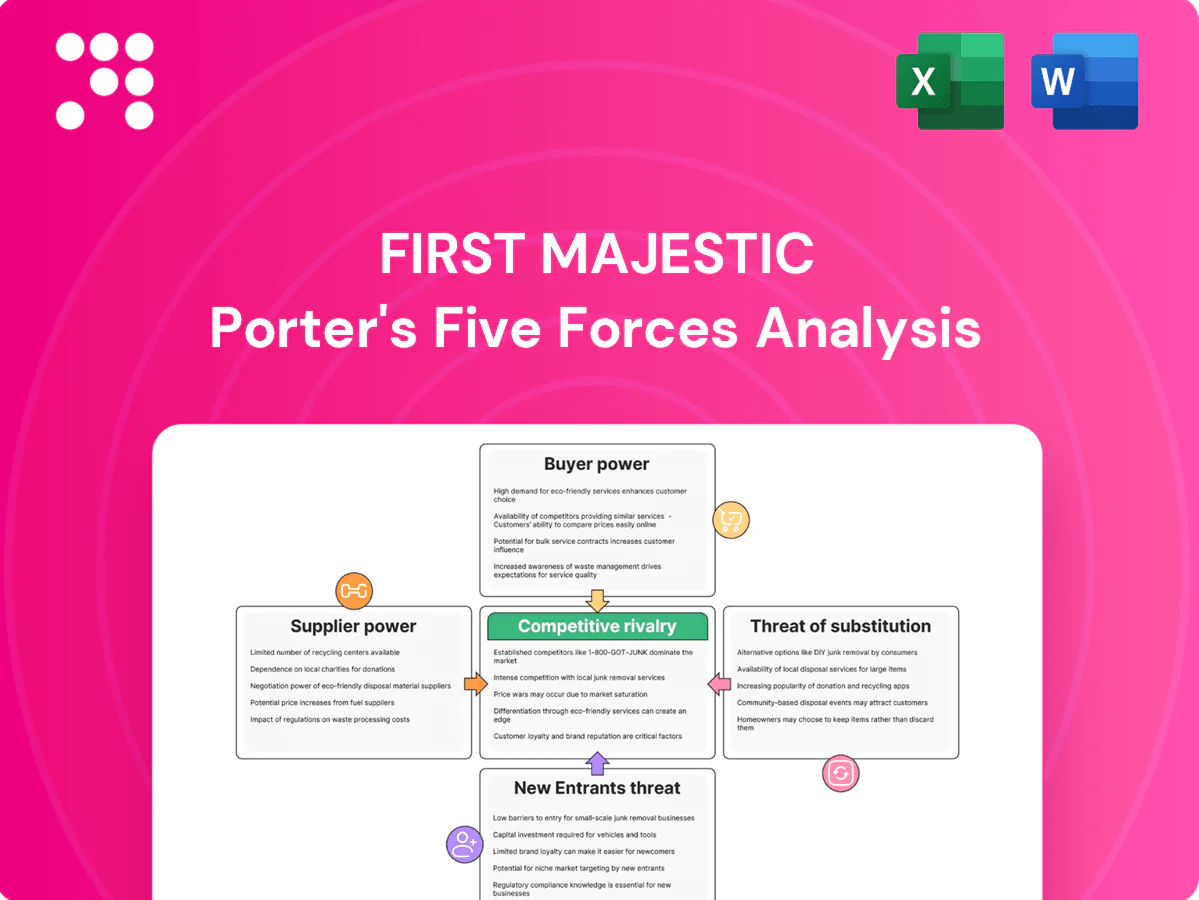
First Majestic Porter's Five Forces Analysis

Go Beyond the Preview—Access the Full Strategic Report
First Majestic’s Porter’s Five Forces snapshot highlights competitive intensity in silver mining, supplier bargaining over inputs, and regulatory and commodity-price pressures that shape margins. This preview teases force-by-force implications; unlock the full analysis for detailed ratings, visuals, and actionable strategy to inform investment or corporate decisions.
Suppliers Bargaining Power

Specialized equipment vendors
Specialized underground and processing equipment is dominated by a few OEMs—notably Sandvik, Epiroc and Caterpillar—concentrating supplier power; 2023–24 supply-chain strains lengthened lead times and raised downtime risk. First Majestic mitigates via multi-sourcing, rebuild programs and long-term service agreements, but switching costs and technical lock-in remain material.
Energy and reagent inputs
Suppliers of diesel, explosives, cyanide and grinding media exert material bargaining power given their criticality and price volatility; Brent averaged about 81 USD/bbl in 2024, feeding diesel and input cost pressure in Mexico. Regional grid constraints and retail fuel pricing in Mexico heighten supplier leverage. First Majestic uses hedging and bulk contracts to dampen swings and process efficiencies to cut intensity, but pass-through remains unavoidable.

Skilled labor and contractors
Experienced miners, engineers and maintenance crews remain scarce in key Mexican districts where First Majestic operates, and 2024 labor talks reflect strong union leverage and stringent safety compliance that complicate negotiations; contractor availability for development and drilling has fluctuated with the commodity cycle, and despite local training and retention programs the company continues to face upward wage pressure.

Smelters and refiners
Smelters and refiners set treatment and refining charges (TCRs) for silver dore and concentrates, with penalties for impurities and rigid contract terms that can erode netbacks; 2024 silver averaged about $25/oz, making TCRs a meaningful drag on margins. Limited global smelter capacity concentrates leverage among a few operators, while diversifying offtake, improving concentrate grade and proximity to smelters reduce that power.
- 2024 silver avg price: ~$25/oz
- High TCRs and penalty clauses cut netbacks
- Diversify offtake and raise concentrate grade
- Logistics proximity lowers smelter bargaining leverage
Community and land access
Community and land access via ejidos and local stakeholders function as critical suppliers of social license; their bargaining power escalates with rising environmental scrutiny and stricter 2024 regulatory expectations, making benefit-sharing and ESG performance central to operational continuity.
Disruptions to access have proven costly for Mexican miners, so proactive engagement, transparent agreements and measurable ESG commitments are essential.
- Ejidos as gatekeepers
- ESG-linked cost exposure
- Benefit-sharing = continuity
- Proactive engagement mitigates disruption
Supplier power spikes costs; Brent $81/bbl, silver $25/oz
Specialized OEMs (Sandvik, Epiroc, Caterpillar) and smelters/inputs (diesel, cyanide) exert material supplier power; 2024 Brent ~81 USD/bbl and silver ~25 USD/oz amplified cost pressure. Labor, contractors and ejidos add local leverage via wages and social license. First Majestic uses multi-sourcing, hedges and long-term contracts, yet switching costs and TCRs keep supplier risk elevated.
| Supplier | 2024 metric | Impact |
|---|---|---|
| Fuel (diesel) | Brent ~81 USD/bbl | Higher opex |
| Precious metal | Silver ~25 USD/oz | TCRs hit netbacks |
| OEMs/smelters | Concentrated | Switching costs |
What is included in the product
 Detailed Word Document
Tailored Porter’s Five Forces analysis for First Majestic that assesses competitive rivalry, buyer and supplier power, and barriers to entry. Identifies disruptive threats and substitutes, highlighting impacts on pricing, profitability, and strategic positioning.

 Customizable Excel Spreadsheet
A concise, one-sheet Porter's Five Forces for First Majestic—ideal for quick strategic decisions and investor briefings. Editable pressure scores and radar chart visualize threats and opportunities, ready to drop into decks or Excel dashboards without macros.
Customers Bargaining Power

Commodity traders and offtakers
Silver is globally priced on markets such as the LBMA, averaging about 27.5 USD/oz in 2024, which limits buyer negotiation on the base metal price but shifts leverage to transactional terms. Large commodity traders and offtakers use scale to press First Majestic on delivery schedules, assay/quality specifications and payment terms. Long-term offtake relationships and a diversified counterparty base reduce concentration risk for the company. Product form matters: dore typically gives producers stronger negotiating power than lower-grade concentrate due to processing/cost differentials.
Industrial users
Electronics, solar and chemical buyers typically source via intermediaries at LBMA/benchmark prices, with industrial silver demand around 400 million ounces in 2024, giving their bargaining power indirect influence through demand cycles and purity specs.
First Majestic secures favorable acceptance by prioritizing process efficiency and consistent assays, while substitution in certain applications can reduce off-take during high-price periods.

Financial and investment demand
Investment bars, coins and ETFs move silver prices via capital flows rather than bilateral bargaining; global silver ETFs held about 300 million oz at end-2024, amplifying liquidity-driven price moves. Liquidity-sensitive swings increased realized volatility in 2024, boosting upside for First Majestic’s spot-exposed revenues while heightening downside risk. Marketing premiums on branded products remain limited by ongoing commoditization.

Geographic diversification of buyers
Geographic diversification of buyers across the US, Asia and Europe reduces any single buyer’s leverage over First Majestic, allowing the company to shift shipments to higher-paying regions and improve realized pricing through contract optionality. However, logistics constraints or export bottlenecks can temporarily re-concentrate bargaining power at ports or regional traders. Varying compliance and documentation standards across jurisdictions increase transactional friction and can raise selling cycle times and costs.
- Access to multiple markets: dilution of single-buyer influence
- Logistics/export bottlenecks: potential re-concentration of power
- Contract optionality: improves realized regional pricing
- Compliance variance: increases transactional friction
Quality and specification requirements
Tighter impurity thresholds give smelters and traders leverage through penalties or shipment rejections, increasing customer bargaining power over First Majestic. Capital spending on metallurgy and mill upgrades that improved recoveries and purity historically shifts negotiating power back to producers by reducing off-spec volumes. Robust QA/QC and consistent product streams lower claims, renegotiations, and enable firmer contract terms.
- penalties/rejections pressure pricing
- metallurgy investment reduces off-spec tonnage
- QA/QC cuts claims and renegotiation frequency
- consistent streams support stronger contracts
LBMA price cap (27.5 USD/oz) shifts negotiation; ETFs ≈300m oz
Global LBMA-linked pricing (avg 27.5 USD/oz in 2024) limits buyer leverage on metal price but shifts negotiation to terms, assays and logistics.
Large traders/offtakers and tighter impurity thresholds increase customer bargaining power; metallurgy upgrades and QA/QC reduce it.
Diversified buyers across US/Asia/Europe and long-term contracts dilute single-buyer risk despite ETF-driven liquidity (≈300m oz end-2024).
| Metric | 2024 |
|---|---|
| Silver price (avg) | 27.5 USD/oz |
| Industrial demand | ≈400m oz |
| ETF holdings | ≈300m oz |
Preview the Actual Deliverable
First Majestic Porter's Five Forces Analysis
This preview displays the exact First Majestic Porter's Five Forces Analysis you'll receive—no placeholders, no samples. The full document is fully formatted and ready for immediate download and use upon purchase. What you see here is precisely the deliverable you'll get instantly after payment.

Go Beyond the Preview—Access the Full Strategic Report
First Majestic’s Porter’s Five Forces snapshot highlights competitive intensity in silver mining, supplier bargaining over inputs, and regulatory and commodity-price pressures that shape margins. This preview teases force-by-force implications; unlock the full analysis for detailed ratings, visuals, and actionable strategy to inform investment or corporate decisions.
Suppliers Bargaining Power
Specialized equipment vendors
Specialized underground and processing equipment is dominated by a few OEMs—notably Sandvik, Epiroc and Caterpillar—concentrating supplier power; 2023–24 supply-chain strains lengthened lead times and raised downtime risk. First Majestic mitigates via multi-sourcing, rebuild programs and long-term service agreements, but switching costs and technical lock-in remain material.
Energy and reagent inputs
Suppliers of diesel, explosives, cyanide and grinding media exert material bargaining power given their criticality and price volatility; Brent averaged about 81 USD/bbl in 2024, feeding diesel and input cost pressure in Mexico. Regional grid constraints and retail fuel pricing in Mexico heighten supplier leverage. First Majestic uses hedging and bulk contracts to dampen swings and process efficiencies to cut intensity, but pass-through remains unavoidable.
Skilled labor and contractors
Experienced miners, engineers and maintenance crews remain scarce in key Mexican districts where First Majestic operates, and 2024 labor talks reflect strong union leverage and stringent safety compliance that complicate negotiations; contractor availability for development and drilling has fluctuated with the commodity cycle, and despite local training and retention programs the company continues to face upward wage pressure.
Smelters and refiners
Smelters and refiners set treatment and refining charges (TCRs) for silver dore and concentrates, with penalties for impurities and rigid contract terms that can erode netbacks; 2024 silver averaged about $25/oz, making TCRs a meaningful drag on margins. Limited global smelter capacity concentrates leverage among a few operators, while diversifying offtake, improving concentrate grade and proximity to smelters reduce that power.
- 2024 silver avg price: ~$25/oz
- High TCRs and penalty clauses cut netbacks
- Diversify offtake and raise concentrate grade
- Logistics proximity lowers smelter bargaining leverage
Community and land access
Community and land access via ejidos and local stakeholders function as critical suppliers of social license; their bargaining power escalates with rising environmental scrutiny and stricter 2024 regulatory expectations, making benefit-sharing and ESG performance central to operational continuity.
Disruptions to access have proven costly for Mexican miners, so proactive engagement, transparent agreements and measurable ESG commitments are essential.
- Ejidos as gatekeepers
- ESG-linked cost exposure
- Benefit-sharing = continuity
- Proactive engagement mitigates disruption
Supplier power spikes costs; Brent $81/bbl, silver $25/oz
Specialized OEMs (Sandvik, Epiroc, Caterpillar) and smelters/inputs (diesel, cyanide) exert material supplier power; 2024 Brent ~81 USD/bbl and silver ~25 USD/oz amplified cost pressure. Labor, contractors and ejidos add local leverage via wages and social license. First Majestic uses multi-sourcing, hedges and long-term contracts, yet switching costs and TCRs keep supplier risk elevated.
| Supplier | 2024 metric | Impact |
|---|---|---|
| Fuel (diesel) | Brent ~81 USD/bbl | Higher opex |
| Precious metal | Silver ~25 USD/oz | TCRs hit netbacks |
| OEMs/smelters | Concentrated | Switching costs |
What is included in the product
Detailed Word Document
Tailored Porter’s Five Forces analysis for First Majestic that assesses competitive rivalry, buyer and supplier power, and barriers to entry. Identifies disruptive threats and substitutes, highlighting impacts on pricing, profitability, and strategic positioning.
Customizable Excel Spreadsheet
A concise, one-sheet Porter's Five Forces for First Majestic—ideal for quick strategic decisions and investor briefings. Editable pressure scores and radar chart visualize threats and opportunities, ready to drop into decks or Excel dashboards without macros.
Customers Bargaining Power
Commodity traders and offtakers
Silver is globally priced on markets such as the LBMA, averaging about 27.5 USD/oz in 2024, which limits buyer negotiation on the base metal price but shifts leverage to transactional terms. Large commodity traders and offtakers use scale to press First Majestic on delivery schedules, assay/quality specifications and payment terms. Long-term offtake relationships and a diversified counterparty base reduce concentration risk for the company. Product form matters: dore typically gives producers stronger negotiating power than lower-grade concentrate due to processing/cost differentials.
Industrial users
Electronics, solar and chemical buyers typically source via intermediaries at LBMA/benchmark prices, with industrial silver demand around 400 million ounces in 2024, giving their bargaining power indirect influence through demand cycles and purity specs.
First Majestic secures favorable acceptance by prioritizing process efficiency and consistent assays, while substitution in certain applications can reduce off-take during high-price periods.
Financial and investment demand
Investment bars, coins and ETFs move silver prices via capital flows rather than bilateral bargaining; global silver ETFs held about 300 million oz at end-2024, amplifying liquidity-driven price moves. Liquidity-sensitive swings increased realized volatility in 2024, boosting upside for First Majestic’s spot-exposed revenues while heightening downside risk. Marketing premiums on branded products remain limited by ongoing commoditization.
Geographic diversification of buyers
Geographic diversification of buyers across the US, Asia and Europe reduces any single buyer’s leverage over First Majestic, allowing the company to shift shipments to higher-paying regions and improve realized pricing through contract optionality. However, logistics constraints or export bottlenecks can temporarily re-concentrate bargaining power at ports or regional traders. Varying compliance and documentation standards across jurisdictions increase transactional friction and can raise selling cycle times and costs.
- Access to multiple markets: dilution of single-buyer influence
- Logistics/export bottlenecks: potential re-concentration of power
- Contract optionality: improves realized regional pricing
- Compliance variance: increases transactional friction
Quality and specification requirements
Tighter impurity thresholds give smelters and traders leverage through penalties or shipment rejections, increasing customer bargaining power over First Majestic. Capital spending on metallurgy and mill upgrades that improved recoveries and purity historically shifts negotiating power back to producers by reducing off-spec volumes. Robust QA/QC and consistent product streams lower claims, renegotiations, and enable firmer contract terms.
- penalties/rejections pressure pricing
- metallurgy investment reduces off-spec tonnage
- QA/QC cuts claims and renegotiation frequency
- consistent streams support stronger contracts
LBMA price cap (27.5 USD/oz) shifts negotiation; ETFs ≈300m oz
Global LBMA-linked pricing (avg 27.5 USD/oz in 2024) limits buyer leverage on metal price but shifts negotiation to terms, assays and logistics.
Large traders/offtakers and tighter impurity thresholds increase customer bargaining power; metallurgy upgrades and QA/QC reduce it.
Diversified buyers across US/Asia/Europe and long-term contracts dilute single-buyer risk despite ETF-driven liquidity (≈300m oz end-2024).
| Metric | 2024 |
|---|---|
| Silver price (avg) | 27.5 USD/oz |
| Industrial demand | ≈400m oz |
| ETF holdings | ≈300m oz |
Preview the Actual Deliverable
First Majestic Porter's Five Forces Analysis
This preview displays the exact First Majestic Porter's Five Forces Analysis you'll receive—no placeholders, no samples. The full document is fully formatted and ready for immediate download and use upon purchase. What you see here is precisely the deliverable you'll get instantly after payment.
Original: $10.00
-65%$10.00
$3.50Description
Go Beyond the Preview—Access the Full Strategic Report
First Majestic’s Porter’s Five Forces snapshot highlights competitive intensity in silver mining, supplier bargaining over inputs, and regulatory and commodity-price pressures that shape margins. This preview teases force-by-force implications; unlock the full analysis for detailed ratings, visuals, and actionable strategy to inform investment or corporate decisions.
Suppliers Bargaining Power
Specialized equipment vendors
Specialized underground and processing equipment is dominated by a few OEMs—notably Sandvik, Epiroc and Caterpillar—concentrating supplier power; 2023–24 supply-chain strains lengthened lead times and raised downtime risk. First Majestic mitigates via multi-sourcing, rebuild programs and long-term service agreements, but switching costs and technical lock-in remain material.
Energy and reagent inputs
Suppliers of diesel, explosives, cyanide and grinding media exert material bargaining power given their criticality and price volatility; Brent averaged about 81 USD/bbl in 2024, feeding diesel and input cost pressure in Mexico. Regional grid constraints and retail fuel pricing in Mexico heighten supplier leverage. First Majestic uses hedging and bulk contracts to dampen swings and process efficiencies to cut intensity, but pass-through remains unavoidable.
Skilled labor and contractors
Experienced miners, engineers and maintenance crews remain scarce in key Mexican districts where First Majestic operates, and 2024 labor talks reflect strong union leverage and stringent safety compliance that complicate negotiations; contractor availability for development and drilling has fluctuated with the commodity cycle, and despite local training and retention programs the company continues to face upward wage pressure.
Smelters and refiners
Smelters and refiners set treatment and refining charges (TCRs) for silver dore and concentrates, with penalties for impurities and rigid contract terms that can erode netbacks; 2024 silver averaged about $25/oz, making TCRs a meaningful drag on margins. Limited global smelter capacity concentrates leverage among a few operators, while diversifying offtake, improving concentrate grade and proximity to smelters reduce that power.
- 2024 silver avg price: ~$25/oz
- High TCRs and penalty clauses cut netbacks
- Diversify offtake and raise concentrate grade
- Logistics proximity lowers smelter bargaining leverage
Community and land access
Community and land access via ejidos and local stakeholders function as critical suppliers of social license; their bargaining power escalates with rising environmental scrutiny and stricter 2024 regulatory expectations, making benefit-sharing and ESG performance central to operational continuity.
Disruptions to access have proven costly for Mexican miners, so proactive engagement, transparent agreements and measurable ESG commitments are essential.
- Ejidos as gatekeepers
- ESG-linked cost exposure
- Benefit-sharing = continuity
- Proactive engagement mitigates disruption
Supplier power spikes costs; Brent $81/bbl, silver $25/oz
Specialized OEMs (Sandvik, Epiroc, Caterpillar) and smelters/inputs (diesel, cyanide) exert material supplier power; 2024 Brent ~81 USD/bbl and silver ~25 USD/oz amplified cost pressure. Labor, contractors and ejidos add local leverage via wages and social license. First Majestic uses multi-sourcing, hedges and long-term contracts, yet switching costs and TCRs keep supplier risk elevated.
| Supplier | 2024 metric | Impact |
|---|---|---|
| Fuel (diesel) | Brent ~81 USD/bbl | Higher opex |
| Precious metal | Silver ~25 USD/oz | TCRs hit netbacks |
| OEMs/smelters | Concentrated | Switching costs |
What is included in the product
Detailed Word Document
Tailored Porter’s Five Forces analysis for First Majestic that assesses competitive rivalry, buyer and supplier power, and barriers to entry. Identifies disruptive threats and substitutes, highlighting impacts on pricing, profitability, and strategic positioning.
Customizable Excel Spreadsheet
A concise, one-sheet Porter's Five Forces for First Majestic—ideal for quick strategic decisions and investor briefings. Editable pressure scores and radar chart visualize threats and opportunities, ready to drop into decks or Excel dashboards without macros.
Customers Bargaining Power
Commodity traders and offtakers
Silver is globally priced on markets such as the LBMA, averaging about 27.5 USD/oz in 2024, which limits buyer negotiation on the base metal price but shifts leverage to transactional terms. Large commodity traders and offtakers use scale to press First Majestic on delivery schedules, assay/quality specifications and payment terms. Long-term offtake relationships and a diversified counterparty base reduce concentration risk for the company. Product form matters: dore typically gives producers stronger negotiating power than lower-grade concentrate due to processing/cost differentials.
Industrial users
Electronics, solar and chemical buyers typically source via intermediaries at LBMA/benchmark prices, with industrial silver demand around 400 million ounces in 2024, giving their bargaining power indirect influence through demand cycles and purity specs.
First Majestic secures favorable acceptance by prioritizing process efficiency and consistent assays, while substitution in certain applications can reduce off-take during high-price periods.
Financial and investment demand
Investment bars, coins and ETFs move silver prices via capital flows rather than bilateral bargaining; global silver ETFs held about 300 million oz at end-2024, amplifying liquidity-driven price moves. Liquidity-sensitive swings increased realized volatility in 2024, boosting upside for First Majestic’s spot-exposed revenues while heightening downside risk. Marketing premiums on branded products remain limited by ongoing commoditization.
Geographic diversification of buyers
Geographic diversification of buyers across the US, Asia and Europe reduces any single buyer’s leverage over First Majestic, allowing the company to shift shipments to higher-paying regions and improve realized pricing through contract optionality. However, logistics constraints or export bottlenecks can temporarily re-concentrate bargaining power at ports or regional traders. Varying compliance and documentation standards across jurisdictions increase transactional friction and can raise selling cycle times and costs.
- Access to multiple markets: dilution of single-buyer influence
- Logistics/export bottlenecks: potential re-concentration of power
- Contract optionality: improves realized regional pricing
- Compliance variance: increases transactional friction
Quality and specification requirements
Tighter impurity thresholds give smelters and traders leverage through penalties or shipment rejections, increasing customer bargaining power over First Majestic. Capital spending on metallurgy and mill upgrades that improved recoveries and purity historically shifts negotiating power back to producers by reducing off-spec volumes. Robust QA/QC and consistent product streams lower claims, renegotiations, and enable firmer contract terms.
- penalties/rejections pressure pricing
- metallurgy investment reduces off-spec tonnage
- QA/QC cuts claims and renegotiation frequency
- consistent streams support stronger contracts
LBMA price cap (27.5 USD/oz) shifts negotiation; ETFs ≈300m oz
Global LBMA-linked pricing (avg 27.5 USD/oz in 2024) limits buyer leverage on metal price but shifts negotiation to terms, assays and logistics.
Large traders/offtakers and tighter impurity thresholds increase customer bargaining power; metallurgy upgrades and QA/QC reduce it.
Diversified buyers across US/Asia/Europe and long-term contracts dilute single-buyer risk despite ETF-driven liquidity (≈300m oz end-2024).
| Metric | 2024 |
|---|---|
| Silver price (avg) | 27.5 USD/oz |
| Industrial demand | ≈400m oz |
| ETF holdings | ≈300m oz |
Preview the Actual Deliverable
First Majestic Porter's Five Forces Analysis
This preview displays the exact First Majestic Porter's Five Forces Analysis you'll receive—no placeholders, no samples. The full document is fully formatted and ready for immediate download and use upon purchase. What you see here is precisely the deliverable you'll get instantly after payment.











