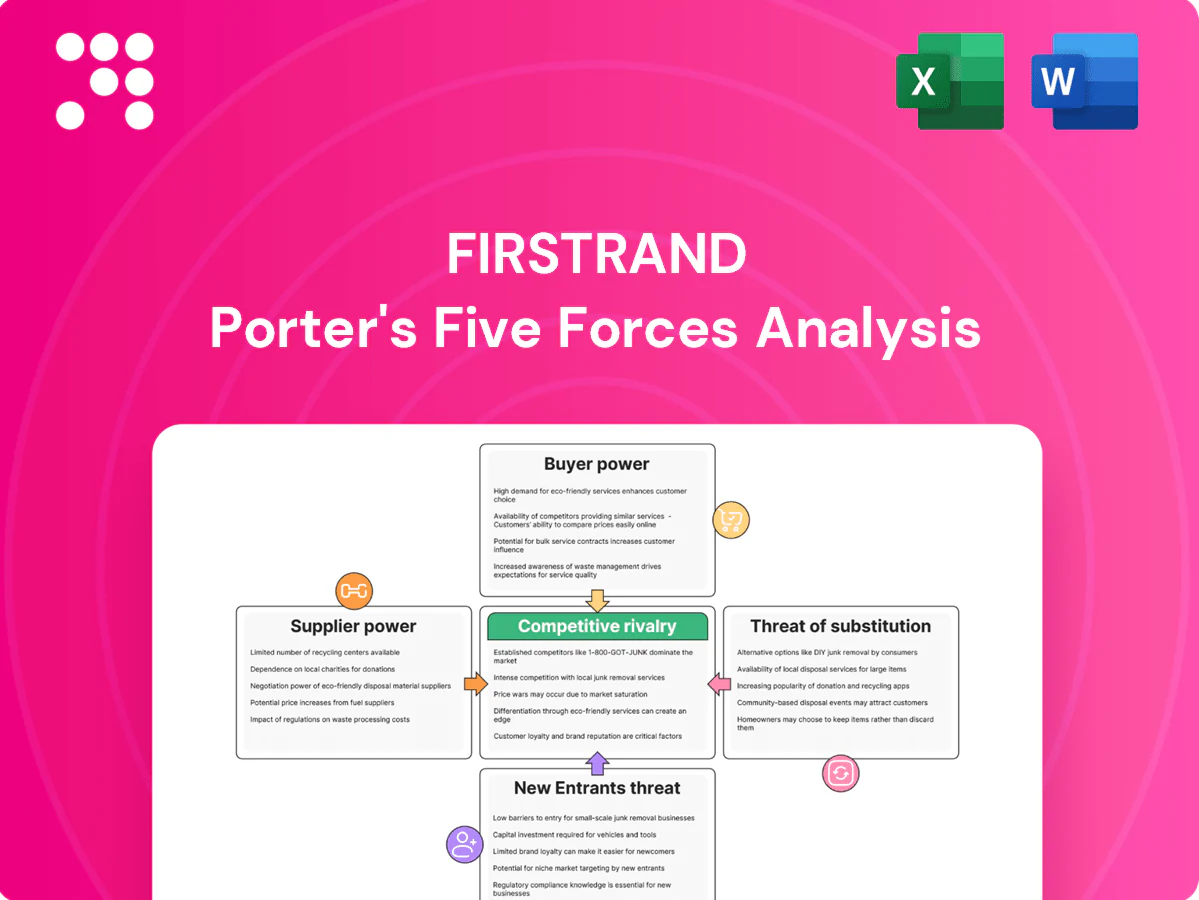
FirstRand Porter's Five Forces Analysis

Elevate Your Analysis with the Complete Porter's Five Forces Analysis
FirstRand faces moderate buyer power, low supplier pressure, significant regulatory and fintech disruption risks, and moderate rivalry across South African and African markets, shaping slim margin and growth dynamics. This brief snapshot only scratches the surface. Unlock the full Porter's Five Forces Analysis to explore FirstRand’s competitive dynamics, market pressures, and strategic advantages in detail.
Suppliers Bargaining Power

Diverse funding base tempers dependence
FirstRand funds itself from retail deposits, wholesale markets, securitisations and capital instruments, with FNB retail deposits serving as the lower-cost, less volatile backbone in 2024. Retail deposits reduced reliance on single-source wholesale funding, but stress episodes in 2024 showed shifts toward pricier institutional funding. Diversification constrains supplier leverage yet does not remove liquidity risk.
Technology and data vendors hold niche leverage
Critical systems—core banking, payments, cybersecurity, cloud and analytics—create high switching costs and integration risk, giving technology and data vendors niche leverage over FirstRand. Vendor concentration in specialized tools can elevate pricing and contract terms, while multi-vendor and selective in-house builds mitigate supplier power but add operational complexity. Long multi-year contracts and strict regulatory compliance requirements lock standards and vendor relationships in place.

Skilled talent as scarce input
Quant, risk, data‑science and engineering talent are scarce and thus command bargaining power; US BLS projects data‑science employment growth of about 36% for 2022–32, underscoring sustained demand into 2024. Retention packages and clear career paths are essential to protect IP and continuity, while wage inflation—industry salary surveys show tech pay rising roughly mid‑single digits into 2023–24—can compress margins on growth and regulatory projects. Group scale helps FirstRand source talent, but persistent global demand keeps the market tight.

Payment networks and market infrastructures
Reliance on national payments rails, card schemes and clearinghouses imposes mandatory fee schedules and technical compliance for FirstRand. Interchange and scheme fees are largely non-negotiable, limiting margin flexibility while ensuring network reach. Strategic partnerships can secure rebates but seldom shift core supplier leverage; global card schemes handle >200 billion card transactions annually in scale (2024).
- Non-negotiable interchange
- Mandatory technical standards
- Reach vs pricing constraint
- Partnerships yield rebates, not power
Regulators as quasi-suppliers of licenses
Regulators such as the South African Reserve Bank act as quasi-suppliers by gatekeeping licenses and access to capital and liquidity, with approvals directly determining FirstRand’s market access; Basel III’s CET1 minimum of 4.5% plus a 2.5% conservation buffer (7% effective) illustrates a concrete regulatory capital floor. Compliance costs are non-discretionary and recurrent, and policy shifts can reprice products or cap fees, materially affecting margins; a strong compliance track record preserves operating latitude.
- Regulatory gatekeeping: SARB approvals required for licensing and liquidity facilities
- Capital floor: CET1 minimum 4.5% + 2.5% buffer = 7%
- Cost nature: compliance costs are recurrent and non-discretionary
- Policy risk: rule changes can reprice products or cap fees
Moderate supplier power: retail deposits steady, tech/talent costs and card fees pressure margins
Supplier power is moderate: diversified funding (retail deposits as 2024 backbone) reduces single-source leverage but liquidity stress pushed pricier wholesale funding. Critical tech vendors and talent (data‑science demand +36% 2022–32) create switching costs and wage pressure. Non‑negotiable card/interchange fees (global schemes >200bn txns 2024) and regulatory capital floor (CET1 7%) cap margin flexibility.
| Metric | 2024 value |
|---|---|
| Retail deposit role | Primary low‑cost funding |
| CET1 requirement | 7% |
| Card transactions (global) | >200bn |
| Data‑science growth (2022–32) | +36% |
What is included in the product
 Detailed Word Document
Concise Porter's Five Forces analysis of FirstRand, uncovering competitive rivalry, buyer/supplier power, entry barriers, substitutes, and disruptive threats shaping its profitability.

 Customizable Excel Spreadsheet
A clear one-sheet Porter's Five Forces for FirstRand with customizable pressure levels and instant spider/radar visualization—ready to drop into pitch decks, pair with Word reports, or integrate into Excel dashboards for fast strategic decisions.
Customers Bargaining Power

Retail customers price sensitive yet sticky
Retail customers are price sensitive due to fee transparency and digital comparison tools, but FirstRand's scale—serving over 11 million customers as of 2024—and ecosystem of rewards and integrated app experiences create switching frictions. Net effect: moderate customer power; visible movement is possible but inertia and bundled value slow churn. Service quality and convenience often trump marginal price differences.
Corporate and public sector negotiate hard
Large corporates and government entities run tenders and mandate multi-bank panels, demanding bespoke pricing, balance-sheet commitments and strict service-levels, which elevates their bargaining power materially. As of 2024 FirstRand remains a top-four South African bank by assets, facing concentrated corporate clients with multiple banking alternatives. Deep cross-sell and integrated solutions help defend margins and offset tender-driven price pressure.

SMEs benefit from digital alternatives
Fintechs now offer low-cost payments, lending and invoicing that expand SME options, a concern as SMEs represent ~90% of firms and ~50% of employment (World Bank, 2024). Falling switching costs from cloud accounting and open APIs make churn easier. FirstRand mitigates this through FNB’s platform features and relationship management. Buyer power rises but can be offset by bundled value and integrated services.

Investment and insurance clients compare yields
Investment and insurance clients shop yields across money market funds, unit trusts and risk products where offerings are highly comparable, driving strong bargaining power and fee compression as passive solutions gain share.
Superior performance records and high-quality advice can retain clients despite lower-cost alternatives, while FirstRand’s multi-brand distribution through RMB and FNB supports cross-selling and stickiness.
- Comparable products: money market, unit trusts, risk products
- Pricing pressure: fee compression and rise of passives
- Retention levers: performance and advisory quality
- Distribution strength: RMB + FNB multi-brand ecosystem
Digital channels elevate transparency
Digital channels make pricing and feature visibility immediate: instant quotes and online reviews let customers compare products in seconds, driving expectations for price matching and personalized offers; FirstRand reported about 65% of customer interactions via digital channels in 2024, raising defection risk if onboarding is clunky. Data-driven personalization—using behavioral and transaction data—recaptures value by boosting relevancy and cross-sell conversion rates.
- Instant comparisons: faster decision cycles
- 65% digital interactions: higher switching threat
- Personalization: increases relevancy, conversion
- Frictionless onboarding: critical to retain customers
Scale shields retail pricing as corporates and passive investing squeeze fees
Customers exert moderate bargaining power: retail price sensitivity is offset by FirstRand’s scale (11.0m customers, 2024) and bundled app experiences; corporates and government hold strong leverage via tenders; SMEs face rising fintech options; investment clients drive fee compression as passives gain share.
| Metric | Value (2024) |
|---|---|
| Retail customers | 11.0m |
| Digital interactions | 65% |
| SME share of firms / employment | ~90% / ~50% |
What You See Is What You Get
FirstRand Porter's Five Forces Analysis
This preview is the exact FirstRand Porter's Five Forces Analysis you'll receive immediately after purchase. The file shown is fully formatted, final and ready for download. No placeholders or samples—what you see is the deliverable. Instant access upon payment.

Elevate Your Analysis with the Complete Porter's Five Forces Analysis
FirstRand faces moderate buyer power, low supplier pressure, significant regulatory and fintech disruption risks, and moderate rivalry across South African and African markets, shaping slim margin and growth dynamics. This brief snapshot only scratches the surface. Unlock the full Porter's Five Forces Analysis to explore FirstRand’s competitive dynamics, market pressures, and strategic advantages in detail.
Suppliers Bargaining Power
Diverse funding base tempers dependence
FirstRand funds itself from retail deposits, wholesale markets, securitisations and capital instruments, with FNB retail deposits serving as the lower-cost, less volatile backbone in 2024. Retail deposits reduced reliance on single-source wholesale funding, but stress episodes in 2024 showed shifts toward pricier institutional funding. Diversification constrains supplier leverage yet does not remove liquidity risk.
Technology and data vendors hold niche leverage
Critical systems—core banking, payments, cybersecurity, cloud and analytics—create high switching costs and integration risk, giving technology and data vendors niche leverage over FirstRand. Vendor concentration in specialized tools can elevate pricing and contract terms, while multi-vendor and selective in-house builds mitigate supplier power but add operational complexity. Long multi-year contracts and strict regulatory compliance requirements lock standards and vendor relationships in place.
Skilled talent as scarce input
Quant, risk, data‑science and engineering talent are scarce and thus command bargaining power; US BLS projects data‑science employment growth of about 36% for 2022–32, underscoring sustained demand into 2024. Retention packages and clear career paths are essential to protect IP and continuity, while wage inflation—industry salary surveys show tech pay rising roughly mid‑single digits into 2023–24—can compress margins on growth and regulatory projects. Group scale helps FirstRand source talent, but persistent global demand keeps the market tight.
Payment networks and market infrastructures
Reliance on national payments rails, card schemes and clearinghouses imposes mandatory fee schedules and technical compliance for FirstRand. Interchange and scheme fees are largely non-negotiable, limiting margin flexibility while ensuring network reach. Strategic partnerships can secure rebates but seldom shift core supplier leverage; global card schemes handle >200 billion card transactions annually in scale (2024).
- Non-negotiable interchange
- Mandatory technical standards
- Reach vs pricing constraint
- Partnerships yield rebates, not power
Regulators as quasi-suppliers of licenses
Regulators such as the South African Reserve Bank act as quasi-suppliers by gatekeeping licenses and access to capital and liquidity, with approvals directly determining FirstRand’s market access; Basel III’s CET1 minimum of 4.5% plus a 2.5% conservation buffer (7% effective) illustrates a concrete regulatory capital floor. Compliance costs are non-discretionary and recurrent, and policy shifts can reprice products or cap fees, materially affecting margins; a strong compliance track record preserves operating latitude.
- Regulatory gatekeeping: SARB approvals required for licensing and liquidity facilities
- Capital floor: CET1 minimum 4.5% + 2.5% buffer = 7%
- Cost nature: compliance costs are recurrent and non-discretionary
- Policy risk: rule changes can reprice products or cap fees
Moderate supplier power: retail deposits steady, tech/talent costs and card fees pressure margins
Supplier power is moderate: diversified funding (retail deposits as 2024 backbone) reduces single-source leverage but liquidity stress pushed pricier wholesale funding. Critical tech vendors and talent (data‑science demand +36% 2022–32) create switching costs and wage pressure. Non‑negotiable card/interchange fees (global schemes >200bn txns 2024) and regulatory capital floor (CET1 7%) cap margin flexibility.
| Metric | 2024 value |
|---|---|
| Retail deposit role | Primary low‑cost funding |
| CET1 requirement | 7% |
| Card transactions (global) | >200bn |
| Data‑science growth (2022–32) | +36% |
What is included in the product
Detailed Word Document
Concise Porter's Five Forces analysis of FirstRand, uncovering competitive rivalry, buyer/supplier power, entry barriers, substitutes, and disruptive threats shaping its profitability.
Customizable Excel Spreadsheet
A clear one-sheet Porter's Five Forces for FirstRand with customizable pressure levels and instant spider/radar visualization—ready to drop into pitch decks, pair with Word reports, or integrate into Excel dashboards for fast strategic decisions.
Customers Bargaining Power
Retail customers price sensitive yet sticky
Retail customers are price sensitive due to fee transparency and digital comparison tools, but FirstRand's scale—serving over 11 million customers as of 2024—and ecosystem of rewards and integrated app experiences create switching frictions. Net effect: moderate customer power; visible movement is possible but inertia and bundled value slow churn. Service quality and convenience often trump marginal price differences.
Corporate and public sector negotiate hard
Large corporates and government entities run tenders and mandate multi-bank panels, demanding bespoke pricing, balance-sheet commitments and strict service-levels, which elevates their bargaining power materially. As of 2024 FirstRand remains a top-four South African bank by assets, facing concentrated corporate clients with multiple banking alternatives. Deep cross-sell and integrated solutions help defend margins and offset tender-driven price pressure.
SMEs benefit from digital alternatives
Fintechs now offer low-cost payments, lending and invoicing that expand SME options, a concern as SMEs represent ~90% of firms and ~50% of employment (World Bank, 2024). Falling switching costs from cloud accounting and open APIs make churn easier. FirstRand mitigates this through FNB’s platform features and relationship management. Buyer power rises but can be offset by bundled value and integrated services.
Investment and insurance clients compare yields
Investment and insurance clients shop yields across money market funds, unit trusts and risk products where offerings are highly comparable, driving strong bargaining power and fee compression as passive solutions gain share.
Superior performance records and high-quality advice can retain clients despite lower-cost alternatives, while FirstRand’s multi-brand distribution through RMB and FNB supports cross-selling and stickiness.
- Comparable products: money market, unit trusts, risk products
- Pricing pressure: fee compression and rise of passives
- Retention levers: performance and advisory quality
- Distribution strength: RMB + FNB multi-brand ecosystem
Digital channels elevate transparency
Digital channels make pricing and feature visibility immediate: instant quotes and online reviews let customers compare products in seconds, driving expectations for price matching and personalized offers; FirstRand reported about 65% of customer interactions via digital channels in 2024, raising defection risk if onboarding is clunky. Data-driven personalization—using behavioral and transaction data—recaptures value by boosting relevancy and cross-sell conversion rates.
- Instant comparisons: faster decision cycles
- 65% digital interactions: higher switching threat
- Personalization: increases relevancy, conversion
- Frictionless onboarding: critical to retain customers
Scale shields retail pricing as corporates and passive investing squeeze fees
Customers exert moderate bargaining power: retail price sensitivity is offset by FirstRand’s scale (11.0m customers, 2024) and bundled app experiences; corporates and government hold strong leverage via tenders; SMEs face rising fintech options; investment clients drive fee compression as passives gain share.
| Metric | Value (2024) |
|---|---|
| Retail customers | 11.0m |
| Digital interactions | 65% |
| SME share of firms / employment | ~90% / ~50% |
What You See Is What You Get
FirstRand Porter's Five Forces Analysis
This preview is the exact FirstRand Porter's Five Forces Analysis you'll receive immediately after purchase. The file shown is fully formatted, final and ready for download. No placeholders or samples—what you see is the deliverable. Instant access upon payment.
Original: $10.00
-65%$10.00
$3.50Description
Elevate Your Analysis with the Complete Porter's Five Forces Analysis
FirstRand faces moderate buyer power, low supplier pressure, significant regulatory and fintech disruption risks, and moderate rivalry across South African and African markets, shaping slim margin and growth dynamics. This brief snapshot only scratches the surface. Unlock the full Porter's Five Forces Analysis to explore FirstRand’s competitive dynamics, market pressures, and strategic advantages in detail.
Suppliers Bargaining Power
Diverse funding base tempers dependence
FirstRand funds itself from retail deposits, wholesale markets, securitisations and capital instruments, with FNB retail deposits serving as the lower-cost, less volatile backbone in 2024. Retail deposits reduced reliance on single-source wholesale funding, but stress episodes in 2024 showed shifts toward pricier institutional funding. Diversification constrains supplier leverage yet does not remove liquidity risk.
Technology and data vendors hold niche leverage
Critical systems—core banking, payments, cybersecurity, cloud and analytics—create high switching costs and integration risk, giving technology and data vendors niche leverage over FirstRand. Vendor concentration in specialized tools can elevate pricing and contract terms, while multi-vendor and selective in-house builds mitigate supplier power but add operational complexity. Long multi-year contracts and strict regulatory compliance requirements lock standards and vendor relationships in place.
Skilled talent as scarce input
Quant, risk, data‑science and engineering talent are scarce and thus command bargaining power; US BLS projects data‑science employment growth of about 36% for 2022–32, underscoring sustained demand into 2024. Retention packages and clear career paths are essential to protect IP and continuity, while wage inflation—industry salary surveys show tech pay rising roughly mid‑single digits into 2023–24—can compress margins on growth and regulatory projects. Group scale helps FirstRand source talent, but persistent global demand keeps the market tight.
Payment networks and market infrastructures
Reliance on national payments rails, card schemes and clearinghouses imposes mandatory fee schedules and technical compliance for FirstRand. Interchange and scheme fees are largely non-negotiable, limiting margin flexibility while ensuring network reach. Strategic partnerships can secure rebates but seldom shift core supplier leverage; global card schemes handle >200 billion card transactions annually in scale (2024).
- Non-negotiable interchange
- Mandatory technical standards
- Reach vs pricing constraint
- Partnerships yield rebates, not power
Regulators as quasi-suppliers of licenses
Regulators such as the South African Reserve Bank act as quasi-suppliers by gatekeeping licenses and access to capital and liquidity, with approvals directly determining FirstRand’s market access; Basel III’s CET1 minimum of 4.5% plus a 2.5% conservation buffer (7% effective) illustrates a concrete regulatory capital floor. Compliance costs are non-discretionary and recurrent, and policy shifts can reprice products or cap fees, materially affecting margins; a strong compliance track record preserves operating latitude.
- Regulatory gatekeeping: SARB approvals required for licensing and liquidity facilities
- Capital floor: CET1 minimum 4.5% + 2.5% buffer = 7%
- Cost nature: compliance costs are recurrent and non-discretionary
- Policy risk: rule changes can reprice products or cap fees
Moderate supplier power: retail deposits steady, tech/talent costs and card fees pressure margins
Supplier power is moderate: diversified funding (retail deposits as 2024 backbone) reduces single-source leverage but liquidity stress pushed pricier wholesale funding. Critical tech vendors and talent (data‑science demand +36% 2022–32) create switching costs and wage pressure. Non‑negotiable card/interchange fees (global schemes >200bn txns 2024) and regulatory capital floor (CET1 7%) cap margin flexibility.
| Metric | 2024 value |
|---|---|
| Retail deposit role | Primary low‑cost funding |
| CET1 requirement | 7% |
| Card transactions (global) | >200bn |
| Data‑science growth (2022–32) | +36% |
What is included in the product
Detailed Word Document
Concise Porter's Five Forces analysis of FirstRand, uncovering competitive rivalry, buyer/supplier power, entry barriers, substitutes, and disruptive threats shaping its profitability.
Customizable Excel Spreadsheet
A clear one-sheet Porter's Five Forces for FirstRand with customizable pressure levels and instant spider/radar visualization—ready to drop into pitch decks, pair with Word reports, or integrate into Excel dashboards for fast strategic decisions.
Customers Bargaining Power
Retail customers price sensitive yet sticky
Retail customers are price sensitive due to fee transparency and digital comparison tools, but FirstRand's scale—serving over 11 million customers as of 2024—and ecosystem of rewards and integrated app experiences create switching frictions. Net effect: moderate customer power; visible movement is possible but inertia and bundled value slow churn. Service quality and convenience often trump marginal price differences.
Corporate and public sector negotiate hard
Large corporates and government entities run tenders and mandate multi-bank panels, demanding bespoke pricing, balance-sheet commitments and strict service-levels, which elevates their bargaining power materially. As of 2024 FirstRand remains a top-four South African bank by assets, facing concentrated corporate clients with multiple banking alternatives. Deep cross-sell and integrated solutions help defend margins and offset tender-driven price pressure.
SMEs benefit from digital alternatives
Fintechs now offer low-cost payments, lending and invoicing that expand SME options, a concern as SMEs represent ~90% of firms and ~50% of employment (World Bank, 2024). Falling switching costs from cloud accounting and open APIs make churn easier. FirstRand mitigates this through FNB’s platform features and relationship management. Buyer power rises but can be offset by bundled value and integrated services.
Investment and insurance clients compare yields
Investment and insurance clients shop yields across money market funds, unit trusts and risk products where offerings are highly comparable, driving strong bargaining power and fee compression as passive solutions gain share.
Superior performance records and high-quality advice can retain clients despite lower-cost alternatives, while FirstRand’s multi-brand distribution through RMB and FNB supports cross-selling and stickiness.
- Comparable products: money market, unit trusts, risk products
- Pricing pressure: fee compression and rise of passives
- Retention levers: performance and advisory quality
- Distribution strength: RMB + FNB multi-brand ecosystem
Digital channels elevate transparency
Digital channels make pricing and feature visibility immediate: instant quotes and online reviews let customers compare products in seconds, driving expectations for price matching and personalized offers; FirstRand reported about 65% of customer interactions via digital channels in 2024, raising defection risk if onboarding is clunky. Data-driven personalization—using behavioral and transaction data—recaptures value by boosting relevancy and cross-sell conversion rates.
- Instant comparisons: faster decision cycles
- 65% digital interactions: higher switching threat
- Personalization: increases relevancy, conversion
- Frictionless onboarding: critical to retain customers
Scale shields retail pricing as corporates and passive investing squeeze fees
Customers exert moderate bargaining power: retail price sensitivity is offset by FirstRand’s scale (11.0m customers, 2024) and bundled app experiences; corporates and government hold strong leverage via tenders; SMEs face rising fintech options; investment clients drive fee compression as passives gain share.
| Metric | Value (2024) |
|---|---|
| Retail customers | 11.0m |
| Digital interactions | 65% |
| SME share of firms / employment | ~90% / ~50% |
What You See Is What You Get
FirstRand Porter's Five Forces Analysis
This preview is the exact FirstRand Porter's Five Forces Analysis you'll receive immediately after purchase. The file shown is fully formatted, final and ready for download. No placeholders or samples—what you see is the deliverable. Instant access upon payment.











