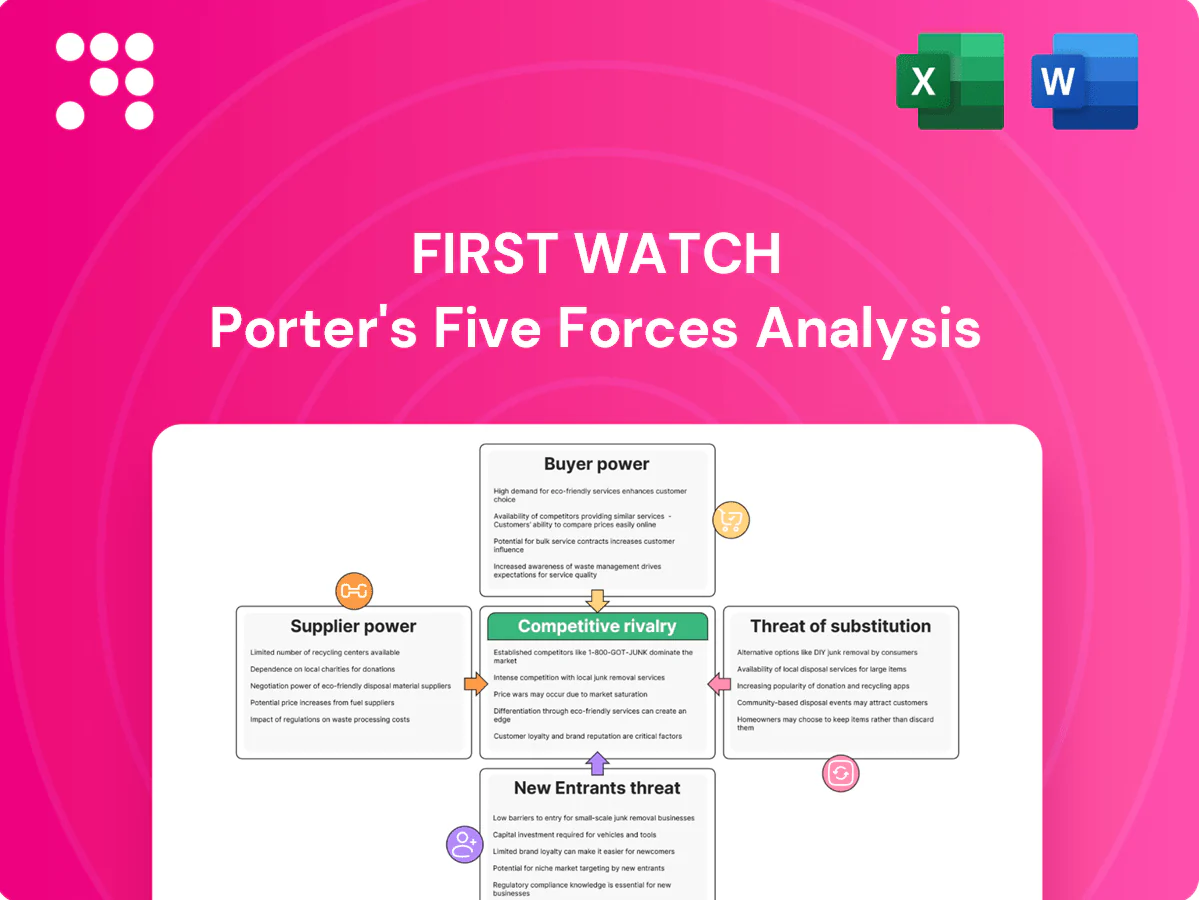
First Watch Porter's Five Forces Analysis

Don't Miss the Bigger Picture
First Watch faces moderate buyer power, rising substitute threats, and niche supplier leverage that shape its breakfast-focused positioning; competitive intensity hinges on unit-level differentiation and franchising strategy. This brief snapshot only scratches the surface. Unlock the full Porter's Five Forces Analysis to explore First Watch’s competitive dynamics, market pressures, and strategic advantages in detail.
Suppliers Bargaining Power

Perishable, seasonal inputs
First Watch depends on fresh eggs, produce, dairy and coffee that are perishable and seasonal, with industry spoilage/losses typically 5–15% and seasonal yield swings of 10–30% that tighten supply and elevate costs. Seasonal menus increase exposure to weather-related crop shortfalls—Arabica coffee and produce markets saw volatility up to ~30% in recent crop cycles. This necessitates agile procurement, hedging and menu flexibility to limit price-driven margin pressure.
Commodity price volatility
Eggs, bacon, avocados and coffee saw supplier-driven price swings of roughly 20–50% in 2024 due to disease outbreaks, feed-cost inflation and global supply shocks, compressing margins in First Watch’s value-sensitive daytime segment. Smaller chains face limited hedging versus mega buyers, leaving contracts and menu pricing to be recalibrated quarterly to protect EBITDA. Sudden spikes erode 1–3 point operating margin in peak months.

Diverse distributor base
First Watch leverages national broadliners Sysco and US Foods plus regional purveyors to limit single‑supplier risk; by 2024 the chain operated over 400 restaurants, enabling multi‑sourcing that improves negotiating leverage and service continuity. Switching costs remain in specs, logistics and QA that slow rapid vendor changes, but continued scale growth incrementally strengthens First Watchs bargaining power with distributors.

Quality and spec stringency
Fresh, made-to-order positioning forces strict specs and food-safety controls (SQF/GFSI-benchmarked audits common in 2024), narrowing qualified suppliers and raising supplier leverage for consistent, scale-ready ingredients. Certification and audit costs increase sourcing expense and limit options; a supplier failure can quickly spill into peak breakfast windows and damage brand trust.
- High-spec sourcing: tight supplier pool
- Audits/certs: increased cost and lead times
- Leverage: suppliers gain bargaining power
Non-food inputs and equipment
Non-food inputs like specialty coffee machines, juice equipment and smallwares face concentrated vendor pools, giving suppliers tangible bargaining power. Lead times in 2024 commonly run 8–24 weeks and maintenance contracts often lock operators into fixed terms that raise switching costs. Disruptions directly impede speed-of-service during First Watch's short operating days, while strategic bundling of purchases can recover some leverage.
- Vendor concentration: few OEMs dominate supply
- Lead times: 8–24 weeks (2024) increases vulnerability
- Mitigation: bundle buys, negotiate service caps, stagger replacements
Perishable supplier power: 5-15% loss, 20-50% swings cut margins
First Watch faces strong supplier power from perishable inputs with 2024 spoilage 5–15% and commodity swings of 20–50%, creating quarterly margin pressure (1–3 ppt hit in peak months). Scale and multi‑sourcing via Sysco/US Foods improves leverage, but tight specs, SQF audits and concentrated equipment OEMs (lead times 8–24 wks) keep switching costs high.
| Metric | 2024 |
|---|---|
| Spoilage/loss | 5–15% |
| Commodity price swings | 20–50% |
| Margin impact | 1–3 ppt/month |
| Equipment lead time | 8–24 wks |
What is included in the product
 Detailed Word Document
Tailored Porter’s Five Forces analysis for First Watch that assesses competitive rivalry, supplier and buyer power, threat of substitutes, and entry barriers while highlighting disruptive trends and pricing pressures; includes strategic commentary suitable for investor materials, internal strategy decks, or business plans.

 Customizable Excel Spreadsheet
First Watch Porter's Five Forces Analysis delivers a clear, one-sheet summary of all five forces for quick decision-making, with customizable pressure levels to reflect evolving market data.
Customers Bargaining Power

Low switching costs
Breakfast diners can shift easily to IHOP, Panera, local cafes, or cook at home, so First Watch faces low switching costs and high churn. Location convenience and wait times — often decisive within minutes — amplify quick trade-offs. Little contractual lock-in or loyalty barriers exist, elevating price and experience sensitivity in a US restaurant market that topped roughly 1 trillion dollars in 2024.
Price-value sensitivity
Daytime guests frequently benchmark First Watch against quick-serve breakfast alternatives, pressuring menu pricing given First Watch operates over 500 locations as of 2024. Growth encounters resistance unless offerings signal health, freshness, or clear portion value. Promotions and limited-time offers drive trial and are used to offset price sensitivity. Transparent pricing and measured upsells are critical to maintain perceived value.

Digital reviews and visibility
Google and Yelp ratings now drive brunch selection—BrightLocal 2024 found 82% of consumers consult reviews before dining—so a few negative service or wait-time reviews can shift local demand quickly; Harvard (2016) showed a one-star Yelp change alters revenue 5–9%. High-quality photos of freshness and seasonal dishes materially boost conversion, with listings showing images receiving substantially higher click-throughs in 2024. Active reputation management therefore directly reduces buyer leverage and stabilizes traffic.

Waiting and speed expectations
Peak brunch demand at First Watch creates queue friction and abandonment risk, with guests showing low tolerance for waits during morning dayparts; efficient waitlist technology and faster table turns measurably reduce churn and protect average check. Slow ticket times erode perceived value and shift spend to quick substitutes; long waits push time-sensitive guests to coffee chains and fast-casual rivals. Operational cadence in 2024 prioritized waitlist systems to preserve throughput and revenue.
- peak demand -> higher abandonment risk
- waitlist tech + faster turns -> lower churn
- slow tickets -> lower perceived value
- long waits -> substitution to coffee chains
Health and dietary preferences
Buyers increasingly demand clean-ingredient, gluten-free and better-for-you options, and First Watch’s health-forward positioning—supported by over 400 restaurants nationwide in 2024—partially lowers buyer power by matching demand. Maintaining consistency across franchised units is vital to retain trust and prevent switching. Clear menu transparency sustains willingness to pay and supports premium pricing.
- clean-ingredient demand
- gluten-free options
- consistency across franchises
- menu transparency preserves pricing
High review sensitivity and low switching costs squeeze diners in a $1T US market
Low switching costs and dense alternatives make customer bargaining high; US dine market ≈1 trillion in 2024 and First Watch operates over 500 locations (2024). 82% consult reviews before dining (BrightLocal 2024), and a one-star Yelp change can alter revenue 5–9% (Harvard 2016), raising sensitivity to service and wait times. Health-forward menu alignment reduces but does not eliminate price pressure.
| Metric | Value |
|---|---|
| US restaurant market (2024) | $1 trillion |
| First Watch locations (2024) | 500+ |
| Consumers using reviews (BrightLocal 2024) | 82% |
| Revenue impact per 1-star Yelp | 5–9% |
Preview Before You Purchase
First Watch Porter's Five Forces Analysis
This preview shows the exact First Watch Porter's Five Forces Analysis you'll receive immediately after purchase—no surprises, no placeholders. The document is professionally formatted and ready for download and use the moment you buy. It's the complete, final analysis you'll get instantly.

Don't Miss the Bigger Picture
First Watch faces moderate buyer power, rising substitute threats, and niche supplier leverage that shape its breakfast-focused positioning; competitive intensity hinges on unit-level differentiation and franchising strategy. This brief snapshot only scratches the surface. Unlock the full Porter's Five Forces Analysis to explore First Watch’s competitive dynamics, market pressures, and strategic advantages in detail.
Suppliers Bargaining Power
Perishable, seasonal inputs
First Watch depends on fresh eggs, produce, dairy and coffee that are perishable and seasonal, with industry spoilage/losses typically 5–15% and seasonal yield swings of 10–30% that tighten supply and elevate costs. Seasonal menus increase exposure to weather-related crop shortfalls—Arabica coffee and produce markets saw volatility up to ~30% in recent crop cycles. This necessitates agile procurement, hedging and menu flexibility to limit price-driven margin pressure.
Commodity price volatility
Eggs, bacon, avocados and coffee saw supplier-driven price swings of roughly 20–50% in 2024 due to disease outbreaks, feed-cost inflation and global supply shocks, compressing margins in First Watch’s value-sensitive daytime segment. Smaller chains face limited hedging versus mega buyers, leaving contracts and menu pricing to be recalibrated quarterly to protect EBITDA. Sudden spikes erode 1–3 point operating margin in peak months.
Diverse distributor base
First Watch leverages national broadliners Sysco and US Foods plus regional purveyors to limit single‑supplier risk; by 2024 the chain operated over 400 restaurants, enabling multi‑sourcing that improves negotiating leverage and service continuity. Switching costs remain in specs, logistics and QA that slow rapid vendor changes, but continued scale growth incrementally strengthens First Watchs bargaining power with distributors.
Quality and spec stringency
Fresh, made-to-order positioning forces strict specs and food-safety controls (SQF/GFSI-benchmarked audits common in 2024), narrowing qualified suppliers and raising supplier leverage for consistent, scale-ready ingredients. Certification and audit costs increase sourcing expense and limit options; a supplier failure can quickly spill into peak breakfast windows and damage brand trust.
- High-spec sourcing: tight supplier pool
- Audits/certs: increased cost and lead times
- Leverage: suppliers gain bargaining power
Non-food inputs and equipment
Non-food inputs like specialty coffee machines, juice equipment and smallwares face concentrated vendor pools, giving suppliers tangible bargaining power. Lead times in 2024 commonly run 8–24 weeks and maintenance contracts often lock operators into fixed terms that raise switching costs. Disruptions directly impede speed-of-service during First Watch's short operating days, while strategic bundling of purchases can recover some leverage.
- Vendor concentration: few OEMs dominate supply
- Lead times: 8–24 weeks (2024) increases vulnerability
- Mitigation: bundle buys, negotiate service caps, stagger replacements
Perishable supplier power: 5-15% loss, 20-50% swings cut margins
First Watch faces strong supplier power from perishable inputs with 2024 spoilage 5–15% and commodity swings of 20–50%, creating quarterly margin pressure (1–3 ppt hit in peak months). Scale and multi‑sourcing via Sysco/US Foods improves leverage, but tight specs, SQF audits and concentrated equipment OEMs (lead times 8–24 wks) keep switching costs high.
| Metric | 2024 |
|---|---|
| Spoilage/loss | 5–15% |
| Commodity price swings | 20–50% |
| Margin impact | 1–3 ppt/month |
| Equipment lead time | 8–24 wks |
What is included in the product
Detailed Word Document
Tailored Porter’s Five Forces analysis for First Watch that assesses competitive rivalry, supplier and buyer power, threat of substitutes, and entry barriers while highlighting disruptive trends and pricing pressures; includes strategic commentary suitable for investor materials, internal strategy decks, or business plans.
Customizable Excel Spreadsheet
First Watch Porter's Five Forces Analysis delivers a clear, one-sheet summary of all five forces for quick decision-making, with customizable pressure levels to reflect evolving market data.
Customers Bargaining Power
Low switching costs
Breakfast diners can shift easily to IHOP, Panera, local cafes, or cook at home, so First Watch faces low switching costs and high churn. Location convenience and wait times — often decisive within minutes — amplify quick trade-offs. Little contractual lock-in or loyalty barriers exist, elevating price and experience sensitivity in a US restaurant market that topped roughly 1 trillion dollars in 2024.
Price-value sensitivity
Daytime guests frequently benchmark First Watch against quick-serve breakfast alternatives, pressuring menu pricing given First Watch operates over 500 locations as of 2024. Growth encounters resistance unless offerings signal health, freshness, or clear portion value. Promotions and limited-time offers drive trial and are used to offset price sensitivity. Transparent pricing and measured upsells are critical to maintain perceived value.
Digital reviews and visibility
Google and Yelp ratings now drive brunch selection—BrightLocal 2024 found 82% of consumers consult reviews before dining—so a few negative service or wait-time reviews can shift local demand quickly; Harvard (2016) showed a one-star Yelp change alters revenue 5–9%. High-quality photos of freshness and seasonal dishes materially boost conversion, with listings showing images receiving substantially higher click-throughs in 2024. Active reputation management therefore directly reduces buyer leverage and stabilizes traffic.
Waiting and speed expectations
Peak brunch demand at First Watch creates queue friction and abandonment risk, with guests showing low tolerance for waits during morning dayparts; efficient waitlist technology and faster table turns measurably reduce churn and protect average check. Slow ticket times erode perceived value and shift spend to quick substitutes; long waits push time-sensitive guests to coffee chains and fast-casual rivals. Operational cadence in 2024 prioritized waitlist systems to preserve throughput and revenue.
- peak demand -> higher abandonment risk
- waitlist tech + faster turns -> lower churn
- slow tickets -> lower perceived value
- long waits -> substitution to coffee chains
Health and dietary preferences
Buyers increasingly demand clean-ingredient, gluten-free and better-for-you options, and First Watch’s health-forward positioning—supported by over 400 restaurants nationwide in 2024—partially lowers buyer power by matching demand. Maintaining consistency across franchised units is vital to retain trust and prevent switching. Clear menu transparency sustains willingness to pay and supports premium pricing.
- clean-ingredient demand
- gluten-free options
- consistency across franchises
- menu transparency preserves pricing
High review sensitivity and low switching costs squeeze diners in a $1T US market
Low switching costs and dense alternatives make customer bargaining high; US dine market ≈1 trillion in 2024 and First Watch operates over 500 locations (2024). 82% consult reviews before dining (BrightLocal 2024), and a one-star Yelp change can alter revenue 5–9% (Harvard 2016), raising sensitivity to service and wait times. Health-forward menu alignment reduces but does not eliminate price pressure.
| Metric | Value |
|---|---|
| US restaurant market (2024) | $1 trillion |
| First Watch locations (2024) | 500+ |
| Consumers using reviews (BrightLocal 2024) | 82% |
| Revenue impact per 1-star Yelp | 5–9% |
Preview Before You Purchase
First Watch Porter's Five Forces Analysis
This preview shows the exact First Watch Porter's Five Forces Analysis you'll receive immediately after purchase—no surprises, no placeholders. The document is professionally formatted and ready for download and use the moment you buy. It's the complete, final analysis you'll get instantly.
Original: $10.00
-65%$10.00
$3.50Description
Don't Miss the Bigger Picture
First Watch faces moderate buyer power, rising substitute threats, and niche supplier leverage that shape its breakfast-focused positioning; competitive intensity hinges on unit-level differentiation and franchising strategy. This brief snapshot only scratches the surface. Unlock the full Porter's Five Forces Analysis to explore First Watch’s competitive dynamics, market pressures, and strategic advantages in detail.
Suppliers Bargaining Power
Perishable, seasonal inputs
First Watch depends on fresh eggs, produce, dairy and coffee that are perishable and seasonal, with industry spoilage/losses typically 5–15% and seasonal yield swings of 10–30% that tighten supply and elevate costs. Seasonal menus increase exposure to weather-related crop shortfalls—Arabica coffee and produce markets saw volatility up to ~30% in recent crop cycles. This necessitates agile procurement, hedging and menu flexibility to limit price-driven margin pressure.
Commodity price volatility
Eggs, bacon, avocados and coffee saw supplier-driven price swings of roughly 20–50% in 2024 due to disease outbreaks, feed-cost inflation and global supply shocks, compressing margins in First Watch’s value-sensitive daytime segment. Smaller chains face limited hedging versus mega buyers, leaving contracts and menu pricing to be recalibrated quarterly to protect EBITDA. Sudden spikes erode 1–3 point operating margin in peak months.
Diverse distributor base
First Watch leverages national broadliners Sysco and US Foods plus regional purveyors to limit single‑supplier risk; by 2024 the chain operated over 400 restaurants, enabling multi‑sourcing that improves negotiating leverage and service continuity. Switching costs remain in specs, logistics and QA that slow rapid vendor changes, but continued scale growth incrementally strengthens First Watchs bargaining power with distributors.
Quality and spec stringency
Fresh, made-to-order positioning forces strict specs and food-safety controls (SQF/GFSI-benchmarked audits common in 2024), narrowing qualified suppliers and raising supplier leverage for consistent, scale-ready ingredients. Certification and audit costs increase sourcing expense and limit options; a supplier failure can quickly spill into peak breakfast windows and damage brand trust.
- High-spec sourcing: tight supplier pool
- Audits/certs: increased cost and lead times
- Leverage: suppliers gain bargaining power
Non-food inputs and equipment
Non-food inputs like specialty coffee machines, juice equipment and smallwares face concentrated vendor pools, giving suppliers tangible bargaining power. Lead times in 2024 commonly run 8–24 weeks and maintenance contracts often lock operators into fixed terms that raise switching costs. Disruptions directly impede speed-of-service during First Watch's short operating days, while strategic bundling of purchases can recover some leverage.
- Vendor concentration: few OEMs dominate supply
- Lead times: 8–24 weeks (2024) increases vulnerability
- Mitigation: bundle buys, negotiate service caps, stagger replacements
Perishable supplier power: 5-15% loss, 20-50% swings cut margins
First Watch faces strong supplier power from perishable inputs with 2024 spoilage 5–15% and commodity swings of 20–50%, creating quarterly margin pressure (1–3 ppt hit in peak months). Scale and multi‑sourcing via Sysco/US Foods improves leverage, but tight specs, SQF audits and concentrated equipment OEMs (lead times 8–24 wks) keep switching costs high.
| Metric | 2024 |
|---|---|
| Spoilage/loss | 5–15% |
| Commodity price swings | 20–50% |
| Margin impact | 1–3 ppt/month |
| Equipment lead time | 8–24 wks |
What is included in the product
Detailed Word Document
Tailored Porter’s Five Forces analysis for First Watch that assesses competitive rivalry, supplier and buyer power, threat of substitutes, and entry barriers while highlighting disruptive trends and pricing pressures; includes strategic commentary suitable for investor materials, internal strategy decks, or business plans.
Customizable Excel Spreadsheet
First Watch Porter's Five Forces Analysis delivers a clear, one-sheet summary of all five forces for quick decision-making, with customizable pressure levels to reflect evolving market data.
Customers Bargaining Power
Low switching costs
Breakfast diners can shift easily to IHOP, Panera, local cafes, or cook at home, so First Watch faces low switching costs and high churn. Location convenience and wait times — often decisive within minutes — amplify quick trade-offs. Little contractual lock-in or loyalty barriers exist, elevating price and experience sensitivity in a US restaurant market that topped roughly 1 trillion dollars in 2024.
Price-value sensitivity
Daytime guests frequently benchmark First Watch against quick-serve breakfast alternatives, pressuring menu pricing given First Watch operates over 500 locations as of 2024. Growth encounters resistance unless offerings signal health, freshness, or clear portion value. Promotions and limited-time offers drive trial and are used to offset price sensitivity. Transparent pricing and measured upsells are critical to maintain perceived value.
Digital reviews and visibility
Google and Yelp ratings now drive brunch selection—BrightLocal 2024 found 82% of consumers consult reviews before dining—so a few negative service or wait-time reviews can shift local demand quickly; Harvard (2016) showed a one-star Yelp change alters revenue 5–9%. High-quality photos of freshness and seasonal dishes materially boost conversion, with listings showing images receiving substantially higher click-throughs in 2024. Active reputation management therefore directly reduces buyer leverage and stabilizes traffic.
Waiting and speed expectations
Peak brunch demand at First Watch creates queue friction and abandonment risk, with guests showing low tolerance for waits during morning dayparts; efficient waitlist technology and faster table turns measurably reduce churn and protect average check. Slow ticket times erode perceived value and shift spend to quick substitutes; long waits push time-sensitive guests to coffee chains and fast-casual rivals. Operational cadence in 2024 prioritized waitlist systems to preserve throughput and revenue.
- peak demand -> higher abandonment risk
- waitlist tech + faster turns -> lower churn
- slow tickets -> lower perceived value
- long waits -> substitution to coffee chains
Health and dietary preferences
Buyers increasingly demand clean-ingredient, gluten-free and better-for-you options, and First Watch’s health-forward positioning—supported by over 400 restaurants nationwide in 2024—partially lowers buyer power by matching demand. Maintaining consistency across franchised units is vital to retain trust and prevent switching. Clear menu transparency sustains willingness to pay and supports premium pricing.
- clean-ingredient demand
- gluten-free options
- consistency across franchises
- menu transparency preserves pricing
High review sensitivity and low switching costs squeeze diners in a $1T US market
Low switching costs and dense alternatives make customer bargaining high; US dine market ≈1 trillion in 2024 and First Watch operates over 500 locations (2024). 82% consult reviews before dining (BrightLocal 2024), and a one-star Yelp change can alter revenue 5–9% (Harvard 2016), raising sensitivity to service and wait times. Health-forward menu alignment reduces but does not eliminate price pressure.
| Metric | Value |
|---|---|
| US restaurant market (2024) | $1 trillion |
| First Watch locations (2024) | 500+ |
| Consumers using reviews (BrightLocal 2024) | 82% |
| Revenue impact per 1-star Yelp | 5–9% |
Preview Before You Purchase
First Watch Porter's Five Forces Analysis
This preview shows the exact First Watch Porter's Five Forces Analysis you'll receive immediately after purchase—no surprises, no placeholders. The document is professionally formatted and ready for download and use the moment you buy. It's the complete, final analysis you'll get instantly.











