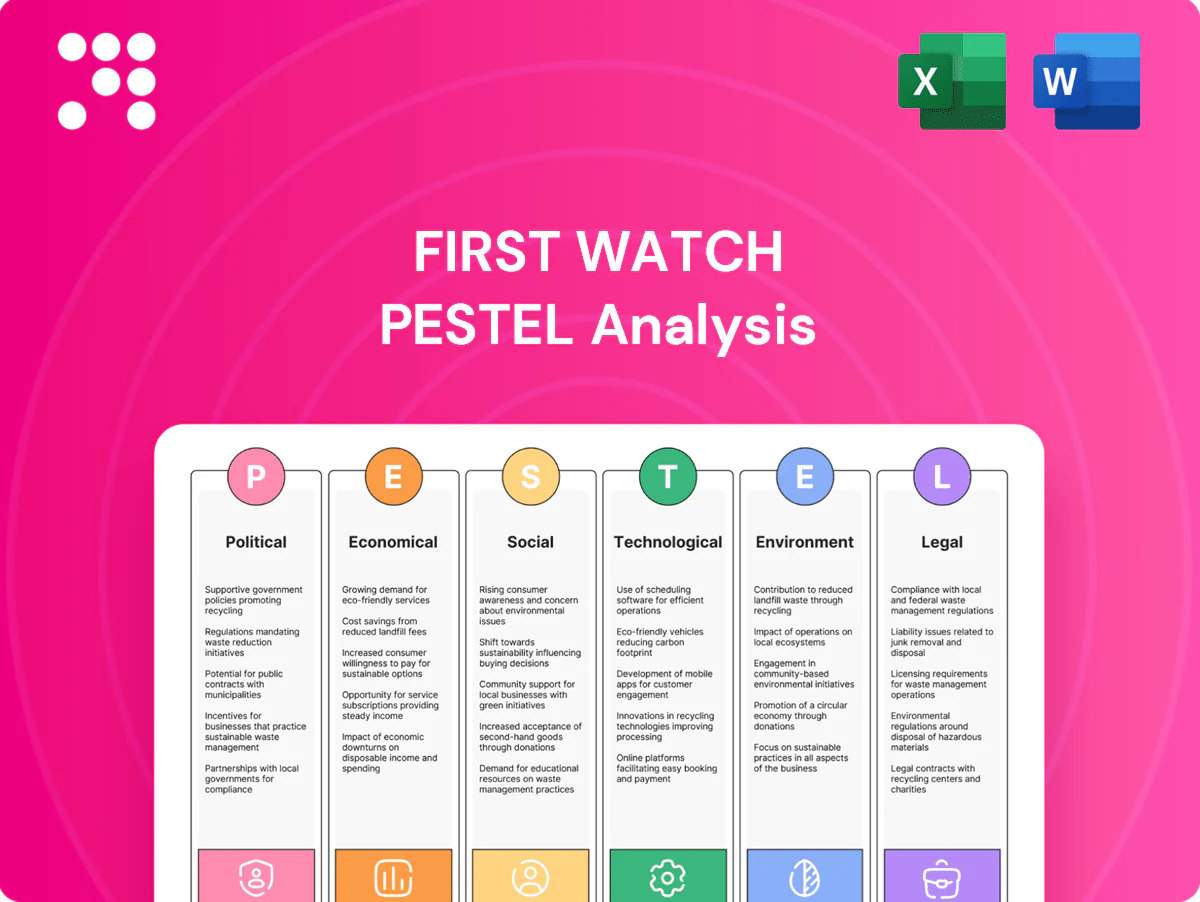
First Watch PESTLE Analysis

Your Shortcut to Market Insight Starts Here
Gain a competitive edge with our PESTLE Analysis of First Watch, revealing political, economic, social, technological, legal, and environmental forces shaping its future. Perfect for investors and strategists, it translates trends into actionable recommendations. Download the full, editable report now to make smarter, faster decisions.
Political factors

Minimum wage policy shifts
Changes to federal and state minimum wages—federal floor remains $7.25/hr—directly raise labor costs for a labor-intensive breakfast concept like First Watch, squeezing margins if not offset. Many First Watch units sit in states with minimums well above the federal floor, creating portfolio variability and localized cost shocks. Strategic pricing, menu engineering and productivity gains are required to offset step-ups and protect unit economics, while franchisees face uneven pressure from local ordinances.
Food policy and agricultural subsidies
Government subsidies and farm policies—with US farm support reported at about $34 billion in 2024—directly affect prices for eggs, dairy, produce and grains that anchor First Watch daytime menus. Policy shifts toward sustainable farming can lift input costs short term but USDA analysis shows they tend to reduce supply shocks over 3–5 years. Volatile commodity programs (price supports, crop insurance) force frequent menu engineering and adaptive sourcing strategies.

Local zoning and permitting
Local zoning, signage and patio permits strongly shape site selection and speed-to-open for First Watch; municipal variances can delay openings and elevate pre-opening costs, with 62% of municipalities reporting permitting backlogs in 2024. Breakfast dayparts favor high-traffic suburban nodes that often impose stricter parking ratios, impacting usable square footage and CAPEX. Proactive municipal engagement and early variance requests can shorten development timelines and lower soft costs.

Health and nutrition guidelines
Public-health initiatives and school/municipal wellness programs have increased demand for healthier options as rising US adult obesity prevalence (41.9% in 2017–2020 CDC data) keeps nutrition central to policy. Federal menu-labeling rules for chains with 20+ locations (finalized 2018) align with First Watch’s fresh positioning; compliance can be a competitive advantage if communicated, but evolving guidelines require continual recipe and label updates.
- Policy: federal menu labeling covers chains with 20+ locations
- Market: obesity 41.9% (CDC 2017–2020)
- Opportunity: transparency boosts brand trust
- Risk: ongoing recipe/label updates needed
Trade and import dynamics
Tariffs and import rules shape costs for specialty ingredients, coffee, and kitchen equipment, raising procurement complexity for First Watch.
Currency swings and trade disputes transmit through supplier invoices, pressuring margins especially on imported beans and parts.
Domestic sourcing diversification reduces import exposure but can constrain menu variety and seasonal offerings.
Long-term contracts and hedging of commodity and FX risks help stabilize input pricing and protect margins.
- Tariffs impact specialty ingredients and equipment
- FX and trade disputes increase supply cost volatility
- Domestic sourcing cuts risk but limits variety
- Hedging and long-term contracts stabilize prices
Wage hikes, farm support, tariffs and permitting backlogs reshape costs and openings
Federal/state wage hikes (federal floor $7.25; many states higher) and local ordinances raise labor costs and create franchise variability. US farm support ~$34B in 2024 and tariffs affect eggs, dairy, coffee input prices and CAPEX. 62% of municipalities reported permitting backlogs in 2024, slowing openings; obesity 41.9% (CDC 2017–2020) keeps nutrition policy central.
| Policy | Stat | Impact |
|---|---|---|
| Minimum wage | Federal $7.25; many state >$12 | Higher labor cost |
| Farm support | $34B (2024) | Input price volatility |
| Permitting | 62% backlog (2024) | Delays/CAPEX↑ |
What is included in the product
 Detailed Word Document
Explores how macro-environmental factors uniquely affect First Watch across Political, Economic, Social, Technological, Environmental, and Legal dimensions, with each category expanded into actionable sub-points and examples specific to the brand and market. Backed by current data and forward-looking insights, the analysis is designed for executives, consultants, and investors to identify threats, opportunities, and strategic responses.

 Customizable Excel Spreadsheet
Provides a clean, summarized PESTLE view of First Watch’s external risks and opportunities, formatted for quick reference in meetings or slide decks to speed decision-making and align teams.
Economic factors

Consumer discretionary spending
Breakfast and brunch frequency is sensitive to real income and confidence—U.S. inflation eased to roughly 3% in 2024, tightening discretionary budgets and shifting some dine-in traffic to at-home occasions. First Watch sustains visits via perceived value—combo pricing and limited-time offers—while beverage and add-on upsell helps protect average check and margin.
Food inflation and commodity volatility
Eggs, bacon, fresh produce and coffee show pronounced cyclical swings—eggs experienced swings exceeding 150% around the 2022–24 avian flu period and coffee futures rose roughly 25–30% in 2023–24, contributing to U.S. food-at-home inflation near 5–6% in 2024. Cost spikes force agile pricing, tighter portion control and aggressive vendor renegotiation to protect unit margins. Active menu-mix management and data-driven forecasting have reduced food cost volatility for comparable operators by up to 200–300 basis points.

Labor market tightness
With US unemployment near 3.7–3.9% in 2024–H1 2025 and average hourly earnings up about 4.1% YoY in 2024, First Watch faces elevated wage pressure and restaurant turnover (industry ~80% annually). Improving training efficiency and retention programs can cut hiring churn and labor hours. Cross-utilization and kitchen simplification preserve throughput under lean staffing. Robust benefits and culture differentiate employer appeal.

Real estate costs and availability
- Rents: $24–26/sqft (2024)
- Rent concessions: 10–20% for daytime leases
- TI allowances: $40–120/sqft
- Site analytics: lower underperforming-site risk
Franchisee capital access
Franchisee capital access is sensitive to US interest rates — the federal funds target averaged about 5.25–5.50% in mid-2024–mid-2025, which tightened borrowing and slowed unit rollouts. Strong unit economics at First Watch typically underpin lender appetite, yet rate spikes can defer projects and thin franchise cashflows. Corporate development funding and proven performance dashboards have recently been used to bridge credit gaps and reassure banks.
- Interest rate headwind: fed funds ~5.25–5.50%
- Unit economics support lending
- Rate spikes delay expansion
- Corporate funding and dashboards improve lender confidence
Wage hikes, farm support, tariffs and permitting backlogs reshape costs and openings
Demand for breakfast is income-sensitive as U.S. CPI eased to ~3% in 2024, while First Watch defends traffic with value bundles and upsell to protect checks and margins. Key commodities remain volatile—eggs swung >150% (2022–24) and coffee futures rose ~25–30% (2023–24), driving ~5–6% food-at-home inflation in 2024. Labor pressure persists with unemployment ~3.7–3.9% and avg hourly earnings +4.1% YoY (2024), raising wage costs. Real estate and financing dynamics—rents ~$24–26/sqft, TI $40–120/sqft, fed funds ~5.25–5.50%—shape unit economics and rollout pace.
| Metric | Value |
|---|---|
| CPI (2024) | ~3% |
| Food-at-home inflation (2024) | 5–6% |
| Egg volatility (2022–24) | >150% |
| Coffee futures (2023–24) | +25–30% |
| Unemployment (2024–H1 2025) | 3.7–3.9% |
| Avg hourly earnings (2024) | +4.1% YoY |
| Rents (2024) | $24–26/sqft |
| TI allowances | $40–120/sqft |
| Fed funds (mid‑2024–mid‑2025) | ~5.25–5.50% |
Preview the Actual Deliverable
First Watch PESTLE Analysis
The preview shown here is the exact First Watch PESTLE Analysis you’ll receive after purchase—fully formatted and ready to use. It contains the complete political, economic, social, technological, legal, and environmental assessment as displayed, with no placeholders or edits. After checkout you’ll instantly download this exact, professionally structured file.

Your Shortcut to Market Insight Starts Here
Gain a competitive edge with our PESTLE Analysis of First Watch, revealing political, economic, social, technological, legal, and environmental forces shaping its future. Perfect for investors and strategists, it translates trends into actionable recommendations. Download the full, editable report now to make smarter, faster decisions.
Political factors
Minimum wage policy shifts
Changes to federal and state minimum wages—federal floor remains $7.25/hr—directly raise labor costs for a labor-intensive breakfast concept like First Watch, squeezing margins if not offset. Many First Watch units sit in states with minimums well above the federal floor, creating portfolio variability and localized cost shocks. Strategic pricing, menu engineering and productivity gains are required to offset step-ups and protect unit economics, while franchisees face uneven pressure from local ordinances.
Food policy and agricultural subsidies
Government subsidies and farm policies—with US farm support reported at about $34 billion in 2024—directly affect prices for eggs, dairy, produce and grains that anchor First Watch daytime menus. Policy shifts toward sustainable farming can lift input costs short term but USDA analysis shows they tend to reduce supply shocks over 3–5 years. Volatile commodity programs (price supports, crop insurance) force frequent menu engineering and adaptive sourcing strategies.
Local zoning and permitting
Local zoning, signage and patio permits strongly shape site selection and speed-to-open for First Watch; municipal variances can delay openings and elevate pre-opening costs, with 62% of municipalities reporting permitting backlogs in 2024. Breakfast dayparts favor high-traffic suburban nodes that often impose stricter parking ratios, impacting usable square footage and CAPEX. Proactive municipal engagement and early variance requests can shorten development timelines and lower soft costs.
Health and nutrition guidelines
Public-health initiatives and school/municipal wellness programs have increased demand for healthier options as rising US adult obesity prevalence (41.9% in 2017–2020 CDC data) keeps nutrition central to policy. Federal menu-labeling rules for chains with 20+ locations (finalized 2018) align with First Watch’s fresh positioning; compliance can be a competitive advantage if communicated, but evolving guidelines require continual recipe and label updates.
- Policy: federal menu labeling covers chains with 20+ locations
- Market: obesity 41.9% (CDC 2017–2020)
- Opportunity: transparency boosts brand trust
- Risk: ongoing recipe/label updates needed
Trade and import dynamics
Tariffs and import rules shape costs for specialty ingredients, coffee, and kitchen equipment, raising procurement complexity for First Watch.
Currency swings and trade disputes transmit through supplier invoices, pressuring margins especially on imported beans and parts.
Domestic sourcing diversification reduces import exposure but can constrain menu variety and seasonal offerings.
Long-term contracts and hedging of commodity and FX risks help stabilize input pricing and protect margins.
- Tariffs impact specialty ingredients and equipment
- FX and trade disputes increase supply cost volatility
- Domestic sourcing cuts risk but limits variety
- Hedging and long-term contracts stabilize prices
Wage hikes, farm support, tariffs and permitting backlogs reshape costs and openings
Federal/state wage hikes (federal floor $7.25; many states higher) and local ordinances raise labor costs and create franchise variability. US farm support ~$34B in 2024 and tariffs affect eggs, dairy, coffee input prices and CAPEX. 62% of municipalities reported permitting backlogs in 2024, slowing openings; obesity 41.9% (CDC 2017–2020) keeps nutrition policy central.
| Policy | Stat | Impact |
|---|---|---|
| Minimum wage | Federal $7.25; many state >$12 | Higher labor cost |
| Farm support | $34B (2024) | Input price volatility |
| Permitting | 62% backlog (2024) | Delays/CAPEX↑ |
What is included in the product
Detailed Word Document
Explores how macro-environmental factors uniquely affect First Watch across Political, Economic, Social, Technological, Environmental, and Legal dimensions, with each category expanded into actionable sub-points and examples specific to the brand and market. Backed by current data and forward-looking insights, the analysis is designed for executives, consultants, and investors to identify threats, opportunities, and strategic responses.
Customizable Excel Spreadsheet
Provides a clean, summarized PESTLE view of First Watch’s external risks and opportunities, formatted for quick reference in meetings or slide decks to speed decision-making and align teams.
Economic factors
Consumer discretionary spending
Breakfast and brunch frequency is sensitive to real income and confidence—U.S. inflation eased to roughly 3% in 2024, tightening discretionary budgets and shifting some dine-in traffic to at-home occasions. First Watch sustains visits via perceived value—combo pricing and limited-time offers—while beverage and add-on upsell helps protect average check and margin.
Food inflation and commodity volatility
Eggs, bacon, fresh produce and coffee show pronounced cyclical swings—eggs experienced swings exceeding 150% around the 2022–24 avian flu period and coffee futures rose roughly 25–30% in 2023–24, contributing to U.S. food-at-home inflation near 5–6% in 2024. Cost spikes force agile pricing, tighter portion control and aggressive vendor renegotiation to protect unit margins. Active menu-mix management and data-driven forecasting have reduced food cost volatility for comparable operators by up to 200–300 basis points.
Labor market tightness
With US unemployment near 3.7–3.9% in 2024–H1 2025 and average hourly earnings up about 4.1% YoY in 2024, First Watch faces elevated wage pressure and restaurant turnover (industry ~80% annually). Improving training efficiency and retention programs can cut hiring churn and labor hours. Cross-utilization and kitchen simplification preserve throughput under lean staffing. Robust benefits and culture differentiate employer appeal.
Real estate costs and availability
- Rents: $24–26/sqft (2024)
- Rent concessions: 10–20% for daytime leases
- TI allowances: $40–120/sqft
- Site analytics: lower underperforming-site risk
Franchisee capital access
Franchisee capital access is sensitive to US interest rates — the federal funds target averaged about 5.25–5.50% in mid-2024–mid-2025, which tightened borrowing and slowed unit rollouts. Strong unit economics at First Watch typically underpin lender appetite, yet rate spikes can defer projects and thin franchise cashflows. Corporate development funding and proven performance dashboards have recently been used to bridge credit gaps and reassure banks.
- Interest rate headwind: fed funds ~5.25–5.50%
- Unit economics support lending
- Rate spikes delay expansion
- Corporate funding and dashboards improve lender confidence
Wage hikes, farm support, tariffs and permitting backlogs reshape costs and openings
Demand for breakfast is income-sensitive as U.S. CPI eased to ~3% in 2024, while First Watch defends traffic with value bundles and upsell to protect checks and margins. Key commodities remain volatile—eggs swung >150% (2022–24) and coffee futures rose ~25–30% (2023–24), driving ~5–6% food-at-home inflation in 2024. Labor pressure persists with unemployment ~3.7–3.9% and avg hourly earnings +4.1% YoY (2024), raising wage costs. Real estate and financing dynamics—rents ~$24–26/sqft, TI $40–120/sqft, fed funds ~5.25–5.50%—shape unit economics and rollout pace.
| Metric | Value |
|---|---|
| CPI (2024) | ~3% |
| Food-at-home inflation (2024) | 5–6% |
| Egg volatility (2022–24) | >150% |
| Coffee futures (2023–24) | +25–30% |
| Unemployment (2024–H1 2025) | 3.7–3.9% |
| Avg hourly earnings (2024) | +4.1% YoY |
| Rents (2024) | $24–26/sqft |
| TI allowances | $40–120/sqft |
| Fed funds (mid‑2024–mid‑2025) | ~5.25–5.50% |
Preview the Actual Deliverable
First Watch PESTLE Analysis
The preview shown here is the exact First Watch PESTLE Analysis you’ll receive after purchase—fully formatted and ready to use. It contains the complete political, economic, social, technological, legal, and environmental assessment as displayed, with no placeholders or edits. After checkout you’ll instantly download this exact, professionally structured file.
Original: $10.00
-65%$10.00
$3.50Description
Your Shortcut to Market Insight Starts Here
Gain a competitive edge with our PESTLE Analysis of First Watch, revealing political, economic, social, technological, legal, and environmental forces shaping its future. Perfect for investors and strategists, it translates trends into actionable recommendations. Download the full, editable report now to make smarter, faster decisions.
Political factors
Minimum wage policy shifts
Changes to federal and state minimum wages—federal floor remains $7.25/hr—directly raise labor costs for a labor-intensive breakfast concept like First Watch, squeezing margins if not offset. Many First Watch units sit in states with minimums well above the federal floor, creating portfolio variability and localized cost shocks. Strategic pricing, menu engineering and productivity gains are required to offset step-ups and protect unit economics, while franchisees face uneven pressure from local ordinances.
Food policy and agricultural subsidies
Government subsidies and farm policies—with US farm support reported at about $34 billion in 2024—directly affect prices for eggs, dairy, produce and grains that anchor First Watch daytime menus. Policy shifts toward sustainable farming can lift input costs short term but USDA analysis shows they tend to reduce supply shocks over 3–5 years. Volatile commodity programs (price supports, crop insurance) force frequent menu engineering and adaptive sourcing strategies.
Local zoning and permitting
Local zoning, signage and patio permits strongly shape site selection and speed-to-open for First Watch; municipal variances can delay openings and elevate pre-opening costs, with 62% of municipalities reporting permitting backlogs in 2024. Breakfast dayparts favor high-traffic suburban nodes that often impose stricter parking ratios, impacting usable square footage and CAPEX. Proactive municipal engagement and early variance requests can shorten development timelines and lower soft costs.
Health and nutrition guidelines
Public-health initiatives and school/municipal wellness programs have increased demand for healthier options as rising US adult obesity prevalence (41.9% in 2017–2020 CDC data) keeps nutrition central to policy. Federal menu-labeling rules for chains with 20+ locations (finalized 2018) align with First Watch’s fresh positioning; compliance can be a competitive advantage if communicated, but evolving guidelines require continual recipe and label updates.
- Policy: federal menu labeling covers chains with 20+ locations
- Market: obesity 41.9% (CDC 2017–2020)
- Opportunity: transparency boosts brand trust
- Risk: ongoing recipe/label updates needed
Trade and import dynamics
Tariffs and import rules shape costs for specialty ingredients, coffee, and kitchen equipment, raising procurement complexity for First Watch.
Currency swings and trade disputes transmit through supplier invoices, pressuring margins especially on imported beans and parts.
Domestic sourcing diversification reduces import exposure but can constrain menu variety and seasonal offerings.
Long-term contracts and hedging of commodity and FX risks help stabilize input pricing and protect margins.
- Tariffs impact specialty ingredients and equipment
- FX and trade disputes increase supply cost volatility
- Domestic sourcing cuts risk but limits variety
- Hedging and long-term contracts stabilize prices
Wage hikes, farm support, tariffs and permitting backlogs reshape costs and openings
Federal/state wage hikes (federal floor $7.25; many states higher) and local ordinances raise labor costs and create franchise variability. US farm support ~$34B in 2024 and tariffs affect eggs, dairy, coffee input prices and CAPEX. 62% of municipalities reported permitting backlogs in 2024, slowing openings; obesity 41.9% (CDC 2017–2020) keeps nutrition policy central.
| Policy | Stat | Impact |
|---|---|---|
| Minimum wage | Federal $7.25; many state >$12 | Higher labor cost |
| Farm support | $34B (2024) | Input price volatility |
| Permitting | 62% backlog (2024) | Delays/CAPEX↑ |
What is included in the product
Detailed Word Document
Explores how macro-environmental factors uniquely affect First Watch across Political, Economic, Social, Technological, Environmental, and Legal dimensions, with each category expanded into actionable sub-points and examples specific to the brand and market. Backed by current data and forward-looking insights, the analysis is designed for executives, consultants, and investors to identify threats, opportunities, and strategic responses.
Customizable Excel Spreadsheet
Provides a clean, summarized PESTLE view of First Watch’s external risks and opportunities, formatted for quick reference in meetings or slide decks to speed decision-making and align teams.
Economic factors
Consumer discretionary spending
Breakfast and brunch frequency is sensitive to real income and confidence—U.S. inflation eased to roughly 3% in 2024, tightening discretionary budgets and shifting some dine-in traffic to at-home occasions. First Watch sustains visits via perceived value—combo pricing and limited-time offers—while beverage and add-on upsell helps protect average check and margin.
Food inflation and commodity volatility
Eggs, bacon, fresh produce and coffee show pronounced cyclical swings—eggs experienced swings exceeding 150% around the 2022–24 avian flu period and coffee futures rose roughly 25–30% in 2023–24, contributing to U.S. food-at-home inflation near 5–6% in 2024. Cost spikes force agile pricing, tighter portion control and aggressive vendor renegotiation to protect unit margins. Active menu-mix management and data-driven forecasting have reduced food cost volatility for comparable operators by up to 200–300 basis points.
Labor market tightness
With US unemployment near 3.7–3.9% in 2024–H1 2025 and average hourly earnings up about 4.1% YoY in 2024, First Watch faces elevated wage pressure and restaurant turnover (industry ~80% annually). Improving training efficiency and retention programs can cut hiring churn and labor hours. Cross-utilization and kitchen simplification preserve throughput under lean staffing. Robust benefits and culture differentiate employer appeal.
Real estate costs and availability
- Rents: $24–26/sqft (2024)
- Rent concessions: 10–20% for daytime leases
- TI allowances: $40–120/sqft
- Site analytics: lower underperforming-site risk
Franchisee capital access
Franchisee capital access is sensitive to US interest rates — the federal funds target averaged about 5.25–5.50% in mid-2024–mid-2025, which tightened borrowing and slowed unit rollouts. Strong unit economics at First Watch typically underpin lender appetite, yet rate spikes can defer projects and thin franchise cashflows. Corporate development funding and proven performance dashboards have recently been used to bridge credit gaps and reassure banks.
- Interest rate headwind: fed funds ~5.25–5.50%
- Unit economics support lending
- Rate spikes delay expansion
- Corporate funding and dashboards improve lender confidence
Wage hikes, farm support, tariffs and permitting backlogs reshape costs and openings
Demand for breakfast is income-sensitive as U.S. CPI eased to ~3% in 2024, while First Watch defends traffic with value bundles and upsell to protect checks and margins. Key commodities remain volatile—eggs swung >150% (2022–24) and coffee futures rose ~25–30% (2023–24), driving ~5–6% food-at-home inflation in 2024. Labor pressure persists with unemployment ~3.7–3.9% and avg hourly earnings +4.1% YoY (2024), raising wage costs. Real estate and financing dynamics—rents ~$24–26/sqft, TI $40–120/sqft, fed funds ~5.25–5.50%—shape unit economics and rollout pace.
| Metric | Value |
|---|---|
| CPI (2024) | ~3% |
| Food-at-home inflation (2024) | 5–6% |
| Egg volatility (2022–24) | >150% |
| Coffee futures (2023–24) | +25–30% |
| Unemployment (2024–H1 2025) | 3.7–3.9% |
| Avg hourly earnings (2024) | +4.1% YoY |
| Rents (2024) | $24–26/sqft |
| TI allowances | $40–120/sqft |
| Fed funds (mid‑2024–mid‑2025) | ~5.25–5.50% |
Preview the Actual Deliverable
First Watch PESTLE Analysis
The preview shown here is the exact First Watch PESTLE Analysis you’ll receive after purchase—fully formatted and ready to use. It contains the complete political, economic, social, technological, legal, and environmental assessment as displayed, with no placeholders or edits. After checkout you’ll instantly download this exact, professionally structured file.











