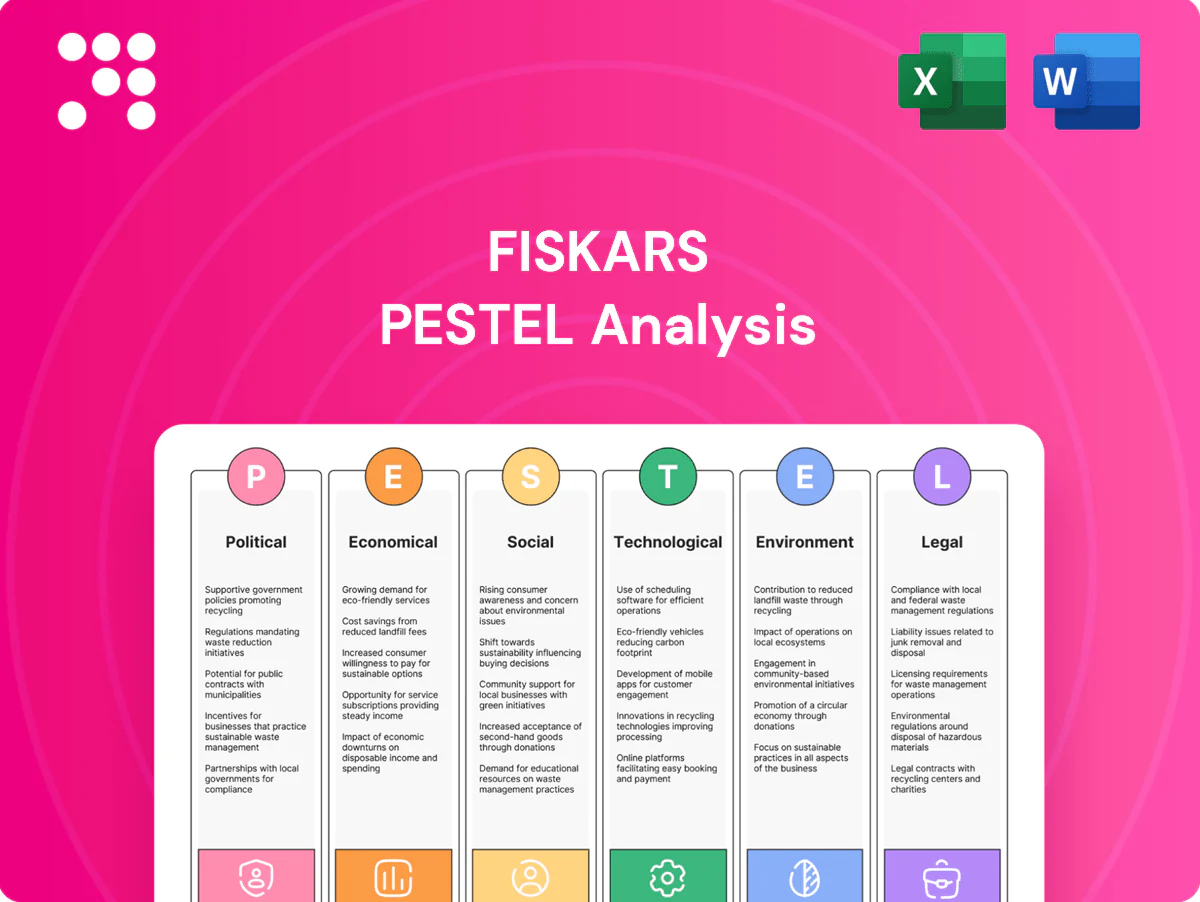
Fiskars PESTLE Analysis

Make Smarter Strategic Decisions with a Complete PESTEL View
Gain a competitive edge with our targeted PESTLE Analysis of Fiskars—uncover how political shifts, economic trends, and tech innovations will shape its growth and risks. Ready-made and research-backed, it’s perfect for investors, consultants, and strategists. Purchase the full report now for the complete, actionable breakdown.
Political factors

Trade policies and tariffs
Operating in 100+ countries exposes Fiskars to import duties on steel, glassware and finished goods, with instruments such as the US Section 232 steel tariff at 25% directly affecting input costs. Shifts in US-EU tariff policy or targeted anti-dumping measures can materially alter landed costs and price competitiveness. Proactive sourcing and tariff engineering reduce duty exposure and supply-chain volatility. Engagement with trade bodies improves rule predictability.
Geopolitical tensions and sanctions
Sanctions regimes and regional conflicts can disrupt materials, logistics corridors and market access for Fiskars, which sells products in over 100 countries and is listed on Nasdaq Helsinki. Fiskars must monitor exposure to sanctioned entities and re-route supply chains; its diversified sales across Europe and North America help cushion revenue shocks. Robust business continuity plans are essential for sudden market exits.

EU policy direction and subsidies
As a Nordic-rooted group, Fiskars is exposed to EU industrial, energy and sustainability policy—EU ETS carbon price exceeded €80/ton in 2024, pressuring glass and metal operations. Access to energy-transition incentives such as NextGenerationEU (€806.9bn) and the EU Innovation Fund (anticipated ~€38bn 2021–2030) can lower decarbonization capex. Compliance with EU product standards supports premium positioning and policy stability aids long-term planning.

Local content and procurement rules
Certain markets increasingly mandate local content for public and retail contracts, and public procurement accounts for roughly 12% of GDP in many OECD countries, making local assembly or finishing pivotal for channel access and brand visibility. Fiskars must run capex versus tariff and lead-time savings analyses when weighing regional setups. Partnerships with regional suppliers can shorten compliance timelines and reduce logistics risk.
- Local content boosts bid eligibility
- Capex vs tariff savings analysis required
- Regional partners accelerate compliance
- Improves retail shelf presence and fulfillment
Post-Brexit and regional regulatory divergence
Post-Brexit UK-EU regulatory divergence has added labeling, standards and customs complexity for Waterford and Fiskars’ broader portfolio, increasing compliance tasks and some SKU fragmentation; Fiskars reported EUR 1,226 million net sales in 2023, making supply-chain frictions material to working capital. Additional documentation and border frictions raise working capital needs and may force dedicated SKUs or dual-compliance pathways; robust customs brokerage mitigates delays.
- Regulatory divergence: labeling, standards, customs
- Working capital impact: higher inventory buffers, transit delays
- Operational fixes: dedicated SKUs or dual compliance
- Mitigation: robust customs brokerage to reduce delays
Tariffs, EU carbon costs and post-Brexit rules squeeze multinationals across 100+ markets
Fiskars (net sales EUR 1,226m 2023) faces trade-tariff risk (US Section 232 steel tariff 25%) and regulatory shifts across 100+ markets. EU ETS >€80/ton (2024) raises production costs while NextGenerationEU and Innovation Fund offer decarbonisation support. Post-Brexit divergence and ~12% public-procurement GDP exposure increase compliance and working-capital needs.
| Factor | Key figure |
|---|---|
| Markets | 100+ countries |
| Net sales | EUR 1,226m (2023) |
| EU ETS | >€80/t (2024) |
What is included in the product
 Detailed Word Document
Explores how macro-environmental factors uniquely affect Fiskars across Political, Economic, Social, Technological, Environmental and Legal dimensions, with data-backed subpoints and sector-specific examples. Designed for executives and investors, it reflects current market and regulatory dynamics and delivers forward-looking insights in clean, presentation-ready format.

 Customizable Excel Spreadsheet
Fiskars PESTLE Analysis is visually segmented by PESTLE categories for quick interpretation, easing strategy discussions and decision-making.
Economic factors

Consumer spending cycles
Non-essential home, garden and luxury tableware are highly sensitive to discretionary income; Fiskars Group, which reported net sales of about EUR 1.1 billion in 2023, sees mix shifts as downturns push consumers toward value ranges while recoveries lift premium and gifting categories. Promotional intensity rises in weak demand but must be controlled to protect margins and gross profit. Inventory agility and SKU flexibility enable rapid response to demand swings and mitigate markdown risk.
FX and interest rate exposure
Fiskars Group, with 2024 net sales of about EUR 1.42 billion, earns substantial revenue in USD/GBP while incurring costs in EUR/SEK, creating FX volatility; a strong USD lifts reported sales but raises US import and input costs. Higher interest rates (US federal funds ~5.25% in 2024, ECB rates ~4%) tighten consumer credit and retailer inventories. Fiskars' hedging policy and regular pricing cadence smooth earnings.

Input costs: energy, metals, and glass
Glassmaking and metal tooling are energy-intensive for Fiskars; global electricity and natural gas volatility drove manufacturing cost pressure in 2024 after energy peaks in 2022–23, and Fiskars’ energy hedges and efficiency projects helped protect gross margin, with the company targeting double-digit percentage savings in specific plants. Supplier contracts with indexation curb immediate shocks but can lag commodity moves, so design-to-cost and lightweighting initiatives preserved unit economics and reduced materials usage by several percentage points in 2024.

Channel mix and retail consolidation
E-commerce penetration reached about 23% of global retail sales in 2024 (Insider Intelligence), and Fiskars’ DTC/online growth improves customer data but necessitates investment in fulfillment and returns handling. Consolidation gives large retailers outsized bargaining power, often capturing 40–60% category share in mature markets and pressuring suppliers on margins and slotting fees. A balanced channel mix and strong omnichannel execution improve resilience and broaden reach, supporting steadier sell-through across channels.
- ecommerce_23%_2024
- retailer_bargaining_40-60%
- fulfillment_investment_needed
- balanced_mix_reduces_dependency
- omnichannel_supports_sell-through
Premiumization and brand equity
Iconic brands such as Iittala (founded 1881) and Waterford (founded 1783) give Fiskars clear pricing power in premium tiers; economic stress can shift sales toward value unless product-level value propositions remain explicit. Limited editions and brand collaborations sustain perceived scarcity, while consistent storytelling supports margin durability across cycles.
- Premium pricing: brand heritage (Iittala 1881, Waterford 1783)
- Risk: mix dilution in downturns
- Scarcity: limited editions/collabs
- Margin support: consistent storytelling
Tariffs, EU carbon costs and post-Brexit rules squeeze multinationals across 100+ markets
Fiskars' 2024 net sales ~EUR 1.42bn; discretionary spend sensitivity shifts mix toward value in downturns while recoveries lift premium/gifting. FX (USD/GBP revenue vs EUR/SEK costs) and higher rates tightens margins and consumer credit; hedging/pricing cadence mitigate swings. Energy and material cost volatility raised COGS in 2024; efficiency and design-to-cost preserved margins.
| Metric | 2024 |
|---|---|
| Net sales | EUR 1.42bn |
| E‑commerce share | 23% |
| Retailer category share | 40–60% |
Preview Before You Purchase
Fiskars PESTLE Analysis
The preview shown here is the exact document you’ll receive after purchase—fully formatted and ready to use. This Fiskars PESTLE Analysis includes comprehensive political, economic, social, technological, legal and environmental insights tailored for strategic decisions. No placeholders or teasers—after checkout you’ll instantly download this final, professionally structured file.

Make Smarter Strategic Decisions with a Complete PESTEL View
Gain a competitive edge with our targeted PESTLE Analysis of Fiskars—uncover how political shifts, economic trends, and tech innovations will shape its growth and risks. Ready-made and research-backed, it’s perfect for investors, consultants, and strategists. Purchase the full report now for the complete, actionable breakdown.
Political factors
Trade policies and tariffs
Operating in 100+ countries exposes Fiskars to import duties on steel, glassware and finished goods, with instruments such as the US Section 232 steel tariff at 25% directly affecting input costs. Shifts in US-EU tariff policy or targeted anti-dumping measures can materially alter landed costs and price competitiveness. Proactive sourcing and tariff engineering reduce duty exposure and supply-chain volatility. Engagement with trade bodies improves rule predictability.
Geopolitical tensions and sanctions
Sanctions regimes and regional conflicts can disrupt materials, logistics corridors and market access for Fiskars, which sells products in over 100 countries and is listed on Nasdaq Helsinki. Fiskars must monitor exposure to sanctioned entities and re-route supply chains; its diversified sales across Europe and North America help cushion revenue shocks. Robust business continuity plans are essential for sudden market exits.
EU policy direction and subsidies
As a Nordic-rooted group, Fiskars is exposed to EU industrial, energy and sustainability policy—EU ETS carbon price exceeded €80/ton in 2024, pressuring glass and metal operations. Access to energy-transition incentives such as NextGenerationEU (€806.9bn) and the EU Innovation Fund (anticipated ~€38bn 2021–2030) can lower decarbonization capex. Compliance with EU product standards supports premium positioning and policy stability aids long-term planning.
Local content and procurement rules
Certain markets increasingly mandate local content for public and retail contracts, and public procurement accounts for roughly 12% of GDP in many OECD countries, making local assembly or finishing pivotal for channel access and brand visibility. Fiskars must run capex versus tariff and lead-time savings analyses when weighing regional setups. Partnerships with regional suppliers can shorten compliance timelines and reduce logistics risk.
- Local content boosts bid eligibility
- Capex vs tariff savings analysis required
- Regional partners accelerate compliance
- Improves retail shelf presence and fulfillment
Post-Brexit and regional regulatory divergence
Post-Brexit UK-EU regulatory divergence has added labeling, standards and customs complexity for Waterford and Fiskars’ broader portfolio, increasing compliance tasks and some SKU fragmentation; Fiskars reported EUR 1,226 million net sales in 2023, making supply-chain frictions material to working capital. Additional documentation and border frictions raise working capital needs and may force dedicated SKUs or dual-compliance pathways; robust customs brokerage mitigates delays.
- Regulatory divergence: labeling, standards, customs
- Working capital impact: higher inventory buffers, transit delays
- Operational fixes: dedicated SKUs or dual compliance
- Mitigation: robust customs brokerage to reduce delays
Tariffs, EU carbon costs and post-Brexit rules squeeze multinationals across 100+ markets
Fiskars (net sales EUR 1,226m 2023) faces trade-tariff risk (US Section 232 steel tariff 25%) and regulatory shifts across 100+ markets. EU ETS >€80/ton (2024) raises production costs while NextGenerationEU and Innovation Fund offer decarbonisation support. Post-Brexit divergence and ~12% public-procurement GDP exposure increase compliance and working-capital needs.
| Factor | Key figure |
|---|---|
| Markets | 100+ countries |
| Net sales | EUR 1,226m (2023) |
| EU ETS | >€80/t (2024) |
What is included in the product
Detailed Word Document
Explores how macro-environmental factors uniquely affect Fiskars across Political, Economic, Social, Technological, Environmental and Legal dimensions, with data-backed subpoints and sector-specific examples. Designed for executives and investors, it reflects current market and regulatory dynamics and delivers forward-looking insights in clean, presentation-ready format.
Customizable Excel Spreadsheet
Fiskars PESTLE Analysis is visually segmented by PESTLE categories for quick interpretation, easing strategy discussions and decision-making.
Economic factors
Consumer spending cycles
Non-essential home, garden and luxury tableware are highly sensitive to discretionary income; Fiskars Group, which reported net sales of about EUR 1.1 billion in 2023, sees mix shifts as downturns push consumers toward value ranges while recoveries lift premium and gifting categories. Promotional intensity rises in weak demand but must be controlled to protect margins and gross profit. Inventory agility and SKU flexibility enable rapid response to demand swings and mitigate markdown risk.
FX and interest rate exposure
Fiskars Group, with 2024 net sales of about EUR 1.42 billion, earns substantial revenue in USD/GBP while incurring costs in EUR/SEK, creating FX volatility; a strong USD lifts reported sales but raises US import and input costs. Higher interest rates (US federal funds ~5.25% in 2024, ECB rates ~4%) tighten consumer credit and retailer inventories. Fiskars' hedging policy and regular pricing cadence smooth earnings.
Input costs: energy, metals, and glass
Glassmaking and metal tooling are energy-intensive for Fiskars; global electricity and natural gas volatility drove manufacturing cost pressure in 2024 after energy peaks in 2022–23, and Fiskars’ energy hedges and efficiency projects helped protect gross margin, with the company targeting double-digit percentage savings in specific plants. Supplier contracts with indexation curb immediate shocks but can lag commodity moves, so design-to-cost and lightweighting initiatives preserved unit economics and reduced materials usage by several percentage points in 2024.
Channel mix and retail consolidation
E-commerce penetration reached about 23% of global retail sales in 2024 (Insider Intelligence), and Fiskars’ DTC/online growth improves customer data but necessitates investment in fulfillment and returns handling. Consolidation gives large retailers outsized bargaining power, often capturing 40–60% category share in mature markets and pressuring suppliers on margins and slotting fees. A balanced channel mix and strong omnichannel execution improve resilience and broaden reach, supporting steadier sell-through across channels.
- ecommerce_23%_2024
- retailer_bargaining_40-60%
- fulfillment_investment_needed
- balanced_mix_reduces_dependency
- omnichannel_supports_sell-through
Premiumization and brand equity
Iconic brands such as Iittala (founded 1881) and Waterford (founded 1783) give Fiskars clear pricing power in premium tiers; economic stress can shift sales toward value unless product-level value propositions remain explicit. Limited editions and brand collaborations sustain perceived scarcity, while consistent storytelling supports margin durability across cycles.
- Premium pricing: brand heritage (Iittala 1881, Waterford 1783)
- Risk: mix dilution in downturns
- Scarcity: limited editions/collabs
- Margin support: consistent storytelling
Tariffs, EU carbon costs and post-Brexit rules squeeze multinationals across 100+ markets
Fiskars' 2024 net sales ~EUR 1.42bn; discretionary spend sensitivity shifts mix toward value in downturns while recoveries lift premium/gifting. FX (USD/GBP revenue vs EUR/SEK costs) and higher rates tightens margins and consumer credit; hedging/pricing cadence mitigate swings. Energy and material cost volatility raised COGS in 2024; efficiency and design-to-cost preserved margins.
| Metric | 2024 |
|---|---|
| Net sales | EUR 1.42bn |
| E‑commerce share | 23% |
| Retailer category share | 40–60% |
Preview Before You Purchase
Fiskars PESTLE Analysis
The preview shown here is the exact document you’ll receive after purchase—fully formatted and ready to use. This Fiskars PESTLE Analysis includes comprehensive political, economic, social, technological, legal and environmental insights tailored for strategic decisions. No placeholders or teasers—after checkout you’ll instantly download this final, professionally structured file.
Original: $10.00
-65%$10.00
$3.50Description
Make Smarter Strategic Decisions with a Complete PESTEL View
Gain a competitive edge with our targeted PESTLE Analysis of Fiskars—uncover how political shifts, economic trends, and tech innovations will shape its growth and risks. Ready-made and research-backed, it’s perfect for investors, consultants, and strategists. Purchase the full report now for the complete, actionable breakdown.
Political factors
Trade policies and tariffs
Operating in 100+ countries exposes Fiskars to import duties on steel, glassware and finished goods, with instruments such as the US Section 232 steel tariff at 25% directly affecting input costs. Shifts in US-EU tariff policy or targeted anti-dumping measures can materially alter landed costs and price competitiveness. Proactive sourcing and tariff engineering reduce duty exposure and supply-chain volatility. Engagement with trade bodies improves rule predictability.
Geopolitical tensions and sanctions
Sanctions regimes and regional conflicts can disrupt materials, logistics corridors and market access for Fiskars, which sells products in over 100 countries and is listed on Nasdaq Helsinki. Fiskars must monitor exposure to sanctioned entities and re-route supply chains; its diversified sales across Europe and North America help cushion revenue shocks. Robust business continuity plans are essential for sudden market exits.
EU policy direction and subsidies
As a Nordic-rooted group, Fiskars is exposed to EU industrial, energy and sustainability policy—EU ETS carbon price exceeded €80/ton in 2024, pressuring glass and metal operations. Access to energy-transition incentives such as NextGenerationEU (€806.9bn) and the EU Innovation Fund (anticipated ~€38bn 2021–2030) can lower decarbonization capex. Compliance with EU product standards supports premium positioning and policy stability aids long-term planning.
Local content and procurement rules
Certain markets increasingly mandate local content for public and retail contracts, and public procurement accounts for roughly 12% of GDP in many OECD countries, making local assembly or finishing pivotal for channel access and brand visibility. Fiskars must run capex versus tariff and lead-time savings analyses when weighing regional setups. Partnerships with regional suppliers can shorten compliance timelines and reduce logistics risk.
- Local content boosts bid eligibility
- Capex vs tariff savings analysis required
- Regional partners accelerate compliance
- Improves retail shelf presence and fulfillment
Post-Brexit and regional regulatory divergence
Post-Brexit UK-EU regulatory divergence has added labeling, standards and customs complexity for Waterford and Fiskars’ broader portfolio, increasing compliance tasks and some SKU fragmentation; Fiskars reported EUR 1,226 million net sales in 2023, making supply-chain frictions material to working capital. Additional documentation and border frictions raise working capital needs and may force dedicated SKUs or dual-compliance pathways; robust customs brokerage mitigates delays.
- Regulatory divergence: labeling, standards, customs
- Working capital impact: higher inventory buffers, transit delays
- Operational fixes: dedicated SKUs or dual compliance
- Mitigation: robust customs brokerage to reduce delays
Tariffs, EU carbon costs and post-Brexit rules squeeze multinationals across 100+ markets
Fiskars (net sales EUR 1,226m 2023) faces trade-tariff risk (US Section 232 steel tariff 25%) and regulatory shifts across 100+ markets. EU ETS >€80/ton (2024) raises production costs while NextGenerationEU and Innovation Fund offer decarbonisation support. Post-Brexit divergence and ~12% public-procurement GDP exposure increase compliance and working-capital needs.
| Factor | Key figure |
|---|---|
| Markets | 100+ countries |
| Net sales | EUR 1,226m (2023) |
| EU ETS | >€80/t (2024) |
What is included in the product
Detailed Word Document
Explores how macro-environmental factors uniquely affect Fiskars across Political, Economic, Social, Technological, Environmental and Legal dimensions, with data-backed subpoints and sector-specific examples. Designed for executives and investors, it reflects current market and regulatory dynamics and delivers forward-looking insights in clean, presentation-ready format.
Customizable Excel Spreadsheet
Fiskars PESTLE Analysis is visually segmented by PESTLE categories for quick interpretation, easing strategy discussions and decision-making.
Economic factors
Consumer spending cycles
Non-essential home, garden and luxury tableware are highly sensitive to discretionary income; Fiskars Group, which reported net sales of about EUR 1.1 billion in 2023, sees mix shifts as downturns push consumers toward value ranges while recoveries lift premium and gifting categories. Promotional intensity rises in weak demand but must be controlled to protect margins and gross profit. Inventory agility and SKU flexibility enable rapid response to demand swings and mitigate markdown risk.
FX and interest rate exposure
Fiskars Group, with 2024 net sales of about EUR 1.42 billion, earns substantial revenue in USD/GBP while incurring costs in EUR/SEK, creating FX volatility; a strong USD lifts reported sales but raises US import and input costs. Higher interest rates (US federal funds ~5.25% in 2024, ECB rates ~4%) tighten consumer credit and retailer inventories. Fiskars' hedging policy and regular pricing cadence smooth earnings.
Input costs: energy, metals, and glass
Glassmaking and metal tooling are energy-intensive for Fiskars; global electricity and natural gas volatility drove manufacturing cost pressure in 2024 after energy peaks in 2022–23, and Fiskars’ energy hedges and efficiency projects helped protect gross margin, with the company targeting double-digit percentage savings in specific plants. Supplier contracts with indexation curb immediate shocks but can lag commodity moves, so design-to-cost and lightweighting initiatives preserved unit economics and reduced materials usage by several percentage points in 2024.
Channel mix and retail consolidation
E-commerce penetration reached about 23% of global retail sales in 2024 (Insider Intelligence), and Fiskars’ DTC/online growth improves customer data but necessitates investment in fulfillment and returns handling. Consolidation gives large retailers outsized bargaining power, often capturing 40–60% category share in mature markets and pressuring suppliers on margins and slotting fees. A balanced channel mix and strong omnichannel execution improve resilience and broaden reach, supporting steadier sell-through across channels.
- ecommerce_23%_2024
- retailer_bargaining_40-60%
- fulfillment_investment_needed
- balanced_mix_reduces_dependency
- omnichannel_supports_sell-through
Premiumization and brand equity
Iconic brands such as Iittala (founded 1881) and Waterford (founded 1783) give Fiskars clear pricing power in premium tiers; economic stress can shift sales toward value unless product-level value propositions remain explicit. Limited editions and brand collaborations sustain perceived scarcity, while consistent storytelling supports margin durability across cycles.
- Premium pricing: brand heritage (Iittala 1881, Waterford 1783)
- Risk: mix dilution in downturns
- Scarcity: limited editions/collabs
- Margin support: consistent storytelling
Tariffs, EU carbon costs and post-Brexit rules squeeze multinationals across 100+ markets
Fiskars' 2024 net sales ~EUR 1.42bn; discretionary spend sensitivity shifts mix toward value in downturns while recoveries lift premium/gifting. FX (USD/GBP revenue vs EUR/SEK costs) and higher rates tightens margins and consumer credit; hedging/pricing cadence mitigate swings. Energy and material cost volatility raised COGS in 2024; efficiency and design-to-cost preserved margins.
| Metric | 2024 |
|---|---|
| Net sales | EUR 1.42bn |
| E‑commerce share | 23% |
| Retailer category share | 40–60% |
Preview Before You Purchase
Fiskars PESTLE Analysis
The preview shown here is the exact document you’ll receive after purchase—fully formatted and ready to use. This Fiskars PESTLE Analysis includes comprehensive political, economic, social, technological, legal and environmental insights tailored for strategic decisions. No placeholders or teasers—after checkout you’ll instantly download this final, professionally structured file.











