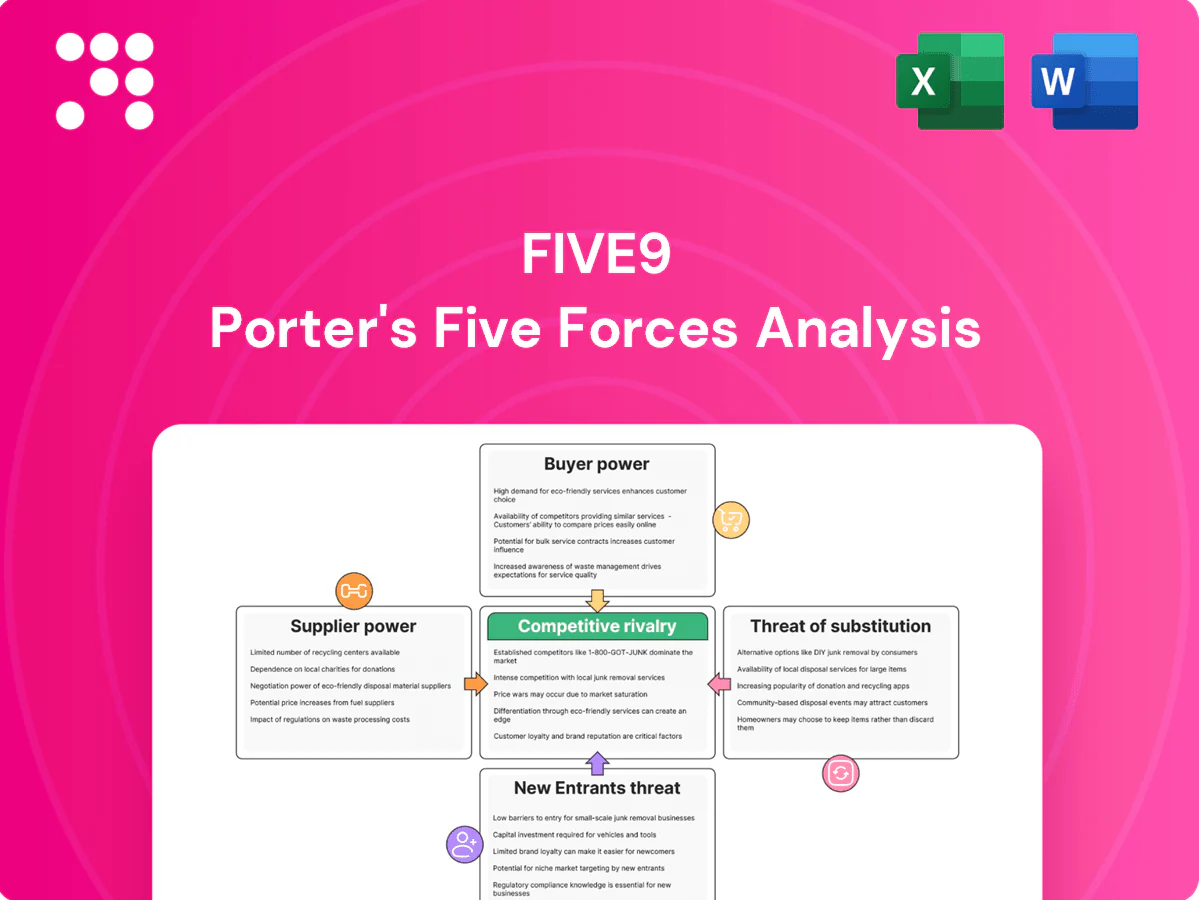
Five9 Porter's Five Forces Analysis

A Must-Have Tool for Decision-Makers
Five9 faces intense competitive rivalry and shifting buyer power as cloud contact center alternatives and AI-driven substitutes emerge, while moderate supplier leverage and barriers to entry shape market dynamics. This snapshot highlights key pressures but only scratches the surface. Unlock the full Porter's Five Forces Analysis for force-by-force ratings, visuals, and strategic takeaways tailored to Five9.
Suppliers Bargaining Power

Cloud IaaS dependency
Five9 depends on hyperscalers for compute, storage and networking, concentrating supplier influence given AWS/Azure/GCP control ~68% of global IaaS (2024 est.: AWS 33%, Azure 24%, GCP 11%). Multi-cloud deployment and multi-year contracts can blunt pricing power, but egress fees (AWS ~$0.09/GB) and specialized GPU/AI services raise switching costs. Provider outages also shift operational leverage toward suppliers.
Telco and carrier interconnects
Voice termination/origination and global PSTN access rely on carriers with regulated footprints, so Five9 must contract multiple carriers to reach over 80 countries that support number portability and comply with regional rules.
Volume commitments and diversified carrier mixes reduce single-point dependence, while number portability, compliance complexity and regional nuances preserve carrier leverage.
Quality-of-service, routing priorities and SLAs are used as commercial leverage to manage costs, latency and churn risk.

AI models and data services
NLP, ASR/TTS and LLM providers (OpenAI, Anthropic, AWS Bedrock, etc.) supply critical AI components, with 2024 API token pricing commonly ranging from ~$0.0004 to $0.03 per 1K tokens and explicit rate limits that create supplier power. Proprietary model access and integration lock-in raise switching costs, while accuracy differentials matter for contact-center SLAs. Building in-house state-of-the-art models typically costs tens to hundreds of millions and months to years, mitigating dependence but at high expense.

Software infrastructure stack
Software infrastructure stack suppliers (databases, observability, security) are critical to Five9s reliability and regulatory compliance; enterprise support tiers and feature gating can materially raise OPEX and TCO. Open-source alternatives reduce licensing spend but migration risk, integration costs and certification requirements limit short-term flexibility. Vendor security certifications are often non‑trivial to replace quickly, creating switching friction as of 2024.
- Vendor lock-in increases switching cost and compliance risk
- Enterprise support tiers drive predictable but higher OPEX
- Open-source lowers license fees but raises migration and cert costs
- Security certifications create high replacement barriers
Specialized labor
Five9 faces scarcity of engineers in real-time communications, AI and compliance; LinkedIn reported AI job postings rose about 32% in 2023–24, strengthening supplier power. Wage inflation and big-tech competition pushed median US software engineer pay roughly 6% higher in 2024, increasing costs. Remote work widens pools but raises global bidding pressure; retention programs and automation help lower dependence over time.
- Scarcity: high demand for niche RTC/AI/compliance skills
- Cost pressure: ~32% rise in AI postings; ~6% median pay growth (2024)
- Mitigants: retention, remote hiring, automation
Hyperscaler dominance, API costs and talent scarcity squeeze contact-center margins
Five9 faces concentrated hyperscaler power (2024 IaaS: AWS 33%, Azure 24%, GCP 11%), with egress ~$0.09/GB and specialized AI services raising switching costs. Global carrier dependence (reach >80 countries) and PSTN/regulatory complexity preserve pricing leverage. AI API pricing (~$0.0004–$0.03/1K tokens) and model lock‑in increase supplier influence. Talent scarcity (AI postings +32% 2023–24; median US engineer pay +6% 2024) raises OPEX.
| Supplier | 2024 metric | Impact |
|---|---|---|
| Hyperscalers | AWS33%/Azure24%/GCP11%; egress ~$0.09/GB | High switching cost, pricing leverage |
| Carriers | Reach >80 countries | Regulatory/coverage dependence |
| AI models/APIs | $0.0004–$0.03 per 1K tokens | Cost and lock‑in |
| Talent | AI job posts +32%; pay +6% | Higher OPEX, retention risk |
What is included in the product
 Detailed Word Document
Tailored Porter's Five Forces analysis for Five9 that uncovers competitive intensity, buyer and supplier influence, potential new entrants and substitutes, and strategic barriers protecting its contact-center cloud market position.

 Customizable Excel Spreadsheet
A clear, one-sheet Five9 Porter's Five Forces analysis that highlights competitive pressure from cloud contact-center rivals, supplier/platform dependencies, buyer negotiation power, substitutes like AI automation, and regulatory risks—perfect for quick, board-ready decisions.
Customers Bargaining Power

Enterprise procurement leverage
Large enterprise buyers commonly negotiate multi-year, multi-seat contracts (often 3+ years and thousands of seats), driving strong pricing pressure on Five9. RFPs force head-to-head comparisons on features and total cost of ownership, with discounting, paid pilots and proof-of-value now standard procurement levers. Active vendor consolidation programs at large customers further amplify buyer bargaining power.
Low switching friction with APIs
Open APIs and cloud delivery enable low-friction trials and phased migrations, helping CCaaS adoption scale into an estimated $24B market in 2024; customers can pilot modules without full commitment. Hidden costs from data migration, agent retraining and workflow redesign remain significant and often exceed initial setup estimates. Existing contract lock-ins and complex integration webs still create inertia, and buyers leverage this balance to extract favorable pricing and service terms.

Demand for uptime and SLAs
Buyers demand stringent SLAs—commonly 99.99% uptime in 2024—plus credits and full transparency on incidents. Any outage is highly visible and immediately creates leverage for concessions and credits. Regulated sectors insist on SOC 2, ISO 27001 and PCI DSS compliance, narrowing vendor options. A strong compliance posture therefore reduces buyer power by limiting viable alternatives.

Feature parity expectations
Buyers treat core routing, WFO/WEM and analytics as table stakes, pushing vendors to bundle advanced AI without premium; the contact center market was estimated at $26.5B in 2024, increasing leverage for purchasers. Frequent roadmap promises become bargaining chips, so Five9 must shift differentiation toward measurable outcomes and deep integrations to reduce customer bargaining power.
- Core parity expected
- AI bundled, no premium
- Roadmaps used in negotiations
- Differentiate on outcomes & integrations
Multi-vendor strategies
Enterprises increasingly mix best-of-breed CCaaS, CRM and CPaaS to avoid vendor lock-in, boosting buyer leverage as credible exit options rise; the global CCaaS market was about $15B in 2024 with ~18% YoY growth, enabling standardized connectors and API-first architectures that make component swaps routine. Vendors must price and bundle creatively to protect wallet share and justify switching costs.
- Multi-vendor adoption: accelerates credible exit options
- Standardized connectors: lower switching friction
- 2024 CCaaS market: ≈$15B, ~18% YoY growth
- Vendor response: creative pricing, bundles, ecosystem ties
Enterprises drive discounts as CCaaS scales to $15–$24B; 99.99% SLAs and bundled AI reshape deals
Large enterprise buyers wield strong pricing leverage via multi-year, multi-seat RFPs, paid pilots and consolidation programs.
Open APIs and cloud pilots scale CCaaS (≈$15B–$24B 2024), increasing credible exit options and lowering switching costs.
Demand for 99.99% SLAs and SOC2/ISO27001/PCI narrows suppliers but buyers extract credits; AI is expected bundled with no premium.
| Metric | 2024 |
|---|---|
| CCaaS market | $15B |
| Broader TAM | $24B |
| YoY growth | ~18% |
| Common SLA | 99.99% |
Full Version Awaits
Five9 Porter's Five Forces Analysis
This preview shows the exact Five9 Porter's Five Forces Analysis you'll receive after purchase—no surprises or placeholders. The analysis covers competitive rivalry, buyer and supplier power, threat of new entrants and substitutes, and strategic implications with clear ratings. It's fully formatted and ready for immediate download and use.

A Must-Have Tool for Decision-Makers
Five9 faces intense competitive rivalry and shifting buyer power as cloud contact center alternatives and AI-driven substitutes emerge, while moderate supplier leverage and barriers to entry shape market dynamics. This snapshot highlights key pressures but only scratches the surface. Unlock the full Porter's Five Forces Analysis for force-by-force ratings, visuals, and strategic takeaways tailored to Five9.
Suppliers Bargaining Power
Cloud IaaS dependency
Five9 depends on hyperscalers for compute, storage and networking, concentrating supplier influence given AWS/Azure/GCP control ~68% of global IaaS (2024 est.: AWS 33%, Azure 24%, GCP 11%). Multi-cloud deployment and multi-year contracts can blunt pricing power, but egress fees (AWS ~$0.09/GB) and specialized GPU/AI services raise switching costs. Provider outages also shift operational leverage toward suppliers.
Telco and carrier interconnects
Voice termination/origination and global PSTN access rely on carriers with regulated footprints, so Five9 must contract multiple carriers to reach over 80 countries that support number portability and comply with regional rules.
Volume commitments and diversified carrier mixes reduce single-point dependence, while number portability, compliance complexity and regional nuances preserve carrier leverage.
Quality-of-service, routing priorities and SLAs are used as commercial leverage to manage costs, latency and churn risk.
AI models and data services
NLP, ASR/TTS and LLM providers (OpenAI, Anthropic, AWS Bedrock, etc.) supply critical AI components, with 2024 API token pricing commonly ranging from ~$0.0004 to $0.03 per 1K tokens and explicit rate limits that create supplier power. Proprietary model access and integration lock-in raise switching costs, while accuracy differentials matter for contact-center SLAs. Building in-house state-of-the-art models typically costs tens to hundreds of millions and months to years, mitigating dependence but at high expense.
Software infrastructure stack
Software infrastructure stack suppliers (databases, observability, security) are critical to Five9s reliability and regulatory compliance; enterprise support tiers and feature gating can materially raise OPEX and TCO. Open-source alternatives reduce licensing spend but migration risk, integration costs and certification requirements limit short-term flexibility. Vendor security certifications are often non‑trivial to replace quickly, creating switching friction as of 2024.
- Vendor lock-in increases switching cost and compliance risk
- Enterprise support tiers drive predictable but higher OPEX
- Open-source lowers license fees but raises migration and cert costs
- Security certifications create high replacement barriers
Specialized labor
Five9 faces scarcity of engineers in real-time communications, AI and compliance; LinkedIn reported AI job postings rose about 32% in 2023–24, strengthening supplier power. Wage inflation and big-tech competition pushed median US software engineer pay roughly 6% higher in 2024, increasing costs. Remote work widens pools but raises global bidding pressure; retention programs and automation help lower dependence over time.
- Scarcity: high demand for niche RTC/AI/compliance skills
- Cost pressure: ~32% rise in AI postings; ~6% median pay growth (2024)
- Mitigants: retention, remote hiring, automation
Hyperscaler dominance, API costs and talent scarcity squeeze contact-center margins
Five9 faces concentrated hyperscaler power (2024 IaaS: AWS 33%, Azure 24%, GCP 11%), with egress ~$0.09/GB and specialized AI services raising switching costs. Global carrier dependence (reach >80 countries) and PSTN/regulatory complexity preserve pricing leverage. AI API pricing (~$0.0004–$0.03/1K tokens) and model lock‑in increase supplier influence. Talent scarcity (AI postings +32% 2023–24; median US engineer pay +6% 2024) raises OPEX.
| Supplier | 2024 metric | Impact |
|---|---|---|
| Hyperscalers | AWS33%/Azure24%/GCP11%; egress ~$0.09/GB | High switching cost, pricing leverage |
| Carriers | Reach >80 countries | Regulatory/coverage dependence |
| AI models/APIs | $0.0004–$0.03 per 1K tokens | Cost and lock‑in |
| Talent | AI job posts +32%; pay +6% | Higher OPEX, retention risk |
What is included in the product
Detailed Word Document
Tailored Porter's Five Forces analysis for Five9 that uncovers competitive intensity, buyer and supplier influence, potential new entrants and substitutes, and strategic barriers protecting its contact-center cloud market position.
Customizable Excel Spreadsheet
A clear, one-sheet Five9 Porter's Five Forces analysis that highlights competitive pressure from cloud contact-center rivals, supplier/platform dependencies, buyer negotiation power, substitutes like AI automation, and regulatory risks—perfect for quick, board-ready decisions.
Customers Bargaining Power
Enterprise procurement leverage
Large enterprise buyers commonly negotiate multi-year, multi-seat contracts (often 3+ years and thousands of seats), driving strong pricing pressure on Five9. RFPs force head-to-head comparisons on features and total cost of ownership, with discounting, paid pilots and proof-of-value now standard procurement levers. Active vendor consolidation programs at large customers further amplify buyer bargaining power.
Low switching friction with APIs
Open APIs and cloud delivery enable low-friction trials and phased migrations, helping CCaaS adoption scale into an estimated $24B market in 2024; customers can pilot modules without full commitment. Hidden costs from data migration, agent retraining and workflow redesign remain significant and often exceed initial setup estimates. Existing contract lock-ins and complex integration webs still create inertia, and buyers leverage this balance to extract favorable pricing and service terms.
Demand for uptime and SLAs
Buyers demand stringent SLAs—commonly 99.99% uptime in 2024—plus credits and full transparency on incidents. Any outage is highly visible and immediately creates leverage for concessions and credits. Regulated sectors insist on SOC 2, ISO 27001 and PCI DSS compliance, narrowing vendor options. A strong compliance posture therefore reduces buyer power by limiting viable alternatives.
Feature parity expectations
Buyers treat core routing, WFO/WEM and analytics as table stakes, pushing vendors to bundle advanced AI without premium; the contact center market was estimated at $26.5B in 2024, increasing leverage for purchasers. Frequent roadmap promises become bargaining chips, so Five9 must shift differentiation toward measurable outcomes and deep integrations to reduce customer bargaining power.
- Core parity expected
- AI bundled, no premium
- Roadmaps used in negotiations
- Differentiate on outcomes & integrations
Multi-vendor strategies
Enterprises increasingly mix best-of-breed CCaaS, CRM and CPaaS to avoid vendor lock-in, boosting buyer leverage as credible exit options rise; the global CCaaS market was about $15B in 2024 with ~18% YoY growth, enabling standardized connectors and API-first architectures that make component swaps routine. Vendors must price and bundle creatively to protect wallet share and justify switching costs.
- Multi-vendor adoption: accelerates credible exit options
- Standardized connectors: lower switching friction
- 2024 CCaaS market: ≈$15B, ~18% YoY growth
- Vendor response: creative pricing, bundles, ecosystem ties
Enterprises drive discounts as CCaaS scales to $15–$24B; 99.99% SLAs and bundled AI reshape deals
Large enterprise buyers wield strong pricing leverage via multi-year, multi-seat RFPs, paid pilots and consolidation programs.
Open APIs and cloud pilots scale CCaaS (≈$15B–$24B 2024), increasing credible exit options and lowering switching costs.
Demand for 99.99% SLAs and SOC2/ISO27001/PCI narrows suppliers but buyers extract credits; AI is expected bundled with no premium.
| Metric | 2024 |
|---|---|
| CCaaS market | $15B |
| Broader TAM | $24B |
| YoY growth | ~18% |
| Common SLA | 99.99% |
Full Version Awaits
Five9 Porter's Five Forces Analysis
This preview shows the exact Five9 Porter's Five Forces Analysis you'll receive after purchase—no surprises or placeholders. The analysis covers competitive rivalry, buyer and supplier power, threat of new entrants and substitutes, and strategic implications with clear ratings. It's fully formatted and ready for immediate download and use.
Original: $10.00
-65%$10.00
$3.50Description
A Must-Have Tool for Decision-Makers
Five9 faces intense competitive rivalry and shifting buyer power as cloud contact center alternatives and AI-driven substitutes emerge, while moderate supplier leverage and barriers to entry shape market dynamics. This snapshot highlights key pressures but only scratches the surface. Unlock the full Porter's Five Forces Analysis for force-by-force ratings, visuals, and strategic takeaways tailored to Five9.
Suppliers Bargaining Power
Cloud IaaS dependency
Five9 depends on hyperscalers for compute, storage and networking, concentrating supplier influence given AWS/Azure/GCP control ~68% of global IaaS (2024 est.: AWS 33%, Azure 24%, GCP 11%). Multi-cloud deployment and multi-year contracts can blunt pricing power, but egress fees (AWS ~$0.09/GB) and specialized GPU/AI services raise switching costs. Provider outages also shift operational leverage toward suppliers.
Telco and carrier interconnects
Voice termination/origination and global PSTN access rely on carriers with regulated footprints, so Five9 must contract multiple carriers to reach over 80 countries that support number portability and comply with regional rules.
Volume commitments and diversified carrier mixes reduce single-point dependence, while number portability, compliance complexity and regional nuances preserve carrier leverage.
Quality-of-service, routing priorities and SLAs are used as commercial leverage to manage costs, latency and churn risk.
AI models and data services
NLP, ASR/TTS and LLM providers (OpenAI, Anthropic, AWS Bedrock, etc.) supply critical AI components, with 2024 API token pricing commonly ranging from ~$0.0004 to $0.03 per 1K tokens and explicit rate limits that create supplier power. Proprietary model access and integration lock-in raise switching costs, while accuracy differentials matter for contact-center SLAs. Building in-house state-of-the-art models typically costs tens to hundreds of millions and months to years, mitigating dependence but at high expense.
Software infrastructure stack
Software infrastructure stack suppliers (databases, observability, security) are critical to Five9s reliability and regulatory compliance; enterprise support tiers and feature gating can materially raise OPEX and TCO. Open-source alternatives reduce licensing spend but migration risk, integration costs and certification requirements limit short-term flexibility. Vendor security certifications are often non‑trivial to replace quickly, creating switching friction as of 2024.
- Vendor lock-in increases switching cost and compliance risk
- Enterprise support tiers drive predictable but higher OPEX
- Open-source lowers license fees but raises migration and cert costs
- Security certifications create high replacement barriers
Specialized labor
Five9 faces scarcity of engineers in real-time communications, AI and compliance; LinkedIn reported AI job postings rose about 32% in 2023–24, strengthening supplier power. Wage inflation and big-tech competition pushed median US software engineer pay roughly 6% higher in 2024, increasing costs. Remote work widens pools but raises global bidding pressure; retention programs and automation help lower dependence over time.
- Scarcity: high demand for niche RTC/AI/compliance skills
- Cost pressure: ~32% rise in AI postings; ~6% median pay growth (2024)
- Mitigants: retention, remote hiring, automation
Hyperscaler dominance, API costs and talent scarcity squeeze contact-center margins
Five9 faces concentrated hyperscaler power (2024 IaaS: AWS 33%, Azure 24%, GCP 11%), with egress ~$0.09/GB and specialized AI services raising switching costs. Global carrier dependence (reach >80 countries) and PSTN/regulatory complexity preserve pricing leverage. AI API pricing (~$0.0004–$0.03/1K tokens) and model lock‑in increase supplier influence. Talent scarcity (AI postings +32% 2023–24; median US engineer pay +6% 2024) raises OPEX.
| Supplier | 2024 metric | Impact |
|---|---|---|
| Hyperscalers | AWS33%/Azure24%/GCP11%; egress ~$0.09/GB | High switching cost, pricing leverage |
| Carriers | Reach >80 countries | Regulatory/coverage dependence |
| AI models/APIs | $0.0004–$0.03 per 1K tokens | Cost and lock‑in |
| Talent | AI job posts +32%; pay +6% | Higher OPEX, retention risk |
What is included in the product
Detailed Word Document
Tailored Porter's Five Forces analysis for Five9 that uncovers competitive intensity, buyer and supplier influence, potential new entrants and substitutes, and strategic barriers protecting its contact-center cloud market position.
Customizable Excel Spreadsheet
A clear, one-sheet Five9 Porter's Five Forces analysis that highlights competitive pressure from cloud contact-center rivals, supplier/platform dependencies, buyer negotiation power, substitutes like AI automation, and regulatory risks—perfect for quick, board-ready decisions.
Customers Bargaining Power
Enterprise procurement leverage
Large enterprise buyers commonly negotiate multi-year, multi-seat contracts (often 3+ years and thousands of seats), driving strong pricing pressure on Five9. RFPs force head-to-head comparisons on features and total cost of ownership, with discounting, paid pilots and proof-of-value now standard procurement levers. Active vendor consolidation programs at large customers further amplify buyer bargaining power.
Low switching friction with APIs
Open APIs and cloud delivery enable low-friction trials and phased migrations, helping CCaaS adoption scale into an estimated $24B market in 2024; customers can pilot modules without full commitment. Hidden costs from data migration, agent retraining and workflow redesign remain significant and often exceed initial setup estimates. Existing contract lock-ins and complex integration webs still create inertia, and buyers leverage this balance to extract favorable pricing and service terms.
Demand for uptime and SLAs
Buyers demand stringent SLAs—commonly 99.99% uptime in 2024—plus credits and full transparency on incidents. Any outage is highly visible and immediately creates leverage for concessions and credits. Regulated sectors insist on SOC 2, ISO 27001 and PCI DSS compliance, narrowing vendor options. A strong compliance posture therefore reduces buyer power by limiting viable alternatives.
Feature parity expectations
Buyers treat core routing, WFO/WEM and analytics as table stakes, pushing vendors to bundle advanced AI without premium; the contact center market was estimated at $26.5B in 2024, increasing leverage for purchasers. Frequent roadmap promises become bargaining chips, so Five9 must shift differentiation toward measurable outcomes and deep integrations to reduce customer bargaining power.
- Core parity expected
- AI bundled, no premium
- Roadmaps used in negotiations
- Differentiate on outcomes & integrations
Multi-vendor strategies
Enterprises increasingly mix best-of-breed CCaaS, CRM and CPaaS to avoid vendor lock-in, boosting buyer leverage as credible exit options rise; the global CCaaS market was about $15B in 2024 with ~18% YoY growth, enabling standardized connectors and API-first architectures that make component swaps routine. Vendors must price and bundle creatively to protect wallet share and justify switching costs.
- Multi-vendor adoption: accelerates credible exit options
- Standardized connectors: lower switching friction
- 2024 CCaaS market: ≈$15B, ~18% YoY growth
- Vendor response: creative pricing, bundles, ecosystem ties
Enterprises drive discounts as CCaaS scales to $15–$24B; 99.99% SLAs and bundled AI reshape deals
Large enterprise buyers wield strong pricing leverage via multi-year, multi-seat RFPs, paid pilots and consolidation programs.
Open APIs and cloud pilots scale CCaaS (≈$15B–$24B 2024), increasing credible exit options and lowering switching costs.
Demand for 99.99% SLAs and SOC2/ISO27001/PCI narrows suppliers but buyers extract credits; AI is expected bundled with no premium.
| Metric | 2024 |
|---|---|
| CCaaS market | $15B |
| Broader TAM | $24B |
| YoY growth | ~18% |
| Common SLA | 99.99% |
Full Version Awaits
Five9 Porter's Five Forces Analysis
This preview shows the exact Five9 Porter's Five Forces Analysis you'll receive after purchase—no surprises or placeholders. The analysis covers competitive rivalry, buyer and supplier power, threat of new entrants and substitutes, and strategic implications with clear ratings. It's fully formatted and ready for immediate download and use.











