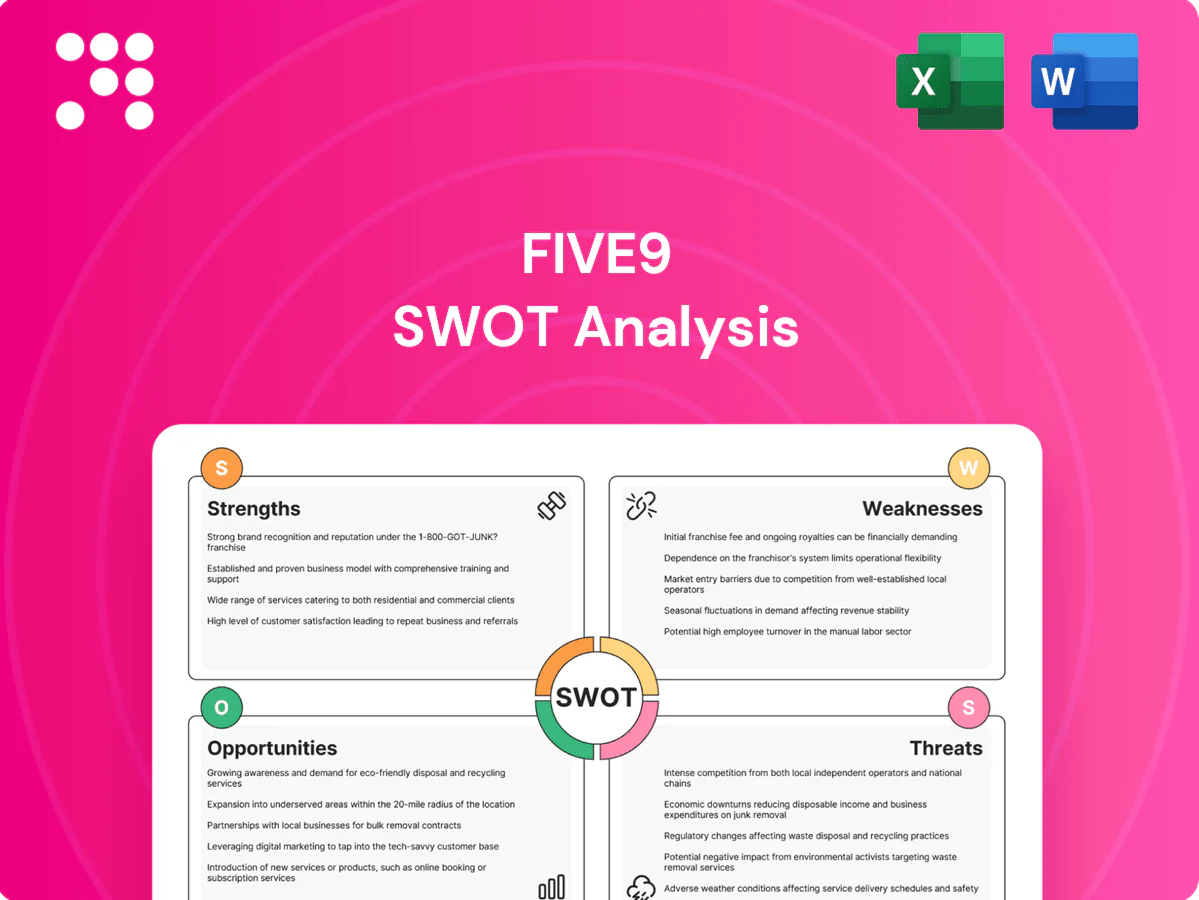
Five9 SWOT Analysis

Go Beyond the Preview—Access the Full Strategic Report
Five9’s SWOT highlights its cloud contact-center leadership, AI-driven product edge, and growth opportunities in omnichannel services, balanced against competitive pressure and margin risks; our full SWOT expands these points with financial context and strategic actions. Purchase the complete, editable report to plan, pitch, or invest with confidence.
Strengths

Leading cloud contact center platform
Five9 is widely recognized as a top-tier cloud contact center provider with a mature, enterprise-grade platform serving over 2,000 customers; its deep feature set and scalability fit complex, high-volume environments. Strong brand equity and referenceability lower buyer risk, supporting premium pricing and stickier relationships, reflected in net dollar retention around 110% and gross retention typically above 90%.
Omnichannel and intelligent routing
Five9's platform natively supports voice, chat, email, SMS, and social and serves 2,000+ customers worldwide. Intelligent routing and skills-based distribution optimize handling times and customer outcomes. Consistent workflows across channels improve agent productivity. Unified customer context reduces friction and increases first-contact resolution.

AI-driven automation and analytics
Five9 deploys AI for agent assist, self-service and quality management, supporting over 2,000 customers and FY2023 revenue of about $618 million. Speech and text analytics surface compliance and coaching insights in real time. Automation can cut handling costs by up to 30% (Gartner) while delivering single- to low-double-digit CSAT gains. Continuous learning models further improve outcomes as usage scales.

Robust integrations ecosystem
Five9 offers prebuilt connectors to leading CRMs (Salesforce, Microsoft Dynamics) and UCaaS platforms (Microsoft Teams, Zoom), accelerating deployments for its 2,000+ customers. Robust REST APIs and SDKs enable custom workflows and seamless data exchange. Tight integrations cut swivel-chair time and reduce errors, boosting agent efficiency and stickiness across an expanding ecosystem of use cases.
- Prebuilt connectors: faster deployment
- Open APIs: custom workflows, data exchange
- Tight integrations: fewer errors, higher agent efficiency
Enterprise-grade reliability and security
Five9's multi-tenant cloud architecture delivers a 99.99% uptime SLA and global reach with active-active regional redundancy to minimize downtime. Compliance with SOC 2, ISO 27001, PCI DSS and HIPAA supports regulated-use adoption. A strong security posture and resilience reassure procurement and InfoSec teams across 2,000+ customers.
- 99.99% SLA
- SOC 2, ISO 27001, PCI DSS, HIPAA
- Active-active redundancy
- 2,000+ customers
Cloud contact center: ~110% NDR, up to 30% handling cost cuts
Five9 is a leading cloud contact-center provider with 2,000+ customers, FY2023 revenue ~$618M, and net dollar retention ~110%, supporting premium pricing and stickier relationships. Its multi-channel platform (voice, chat, email, SMS) and AI-driven automation improve FCR and can cut handling costs up to 30% (Gartner). Enterprise-grade security (99.99% SLA, SOC 2, ISO 27001, PCI, HIPAA) enables regulated deployments.
| Metric | Value |
|---|---|
| Customers | 2,000+ |
| FY2023 Revenue | ~$618M |
| Net Dollar Retention | ~110% |
| Gross Retention | >90% |
| SLA | 99.99% |
| Certifications | SOC 2, ISO 27001, PCI DSS, HIPAA |
What is included in the product
 Detailed Word Document
Provides a concise SWOT analysis of Five9, highlighting internal strengths and weaknesses and external opportunities and threats that shape its competitive position and growth prospects.

 Customizable Excel Spreadsheet
Provides a concise Five9 SWOT matrix for fast, visual strategy alignment, helping teams pinpoint the contact-center SaaS strengths, weaknesses, opportunities, and threats to relieve strategic pain points.
Weaknesses

Reliance on third-party clouds
Reliance on hyperscalers such as AWS, Azure and Google Cloud (2024 market shares ~32%, 23%, 11% respectively) constrains Five9s cost and control levers. Outages or pricing shifts by these providers can compress margins and jeopardize SLAs, as seen in industry-wide incidents that disrupted contact centers. Limited infrastructure-layer differentiation and vendor concentration elevate operational and supply-chain risk.
Complex integrations and deployments
Enterprise rollouts for Five9 can be lengthy due to legacy systems and data silos, often stretching 6–18 months for large customers. Heavy customization raises implementation effort and cost, pushing professional services demand higher; Five9 serves over 2,000 customers, increasing PS load. Integration complexity can delay time-to-value and may strain smaller customers lacking robust IT resources.

Pricing pressure in competitive bids
Feature parity with rivals intensifies discounting in competitive bids, forcing Five9 to defend price rather than differentiate on capabilities. Greater scrutiny of total cost of ownership drives procurement toward lower-cost alternatives, raising the likelihood of losing renewals. Large RFPs increase margin compression risk as scale buyers demand deeper concessions. Clearer value communication is required to prevent deals being reduced to pure price comparisons.

Churn risk from switching ease
Churn risk rises as cloud-to-cloud migrations become easier; Gartner estimates 75% of contact centers will be cloud-based by 2025. Buyers increasingly use low-cost trials and PoCs to test competitors, so if outcomes stagnate customers re-evaluate vendors. Contract renewals become battlegrounds for retention and pricing pressure.
- 75% cloud contact centers by 2025 — migration tailwind
- Low-cost trials/PoCs reduce switching barriers
- Renewals concentrate retention and price risk
Limited appeal for on-premise holdouts
Five9s cloud-first contact center model can clash with highly regulated or sovereign-data clients that mandate on-prem or private cloud deployments, leaving some government and sensitive-industry buyers out of reach. This gap may lengthen sales cycles as procurement stumbles over data residency and control requirements. Market exclusion risks losing enterprise deals tied to strict compliance regimes.
- Regulatory mismatch: on-prem required
- Enterprise segments: government, defense, healthcare
- Sales impact: longer cycles, stalled RFPs
Hyperscaler reliance and long rollouts heighten margin, SLA and churn risk in cloud contact centers
Dependence on hyperscalers (AWS 32%, Azure 23%, Google 11% in 2024) raises margin and SLA risk from outages/pricing shifts; large enterprise rollouts (6–18 months) and heavy customization increase professional services load across Five9s >2,000 customers; intensifying feature parity and easier cloud-to-cloud migration (75% cloud contact centers by 2025) heighten renewal and price-pressure risk.
| Weakness | Impact | Metric (2024/25) |
|---|---|---|
| Hyperscaler reliance | Margin/SLA risk | AWS 32%, Azure 23%, GCP 11% (2024) |
| Slow enterprise rollouts | Higher PS cost | 6–18 months; >2,000 customers |
| Price/churn pressure | Renewal risk | 75% cloud CCs by 2025 |
What You See Is What You Get
Five9 SWOT Analysis
This is the actual Five9 SWOT analysis document you’ll receive upon purchase—no surprises, just professional quality. The preview below is taken directly from the full report you'll get; purchase unlocks the entire in-depth, editable version. You’re viewing a live preview of the real file—buy now to access the complete, detailed analysis.

Go Beyond the Preview—Access the Full Strategic Report
Five9’s SWOT highlights its cloud contact-center leadership, AI-driven product edge, and growth opportunities in omnichannel services, balanced against competitive pressure and margin risks; our full SWOT expands these points with financial context and strategic actions. Purchase the complete, editable report to plan, pitch, or invest with confidence.
Strengths
Leading cloud contact center platform
Five9 is widely recognized as a top-tier cloud contact center provider with a mature, enterprise-grade platform serving over 2,000 customers; its deep feature set and scalability fit complex, high-volume environments. Strong brand equity and referenceability lower buyer risk, supporting premium pricing and stickier relationships, reflected in net dollar retention around 110% and gross retention typically above 90%.
Omnichannel and intelligent routing
Five9's platform natively supports voice, chat, email, SMS, and social and serves 2,000+ customers worldwide. Intelligent routing and skills-based distribution optimize handling times and customer outcomes. Consistent workflows across channels improve agent productivity. Unified customer context reduces friction and increases first-contact resolution.
AI-driven automation and analytics
Five9 deploys AI for agent assist, self-service and quality management, supporting over 2,000 customers and FY2023 revenue of about $618 million. Speech and text analytics surface compliance and coaching insights in real time. Automation can cut handling costs by up to 30% (Gartner) while delivering single- to low-double-digit CSAT gains. Continuous learning models further improve outcomes as usage scales.
Robust integrations ecosystem
Five9 offers prebuilt connectors to leading CRMs (Salesforce, Microsoft Dynamics) and UCaaS platforms (Microsoft Teams, Zoom), accelerating deployments for its 2,000+ customers. Robust REST APIs and SDKs enable custom workflows and seamless data exchange. Tight integrations cut swivel-chair time and reduce errors, boosting agent efficiency and stickiness across an expanding ecosystem of use cases.
- Prebuilt connectors: faster deployment
- Open APIs: custom workflows, data exchange
- Tight integrations: fewer errors, higher agent efficiency
Enterprise-grade reliability and security
Five9's multi-tenant cloud architecture delivers a 99.99% uptime SLA and global reach with active-active regional redundancy to minimize downtime. Compliance with SOC 2, ISO 27001, PCI DSS and HIPAA supports regulated-use adoption. A strong security posture and resilience reassure procurement and InfoSec teams across 2,000+ customers.
- 99.99% SLA
- SOC 2, ISO 27001, PCI DSS, HIPAA
- Active-active redundancy
- 2,000+ customers
Cloud contact center: ~110% NDR, up to 30% handling cost cuts
Five9 is a leading cloud contact-center provider with 2,000+ customers, FY2023 revenue ~$618M, and net dollar retention ~110%, supporting premium pricing and stickier relationships. Its multi-channel platform (voice, chat, email, SMS) and AI-driven automation improve FCR and can cut handling costs up to 30% (Gartner). Enterprise-grade security (99.99% SLA, SOC 2, ISO 27001, PCI, HIPAA) enables regulated deployments.
| Metric | Value |
|---|---|
| Customers | 2,000+ |
| FY2023 Revenue | ~$618M |
| Net Dollar Retention | ~110% |
| Gross Retention | >90% |
| SLA | 99.99% |
| Certifications | SOC 2, ISO 27001, PCI DSS, HIPAA |
What is included in the product
Detailed Word Document
Provides a concise SWOT analysis of Five9, highlighting internal strengths and weaknesses and external opportunities and threats that shape its competitive position and growth prospects.
Customizable Excel Spreadsheet
Provides a concise Five9 SWOT matrix for fast, visual strategy alignment, helping teams pinpoint the contact-center SaaS strengths, weaknesses, opportunities, and threats to relieve strategic pain points.
Weaknesses
Reliance on third-party clouds
Reliance on hyperscalers such as AWS, Azure and Google Cloud (2024 market shares ~32%, 23%, 11% respectively) constrains Five9s cost and control levers. Outages or pricing shifts by these providers can compress margins and jeopardize SLAs, as seen in industry-wide incidents that disrupted contact centers. Limited infrastructure-layer differentiation and vendor concentration elevate operational and supply-chain risk.
Complex integrations and deployments
Enterprise rollouts for Five9 can be lengthy due to legacy systems and data silos, often stretching 6–18 months for large customers. Heavy customization raises implementation effort and cost, pushing professional services demand higher; Five9 serves over 2,000 customers, increasing PS load. Integration complexity can delay time-to-value and may strain smaller customers lacking robust IT resources.
Pricing pressure in competitive bids
Feature parity with rivals intensifies discounting in competitive bids, forcing Five9 to defend price rather than differentiate on capabilities. Greater scrutiny of total cost of ownership drives procurement toward lower-cost alternatives, raising the likelihood of losing renewals. Large RFPs increase margin compression risk as scale buyers demand deeper concessions. Clearer value communication is required to prevent deals being reduced to pure price comparisons.
Churn risk from switching ease
Churn risk rises as cloud-to-cloud migrations become easier; Gartner estimates 75% of contact centers will be cloud-based by 2025. Buyers increasingly use low-cost trials and PoCs to test competitors, so if outcomes stagnate customers re-evaluate vendors. Contract renewals become battlegrounds for retention and pricing pressure.
- 75% cloud contact centers by 2025 — migration tailwind
- Low-cost trials/PoCs reduce switching barriers
- Renewals concentrate retention and price risk
Limited appeal for on-premise holdouts
Five9s cloud-first contact center model can clash with highly regulated or sovereign-data clients that mandate on-prem or private cloud deployments, leaving some government and sensitive-industry buyers out of reach. This gap may lengthen sales cycles as procurement stumbles over data residency and control requirements. Market exclusion risks losing enterprise deals tied to strict compliance regimes.
- Regulatory mismatch: on-prem required
- Enterprise segments: government, defense, healthcare
- Sales impact: longer cycles, stalled RFPs
Hyperscaler reliance and long rollouts heighten margin, SLA and churn risk in cloud contact centers
Dependence on hyperscalers (AWS 32%, Azure 23%, Google 11% in 2024) raises margin and SLA risk from outages/pricing shifts; large enterprise rollouts (6–18 months) and heavy customization increase professional services load across Five9s >2,000 customers; intensifying feature parity and easier cloud-to-cloud migration (75% cloud contact centers by 2025) heighten renewal and price-pressure risk.
| Weakness | Impact | Metric (2024/25) |
|---|---|---|
| Hyperscaler reliance | Margin/SLA risk | AWS 32%, Azure 23%, GCP 11% (2024) |
| Slow enterprise rollouts | Higher PS cost | 6–18 months; >2,000 customers |
| Price/churn pressure | Renewal risk | 75% cloud CCs by 2025 |
What You See Is What You Get
Five9 SWOT Analysis
This is the actual Five9 SWOT analysis document you’ll receive upon purchase—no surprises, just professional quality. The preview below is taken directly from the full report you'll get; purchase unlocks the entire in-depth, editable version. You’re viewing a live preview of the real file—buy now to access the complete, detailed analysis.
Original: $10.00
-65%$10.00
$3.50Description
Go Beyond the Preview—Access the Full Strategic Report
Five9’s SWOT highlights its cloud contact-center leadership, AI-driven product edge, and growth opportunities in omnichannel services, balanced against competitive pressure and margin risks; our full SWOT expands these points with financial context and strategic actions. Purchase the complete, editable report to plan, pitch, or invest with confidence.
Strengths
Leading cloud contact center platform
Five9 is widely recognized as a top-tier cloud contact center provider with a mature, enterprise-grade platform serving over 2,000 customers; its deep feature set and scalability fit complex, high-volume environments. Strong brand equity and referenceability lower buyer risk, supporting premium pricing and stickier relationships, reflected in net dollar retention around 110% and gross retention typically above 90%.
Omnichannel and intelligent routing
Five9's platform natively supports voice, chat, email, SMS, and social and serves 2,000+ customers worldwide. Intelligent routing and skills-based distribution optimize handling times and customer outcomes. Consistent workflows across channels improve agent productivity. Unified customer context reduces friction and increases first-contact resolution.
AI-driven automation and analytics
Five9 deploys AI for agent assist, self-service and quality management, supporting over 2,000 customers and FY2023 revenue of about $618 million. Speech and text analytics surface compliance and coaching insights in real time. Automation can cut handling costs by up to 30% (Gartner) while delivering single- to low-double-digit CSAT gains. Continuous learning models further improve outcomes as usage scales.
Robust integrations ecosystem
Five9 offers prebuilt connectors to leading CRMs (Salesforce, Microsoft Dynamics) and UCaaS platforms (Microsoft Teams, Zoom), accelerating deployments for its 2,000+ customers. Robust REST APIs and SDKs enable custom workflows and seamless data exchange. Tight integrations cut swivel-chair time and reduce errors, boosting agent efficiency and stickiness across an expanding ecosystem of use cases.
- Prebuilt connectors: faster deployment
- Open APIs: custom workflows, data exchange
- Tight integrations: fewer errors, higher agent efficiency
Enterprise-grade reliability and security
Five9's multi-tenant cloud architecture delivers a 99.99% uptime SLA and global reach with active-active regional redundancy to minimize downtime. Compliance with SOC 2, ISO 27001, PCI DSS and HIPAA supports regulated-use adoption. A strong security posture and resilience reassure procurement and InfoSec teams across 2,000+ customers.
- 99.99% SLA
- SOC 2, ISO 27001, PCI DSS, HIPAA
- Active-active redundancy
- 2,000+ customers
Cloud contact center: ~110% NDR, up to 30% handling cost cuts
Five9 is a leading cloud contact-center provider with 2,000+ customers, FY2023 revenue ~$618M, and net dollar retention ~110%, supporting premium pricing and stickier relationships. Its multi-channel platform (voice, chat, email, SMS) and AI-driven automation improve FCR and can cut handling costs up to 30% (Gartner). Enterprise-grade security (99.99% SLA, SOC 2, ISO 27001, PCI, HIPAA) enables regulated deployments.
| Metric | Value |
|---|---|
| Customers | 2,000+ |
| FY2023 Revenue | ~$618M |
| Net Dollar Retention | ~110% |
| Gross Retention | >90% |
| SLA | 99.99% |
| Certifications | SOC 2, ISO 27001, PCI DSS, HIPAA |
What is included in the product
Detailed Word Document
Provides a concise SWOT analysis of Five9, highlighting internal strengths and weaknesses and external opportunities and threats that shape its competitive position and growth prospects.
Customizable Excel Spreadsheet
Provides a concise Five9 SWOT matrix for fast, visual strategy alignment, helping teams pinpoint the contact-center SaaS strengths, weaknesses, opportunities, and threats to relieve strategic pain points.
Weaknesses
Reliance on third-party clouds
Reliance on hyperscalers such as AWS, Azure and Google Cloud (2024 market shares ~32%, 23%, 11% respectively) constrains Five9s cost and control levers. Outages or pricing shifts by these providers can compress margins and jeopardize SLAs, as seen in industry-wide incidents that disrupted contact centers. Limited infrastructure-layer differentiation and vendor concentration elevate operational and supply-chain risk.
Complex integrations and deployments
Enterprise rollouts for Five9 can be lengthy due to legacy systems and data silos, often stretching 6–18 months for large customers. Heavy customization raises implementation effort and cost, pushing professional services demand higher; Five9 serves over 2,000 customers, increasing PS load. Integration complexity can delay time-to-value and may strain smaller customers lacking robust IT resources.
Pricing pressure in competitive bids
Feature parity with rivals intensifies discounting in competitive bids, forcing Five9 to defend price rather than differentiate on capabilities. Greater scrutiny of total cost of ownership drives procurement toward lower-cost alternatives, raising the likelihood of losing renewals. Large RFPs increase margin compression risk as scale buyers demand deeper concessions. Clearer value communication is required to prevent deals being reduced to pure price comparisons.
Churn risk from switching ease
Churn risk rises as cloud-to-cloud migrations become easier; Gartner estimates 75% of contact centers will be cloud-based by 2025. Buyers increasingly use low-cost trials and PoCs to test competitors, so if outcomes stagnate customers re-evaluate vendors. Contract renewals become battlegrounds for retention and pricing pressure.
- 75% cloud contact centers by 2025 — migration tailwind
- Low-cost trials/PoCs reduce switching barriers
- Renewals concentrate retention and price risk
Limited appeal for on-premise holdouts
Five9s cloud-first contact center model can clash with highly regulated or sovereign-data clients that mandate on-prem or private cloud deployments, leaving some government and sensitive-industry buyers out of reach. This gap may lengthen sales cycles as procurement stumbles over data residency and control requirements. Market exclusion risks losing enterprise deals tied to strict compliance regimes.
- Regulatory mismatch: on-prem required
- Enterprise segments: government, defense, healthcare
- Sales impact: longer cycles, stalled RFPs
Hyperscaler reliance and long rollouts heighten margin, SLA and churn risk in cloud contact centers
Dependence on hyperscalers (AWS 32%, Azure 23%, Google 11% in 2024) raises margin and SLA risk from outages/pricing shifts; large enterprise rollouts (6–18 months) and heavy customization increase professional services load across Five9s >2,000 customers; intensifying feature parity and easier cloud-to-cloud migration (75% cloud contact centers by 2025) heighten renewal and price-pressure risk.
| Weakness | Impact | Metric (2024/25) |
|---|---|---|
| Hyperscaler reliance | Margin/SLA risk | AWS 32%, Azure 23%, GCP 11% (2024) |
| Slow enterprise rollouts | Higher PS cost | 6–18 months; >2,000 customers |
| Price/churn pressure | Renewal risk | 75% cloud CCs by 2025 |
What You See Is What You Get
Five9 SWOT Analysis
This is the actual Five9 SWOT analysis document you’ll receive upon purchase—no surprises, just professional quality. The preview below is taken directly from the full report you'll get; purchase unlocks the entire in-depth, editable version. You’re viewing a live preview of the real file—buy now to access the complete, detailed analysis.











