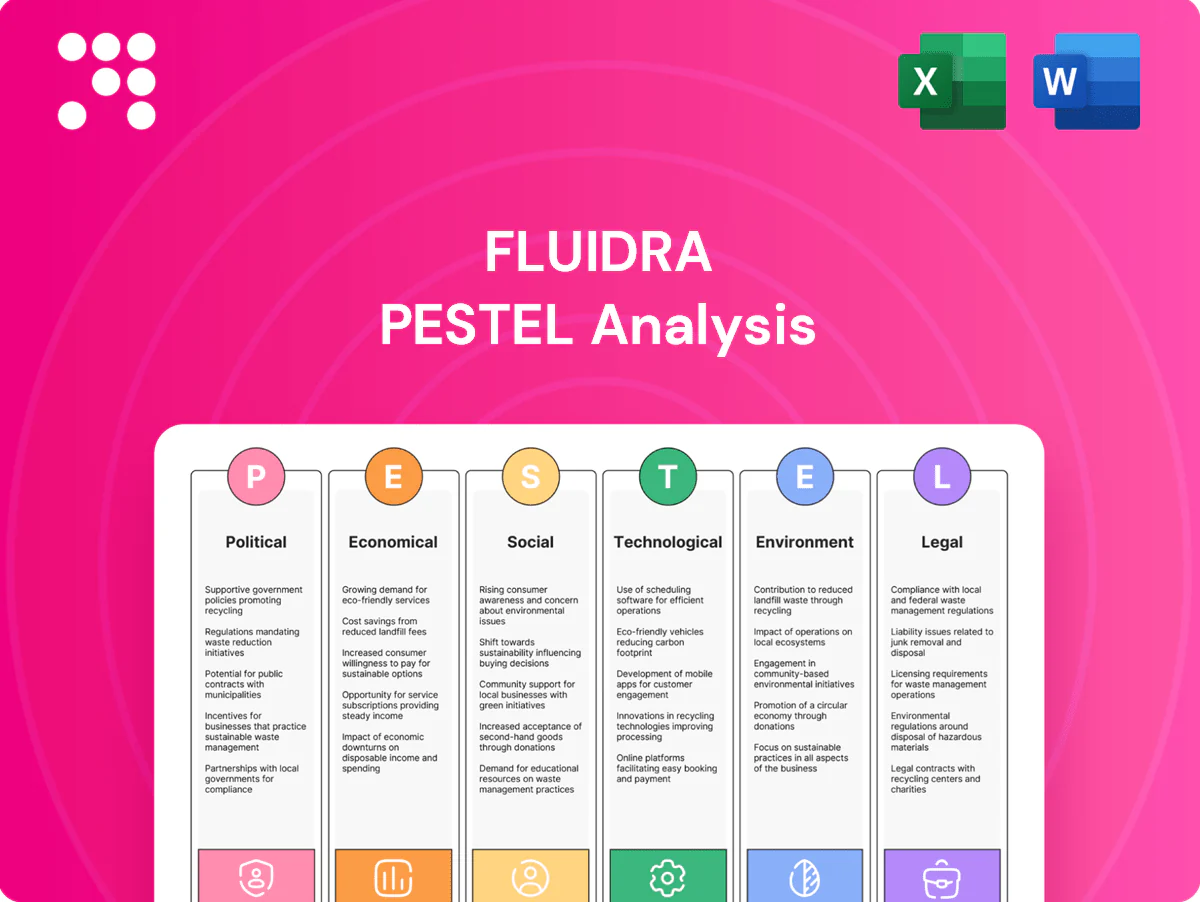
Fluidra PESTLE Analysis

Skip the Research. Get the Strategy.
Our PESTLE analysis for Fluidra reveals how political, economic, social, technological, legal and environmental forces shape its market prospects, risks and growth opportunities. Ideal for investors and strategists, it’s fully researched and actionable. Purchase the full report to get the complete, editable breakdown instantly.
Political factors

Trade policy and tariffs
As a global manufacturer, Fluidra faces tariff volatility on pumps, heaters and electronic components, with US Section 301 measures and retaliatory tariffs reaching up to 25% on some Chinese-origin goods. Shifts in US–EU–China trade policy can reprice bill-of-materials and compress margins through sudden cost increases. Diversifying sourcing and nearshoring mitigate exposure, while proactive tariff engineering and HTS optimization serve as strategic levers to protect gross margins.
Water policy and public incentives
Government incentives for water efficiency and drought mitigation materially shape Fluidra product demand, directing capital toward low-water, energy-efficient pool systems. The 2021 US Infrastructure Investment and Jobs Act committed roughly 55 billion USD for water infrastructure, creating procurement and retrofit opportunities. Utility rebates for variable-speed pumps and smart controllers accelerate adoption and allow Fluidra to align products with public pool codes and funding cycles to pursue co-marketing with utilities.

Geopolitical and energy security
Geopolitical tensions and energy policy since 2022 pushed European wholesale electricity and gas prices up roughly 30% at peaks, raising pool operating costs for Fluidra and customers. Higher energy bills have increased demand for high-efficiency variable-speed pumps and heat-pump solutions, with manufacturers claiming up to 70% lifecycle energy savings. Supply-chain disruptions in 2022–24 delayed critical components by 8–12 weeks for some suppliers; scenario planning and inventory buffers help maintain service levels.

Local content and procurement rules
Some markets favor local manufacturing in public tenders; as of 2024 jurisdictions such as India and Brazil enforce local content thresholds that can reach up to 60%, shaping supply strategies. These thresholds influence Fluidra’s plant footprint and partnerships, while certifying local assembly measurably improves bid competitiveness and supports delivery reliability. Compliance enhances political goodwill and access to public projects.
- local-content: thresholds up to 60% (2024)
- plant-footprint: drives regional JV and assembly hubs
- certification: boosts bid success in public tenders
- compliance: strengthens political goodwill and on-time delivery
Urban planning and tourism policy
Resort development and municipal wellness initiatives drive commercial demand for Fluidra products as new resorts and city spa programs expand retrofit and new-build opportunities. Tourism incentives often accelerate spa and aquatic center projects, while zoning and permitting timelines materially affect project cycles and cash flow timing. Early engagement with authorities reduces approval delays and cost overruns.
- Resort development: boosts commercial pool demand
- Tourism incentives: spur spa projects
- Zoning/permitting: lengthen project cycles
- Early engagement: cuts delays
Tariff shocks, local-content mandates and energy spikes drive electrification and supply reshuffle
Fluidra faces tariff swings (up to 25% on some Chinese-origin goods) and local-content rules (up to 60% in India/Brazil) that reshape sourcing and margins. Public funding (US IIJA ~55 billion USD for water) and utility rebates boost demand for efficient equipment, while 2022–24 energy spikes (~+30%) and 8–12 week supply delays accelerate product electrification and inventory strategies.
| Factor | Key metric |
|---|---|
| Tariffs | Up to 25% |
| Local content | Up to 60% (2024) |
| Public funding | ~55bn USD (US IIJA) |
| Energy impact | +30% peak (2022–24) |
| Supply delays | 8–12 weeks |
What is included in the product
 Detailed Word Document
Explores how macro-environmental factors uniquely affect Fluidra—Political, Economic, Social, Technological, Environmental, and Legal—with data-driven insights and trend-backed subpoints to identify threats, opportunities and forward-looking scenarios for executives, investors and strategists operating in the global pool and water-treatment market.

 Customizable Excel Spreadsheet
A concise, visually segmented PESTLE summary for Fluidra that eases stakeholder alignment, supports external risk and market positioning discussions, and can be dropped into presentations or planning packs while remaining editable for region- or product-specific notes.
Economic factors

Housing cycle sensitivity
Residential pool demand closely follows new-build and renovation activity: downturns often delay discretionary upgrades while recoveries boost aftermarket; Fluidra reported ~€2.38bn revenue in 2023 with aftermarket and services representing roughly one-third of sales, helping cushion cyclicality. Strong aftermarket service and replacement activity plus flexible pricing and consumer financing programs support volumes during housing slowdowns.
Interest rates and consumer credit
Higher rates—US federal funds roughly 5.25–5.50% in 2024–25 and 30‑year mortgage rates near 7%—raise borrowing costs for homeowners and dealers, tightening demand for discretionary pool projects. Financing availability materially influences big‑ticket equipment sales. Offering promotional financing programs can sustain throughput and close deals. Rigorous working capital discipline mitigates dealer inventory swings and cashflow pressure.

Disposable income and wealth effects
Rising disposable income and wealth effects push consumers toward luxury pool and wellness upgrades, supporting Fluidra’s premium lines as seen with 2024 revenue of €2.07bn. Equity and home-price movements (OECD house prices +3.5% in 2024) influence homeowner confidence and replacement cycles. Fluidra’s tiered ranges capture value and premium segments, while pricing analytics protect margins during demand shifts.

FX exposure and global footprint
Multi-currency revenues and costs expose Fluidra to translation and transaction risk across USD, EUR and emerging-market currencies, impacting reported margins and cash flows.
USD/EUR volatility and EM currency swings influence competitiveness in sourcing and pricing; Fluidra offsets this via natural hedging and use of derivatives to smooth earnings.
Local pricing policies and pass-through mechanisms help protect margins in inflationary or depreciating-currency markets.
- FX exposure: multi-currency revenues/costs
- Key drivers: USD, EUR, emerging-market volatility
- Mitigants: natural hedging, derivatives
- Policy: local pricing to manage pass-through
Input costs and logistics
Input costs for Fluidra—metals, resins and electronics—directly pressure COGS; Fluidra reported approximately €2.4bn revenue in 2023, so margin sensitivity to commodity swings is material. Freight volatility (container rates fell over 60% from 2022 peaks to 2024 per Drewry) and supply bottlenecks can extend lead times and inflate inventories. Dual-sourcing, design-to-cost and SIOP processes have been used to realign capacity with demand and reduce stockholding.
- Metals/resins/electronics raise COGS and margin risk
- Freight volatility: >60% decline from 2022 peak to 2024 (Drewry)
- Supply bottlenecks lengthen lead times, raise inventory
- Mitigants: dual-sourcing, design-to-cost, SIOP
Tariff shocks, local-content mandates and energy spikes drive electrification and supply reshuffle
Fluidra faces cyclical residential demand with revenue ~€2.38bn in 2023 and €2.07bn in 2024; strong aftermarket (~33%) cushions swings. Higher rates (US fed funds ~5.25–5.50% 2024–25; 30y mortgage ~7%) tighten big‑ticket demand while OECD house prices +3.5% (2024) support upgrades. Commodity, freight and FX volatility (freight >60% decline from 2022 peak) pressure margins; hedging and pricing pass‑through help mitigate.
| Metric | Value |
|---|---|
| Revenue 2023 | €2.38bn |
| Revenue 2024 | €2.07bn |
| US rates (2024–25) | 5.25–5.50% |
| 30y mortgage | ~7% |
| OECD house prices (2024) | +3.5% |
| Freight change | >60% decline vs 2022 peak |
Full Version Awaits
Fluidra PESTLE Analysis
The preview shown here is the exact Fluidra PESTLE Analysis you’ll receive after purchase—fully formatted and ready to use. It covers Political, Economic, Social, Technological, Legal and Environmental factors impacting Fluidra. No placeholders or teasers; download the final file immediately after payment.

Skip the Research. Get the Strategy.
Our PESTLE analysis for Fluidra reveals how political, economic, social, technological, legal and environmental forces shape its market prospects, risks and growth opportunities. Ideal for investors and strategists, it’s fully researched and actionable. Purchase the full report to get the complete, editable breakdown instantly.
Political factors
Trade policy and tariffs
As a global manufacturer, Fluidra faces tariff volatility on pumps, heaters and electronic components, with US Section 301 measures and retaliatory tariffs reaching up to 25% on some Chinese-origin goods. Shifts in US–EU–China trade policy can reprice bill-of-materials and compress margins through sudden cost increases. Diversifying sourcing and nearshoring mitigate exposure, while proactive tariff engineering and HTS optimization serve as strategic levers to protect gross margins.
Water policy and public incentives
Government incentives for water efficiency and drought mitigation materially shape Fluidra product demand, directing capital toward low-water, energy-efficient pool systems. The 2021 US Infrastructure Investment and Jobs Act committed roughly 55 billion USD for water infrastructure, creating procurement and retrofit opportunities. Utility rebates for variable-speed pumps and smart controllers accelerate adoption and allow Fluidra to align products with public pool codes and funding cycles to pursue co-marketing with utilities.
Geopolitical and energy security
Geopolitical tensions and energy policy since 2022 pushed European wholesale electricity and gas prices up roughly 30% at peaks, raising pool operating costs for Fluidra and customers. Higher energy bills have increased demand for high-efficiency variable-speed pumps and heat-pump solutions, with manufacturers claiming up to 70% lifecycle energy savings. Supply-chain disruptions in 2022–24 delayed critical components by 8–12 weeks for some suppliers; scenario planning and inventory buffers help maintain service levels.
Local content and procurement rules
Some markets favor local manufacturing in public tenders; as of 2024 jurisdictions such as India and Brazil enforce local content thresholds that can reach up to 60%, shaping supply strategies. These thresholds influence Fluidra’s plant footprint and partnerships, while certifying local assembly measurably improves bid competitiveness and supports delivery reliability. Compliance enhances political goodwill and access to public projects.
- local-content: thresholds up to 60% (2024)
- plant-footprint: drives regional JV and assembly hubs
- certification: boosts bid success in public tenders
- compliance: strengthens political goodwill and on-time delivery
Urban planning and tourism policy
Resort development and municipal wellness initiatives drive commercial demand for Fluidra products as new resorts and city spa programs expand retrofit and new-build opportunities. Tourism incentives often accelerate spa and aquatic center projects, while zoning and permitting timelines materially affect project cycles and cash flow timing. Early engagement with authorities reduces approval delays and cost overruns.
- Resort development: boosts commercial pool demand
- Tourism incentives: spur spa projects
- Zoning/permitting: lengthen project cycles
- Early engagement: cuts delays
Tariff shocks, local-content mandates and energy spikes drive electrification and supply reshuffle
Fluidra faces tariff swings (up to 25% on some Chinese-origin goods) and local-content rules (up to 60% in India/Brazil) that reshape sourcing and margins. Public funding (US IIJA ~55 billion USD for water) and utility rebates boost demand for efficient equipment, while 2022–24 energy spikes (~+30%) and 8–12 week supply delays accelerate product electrification and inventory strategies.
| Factor | Key metric |
|---|---|
| Tariffs | Up to 25% |
| Local content | Up to 60% (2024) |
| Public funding | ~55bn USD (US IIJA) |
| Energy impact | +30% peak (2022–24) |
| Supply delays | 8–12 weeks |
What is included in the product
Detailed Word Document
Explores how macro-environmental factors uniquely affect Fluidra—Political, Economic, Social, Technological, Environmental, and Legal—with data-driven insights and trend-backed subpoints to identify threats, opportunities and forward-looking scenarios for executives, investors and strategists operating in the global pool and water-treatment market.
Customizable Excel Spreadsheet
A concise, visually segmented PESTLE summary for Fluidra that eases stakeholder alignment, supports external risk and market positioning discussions, and can be dropped into presentations or planning packs while remaining editable for region- or product-specific notes.
Economic factors
Housing cycle sensitivity
Residential pool demand closely follows new-build and renovation activity: downturns often delay discretionary upgrades while recoveries boost aftermarket; Fluidra reported ~€2.38bn revenue in 2023 with aftermarket and services representing roughly one-third of sales, helping cushion cyclicality. Strong aftermarket service and replacement activity plus flexible pricing and consumer financing programs support volumes during housing slowdowns.
Interest rates and consumer credit
Higher rates—US federal funds roughly 5.25–5.50% in 2024–25 and 30‑year mortgage rates near 7%—raise borrowing costs for homeowners and dealers, tightening demand for discretionary pool projects. Financing availability materially influences big‑ticket equipment sales. Offering promotional financing programs can sustain throughput and close deals. Rigorous working capital discipline mitigates dealer inventory swings and cashflow pressure.
Disposable income and wealth effects
Rising disposable income and wealth effects push consumers toward luxury pool and wellness upgrades, supporting Fluidra’s premium lines as seen with 2024 revenue of €2.07bn. Equity and home-price movements (OECD house prices +3.5% in 2024) influence homeowner confidence and replacement cycles. Fluidra’s tiered ranges capture value and premium segments, while pricing analytics protect margins during demand shifts.
FX exposure and global footprint
Multi-currency revenues and costs expose Fluidra to translation and transaction risk across USD, EUR and emerging-market currencies, impacting reported margins and cash flows.
USD/EUR volatility and EM currency swings influence competitiveness in sourcing and pricing; Fluidra offsets this via natural hedging and use of derivatives to smooth earnings.
Local pricing policies and pass-through mechanisms help protect margins in inflationary or depreciating-currency markets.
- FX exposure: multi-currency revenues/costs
- Key drivers: USD, EUR, emerging-market volatility
- Mitigants: natural hedging, derivatives
- Policy: local pricing to manage pass-through
Input costs and logistics
Input costs for Fluidra—metals, resins and electronics—directly pressure COGS; Fluidra reported approximately €2.4bn revenue in 2023, so margin sensitivity to commodity swings is material. Freight volatility (container rates fell over 60% from 2022 peaks to 2024 per Drewry) and supply bottlenecks can extend lead times and inflate inventories. Dual-sourcing, design-to-cost and SIOP processes have been used to realign capacity with demand and reduce stockholding.
- Metals/resins/electronics raise COGS and margin risk
- Freight volatility: >60% decline from 2022 peak to 2024 (Drewry)
- Supply bottlenecks lengthen lead times, raise inventory
- Mitigants: dual-sourcing, design-to-cost, SIOP
Tariff shocks, local-content mandates and energy spikes drive electrification and supply reshuffle
Fluidra faces cyclical residential demand with revenue ~€2.38bn in 2023 and €2.07bn in 2024; strong aftermarket (~33%) cushions swings. Higher rates (US fed funds ~5.25–5.50% 2024–25; 30y mortgage ~7%) tighten big‑ticket demand while OECD house prices +3.5% (2024) support upgrades. Commodity, freight and FX volatility (freight >60% decline from 2022 peak) pressure margins; hedging and pricing pass‑through help mitigate.
| Metric | Value |
|---|---|
| Revenue 2023 | €2.38bn |
| Revenue 2024 | €2.07bn |
| US rates (2024–25) | 5.25–5.50% |
| 30y mortgage | ~7% |
| OECD house prices (2024) | +3.5% |
| Freight change | >60% decline vs 2022 peak |
Full Version Awaits
Fluidra PESTLE Analysis
The preview shown here is the exact Fluidra PESTLE Analysis you’ll receive after purchase—fully formatted and ready to use. It covers Political, Economic, Social, Technological, Legal and Environmental factors impacting Fluidra. No placeholders or teasers; download the final file immediately after payment.
Description
Skip the Research. Get the Strategy.
Our PESTLE analysis for Fluidra reveals how political, economic, social, technological, legal and environmental forces shape its market prospects, risks and growth opportunities. Ideal for investors and strategists, it’s fully researched and actionable. Purchase the full report to get the complete, editable breakdown instantly.
Political factors
Trade policy and tariffs
As a global manufacturer, Fluidra faces tariff volatility on pumps, heaters and electronic components, with US Section 301 measures and retaliatory tariffs reaching up to 25% on some Chinese-origin goods. Shifts in US–EU–China trade policy can reprice bill-of-materials and compress margins through sudden cost increases. Diversifying sourcing and nearshoring mitigate exposure, while proactive tariff engineering and HTS optimization serve as strategic levers to protect gross margins.
Water policy and public incentives
Government incentives for water efficiency and drought mitigation materially shape Fluidra product demand, directing capital toward low-water, energy-efficient pool systems. The 2021 US Infrastructure Investment and Jobs Act committed roughly 55 billion USD for water infrastructure, creating procurement and retrofit opportunities. Utility rebates for variable-speed pumps and smart controllers accelerate adoption and allow Fluidra to align products with public pool codes and funding cycles to pursue co-marketing with utilities.
Geopolitical and energy security
Geopolitical tensions and energy policy since 2022 pushed European wholesale electricity and gas prices up roughly 30% at peaks, raising pool operating costs for Fluidra and customers. Higher energy bills have increased demand for high-efficiency variable-speed pumps and heat-pump solutions, with manufacturers claiming up to 70% lifecycle energy savings. Supply-chain disruptions in 2022–24 delayed critical components by 8–12 weeks for some suppliers; scenario planning and inventory buffers help maintain service levels.
Local content and procurement rules
Some markets favor local manufacturing in public tenders; as of 2024 jurisdictions such as India and Brazil enforce local content thresholds that can reach up to 60%, shaping supply strategies. These thresholds influence Fluidra’s plant footprint and partnerships, while certifying local assembly measurably improves bid competitiveness and supports delivery reliability. Compliance enhances political goodwill and access to public projects.
- local-content: thresholds up to 60% (2024)
- plant-footprint: drives regional JV and assembly hubs
- certification: boosts bid success in public tenders
- compliance: strengthens political goodwill and on-time delivery
Urban planning and tourism policy
Resort development and municipal wellness initiatives drive commercial demand for Fluidra products as new resorts and city spa programs expand retrofit and new-build opportunities. Tourism incentives often accelerate spa and aquatic center projects, while zoning and permitting timelines materially affect project cycles and cash flow timing. Early engagement with authorities reduces approval delays and cost overruns.
- Resort development: boosts commercial pool demand
- Tourism incentives: spur spa projects
- Zoning/permitting: lengthen project cycles
- Early engagement: cuts delays
Tariff shocks, local-content mandates and energy spikes drive electrification and supply reshuffle
Fluidra faces tariff swings (up to 25% on some Chinese-origin goods) and local-content rules (up to 60% in India/Brazil) that reshape sourcing and margins. Public funding (US IIJA ~55 billion USD for water) and utility rebates boost demand for efficient equipment, while 2022–24 energy spikes (~+30%) and 8–12 week supply delays accelerate product electrification and inventory strategies.
| Factor | Key metric |
|---|---|
| Tariffs | Up to 25% |
| Local content | Up to 60% (2024) |
| Public funding | ~55bn USD (US IIJA) |
| Energy impact | +30% peak (2022–24) |
| Supply delays | 8–12 weeks |
What is included in the product
Detailed Word Document
Explores how macro-environmental factors uniquely affect Fluidra—Political, Economic, Social, Technological, Environmental, and Legal—with data-driven insights and trend-backed subpoints to identify threats, opportunities and forward-looking scenarios for executives, investors and strategists operating in the global pool and water-treatment market.
Customizable Excel Spreadsheet
A concise, visually segmented PESTLE summary for Fluidra that eases stakeholder alignment, supports external risk and market positioning discussions, and can be dropped into presentations or planning packs while remaining editable for region- or product-specific notes.
Economic factors
Housing cycle sensitivity
Residential pool demand closely follows new-build and renovation activity: downturns often delay discretionary upgrades while recoveries boost aftermarket; Fluidra reported ~€2.38bn revenue in 2023 with aftermarket and services representing roughly one-third of sales, helping cushion cyclicality. Strong aftermarket service and replacement activity plus flexible pricing and consumer financing programs support volumes during housing slowdowns.
Interest rates and consumer credit
Higher rates—US federal funds roughly 5.25–5.50% in 2024–25 and 30‑year mortgage rates near 7%—raise borrowing costs for homeowners and dealers, tightening demand for discretionary pool projects. Financing availability materially influences big‑ticket equipment sales. Offering promotional financing programs can sustain throughput and close deals. Rigorous working capital discipline mitigates dealer inventory swings and cashflow pressure.
Disposable income and wealth effects
Rising disposable income and wealth effects push consumers toward luxury pool and wellness upgrades, supporting Fluidra’s premium lines as seen with 2024 revenue of €2.07bn. Equity and home-price movements (OECD house prices +3.5% in 2024) influence homeowner confidence and replacement cycles. Fluidra’s tiered ranges capture value and premium segments, while pricing analytics protect margins during demand shifts.
FX exposure and global footprint
Multi-currency revenues and costs expose Fluidra to translation and transaction risk across USD, EUR and emerging-market currencies, impacting reported margins and cash flows.
USD/EUR volatility and EM currency swings influence competitiveness in sourcing and pricing; Fluidra offsets this via natural hedging and use of derivatives to smooth earnings.
Local pricing policies and pass-through mechanisms help protect margins in inflationary or depreciating-currency markets.
- FX exposure: multi-currency revenues/costs
- Key drivers: USD, EUR, emerging-market volatility
- Mitigants: natural hedging, derivatives
- Policy: local pricing to manage pass-through
Input costs and logistics
Input costs for Fluidra—metals, resins and electronics—directly pressure COGS; Fluidra reported approximately €2.4bn revenue in 2023, so margin sensitivity to commodity swings is material. Freight volatility (container rates fell over 60% from 2022 peaks to 2024 per Drewry) and supply bottlenecks can extend lead times and inflate inventories. Dual-sourcing, design-to-cost and SIOP processes have been used to realign capacity with demand and reduce stockholding.
- Metals/resins/electronics raise COGS and margin risk
- Freight volatility: >60% decline from 2022 peak to 2024 (Drewry)
- Supply bottlenecks lengthen lead times, raise inventory
- Mitigants: dual-sourcing, design-to-cost, SIOP
Tariff shocks, local-content mandates and energy spikes drive electrification and supply reshuffle
Fluidra faces cyclical residential demand with revenue ~€2.38bn in 2023 and €2.07bn in 2024; strong aftermarket (~33%) cushions swings. Higher rates (US fed funds ~5.25–5.50% 2024–25; 30y mortgage ~7%) tighten big‑ticket demand while OECD house prices +3.5% (2024) support upgrades. Commodity, freight and FX volatility (freight >60% decline from 2022 peak) pressure margins; hedging and pricing pass‑through help mitigate.
| Metric | Value |
|---|---|
| Revenue 2023 | €2.38bn |
| Revenue 2024 | €2.07bn |
| US rates (2024–25) | 5.25–5.50% |
| 30y mortgage | ~7% |
| OECD house prices (2024) | +3.5% |
| Freight change | >60% decline vs 2022 peak |
Full Version Awaits
Fluidra PESTLE Analysis
The preview shown here is the exact Fluidra PESTLE Analysis you’ll receive after purchase—fully formatted and ready to use. It covers Political, Economic, Social, Technological, Legal and Environmental factors impacting Fluidra. No placeholders or teasers; download the final file immediately after payment.











