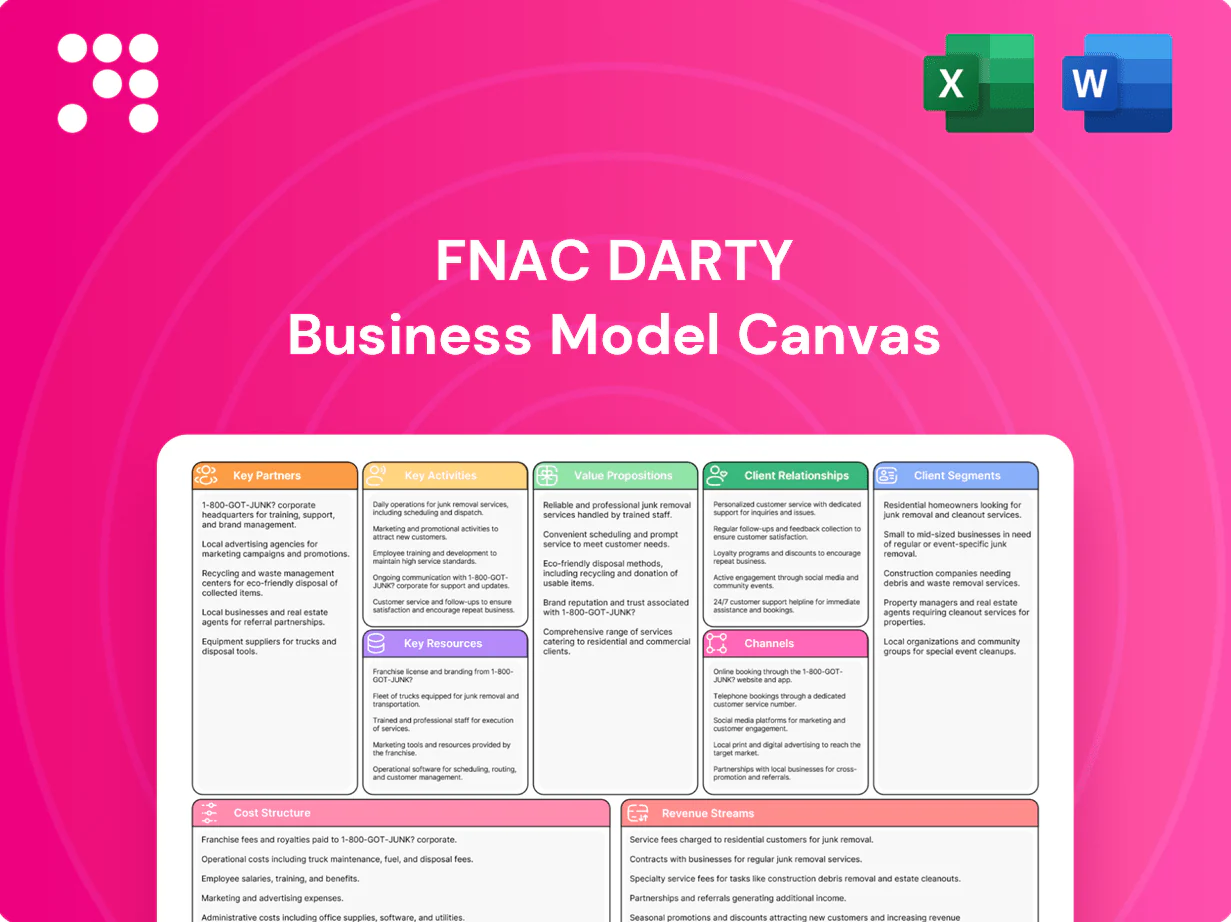
Fnac Darty Business Model Canvas

Omnichannel Retail & Services Canvas: Driving Loyalty, After-Sales and Margin Growth
Unlock the strategic engine behind Fnac Darty with our concise Business Model Canvas—detailing customer segments, omnichannel value propositions, key partners, and revenue levers. Learn how the group balances retail, services, and after-sales to drive loyalty and margin. Ideal for investors, consultants, and founders seeking actionable clarity. Download the full editable Canvas in Word and Excel to apply these insights today.
Partnerships

Electronics and cultural product suppliers
Partnerships with OEMs, publishers and labels secure Fnac Darty access to leading tech and cultural catalogues, supporting assortments across its c.1,000 stores and omnichannel network. Preferred commercial terms and exclusives expand breadth and depth of offers, improving margins and assortment differentiation. Co-marketing with brands drives launch visibility and traffic, while stable supply relationships reduce stockouts and shrinkage, supporting retail continuity and customer retention.
Repair, warranty, and service providers
Authorized service centers and OEM-certified technicians underpin after-sales promises, with over 600 service points in 2024 ensuring broad coverage. Extended warranty and insurance partners add value and recurring revenue, increasingly driving service-margin growth. Rapid turnaround improves NPS and repeat purchases, shortening replacement cycles. Shared repair data enhances failure-rate insights and inventory planning.

Logistics, last-mile, and installation partners
3PLs, courier networks and certified installers enable Fnac Darty to promise fast delivery and on-site set-up across its network of ~940 stores, while heavy-goods specialists handle safe transport of large appliances. Slot-based delivery and haul-away services cut failed deliveries and waste, improving sustainability and customer convenience. Performance SLAs (response and installation windows) protect the customer experience and tie provider payments to KPIs.

Payment, credit, and fintech alliances
Payment, credit, and fintech alliances let Fnac Darty increase basket size and conversion through BNPL and point-of-sale credit, supported by its ~€8.4bn group revenue (2023). Secure gateways and fraud prevention reduce chargebacks and cart abandonment, while co-branded financing improves retention and repeat purchases. Consent-based data-sharing refines risk models and personalizes offers.
- BNPL and credit partners: larger AOV, higher conversion
- Secure gateways: fewer fraud losses, lower abandonment
- Co-branded financing: loyalty and repeat sales
- Data-sharing (with consent): better risk pricing, personalized offers
Ticketing, content, and marketplace partners
Ticketing, content and marketplace partners let Fnac Darty extend services beyond products, leveraging event and streaming tie-ins to boost engagement; in 2023 the group reported ~€8.5bn pro forma revenue, with marketplace and services materially lifting margins.
Third-party sellers expand assortment without inventory risk via commission models that deliver higher-margin revenue; curated partner selection preserves brand standards and customer trust.
- Partner-driven services: increased ARPU
- Commission model: higher-margin revenue
- Third-party sellers: broader SKU range, lower inventory cost
- Curated partners: protect brand trust
Omnichannel retailer uses partnerships, BNPL and warranties to lift AOV and reduce stockouts
Fnac Darty leverages OEMs, publishers, 3PLs, fintechs and service partners to secure assortments, fast delivery and recurring service revenue, supporting ~940 stores and 600+ service points in 2024. BNPL and warranties lift AOV and margins; marketplace and third-party sellers broaden SKUs with low inventory risk. Partnerships tie payments to KPIs, reducing stockouts and improving NPS.
| Metric | 2023/2024 |
|---|---|
| Group revenue | €8.4bn (2023) |
| Stores | ~940 (2024) |
| Service points | 600+ (2024) |
What is included in the product
 Detailed Word Document
A comprehensive Business Model Canvas for Fnac Darty detailing customer segments, omnichannel channels, differentiated value propositions (electronics, cultural goods, after‑sales service), revenue streams, key partners and resources, plus competitive advantages and linked SWOT insights—organized into the 9 classic BMC blocks for investor presentations and strategic planning.

 Customizable Excel Spreadsheet
Condenses Fnac Darty’s omnichannel strategy into a digestible one-page Business Model Canvas, quickly identifying customer pain points, service strengths and operational gaps. Great for team workshops, executive summaries, and fast comparison across retail models.
Activities

Omnichannel merchandising and assortment
Curating culture, leisure and tech ranges aligned with demand trends drives Fnac Darty’s omnichannel assortment strategy, supporting a group generating about €8.1bn in 2024 sales and prioritizing fast-selling categories across stores and web.
Teams manage product launches, exclusives and seasonal rotations to lift conversion and AOV, while negotiating supplier terms and coop marketing to share promotional costs and secure margin.
Merchandising balances depth versus breadth to optimize working capital and inventory turns, focusing spend on high-velocity SKUs and reducing slow-moving stock.
Store operations and experiential retail
Running consultative sales floors with demos and expert advice across about 1,150 stores supports higher basket conversion and customer loyalty; Fnac Darty reported c. €8.8bn revenue in 2024. Executing seamless click-and-collect and returns integrates online and in-store channels to reduce friction and speed fulfillment. Hosting events, signings, and workshops drives weekly footfall and trial; maintained visual merchandising enhances product discovery and upsell.

E-commerce, marketplace, and digital growth
E-commerce focus optimizes web and app UX to lift conversion and AOV, leveraging A/B testing and personalized funnels across 25+ million customers; marketplace onboarding and policing enforce quality standards and reduce returns. SEO/SEM, CRM, and dynamic personalization drive acquisition and retention while managing product content, ratings, and recommendation engines to maximize basket size and lifetime value.

After-sales service, repairs, and care plans
After-sales centers in 2024 combine diagnostics, centralized repair logistics, and spare-parts management to minimize turnaround and inventory holding, leveraging centralized reverse-logistics hubs and certified technicians.
Administering warranties and protection plans through unified CRM and digital claims reduces handling time and supports recurring revenue for Fnac Darty.
Proactive outreach with automated status updates and feedback loops feeds product selection and QA, lowering churn and improving NPS.
- Diagnostics: centralized hubs
- Logistics: reverse-flow repair
- Warranties: unified CRM
- Retention: proactive updates
- Quality: customer feedback
Supply chain, forecasting, and inventory control
Fnac Darty uses demand planning to cut stockouts and markdowns, aligning assortments with omnichannel sales to protect margins and availability; the group leverages multi-node fulfillment from regional DCs and stores to speed delivery and reduce logistics costs. Reverse logistics and refurbishment channels recover value from returns, while vendor-managed inventory and EDI shorten supplier lead times and improve rotation.
- Demand planning: reduces stockouts/markdowns
- Multi-node fulfillment: DCs + stores
- Reverse logistics: returns → refurb
- VMI + EDI: shorter lead times
Omnichannel merchandising and sourcing drive €8.8bn revenue and ~1,150 stores
Curating culture, leisure and tech assortments for omnichannel demand drives Fnac Darty’s merchandising and sourcing, supporting €8.8bn revenue in 2024 and ~1,150 stores.
Teams run launches, exclusives and coop promotions to boost conversion and AOV while negotiating supplier terms to protect margin.
Omnichannel fulfillment, click‑and‑collect and reverse logistics shorten delivery and recover value from returns.
After‑sales hubs and unified CRM for warranties raise NPS across 25M+ customers.
| Metric | 2024 |
|---|---|
| Revenue | €8.8bn |
| Stores | ~1,150 |
| Customers | 25M+ |
Preview Before You Purchase
Business Model Canvas
The Fnac Darty Business Model Canvas preview shown here is the actual deliverable, not a mockup; it’s a direct snapshot of the file you’ll receive after purchase. Upon buying, you’ll instantly download the complete document in editable Word and Excel formats. No placeholders, no surprises—ready to present, edit, and apply to your strategy.

Omnichannel Retail & Services Canvas: Driving Loyalty, After-Sales and Margin Growth
Unlock the strategic engine behind Fnac Darty with our concise Business Model Canvas—detailing customer segments, omnichannel value propositions, key partners, and revenue levers. Learn how the group balances retail, services, and after-sales to drive loyalty and margin. Ideal for investors, consultants, and founders seeking actionable clarity. Download the full editable Canvas in Word and Excel to apply these insights today.
Partnerships
Electronics and cultural product suppliers
Partnerships with OEMs, publishers and labels secure Fnac Darty access to leading tech and cultural catalogues, supporting assortments across its c.1,000 stores and omnichannel network. Preferred commercial terms and exclusives expand breadth and depth of offers, improving margins and assortment differentiation. Co-marketing with brands drives launch visibility and traffic, while stable supply relationships reduce stockouts and shrinkage, supporting retail continuity and customer retention.
Repair, warranty, and service providers
Authorized service centers and OEM-certified technicians underpin after-sales promises, with over 600 service points in 2024 ensuring broad coverage. Extended warranty and insurance partners add value and recurring revenue, increasingly driving service-margin growth. Rapid turnaround improves NPS and repeat purchases, shortening replacement cycles. Shared repair data enhances failure-rate insights and inventory planning.
Logistics, last-mile, and installation partners
3PLs, courier networks and certified installers enable Fnac Darty to promise fast delivery and on-site set-up across its network of ~940 stores, while heavy-goods specialists handle safe transport of large appliances. Slot-based delivery and haul-away services cut failed deliveries and waste, improving sustainability and customer convenience. Performance SLAs (response and installation windows) protect the customer experience and tie provider payments to KPIs.
Payment, credit, and fintech alliances
Payment, credit, and fintech alliances let Fnac Darty increase basket size and conversion through BNPL and point-of-sale credit, supported by its ~€8.4bn group revenue (2023). Secure gateways and fraud prevention reduce chargebacks and cart abandonment, while co-branded financing improves retention and repeat purchases. Consent-based data-sharing refines risk models and personalizes offers.
- BNPL and credit partners: larger AOV, higher conversion
- Secure gateways: fewer fraud losses, lower abandonment
- Co-branded financing: loyalty and repeat sales
- Data-sharing (with consent): better risk pricing, personalized offers
Ticketing, content, and marketplace partners
Ticketing, content and marketplace partners let Fnac Darty extend services beyond products, leveraging event and streaming tie-ins to boost engagement; in 2023 the group reported ~€8.5bn pro forma revenue, with marketplace and services materially lifting margins.
Third-party sellers expand assortment without inventory risk via commission models that deliver higher-margin revenue; curated partner selection preserves brand standards and customer trust.
- Partner-driven services: increased ARPU
- Commission model: higher-margin revenue
- Third-party sellers: broader SKU range, lower inventory cost
- Curated partners: protect brand trust
Omnichannel retailer uses partnerships, BNPL and warranties to lift AOV and reduce stockouts
Fnac Darty leverages OEMs, publishers, 3PLs, fintechs and service partners to secure assortments, fast delivery and recurring service revenue, supporting ~940 stores and 600+ service points in 2024. BNPL and warranties lift AOV and margins; marketplace and third-party sellers broaden SKUs with low inventory risk. Partnerships tie payments to KPIs, reducing stockouts and improving NPS.
| Metric | 2023/2024 |
|---|---|
| Group revenue | €8.4bn (2023) |
| Stores | ~940 (2024) |
| Service points | 600+ (2024) |
What is included in the product
Detailed Word Document
A comprehensive Business Model Canvas for Fnac Darty detailing customer segments, omnichannel channels, differentiated value propositions (electronics, cultural goods, after‑sales service), revenue streams, key partners and resources, plus competitive advantages and linked SWOT insights—organized into the 9 classic BMC blocks for investor presentations and strategic planning.
Customizable Excel Spreadsheet
Condenses Fnac Darty’s omnichannel strategy into a digestible one-page Business Model Canvas, quickly identifying customer pain points, service strengths and operational gaps. Great for team workshops, executive summaries, and fast comparison across retail models.
Activities
Omnichannel merchandising and assortment
Curating culture, leisure and tech ranges aligned with demand trends drives Fnac Darty’s omnichannel assortment strategy, supporting a group generating about €8.1bn in 2024 sales and prioritizing fast-selling categories across stores and web.
Teams manage product launches, exclusives and seasonal rotations to lift conversion and AOV, while negotiating supplier terms and coop marketing to share promotional costs and secure margin.
Merchandising balances depth versus breadth to optimize working capital and inventory turns, focusing spend on high-velocity SKUs and reducing slow-moving stock.
Store operations and experiential retail
Running consultative sales floors with demos and expert advice across about 1,150 stores supports higher basket conversion and customer loyalty; Fnac Darty reported c. €8.8bn revenue in 2024. Executing seamless click-and-collect and returns integrates online and in-store channels to reduce friction and speed fulfillment. Hosting events, signings, and workshops drives weekly footfall and trial; maintained visual merchandising enhances product discovery and upsell.
E-commerce, marketplace, and digital growth
E-commerce focus optimizes web and app UX to lift conversion and AOV, leveraging A/B testing and personalized funnels across 25+ million customers; marketplace onboarding and policing enforce quality standards and reduce returns. SEO/SEM, CRM, and dynamic personalization drive acquisition and retention while managing product content, ratings, and recommendation engines to maximize basket size and lifetime value.
After-sales service, repairs, and care plans
After-sales centers in 2024 combine diagnostics, centralized repair logistics, and spare-parts management to minimize turnaround and inventory holding, leveraging centralized reverse-logistics hubs and certified technicians.
Administering warranties and protection plans through unified CRM and digital claims reduces handling time and supports recurring revenue for Fnac Darty.
Proactive outreach with automated status updates and feedback loops feeds product selection and QA, lowering churn and improving NPS.
- Diagnostics: centralized hubs
- Logistics: reverse-flow repair
- Warranties: unified CRM
- Retention: proactive updates
- Quality: customer feedback
Supply chain, forecasting, and inventory control
Fnac Darty uses demand planning to cut stockouts and markdowns, aligning assortments with omnichannel sales to protect margins and availability; the group leverages multi-node fulfillment from regional DCs and stores to speed delivery and reduce logistics costs. Reverse logistics and refurbishment channels recover value from returns, while vendor-managed inventory and EDI shorten supplier lead times and improve rotation.
- Demand planning: reduces stockouts/markdowns
- Multi-node fulfillment: DCs + stores
- Reverse logistics: returns → refurb
- VMI + EDI: shorter lead times
Omnichannel merchandising and sourcing drive €8.8bn revenue and ~1,150 stores
Curating culture, leisure and tech assortments for omnichannel demand drives Fnac Darty’s merchandising and sourcing, supporting €8.8bn revenue in 2024 and ~1,150 stores.
Teams run launches, exclusives and coop promotions to boost conversion and AOV while negotiating supplier terms to protect margin.
Omnichannel fulfillment, click‑and‑collect and reverse logistics shorten delivery and recover value from returns.
After‑sales hubs and unified CRM for warranties raise NPS across 25M+ customers.
| Metric | 2024 |
|---|---|
| Revenue | €8.8bn |
| Stores | ~1,150 |
| Customers | 25M+ |
Preview Before You Purchase
Business Model Canvas
The Fnac Darty Business Model Canvas preview shown here is the actual deliverable, not a mockup; it’s a direct snapshot of the file you’ll receive after purchase. Upon buying, you’ll instantly download the complete document in editable Word and Excel formats. No placeholders, no surprises—ready to present, edit, and apply to your strategy.
Description
Omnichannel Retail & Services Canvas: Driving Loyalty, After-Sales and Margin Growth
Unlock the strategic engine behind Fnac Darty with our concise Business Model Canvas—detailing customer segments, omnichannel value propositions, key partners, and revenue levers. Learn how the group balances retail, services, and after-sales to drive loyalty and margin. Ideal for investors, consultants, and founders seeking actionable clarity. Download the full editable Canvas in Word and Excel to apply these insights today.
Partnerships
Electronics and cultural product suppliers
Partnerships with OEMs, publishers and labels secure Fnac Darty access to leading tech and cultural catalogues, supporting assortments across its c.1,000 stores and omnichannel network. Preferred commercial terms and exclusives expand breadth and depth of offers, improving margins and assortment differentiation. Co-marketing with brands drives launch visibility and traffic, while stable supply relationships reduce stockouts and shrinkage, supporting retail continuity and customer retention.
Repair, warranty, and service providers
Authorized service centers and OEM-certified technicians underpin after-sales promises, with over 600 service points in 2024 ensuring broad coverage. Extended warranty and insurance partners add value and recurring revenue, increasingly driving service-margin growth. Rapid turnaround improves NPS and repeat purchases, shortening replacement cycles. Shared repair data enhances failure-rate insights and inventory planning.
Logistics, last-mile, and installation partners
3PLs, courier networks and certified installers enable Fnac Darty to promise fast delivery and on-site set-up across its network of ~940 stores, while heavy-goods specialists handle safe transport of large appliances. Slot-based delivery and haul-away services cut failed deliveries and waste, improving sustainability and customer convenience. Performance SLAs (response and installation windows) protect the customer experience and tie provider payments to KPIs.
Payment, credit, and fintech alliances
Payment, credit, and fintech alliances let Fnac Darty increase basket size and conversion through BNPL and point-of-sale credit, supported by its ~€8.4bn group revenue (2023). Secure gateways and fraud prevention reduce chargebacks and cart abandonment, while co-branded financing improves retention and repeat purchases. Consent-based data-sharing refines risk models and personalizes offers.
- BNPL and credit partners: larger AOV, higher conversion
- Secure gateways: fewer fraud losses, lower abandonment
- Co-branded financing: loyalty and repeat sales
- Data-sharing (with consent): better risk pricing, personalized offers
Ticketing, content, and marketplace partners
Ticketing, content and marketplace partners let Fnac Darty extend services beyond products, leveraging event and streaming tie-ins to boost engagement; in 2023 the group reported ~€8.5bn pro forma revenue, with marketplace and services materially lifting margins.
Third-party sellers expand assortment without inventory risk via commission models that deliver higher-margin revenue; curated partner selection preserves brand standards and customer trust.
- Partner-driven services: increased ARPU
- Commission model: higher-margin revenue
- Third-party sellers: broader SKU range, lower inventory cost
- Curated partners: protect brand trust
Omnichannel retailer uses partnerships, BNPL and warranties to lift AOV and reduce stockouts
Fnac Darty leverages OEMs, publishers, 3PLs, fintechs and service partners to secure assortments, fast delivery and recurring service revenue, supporting ~940 stores and 600+ service points in 2024. BNPL and warranties lift AOV and margins; marketplace and third-party sellers broaden SKUs with low inventory risk. Partnerships tie payments to KPIs, reducing stockouts and improving NPS.
| Metric | 2023/2024 |
|---|---|
| Group revenue | €8.4bn (2023) |
| Stores | ~940 (2024) |
| Service points | 600+ (2024) |
What is included in the product
Detailed Word Document
A comprehensive Business Model Canvas for Fnac Darty detailing customer segments, omnichannel channels, differentiated value propositions (electronics, cultural goods, after‑sales service), revenue streams, key partners and resources, plus competitive advantages and linked SWOT insights—organized into the 9 classic BMC blocks for investor presentations and strategic planning.
Customizable Excel Spreadsheet
Condenses Fnac Darty’s omnichannel strategy into a digestible one-page Business Model Canvas, quickly identifying customer pain points, service strengths and operational gaps. Great for team workshops, executive summaries, and fast comparison across retail models.
Activities
Omnichannel merchandising and assortment
Curating culture, leisure and tech ranges aligned with demand trends drives Fnac Darty’s omnichannel assortment strategy, supporting a group generating about €8.1bn in 2024 sales and prioritizing fast-selling categories across stores and web.
Teams manage product launches, exclusives and seasonal rotations to lift conversion and AOV, while negotiating supplier terms and coop marketing to share promotional costs and secure margin.
Merchandising balances depth versus breadth to optimize working capital and inventory turns, focusing spend on high-velocity SKUs and reducing slow-moving stock.
Store operations and experiential retail
Running consultative sales floors with demos and expert advice across about 1,150 stores supports higher basket conversion and customer loyalty; Fnac Darty reported c. €8.8bn revenue in 2024. Executing seamless click-and-collect and returns integrates online and in-store channels to reduce friction and speed fulfillment. Hosting events, signings, and workshops drives weekly footfall and trial; maintained visual merchandising enhances product discovery and upsell.
E-commerce, marketplace, and digital growth
E-commerce focus optimizes web and app UX to lift conversion and AOV, leveraging A/B testing and personalized funnels across 25+ million customers; marketplace onboarding and policing enforce quality standards and reduce returns. SEO/SEM, CRM, and dynamic personalization drive acquisition and retention while managing product content, ratings, and recommendation engines to maximize basket size and lifetime value.
After-sales service, repairs, and care plans
After-sales centers in 2024 combine diagnostics, centralized repair logistics, and spare-parts management to minimize turnaround and inventory holding, leveraging centralized reverse-logistics hubs and certified technicians.
Administering warranties and protection plans through unified CRM and digital claims reduces handling time and supports recurring revenue for Fnac Darty.
Proactive outreach with automated status updates and feedback loops feeds product selection and QA, lowering churn and improving NPS.
- Diagnostics: centralized hubs
- Logistics: reverse-flow repair
- Warranties: unified CRM
- Retention: proactive updates
- Quality: customer feedback
Supply chain, forecasting, and inventory control
Fnac Darty uses demand planning to cut stockouts and markdowns, aligning assortments with omnichannel sales to protect margins and availability; the group leverages multi-node fulfillment from regional DCs and stores to speed delivery and reduce logistics costs. Reverse logistics and refurbishment channels recover value from returns, while vendor-managed inventory and EDI shorten supplier lead times and improve rotation.
- Demand planning: reduces stockouts/markdowns
- Multi-node fulfillment: DCs + stores
- Reverse logistics: returns → refurb
- VMI + EDI: shorter lead times
Omnichannel merchandising and sourcing drive €8.8bn revenue and ~1,150 stores
Curating culture, leisure and tech assortments for omnichannel demand drives Fnac Darty’s merchandising and sourcing, supporting €8.8bn revenue in 2024 and ~1,150 stores.
Teams run launches, exclusives and coop promotions to boost conversion and AOV while negotiating supplier terms to protect margin.
Omnichannel fulfillment, click‑and‑collect and reverse logistics shorten delivery and recover value from returns.
After‑sales hubs and unified CRM for warranties raise NPS across 25M+ customers.
| Metric | 2024 |
|---|---|
| Revenue | €8.8bn |
| Stores | ~1,150 |
| Customers | 25M+ |
Preview Before You Purchase
Business Model Canvas
The Fnac Darty Business Model Canvas preview shown here is the actual deliverable, not a mockup; it’s a direct snapshot of the file you’ll receive after purchase. Upon buying, you’ll instantly download the complete document in editable Word and Excel formats. No placeholders, no surprises—ready to present, edit, and apply to your strategy.











