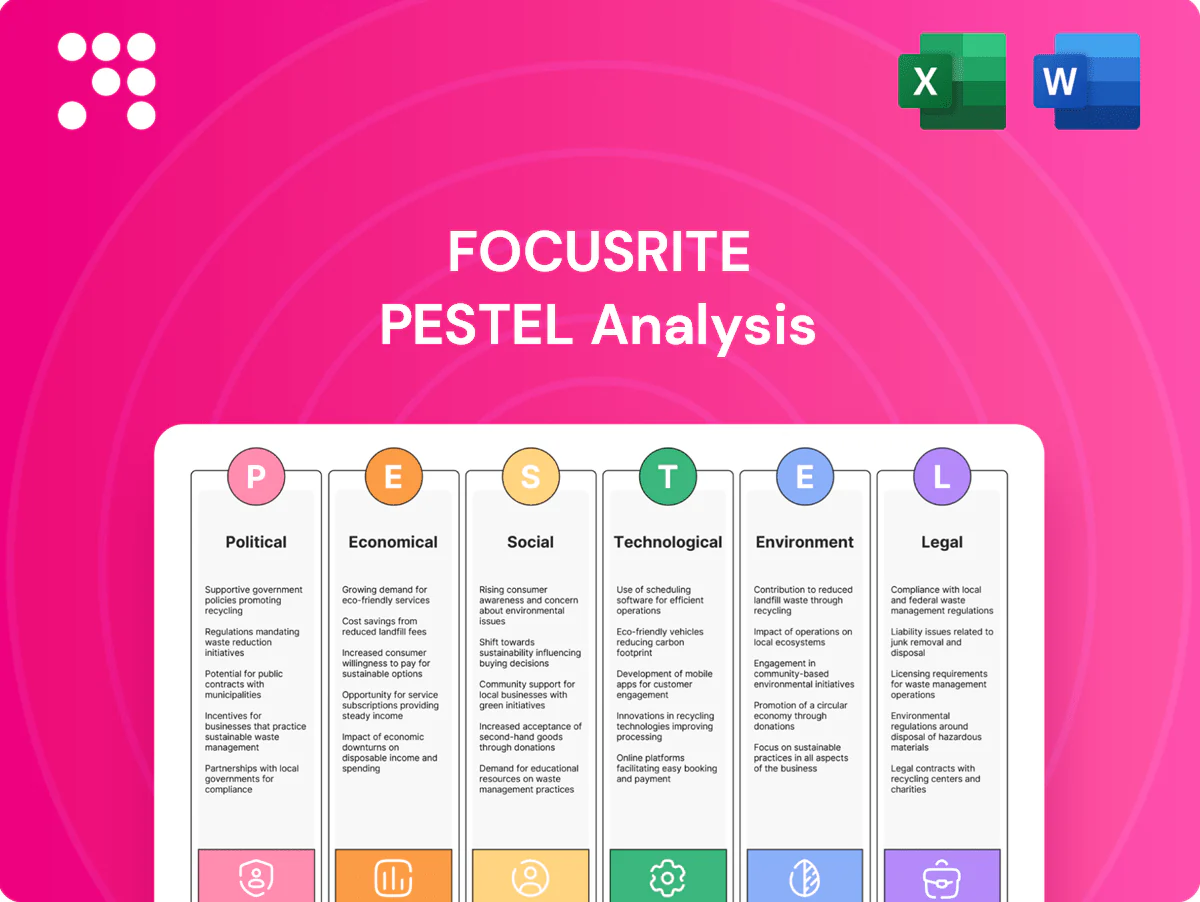
Focusrite PESTLE Analysis

Skip the Research. Get the Strategy.
Gain a strategic edge with our focused PESTLE analysis of Focusrite — revealing political, economic, social, technological, legal and environmental forces shaping its future. Ideal for investors, advisors and strategists, the report translates trends into actionable risks and opportunities. Purchase the full, downloadable analysis now to get the complete, editable briefing.
Political factors

Trade policy and tariffs
Changes to tariffs on electronics and audio equipment directly affect landed costs and pricing power, with US Section 301 measures and retaliatory duties adding up to around 25% on some China-origin goods. UK–EU Trade and Cooperation Agreement allows zero tariffs for qualifying goods but rules of origin increase sourcing complexity. UK accession to CPTPP in 2024 expands preferential access; monitoring schedules and using bonded warehousing or nearshoring (eg Mexico) can mitigate volatility.
Brexit-related frictions
Brexit-related frictions — rules of origin, customs checks and changed VAT treatment — have increased admin and transit delays for EU sales; UK exports to the EU fell about 15% in 2021 versus 2019 per ONS, illustrating trade impact. Certification divergence (UKCA vs CE) since 2021 can force dual testing and labelling for audio hardware. Small frictions compound across SKUs and seasons, raising lead times. Proactive logistics planning and EU warehousing can preserve service levels and mitigate border delays.

Geopolitical supply risk
Geopolitical friction in East Asia and the Red Sea threatens semiconductor and PCB flows—TSMC held about 54% of global foundry share in 2023, creating concentration risk for audio electronics supply chains. Political instability has pushed Red Sea war-risk premiums into the five-figure range per voyage and lengthened lead times. Sanctions regimes since 2022 complicate supplier selection. Multi-sourcing and regionalization reduce single-point exposure.

Public arts and education funding
Government budgets for music education and cultural programs shape institutional demand for Focusrite gear; EU Creative Europe allocates €2.4bn (2021–2027) to culture, driving grant-backed purchases and school adoption. Grants stimulate studio upgrades in funded programs, while austerity cycles reduce midrange gear procurement by institutions. Aligning products with funded curricula captures incremental spend from grant pools.
- Grant leverage: targets funded programs
- Curriculum fit: increases institutional uptake
- Austerity risk: compresses midrange sales
Export controls and standards diplomacy
Tariffs ≈25%, Brexit -15%, concentration, compliance risk
Tariff shifts (US Section 301 ≈25% on some China-origin goods) and UK–EU rules of origin raise landed costs and sourcing complexity; Brexit cut UK→EU exports ~15% in 2021 vs 2019 (ONS). Concentration risk: TSMC ~54% foundry share (2023) and Red Sea war-risk premiums hit five-figure per voyage. Grants (EU Creative Europe €2.4bn 2021–27) boost institutional demand; export controls and BIS fines (up to $300,000 or 2x value) raise compliance costs.
| Issue | Metric | Implication |
|---|---|---|
| Tariffs | ~25% (Section 301) | Higher landed cost |
| Brexit impact | -15% UK→EU (2021 v 2019) | Logistics delays |
| Supply risk | TSMC 54% (2023) | Single-point exposure |
| War-risk | Five-figure/voyage | Longer lead times |
| Grants | €2.4bn (Creative Europe) | Institutional demand |
| Penalties | BIS up to $300k or 2x | Compliance cost |
What is included in the product
 Detailed Word Document
Explores how Political, Economic, Social, Technological, Environmental and Legal forces uniquely impact Focusrite, with data-driven subpoints and forward-looking insights to identify risks and opportunities; designed for executives and investors and formatted for immediate inclusion in plans and decks.

 Customizable Excel Spreadsheet
A concise, visually segmented Focusrite PESTLE that distills external risks and opportunities for quick team alignment; editable notes let stakeholders adapt insights to regions or product lines for faster strategic decision-making.
Economic factors

Consumer cycle sensitivity
Audio gear is partially discretionary and tracks employment and consumer confidence; with global GDP growth at about 3.1% in 2024 (IMF), downturns tend to slow prosumer upgrades while recoveries spur studio and creator spend. Entry-level interfaces show resilience as hobbyist demand persists, whereas premium lines are more cyclical. Focusrite’s tiered pricing helps smooth revenue volatility across cycles.
FX and currency mix
Focusrite's GBP cost base against significant USD and EUR revenues creates translation and transaction risk; with USD/GBP around 1.27 and EUR/GBP near 1.17 in mid-2025, dollar strength can depress reported sales and margins when converted to sterling. Active hedging and natural offsets from USD-denominated sourcing have been used to stabilise gross profit. Price lists require periodic calibration to protect margins.

Component inflation and availability
Semiconductor lead times, which eased from pandemic peaks to roughly 16–18 weeks by 2024, and ongoing analog component shortages continue to pressure Focusrite's COGS. Spot buys and board redesigns add NRE and have delayed product launches, raising time-to-market and development costs. Inflation in 2024 pushed component input costs up about 5–7%, constraining MSRP moves in price-sensitive audio segments. Strategic inventory and design-to-availability mitigations have been used to defend margins.

E-commerce and retail channel shifts
Direct-to-consumer growth boosts margin and customer data but increases marketing spend; global e-commerce reached about $6.3 trillion in 2024 and marketplaces (Amazon ~40% of US e-commerce) heighten price transparency. Retail consolidators drive bargaining power and promotional cadence, while omnichannel execution is needed to balance reach with brand control and margin protection.
- DTC: better margins, higher marketing cost
- Marketplaces: price transparency, comparison shopping
- Retail consolidators: stronger bargaining/promo pressure
- Omnichannel: reach vs brand control
Emerging market expansion
- Tag: TAM growth—Asia/LatAm/Africa
- Tag: Creator base—~50M globally
- Tag: Payments—mobile money ~60% (Africa pockets)
- Tag: Risks—FX volatility, duties; Mitigants—bundles, financing
Tariffs ≈25%, Brexit -15%, concentration, compliance risk
Audio spend tracks cycles; global GDP ~3.1% in 2024, entry-level resilient while premium is cyclical. USD strength (USD/GBP ~1.27 mid‑2025) and EUR/GBP ~1.17 create FX translation risk despite hedging. Component lead times ~16–18 weeks and 5–7% input-cost inflation in 2024 raise COGS; DTC growth boosts margin but raises marketing spend.
Full Version Awaits
Focusrite PESTLE Analysis
The preview shown here is the exact Focusrite PESTLE Analysis document you’ll receive after purchase—fully formatted and ready to use. It contains the same structured political, economic, social, technological, legal and environmental insights visible in the screenshot. No placeholders or teasers—this is the final file you’ll download immediately after payment.

Skip the Research. Get the Strategy.
Gain a strategic edge with our focused PESTLE analysis of Focusrite — revealing political, economic, social, technological, legal and environmental forces shaping its future. Ideal for investors, advisors and strategists, the report translates trends into actionable risks and opportunities. Purchase the full, downloadable analysis now to get the complete, editable briefing.
Political factors
Trade policy and tariffs
Changes to tariffs on electronics and audio equipment directly affect landed costs and pricing power, with US Section 301 measures and retaliatory duties adding up to around 25% on some China-origin goods. UK–EU Trade and Cooperation Agreement allows zero tariffs for qualifying goods but rules of origin increase sourcing complexity. UK accession to CPTPP in 2024 expands preferential access; monitoring schedules and using bonded warehousing or nearshoring (eg Mexico) can mitigate volatility.
Brexit-related frictions
Brexit-related frictions — rules of origin, customs checks and changed VAT treatment — have increased admin and transit delays for EU sales; UK exports to the EU fell about 15% in 2021 versus 2019 per ONS, illustrating trade impact. Certification divergence (UKCA vs CE) since 2021 can force dual testing and labelling for audio hardware. Small frictions compound across SKUs and seasons, raising lead times. Proactive logistics planning and EU warehousing can preserve service levels and mitigate border delays.
Geopolitical supply risk
Geopolitical friction in East Asia and the Red Sea threatens semiconductor and PCB flows—TSMC held about 54% of global foundry share in 2023, creating concentration risk for audio electronics supply chains. Political instability has pushed Red Sea war-risk premiums into the five-figure range per voyage and lengthened lead times. Sanctions regimes since 2022 complicate supplier selection. Multi-sourcing and regionalization reduce single-point exposure.
Public arts and education funding
Government budgets for music education and cultural programs shape institutional demand for Focusrite gear; EU Creative Europe allocates €2.4bn (2021–2027) to culture, driving grant-backed purchases and school adoption. Grants stimulate studio upgrades in funded programs, while austerity cycles reduce midrange gear procurement by institutions. Aligning products with funded curricula captures incremental spend from grant pools.
- Grant leverage: targets funded programs
- Curriculum fit: increases institutional uptake
- Austerity risk: compresses midrange sales
Export controls and standards diplomacy
Tariffs ≈25%, Brexit -15%, concentration, compliance risk
Tariff shifts (US Section 301 ≈25% on some China-origin goods) and UK–EU rules of origin raise landed costs and sourcing complexity; Brexit cut UK→EU exports ~15% in 2021 vs 2019 (ONS). Concentration risk: TSMC ~54% foundry share (2023) and Red Sea war-risk premiums hit five-figure per voyage. Grants (EU Creative Europe €2.4bn 2021–27) boost institutional demand; export controls and BIS fines (up to $300,000 or 2x value) raise compliance costs.
| Issue | Metric | Implication |
|---|---|---|
| Tariffs | ~25% (Section 301) | Higher landed cost |
| Brexit impact | -15% UK→EU (2021 v 2019) | Logistics delays |
| Supply risk | TSMC 54% (2023) | Single-point exposure |
| War-risk | Five-figure/voyage | Longer lead times |
| Grants | €2.4bn (Creative Europe) | Institutional demand |
| Penalties | BIS up to $300k or 2x | Compliance cost |
What is included in the product
Detailed Word Document
Explores how Political, Economic, Social, Technological, Environmental and Legal forces uniquely impact Focusrite, with data-driven subpoints and forward-looking insights to identify risks and opportunities; designed for executives and investors and formatted for immediate inclusion in plans and decks.
Customizable Excel Spreadsheet
A concise, visually segmented Focusrite PESTLE that distills external risks and opportunities for quick team alignment; editable notes let stakeholders adapt insights to regions or product lines for faster strategic decision-making.
Economic factors
Consumer cycle sensitivity
Audio gear is partially discretionary and tracks employment and consumer confidence; with global GDP growth at about 3.1% in 2024 (IMF), downturns tend to slow prosumer upgrades while recoveries spur studio and creator spend. Entry-level interfaces show resilience as hobbyist demand persists, whereas premium lines are more cyclical. Focusrite’s tiered pricing helps smooth revenue volatility across cycles.
FX and currency mix
Focusrite's GBP cost base against significant USD and EUR revenues creates translation and transaction risk; with USD/GBP around 1.27 and EUR/GBP near 1.17 in mid-2025, dollar strength can depress reported sales and margins when converted to sterling. Active hedging and natural offsets from USD-denominated sourcing have been used to stabilise gross profit. Price lists require periodic calibration to protect margins.
Component inflation and availability
Semiconductor lead times, which eased from pandemic peaks to roughly 16–18 weeks by 2024, and ongoing analog component shortages continue to pressure Focusrite's COGS. Spot buys and board redesigns add NRE and have delayed product launches, raising time-to-market and development costs. Inflation in 2024 pushed component input costs up about 5–7%, constraining MSRP moves in price-sensitive audio segments. Strategic inventory and design-to-availability mitigations have been used to defend margins.
E-commerce and retail channel shifts
Direct-to-consumer growth boosts margin and customer data but increases marketing spend; global e-commerce reached about $6.3 trillion in 2024 and marketplaces (Amazon ~40% of US e-commerce) heighten price transparency. Retail consolidators drive bargaining power and promotional cadence, while omnichannel execution is needed to balance reach with brand control and margin protection.
- DTC: better margins, higher marketing cost
- Marketplaces: price transparency, comparison shopping
- Retail consolidators: stronger bargaining/promo pressure
- Omnichannel: reach vs brand control
Emerging market expansion
- Tag: TAM growth—Asia/LatAm/Africa
- Tag: Creator base—~50M globally
- Tag: Payments—mobile money ~60% (Africa pockets)
- Tag: Risks—FX volatility, duties; Mitigants—bundles, financing
Tariffs ≈25%, Brexit -15%, concentration, compliance risk
Audio spend tracks cycles; global GDP ~3.1% in 2024, entry-level resilient while premium is cyclical. USD strength (USD/GBP ~1.27 mid‑2025) and EUR/GBP ~1.17 create FX translation risk despite hedging. Component lead times ~16–18 weeks and 5–7% input-cost inflation in 2024 raise COGS; DTC growth boosts margin but raises marketing spend.
Full Version Awaits
Focusrite PESTLE Analysis
The preview shown here is the exact Focusrite PESTLE Analysis document you’ll receive after purchase—fully formatted and ready to use. It contains the same structured political, economic, social, technological, legal and environmental insights visible in the screenshot. No placeholders or teasers—this is the final file you’ll download immediately after payment.
Original: $10.00
-65%$10.00
$3.50Description
Skip the Research. Get the Strategy.
Gain a strategic edge with our focused PESTLE analysis of Focusrite — revealing political, economic, social, technological, legal and environmental forces shaping its future. Ideal for investors, advisors and strategists, the report translates trends into actionable risks and opportunities. Purchase the full, downloadable analysis now to get the complete, editable briefing.
Political factors
Trade policy and tariffs
Changes to tariffs on electronics and audio equipment directly affect landed costs and pricing power, with US Section 301 measures and retaliatory duties adding up to around 25% on some China-origin goods. UK–EU Trade and Cooperation Agreement allows zero tariffs for qualifying goods but rules of origin increase sourcing complexity. UK accession to CPTPP in 2024 expands preferential access; monitoring schedules and using bonded warehousing or nearshoring (eg Mexico) can mitigate volatility.
Brexit-related frictions
Brexit-related frictions — rules of origin, customs checks and changed VAT treatment — have increased admin and transit delays for EU sales; UK exports to the EU fell about 15% in 2021 versus 2019 per ONS, illustrating trade impact. Certification divergence (UKCA vs CE) since 2021 can force dual testing and labelling for audio hardware. Small frictions compound across SKUs and seasons, raising lead times. Proactive logistics planning and EU warehousing can preserve service levels and mitigate border delays.
Geopolitical supply risk
Geopolitical friction in East Asia and the Red Sea threatens semiconductor and PCB flows—TSMC held about 54% of global foundry share in 2023, creating concentration risk for audio electronics supply chains. Political instability has pushed Red Sea war-risk premiums into the five-figure range per voyage and lengthened lead times. Sanctions regimes since 2022 complicate supplier selection. Multi-sourcing and regionalization reduce single-point exposure.
Public arts and education funding
Government budgets for music education and cultural programs shape institutional demand for Focusrite gear; EU Creative Europe allocates €2.4bn (2021–2027) to culture, driving grant-backed purchases and school adoption. Grants stimulate studio upgrades in funded programs, while austerity cycles reduce midrange gear procurement by institutions. Aligning products with funded curricula captures incremental spend from grant pools.
- Grant leverage: targets funded programs
- Curriculum fit: increases institutional uptake
- Austerity risk: compresses midrange sales
Export controls and standards diplomacy
Tariffs ≈25%, Brexit -15%, concentration, compliance risk
Tariff shifts (US Section 301 ≈25% on some China-origin goods) and UK–EU rules of origin raise landed costs and sourcing complexity; Brexit cut UK→EU exports ~15% in 2021 vs 2019 (ONS). Concentration risk: TSMC ~54% foundry share (2023) and Red Sea war-risk premiums hit five-figure per voyage. Grants (EU Creative Europe €2.4bn 2021–27) boost institutional demand; export controls and BIS fines (up to $300,000 or 2x value) raise compliance costs.
| Issue | Metric | Implication |
|---|---|---|
| Tariffs | ~25% (Section 301) | Higher landed cost |
| Brexit impact | -15% UK→EU (2021 v 2019) | Logistics delays |
| Supply risk | TSMC 54% (2023) | Single-point exposure |
| War-risk | Five-figure/voyage | Longer lead times |
| Grants | €2.4bn (Creative Europe) | Institutional demand |
| Penalties | BIS up to $300k or 2x | Compliance cost |
What is included in the product
Detailed Word Document
Explores how Political, Economic, Social, Technological, Environmental and Legal forces uniquely impact Focusrite, with data-driven subpoints and forward-looking insights to identify risks and opportunities; designed for executives and investors and formatted for immediate inclusion in plans and decks.
Customizable Excel Spreadsheet
A concise, visually segmented Focusrite PESTLE that distills external risks and opportunities for quick team alignment; editable notes let stakeholders adapt insights to regions or product lines for faster strategic decision-making.
Economic factors
Consumer cycle sensitivity
Audio gear is partially discretionary and tracks employment and consumer confidence; with global GDP growth at about 3.1% in 2024 (IMF), downturns tend to slow prosumer upgrades while recoveries spur studio and creator spend. Entry-level interfaces show resilience as hobbyist demand persists, whereas premium lines are more cyclical. Focusrite’s tiered pricing helps smooth revenue volatility across cycles.
FX and currency mix
Focusrite's GBP cost base against significant USD and EUR revenues creates translation and transaction risk; with USD/GBP around 1.27 and EUR/GBP near 1.17 in mid-2025, dollar strength can depress reported sales and margins when converted to sterling. Active hedging and natural offsets from USD-denominated sourcing have been used to stabilise gross profit. Price lists require periodic calibration to protect margins.
Component inflation and availability
Semiconductor lead times, which eased from pandemic peaks to roughly 16–18 weeks by 2024, and ongoing analog component shortages continue to pressure Focusrite's COGS. Spot buys and board redesigns add NRE and have delayed product launches, raising time-to-market and development costs. Inflation in 2024 pushed component input costs up about 5–7%, constraining MSRP moves in price-sensitive audio segments. Strategic inventory and design-to-availability mitigations have been used to defend margins.
E-commerce and retail channel shifts
Direct-to-consumer growth boosts margin and customer data but increases marketing spend; global e-commerce reached about $6.3 trillion in 2024 and marketplaces (Amazon ~40% of US e-commerce) heighten price transparency. Retail consolidators drive bargaining power and promotional cadence, while omnichannel execution is needed to balance reach with brand control and margin protection.
- DTC: better margins, higher marketing cost
- Marketplaces: price transparency, comparison shopping
- Retail consolidators: stronger bargaining/promo pressure
- Omnichannel: reach vs brand control
Emerging market expansion
- Tag: TAM growth—Asia/LatAm/Africa
- Tag: Creator base—~50M globally
- Tag: Payments—mobile money ~60% (Africa pockets)
- Tag: Risks—FX volatility, duties; Mitigants—bundles, financing
Tariffs ≈25%, Brexit -15%, concentration, compliance risk
Audio spend tracks cycles; global GDP ~3.1% in 2024, entry-level resilient while premium is cyclical. USD strength (USD/GBP ~1.27 mid‑2025) and EUR/GBP ~1.17 create FX translation risk despite hedging. Component lead times ~16–18 weeks and 5–7% input-cost inflation in 2024 raise COGS; DTC growth boosts margin but raises marketing spend.
Full Version Awaits
Focusrite PESTLE Analysis
The preview shown here is the exact Focusrite PESTLE Analysis document you’ll receive after purchase—fully formatted and ready to use. It contains the same structured political, economic, social, technological, legal and environmental insights visible in the screenshot. No placeholders or teasers—this is the final file you’ll download immediately after payment.











