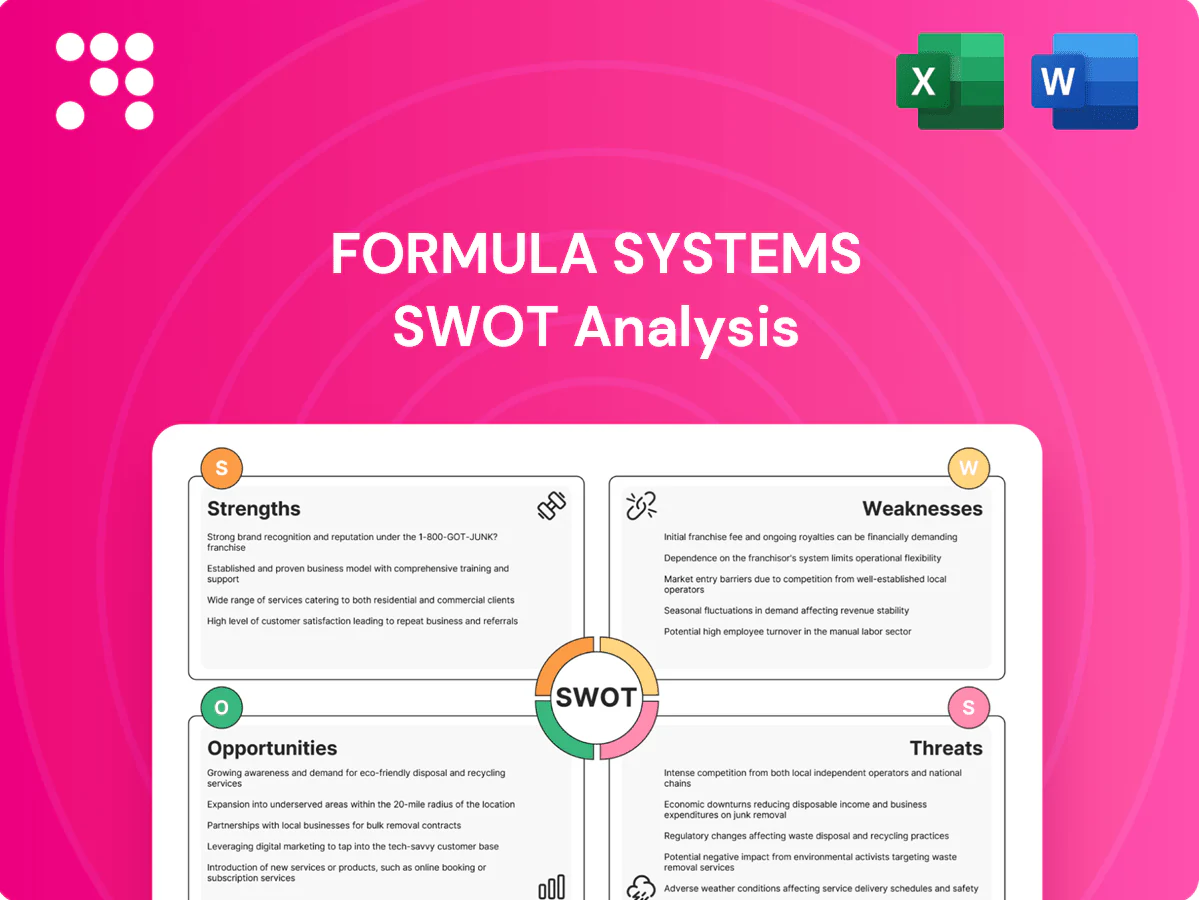
Formula Systems SWOT Analysis

Elevate Your Analysis with the Complete SWOT Report
Unpack Formula Systems’ competitive edge, risks, and growth drivers with our concise SWOT preview—then purchase the full analysis for deep, research-backed insights, strategic recommendations, and editable Word+Excel deliverables to support investment decisions, pitches, and planning.
Strengths

Diversified IT Portfolio
Founded in 1985 and listed on the Tel Aviv Stock Exchange, Formula Systems spans software development, IT services and infrastructure, reducing reliance on any single revenue stream. This breadth enables cross-selling and bundled solutions that improve client retention. The multi-segment mix cushions cyclical downturns and supports more stable cash flows across its over 35-year operating history.
Global Subsidiary Network
An investment-holding structure with multiple operating subsidiaries gives Formula Systems broad geographic reach and local-market expertise, accelerating market entry and simplifying regulatory compliance across jurisdictions. Shared services and cross-subsidiary best practices lift operational efficiency and scale. Portfolio optionality enables capital reallocation to higher-performing units, supporting strategic growth and risk diversification.

Cloud and Cybersecurity Capabilities
Participation in high-demand domains like cloud migration, managed services and cybersecurity enables premium pricing and higher margin contracts; cloud leaders command scale (AWS ~33% market share in 2024) which raises willingness to pay for integrated solutions. These offerings address mission-critical client needs, driving strong renewal dynamics. Continuous updates and managed security deepen client lock-in, while recognized security credentials boost trust and win rates.

Enterprise Software Expertise
Enterprise-grade expertise drives long sales cycles but yields high contract stickiness and recurring revenue; the global enterprise software market was about 600 billion USD in 2024, underscoring scale. Strong integration capabilities shorten time-to-value, cross-industry domain knowledge raises solution relevance, and maintenance/upgrades provide predictable cash flow.
- High contract retention
- Faster deployment
- Cross-industry fit
- Predictable recurring revenue
Cross-Industry Client Base
Formula Systems leverages a cross-industry client base—spanning finance, healthcare, telecom and public sector—which spreads revenue risk across cycles and enhances resilience; the group is listed on the Tel Aviv Stock Exchange. Industry insights are reused across engagements to accelerate solution development, boosting innovation and robustness while expanding the sales pipeline and partner ecosystem.
- Risk diversification
- Cross-sector innovation
- Wider pipeline & partners
35+ Years Driving Enterprise Software Growth in a $600B Cloud and Cybersecurity Market
Founded 1985 and listed on the Tel Aviv Stock Exchange, Formula Systems leverages 35+ years of enterprise software and IT services experience. Diversified holdings reduce single-stream risk and enable capital reallocation across cloud, managed services and cybersecurity. Enterprise focus yields high contract stickiness and recurring revenue in a $600B global enterprise software market (2024).
| Metric | Value (2024) |
|---|---|
| Years | 35+ |
| Market | Enterprise software $600B |
| Cloud leader share | AWS ~33% |
What is included in the product
 Detailed Word Document
Provides a concise SWOT analysis of Formula Systems, outlining its internal strengths and weaknesses and external opportunities and threats to assess strategic positioning and future risks.

 Customizable Excel Spreadsheet
Provides a concise, visual SWOT matrix tailored to Formula Systems for rapid strategy alignment and clear stakeholder communication.
Weaknesses

Complex Holding Structure
Complex holding structure with multiple subsidiaries can slow decision-making and raise management complexity; public disclosures and FY2024 filings show recurrent governance coordination issues across units. Duplicated back-office functions have increased overheads, pressuring margins in recent quarters. Investor transparency is constrained by layered reporting, complicating valuation and comparability for analysts.
Integration and Standardization Gaps
Diverse platforms and tools across Formula Systems' subsidiaries hinder seamless delivery, contributing to operational fragmentation; 70% of digital transformations fail when integration gaps persist. Lack of unified frameworks increases delivery risk and delays time-to-market. Standardizing methodologies demands CAPEX and change management, and inconsistency can degrade client experience.

Talent Dependence
IT services depend on specialized human capital; industry voluntary attrition ran about 20–25% in 2023, disrupting project continuity. Recruiting and retaining top engineers remains costly—average hiring and onboarding can exceed $30,000 per senior hire. Attrition-driven rework and bench time erode utilization and margins. Wage inflation around 6–8% in 2024 further compresses profitability.

Project Execution Risk
Large custom engagements at Formula Systems face frequent scope creep and schedule slippage; industry data shows only 31% of technology projects are classified as successful (Standish Group), increasing exposure to delays and cost overruns. Fixed-bid contracts risk margin erosion when estimates miss—PMI reported organizations lose roughly 12% of investment due to poor project performance (2023). Multi-vendor deployments complicate accountability and slow issue resolution, while heavy client-specific customizations cut reuse and raise per-project delivery costs.
- scope creep: 31% success rate
- fixed-bid margin risk: ~12% wasted investment
- multi-vendor: diluted accountability
- customizations: lower reusability
Brand Dilution Across Subsidiaries
Operating under multiple brands can dilute Formula Systems corporate identity, reducing clarity for clients and partners and slowing brand-equity accrual; consistent-branding studies show up to 23% higher revenue when messaging is unified (Lucidpress, 2019).
Marketing efficiency may suffer without a unified message, raising per-lead costs and complicating campaign ROI; cross-selling is harder when clients perceive fragmentation across subsidiaries.
- Diluted corporate identity
- Higher marketing costs / lower ROI
- Weakened cross-selling
- Slower brand-equity growth (consistent-branding benefit: +23% revenue)
Unify brand to cut attrition and overruns; lift revenue 23%
Complex conglomerate structure slows decisions and raises governance costs (FY2024); attrition 20–25% and senior hire cost >$30,000 strain margins amid 6–8% wage inflation. Integration gaps reduce delivery success (~31%) and fixed-bid overruns cost ~12%. Brand dilution raises marketing CAC; unified branding can boost revenue ~23%.
| Metric | Value |
|---|---|
| Attrition 2023 | 20–25% |
| Senior hire cost | >$30,000 |
| Wage inflation 2024 | 6–8% |
| Project success | 31% |
| Overrun loss | ~12% |
| Brand lift | +23% |
Preview Before You Purchase
Formula Systems SWOT Analysis
This is the actual SWOT analysis document for Formula Systems you’ll receive upon purchase—no surprises, just professional quality. The preview below is taken directly from the full report; buy to unlock the complete, editable version with in-depth insights and actionable findings. It’s structured and ready to use in presentations or strategic planning.

Elevate Your Analysis with the Complete SWOT Report
Unpack Formula Systems’ competitive edge, risks, and growth drivers with our concise SWOT preview—then purchase the full analysis for deep, research-backed insights, strategic recommendations, and editable Word+Excel deliverables to support investment decisions, pitches, and planning.
Strengths
Diversified IT Portfolio
Founded in 1985 and listed on the Tel Aviv Stock Exchange, Formula Systems spans software development, IT services and infrastructure, reducing reliance on any single revenue stream. This breadth enables cross-selling and bundled solutions that improve client retention. The multi-segment mix cushions cyclical downturns and supports more stable cash flows across its over 35-year operating history.
Global Subsidiary Network
An investment-holding structure with multiple operating subsidiaries gives Formula Systems broad geographic reach and local-market expertise, accelerating market entry and simplifying regulatory compliance across jurisdictions. Shared services and cross-subsidiary best practices lift operational efficiency and scale. Portfolio optionality enables capital reallocation to higher-performing units, supporting strategic growth and risk diversification.
Cloud and Cybersecurity Capabilities
Participation in high-demand domains like cloud migration, managed services and cybersecurity enables premium pricing and higher margin contracts; cloud leaders command scale (AWS ~33% market share in 2024) which raises willingness to pay for integrated solutions. These offerings address mission-critical client needs, driving strong renewal dynamics. Continuous updates and managed security deepen client lock-in, while recognized security credentials boost trust and win rates.
Enterprise Software Expertise
Enterprise-grade expertise drives long sales cycles but yields high contract stickiness and recurring revenue; the global enterprise software market was about 600 billion USD in 2024, underscoring scale. Strong integration capabilities shorten time-to-value, cross-industry domain knowledge raises solution relevance, and maintenance/upgrades provide predictable cash flow.
- High contract retention
- Faster deployment
- Cross-industry fit
- Predictable recurring revenue
Cross-Industry Client Base
Formula Systems leverages a cross-industry client base—spanning finance, healthcare, telecom and public sector—which spreads revenue risk across cycles and enhances resilience; the group is listed on the Tel Aviv Stock Exchange. Industry insights are reused across engagements to accelerate solution development, boosting innovation and robustness while expanding the sales pipeline and partner ecosystem.
- Risk diversification
- Cross-sector innovation
- Wider pipeline & partners
35+ Years Driving Enterprise Software Growth in a $600B Cloud and Cybersecurity Market
Founded 1985 and listed on the Tel Aviv Stock Exchange, Formula Systems leverages 35+ years of enterprise software and IT services experience. Diversified holdings reduce single-stream risk and enable capital reallocation across cloud, managed services and cybersecurity. Enterprise focus yields high contract stickiness and recurring revenue in a $600B global enterprise software market (2024).
| Metric | Value (2024) |
|---|---|
| Years | 35+ |
| Market | Enterprise software $600B |
| Cloud leader share | AWS ~33% |
What is included in the product
Detailed Word Document
Provides a concise SWOT analysis of Formula Systems, outlining its internal strengths and weaknesses and external opportunities and threats to assess strategic positioning and future risks.
Customizable Excel Spreadsheet
Provides a concise, visual SWOT matrix tailored to Formula Systems for rapid strategy alignment and clear stakeholder communication.
Weaknesses
Complex Holding Structure
Complex holding structure with multiple subsidiaries can slow decision-making and raise management complexity; public disclosures and FY2024 filings show recurrent governance coordination issues across units. Duplicated back-office functions have increased overheads, pressuring margins in recent quarters. Investor transparency is constrained by layered reporting, complicating valuation and comparability for analysts.
Integration and Standardization Gaps
Diverse platforms and tools across Formula Systems' subsidiaries hinder seamless delivery, contributing to operational fragmentation; 70% of digital transformations fail when integration gaps persist. Lack of unified frameworks increases delivery risk and delays time-to-market. Standardizing methodologies demands CAPEX and change management, and inconsistency can degrade client experience.
Talent Dependence
IT services depend on specialized human capital; industry voluntary attrition ran about 20–25% in 2023, disrupting project continuity. Recruiting and retaining top engineers remains costly—average hiring and onboarding can exceed $30,000 per senior hire. Attrition-driven rework and bench time erode utilization and margins. Wage inflation around 6–8% in 2024 further compresses profitability.
Project Execution Risk
Large custom engagements at Formula Systems face frequent scope creep and schedule slippage; industry data shows only 31% of technology projects are classified as successful (Standish Group), increasing exposure to delays and cost overruns. Fixed-bid contracts risk margin erosion when estimates miss—PMI reported organizations lose roughly 12% of investment due to poor project performance (2023). Multi-vendor deployments complicate accountability and slow issue resolution, while heavy client-specific customizations cut reuse and raise per-project delivery costs.
- scope creep: 31% success rate
- fixed-bid margin risk: ~12% wasted investment
- multi-vendor: diluted accountability
- customizations: lower reusability
Brand Dilution Across Subsidiaries
Operating under multiple brands can dilute Formula Systems corporate identity, reducing clarity for clients and partners and slowing brand-equity accrual; consistent-branding studies show up to 23% higher revenue when messaging is unified (Lucidpress, 2019).
Marketing efficiency may suffer without a unified message, raising per-lead costs and complicating campaign ROI; cross-selling is harder when clients perceive fragmentation across subsidiaries.
- Diluted corporate identity
- Higher marketing costs / lower ROI
- Weakened cross-selling
- Slower brand-equity growth (consistent-branding benefit: +23% revenue)
Unify brand to cut attrition and overruns; lift revenue 23%
Complex conglomerate structure slows decisions and raises governance costs (FY2024); attrition 20–25% and senior hire cost >$30,000 strain margins amid 6–8% wage inflation. Integration gaps reduce delivery success (~31%) and fixed-bid overruns cost ~12%. Brand dilution raises marketing CAC; unified branding can boost revenue ~23%.
| Metric | Value |
|---|---|
| Attrition 2023 | 20–25% |
| Senior hire cost | >$30,000 |
| Wage inflation 2024 | 6–8% |
| Project success | 31% |
| Overrun loss | ~12% |
| Brand lift | +23% |
Preview Before You Purchase
Formula Systems SWOT Analysis
This is the actual SWOT analysis document for Formula Systems you’ll receive upon purchase—no surprises, just professional quality. The preview below is taken directly from the full report; buy to unlock the complete, editable version with in-depth insights and actionable findings. It’s structured and ready to use in presentations or strategic planning.
Description
Elevate Your Analysis with the Complete SWOT Report
Unpack Formula Systems’ competitive edge, risks, and growth drivers with our concise SWOT preview—then purchase the full analysis for deep, research-backed insights, strategic recommendations, and editable Word+Excel deliverables to support investment decisions, pitches, and planning.
Strengths
Diversified IT Portfolio
Founded in 1985 and listed on the Tel Aviv Stock Exchange, Formula Systems spans software development, IT services and infrastructure, reducing reliance on any single revenue stream. This breadth enables cross-selling and bundled solutions that improve client retention. The multi-segment mix cushions cyclical downturns and supports more stable cash flows across its over 35-year operating history.
Global Subsidiary Network
An investment-holding structure with multiple operating subsidiaries gives Formula Systems broad geographic reach and local-market expertise, accelerating market entry and simplifying regulatory compliance across jurisdictions. Shared services and cross-subsidiary best practices lift operational efficiency and scale. Portfolio optionality enables capital reallocation to higher-performing units, supporting strategic growth and risk diversification.
Cloud and Cybersecurity Capabilities
Participation in high-demand domains like cloud migration, managed services and cybersecurity enables premium pricing and higher margin contracts; cloud leaders command scale (AWS ~33% market share in 2024) which raises willingness to pay for integrated solutions. These offerings address mission-critical client needs, driving strong renewal dynamics. Continuous updates and managed security deepen client lock-in, while recognized security credentials boost trust and win rates.
Enterprise Software Expertise
Enterprise-grade expertise drives long sales cycles but yields high contract stickiness and recurring revenue; the global enterprise software market was about 600 billion USD in 2024, underscoring scale. Strong integration capabilities shorten time-to-value, cross-industry domain knowledge raises solution relevance, and maintenance/upgrades provide predictable cash flow.
- High contract retention
- Faster deployment
- Cross-industry fit
- Predictable recurring revenue
Cross-Industry Client Base
Formula Systems leverages a cross-industry client base—spanning finance, healthcare, telecom and public sector—which spreads revenue risk across cycles and enhances resilience; the group is listed on the Tel Aviv Stock Exchange. Industry insights are reused across engagements to accelerate solution development, boosting innovation and robustness while expanding the sales pipeline and partner ecosystem.
- Risk diversification
- Cross-sector innovation
- Wider pipeline & partners
35+ Years Driving Enterprise Software Growth in a $600B Cloud and Cybersecurity Market
Founded 1985 and listed on the Tel Aviv Stock Exchange, Formula Systems leverages 35+ years of enterprise software and IT services experience. Diversified holdings reduce single-stream risk and enable capital reallocation across cloud, managed services and cybersecurity. Enterprise focus yields high contract stickiness and recurring revenue in a $600B global enterprise software market (2024).
| Metric | Value (2024) |
|---|---|
| Years | 35+ |
| Market | Enterprise software $600B |
| Cloud leader share | AWS ~33% |
What is included in the product
Detailed Word Document
Provides a concise SWOT analysis of Formula Systems, outlining its internal strengths and weaknesses and external opportunities and threats to assess strategic positioning and future risks.
Customizable Excel Spreadsheet
Provides a concise, visual SWOT matrix tailored to Formula Systems for rapid strategy alignment and clear stakeholder communication.
Weaknesses
Complex Holding Structure
Complex holding structure with multiple subsidiaries can slow decision-making and raise management complexity; public disclosures and FY2024 filings show recurrent governance coordination issues across units. Duplicated back-office functions have increased overheads, pressuring margins in recent quarters. Investor transparency is constrained by layered reporting, complicating valuation and comparability for analysts.
Integration and Standardization Gaps
Diverse platforms and tools across Formula Systems' subsidiaries hinder seamless delivery, contributing to operational fragmentation; 70% of digital transformations fail when integration gaps persist. Lack of unified frameworks increases delivery risk and delays time-to-market. Standardizing methodologies demands CAPEX and change management, and inconsistency can degrade client experience.
Talent Dependence
IT services depend on specialized human capital; industry voluntary attrition ran about 20–25% in 2023, disrupting project continuity. Recruiting and retaining top engineers remains costly—average hiring and onboarding can exceed $30,000 per senior hire. Attrition-driven rework and bench time erode utilization and margins. Wage inflation around 6–8% in 2024 further compresses profitability.
Project Execution Risk
Large custom engagements at Formula Systems face frequent scope creep and schedule slippage; industry data shows only 31% of technology projects are classified as successful (Standish Group), increasing exposure to delays and cost overruns. Fixed-bid contracts risk margin erosion when estimates miss—PMI reported organizations lose roughly 12% of investment due to poor project performance (2023). Multi-vendor deployments complicate accountability and slow issue resolution, while heavy client-specific customizations cut reuse and raise per-project delivery costs.
- scope creep: 31% success rate
- fixed-bid margin risk: ~12% wasted investment
- multi-vendor: diluted accountability
- customizations: lower reusability
Brand Dilution Across Subsidiaries
Operating under multiple brands can dilute Formula Systems corporate identity, reducing clarity for clients and partners and slowing brand-equity accrual; consistent-branding studies show up to 23% higher revenue when messaging is unified (Lucidpress, 2019).
Marketing efficiency may suffer without a unified message, raising per-lead costs and complicating campaign ROI; cross-selling is harder when clients perceive fragmentation across subsidiaries.
- Diluted corporate identity
- Higher marketing costs / lower ROI
- Weakened cross-selling
- Slower brand-equity growth (consistent-branding benefit: +23% revenue)
Unify brand to cut attrition and overruns; lift revenue 23%
Complex conglomerate structure slows decisions and raises governance costs (FY2024); attrition 20–25% and senior hire cost >$30,000 strain margins amid 6–8% wage inflation. Integration gaps reduce delivery success (~31%) and fixed-bid overruns cost ~12%. Brand dilution raises marketing CAC; unified branding can boost revenue ~23%.
| Metric | Value |
|---|---|
| Attrition 2023 | 20–25% |
| Senior hire cost | >$30,000 |
| Wage inflation 2024 | 6–8% |
| Project success | 31% |
| Overrun loss | ~12% |
| Brand lift | +23% |
Preview Before You Purchase
Formula Systems SWOT Analysis
This is the actual SWOT analysis document for Formula Systems you’ll receive upon purchase—no surprises, just professional quality. The preview below is taken directly from the full report; buy to unlock the complete, editable version with in-depth insights and actionable findings. It’s structured and ready to use in presentations or strategic planning.











