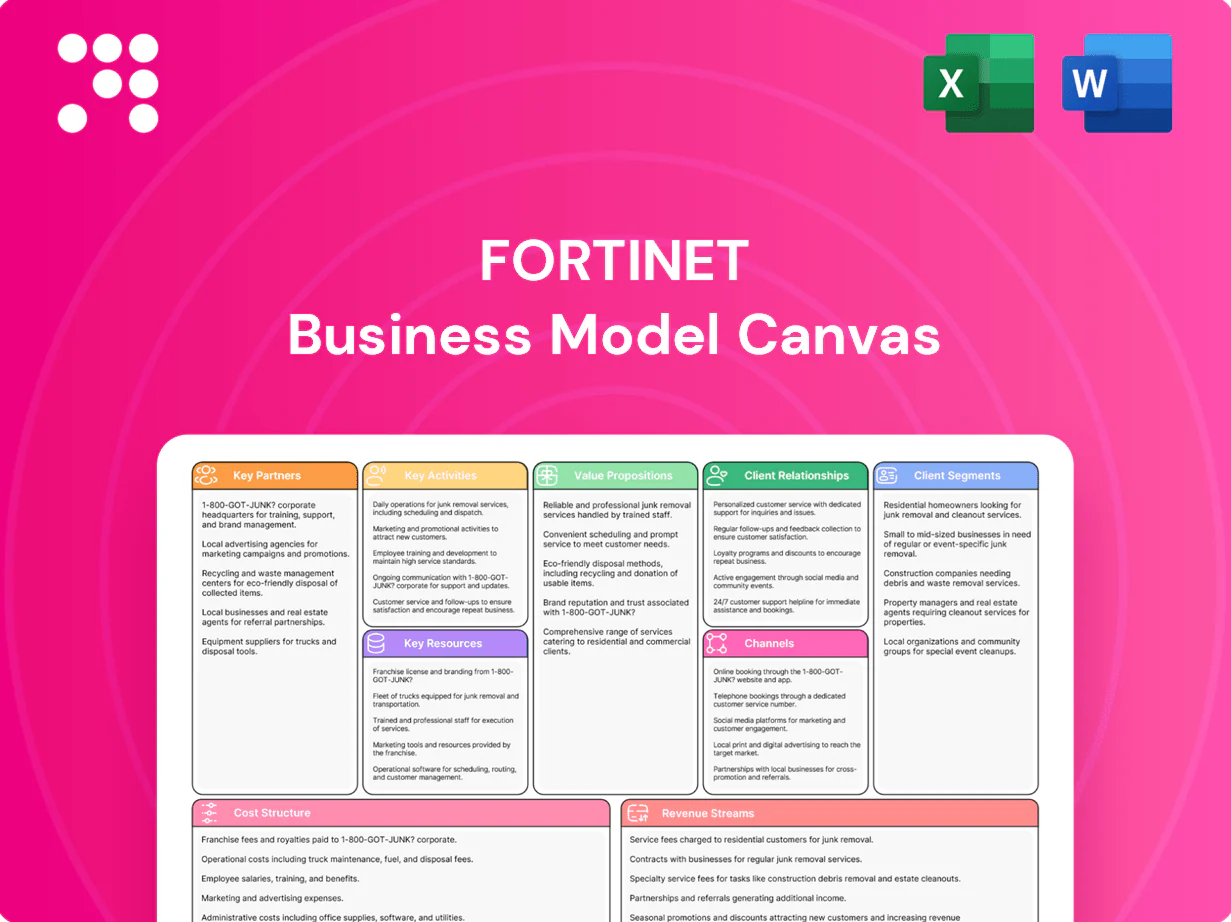
Fortinet Business Model Canvas

Unlock a company-specific Business Model Canvas to benchmark cybersecurity strategy
Unlock the strategic blueprint behind Fortinet with our Business Model Canvas. This concise, company-specific canvas reveals value propositions, revenue streams, partnerships and growth levers to inform investors, consultants and founders. Download the full Word/Excel kit to benchmark, plan and act.
Partnerships

Cloud hyperscalers (AWS, Azure, GCP)
Joint reference architectures embed Fortinet security into native cloud networking across AWS, Azure, GCP, aligning with 2024 IaaS/PaaS market shares of ~32% AWS, ~23% Azure, ~11% GCP (Gartner 2024). Marketplace listings on the three hyperscalers streamline procurement and metering, accelerating deployments. Co-selling and deep technical integrations enable consistent hybrid and multicloud security while shared threat telemetry raises detection fidelity across environments.
Global distributors and value-added resellers
Global distributors and value-added resellers extend Fortinet’s reach, localization, and logistics for hardware and subscription delivery, supporting a partner ecosystem of over 10,000 resellers and distributors in 2024.
Deal registration, certification and enablement programs drive channel-led growth and account for the majority of sales, increasing partner-driven bookings year-over-year in 2024.
Bundled services from VARs—managed services, integration and support—boost adoption and stickiness for Fortinet’s security fabric, while co-marketing initiatives in 2024 accelerate pipeline generation and deal velocity.

Managed security service providers (MSSPs/MSPs)
Operators deliver Fortinet-powered SOC, MDR and co-managed services across on-prem and cloud environments, leveraging Fortinet Fabric integrations to speed deployment and threat detection. Multi-tenant tooling underpins scale and SLA delivery, enabling centralized SLA reporting and tenant isolation. Usage-based pricing aligns with recurring revenue models and predictable ARR; the global MSSP market was estimated at about $48.9B in 2024. Joint service catalogs target SMB through enterprise segments to expand addressable market and cross-sell opportunities.

Technology alliances and OEMs
Fortinet’s APIs and Fabric-Ready integrations tie networking, identity, SIEM and SOAR into unified workflows, with 700+ Fabric-Ready integrations reported in 2024, easing cross-vendor automation. OEM and embedded models place Fortinet software into adjacent platforms, expanding addressable markets. Interoperability lowers deployment friction and co-validation with partners shortens sales cycles.
- Fabric-Ready: 700+ integrations (2024)
- APIs: cross-domain automation
- OEM: embedded expansion
- Outcome: reduced friction, faster sales
Contract manufacturers and component suppliers
Hardware partners produce FortiGate appliances and specialized ASIC-based units; Fortinet reported FY2024 revenue of approximately $5.7B, reflecting strong hardware demand. Supply-chain collaboration balances cost, yield and average lead times of 12–16 weeks in 2024. Secure manufacturing practices and firmware verification protect device integrity while multi-sourcing mitigates component risk.
- Hardware: FortiGate and ASIC appliances
- Lead times: 12–16 weeks (2024)
- Security: secure manufacturing and firmware verification
- Risk: multi-sourcing to reduce supplier concentration
Multicloud security: AWS 32% / Azure 23% / GCP 11%; 700+ integrations; FY2024 $5.7B
Fortinet leverages hyperscaler integrations (AWS 32% / Azure 23% / GCP 11% IaaS/PaaS share 2024) and 700+ Fabric-Ready integrations to enable multicloud security and faster sales cycles. A global channel of >10,000 resellers, distributors and OEMs plus MSSP/operator partnerships ($48.9B MSSP market 2024) expand reach and recurring revenue; FY2024 revenue ~$5.7B. Supply-chain partners keep lead times 12–16 weeks.
| Metric | 2024 |
|---|---|
| Hyperscaler share | AWS 32% / Azure 23% / GCP 11% |
| Fabric integrations | 700+ |
| Channel partners | >10,000 |
| FY revenue | $5.7B |
| MSSP market | $48.9B |
| Lead times | 12–16 weeks |
What is included in the product
 Detailed Word Document
A comprehensive Fortinet Business Model Canvas outlining its 9 BMC blocks—customers (enterprises, MSSPs, carriers), channels, and integrated cybersecurity value propositions across hardware, software, and services; includes revenue streams, key partners, cost structure, competitive advantages, and linked SWOT insights for strategic decisions and investor presentations.

 Customizable Excel Spreadsheet
One-page Fortinet Business Model Canvas that condenses complex cybersecurity strategy, channel dynamics, and product portfolio into editable cells for rapid alignment. Ideal for quickly resolving strategic confusion, saving hours of planning and enabling clear, shareable decisions across teams and boardrooms.
Activities

Security R&D and product engineering
Fortinet's Security R&D and product engineering continuously evolve FortiOS, FortiGate, and the Security Fabric, supporting over 700,000 customers worldwide and aligning feature roadmaps to SASE, SD-WAN, and OT use cases. Custom ASIC design and optimization (NP ASIC family) drive superior performance per watt for high-throughput appliances. Roadmaps prioritize SASE and OT integrations while rapid iteration and frequent FortiGuard updates address emerging threats.
Threat intelligence and analytics
FortiGuard Labs aggregates global telemetry to build signatures and AI models, feeding automated prevention across Fortinet platforms. In fiscal 2024 Fortinet reported $6.06 billion revenue, underscoring product-led scale that deploys this intelligence. Research publishes advisories, supports takedowns, and data science continuously tunes detection efficacy to reduce false positives and improve response times.

Cloud/SaaS operations and reliability
Operate SASE PoPs, cloud firewalls, and management consoles with enterprise SLAs such as 99.99% uptime and sub-50 ms latency targets to meet customer needs. Offer regional data residency options and maintain ISO 27001 and SOC 2 compliance to pass security audits and preserve trust. Observability and telemetry pipelines process high-volume logs and metrics to support scale and resilience across distributed clouds.

Channel enablement and sales execution
Channel enablement and sales execution focus on training partners and certifying sellers via the NSE program (surpassing 1,000,000 certifications by 2024), running demand-gen campaigns, and structuring deals to support subscriptions and enterprise agreements; Fortinet reported FY2024 revenue of $5.14 billion, underscoring channel impact. Solution demos and POCs shorten sales cycles, while vertical playbooks tailor use cases for faster adoption.
- Train partners / NSE certifications >1,000,000 (2024)
- Deal structuring: subscriptions & enterprise agreements
- Demos & POCs: reduced time-to-close
- Vertical playbooks: tailored use cases
Customer success and professional services
Implementation, migration and optimization services accelerate time-to-value for Fortinet deployments, supporting 600,000+ customers (2024) and reducing rollout friction. Tiered support resolves incidents and sustains security posture. Regular health checks and QBRs drive seat and license expansion while education programs uplift admin skills and reduce churn.
- implementation
- support-tiers
- health-checks-qbrs
- education-programs
Security platform delivers SASE, SD-WAN and OT for 700,000+ customers
R&D and product engineering iterate FortiOS, FortiGate and Security Fabric to deliver SASE, SD-WAN and OT features for 700,000+ customers. FortiGuard Labs ships telemetry-driven prevention and AI models; ASICs boost throughput and efficiency. Operations sustain cloud PoPs and 99.99% SLAs while channel/NSE enablement (1,000,000+ certs) drives subscription growth.
| Metric | Value (2024) |
|---|---|
| Customers | 700,000+ |
| Revenue FY2024 | $6.06B |
| NSE Certifications | 1,000,000+ |
| Deployments | 600,000+ |
| SLA Target | 99.99% |
Preview Before You Purchase
Business Model Canvas
The Fortinet Business Model Canvas shown here is the actual deliverable, not a mockup, and reflects the exact structure and content you’ll receive after purchase. When you complete your order, you’ll get this same professional, ready-to-edit document in Word and Excel formats. No filler pages or altered layouts—what you preview is what you’ll download, fully formatted and ready for presentation or analysis.

Unlock a company-specific Business Model Canvas to benchmark cybersecurity strategy
Unlock the strategic blueprint behind Fortinet with our Business Model Canvas. This concise, company-specific canvas reveals value propositions, revenue streams, partnerships and growth levers to inform investors, consultants and founders. Download the full Word/Excel kit to benchmark, plan and act.
Partnerships
Cloud hyperscalers (AWS, Azure, GCP)
Joint reference architectures embed Fortinet security into native cloud networking across AWS, Azure, GCP, aligning with 2024 IaaS/PaaS market shares of ~32% AWS, ~23% Azure, ~11% GCP (Gartner 2024). Marketplace listings on the three hyperscalers streamline procurement and metering, accelerating deployments. Co-selling and deep technical integrations enable consistent hybrid and multicloud security while shared threat telemetry raises detection fidelity across environments.
Global distributors and value-added resellers
Global distributors and value-added resellers extend Fortinet’s reach, localization, and logistics for hardware and subscription delivery, supporting a partner ecosystem of over 10,000 resellers and distributors in 2024.
Deal registration, certification and enablement programs drive channel-led growth and account for the majority of sales, increasing partner-driven bookings year-over-year in 2024.
Bundled services from VARs—managed services, integration and support—boost adoption and stickiness for Fortinet’s security fabric, while co-marketing initiatives in 2024 accelerate pipeline generation and deal velocity.
Managed security service providers (MSSPs/MSPs)
Operators deliver Fortinet-powered SOC, MDR and co-managed services across on-prem and cloud environments, leveraging Fortinet Fabric integrations to speed deployment and threat detection. Multi-tenant tooling underpins scale and SLA delivery, enabling centralized SLA reporting and tenant isolation. Usage-based pricing aligns with recurring revenue models and predictable ARR; the global MSSP market was estimated at about $48.9B in 2024. Joint service catalogs target SMB through enterprise segments to expand addressable market and cross-sell opportunities.
Technology alliances and OEMs
Fortinet’s APIs and Fabric-Ready integrations tie networking, identity, SIEM and SOAR into unified workflows, with 700+ Fabric-Ready integrations reported in 2024, easing cross-vendor automation. OEM and embedded models place Fortinet software into adjacent platforms, expanding addressable markets. Interoperability lowers deployment friction and co-validation with partners shortens sales cycles.
- Fabric-Ready: 700+ integrations (2024)
- APIs: cross-domain automation
- OEM: embedded expansion
- Outcome: reduced friction, faster sales
Contract manufacturers and component suppliers
Hardware partners produce FortiGate appliances and specialized ASIC-based units; Fortinet reported FY2024 revenue of approximately $5.7B, reflecting strong hardware demand. Supply-chain collaboration balances cost, yield and average lead times of 12–16 weeks in 2024. Secure manufacturing practices and firmware verification protect device integrity while multi-sourcing mitigates component risk.
- Hardware: FortiGate and ASIC appliances
- Lead times: 12–16 weeks (2024)
- Security: secure manufacturing and firmware verification
- Risk: multi-sourcing to reduce supplier concentration
Multicloud security: AWS 32% / Azure 23% / GCP 11%; 700+ integrations; FY2024 $5.7B
Fortinet leverages hyperscaler integrations (AWS 32% / Azure 23% / GCP 11% IaaS/PaaS share 2024) and 700+ Fabric-Ready integrations to enable multicloud security and faster sales cycles. A global channel of >10,000 resellers, distributors and OEMs plus MSSP/operator partnerships ($48.9B MSSP market 2024) expand reach and recurring revenue; FY2024 revenue ~$5.7B. Supply-chain partners keep lead times 12–16 weeks.
| Metric | 2024 |
|---|---|
| Hyperscaler share | AWS 32% / Azure 23% / GCP 11% |
| Fabric integrations | 700+ |
| Channel partners | >10,000 |
| FY revenue | $5.7B |
| MSSP market | $48.9B |
| Lead times | 12–16 weeks |
What is included in the product
Detailed Word Document
A comprehensive Fortinet Business Model Canvas outlining its 9 BMC blocks—customers (enterprises, MSSPs, carriers), channels, and integrated cybersecurity value propositions across hardware, software, and services; includes revenue streams, key partners, cost structure, competitive advantages, and linked SWOT insights for strategic decisions and investor presentations.
Customizable Excel Spreadsheet
One-page Fortinet Business Model Canvas that condenses complex cybersecurity strategy, channel dynamics, and product portfolio into editable cells for rapid alignment. Ideal for quickly resolving strategic confusion, saving hours of planning and enabling clear, shareable decisions across teams and boardrooms.
Activities
Security R&D and product engineering
Fortinet's Security R&D and product engineering continuously evolve FortiOS, FortiGate, and the Security Fabric, supporting over 700,000 customers worldwide and aligning feature roadmaps to SASE, SD-WAN, and OT use cases. Custom ASIC design and optimization (NP ASIC family) drive superior performance per watt for high-throughput appliances. Roadmaps prioritize SASE and OT integrations while rapid iteration and frequent FortiGuard updates address emerging threats.
Threat intelligence and analytics
FortiGuard Labs aggregates global telemetry to build signatures and AI models, feeding automated prevention across Fortinet platforms. In fiscal 2024 Fortinet reported $6.06 billion revenue, underscoring product-led scale that deploys this intelligence. Research publishes advisories, supports takedowns, and data science continuously tunes detection efficacy to reduce false positives and improve response times.
Cloud/SaaS operations and reliability
Operate SASE PoPs, cloud firewalls, and management consoles with enterprise SLAs such as 99.99% uptime and sub-50 ms latency targets to meet customer needs. Offer regional data residency options and maintain ISO 27001 and SOC 2 compliance to pass security audits and preserve trust. Observability and telemetry pipelines process high-volume logs and metrics to support scale and resilience across distributed clouds.
Channel enablement and sales execution
Channel enablement and sales execution focus on training partners and certifying sellers via the NSE program (surpassing 1,000,000 certifications by 2024), running demand-gen campaigns, and structuring deals to support subscriptions and enterprise agreements; Fortinet reported FY2024 revenue of $5.14 billion, underscoring channel impact. Solution demos and POCs shorten sales cycles, while vertical playbooks tailor use cases for faster adoption.
- Train partners / NSE certifications >1,000,000 (2024)
- Deal structuring: subscriptions & enterprise agreements
- Demos & POCs: reduced time-to-close
- Vertical playbooks: tailored use cases
Customer success and professional services
Implementation, migration and optimization services accelerate time-to-value for Fortinet deployments, supporting 600,000+ customers (2024) and reducing rollout friction. Tiered support resolves incidents and sustains security posture. Regular health checks and QBRs drive seat and license expansion while education programs uplift admin skills and reduce churn.
- implementation
- support-tiers
- health-checks-qbrs
- education-programs
Security platform delivers SASE, SD-WAN and OT for 700,000+ customers
R&D and product engineering iterate FortiOS, FortiGate and Security Fabric to deliver SASE, SD-WAN and OT features for 700,000+ customers. FortiGuard Labs ships telemetry-driven prevention and AI models; ASICs boost throughput and efficiency. Operations sustain cloud PoPs and 99.99% SLAs while channel/NSE enablement (1,000,000+ certs) drives subscription growth.
| Metric | Value (2024) |
|---|---|
| Customers | 700,000+ |
| Revenue FY2024 | $6.06B |
| NSE Certifications | 1,000,000+ |
| Deployments | 600,000+ |
| SLA Target | 99.99% |
Preview Before You Purchase
Business Model Canvas
The Fortinet Business Model Canvas shown here is the actual deliverable, not a mockup, and reflects the exact structure and content you’ll receive after purchase. When you complete your order, you’ll get this same professional, ready-to-edit document in Word and Excel formats. No filler pages or altered layouts—what you preview is what you’ll download, fully formatted and ready for presentation or analysis.
Description
Unlock a company-specific Business Model Canvas to benchmark cybersecurity strategy
Unlock the strategic blueprint behind Fortinet with our Business Model Canvas. This concise, company-specific canvas reveals value propositions, revenue streams, partnerships and growth levers to inform investors, consultants and founders. Download the full Word/Excel kit to benchmark, plan and act.
Partnerships
Cloud hyperscalers (AWS, Azure, GCP)
Joint reference architectures embed Fortinet security into native cloud networking across AWS, Azure, GCP, aligning with 2024 IaaS/PaaS market shares of ~32% AWS, ~23% Azure, ~11% GCP (Gartner 2024). Marketplace listings on the three hyperscalers streamline procurement and metering, accelerating deployments. Co-selling and deep technical integrations enable consistent hybrid and multicloud security while shared threat telemetry raises detection fidelity across environments.
Global distributors and value-added resellers
Global distributors and value-added resellers extend Fortinet’s reach, localization, and logistics for hardware and subscription delivery, supporting a partner ecosystem of over 10,000 resellers and distributors in 2024.
Deal registration, certification and enablement programs drive channel-led growth and account for the majority of sales, increasing partner-driven bookings year-over-year in 2024.
Bundled services from VARs—managed services, integration and support—boost adoption and stickiness for Fortinet’s security fabric, while co-marketing initiatives in 2024 accelerate pipeline generation and deal velocity.
Managed security service providers (MSSPs/MSPs)
Operators deliver Fortinet-powered SOC, MDR and co-managed services across on-prem and cloud environments, leveraging Fortinet Fabric integrations to speed deployment and threat detection. Multi-tenant tooling underpins scale and SLA delivery, enabling centralized SLA reporting and tenant isolation. Usage-based pricing aligns with recurring revenue models and predictable ARR; the global MSSP market was estimated at about $48.9B in 2024. Joint service catalogs target SMB through enterprise segments to expand addressable market and cross-sell opportunities.
Technology alliances and OEMs
Fortinet’s APIs and Fabric-Ready integrations tie networking, identity, SIEM and SOAR into unified workflows, with 700+ Fabric-Ready integrations reported in 2024, easing cross-vendor automation. OEM and embedded models place Fortinet software into adjacent platforms, expanding addressable markets. Interoperability lowers deployment friction and co-validation with partners shortens sales cycles.
- Fabric-Ready: 700+ integrations (2024)
- APIs: cross-domain automation
- OEM: embedded expansion
- Outcome: reduced friction, faster sales
Contract manufacturers and component suppliers
Hardware partners produce FortiGate appliances and specialized ASIC-based units; Fortinet reported FY2024 revenue of approximately $5.7B, reflecting strong hardware demand. Supply-chain collaboration balances cost, yield and average lead times of 12–16 weeks in 2024. Secure manufacturing practices and firmware verification protect device integrity while multi-sourcing mitigates component risk.
- Hardware: FortiGate and ASIC appliances
- Lead times: 12–16 weeks (2024)
- Security: secure manufacturing and firmware verification
- Risk: multi-sourcing to reduce supplier concentration
Multicloud security: AWS 32% / Azure 23% / GCP 11%; 700+ integrations; FY2024 $5.7B
Fortinet leverages hyperscaler integrations (AWS 32% / Azure 23% / GCP 11% IaaS/PaaS share 2024) and 700+ Fabric-Ready integrations to enable multicloud security and faster sales cycles. A global channel of >10,000 resellers, distributors and OEMs plus MSSP/operator partnerships ($48.9B MSSP market 2024) expand reach and recurring revenue; FY2024 revenue ~$5.7B. Supply-chain partners keep lead times 12–16 weeks.
| Metric | 2024 |
|---|---|
| Hyperscaler share | AWS 32% / Azure 23% / GCP 11% |
| Fabric integrations | 700+ |
| Channel partners | >10,000 |
| FY revenue | $5.7B |
| MSSP market | $48.9B |
| Lead times | 12–16 weeks |
What is included in the product
Detailed Word Document
A comprehensive Fortinet Business Model Canvas outlining its 9 BMC blocks—customers (enterprises, MSSPs, carriers), channels, and integrated cybersecurity value propositions across hardware, software, and services; includes revenue streams, key partners, cost structure, competitive advantages, and linked SWOT insights for strategic decisions and investor presentations.
Customizable Excel Spreadsheet
One-page Fortinet Business Model Canvas that condenses complex cybersecurity strategy, channel dynamics, and product portfolio into editable cells for rapid alignment. Ideal for quickly resolving strategic confusion, saving hours of planning and enabling clear, shareable decisions across teams and boardrooms.
Activities
Security R&D and product engineering
Fortinet's Security R&D and product engineering continuously evolve FortiOS, FortiGate, and the Security Fabric, supporting over 700,000 customers worldwide and aligning feature roadmaps to SASE, SD-WAN, and OT use cases. Custom ASIC design and optimization (NP ASIC family) drive superior performance per watt for high-throughput appliances. Roadmaps prioritize SASE and OT integrations while rapid iteration and frequent FortiGuard updates address emerging threats.
Threat intelligence and analytics
FortiGuard Labs aggregates global telemetry to build signatures and AI models, feeding automated prevention across Fortinet platforms. In fiscal 2024 Fortinet reported $6.06 billion revenue, underscoring product-led scale that deploys this intelligence. Research publishes advisories, supports takedowns, and data science continuously tunes detection efficacy to reduce false positives and improve response times.
Cloud/SaaS operations and reliability
Operate SASE PoPs, cloud firewalls, and management consoles with enterprise SLAs such as 99.99% uptime and sub-50 ms latency targets to meet customer needs. Offer regional data residency options and maintain ISO 27001 and SOC 2 compliance to pass security audits and preserve trust. Observability and telemetry pipelines process high-volume logs and metrics to support scale and resilience across distributed clouds.
Channel enablement and sales execution
Channel enablement and sales execution focus on training partners and certifying sellers via the NSE program (surpassing 1,000,000 certifications by 2024), running demand-gen campaigns, and structuring deals to support subscriptions and enterprise agreements; Fortinet reported FY2024 revenue of $5.14 billion, underscoring channel impact. Solution demos and POCs shorten sales cycles, while vertical playbooks tailor use cases for faster adoption.
- Train partners / NSE certifications >1,000,000 (2024)
- Deal structuring: subscriptions & enterprise agreements
- Demos & POCs: reduced time-to-close
- Vertical playbooks: tailored use cases
Customer success and professional services
Implementation, migration and optimization services accelerate time-to-value for Fortinet deployments, supporting 600,000+ customers (2024) and reducing rollout friction. Tiered support resolves incidents and sustains security posture. Regular health checks and QBRs drive seat and license expansion while education programs uplift admin skills and reduce churn.
- implementation
- support-tiers
- health-checks-qbrs
- education-programs
Security platform delivers SASE, SD-WAN and OT for 700,000+ customers
R&D and product engineering iterate FortiOS, FortiGate and Security Fabric to deliver SASE, SD-WAN and OT features for 700,000+ customers. FortiGuard Labs ships telemetry-driven prevention and AI models; ASICs boost throughput and efficiency. Operations sustain cloud PoPs and 99.99% SLAs while channel/NSE enablement (1,000,000+ certs) drives subscription growth.
| Metric | Value (2024) |
|---|---|
| Customers | 700,000+ |
| Revenue FY2024 | $6.06B |
| NSE Certifications | 1,000,000+ |
| Deployments | 600,000+ |
| SLA Target | 99.99% |
Preview Before You Purchase
Business Model Canvas
The Fortinet Business Model Canvas shown here is the actual deliverable, not a mockup, and reflects the exact structure and content you’ll receive after purchase. When you complete your order, you’ll get this same professional, ready-to-edit document in Word and Excel formats. No filler pages or altered layouts—what you preview is what you’ll download, fully formatted and ready for presentation or analysis.











