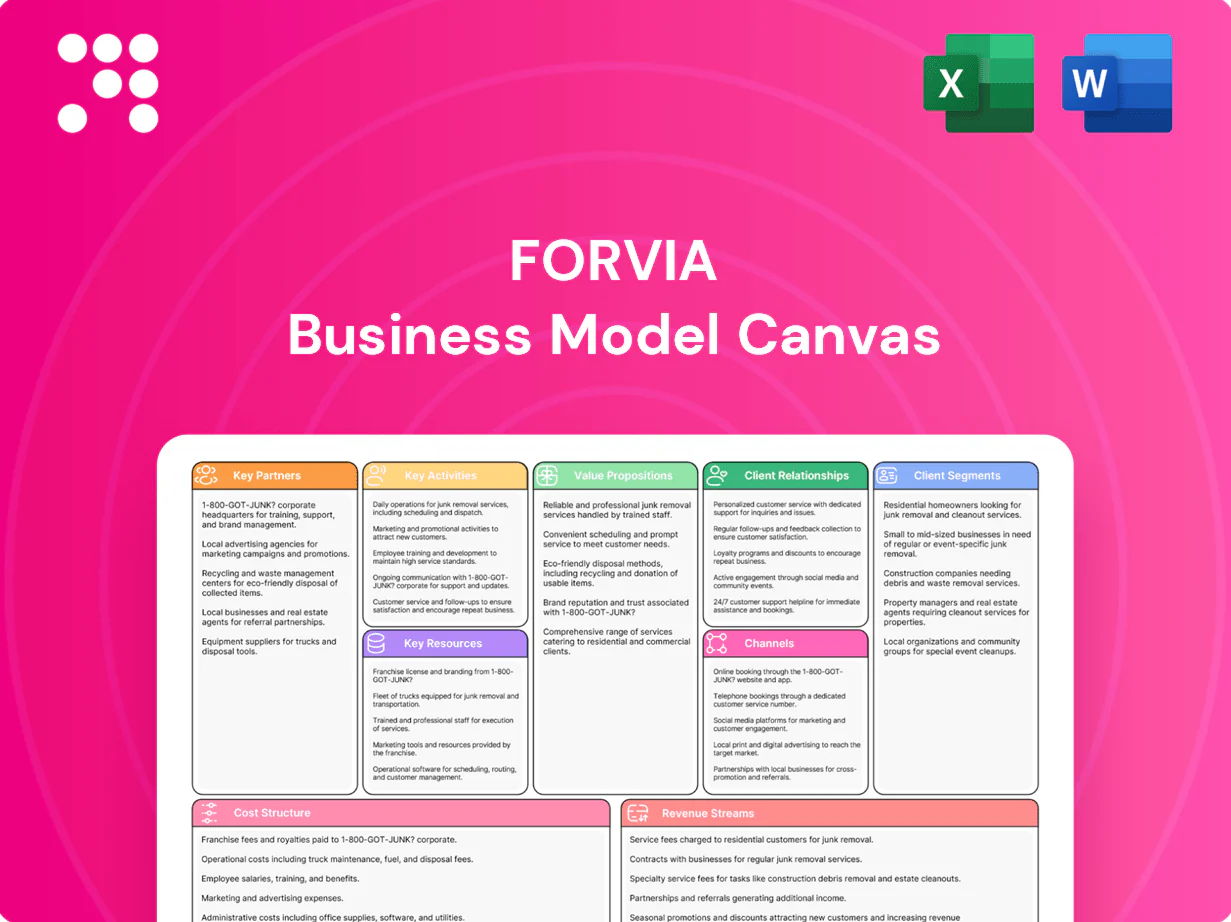
Forvia Business Model Canvas

Unlock the full strategic Business Model Canvas with downloadable Word/Excel pack
Unlock the full strategic blueprint behind Forvia's business model. This in-depth Business Model Canvas reveals how the company drives value, captures market share, and stays ahead in a competitive landscape. Ideal for entrepreneurs, consultants, and investors—download the complete Word/Excel pack to benchmark and act.
Partnerships

Global OEM alliances
Forvia collaborates with 30+ global OEMs to co-develop seats, interiors, electronics and clean mobility systems, aligning joint roadmaps with vehicle launch cycles to time tech releases. Early nomination and design-in secure multi-year volume commitments and reduce integration risk. Strategic alliances accelerate adoption; Forvia's 2024 footprint spans 35 countries with ~120,000 employees, supporting scale and production continuity.
Semiconductor & software partners
Partnerships with leading chipmakers and software firms power Forvia cockpit electronics, ADAS and connected services. Joint reference designs accelerate integration, improve performance and lower cost while shortening development cycles. Multi-year supply agreements, commonly 3–5 years, mitigate semiconductor shortages and pricing volatility. Ecosystem certifications such as ISO/SAE 21434 ensure compatibility and automotive cybersecurity.

Tier-2 materials suppliers
Advanced polymers, foams, technical textiles and lightweight composites are sourced from specialty Tier-2 suppliers to meet automotive performance and weight targets. Co-innovation programs launched in 2024 focus on recyclable and bio-based formulations to improve circularity. Dual-sourcing strategies safeguard continuity and stabilize pricing across regionally diversified supply bases. Supplier quality programs enforce automotive standards such as IATF 16949 and ISO 14001.

Research institutes & startups
Forvia partners with universities and startups to accelerate breakthroughs in HMI, energy storage and AI, running pilots to de-risk concepts before scaling and using IP-sharing frameworks to protect value creation; as of 2024 Forvia employs about 125,000 people across R&D and production hubs.
Sustainability & recycling networks
Partnerships with sustainability and recycling networks enable circularity for plastics, metals and batteries, while traceability systems document carbon footprints and regulatory compliance. Take-back programs close material loops and feed secondary material streams back into production. Renewable energy agreements reduce Scope 2 emissions and support supplier decarbonization.
- circularity: plastics, metals, batteries
- traceability: carbon & compliance
- take-back: closed loops
- renewables: lower Scope 2
Global supplier wins 30+ OEM design‑ins across 35 countries with 3–5yr supply deals
Forvia partners with 30+ global OEMs across 35 countries, securing early design-ins and multi-year volume commitments; 2024 footprint ~125,000 employees. Key tech partners (chipmakers, software) use 3–5 year supply agreements to stabilize sourcing; supplier standards include IATF 16949 and ISO/SAE 21434. Sustainability partnerships enable take-back, traceability and renewable energy sourcing.
| Metric | 2024 |
|---|---|
| OEM partners | 30+ |
| Countries | 35 |
| Employees | ~125,000 |
| Supply deal length | 3–5 yrs |
What is included in the product
 Detailed Word Document
A comprehensive, pre-written Business Model Canvas for Forvia that details customer segments, value propositions, channels, revenue streams and the 9 classic BMC blocks while reflecting real-world operations and strategic plans; includes competitive advantages, SWOT-linked insights and polished design to support presentations, investor discussions and informed decision-making.

 Customizable Excel Spreadsheet
High-level, editable one-page canvas that saves hours of formatting and structuring while helping teams quickly identify, compare, and present Forvia’s core strategy for boardrooms, workshops, or rapid decision-making.
Activities

R&D and validation
Designing seating, interiors, electronics and clean mobility solutions is core to Forvia, with R&D and validation centered on safety, comfort and durability through crash, climate and lifecycle testing. Software development underpins HMI, connectivity and control systems, supporting rising EV adoption (global EV sales ~14% in 2024). Continuous improvement and platform updates keep products competitive amid supplier R&D intensities near mid-single-digit percent of revenue in 2024.
Advanced manufacturing
Lean plants produce modules to IATF 16949 automotive quality levels; in 2024 traceable, serialized components enable full batch genealogy for recalls and audits. Automation and digital traceability increase yield and regulatory compliance while reducing variability. Flexible lines switch across multi-OEM variants with takt-time tooling. PPAP and APQP processes govern all new-product launches.

Supply chain orchestration
Forvia orchestrates global sourcing for materials and chips across ~135,000 employees and a pro forma footprint reported at roughly €26bn in combined sales, coordinating multi‑tier suppliers to secure critical semiconductors. Advanced forecasting and inventory buffers (typical 8–12 week cover in key programs) smooth volatility. Logistics optimization cuts costs and emissions through modal shifts and route planning, aiming for double‑digit CO2 reductions. Supplier development programs raise on‑time quality and reliability metrics.

Program management
Cross-functional teams run RFQ-to-SOP execution, coordinating engineering, purchasing, and quality to meet OEM milestone gates and avoid late changes. Milestone control aligns program reviews with OEM gates and enforces corrective actions at each decision point. Tooling, industrialization, and change management are tightly managed with cost, quality, and delivery KPIs driving accountability across suppliers and internal sites.
- RFQ-to-SOP coordination
- OEM gate-aligned milestones
- Tooling & industrialization control
- KPIs: cost, quality, delivery
Sustainability & compliance
LCA-driven design at Forvia prioritizes lightweighting to cut life-cycle emissions and materials use, while regulatory adherence spans safety, cybersecurity, and expanded ESG reporting under CSRD (affecting ~50,000 EU firms from 2024). Eco-design and recyclability targets are embedded in product roadmaps and supplier contracts. Regular audits and certifications (ISO 14001, IATF 16949) secure market access.
- LCA-driven lightweighting
- CSRD reporting (~50,000 firms, 2024)
- Eco-design & recyclability targets
- ISO 14001 / IATF 16949 audits
EV-ready automotive supplier: €26bn scale, ~135,000 staff, 8–12 week inventory cover
Forvia focuses on design (seating, interiors, electronics, clean mobility) and software for HMI/connectivity with R&D on safety, durability and EV readiness (global EV sales ~14% in 2024). Lean, IATF 16949 plants use automation, serialized traceability and flexible lines; inventory hedges typically 8–12 week cover. Global sourcing coordinates multi‑tier suppliers across ~135,000 employees and pro forma ~€26bn sales.
| Metric | 2024 |
|---|---|
| Pro forma sales | €26bn |
| Employees | ~135,000 |
| EV global share | ~14% |
| Inventory cover | 8–12 weeks |
| CSRD scope | ~50,000 EU firms |
Full Document Unlocks After Purchase
Business Model Canvas
The Forvia Business Model Canvas you’re previewing is the actual deliverable—not a mockup—and shows the same content and layout you'll receive after purchase. Upon checkout you’ll get the complete, editable file (Word and Excel) instantly, formatted exactly as shown for immediate use, presentation, or sharing.

Unlock the full strategic Business Model Canvas with downloadable Word/Excel pack
Unlock the full strategic blueprint behind Forvia's business model. This in-depth Business Model Canvas reveals how the company drives value, captures market share, and stays ahead in a competitive landscape. Ideal for entrepreneurs, consultants, and investors—download the complete Word/Excel pack to benchmark and act.
Partnerships
Global OEM alliances
Forvia collaborates with 30+ global OEMs to co-develop seats, interiors, electronics and clean mobility systems, aligning joint roadmaps with vehicle launch cycles to time tech releases. Early nomination and design-in secure multi-year volume commitments and reduce integration risk. Strategic alliances accelerate adoption; Forvia's 2024 footprint spans 35 countries with ~120,000 employees, supporting scale and production continuity.
Semiconductor & software partners
Partnerships with leading chipmakers and software firms power Forvia cockpit electronics, ADAS and connected services. Joint reference designs accelerate integration, improve performance and lower cost while shortening development cycles. Multi-year supply agreements, commonly 3–5 years, mitigate semiconductor shortages and pricing volatility. Ecosystem certifications such as ISO/SAE 21434 ensure compatibility and automotive cybersecurity.
Tier-2 materials suppliers
Advanced polymers, foams, technical textiles and lightweight composites are sourced from specialty Tier-2 suppliers to meet automotive performance and weight targets. Co-innovation programs launched in 2024 focus on recyclable and bio-based formulations to improve circularity. Dual-sourcing strategies safeguard continuity and stabilize pricing across regionally diversified supply bases. Supplier quality programs enforce automotive standards such as IATF 16949 and ISO 14001.
Research institutes & startups
Forvia partners with universities and startups to accelerate breakthroughs in HMI, energy storage and AI, running pilots to de-risk concepts before scaling and using IP-sharing frameworks to protect value creation; as of 2024 Forvia employs about 125,000 people across R&D and production hubs.
Sustainability & recycling networks
Partnerships with sustainability and recycling networks enable circularity for plastics, metals and batteries, while traceability systems document carbon footprints and regulatory compliance. Take-back programs close material loops and feed secondary material streams back into production. Renewable energy agreements reduce Scope 2 emissions and support supplier decarbonization.
- circularity: plastics, metals, batteries
- traceability: carbon & compliance
- take-back: closed loops
- renewables: lower Scope 2
Global supplier wins 30+ OEM design‑ins across 35 countries with 3–5yr supply deals
Forvia partners with 30+ global OEMs across 35 countries, securing early design-ins and multi-year volume commitments; 2024 footprint ~125,000 employees. Key tech partners (chipmakers, software) use 3–5 year supply agreements to stabilize sourcing; supplier standards include IATF 16949 and ISO/SAE 21434. Sustainability partnerships enable take-back, traceability and renewable energy sourcing.
| Metric | 2024 |
|---|---|
| OEM partners | 30+ |
| Countries | 35 |
| Employees | ~125,000 |
| Supply deal length | 3–5 yrs |
What is included in the product
Detailed Word Document
A comprehensive, pre-written Business Model Canvas for Forvia that details customer segments, value propositions, channels, revenue streams and the 9 classic BMC blocks while reflecting real-world operations and strategic plans; includes competitive advantages, SWOT-linked insights and polished design to support presentations, investor discussions and informed decision-making.
Customizable Excel Spreadsheet
High-level, editable one-page canvas that saves hours of formatting and structuring while helping teams quickly identify, compare, and present Forvia’s core strategy for boardrooms, workshops, or rapid decision-making.
Activities
R&D and validation
Designing seating, interiors, electronics and clean mobility solutions is core to Forvia, with R&D and validation centered on safety, comfort and durability through crash, climate and lifecycle testing. Software development underpins HMI, connectivity and control systems, supporting rising EV adoption (global EV sales ~14% in 2024). Continuous improvement and platform updates keep products competitive amid supplier R&D intensities near mid-single-digit percent of revenue in 2024.
Advanced manufacturing
Lean plants produce modules to IATF 16949 automotive quality levels; in 2024 traceable, serialized components enable full batch genealogy for recalls and audits. Automation and digital traceability increase yield and regulatory compliance while reducing variability. Flexible lines switch across multi-OEM variants with takt-time tooling. PPAP and APQP processes govern all new-product launches.
Supply chain orchestration
Forvia orchestrates global sourcing for materials and chips across ~135,000 employees and a pro forma footprint reported at roughly €26bn in combined sales, coordinating multi‑tier suppliers to secure critical semiconductors. Advanced forecasting and inventory buffers (typical 8–12 week cover in key programs) smooth volatility. Logistics optimization cuts costs and emissions through modal shifts and route planning, aiming for double‑digit CO2 reductions. Supplier development programs raise on‑time quality and reliability metrics.
Program management
Cross-functional teams run RFQ-to-SOP execution, coordinating engineering, purchasing, and quality to meet OEM milestone gates and avoid late changes. Milestone control aligns program reviews with OEM gates and enforces corrective actions at each decision point. Tooling, industrialization, and change management are tightly managed with cost, quality, and delivery KPIs driving accountability across suppliers and internal sites.
- RFQ-to-SOP coordination
- OEM gate-aligned milestones
- Tooling & industrialization control
- KPIs: cost, quality, delivery
Sustainability & compliance
LCA-driven design at Forvia prioritizes lightweighting to cut life-cycle emissions and materials use, while regulatory adherence spans safety, cybersecurity, and expanded ESG reporting under CSRD (affecting ~50,000 EU firms from 2024). Eco-design and recyclability targets are embedded in product roadmaps and supplier contracts. Regular audits and certifications (ISO 14001, IATF 16949) secure market access.
- LCA-driven lightweighting
- CSRD reporting (~50,000 firms, 2024)
- Eco-design & recyclability targets
- ISO 14001 / IATF 16949 audits
EV-ready automotive supplier: €26bn scale, ~135,000 staff, 8–12 week inventory cover
Forvia focuses on design (seating, interiors, electronics, clean mobility) and software for HMI/connectivity with R&D on safety, durability and EV readiness (global EV sales ~14% in 2024). Lean, IATF 16949 plants use automation, serialized traceability and flexible lines; inventory hedges typically 8–12 week cover. Global sourcing coordinates multi‑tier suppliers across ~135,000 employees and pro forma ~€26bn sales.
| Metric | 2024 |
|---|---|
| Pro forma sales | €26bn |
| Employees | ~135,000 |
| EV global share | ~14% |
| Inventory cover | 8–12 weeks |
| CSRD scope | ~50,000 EU firms |
Full Document Unlocks After Purchase
Business Model Canvas
The Forvia Business Model Canvas you’re previewing is the actual deliverable—not a mockup—and shows the same content and layout you'll receive after purchase. Upon checkout you’ll get the complete, editable file (Word and Excel) instantly, formatted exactly as shown for immediate use, presentation, or sharing.
Original: $10.00
-65%$10.00
$3.50Description
Unlock the full strategic Business Model Canvas with downloadable Word/Excel pack
Unlock the full strategic blueprint behind Forvia's business model. This in-depth Business Model Canvas reveals how the company drives value, captures market share, and stays ahead in a competitive landscape. Ideal for entrepreneurs, consultants, and investors—download the complete Word/Excel pack to benchmark and act.
Partnerships
Global OEM alliances
Forvia collaborates with 30+ global OEMs to co-develop seats, interiors, electronics and clean mobility systems, aligning joint roadmaps with vehicle launch cycles to time tech releases. Early nomination and design-in secure multi-year volume commitments and reduce integration risk. Strategic alliances accelerate adoption; Forvia's 2024 footprint spans 35 countries with ~120,000 employees, supporting scale and production continuity.
Semiconductor & software partners
Partnerships with leading chipmakers and software firms power Forvia cockpit electronics, ADAS and connected services. Joint reference designs accelerate integration, improve performance and lower cost while shortening development cycles. Multi-year supply agreements, commonly 3–5 years, mitigate semiconductor shortages and pricing volatility. Ecosystem certifications such as ISO/SAE 21434 ensure compatibility and automotive cybersecurity.
Tier-2 materials suppliers
Advanced polymers, foams, technical textiles and lightweight composites are sourced from specialty Tier-2 suppliers to meet automotive performance and weight targets. Co-innovation programs launched in 2024 focus on recyclable and bio-based formulations to improve circularity. Dual-sourcing strategies safeguard continuity and stabilize pricing across regionally diversified supply bases. Supplier quality programs enforce automotive standards such as IATF 16949 and ISO 14001.
Research institutes & startups
Forvia partners with universities and startups to accelerate breakthroughs in HMI, energy storage and AI, running pilots to de-risk concepts before scaling and using IP-sharing frameworks to protect value creation; as of 2024 Forvia employs about 125,000 people across R&D and production hubs.
Sustainability & recycling networks
Partnerships with sustainability and recycling networks enable circularity for plastics, metals and batteries, while traceability systems document carbon footprints and regulatory compliance. Take-back programs close material loops and feed secondary material streams back into production. Renewable energy agreements reduce Scope 2 emissions and support supplier decarbonization.
- circularity: plastics, metals, batteries
- traceability: carbon & compliance
- take-back: closed loops
- renewables: lower Scope 2
Global supplier wins 30+ OEM design‑ins across 35 countries with 3–5yr supply deals
Forvia partners with 30+ global OEMs across 35 countries, securing early design-ins and multi-year volume commitments; 2024 footprint ~125,000 employees. Key tech partners (chipmakers, software) use 3–5 year supply agreements to stabilize sourcing; supplier standards include IATF 16949 and ISO/SAE 21434. Sustainability partnerships enable take-back, traceability and renewable energy sourcing.
| Metric | 2024 |
|---|---|
| OEM partners | 30+ |
| Countries | 35 |
| Employees | ~125,000 |
| Supply deal length | 3–5 yrs |
What is included in the product
Detailed Word Document
A comprehensive, pre-written Business Model Canvas for Forvia that details customer segments, value propositions, channels, revenue streams and the 9 classic BMC blocks while reflecting real-world operations and strategic plans; includes competitive advantages, SWOT-linked insights and polished design to support presentations, investor discussions and informed decision-making.
Customizable Excel Spreadsheet
High-level, editable one-page canvas that saves hours of formatting and structuring while helping teams quickly identify, compare, and present Forvia’s core strategy for boardrooms, workshops, or rapid decision-making.
Activities
R&D and validation
Designing seating, interiors, electronics and clean mobility solutions is core to Forvia, with R&D and validation centered on safety, comfort and durability through crash, climate and lifecycle testing. Software development underpins HMI, connectivity and control systems, supporting rising EV adoption (global EV sales ~14% in 2024). Continuous improvement and platform updates keep products competitive amid supplier R&D intensities near mid-single-digit percent of revenue in 2024.
Advanced manufacturing
Lean plants produce modules to IATF 16949 automotive quality levels; in 2024 traceable, serialized components enable full batch genealogy for recalls and audits. Automation and digital traceability increase yield and regulatory compliance while reducing variability. Flexible lines switch across multi-OEM variants with takt-time tooling. PPAP and APQP processes govern all new-product launches.
Supply chain orchestration
Forvia orchestrates global sourcing for materials and chips across ~135,000 employees and a pro forma footprint reported at roughly €26bn in combined sales, coordinating multi‑tier suppliers to secure critical semiconductors. Advanced forecasting and inventory buffers (typical 8–12 week cover in key programs) smooth volatility. Logistics optimization cuts costs and emissions through modal shifts and route planning, aiming for double‑digit CO2 reductions. Supplier development programs raise on‑time quality and reliability metrics.
Program management
Cross-functional teams run RFQ-to-SOP execution, coordinating engineering, purchasing, and quality to meet OEM milestone gates and avoid late changes. Milestone control aligns program reviews with OEM gates and enforces corrective actions at each decision point. Tooling, industrialization, and change management are tightly managed with cost, quality, and delivery KPIs driving accountability across suppliers and internal sites.
- RFQ-to-SOP coordination
- OEM gate-aligned milestones
- Tooling & industrialization control
- KPIs: cost, quality, delivery
Sustainability & compliance
LCA-driven design at Forvia prioritizes lightweighting to cut life-cycle emissions and materials use, while regulatory adherence spans safety, cybersecurity, and expanded ESG reporting under CSRD (affecting ~50,000 EU firms from 2024). Eco-design and recyclability targets are embedded in product roadmaps and supplier contracts. Regular audits and certifications (ISO 14001, IATF 16949) secure market access.
- LCA-driven lightweighting
- CSRD reporting (~50,000 firms, 2024)
- Eco-design & recyclability targets
- ISO 14001 / IATF 16949 audits
EV-ready automotive supplier: €26bn scale, ~135,000 staff, 8–12 week inventory cover
Forvia focuses on design (seating, interiors, electronics, clean mobility) and software for HMI/connectivity with R&D on safety, durability and EV readiness (global EV sales ~14% in 2024). Lean, IATF 16949 plants use automation, serialized traceability and flexible lines; inventory hedges typically 8–12 week cover. Global sourcing coordinates multi‑tier suppliers across ~135,000 employees and pro forma ~€26bn sales.
| Metric | 2024 |
|---|---|
| Pro forma sales | €26bn |
| Employees | ~135,000 |
| EV global share | ~14% |
| Inventory cover | 8–12 weeks |
| CSRD scope | ~50,000 EU firms |
Full Document Unlocks After Purchase
Business Model Canvas
The Forvia Business Model Canvas you’re previewing is the actual deliverable—not a mockup—and shows the same content and layout you'll receive after purchase. Upon checkout you’ll get the complete, editable file (Word and Excel) instantly, formatted exactly as shown for immediate use, presentation, or sharing.











