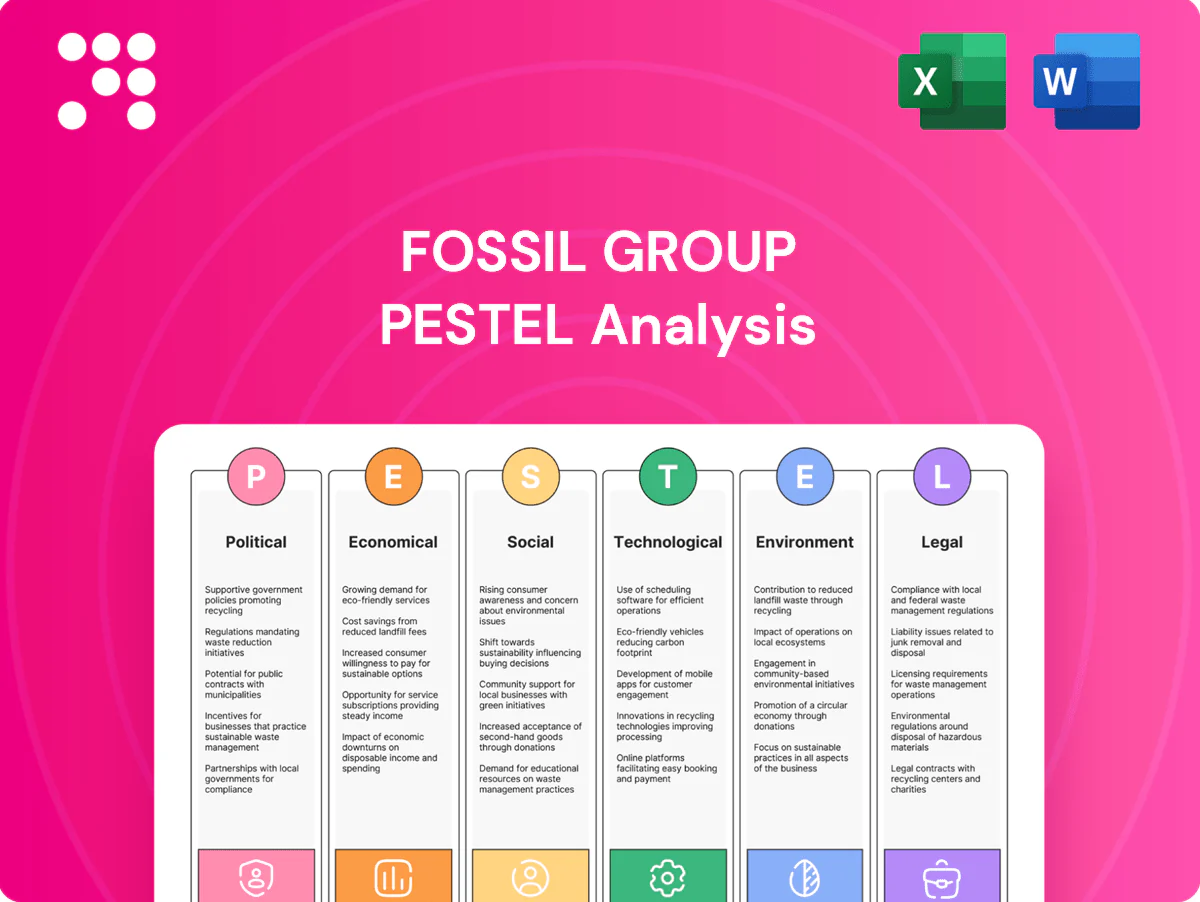
Fossil Group PESTLE Analysis

Your Competitive Advantage Starts with This Report
Unlock strategic clarity with our concise PESTLE Analysis of Fossil Group—three to five focused sentences revealing how political, economic, social, technological, legal and environmental forces shape its prospects. Use these insights to anticipate risks and spot growth opportunities. Purchase the full, editable report for the complete, actionable breakdown and immediate download.
Political factors

Trade tariffs and geopolitics
Shifts in US–China and EU trade policies can raise import costs on watches, wearables and leather goods, with US goods imports from China at about $540B in 2023 highlighting exposure. Tariff uncertainty complicates sourcing and pricing across wholesale and DTC channels, while geopolitical tensions raise logistics risk and lead times; container spot rates plunged ~85% from 2021 peaks to ~US$1,500 in 2024, so diversifying suppliers mitigates exposure but adds complexity.
Customs and import regulations
Classification of watch movements, batteries, and electronics determines tariff lines and compliance paperwork, directly affecting Fossil Group’s landed costs and audit exposure. Changes to rules of origin under over 300 regional trade agreements can shift duty rates and supplier sourcing economics. Border inspections and anti-dumping measures frequently delay shipments, raising inventory carrying costs. Proactive customs broker management preserves delivery reliability and mitigates disruption risk.

Industrial policy and incentives
Subsidies such as the US CHIPS Act's roughly $52 billion for semiconductor production and national incentives for electronics favor nearshoring and partner facilities, lowering component costs for watchmakers. Governments building digital ecosystems—wearables market revenue was about $51.5 billion in 2023—increase smartwatch adoption and addressable demand. Conversely, localization mandates raise compliance and logistics costs, so aligning production footprints with incentives preserves Fossil Group margins.

Political stability in key markets
Unrest or policy swings in emerging markets can abruptly disrupt Fossil Group retail operations and wholesale partners, while currency controls and capital restrictions hinder cash repatriation and working capital management. Election cycles in 2024–25 have shifted consumer confidence and VAT rates in key markets, so scenario planning is used to guide inventory and dynamic pricing decisions.
- Operational disruption risk: emerging markets
- Cash flow constraint: currency controls
- Demand volatility: election cycles
- Mitigation: scenario-driven inventory and pricing
Public health and policy responses
Pandemic-era policy playbooks remain influential after WHO and US federal emergency declarations ended in May 2023, shaping retail footfall and supply continuity. Sudden local mandates still force rapid store closures and labor rescheduling, while health-related import checks for lithium batteries and wearables can tighten customs timelines. Fossil Group's omnichannel channels mitigate policy-driven sales swings by enabling online fulfillment when stores are affected.
- WHO/CDC emergency end: May 2023
- Mandates cause rapid store/labor shifts
- Battery/wearable import checks rise
- Omnichannel reduces volatility
Trade shifts lift import costs; $540B, $1,500
Shifts in US–China and EU trade policy raise import costs for watches, wearables and leather goods—US goods imports from China were about $540B in 2023—while tariff and ROO changes complicate sourcing. Container spot rates plunged ~85% from 2021 peaks to ~US$1,500 in 2024, altering logistics costs and lead times. Policy incentives (CHIPS ~US$52B) and growing wearables demand (US$51.5B revenue in 2023) favor nearshoring but add compliance costs.
| Risk/Driver | Metric | Value |
|---|---|---|
| Trade exposure | US imports from China | $540B (2023) |
| Logistics | Container spot rate | $1,500 (2024, ~-85%) |
| Market demand | Wearables revenue | $51.5B (2023) |
| Incentives | CHIPS funding | $52B |
What is included in the product
 Detailed Word Document
Explores how Political, Economic, Social, Technological, Environmental, and Legal forces uniquely impact Fossil Group, with data-backed trends, forward-looking insights, and practical implications to guide executives, investors, and strategists.

 Customizable Excel Spreadsheet
A concise, visually segmented PESTLE summary of Fossil Group that’s editable for regional or business-line context, drop-in ready for presentations and easily shareable to align teams quickly during strategy and risk discussions.
Economic factors

Consumer discretionary cycles
Accessories sales are highly sensitive to income and employment trends; US unemployment around 3.7% (Nov 2024) tightens mid-price watch and handbag demand while luxury segments prove more resilient. Downturns drive higher promotional intensity, compressing gross margins for Fossil Group. Rapid inventory turns and expanded outlet/channel clearance protect cash and reduce markdown risk.
FX volatility and cost of goods
Dollar strength compresses Fossil Group’s translated international revenue while potentially lowering costs for USD‑priced inputs; currency swings also complicate transfer pricing and hedging between US, CNY and EUR regions. Suppliers invoicing in CNY or EUR increase exposure to cost shocks, especially for components sourced from China and Europe. Structured hedges and price ladders are used to balance transaction and translation risks.

Wholesale vs DTC mix
Wholesale delivers scale but typically compresses margins and limits pricing control; Fossil shifted toward DTC, which reached roughly 40% of revenue in 2024, improving gross margin by about 700 basis points versus wholesale. E-commerce and owned retail lift gross margins but raise fulfillment and returns (online return rates near 20–25%), increasing operating and reverse-logistics costs. Channel mix shifts lengthen inventory turnover and affect markdown cadence and working capital days, while optimizing the mix stabilizes EBITDA.

Wearables growth and substitution
- 151M 2024 smartwatch shipments
- ASP dispersion — need tiered SKUs
- Licensed brands boost premium sales
- Innovation required to protect margins
Input inflation and logistics
Input inflation for Fossil Group remains driven by cyclical cost pressure in labor, leather, metals and semiconductors; global container spot rates fell roughly 50–60% from 2021 peaks by 2023 but stayed volatile through 2024, while wage growth in key sourcing markets averaged near 4%–5% in 2023–24. Supplier consolidation has increased supplier bargaining power and concentration risk; should-costing and multi-sourcing are used to protect margins.
- Labor: wage growth ~4%–5% (2023–24)
- Logistics: container rates down ~50–60% vs 2021 highs
- Risk: supplier consolidation = leverage + concentration
- Mitigation: should-costing, multi-sourcing sustain margins
Trade shifts lift import costs; $540B, $1,500
Demand tied to income: US unemployment ~3.7% (Nov 2024) pressures mid‑tier accessory sales while luxury holds. Channel shift to DTC (~40% revenue in 2024) lifts gross margin but raises fulfillment/returns (~20–25%). Input cost mix: smartwatch disruption (151M units 2024), wage growth ~4–5% and container rates down ~50–60% vs 2021, driving sourcing and pricing tactics.
| Metric | 2024/2025 |
|---|---|
| US unemployment | 3.7% (Nov 2024) |
| DTC revenue | ~40% (2024) |
| Smartwatch shipments | 151M (2024) |
| Online returns | 20–25% |
| Wage growth (sourcing) | 4–5% |
| Container rates vs 2021 | -50–60% |
Same Document Delivered
Fossil Group PESTLE Analysis
The Fossil Group PESTLE Analysis preview shown here is the exact document you’ll receive after purchase—fully formatted and ready to use. The layout, content, and structure visible are exactly what you’ll download immediately after payment. No placeholders or teasers—this is the real, finished file.

Your Competitive Advantage Starts with This Report
Unlock strategic clarity with our concise PESTLE Analysis of Fossil Group—three to five focused sentences revealing how political, economic, social, technological, legal and environmental forces shape its prospects. Use these insights to anticipate risks and spot growth opportunities. Purchase the full, editable report for the complete, actionable breakdown and immediate download.
Political factors
Trade tariffs and geopolitics
Shifts in US–China and EU trade policies can raise import costs on watches, wearables and leather goods, with US goods imports from China at about $540B in 2023 highlighting exposure. Tariff uncertainty complicates sourcing and pricing across wholesale and DTC channels, while geopolitical tensions raise logistics risk and lead times; container spot rates plunged ~85% from 2021 peaks to ~US$1,500 in 2024, so diversifying suppliers mitigates exposure but adds complexity.
Customs and import regulations
Classification of watch movements, batteries, and electronics determines tariff lines and compliance paperwork, directly affecting Fossil Group’s landed costs and audit exposure. Changes to rules of origin under over 300 regional trade agreements can shift duty rates and supplier sourcing economics. Border inspections and anti-dumping measures frequently delay shipments, raising inventory carrying costs. Proactive customs broker management preserves delivery reliability and mitigates disruption risk.
Industrial policy and incentives
Subsidies such as the US CHIPS Act's roughly $52 billion for semiconductor production and national incentives for electronics favor nearshoring and partner facilities, lowering component costs for watchmakers. Governments building digital ecosystems—wearables market revenue was about $51.5 billion in 2023—increase smartwatch adoption and addressable demand. Conversely, localization mandates raise compliance and logistics costs, so aligning production footprints with incentives preserves Fossil Group margins.
Political stability in key markets
Unrest or policy swings in emerging markets can abruptly disrupt Fossil Group retail operations and wholesale partners, while currency controls and capital restrictions hinder cash repatriation and working capital management. Election cycles in 2024–25 have shifted consumer confidence and VAT rates in key markets, so scenario planning is used to guide inventory and dynamic pricing decisions.
- Operational disruption risk: emerging markets
- Cash flow constraint: currency controls
- Demand volatility: election cycles
- Mitigation: scenario-driven inventory and pricing
Public health and policy responses
Pandemic-era policy playbooks remain influential after WHO and US federal emergency declarations ended in May 2023, shaping retail footfall and supply continuity. Sudden local mandates still force rapid store closures and labor rescheduling, while health-related import checks for lithium batteries and wearables can tighten customs timelines. Fossil Group's omnichannel channels mitigate policy-driven sales swings by enabling online fulfillment when stores are affected.
- WHO/CDC emergency end: May 2023
- Mandates cause rapid store/labor shifts
- Battery/wearable import checks rise
- Omnichannel reduces volatility
Trade shifts lift import costs; $540B, $1,500
Shifts in US–China and EU trade policy raise import costs for watches, wearables and leather goods—US goods imports from China were about $540B in 2023—while tariff and ROO changes complicate sourcing. Container spot rates plunged ~85% from 2021 peaks to ~US$1,500 in 2024, altering logistics costs and lead times. Policy incentives (CHIPS ~US$52B) and growing wearables demand (US$51.5B revenue in 2023) favor nearshoring but add compliance costs.
| Risk/Driver | Metric | Value |
|---|---|---|
| Trade exposure | US imports from China | $540B (2023) |
| Logistics | Container spot rate | $1,500 (2024, ~-85%) |
| Market demand | Wearables revenue | $51.5B (2023) |
| Incentives | CHIPS funding | $52B |
What is included in the product
Detailed Word Document
Explores how Political, Economic, Social, Technological, Environmental, and Legal forces uniquely impact Fossil Group, with data-backed trends, forward-looking insights, and practical implications to guide executives, investors, and strategists.
Customizable Excel Spreadsheet
A concise, visually segmented PESTLE summary of Fossil Group that’s editable for regional or business-line context, drop-in ready for presentations and easily shareable to align teams quickly during strategy and risk discussions.
Economic factors
Consumer discretionary cycles
Accessories sales are highly sensitive to income and employment trends; US unemployment around 3.7% (Nov 2024) tightens mid-price watch and handbag demand while luxury segments prove more resilient. Downturns drive higher promotional intensity, compressing gross margins for Fossil Group. Rapid inventory turns and expanded outlet/channel clearance protect cash and reduce markdown risk.
FX volatility and cost of goods
Dollar strength compresses Fossil Group’s translated international revenue while potentially lowering costs for USD‑priced inputs; currency swings also complicate transfer pricing and hedging between US, CNY and EUR regions. Suppliers invoicing in CNY or EUR increase exposure to cost shocks, especially for components sourced from China and Europe. Structured hedges and price ladders are used to balance transaction and translation risks.
Wholesale vs DTC mix
Wholesale delivers scale but typically compresses margins and limits pricing control; Fossil shifted toward DTC, which reached roughly 40% of revenue in 2024, improving gross margin by about 700 basis points versus wholesale. E-commerce and owned retail lift gross margins but raise fulfillment and returns (online return rates near 20–25%), increasing operating and reverse-logistics costs. Channel mix shifts lengthen inventory turnover and affect markdown cadence and working capital days, while optimizing the mix stabilizes EBITDA.
Wearables growth and substitution
- 151M 2024 smartwatch shipments
- ASP dispersion — need tiered SKUs
- Licensed brands boost premium sales
- Innovation required to protect margins
Input inflation and logistics
Input inflation for Fossil Group remains driven by cyclical cost pressure in labor, leather, metals and semiconductors; global container spot rates fell roughly 50–60% from 2021 peaks by 2023 but stayed volatile through 2024, while wage growth in key sourcing markets averaged near 4%–5% in 2023–24. Supplier consolidation has increased supplier bargaining power and concentration risk; should-costing and multi-sourcing are used to protect margins.
- Labor: wage growth ~4%–5% (2023–24)
- Logistics: container rates down ~50–60% vs 2021 highs
- Risk: supplier consolidation = leverage + concentration
- Mitigation: should-costing, multi-sourcing sustain margins
Trade shifts lift import costs; $540B, $1,500
Demand tied to income: US unemployment ~3.7% (Nov 2024) pressures mid‑tier accessory sales while luxury holds. Channel shift to DTC (~40% revenue in 2024) lifts gross margin but raises fulfillment/returns (~20–25%). Input cost mix: smartwatch disruption (151M units 2024), wage growth ~4–5% and container rates down ~50–60% vs 2021, driving sourcing and pricing tactics.
| Metric | 2024/2025 |
|---|---|
| US unemployment | 3.7% (Nov 2024) |
| DTC revenue | ~40% (2024) |
| Smartwatch shipments | 151M (2024) |
| Online returns | 20–25% |
| Wage growth (sourcing) | 4–5% |
| Container rates vs 2021 | -50–60% |
Same Document Delivered
Fossil Group PESTLE Analysis
The Fossil Group PESTLE Analysis preview shown here is the exact document you’ll receive after purchase—fully formatted and ready to use. The layout, content, and structure visible are exactly what you’ll download immediately after payment. No placeholders or teasers—this is the real, finished file.
Description
Your Competitive Advantage Starts with This Report
Unlock strategic clarity with our concise PESTLE Analysis of Fossil Group—three to five focused sentences revealing how political, economic, social, technological, legal and environmental forces shape its prospects. Use these insights to anticipate risks and spot growth opportunities. Purchase the full, editable report for the complete, actionable breakdown and immediate download.
Political factors
Trade tariffs and geopolitics
Shifts in US–China and EU trade policies can raise import costs on watches, wearables and leather goods, with US goods imports from China at about $540B in 2023 highlighting exposure. Tariff uncertainty complicates sourcing and pricing across wholesale and DTC channels, while geopolitical tensions raise logistics risk and lead times; container spot rates plunged ~85% from 2021 peaks to ~US$1,500 in 2024, so diversifying suppliers mitigates exposure but adds complexity.
Customs and import regulations
Classification of watch movements, batteries, and electronics determines tariff lines and compliance paperwork, directly affecting Fossil Group’s landed costs and audit exposure. Changes to rules of origin under over 300 regional trade agreements can shift duty rates and supplier sourcing economics. Border inspections and anti-dumping measures frequently delay shipments, raising inventory carrying costs. Proactive customs broker management preserves delivery reliability and mitigates disruption risk.
Industrial policy and incentives
Subsidies such as the US CHIPS Act's roughly $52 billion for semiconductor production and national incentives for electronics favor nearshoring and partner facilities, lowering component costs for watchmakers. Governments building digital ecosystems—wearables market revenue was about $51.5 billion in 2023—increase smartwatch adoption and addressable demand. Conversely, localization mandates raise compliance and logistics costs, so aligning production footprints with incentives preserves Fossil Group margins.
Political stability in key markets
Unrest or policy swings in emerging markets can abruptly disrupt Fossil Group retail operations and wholesale partners, while currency controls and capital restrictions hinder cash repatriation and working capital management. Election cycles in 2024–25 have shifted consumer confidence and VAT rates in key markets, so scenario planning is used to guide inventory and dynamic pricing decisions.
- Operational disruption risk: emerging markets
- Cash flow constraint: currency controls
- Demand volatility: election cycles
- Mitigation: scenario-driven inventory and pricing
Public health and policy responses
Pandemic-era policy playbooks remain influential after WHO and US federal emergency declarations ended in May 2023, shaping retail footfall and supply continuity. Sudden local mandates still force rapid store closures and labor rescheduling, while health-related import checks for lithium batteries and wearables can tighten customs timelines. Fossil Group's omnichannel channels mitigate policy-driven sales swings by enabling online fulfillment when stores are affected.
- WHO/CDC emergency end: May 2023
- Mandates cause rapid store/labor shifts
- Battery/wearable import checks rise
- Omnichannel reduces volatility
Trade shifts lift import costs; $540B, $1,500
Shifts in US–China and EU trade policy raise import costs for watches, wearables and leather goods—US goods imports from China were about $540B in 2023—while tariff and ROO changes complicate sourcing. Container spot rates plunged ~85% from 2021 peaks to ~US$1,500 in 2024, altering logistics costs and lead times. Policy incentives (CHIPS ~US$52B) and growing wearables demand (US$51.5B revenue in 2023) favor nearshoring but add compliance costs.
| Risk/Driver | Metric | Value |
|---|---|---|
| Trade exposure | US imports from China | $540B (2023) |
| Logistics | Container spot rate | $1,500 (2024, ~-85%) |
| Market demand | Wearables revenue | $51.5B (2023) |
| Incentives | CHIPS funding | $52B |
What is included in the product
Detailed Word Document
Explores how Political, Economic, Social, Technological, Environmental, and Legal forces uniquely impact Fossil Group, with data-backed trends, forward-looking insights, and practical implications to guide executives, investors, and strategists.
Customizable Excel Spreadsheet
A concise, visually segmented PESTLE summary of Fossil Group that’s editable for regional or business-line context, drop-in ready for presentations and easily shareable to align teams quickly during strategy and risk discussions.
Economic factors
Consumer discretionary cycles
Accessories sales are highly sensitive to income and employment trends; US unemployment around 3.7% (Nov 2024) tightens mid-price watch and handbag demand while luxury segments prove more resilient. Downturns drive higher promotional intensity, compressing gross margins for Fossil Group. Rapid inventory turns and expanded outlet/channel clearance protect cash and reduce markdown risk.
FX volatility and cost of goods
Dollar strength compresses Fossil Group’s translated international revenue while potentially lowering costs for USD‑priced inputs; currency swings also complicate transfer pricing and hedging between US, CNY and EUR regions. Suppliers invoicing in CNY or EUR increase exposure to cost shocks, especially for components sourced from China and Europe. Structured hedges and price ladders are used to balance transaction and translation risks.
Wholesale vs DTC mix
Wholesale delivers scale but typically compresses margins and limits pricing control; Fossil shifted toward DTC, which reached roughly 40% of revenue in 2024, improving gross margin by about 700 basis points versus wholesale. E-commerce and owned retail lift gross margins but raise fulfillment and returns (online return rates near 20–25%), increasing operating and reverse-logistics costs. Channel mix shifts lengthen inventory turnover and affect markdown cadence and working capital days, while optimizing the mix stabilizes EBITDA.
Wearables growth and substitution
- 151M 2024 smartwatch shipments
- ASP dispersion — need tiered SKUs
- Licensed brands boost premium sales
- Innovation required to protect margins
Input inflation and logistics
Input inflation for Fossil Group remains driven by cyclical cost pressure in labor, leather, metals and semiconductors; global container spot rates fell roughly 50–60% from 2021 peaks by 2023 but stayed volatile through 2024, while wage growth in key sourcing markets averaged near 4%–5% in 2023–24. Supplier consolidation has increased supplier bargaining power and concentration risk; should-costing and multi-sourcing are used to protect margins.
- Labor: wage growth ~4%–5% (2023–24)
- Logistics: container rates down ~50–60% vs 2021 highs
- Risk: supplier consolidation = leverage + concentration
- Mitigation: should-costing, multi-sourcing sustain margins
Trade shifts lift import costs; $540B, $1,500
Demand tied to income: US unemployment ~3.7% (Nov 2024) pressures mid‑tier accessory sales while luxury holds. Channel shift to DTC (~40% revenue in 2024) lifts gross margin but raises fulfillment/returns (~20–25%). Input cost mix: smartwatch disruption (151M units 2024), wage growth ~4–5% and container rates down ~50–60% vs 2021, driving sourcing and pricing tactics.
| Metric | 2024/2025 |
|---|---|
| US unemployment | 3.7% (Nov 2024) |
| DTC revenue | ~40% (2024) |
| Smartwatch shipments | 151M (2024) |
| Online returns | 20–25% |
| Wage growth (sourcing) | 4–5% |
| Container rates vs 2021 | -50–60% |
Same Document Delivered
Fossil Group PESTLE Analysis
The Fossil Group PESTLE Analysis preview shown here is the exact document you’ll receive after purchase—fully formatted and ready to use. The layout, content, and structure visible are exactly what you’ll download immediately after payment. No placeholders or teasers—this is the real, finished file.











