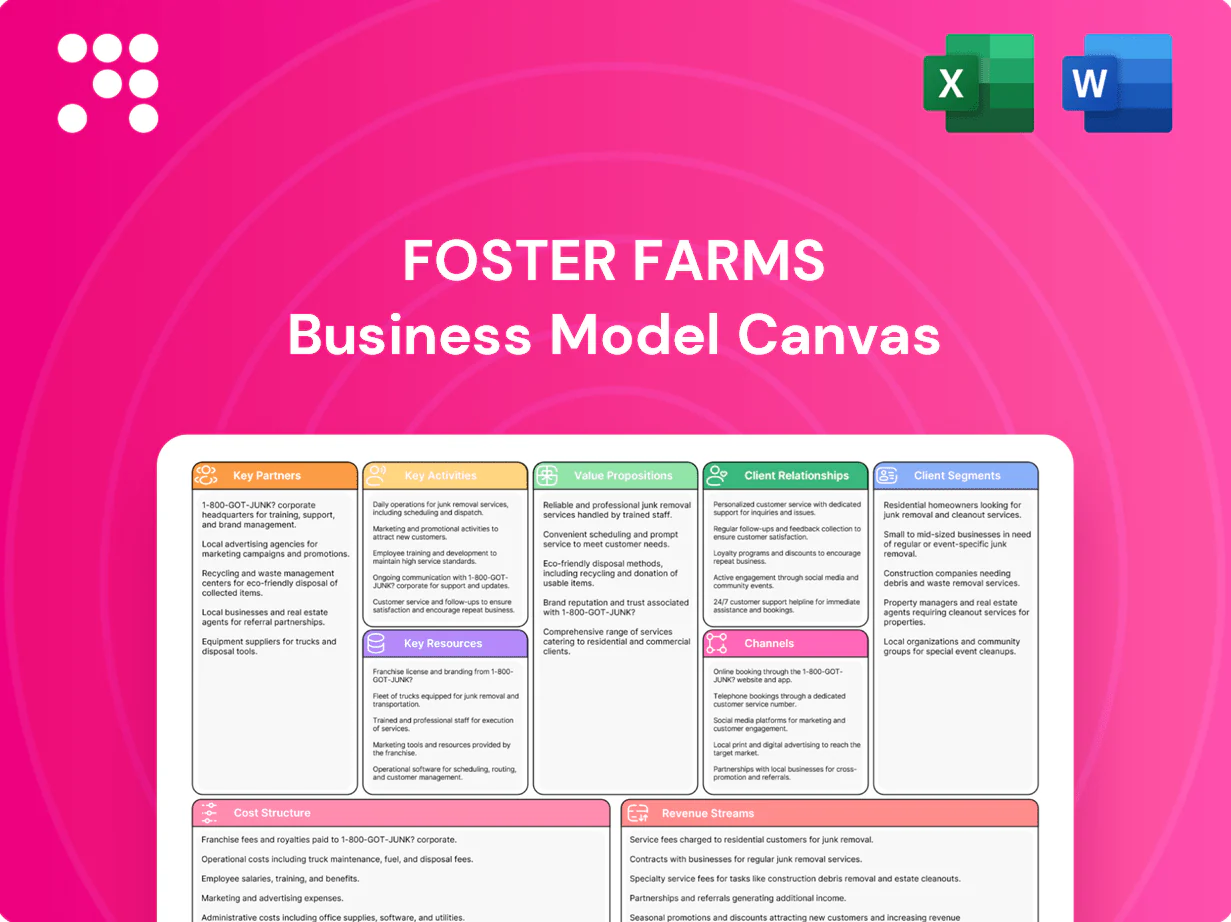
Foster Farms Business Model Canvas

Business Model Canvas: Strategic blueprint for poultry producer investors
Unlock the strategic blueprint behind Foster Farms with our Business Model Canvas. This concise snapshot explains customer segments, value propositions, channels, partnerships and revenue streams, plus key risks and growth opportunities. Ideal for investors, consultants, and founders—purchase the full downloadable Canvas for detailed, editable insights.
Partnerships

Feed and grain suppliers
Securing reliable corn and soy inputs stabilizes feed quality and cost, critical since feed represents roughly 60–70% of poultry production expenses. Long-term contracts and hedging reduce exposure to commodity swings—U.S. corn and soybean markets in 2024 saw notable volatility that raised risk premiums for processors. Collaboration on nutrient formulations improves feed conversion and bird health, while joint sustainability programs can verify responsible sourcing and meet retailer ESG requirements.
Breeding genetics companies
Partnering with breeding genetics firms gives Foster Farms access to high-performance broiler and turkey lines that reach ~2.5 kg in 35–42 days with FCRs around 1.5–1.8 (2024 benchmarks), boosting yield and livability. Co-developing breeding goals aligns carcass traits to market demand, healthier genetics can cut mortality by 1–2 percentage points and lower medication use, while data-sharing drives continuous yearly gains.

Cold chain and logistics providers
Regional refrigerated carriers and 3PLs secure on-time, temperature-controlled delivery for Foster Farms, reducing spoilage and compliance risk. These partnerships enable dynamic routing and backhaul efficiencies that cut empty miles and transportation cost per pound. Shared visibility platforms raise order tracking and fill rates through real-time ETAs and inventory sync. Capacity planning smooths holiday peaks—National Turkey Federation reported about 46 million turkeys consumed on Thanksgiving 2023.

Retailers, delis, and foodservice distributors
Joint business planning with retailers, delis and foodservice distributors secures shelf space and menu placements while aligned promotions drive volume and category growth; industry studies show coordinated promotions can lift category sales by double digits seasonally.
Vendor-managed inventory programs improve freshness and can cut waste by 10–20% and raise on-shelf availability above 95%, while rapid feedback loops from partners refine product specs and packaging formats to match retail and foodservice needs.
- Joint planning: shelf/menu placement
- Promotions: double-digit seasonal lifts
- VMI: waste down 10–20%, availability >95%
- Feedback: faster spec & packaging updates
Regulatory, certification, and animal welfare bodies
Working with USDA FSIS (which in 2024 employs roughly 9,000 inspection staff), state agencies, and accredited third-party auditors ensures continuous plant inspection and regulatory compliance. Certifications such as third-party welfare audits bolster consumer trust and validate safety claims. Ongoing training programs raise farm and plant standards, while transparent verification supports brand claims and retailer contracts.
- USDA FSIS continuous inspection (2024: ~9,000 inspectors)
- Accredited third-party audits: annual/quarterly verification
- Certifications increase retailer/consumer trust
- Continuous training elevates compliance and welfare
Feed 60–70%, FCR 1.5–1.8, VMI 10–20% waste, avail >95%
Partners secure feed (60–70% of cost), genetics (2.5 kg in 35–42 days; FCR 1.5–1.8), cold-chain/3PLs and retailers; VMI cuts waste 10–20% and raises availability >95%. USDA FSIS (~9,000 inspectors in 2024) and third-party audits ensure compliance. Promotions drive double-digit seasonal lifts (46M turkeys Thanksgiving 2023).
| Partner | Metric |
|---|---|
| Feed | 60–70% cost |
| Genetics | FCR 1.5–1.8 |
| VMI | Waste −10–20% |
| Reg | FSIS ≈9,000 |
What is included in the product
 Detailed Word Document
A concise, pre-written Business Model Canvas for Foster Farms detailing customer segments, channels, value propositions, key partners, activities, resources, cost structure, and revenue streams across the 9 classic blocks. Designed to reflect real-world poultry operations, competitive advantages, and linked SWOT analysis for presentations, financing, and strategic decision-making.

 Customizable Excel Spreadsheet
High-level snapshot of Foster Farms' business model with editable cells to quickly surface supply-chain, processing, and distribution pain points and streamline decisions on cost, capacity, and food safety. Perfect for team collaboration, rapid comparisons, and creating executive summaries without hours of formatting.
Activities

Hatchery and live production management
Managing breeder flocks, egg incubation and chick placement underpins supply with industry hatchability typically 80–85% and target broiler mortality under 3%; Foster Farms centralizes these operations for consistent throughput. Rigorous biosecurity and vaccination protocols reduce disease losses and protect flock health. Optimized feed, water and housing drive feed conversion ratios around 1.6–1.9, while continuous data capture across houses supports performance benchmarking.
Processing and further fabrication
Slaughter, debone, cut-up and portioning convert live birds into market-ready SKUs—fresh cuts, value-added parts and prepared meal components—feeding retail and foodservice channels.
Automation and rigorous QA systems reduce defects and improve yields while enabling higher throughput for per-shift processing lines.
Further processing produces marinated, breaded and fully cooked items tailored to private-label and branded programs.
HACCP controls (established USDA policy since 1996) and FSIS microbiological testing programs safeguard product safety and regulatory compliance.

Cold chain management
Chilling (≤40°F / 4°C), freezing (−18°C / 0°F) and controlled storage preserve Foster Farms product integrity across the supply chain. Strict inventory rotation and date-control programs cut shrink tied to spoilage in an industry where EPA/USDA estimate roughly 30–40% of food supply is wasted. Load planning maximizes cube utilization and service levels, while continuous temperature monitoring ensures compliance from plant to customer.

Quality assurance and food safety
Robust SOPs, 24/7 CCP monitoring and verification limit operational and food-safety risk while supporting regulatory compliance; environmental testing programs target Listeria and Salmonella hotspots to prevent cross-contamination. Supplier approval and full traceability enable rapid recalls and batch isolation, often within 48 hours in industry best-practice systems. Continuous improvement programs drive higher audit scores and corrective actions.
- Robust SOPs
- 24/7 CCP monitoring
- Supplier approval + traceability (recall readiness)
- Environmental testing & continuous improvement
Sales, category management, and demand planning
Negotiating retailer and distributor programs secures volume and supports Foster Farms’ ~$3B 2024 sales, while category insights from POS and IRI guide assortment and pricing to lift sell-through by ~8%. Collaborative forecasting with key partners synchronizes supply and demand, cutting out-of-stocks up to 30%. Focused trade execution improves promotional ROI, typically raising incremental sales by ~40%.
- Programs: retailer/distributor deals → volume, revenue ≈ $3B (2024)
- Insights: POS/IRI → +8% sell-through
- Forecasting: −30% OOS
- Trade execution: +40% promo uplift
Integrated chain drives $3B, 80–85% hatch, FCR 1.6–1.9
Integrated breeding-to-retail operations deliver consistent throughput (hatchability 80–85%, broiler mortality <3%) while optimized feed/housing yields FCR ~1.6–1.9. High-throughput processing and further-processing supply fresh, value-added and branded SKUs. Rigorous HACCP/FSIS QA, 24/7 CCPs and traceability enable rapid recalls; commercial programs drive ~$3B 2024 sales and improved sell-through.
| Metric | Value (2024) |
|---|---|
| Sales | $3B |
| Hatchability | 80–85% |
| Broiler mortality | <3% |
| FCR | 1.6–1.9 |
| Promo uplift | +40% |
| OOS reduction | −30% |
| Sell-through lift | +8% |
What You See Is What You Get
Business Model Canvas
The Business Model Canvas for Foster Farms shown here is the exact section from the final deliverable, not a mockup or sample. When you purchase, you’ll receive this same complete, editable document ready for use. The file is delivered in the same professional format as previewed.

Business Model Canvas: Strategic blueprint for poultry producer investors
Unlock the strategic blueprint behind Foster Farms with our Business Model Canvas. This concise snapshot explains customer segments, value propositions, channels, partnerships and revenue streams, plus key risks and growth opportunities. Ideal for investors, consultants, and founders—purchase the full downloadable Canvas for detailed, editable insights.
Partnerships
Feed and grain suppliers
Securing reliable corn and soy inputs stabilizes feed quality and cost, critical since feed represents roughly 60–70% of poultry production expenses. Long-term contracts and hedging reduce exposure to commodity swings—U.S. corn and soybean markets in 2024 saw notable volatility that raised risk premiums for processors. Collaboration on nutrient formulations improves feed conversion and bird health, while joint sustainability programs can verify responsible sourcing and meet retailer ESG requirements.
Breeding genetics companies
Partnering with breeding genetics firms gives Foster Farms access to high-performance broiler and turkey lines that reach ~2.5 kg in 35–42 days with FCRs around 1.5–1.8 (2024 benchmarks), boosting yield and livability. Co-developing breeding goals aligns carcass traits to market demand, healthier genetics can cut mortality by 1–2 percentage points and lower medication use, while data-sharing drives continuous yearly gains.
Cold chain and logistics providers
Regional refrigerated carriers and 3PLs secure on-time, temperature-controlled delivery for Foster Farms, reducing spoilage and compliance risk. These partnerships enable dynamic routing and backhaul efficiencies that cut empty miles and transportation cost per pound. Shared visibility platforms raise order tracking and fill rates through real-time ETAs and inventory sync. Capacity planning smooths holiday peaks—National Turkey Federation reported about 46 million turkeys consumed on Thanksgiving 2023.
Retailers, delis, and foodservice distributors
Joint business planning with retailers, delis and foodservice distributors secures shelf space and menu placements while aligned promotions drive volume and category growth; industry studies show coordinated promotions can lift category sales by double digits seasonally.
Vendor-managed inventory programs improve freshness and can cut waste by 10–20% and raise on-shelf availability above 95%, while rapid feedback loops from partners refine product specs and packaging formats to match retail and foodservice needs.
- Joint planning: shelf/menu placement
- Promotions: double-digit seasonal lifts
- VMI: waste down 10–20%, availability >95%
- Feedback: faster spec & packaging updates
Regulatory, certification, and animal welfare bodies
Working with USDA FSIS (which in 2024 employs roughly 9,000 inspection staff), state agencies, and accredited third-party auditors ensures continuous plant inspection and regulatory compliance. Certifications such as third-party welfare audits bolster consumer trust and validate safety claims. Ongoing training programs raise farm and plant standards, while transparent verification supports brand claims and retailer contracts.
- USDA FSIS continuous inspection (2024: ~9,000 inspectors)
- Accredited third-party audits: annual/quarterly verification
- Certifications increase retailer/consumer trust
- Continuous training elevates compliance and welfare
Feed 60–70%, FCR 1.5–1.8, VMI 10–20% waste, avail >95%
Partners secure feed (60–70% of cost), genetics (2.5 kg in 35–42 days; FCR 1.5–1.8), cold-chain/3PLs and retailers; VMI cuts waste 10–20% and raises availability >95%. USDA FSIS (~9,000 inspectors in 2024) and third-party audits ensure compliance. Promotions drive double-digit seasonal lifts (46M turkeys Thanksgiving 2023).
| Partner | Metric |
|---|---|
| Feed | 60–70% cost |
| Genetics | FCR 1.5–1.8 |
| VMI | Waste −10–20% |
| Reg | FSIS ≈9,000 |
What is included in the product
Detailed Word Document
A concise, pre-written Business Model Canvas for Foster Farms detailing customer segments, channels, value propositions, key partners, activities, resources, cost structure, and revenue streams across the 9 classic blocks. Designed to reflect real-world poultry operations, competitive advantages, and linked SWOT analysis for presentations, financing, and strategic decision-making.
Customizable Excel Spreadsheet
High-level snapshot of Foster Farms' business model with editable cells to quickly surface supply-chain, processing, and distribution pain points and streamline decisions on cost, capacity, and food safety. Perfect for team collaboration, rapid comparisons, and creating executive summaries without hours of formatting.
Activities
Hatchery and live production management
Managing breeder flocks, egg incubation and chick placement underpins supply with industry hatchability typically 80–85% and target broiler mortality under 3%; Foster Farms centralizes these operations for consistent throughput. Rigorous biosecurity and vaccination protocols reduce disease losses and protect flock health. Optimized feed, water and housing drive feed conversion ratios around 1.6–1.9, while continuous data capture across houses supports performance benchmarking.
Processing and further fabrication
Slaughter, debone, cut-up and portioning convert live birds into market-ready SKUs—fresh cuts, value-added parts and prepared meal components—feeding retail and foodservice channels.
Automation and rigorous QA systems reduce defects and improve yields while enabling higher throughput for per-shift processing lines.
Further processing produces marinated, breaded and fully cooked items tailored to private-label and branded programs.
HACCP controls (established USDA policy since 1996) and FSIS microbiological testing programs safeguard product safety and regulatory compliance.
Cold chain management
Chilling (≤40°F / 4°C), freezing (−18°C / 0°F) and controlled storage preserve Foster Farms product integrity across the supply chain. Strict inventory rotation and date-control programs cut shrink tied to spoilage in an industry where EPA/USDA estimate roughly 30–40% of food supply is wasted. Load planning maximizes cube utilization and service levels, while continuous temperature monitoring ensures compliance from plant to customer.
Quality assurance and food safety
Robust SOPs, 24/7 CCP monitoring and verification limit operational and food-safety risk while supporting regulatory compliance; environmental testing programs target Listeria and Salmonella hotspots to prevent cross-contamination. Supplier approval and full traceability enable rapid recalls and batch isolation, often within 48 hours in industry best-practice systems. Continuous improvement programs drive higher audit scores and corrective actions.
- Robust SOPs
- 24/7 CCP monitoring
- Supplier approval + traceability (recall readiness)
- Environmental testing & continuous improvement
Sales, category management, and demand planning
Negotiating retailer and distributor programs secures volume and supports Foster Farms’ ~$3B 2024 sales, while category insights from POS and IRI guide assortment and pricing to lift sell-through by ~8%. Collaborative forecasting with key partners synchronizes supply and demand, cutting out-of-stocks up to 30%. Focused trade execution improves promotional ROI, typically raising incremental sales by ~40%.
- Programs: retailer/distributor deals → volume, revenue ≈ $3B (2024)
- Insights: POS/IRI → +8% sell-through
- Forecasting: −30% OOS
- Trade execution: +40% promo uplift
Integrated chain drives $3B, 80–85% hatch, FCR 1.6–1.9
Integrated breeding-to-retail operations deliver consistent throughput (hatchability 80–85%, broiler mortality <3%) while optimized feed/housing yields FCR ~1.6–1.9. High-throughput processing and further-processing supply fresh, value-added and branded SKUs. Rigorous HACCP/FSIS QA, 24/7 CCPs and traceability enable rapid recalls; commercial programs drive ~$3B 2024 sales and improved sell-through.
| Metric | Value (2024) |
|---|---|
| Sales | $3B |
| Hatchability | 80–85% |
| Broiler mortality | <3% |
| FCR | 1.6–1.9 |
| Promo uplift | +40% |
| OOS reduction | −30% |
| Sell-through lift | +8% |
What You See Is What You Get
Business Model Canvas
The Business Model Canvas for Foster Farms shown here is the exact section from the final deliverable, not a mockup or sample. When you purchase, you’ll receive this same complete, editable document ready for use. The file is delivered in the same professional format as previewed.
Original: $10.00
-65%$10.00
$3.50Description
Business Model Canvas: Strategic blueprint for poultry producer investors
Unlock the strategic blueprint behind Foster Farms with our Business Model Canvas. This concise snapshot explains customer segments, value propositions, channels, partnerships and revenue streams, plus key risks and growth opportunities. Ideal for investors, consultants, and founders—purchase the full downloadable Canvas for detailed, editable insights.
Partnerships
Feed and grain suppliers
Securing reliable corn and soy inputs stabilizes feed quality and cost, critical since feed represents roughly 60–70% of poultry production expenses. Long-term contracts and hedging reduce exposure to commodity swings—U.S. corn and soybean markets in 2024 saw notable volatility that raised risk premiums for processors. Collaboration on nutrient formulations improves feed conversion and bird health, while joint sustainability programs can verify responsible sourcing and meet retailer ESG requirements.
Breeding genetics companies
Partnering with breeding genetics firms gives Foster Farms access to high-performance broiler and turkey lines that reach ~2.5 kg in 35–42 days with FCRs around 1.5–1.8 (2024 benchmarks), boosting yield and livability. Co-developing breeding goals aligns carcass traits to market demand, healthier genetics can cut mortality by 1–2 percentage points and lower medication use, while data-sharing drives continuous yearly gains.
Cold chain and logistics providers
Regional refrigerated carriers and 3PLs secure on-time, temperature-controlled delivery for Foster Farms, reducing spoilage and compliance risk. These partnerships enable dynamic routing and backhaul efficiencies that cut empty miles and transportation cost per pound. Shared visibility platforms raise order tracking and fill rates through real-time ETAs and inventory sync. Capacity planning smooths holiday peaks—National Turkey Federation reported about 46 million turkeys consumed on Thanksgiving 2023.
Retailers, delis, and foodservice distributors
Joint business planning with retailers, delis and foodservice distributors secures shelf space and menu placements while aligned promotions drive volume and category growth; industry studies show coordinated promotions can lift category sales by double digits seasonally.
Vendor-managed inventory programs improve freshness and can cut waste by 10–20% and raise on-shelf availability above 95%, while rapid feedback loops from partners refine product specs and packaging formats to match retail and foodservice needs.
- Joint planning: shelf/menu placement
- Promotions: double-digit seasonal lifts
- VMI: waste down 10–20%, availability >95%
- Feedback: faster spec & packaging updates
Regulatory, certification, and animal welfare bodies
Working with USDA FSIS (which in 2024 employs roughly 9,000 inspection staff), state agencies, and accredited third-party auditors ensures continuous plant inspection and regulatory compliance. Certifications such as third-party welfare audits bolster consumer trust and validate safety claims. Ongoing training programs raise farm and plant standards, while transparent verification supports brand claims and retailer contracts.
- USDA FSIS continuous inspection (2024: ~9,000 inspectors)
- Accredited third-party audits: annual/quarterly verification
- Certifications increase retailer/consumer trust
- Continuous training elevates compliance and welfare
Feed 60–70%, FCR 1.5–1.8, VMI 10–20% waste, avail >95%
Partners secure feed (60–70% of cost), genetics (2.5 kg in 35–42 days; FCR 1.5–1.8), cold-chain/3PLs and retailers; VMI cuts waste 10–20% and raises availability >95%. USDA FSIS (~9,000 inspectors in 2024) and third-party audits ensure compliance. Promotions drive double-digit seasonal lifts (46M turkeys Thanksgiving 2023).
| Partner | Metric |
|---|---|
| Feed | 60–70% cost |
| Genetics | FCR 1.5–1.8 |
| VMI | Waste −10–20% |
| Reg | FSIS ≈9,000 |
What is included in the product
Detailed Word Document
A concise, pre-written Business Model Canvas for Foster Farms detailing customer segments, channels, value propositions, key partners, activities, resources, cost structure, and revenue streams across the 9 classic blocks. Designed to reflect real-world poultry operations, competitive advantages, and linked SWOT analysis for presentations, financing, and strategic decision-making.
Customizable Excel Spreadsheet
High-level snapshot of Foster Farms' business model with editable cells to quickly surface supply-chain, processing, and distribution pain points and streamline decisions on cost, capacity, and food safety. Perfect for team collaboration, rapid comparisons, and creating executive summaries without hours of formatting.
Activities
Hatchery and live production management
Managing breeder flocks, egg incubation and chick placement underpins supply with industry hatchability typically 80–85% and target broiler mortality under 3%; Foster Farms centralizes these operations for consistent throughput. Rigorous biosecurity and vaccination protocols reduce disease losses and protect flock health. Optimized feed, water and housing drive feed conversion ratios around 1.6–1.9, while continuous data capture across houses supports performance benchmarking.
Processing and further fabrication
Slaughter, debone, cut-up and portioning convert live birds into market-ready SKUs—fresh cuts, value-added parts and prepared meal components—feeding retail and foodservice channels.
Automation and rigorous QA systems reduce defects and improve yields while enabling higher throughput for per-shift processing lines.
Further processing produces marinated, breaded and fully cooked items tailored to private-label and branded programs.
HACCP controls (established USDA policy since 1996) and FSIS microbiological testing programs safeguard product safety and regulatory compliance.
Cold chain management
Chilling (≤40°F / 4°C), freezing (−18°C / 0°F) and controlled storage preserve Foster Farms product integrity across the supply chain. Strict inventory rotation and date-control programs cut shrink tied to spoilage in an industry where EPA/USDA estimate roughly 30–40% of food supply is wasted. Load planning maximizes cube utilization and service levels, while continuous temperature monitoring ensures compliance from plant to customer.
Quality assurance and food safety
Robust SOPs, 24/7 CCP monitoring and verification limit operational and food-safety risk while supporting regulatory compliance; environmental testing programs target Listeria and Salmonella hotspots to prevent cross-contamination. Supplier approval and full traceability enable rapid recalls and batch isolation, often within 48 hours in industry best-practice systems. Continuous improvement programs drive higher audit scores and corrective actions.
- Robust SOPs
- 24/7 CCP monitoring
- Supplier approval + traceability (recall readiness)
- Environmental testing & continuous improvement
Sales, category management, and demand planning
Negotiating retailer and distributor programs secures volume and supports Foster Farms’ ~$3B 2024 sales, while category insights from POS and IRI guide assortment and pricing to lift sell-through by ~8%. Collaborative forecasting with key partners synchronizes supply and demand, cutting out-of-stocks up to 30%. Focused trade execution improves promotional ROI, typically raising incremental sales by ~40%.
- Programs: retailer/distributor deals → volume, revenue ≈ $3B (2024)
- Insights: POS/IRI → +8% sell-through
- Forecasting: −30% OOS
- Trade execution: +40% promo uplift
Integrated chain drives $3B, 80–85% hatch, FCR 1.6–1.9
Integrated breeding-to-retail operations deliver consistent throughput (hatchability 80–85%, broiler mortality <3%) while optimized feed/housing yields FCR ~1.6–1.9. High-throughput processing and further-processing supply fresh, value-added and branded SKUs. Rigorous HACCP/FSIS QA, 24/7 CCPs and traceability enable rapid recalls; commercial programs drive ~$3B 2024 sales and improved sell-through.
| Metric | Value (2024) |
|---|---|
| Sales | $3B |
| Hatchability | 80–85% |
| Broiler mortality | <3% |
| FCR | 1.6–1.9 |
| Promo uplift | +40% |
| OOS reduction | −30% |
| Sell-through lift | +8% |
What You See Is What You Get
Business Model Canvas
The Business Model Canvas for Foster Farms shown here is the exact section from the final deliverable, not a mockup or sample. When you purchase, you’ll receive this same complete, editable document ready for use. The file is delivered in the same professional format as previewed.











