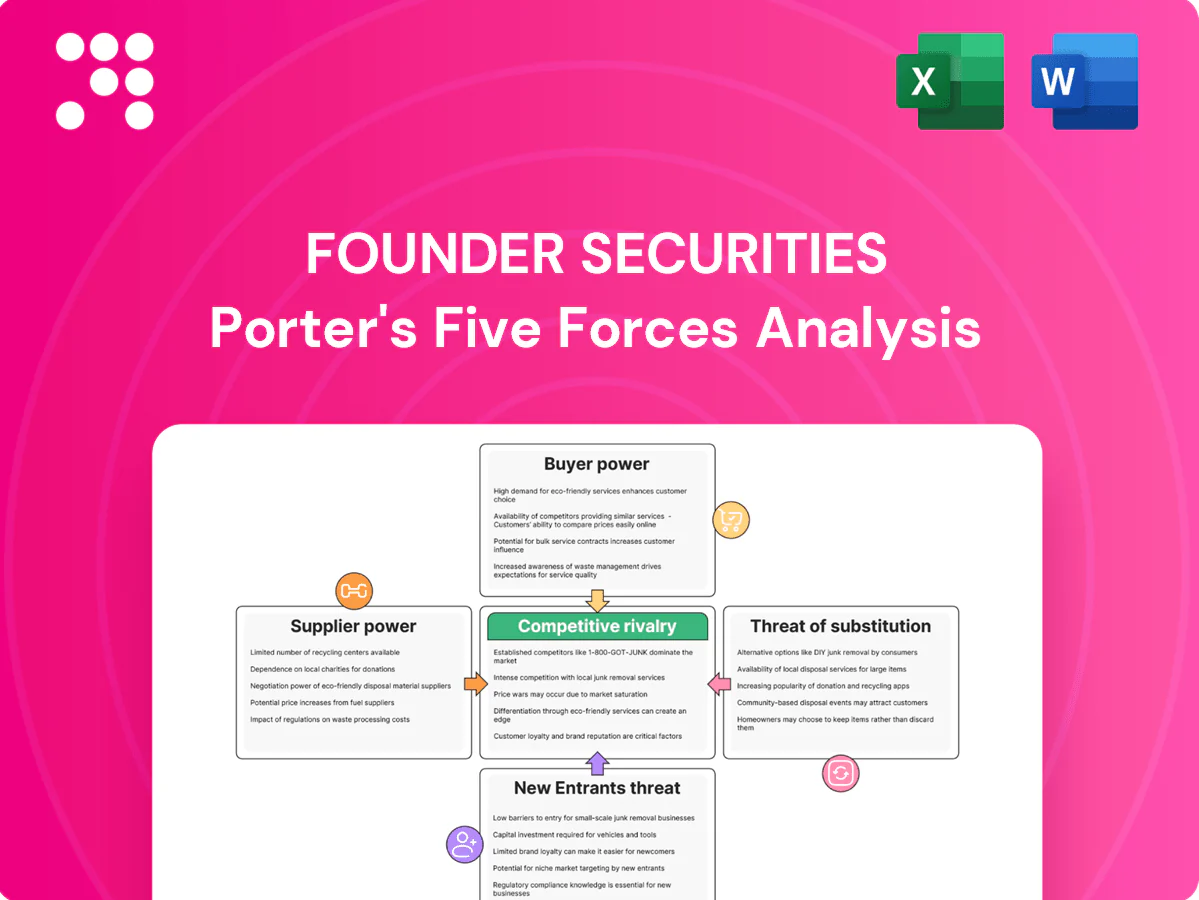
Founder Securities Porter's Five Forces Analysis

From Overview to Strategy Blueprint
This brief snapshot outlines Founder Securities’s competitive dynamics—supplier influence, buyer power, substitute threats and entry barriers—and signals where strategic pressure is highest. Unlock the full Porter’s Five Forces Analysis for force-by-force ratings, visuals and actionable recommendations to inform investment or strategy decisions.
Suppliers Bargaining Power

Exchange and clearing dependency
Founder Securities depends on Shanghai and Shenzhen exchanges and the China Securities Depository and Clearing Corporation for market access, trading and settlement; these venues govern fee schedules, halts and listing rules. Stamp duty on share sales remains 0.1%, and mainland markets host around 5,000 A-share listings in 2024, concentrating supplier influence. Changes in exchange technology or pricing flow directly into Founder’s costs and service quality, with state oversight limiting but not eliminating supplier power.
Technology and data vendors
Core trading systems, market data, risk engines and cybersecurity tools are concentrated among a handful of global vendors (Bloomberg, Refinitiv, ION, MSCI, Numerix, Palo Alto), with the top 3 market-data providers covering roughly 70% of real-time feeds; Bloomberg reported ~11–12bn USD revenue in 2023. Integration and certification typically take 6–18 months, making switching costly and giving suppliers strong leverage despite volume discounts; global cybersecurity spend reached ~220bn USD in 2024, reinforcing vendor power.

Wholesale funding sources
Repo counterparties, interbank lenders and prime brokers supply margin financing and market-making liquidity; with the federal funds target at 5.25–5.50% in 2024 funding costs remained elevated. In volatility haircuts widen and funding costs rise, tightening economics and amplifying rate sensitivity for short-term-funded firms. Diversified counterparties and pledged collateral mitigate but do not eliminate supplier power.

Licensed talent pipeline
Star bankers, traders, quants and analysts remain scarce in China’s securities labor market; 2024 market reports show top performers often command retention guarantees and pay premiums well above median compensation, raising input costs. Non-compete clauses and licensing delays (commonly 3–12 months) slow replacement, reinforcing supplier power, while culture and equity incentives partially offset bargaining asymmetry.
- Scarcity: high demand, low supply
- Premiums: retention guarantees and outsized pay
- Frictions: non-competes, licensing delays
- Mitigants: culture alignment, equity incentives
Ecosystem partners
Supplier concentration squeezes brokers: market data, exchanges, funding and talent pressure margins
Founder Securities faces concentrated supplier power: exchanges and CSDC set fees and rules; top 3 market-data vendors supply ~70% of real-time feeds; repo/prime funding costs rose with policy rates at 5.25–5.50% in 2024. Talent scarcity lifts pay and retention guarantees; index licensors and custodians capture outsized pricing leverage.
| Supplier | Concentration | 2024 metric |
|---|---|---|
| Market data | Top 3 ~70% | Bloomberg rev ≈ $11–12bn (2023) |
| Exchanges/CSDC | High | ~5,000 A‑share listings (2024) |
| Funding | Fragmented | Policy rate 5.25–5.50% (2024) |
What is included in the product
 Detailed Word Document
Provides a tailored Porter's Five Forces assessment of Founder Securities, uncovering competitive pressures, buyer and supplier power, threat of substitutes and new entrants, and intensity of rivalry; highlights disruptive threats and strategic levers to defend market share, pricing, and long-term profitability.

 Customizable Excel Spreadsheet
A concise one-sheet Founder Securities Porter's Five Forces summary with editable pressure sliders and an instant spider chart—diagnose competitive threats, run pre/post-regulation or new-entrant scenarios, and export clean visuals for decks without any complex code.
Customers Bargaining Power

Price-sensitive retail traders
In 2024 Chinese retail clients remain highly fee-sensitive with low switching costs across mobile broker apps, driving frequent app churn and price comparisons.
Industry-wide commission compression has narrowed pricing discretion as rivals amplify zero-commission promotions and cashback offers, increasing buyer power.
Meaningful differentiation for Founder Securities must come from superior UX, proprietary research, and broader product breadth rather than price alone.
Institutional mandate leverage
Funds, insurers and proprietary desks demand bespoke execution, research and capital solutions, with institutional clients—responsible for roughly 70% of equity trading volume in 2024—securing superior pricing and SLAs due to larger ticket sizes and block trades often exceeding $1m. Multi-broker setups let them shift flow quickly, while performance-linked fees and collateral support arrangements (CSA) further amplify their bargaining leverage.

Corporate issuers in IB
Corporate issuers in IB can shop underwriting, advisory and bond deals among dozens of brokers and global entrants, increasing buyer leverage. League-table pressure drives fee concessions and balance-sheet usage as banks chase rankings and mandates. Repeat mandates hinge on execution certainty and distribution reach, not just price. Competitive bake-offs keep spreads tight, amplifying issuer bargaining power.

Wealth clients seeking yield
Wealth clients, from HNWI to mass affluent, increasingly compare products across banks, AMCs and fintechs, pressuring price and product differentiation; global AUM exceeded $120 trillion in 2024, intensifying platform competition.
Demand for principal‑protected or higher‑yield solutions squeezes distributor margins as yield costs rise, while fee‑transparency tools make pricing more salient.
Relationship managers must bundle advisory, tax and digital services to retain share and counter switching.
- Comparison across channels
- Principal‑protected demand → margin squeeze
- Fee transparency → pricing pressure
- RMs must bundle services
Digital channel comparability
App-store ratings, social media and comparison portals make service quality and pricing transparent to 4.9 billion smartphone users in 2024, amplifying public feedback and accelerating switching. Frictionless onboarding and transfer processes reduce lock-in as account moves and KYC can be completed in minutes, raising buyer expectations. Loyalty must be earned through continuous feature upgrades and service reliability.
- Visible feedback channels: app ratings, reviews, social mentions
- Lower switching cost: faster onboarding and transfers
- Raised expectations: continuous product updates required
Retail churn rises; institutions capture ~70% equity volume as AUM hits $120tn
In 2024 Chinese retail clients remain fee-sensitive with low switching costs across apps, driving churn and price comparison. Institutional clients (~70% of equity trading volume in 2024) secure better pricing on >$1m blocks, amplifying buyer power. Wealth trends (global AUM $120tn; 4.9bn smartphone users) heighten transparency and margin pressure on distributors.
| Category | 2024 metric | Impact |
|---|---|---|
| Institutional share | ~70% equity volume | Pricing leverage |
| Global AUM | $120tn | Platform competition |
| Smartphone users | 4.9bn | Transparency/switching |
Preview Before You Purchase
Founder Securities Porter's Five Forces Analysis
This preview shows the exact Founder Securities Porter’s Five Forces Analysis you'll receive immediately after purchase—no placeholders or samples. The document is fully formatted, complete and ready for download and use upon payment. No mockups; this is the final, professionally written deliverable you’ll get instantly.

From Overview to Strategy Blueprint
This brief snapshot outlines Founder Securities’s competitive dynamics—supplier influence, buyer power, substitute threats and entry barriers—and signals where strategic pressure is highest. Unlock the full Porter’s Five Forces Analysis for force-by-force ratings, visuals and actionable recommendations to inform investment or strategy decisions.
Suppliers Bargaining Power
Exchange and clearing dependency
Founder Securities depends on Shanghai and Shenzhen exchanges and the China Securities Depository and Clearing Corporation for market access, trading and settlement; these venues govern fee schedules, halts and listing rules. Stamp duty on share sales remains 0.1%, and mainland markets host around 5,000 A-share listings in 2024, concentrating supplier influence. Changes in exchange technology or pricing flow directly into Founder’s costs and service quality, with state oversight limiting but not eliminating supplier power.
Technology and data vendors
Core trading systems, market data, risk engines and cybersecurity tools are concentrated among a handful of global vendors (Bloomberg, Refinitiv, ION, MSCI, Numerix, Palo Alto), with the top 3 market-data providers covering roughly 70% of real-time feeds; Bloomberg reported ~11–12bn USD revenue in 2023. Integration and certification typically take 6–18 months, making switching costly and giving suppliers strong leverage despite volume discounts; global cybersecurity spend reached ~220bn USD in 2024, reinforcing vendor power.
Wholesale funding sources
Repo counterparties, interbank lenders and prime brokers supply margin financing and market-making liquidity; with the federal funds target at 5.25–5.50% in 2024 funding costs remained elevated. In volatility haircuts widen and funding costs rise, tightening economics and amplifying rate sensitivity for short-term-funded firms. Diversified counterparties and pledged collateral mitigate but do not eliminate supplier power.
Licensed talent pipeline
Star bankers, traders, quants and analysts remain scarce in China’s securities labor market; 2024 market reports show top performers often command retention guarantees and pay premiums well above median compensation, raising input costs. Non-compete clauses and licensing delays (commonly 3–12 months) slow replacement, reinforcing supplier power, while culture and equity incentives partially offset bargaining asymmetry.
- Scarcity: high demand, low supply
- Premiums: retention guarantees and outsized pay
- Frictions: non-competes, licensing delays
- Mitigants: culture alignment, equity incentives
Ecosystem partners
Supplier concentration squeezes brokers: market data, exchanges, funding and talent pressure margins
Founder Securities faces concentrated supplier power: exchanges and CSDC set fees and rules; top 3 market-data vendors supply ~70% of real-time feeds; repo/prime funding costs rose with policy rates at 5.25–5.50% in 2024. Talent scarcity lifts pay and retention guarantees; index licensors and custodians capture outsized pricing leverage.
| Supplier | Concentration | 2024 metric |
|---|---|---|
| Market data | Top 3 ~70% | Bloomberg rev ≈ $11–12bn (2023) |
| Exchanges/CSDC | High | ~5,000 A‑share listings (2024) |
| Funding | Fragmented | Policy rate 5.25–5.50% (2024) |
What is included in the product
Detailed Word Document
Provides a tailored Porter's Five Forces assessment of Founder Securities, uncovering competitive pressures, buyer and supplier power, threat of substitutes and new entrants, and intensity of rivalry; highlights disruptive threats and strategic levers to defend market share, pricing, and long-term profitability.
Customizable Excel Spreadsheet
A concise one-sheet Founder Securities Porter's Five Forces summary with editable pressure sliders and an instant spider chart—diagnose competitive threats, run pre/post-regulation or new-entrant scenarios, and export clean visuals for decks without any complex code.
Customers Bargaining Power
Price-sensitive retail traders
In 2024 Chinese retail clients remain highly fee-sensitive with low switching costs across mobile broker apps, driving frequent app churn and price comparisons.
Industry-wide commission compression has narrowed pricing discretion as rivals amplify zero-commission promotions and cashback offers, increasing buyer power.
Meaningful differentiation for Founder Securities must come from superior UX, proprietary research, and broader product breadth rather than price alone.
Institutional mandate leverage
Funds, insurers and proprietary desks demand bespoke execution, research and capital solutions, with institutional clients—responsible for roughly 70% of equity trading volume in 2024—securing superior pricing and SLAs due to larger ticket sizes and block trades often exceeding $1m. Multi-broker setups let them shift flow quickly, while performance-linked fees and collateral support arrangements (CSA) further amplify their bargaining leverage.
Corporate issuers in IB
Corporate issuers in IB can shop underwriting, advisory and bond deals among dozens of brokers and global entrants, increasing buyer leverage. League-table pressure drives fee concessions and balance-sheet usage as banks chase rankings and mandates. Repeat mandates hinge on execution certainty and distribution reach, not just price. Competitive bake-offs keep spreads tight, amplifying issuer bargaining power.
Wealth clients seeking yield
Wealth clients, from HNWI to mass affluent, increasingly compare products across banks, AMCs and fintechs, pressuring price and product differentiation; global AUM exceeded $120 trillion in 2024, intensifying platform competition.
Demand for principal‑protected or higher‑yield solutions squeezes distributor margins as yield costs rise, while fee‑transparency tools make pricing more salient.
Relationship managers must bundle advisory, tax and digital services to retain share and counter switching.
- Comparison across channels
- Principal‑protected demand → margin squeeze
- Fee transparency → pricing pressure
- RMs must bundle services
Digital channel comparability
App-store ratings, social media and comparison portals make service quality and pricing transparent to 4.9 billion smartphone users in 2024, amplifying public feedback and accelerating switching. Frictionless onboarding and transfer processes reduce lock-in as account moves and KYC can be completed in minutes, raising buyer expectations. Loyalty must be earned through continuous feature upgrades and service reliability.
- Visible feedback channels: app ratings, reviews, social mentions
- Lower switching cost: faster onboarding and transfers
- Raised expectations: continuous product updates required
Retail churn rises; institutions capture ~70% equity volume as AUM hits $120tn
In 2024 Chinese retail clients remain fee-sensitive with low switching costs across apps, driving churn and price comparison. Institutional clients (~70% of equity trading volume in 2024) secure better pricing on >$1m blocks, amplifying buyer power. Wealth trends (global AUM $120tn; 4.9bn smartphone users) heighten transparency and margin pressure on distributors.
| Category | 2024 metric | Impact |
|---|---|---|
| Institutional share | ~70% equity volume | Pricing leverage |
| Global AUM | $120tn | Platform competition |
| Smartphone users | 4.9bn | Transparency/switching |
Preview Before You Purchase
Founder Securities Porter's Five Forces Analysis
This preview shows the exact Founder Securities Porter’s Five Forces Analysis you'll receive immediately after purchase—no placeholders or samples. The document is fully formatted, complete and ready for download and use upon payment. No mockups; this is the final, professionally written deliverable you’ll get instantly.
Description
From Overview to Strategy Blueprint
This brief snapshot outlines Founder Securities’s competitive dynamics—supplier influence, buyer power, substitute threats and entry barriers—and signals where strategic pressure is highest. Unlock the full Porter’s Five Forces Analysis for force-by-force ratings, visuals and actionable recommendations to inform investment or strategy decisions.
Suppliers Bargaining Power
Exchange and clearing dependency
Founder Securities depends on Shanghai and Shenzhen exchanges and the China Securities Depository and Clearing Corporation for market access, trading and settlement; these venues govern fee schedules, halts and listing rules. Stamp duty on share sales remains 0.1%, and mainland markets host around 5,000 A-share listings in 2024, concentrating supplier influence. Changes in exchange technology or pricing flow directly into Founder’s costs and service quality, with state oversight limiting but not eliminating supplier power.
Technology and data vendors
Core trading systems, market data, risk engines and cybersecurity tools are concentrated among a handful of global vendors (Bloomberg, Refinitiv, ION, MSCI, Numerix, Palo Alto), with the top 3 market-data providers covering roughly 70% of real-time feeds; Bloomberg reported ~11–12bn USD revenue in 2023. Integration and certification typically take 6–18 months, making switching costly and giving suppliers strong leverage despite volume discounts; global cybersecurity spend reached ~220bn USD in 2024, reinforcing vendor power.
Wholesale funding sources
Repo counterparties, interbank lenders and prime brokers supply margin financing and market-making liquidity; with the federal funds target at 5.25–5.50% in 2024 funding costs remained elevated. In volatility haircuts widen and funding costs rise, tightening economics and amplifying rate sensitivity for short-term-funded firms. Diversified counterparties and pledged collateral mitigate but do not eliminate supplier power.
Licensed talent pipeline
Star bankers, traders, quants and analysts remain scarce in China’s securities labor market; 2024 market reports show top performers often command retention guarantees and pay premiums well above median compensation, raising input costs. Non-compete clauses and licensing delays (commonly 3–12 months) slow replacement, reinforcing supplier power, while culture and equity incentives partially offset bargaining asymmetry.
- Scarcity: high demand, low supply
- Premiums: retention guarantees and outsized pay
- Frictions: non-competes, licensing delays
- Mitigants: culture alignment, equity incentives
Ecosystem partners
Supplier concentration squeezes brokers: market data, exchanges, funding and talent pressure margins
Founder Securities faces concentrated supplier power: exchanges and CSDC set fees and rules; top 3 market-data vendors supply ~70% of real-time feeds; repo/prime funding costs rose with policy rates at 5.25–5.50% in 2024. Talent scarcity lifts pay and retention guarantees; index licensors and custodians capture outsized pricing leverage.
| Supplier | Concentration | 2024 metric |
|---|---|---|
| Market data | Top 3 ~70% | Bloomberg rev ≈ $11–12bn (2023) |
| Exchanges/CSDC | High | ~5,000 A‑share listings (2024) |
| Funding | Fragmented | Policy rate 5.25–5.50% (2024) |
What is included in the product
Detailed Word Document
Provides a tailored Porter's Five Forces assessment of Founder Securities, uncovering competitive pressures, buyer and supplier power, threat of substitutes and new entrants, and intensity of rivalry; highlights disruptive threats and strategic levers to defend market share, pricing, and long-term profitability.
Customizable Excel Spreadsheet
A concise one-sheet Founder Securities Porter's Five Forces summary with editable pressure sliders and an instant spider chart—diagnose competitive threats, run pre/post-regulation or new-entrant scenarios, and export clean visuals for decks without any complex code.
Customers Bargaining Power
Price-sensitive retail traders
In 2024 Chinese retail clients remain highly fee-sensitive with low switching costs across mobile broker apps, driving frequent app churn and price comparisons.
Industry-wide commission compression has narrowed pricing discretion as rivals amplify zero-commission promotions and cashback offers, increasing buyer power.
Meaningful differentiation for Founder Securities must come from superior UX, proprietary research, and broader product breadth rather than price alone.
Institutional mandate leverage
Funds, insurers and proprietary desks demand bespoke execution, research and capital solutions, with institutional clients—responsible for roughly 70% of equity trading volume in 2024—securing superior pricing and SLAs due to larger ticket sizes and block trades often exceeding $1m. Multi-broker setups let them shift flow quickly, while performance-linked fees and collateral support arrangements (CSA) further amplify their bargaining leverage.
Corporate issuers in IB
Corporate issuers in IB can shop underwriting, advisory and bond deals among dozens of brokers and global entrants, increasing buyer leverage. League-table pressure drives fee concessions and balance-sheet usage as banks chase rankings and mandates. Repeat mandates hinge on execution certainty and distribution reach, not just price. Competitive bake-offs keep spreads tight, amplifying issuer bargaining power.
Wealth clients seeking yield
Wealth clients, from HNWI to mass affluent, increasingly compare products across banks, AMCs and fintechs, pressuring price and product differentiation; global AUM exceeded $120 trillion in 2024, intensifying platform competition.
Demand for principal‑protected or higher‑yield solutions squeezes distributor margins as yield costs rise, while fee‑transparency tools make pricing more salient.
Relationship managers must bundle advisory, tax and digital services to retain share and counter switching.
- Comparison across channels
- Principal‑protected demand → margin squeeze
- Fee transparency → pricing pressure
- RMs must bundle services
Digital channel comparability
App-store ratings, social media and comparison portals make service quality and pricing transparent to 4.9 billion smartphone users in 2024, amplifying public feedback and accelerating switching. Frictionless onboarding and transfer processes reduce lock-in as account moves and KYC can be completed in minutes, raising buyer expectations. Loyalty must be earned through continuous feature upgrades and service reliability.
- Visible feedback channels: app ratings, reviews, social mentions
- Lower switching cost: faster onboarding and transfers
- Raised expectations: continuous product updates required
Retail churn rises; institutions capture ~70% equity volume as AUM hits $120tn
In 2024 Chinese retail clients remain fee-sensitive with low switching costs across apps, driving churn and price comparison. Institutional clients (~70% of equity trading volume in 2024) secure better pricing on >$1m blocks, amplifying buyer power. Wealth trends (global AUM $120tn; 4.9bn smartphone users) heighten transparency and margin pressure on distributors.
| Category | 2024 metric | Impact |
|---|---|---|
| Institutional share | ~70% equity volume | Pricing leverage |
| Global AUM | $120tn | Platform competition |
| Smartphone users | 4.9bn | Transparency/switching |
Preview Before You Purchase
Founder Securities Porter's Five Forces Analysis
This preview shows the exact Founder Securities Porter’s Five Forces Analysis you'll receive immediately after purchase—no placeholders or samples. The document is fully formatted, complete and ready for download and use upon payment. No mockups; this is the final, professionally written deliverable you’ll get instantly.











