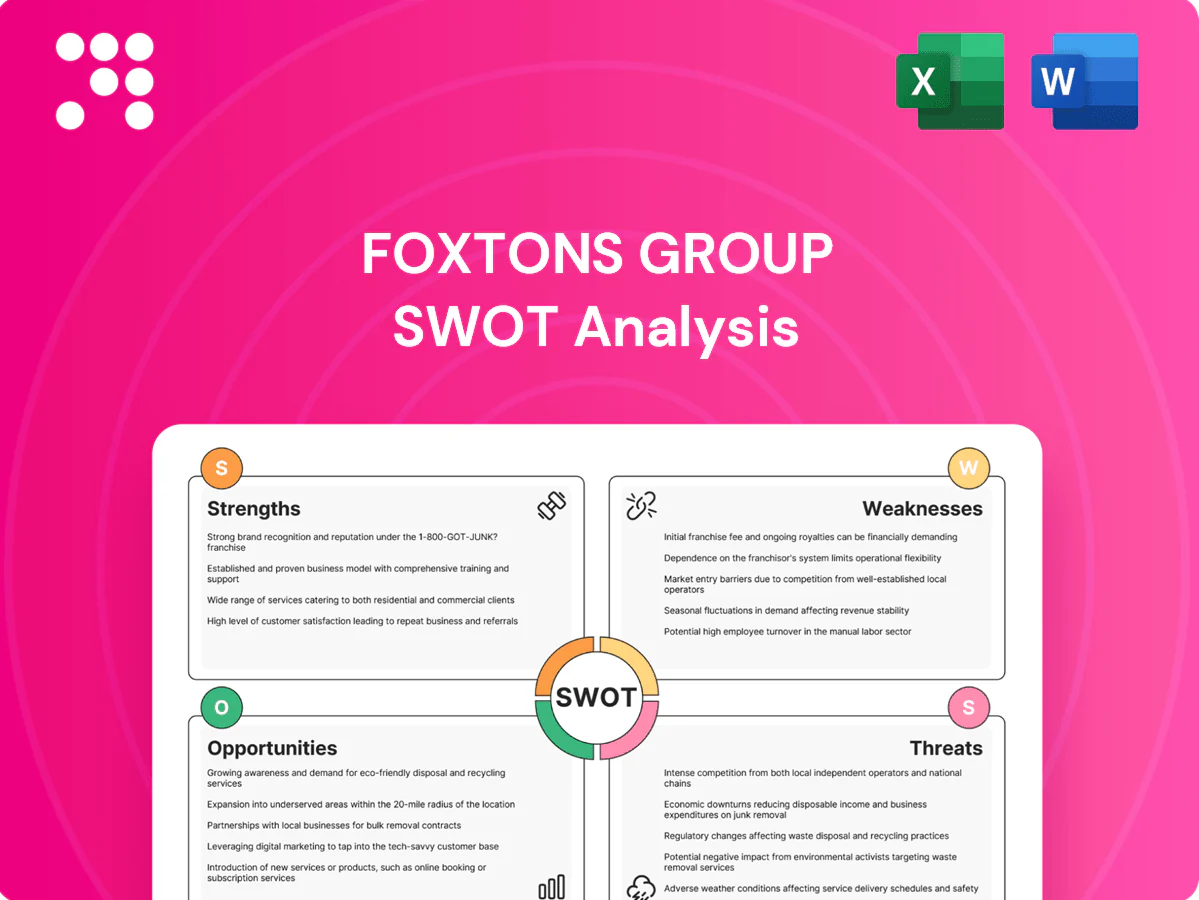
Foxtons Group SWOT Analysis

Go Beyond the Preview—Access the Full Strategic Report
Foxtons Group's SWOT reveals a premium brand, strong London footprint, and digital sales channels as clear strengths, while exposure to cyclical property markets and regulatory risk are notable weaknesses. Opportunities include lettings growth and tech-driven scale; threats stem from interest rate volatility and competitive pricing pressure. Want the full story behind the company’s strengths, risks, and growth drivers? Purchase the complete SWOT analysis to gain a professionally written, editable report for strategy and investment.
Strengths

Iconic London brand recognition
Foxtons benefits from iconic London brand recognition—after 44 years since its 1981 founding and listed on the LSE under ticker FOXT—boosting instruction win rates by attracting sellers and landlords. Brand familiarity lowers customer acquisition costs across boroughs and enables premium fee positioning in core postcodes. Scale marketing spend compounds awareness versus independent agents, reinforcing network effects.
Deep local market expertise
Foxtons (LSE: FOXT) leverages area-focused negotiators and valuers across Greater London, with a network of over 40 offices sharpening pricing accuracy and accelerating time to sale/let.
Hyperlocal intel improves buyer and tenant matching, reducing fall-throughs and supporting a more resilient pipeline through market cycles compared with national portals.

Diversified services across sales, lettings, management
Diversified services across sales, lettings and management give Foxtons multiple revenue streams that smooth sales cyclicality with steadier lettings income; lettings have contributed roughly half of group revenue in recent years. Property management produces recurring, higher-visibility cash flows and more predictable ARR. Cross-sell across services raises client lifetime value, while corporate and relocation contracts broaden demand beyond retail buyers and renters.

High-street branch network across London
Foxtons' over 40 high-street branches across London (2024) bolster trust and capture high-intent walk-ins in dense neighbourhoods, anchoring local canvassing and vendor/landlord prospecting while shortening response times for viewings and maintenance, sustaining brand prominence in competitive micro-markets.
- Physical presence: over 40 branches (2024)
- Faster viewings: local proximity
- Stronger lead-gen: street-level canvassing
- High visibility: sustained brand recall
Process discipline and scalable systems
Process discipline and scalable systems underpin Foxtons (LSE: FOXT), with standardized workflows driving high transaction throughput and regulatory compliance. Integrated CRM, valuation and pipeline tools boost conversion and fee control across operations. Training, playbooks and a network of over 30 London-area offices enable rapid replication, bolt-on acquisitions and coverage expansion.
- Standardized workflows: higher throughput, compliance
- CRM & pipeline tools: improved conversion, fee control
- Training/playbooks: consistent best practices
- Scalability: supports bolt-on M&A and coverage growth
Premium London agent, ≈50% lettings, over 40 branches
Foxtons (LSE: FOXT), founded 1981, has strong London brand recognition and premium-fee positioning across core postcodes. Over 40 high-street branches (2024) and area-focused negotiators speed viewings and improve match rates. Diversified sales/lettings/management (lettings ≈50% of group revenue) plus standardized CRM and playbooks support high throughput and recurring cash flow.
| Metric | Value |
|---|---|
| Branches (2024) | over 40 |
| Founding year | 1981 |
| Lettings share | ≈50% revenue |
What is included in the product
 Detailed Word Document
Provides a concise SWOT analysis of Foxtons Group, highlighting internal strengths and weaknesses and external opportunities and threats that shape its competitive position and strategic outlook.

 Customizable Excel Spreadsheet
Provides a concise SWOT matrix for Foxtons Group, enabling fast alignment on competitive strengths, market opportunities and regulatory risks to streamline strategic decisions and stakeholder updates.
Weaknesses

Concentration in the London market
Reliance on the London market exposes Foxtons to localized economic and demand shocks that can sharply reduce revenue in downturns.
Policy changes or affordability shifts in London housing, such as stamp duty adjustments or interest rate-driven price falls, can disproportionately depress transaction volumes and rental yields.
Geographic concentration limits diversification benefits and scaling outside London will require new regional capabilities, licence networks and significant brand investment.
Exposure to housing cycle and transaction volumes
Sales fees are highly sensitive to interest-rate moves, mortgage availability and buyer sentiment, reducing Foxtons revenue when financing tightens. High fall-through rates during stressed periods compress revenue per agent and lower productivity. Fixed and semi-fixed costs can remain sticky against rapid volume declines, making margins volatile. Macro inflection points amplify forecasting uncertainty across the cycle.

High fixed costs from branch footprint
High fixed costs from Foxtons’ branch footprint—rents, salaried staff and compliance overhead—create strong operational leverage: revenue falls hit margins fast and unpredictably. Consolidating or reconfiguring branches is expensive and disrupts service. Digital-first rivals operating with lower unit costs can undercut pricing and pressure market share.

Competitive pressure on fees
Online and hybrid agents have increased price transparency and discounting, often undercutting traditional commission models by around 20–50%, forcing Foxtons to defend fees; landlords and vendors press harder to negotiate during softer market phases. Maintaining premium fees now requires demonstrable performance and enhanced service levels, as fee compression can erode profitability even if transaction volumes remain stable.
- price-discounting: online/hybrid fees ~20–50% lower
- negotiation-pressure: landlords push fees down in slow markets
- service-proof: premium fees demand clear performance metrics
- margin-risk: fee compression reduces profitability despite volumes
Reputation risk in a scrutiny-heavy sector
Consumer reviews and social media can amplify isolated service issues rapidly, magnifying reputational impact across lettings and sales; compliance missteps risk both regulatory penalties and sharp PR fallout. Lettings and management disputes directly erode trust and reduce referral flows, requiring sustained investment in culture and targeted training to rebuild confidence.
London focus, big branch costs and 20-50% discounting squeeze margins
Reliance on London makes Foxtons vulnerable to localized downturns and policy shifts that cut volumes and yields. High fixed costs from a large branch footprint and salaried staff create volatile margins during volume declines. Aggressive online/hybrid discounting (fees ~20–50% lower) and amplified negative reviews pressure fees, referrals and brand trust.
| Metric | Value (2024/25) |
|---|---|
| Online/hybrid fee gap | ~20–50% lower |
| Branch footprint | ~70 (2024) |
Preview Before You Purchase
Foxtons Group SWOT Analysis
This is the actual SWOT analysis document you'll receive upon purchase—no surprises, just professional quality. The preview below is taken directly from the full Foxtons Group SWOT report you'll get; purchase unlocks the entire in-depth version. The downloadable file is complete and editable, ready for immediate use after checkout.

Go Beyond the Preview—Access the Full Strategic Report
Foxtons Group's SWOT reveals a premium brand, strong London footprint, and digital sales channels as clear strengths, while exposure to cyclical property markets and regulatory risk are notable weaknesses. Opportunities include lettings growth and tech-driven scale; threats stem from interest rate volatility and competitive pricing pressure. Want the full story behind the company’s strengths, risks, and growth drivers? Purchase the complete SWOT analysis to gain a professionally written, editable report for strategy and investment.
Strengths
Iconic London brand recognition
Foxtons benefits from iconic London brand recognition—after 44 years since its 1981 founding and listed on the LSE under ticker FOXT—boosting instruction win rates by attracting sellers and landlords. Brand familiarity lowers customer acquisition costs across boroughs and enables premium fee positioning in core postcodes. Scale marketing spend compounds awareness versus independent agents, reinforcing network effects.
Deep local market expertise
Foxtons (LSE: FOXT) leverages area-focused negotiators and valuers across Greater London, with a network of over 40 offices sharpening pricing accuracy and accelerating time to sale/let.
Hyperlocal intel improves buyer and tenant matching, reducing fall-throughs and supporting a more resilient pipeline through market cycles compared with national portals.
Diversified services across sales, lettings, management
Diversified services across sales, lettings and management give Foxtons multiple revenue streams that smooth sales cyclicality with steadier lettings income; lettings have contributed roughly half of group revenue in recent years. Property management produces recurring, higher-visibility cash flows and more predictable ARR. Cross-sell across services raises client lifetime value, while corporate and relocation contracts broaden demand beyond retail buyers and renters.
High-street branch network across London
Foxtons' over 40 high-street branches across London (2024) bolster trust and capture high-intent walk-ins in dense neighbourhoods, anchoring local canvassing and vendor/landlord prospecting while shortening response times for viewings and maintenance, sustaining brand prominence in competitive micro-markets.
- Physical presence: over 40 branches (2024)
- Faster viewings: local proximity
- Stronger lead-gen: street-level canvassing
- High visibility: sustained brand recall
Process discipline and scalable systems
Process discipline and scalable systems underpin Foxtons (LSE: FOXT), with standardized workflows driving high transaction throughput and regulatory compliance. Integrated CRM, valuation and pipeline tools boost conversion and fee control across operations. Training, playbooks and a network of over 30 London-area offices enable rapid replication, bolt-on acquisitions and coverage expansion.
- Standardized workflows: higher throughput, compliance
- CRM & pipeline tools: improved conversion, fee control
- Training/playbooks: consistent best practices
- Scalability: supports bolt-on M&A and coverage growth
Premium London agent, ≈50% lettings, over 40 branches
Foxtons (LSE: FOXT), founded 1981, has strong London brand recognition and premium-fee positioning across core postcodes. Over 40 high-street branches (2024) and area-focused negotiators speed viewings and improve match rates. Diversified sales/lettings/management (lettings ≈50% of group revenue) plus standardized CRM and playbooks support high throughput and recurring cash flow.
| Metric | Value |
|---|---|
| Branches (2024) | over 40 |
| Founding year | 1981 |
| Lettings share | ≈50% revenue |
What is included in the product
Detailed Word Document
Provides a concise SWOT analysis of Foxtons Group, highlighting internal strengths and weaknesses and external opportunities and threats that shape its competitive position and strategic outlook.
Customizable Excel Spreadsheet
Provides a concise SWOT matrix for Foxtons Group, enabling fast alignment on competitive strengths, market opportunities and regulatory risks to streamline strategic decisions and stakeholder updates.
Weaknesses
Concentration in the London market
Reliance on the London market exposes Foxtons to localized economic and demand shocks that can sharply reduce revenue in downturns.
Policy changes or affordability shifts in London housing, such as stamp duty adjustments or interest rate-driven price falls, can disproportionately depress transaction volumes and rental yields.
Geographic concentration limits diversification benefits and scaling outside London will require new regional capabilities, licence networks and significant brand investment.
Exposure to housing cycle and transaction volumes
Sales fees are highly sensitive to interest-rate moves, mortgage availability and buyer sentiment, reducing Foxtons revenue when financing tightens. High fall-through rates during stressed periods compress revenue per agent and lower productivity. Fixed and semi-fixed costs can remain sticky against rapid volume declines, making margins volatile. Macro inflection points amplify forecasting uncertainty across the cycle.
High fixed costs from branch footprint
High fixed costs from Foxtons’ branch footprint—rents, salaried staff and compliance overhead—create strong operational leverage: revenue falls hit margins fast and unpredictably. Consolidating or reconfiguring branches is expensive and disrupts service. Digital-first rivals operating with lower unit costs can undercut pricing and pressure market share.
Competitive pressure on fees
Online and hybrid agents have increased price transparency and discounting, often undercutting traditional commission models by around 20–50%, forcing Foxtons to defend fees; landlords and vendors press harder to negotiate during softer market phases. Maintaining premium fees now requires demonstrable performance and enhanced service levels, as fee compression can erode profitability even if transaction volumes remain stable.
- price-discounting: online/hybrid fees ~20–50% lower
- negotiation-pressure: landlords push fees down in slow markets
- service-proof: premium fees demand clear performance metrics
- margin-risk: fee compression reduces profitability despite volumes
Reputation risk in a scrutiny-heavy sector
Consumer reviews and social media can amplify isolated service issues rapidly, magnifying reputational impact across lettings and sales; compliance missteps risk both regulatory penalties and sharp PR fallout. Lettings and management disputes directly erode trust and reduce referral flows, requiring sustained investment in culture and targeted training to rebuild confidence.
London focus, big branch costs and 20-50% discounting squeeze margins
Reliance on London makes Foxtons vulnerable to localized downturns and policy shifts that cut volumes and yields. High fixed costs from a large branch footprint and salaried staff create volatile margins during volume declines. Aggressive online/hybrid discounting (fees ~20–50% lower) and amplified negative reviews pressure fees, referrals and brand trust.
| Metric | Value (2024/25) |
|---|---|
| Online/hybrid fee gap | ~20–50% lower |
| Branch footprint | ~70 (2024) |
Preview Before You Purchase
Foxtons Group SWOT Analysis
This is the actual SWOT analysis document you'll receive upon purchase—no surprises, just professional quality. The preview below is taken directly from the full Foxtons Group SWOT report you'll get; purchase unlocks the entire in-depth version. The downloadable file is complete and editable, ready for immediate use after checkout.
Original: $10.00
-65%$10.00
$3.50Description
Go Beyond the Preview—Access the Full Strategic Report
Foxtons Group's SWOT reveals a premium brand, strong London footprint, and digital sales channels as clear strengths, while exposure to cyclical property markets and regulatory risk are notable weaknesses. Opportunities include lettings growth and tech-driven scale; threats stem from interest rate volatility and competitive pricing pressure. Want the full story behind the company’s strengths, risks, and growth drivers? Purchase the complete SWOT analysis to gain a professionally written, editable report for strategy and investment.
Strengths
Iconic London brand recognition
Foxtons benefits from iconic London brand recognition—after 44 years since its 1981 founding and listed on the LSE under ticker FOXT—boosting instruction win rates by attracting sellers and landlords. Brand familiarity lowers customer acquisition costs across boroughs and enables premium fee positioning in core postcodes. Scale marketing spend compounds awareness versus independent agents, reinforcing network effects.
Deep local market expertise
Foxtons (LSE: FOXT) leverages area-focused negotiators and valuers across Greater London, with a network of over 40 offices sharpening pricing accuracy and accelerating time to sale/let.
Hyperlocal intel improves buyer and tenant matching, reducing fall-throughs and supporting a more resilient pipeline through market cycles compared with national portals.
Diversified services across sales, lettings, management
Diversified services across sales, lettings and management give Foxtons multiple revenue streams that smooth sales cyclicality with steadier lettings income; lettings have contributed roughly half of group revenue in recent years. Property management produces recurring, higher-visibility cash flows and more predictable ARR. Cross-sell across services raises client lifetime value, while corporate and relocation contracts broaden demand beyond retail buyers and renters.
High-street branch network across London
Foxtons' over 40 high-street branches across London (2024) bolster trust and capture high-intent walk-ins in dense neighbourhoods, anchoring local canvassing and vendor/landlord prospecting while shortening response times for viewings and maintenance, sustaining brand prominence in competitive micro-markets.
- Physical presence: over 40 branches (2024)
- Faster viewings: local proximity
- Stronger lead-gen: street-level canvassing
- High visibility: sustained brand recall
Process discipline and scalable systems
Process discipline and scalable systems underpin Foxtons (LSE: FOXT), with standardized workflows driving high transaction throughput and regulatory compliance. Integrated CRM, valuation and pipeline tools boost conversion and fee control across operations. Training, playbooks and a network of over 30 London-area offices enable rapid replication, bolt-on acquisitions and coverage expansion.
- Standardized workflows: higher throughput, compliance
- CRM & pipeline tools: improved conversion, fee control
- Training/playbooks: consistent best practices
- Scalability: supports bolt-on M&A and coverage growth
Premium London agent, ≈50% lettings, over 40 branches
Foxtons (LSE: FOXT), founded 1981, has strong London brand recognition and premium-fee positioning across core postcodes. Over 40 high-street branches (2024) and area-focused negotiators speed viewings and improve match rates. Diversified sales/lettings/management (lettings ≈50% of group revenue) plus standardized CRM and playbooks support high throughput and recurring cash flow.
| Metric | Value |
|---|---|
| Branches (2024) | over 40 |
| Founding year | 1981 |
| Lettings share | ≈50% revenue |
What is included in the product
Detailed Word Document
Provides a concise SWOT analysis of Foxtons Group, highlighting internal strengths and weaknesses and external opportunities and threats that shape its competitive position and strategic outlook.
Customizable Excel Spreadsheet
Provides a concise SWOT matrix for Foxtons Group, enabling fast alignment on competitive strengths, market opportunities and regulatory risks to streamline strategic decisions and stakeholder updates.
Weaknesses
Concentration in the London market
Reliance on the London market exposes Foxtons to localized economic and demand shocks that can sharply reduce revenue in downturns.
Policy changes or affordability shifts in London housing, such as stamp duty adjustments or interest rate-driven price falls, can disproportionately depress transaction volumes and rental yields.
Geographic concentration limits diversification benefits and scaling outside London will require new regional capabilities, licence networks and significant brand investment.
Exposure to housing cycle and transaction volumes
Sales fees are highly sensitive to interest-rate moves, mortgage availability and buyer sentiment, reducing Foxtons revenue when financing tightens. High fall-through rates during stressed periods compress revenue per agent and lower productivity. Fixed and semi-fixed costs can remain sticky against rapid volume declines, making margins volatile. Macro inflection points amplify forecasting uncertainty across the cycle.
High fixed costs from branch footprint
High fixed costs from Foxtons’ branch footprint—rents, salaried staff and compliance overhead—create strong operational leverage: revenue falls hit margins fast and unpredictably. Consolidating or reconfiguring branches is expensive and disrupts service. Digital-first rivals operating with lower unit costs can undercut pricing and pressure market share.
Competitive pressure on fees
Online and hybrid agents have increased price transparency and discounting, often undercutting traditional commission models by around 20–50%, forcing Foxtons to defend fees; landlords and vendors press harder to negotiate during softer market phases. Maintaining premium fees now requires demonstrable performance and enhanced service levels, as fee compression can erode profitability even if transaction volumes remain stable.
- price-discounting: online/hybrid fees ~20–50% lower
- negotiation-pressure: landlords push fees down in slow markets
- service-proof: premium fees demand clear performance metrics
- margin-risk: fee compression reduces profitability despite volumes
Reputation risk in a scrutiny-heavy sector
Consumer reviews and social media can amplify isolated service issues rapidly, magnifying reputational impact across lettings and sales; compliance missteps risk both regulatory penalties and sharp PR fallout. Lettings and management disputes directly erode trust and reduce referral flows, requiring sustained investment in culture and targeted training to rebuild confidence.
London focus, big branch costs and 20-50% discounting squeeze margins
Reliance on London makes Foxtons vulnerable to localized downturns and policy shifts that cut volumes and yields. High fixed costs from a large branch footprint and salaried staff create volatile margins during volume declines. Aggressive online/hybrid discounting (fees ~20–50% lower) and amplified negative reviews pressure fees, referrals and brand trust.
| Metric | Value (2024/25) |
|---|---|
| Online/hybrid fee gap | ~20–50% lower |
| Branch footprint | ~70 (2024) |
Preview Before You Purchase
Foxtons Group SWOT Analysis
This is the actual SWOT analysis document you'll receive upon purchase—no surprises, just professional quality. The preview below is taken directly from the full Foxtons Group SWOT report you'll get; purchase unlocks the entire in-depth version. The downloadable file is complete and editable, ready for immediate use after checkout.











