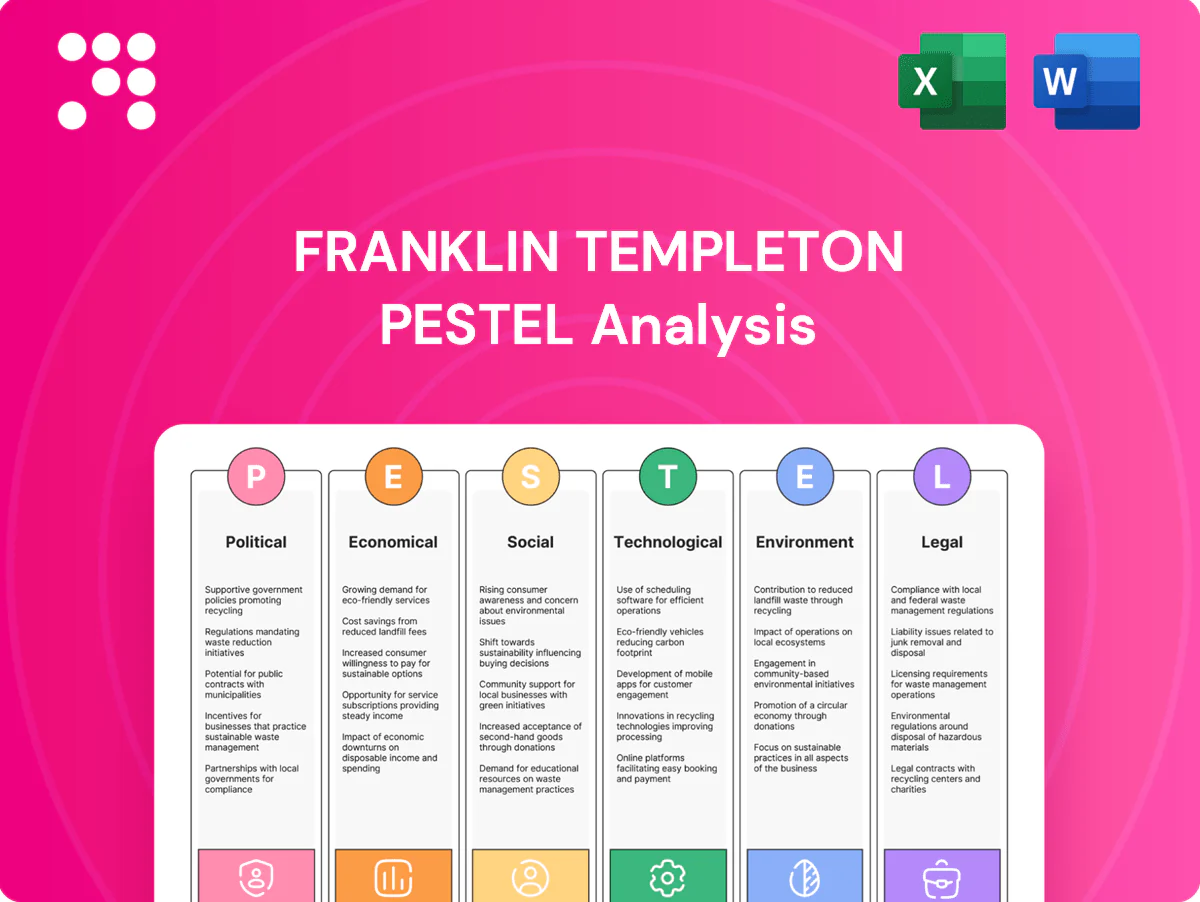
Franklin Templeton PESTLE Analysis

Your Competitive Advantage Starts with This Report
Unlock strategic clarity with our Franklin Templeton PESTLE Analysis—concise insights into political, economic, social, technological, legal, and environmental forces shaping the firm's outlook. Perfect for investors and strategists needing actionable intelligence. Purchase the full report to access the complete, editable deep-dive and make better-informed decisions today.
Political factors

Regulatory fragmentation across jurisdictions
Operating across the US, EU, APAC and emerging markets exposes Franklin Templeton, with about $1.5 trillion AUM mid‑2024, to divergent rulebooks and supervisory expectations. Policy drift forces parallel processes for disclosures, marketing and fund structures, increasing complexity. Harmonizing compliance raises cost-to-serve and can add roughly 3–6 months to time-to-market. Strategic localization of products and governance mitigates regulatory friction.
Geopolitical tensions and sanctions regimes
Sanctions, trade disputes and capital controls (OFAC SDN list topped ~10,000 entries by mid‑2024) can sharply reduce investable universes and usable counterparties for Franklin Templeton, forcing portfolio rebalancing that raises tracking error and may dent performance. Rapid list changes elevate transaction, custody and legal risks and increase settlement failures. Pre‑trade controls and enhanced due diligence become mission‑critical to avoid breaches and fines.

Fiscal and monetary policy shifts
Government spending priorities and taxation—US FY2024 deficit ~1.7 trillion and debt/GDP ~120%—directly affect growth, bond yields and equity risk premia (global ERP ~4.5% in 2024). Central bank tightening (Fed funds 5.25–5.50% mid-2024) or easing reshapes demand across fixed income, multi-asset and alternatives. Policy surprises have driven flows between active and passive vehicles as ETF AUM topped ~11.5 trillion in 2024. Scenario planning aligns product shelf with shifting macro regimes.

Pension and sovereign wealth governance
Public funds and SWFs drive large mandates with policy-linked objectives; SWF assets were about $12.5 trillion in 2024, shifting scale and mandate scope. Changes in liability frameworks or strategic asset allocations materially change mandate size and style, increasing allocations to private markets and duration-sensitive instruments. Stewardship expectations and voting policies are more prescriptive, making relationship management and reporting sophistication key differentiators.
- Policy-linked mandates: scale and time horizon
- Mandate shifts: liability rules reshape allocations
- Stewardship: prescriptive voting/reporting standards
- Competitive edge: relationship management + reporting sophistication
Political stability in key distribution markets
Elections such as the US presidential vote on 5 Nov 2024 and India’s May 2024 general election (BJP re-elected) have reshaped investor confidence; Franklin Templeton, with roughly $1.4 trillion AUM (mid‑2025), notes that coalition dynamics and reform agendas materially affect capital‑market depth and product demand. Regulatory continuity supports multi‑year product development, while instability can delay approvals and reduce retail flows; country risk assessment guides allocation timing.
- Election dates: US 05‑Nov‑2024, India May‑2024
- Franklin Templeton AUM: ~$1.4T (mid‑2025)
- Instability effect: delays approvals, lowers retail inflows
- Action: country risk assessment to time market entry
Global AUM scale and sanctions thrust managers into costlier compliance and private-market pivot
Operating across ~40 jurisdictions with ~$1.4T AUM (mid‑2025) exposes Franklin Templeton to divergent rulebooks, raising compliance costs and time‑to‑market. Sanctions/OFAC (~10,000 SDNs mid‑2024) and trade restrictions force portfolio rebalancing and higher operational risk. Macro policy (Fed 5.25–5.50% mid‑2024; global ERP ~4.5%) and SWF scale (~$12.5T 2024) shift mandate demand toward private markets.
| Tag | Value | Impact |
|---|---|---|
| AUM | $1.4T (mid‑2025) | Scale/complexity |
| OFAC SDN | ~10,000 (mid‑2024) | Counterparty risk |
| SWF assets | $12.5T (2024) | Large mandates |
What is included in the product
 Detailed Word Document
Explores how external macro-environmental factors uniquely affect Franklin Templeton across six dimensions—Political, Economic, Social, Technological, Environmental and Legal—backed by current data and trends to identify threats and opportunities for executives, consultants and investors, with forward-looking insights and clean formatting ready for reports or pitch decks.

 Customizable Excel Spreadsheet
A concise, visually segmented PESTLE summary of Franklin Templeton that can be dropped into presentations or shared across teams, enabling quick alignment, focused external risk discussions, and easy customization with region- or business-line specific notes.
Economic factors

Interest rate cycles and yield curve dynamics
Elevated policy rates (peak federal funds 5.25–5.50% in the 2023–24 tightening) and 10-year Treasury moves (roughly 3–4.5% in 2024) drive fixed-income returns, discount rates, and valuation multiples for Franklin Templeton portfolios. Yield-curve inversions or steepenings reshape duration and credit preferences, shifting capital between investment-grade duration and high-yield credit. Income-oriented mutual funds and ETFs gain or lose investor appeal accordingly. Active duration management and sector rotation capabilities become pivotal to preserve yield and manage convexity risk.
Market volatility and AUM sensitivity
Franklin Templeton’s revenue scales with roughly $1.5 trillion AUM (H1 2025), so market drawdowns directly cut AUM and fee income proportionally; a 10% market decline can trim fees by ~10% absent flows. Volatility spikes widen spreads and create alpha opportunities for active strategies, while breadth across defensive fixed income and alternatives smooths earnings. Strong liquidity management preserves client outcomes during stress.

Foreign exchange movements
Foreign exchange movements alter multi-currency returns, fee translation and cost bases across Franklin Templeton's $1.53 trillion AUM (Mar 31, 2024), directly affecting reported performance. Hedging policies influence tracking error and must match client mandates. Currency cycles, highlighted by USD strength into 2022–24, reshape demand for local versus global funds. Robust operational FX controls reduce leakage.

Inflation and real income trends
US inflation eased to about 3.4% in 2024 while the federal funds rate stayed near 5.25–5.50% into 2025, shifting investor demand toward TIPS, shorter-duration bonds, commodities and real assets as real returns compress; persistent price pressures lift operating costs and force Franklin Templeton to balance pricing discipline with flexible product mix to protect margins, as wage and savings trends reshape retail subscription behavior.
- Inflation: 2024 CPI ~3.4%
- Rates: fed funds ~5.25–5.50% (mid-2025)
- Flows: tilt to TIPS/short duration
- Risk: higher operating costs, margin pressure
Fee compression and competitive dynamics
Passive expansion and stronger platform bargaining drove headline fee pressure in 2024–25; ETFs averaged ~0.06% expense ratios while active equity fees compressed toward ~0.40%, forcing Franklin Templeton (AUM ~1.6 trillion USD) to protect margins via scale and differentiated alpha offerings. Value-added services—custom SMAs, OCIO mandates and model portfolios—create blended economics and justify premium pricing. Cost efficiency and automation (RPA/AI) sustain profitability by lowering operating ratios.
- Scale: AUM ~1.6T USD
- Fee gap: ETF 0.06% vs active ~0.40%
- Growth drivers: SMAs/OCIO/model portfolios
Global AUM scale and sanctions thrust managers into costlier compliance and private-market pivot
Higher policy rates (fed funds 5.25–5.50% mid‑2025) and 10y yields (≈3–4.5% in 2024) compress multiples, boost fixed‑income returns and force active duration/sector shifts. AUM sensitivity (1.53T USD Mar 31, 2024) links market drawdowns to fee revenue; fee compression favors scale and OCIO/SMAs. USD strength and 2024 CPI ~3.4% alter multi‑currency returns, costs and product demand.
| Metric | Value |
|---|---|
| Fed funds | 5.25–5.50% |
| 10y Treasury | 3–4.5% |
| CPI 2024 | ≈3.4% |
| AUM (Mar 31, 2024) | 1.53T USD |
| ETF avg fee | 0.06% |
| Active fee | ≈0.40% |
What You See Is What You Get
Franklin Templeton PESTLE Analysis
The Franklin Templeton PESTLE Analysis provides a concise, actionable assessment of political, economic, sociocultural, technological, legal, and environmental factors affecting the firm. The preview shown here is the exact document you’ll receive after purchase—fully formatted and ready to use. It’s fully referenced, visually organized, and ready for immediate download and application in investment or strategic decision-making.

Your Competitive Advantage Starts with This Report
Unlock strategic clarity with our Franklin Templeton PESTLE Analysis—concise insights into political, economic, social, technological, legal, and environmental forces shaping the firm's outlook. Perfect for investors and strategists needing actionable intelligence. Purchase the full report to access the complete, editable deep-dive and make better-informed decisions today.
Political factors
Regulatory fragmentation across jurisdictions
Operating across the US, EU, APAC and emerging markets exposes Franklin Templeton, with about $1.5 trillion AUM mid‑2024, to divergent rulebooks and supervisory expectations. Policy drift forces parallel processes for disclosures, marketing and fund structures, increasing complexity. Harmonizing compliance raises cost-to-serve and can add roughly 3–6 months to time-to-market. Strategic localization of products and governance mitigates regulatory friction.
Geopolitical tensions and sanctions regimes
Sanctions, trade disputes and capital controls (OFAC SDN list topped ~10,000 entries by mid‑2024) can sharply reduce investable universes and usable counterparties for Franklin Templeton, forcing portfolio rebalancing that raises tracking error and may dent performance. Rapid list changes elevate transaction, custody and legal risks and increase settlement failures. Pre‑trade controls and enhanced due diligence become mission‑critical to avoid breaches and fines.
Fiscal and monetary policy shifts
Government spending priorities and taxation—US FY2024 deficit ~1.7 trillion and debt/GDP ~120%—directly affect growth, bond yields and equity risk premia (global ERP ~4.5% in 2024). Central bank tightening (Fed funds 5.25–5.50% mid-2024) or easing reshapes demand across fixed income, multi-asset and alternatives. Policy surprises have driven flows between active and passive vehicles as ETF AUM topped ~11.5 trillion in 2024. Scenario planning aligns product shelf with shifting macro regimes.
Pension and sovereign wealth governance
Public funds and SWFs drive large mandates with policy-linked objectives; SWF assets were about $12.5 trillion in 2024, shifting scale and mandate scope. Changes in liability frameworks or strategic asset allocations materially change mandate size and style, increasing allocations to private markets and duration-sensitive instruments. Stewardship expectations and voting policies are more prescriptive, making relationship management and reporting sophistication key differentiators.
- Policy-linked mandates: scale and time horizon
- Mandate shifts: liability rules reshape allocations
- Stewardship: prescriptive voting/reporting standards
- Competitive edge: relationship management + reporting sophistication
Political stability in key distribution markets
Elections such as the US presidential vote on 5 Nov 2024 and India’s May 2024 general election (BJP re-elected) have reshaped investor confidence; Franklin Templeton, with roughly $1.4 trillion AUM (mid‑2025), notes that coalition dynamics and reform agendas materially affect capital‑market depth and product demand. Regulatory continuity supports multi‑year product development, while instability can delay approvals and reduce retail flows; country risk assessment guides allocation timing.
- Election dates: US 05‑Nov‑2024, India May‑2024
- Franklin Templeton AUM: ~$1.4T (mid‑2025)
- Instability effect: delays approvals, lowers retail inflows
- Action: country risk assessment to time market entry
Global AUM scale and sanctions thrust managers into costlier compliance and private-market pivot
Operating across ~40 jurisdictions with ~$1.4T AUM (mid‑2025) exposes Franklin Templeton to divergent rulebooks, raising compliance costs and time‑to‑market. Sanctions/OFAC (~10,000 SDNs mid‑2024) and trade restrictions force portfolio rebalancing and higher operational risk. Macro policy (Fed 5.25–5.50% mid‑2024; global ERP ~4.5%) and SWF scale (~$12.5T 2024) shift mandate demand toward private markets.
| Tag | Value | Impact |
|---|---|---|
| AUM | $1.4T (mid‑2025) | Scale/complexity |
| OFAC SDN | ~10,000 (mid‑2024) | Counterparty risk |
| SWF assets | $12.5T (2024) | Large mandates |
What is included in the product
Detailed Word Document
Explores how external macro-environmental factors uniquely affect Franklin Templeton across six dimensions—Political, Economic, Social, Technological, Environmental and Legal—backed by current data and trends to identify threats and opportunities for executives, consultants and investors, with forward-looking insights and clean formatting ready for reports or pitch decks.
Customizable Excel Spreadsheet
A concise, visually segmented PESTLE summary of Franklin Templeton that can be dropped into presentations or shared across teams, enabling quick alignment, focused external risk discussions, and easy customization with region- or business-line specific notes.
Economic factors
Interest rate cycles and yield curve dynamics
Elevated policy rates (peak federal funds 5.25–5.50% in the 2023–24 tightening) and 10-year Treasury moves (roughly 3–4.5% in 2024) drive fixed-income returns, discount rates, and valuation multiples for Franklin Templeton portfolios. Yield-curve inversions or steepenings reshape duration and credit preferences, shifting capital between investment-grade duration and high-yield credit. Income-oriented mutual funds and ETFs gain or lose investor appeal accordingly. Active duration management and sector rotation capabilities become pivotal to preserve yield and manage convexity risk.
Market volatility and AUM sensitivity
Franklin Templeton’s revenue scales with roughly $1.5 trillion AUM (H1 2025), so market drawdowns directly cut AUM and fee income proportionally; a 10% market decline can trim fees by ~10% absent flows. Volatility spikes widen spreads and create alpha opportunities for active strategies, while breadth across defensive fixed income and alternatives smooths earnings. Strong liquidity management preserves client outcomes during stress.
Foreign exchange movements
Foreign exchange movements alter multi-currency returns, fee translation and cost bases across Franklin Templeton's $1.53 trillion AUM (Mar 31, 2024), directly affecting reported performance. Hedging policies influence tracking error and must match client mandates. Currency cycles, highlighted by USD strength into 2022–24, reshape demand for local versus global funds. Robust operational FX controls reduce leakage.
Inflation and real income trends
US inflation eased to about 3.4% in 2024 while the federal funds rate stayed near 5.25–5.50% into 2025, shifting investor demand toward TIPS, shorter-duration bonds, commodities and real assets as real returns compress; persistent price pressures lift operating costs and force Franklin Templeton to balance pricing discipline with flexible product mix to protect margins, as wage and savings trends reshape retail subscription behavior.
- Inflation: 2024 CPI ~3.4%
- Rates: fed funds ~5.25–5.50% (mid-2025)
- Flows: tilt to TIPS/short duration
- Risk: higher operating costs, margin pressure
Fee compression and competitive dynamics
Passive expansion and stronger platform bargaining drove headline fee pressure in 2024–25; ETFs averaged ~0.06% expense ratios while active equity fees compressed toward ~0.40%, forcing Franklin Templeton (AUM ~1.6 trillion USD) to protect margins via scale and differentiated alpha offerings. Value-added services—custom SMAs, OCIO mandates and model portfolios—create blended economics and justify premium pricing. Cost efficiency and automation (RPA/AI) sustain profitability by lowering operating ratios.
- Scale: AUM ~1.6T USD
- Fee gap: ETF 0.06% vs active ~0.40%
- Growth drivers: SMAs/OCIO/model portfolios
Global AUM scale and sanctions thrust managers into costlier compliance and private-market pivot
Higher policy rates (fed funds 5.25–5.50% mid‑2025) and 10y yields (≈3–4.5% in 2024) compress multiples, boost fixed‑income returns and force active duration/sector shifts. AUM sensitivity (1.53T USD Mar 31, 2024) links market drawdowns to fee revenue; fee compression favors scale and OCIO/SMAs. USD strength and 2024 CPI ~3.4% alter multi‑currency returns, costs and product demand.
| Metric | Value |
|---|---|
| Fed funds | 5.25–5.50% |
| 10y Treasury | 3–4.5% |
| CPI 2024 | ≈3.4% |
| AUM (Mar 31, 2024) | 1.53T USD |
| ETF avg fee | 0.06% |
| Active fee | ≈0.40% |
What You See Is What You Get
Franklin Templeton PESTLE Analysis
The Franklin Templeton PESTLE Analysis provides a concise, actionable assessment of political, economic, sociocultural, technological, legal, and environmental factors affecting the firm. The preview shown here is the exact document you’ll receive after purchase—fully formatted and ready to use. It’s fully referenced, visually organized, and ready for immediate download and application in investment or strategic decision-making.
Original: $10.00
-65%$10.00
$3.50Description
Your Competitive Advantage Starts with This Report
Unlock strategic clarity with our Franklin Templeton PESTLE Analysis—concise insights into political, economic, social, technological, legal, and environmental forces shaping the firm's outlook. Perfect for investors and strategists needing actionable intelligence. Purchase the full report to access the complete, editable deep-dive and make better-informed decisions today.
Political factors
Regulatory fragmentation across jurisdictions
Operating across the US, EU, APAC and emerging markets exposes Franklin Templeton, with about $1.5 trillion AUM mid‑2024, to divergent rulebooks and supervisory expectations. Policy drift forces parallel processes for disclosures, marketing and fund structures, increasing complexity. Harmonizing compliance raises cost-to-serve and can add roughly 3–6 months to time-to-market. Strategic localization of products and governance mitigates regulatory friction.
Geopolitical tensions and sanctions regimes
Sanctions, trade disputes and capital controls (OFAC SDN list topped ~10,000 entries by mid‑2024) can sharply reduce investable universes and usable counterparties for Franklin Templeton, forcing portfolio rebalancing that raises tracking error and may dent performance. Rapid list changes elevate transaction, custody and legal risks and increase settlement failures. Pre‑trade controls and enhanced due diligence become mission‑critical to avoid breaches and fines.
Fiscal and monetary policy shifts
Government spending priorities and taxation—US FY2024 deficit ~1.7 trillion and debt/GDP ~120%—directly affect growth, bond yields and equity risk premia (global ERP ~4.5% in 2024). Central bank tightening (Fed funds 5.25–5.50% mid-2024) or easing reshapes demand across fixed income, multi-asset and alternatives. Policy surprises have driven flows between active and passive vehicles as ETF AUM topped ~11.5 trillion in 2024. Scenario planning aligns product shelf with shifting macro regimes.
Pension and sovereign wealth governance
Public funds and SWFs drive large mandates with policy-linked objectives; SWF assets were about $12.5 trillion in 2024, shifting scale and mandate scope. Changes in liability frameworks or strategic asset allocations materially change mandate size and style, increasing allocations to private markets and duration-sensitive instruments. Stewardship expectations and voting policies are more prescriptive, making relationship management and reporting sophistication key differentiators.
- Policy-linked mandates: scale and time horizon
- Mandate shifts: liability rules reshape allocations
- Stewardship: prescriptive voting/reporting standards
- Competitive edge: relationship management + reporting sophistication
Political stability in key distribution markets
Elections such as the US presidential vote on 5 Nov 2024 and India’s May 2024 general election (BJP re-elected) have reshaped investor confidence; Franklin Templeton, with roughly $1.4 trillion AUM (mid‑2025), notes that coalition dynamics and reform agendas materially affect capital‑market depth and product demand. Regulatory continuity supports multi‑year product development, while instability can delay approvals and reduce retail flows; country risk assessment guides allocation timing.
- Election dates: US 05‑Nov‑2024, India May‑2024
- Franklin Templeton AUM: ~$1.4T (mid‑2025)
- Instability effect: delays approvals, lowers retail inflows
- Action: country risk assessment to time market entry
Global AUM scale and sanctions thrust managers into costlier compliance and private-market pivot
Operating across ~40 jurisdictions with ~$1.4T AUM (mid‑2025) exposes Franklin Templeton to divergent rulebooks, raising compliance costs and time‑to‑market. Sanctions/OFAC (~10,000 SDNs mid‑2024) and trade restrictions force portfolio rebalancing and higher operational risk. Macro policy (Fed 5.25–5.50% mid‑2024; global ERP ~4.5%) and SWF scale (~$12.5T 2024) shift mandate demand toward private markets.
| Tag | Value | Impact |
|---|---|---|
| AUM | $1.4T (mid‑2025) | Scale/complexity |
| OFAC SDN | ~10,000 (mid‑2024) | Counterparty risk |
| SWF assets | $12.5T (2024) | Large mandates |
What is included in the product
Detailed Word Document
Explores how external macro-environmental factors uniquely affect Franklin Templeton across six dimensions—Political, Economic, Social, Technological, Environmental and Legal—backed by current data and trends to identify threats and opportunities for executives, consultants and investors, with forward-looking insights and clean formatting ready for reports or pitch decks.
Customizable Excel Spreadsheet
A concise, visually segmented PESTLE summary of Franklin Templeton that can be dropped into presentations or shared across teams, enabling quick alignment, focused external risk discussions, and easy customization with region- or business-line specific notes.
Economic factors
Interest rate cycles and yield curve dynamics
Elevated policy rates (peak federal funds 5.25–5.50% in the 2023–24 tightening) and 10-year Treasury moves (roughly 3–4.5% in 2024) drive fixed-income returns, discount rates, and valuation multiples for Franklin Templeton portfolios. Yield-curve inversions or steepenings reshape duration and credit preferences, shifting capital between investment-grade duration and high-yield credit. Income-oriented mutual funds and ETFs gain or lose investor appeal accordingly. Active duration management and sector rotation capabilities become pivotal to preserve yield and manage convexity risk.
Market volatility and AUM sensitivity
Franklin Templeton’s revenue scales with roughly $1.5 trillion AUM (H1 2025), so market drawdowns directly cut AUM and fee income proportionally; a 10% market decline can trim fees by ~10% absent flows. Volatility spikes widen spreads and create alpha opportunities for active strategies, while breadth across defensive fixed income and alternatives smooths earnings. Strong liquidity management preserves client outcomes during stress.
Foreign exchange movements
Foreign exchange movements alter multi-currency returns, fee translation and cost bases across Franklin Templeton's $1.53 trillion AUM (Mar 31, 2024), directly affecting reported performance. Hedging policies influence tracking error and must match client mandates. Currency cycles, highlighted by USD strength into 2022–24, reshape demand for local versus global funds. Robust operational FX controls reduce leakage.
Inflation and real income trends
US inflation eased to about 3.4% in 2024 while the federal funds rate stayed near 5.25–5.50% into 2025, shifting investor demand toward TIPS, shorter-duration bonds, commodities and real assets as real returns compress; persistent price pressures lift operating costs and force Franklin Templeton to balance pricing discipline with flexible product mix to protect margins, as wage and savings trends reshape retail subscription behavior.
- Inflation: 2024 CPI ~3.4%
- Rates: fed funds ~5.25–5.50% (mid-2025)
- Flows: tilt to TIPS/short duration
- Risk: higher operating costs, margin pressure
Fee compression and competitive dynamics
Passive expansion and stronger platform bargaining drove headline fee pressure in 2024–25; ETFs averaged ~0.06% expense ratios while active equity fees compressed toward ~0.40%, forcing Franklin Templeton (AUM ~1.6 trillion USD) to protect margins via scale and differentiated alpha offerings. Value-added services—custom SMAs, OCIO mandates and model portfolios—create blended economics and justify premium pricing. Cost efficiency and automation (RPA/AI) sustain profitability by lowering operating ratios.
- Scale: AUM ~1.6T USD
- Fee gap: ETF 0.06% vs active ~0.40%
- Growth drivers: SMAs/OCIO/model portfolios
Global AUM scale and sanctions thrust managers into costlier compliance and private-market pivot
Higher policy rates (fed funds 5.25–5.50% mid‑2025) and 10y yields (≈3–4.5% in 2024) compress multiples, boost fixed‑income returns and force active duration/sector shifts. AUM sensitivity (1.53T USD Mar 31, 2024) links market drawdowns to fee revenue; fee compression favors scale and OCIO/SMAs. USD strength and 2024 CPI ~3.4% alter multi‑currency returns, costs and product demand.
| Metric | Value |
|---|---|
| Fed funds | 5.25–5.50% |
| 10y Treasury | 3–4.5% |
| CPI 2024 | ≈3.4% |
| AUM (Mar 31, 2024) | 1.53T USD |
| ETF avg fee | 0.06% |
| Active fee | ≈0.40% |
What You See Is What You Get
Franklin Templeton PESTLE Analysis
The Franklin Templeton PESTLE Analysis provides a concise, actionable assessment of political, economic, sociocultural, technological, legal, and environmental factors affecting the firm. The preview shown here is the exact document you’ll receive after purchase—fully formatted and ready to use. It’s fully referenced, visually organized, and ready for immediate download and application in investment or strategic decision-making.











