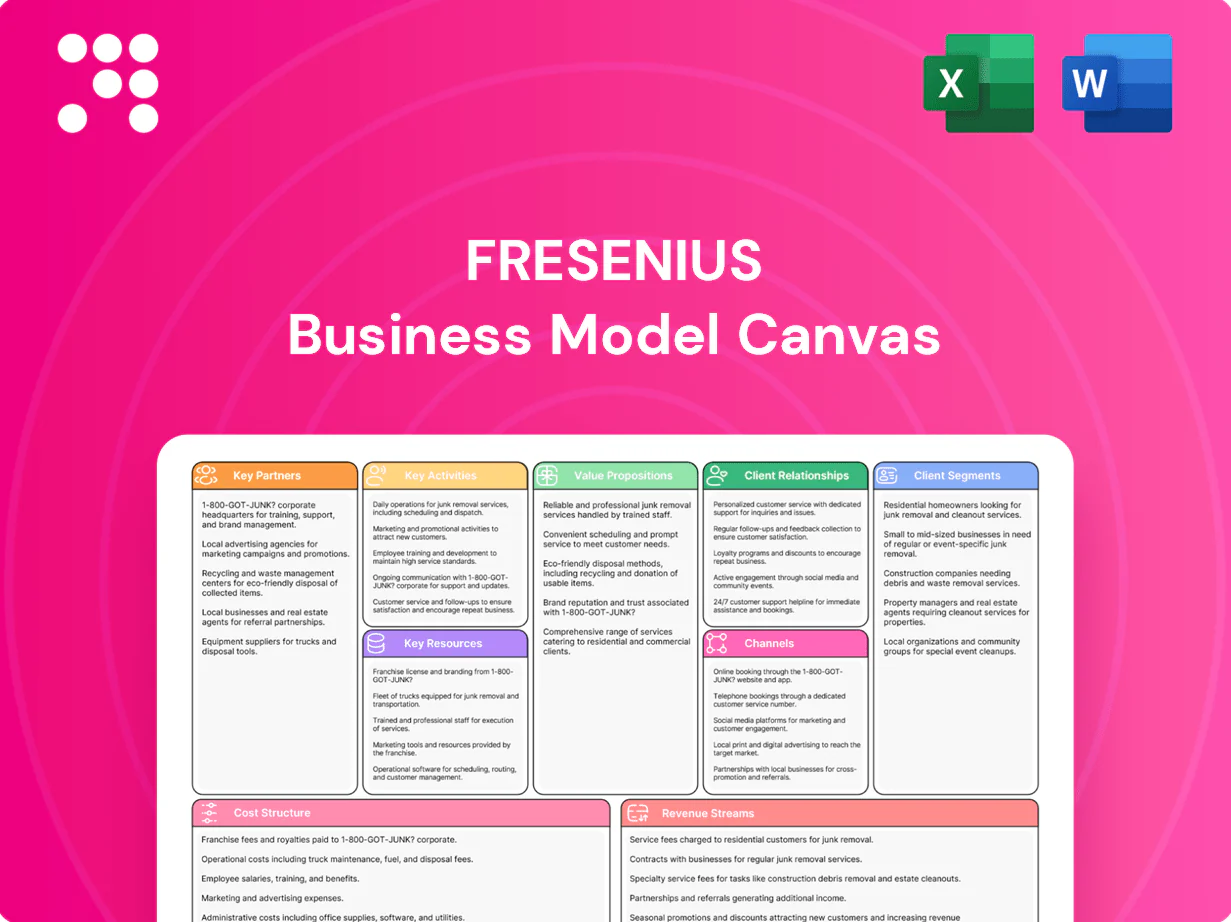
Fresenius Business Model Canvas

Unlock the business model blueprint of a global healthcare leader - concise BMC and growth levers
Unlock the full strategic blueprint behind Fresenius’s business model. This concise Business Model Canvas exposes how the company creates value across healthcare services, medical devices, and pharmaceuticals, revealing partnerships, revenue streams, and growth levers. Purchase the complete, editable Word/Excel canvas to benchmark, plan strategy, or present investor-ready insights.
Partnerships

Payers and public health authorities
Partnerships with insurers and government payers secure reimbursement, patient volume, and long-term service stability for Fresenius, which treated about 345,000 dialysis patients globally and operates in over 100 countries (2023). They enable value-based contracts that align outcomes with payments, while close coordination keeps coding, tariffs, and approvals current. These ties de-risk capital investments in clinics, hospitals, and capacity.
Suppliers and contract manufacturers
Strategic sourcing secures sterile injectables, disposables and device components to GMP and continuity standards through certified suppliers and validated supply chains. Dual-sourcing and contract manufacturing organizations reduce shortage and geopolitical risk by creating parallel supply streams. Joint quality programs with suppliers ensure continuous audit readiness and CAPA alignment. Volume agreements drive cost efficiency and stabilize lead times.

Academic centers and research consortia
Academic clinical research partners accelerate trial enrollment and evidence generation, tapping into a global trial registry of over 460,000 studies on ClinicalTrials.gov (2024) and shortening enrollment timelines. Co-development with centers validates therapies, devices and protocols in real-world settings and leverages Fresenius’s scale (roughly 300,000 employees) for operational rollout. Access to investigators improves study design and publication outcomes, reinforcing credibility with regulators and payers.

Health IT, EHR, and telemedicine partners
Interoperability with major EHRs and remote monitoring platforms streamlines clinical workflows and centralizes dialysis data for clinicians. Integrated data enables outcomes tracking and value-based reporting aligned with pay-for-performance; the global telemedicine market was about $90.7B in 2024. Cybersecurity and cloud partners support compliant scaling while digital tools boost patient engagement and clinician productivity.
- Interoperability: EHR, RPM integration
- Outcomes: value-based reporting
- Security: cybersecurity, compliant cloud
- Engagement: patient apps, clinician productivity
Construction, engineering, and facility operators
EPC and FM partners deliver turnkey hospital and clinic projects, shortening delivery timelines and consolidating capex-to-O&M handovers.
Collaborative planning with engineering and facility operators reduces lifecycle costs, improves safety standards and advances sustainability goals; industry SLAs commonly target 99.5% uptime (2024).
Local partners de-risk permitting and execution; long-term O&M alliances provide performance guarantees and predictable operating expenditure.
- Turnkey delivery: integrated EPC+FM
- Lifecycle focus: cost, safety, sustainability
- Local partners: permitting & execution risk mitigation
- O&M alliances: 99.5% uptime SLAs, performance guarantees
Payer and supplier partnerships secure reimbursement, trials and 99.5% uptime
Partnerships with payers secure reimbursement and patient volume (Fresenius treated ~345,000 dialysis patients across >100 countries, 2023) and enable value-based contracts. Strategic suppliers and CMOs ensure sterile supplies via dual-sourcing and volume agreements. Research and academic partners accelerate trials (ClinicalTrials.gov ~460,000 studies, 2024) and real-world validation. Digital, EPC and FM partners support EHR/RPM integration, cybersecurity and 99.5% uptime SLAs.
| Partner type | Role | Key metric |
|---|---|---|
| Payers | Reimbursement, VBC | ~345,000 patients (2023) |
| Suppliers/CMO | Continuity, dual-source | GMP, volume contracts |
| Research | Trials, evidence | ClinicalTrials.gov ~460,000 (2024) |
| Digital | EHR/RPM, security | Telemed market $90.7B (2024) |
| EPC/FM | Build+O&M | 99.5% uptime SLA |
What is included in the product
 Detailed Word Document
A comprehensive Business Model Canvas for Fresenius detailing all nine blocks—customer segments, value propositions, channels, relationships, revenue streams, key resources, activities, partners, and cost structure—aligned with its healthcare services and products. Designed for analysts and investors, it includes competitive advantages and linked SWOT insights to support strategic decisions and funding discussions.

 Customizable Excel Spreadsheet
High-level, editable Business Model Canvas that distills Fresenius’ complex healthcare operations into a one-page snapshot, easing stakeholder alignment and saving hours of structuring strategic analysis.
Activities

R&D and clinical development
R&D and clinical development at Fresenius spans generics, biosimilars, nutrition and devices, with pipeline activity supporting the group that reported roughly €36.1bn in sales in 2023. Clinical trials validate safety, efficacy and health-economic value, feeding payer dossiers and HTA submissions across markets. Post-market studies expand labels and real-world evidence, strengthening reimbursement cases. Continuous innovation sustains differentiation and margin resilience.
Manufacturing of medicines and devices
Manufacturing sterile injectables, parenteral nutrition, infusion pumps and dialysis products requires strict GMP sites and validated cleanrooms to meet regulatory release and aseptic standards; Fresenius Medical Care serves about 350,000 dialysis patients worldwide (2024), driving scale requirements. Network optimization across sites improves yield, product quality and cost control. Automation and technology transfers enable consistent global scale-up while redundancy and inventory planning sustain supply resilience.

Hospital and clinic operations
Care delivery spans acute, elective and chronic therapies across Fresenius hospital and clinic networks, with Fresenius Medical Care treating about 345,000 dialysis patients globally in 2024. Standardized clinical pathways cut variability and shorten LOS, improving outcomes and cost efficiency. Workforce management aligns staffing to patient acuity to control labor spend. Robust patient experience and safety programs underpin reputation and payer/provider contracts.

Project development and facility management
Design, build, and modernization projects expand healthcare capacity through turnkey hospital and clinic programs; lifecycle services ensure equipment availability and MDR/ISO regulatory compliance; energy and asset management reduce operating costs and CO2 emissions; performance‑based contracts tie Fresenius fees to client outcomes and utilization metrics. In 2024 Fresenius employed about 300,000 people globally.
- Design & construction
- Lifecycle maintenance & compliance
- Energy & asset optimization
- Performance‑based contracting
Regulatory, quality, and market access
- Global footprint: 100+ countries
- QMS/PV: continuous safety monitoring
- HEOR: supports tenders and reimbursement
- Compliance: lowers legal/operational risk
Sustaining €36.1bn in sales through R&D, GMP manufacturing and integrated care for 345,000 patients
R&D, clinical development and HEOR advance generics, biosimilars, nutrition and devices to sustain €36.1bn sales (2023) and payer access. GMP manufacturing and automation supply sterile injectables, nutrition and dialysis products for ~345,000 patients (2024). Integrated care delivery, facility projects and performance contracts optimize outcomes and costs across 100+ countries.
| Metric | Value |
|---|---|
| Sales (2023) | €36.1bn |
| Employees (2024) | ~300,000 |
| Dialysis patients (2024) | ~345,000 |
| Countries | 100+ |
Preview Before You Purchase
Business Model Canvas
The document you're previewing is the actual Fresenius Business Model Canvas, not a mockup. When you purchase, you'll receive this same professionally formatted file with all sections included. The final deliverable is ready to edit, present, or integrate into your analysis.

Unlock the business model blueprint of a global healthcare leader - concise BMC and growth levers
Unlock the full strategic blueprint behind Fresenius’s business model. This concise Business Model Canvas exposes how the company creates value across healthcare services, medical devices, and pharmaceuticals, revealing partnerships, revenue streams, and growth levers. Purchase the complete, editable Word/Excel canvas to benchmark, plan strategy, or present investor-ready insights.
Partnerships
Payers and public health authorities
Partnerships with insurers and government payers secure reimbursement, patient volume, and long-term service stability for Fresenius, which treated about 345,000 dialysis patients globally and operates in over 100 countries (2023). They enable value-based contracts that align outcomes with payments, while close coordination keeps coding, tariffs, and approvals current. These ties de-risk capital investments in clinics, hospitals, and capacity.
Suppliers and contract manufacturers
Strategic sourcing secures sterile injectables, disposables and device components to GMP and continuity standards through certified suppliers and validated supply chains. Dual-sourcing and contract manufacturing organizations reduce shortage and geopolitical risk by creating parallel supply streams. Joint quality programs with suppliers ensure continuous audit readiness and CAPA alignment. Volume agreements drive cost efficiency and stabilize lead times.
Academic centers and research consortia
Academic clinical research partners accelerate trial enrollment and evidence generation, tapping into a global trial registry of over 460,000 studies on ClinicalTrials.gov (2024) and shortening enrollment timelines. Co-development with centers validates therapies, devices and protocols in real-world settings and leverages Fresenius’s scale (roughly 300,000 employees) for operational rollout. Access to investigators improves study design and publication outcomes, reinforcing credibility with regulators and payers.
Health IT, EHR, and telemedicine partners
Interoperability with major EHRs and remote monitoring platforms streamlines clinical workflows and centralizes dialysis data for clinicians. Integrated data enables outcomes tracking and value-based reporting aligned with pay-for-performance; the global telemedicine market was about $90.7B in 2024. Cybersecurity and cloud partners support compliant scaling while digital tools boost patient engagement and clinician productivity.
- Interoperability: EHR, RPM integration
- Outcomes: value-based reporting
- Security: cybersecurity, compliant cloud
- Engagement: patient apps, clinician productivity
Construction, engineering, and facility operators
EPC and FM partners deliver turnkey hospital and clinic projects, shortening delivery timelines and consolidating capex-to-O&M handovers.
Collaborative planning with engineering and facility operators reduces lifecycle costs, improves safety standards and advances sustainability goals; industry SLAs commonly target 99.5% uptime (2024).
Local partners de-risk permitting and execution; long-term O&M alliances provide performance guarantees and predictable operating expenditure.
- Turnkey delivery: integrated EPC+FM
- Lifecycle focus: cost, safety, sustainability
- Local partners: permitting & execution risk mitigation
- O&M alliances: 99.5% uptime SLAs, performance guarantees
Payer and supplier partnerships secure reimbursement, trials and 99.5% uptime
Partnerships with payers secure reimbursement and patient volume (Fresenius treated ~345,000 dialysis patients across >100 countries, 2023) and enable value-based contracts. Strategic suppliers and CMOs ensure sterile supplies via dual-sourcing and volume agreements. Research and academic partners accelerate trials (ClinicalTrials.gov ~460,000 studies, 2024) and real-world validation. Digital, EPC and FM partners support EHR/RPM integration, cybersecurity and 99.5% uptime SLAs.
| Partner type | Role | Key metric |
|---|---|---|
| Payers | Reimbursement, VBC | ~345,000 patients (2023) |
| Suppliers/CMO | Continuity, dual-source | GMP, volume contracts |
| Research | Trials, evidence | ClinicalTrials.gov ~460,000 (2024) |
| Digital | EHR/RPM, security | Telemed market $90.7B (2024) |
| EPC/FM | Build+O&M | 99.5% uptime SLA |
What is included in the product
Detailed Word Document
A comprehensive Business Model Canvas for Fresenius detailing all nine blocks—customer segments, value propositions, channels, relationships, revenue streams, key resources, activities, partners, and cost structure—aligned with its healthcare services and products. Designed for analysts and investors, it includes competitive advantages and linked SWOT insights to support strategic decisions and funding discussions.
Customizable Excel Spreadsheet
High-level, editable Business Model Canvas that distills Fresenius’ complex healthcare operations into a one-page snapshot, easing stakeholder alignment and saving hours of structuring strategic analysis.
Activities
R&D and clinical development
R&D and clinical development at Fresenius spans generics, biosimilars, nutrition and devices, with pipeline activity supporting the group that reported roughly €36.1bn in sales in 2023. Clinical trials validate safety, efficacy and health-economic value, feeding payer dossiers and HTA submissions across markets. Post-market studies expand labels and real-world evidence, strengthening reimbursement cases. Continuous innovation sustains differentiation and margin resilience.
Manufacturing of medicines and devices
Manufacturing sterile injectables, parenteral nutrition, infusion pumps and dialysis products requires strict GMP sites and validated cleanrooms to meet regulatory release and aseptic standards; Fresenius Medical Care serves about 350,000 dialysis patients worldwide (2024), driving scale requirements. Network optimization across sites improves yield, product quality and cost control. Automation and technology transfers enable consistent global scale-up while redundancy and inventory planning sustain supply resilience.
Hospital and clinic operations
Care delivery spans acute, elective and chronic therapies across Fresenius hospital and clinic networks, with Fresenius Medical Care treating about 345,000 dialysis patients globally in 2024. Standardized clinical pathways cut variability and shorten LOS, improving outcomes and cost efficiency. Workforce management aligns staffing to patient acuity to control labor spend. Robust patient experience and safety programs underpin reputation and payer/provider contracts.
Project development and facility management
Design, build, and modernization projects expand healthcare capacity through turnkey hospital and clinic programs; lifecycle services ensure equipment availability and MDR/ISO regulatory compliance; energy and asset management reduce operating costs and CO2 emissions; performance‑based contracts tie Fresenius fees to client outcomes and utilization metrics. In 2024 Fresenius employed about 300,000 people globally.
- Design & construction
- Lifecycle maintenance & compliance
- Energy & asset optimization
- Performance‑based contracting
Regulatory, quality, and market access
- Global footprint: 100+ countries
- QMS/PV: continuous safety monitoring
- HEOR: supports tenders and reimbursement
- Compliance: lowers legal/operational risk
Sustaining €36.1bn in sales through R&D, GMP manufacturing and integrated care for 345,000 patients
R&D, clinical development and HEOR advance generics, biosimilars, nutrition and devices to sustain €36.1bn sales (2023) and payer access. GMP manufacturing and automation supply sterile injectables, nutrition and dialysis products for ~345,000 patients (2024). Integrated care delivery, facility projects and performance contracts optimize outcomes and costs across 100+ countries.
| Metric | Value |
|---|---|
| Sales (2023) | €36.1bn |
| Employees (2024) | ~300,000 |
| Dialysis patients (2024) | ~345,000 |
| Countries | 100+ |
Preview Before You Purchase
Business Model Canvas
The document you're previewing is the actual Fresenius Business Model Canvas, not a mockup. When you purchase, you'll receive this same professionally formatted file with all sections included. The final deliverable is ready to edit, present, or integrate into your analysis.
Original: $10.00
-65%$10.00
$3.50Description
Unlock the business model blueprint of a global healthcare leader - concise BMC and growth levers
Unlock the full strategic blueprint behind Fresenius’s business model. This concise Business Model Canvas exposes how the company creates value across healthcare services, medical devices, and pharmaceuticals, revealing partnerships, revenue streams, and growth levers. Purchase the complete, editable Word/Excel canvas to benchmark, plan strategy, or present investor-ready insights.
Partnerships
Payers and public health authorities
Partnerships with insurers and government payers secure reimbursement, patient volume, and long-term service stability for Fresenius, which treated about 345,000 dialysis patients globally and operates in over 100 countries (2023). They enable value-based contracts that align outcomes with payments, while close coordination keeps coding, tariffs, and approvals current. These ties de-risk capital investments in clinics, hospitals, and capacity.
Suppliers and contract manufacturers
Strategic sourcing secures sterile injectables, disposables and device components to GMP and continuity standards through certified suppliers and validated supply chains. Dual-sourcing and contract manufacturing organizations reduce shortage and geopolitical risk by creating parallel supply streams. Joint quality programs with suppliers ensure continuous audit readiness and CAPA alignment. Volume agreements drive cost efficiency and stabilize lead times.
Academic centers and research consortia
Academic clinical research partners accelerate trial enrollment and evidence generation, tapping into a global trial registry of over 460,000 studies on ClinicalTrials.gov (2024) and shortening enrollment timelines. Co-development with centers validates therapies, devices and protocols in real-world settings and leverages Fresenius’s scale (roughly 300,000 employees) for operational rollout. Access to investigators improves study design and publication outcomes, reinforcing credibility with regulators and payers.
Health IT, EHR, and telemedicine partners
Interoperability with major EHRs and remote monitoring platforms streamlines clinical workflows and centralizes dialysis data for clinicians. Integrated data enables outcomes tracking and value-based reporting aligned with pay-for-performance; the global telemedicine market was about $90.7B in 2024. Cybersecurity and cloud partners support compliant scaling while digital tools boost patient engagement and clinician productivity.
- Interoperability: EHR, RPM integration
- Outcomes: value-based reporting
- Security: cybersecurity, compliant cloud
- Engagement: patient apps, clinician productivity
Construction, engineering, and facility operators
EPC and FM partners deliver turnkey hospital and clinic projects, shortening delivery timelines and consolidating capex-to-O&M handovers.
Collaborative planning with engineering and facility operators reduces lifecycle costs, improves safety standards and advances sustainability goals; industry SLAs commonly target 99.5% uptime (2024).
Local partners de-risk permitting and execution; long-term O&M alliances provide performance guarantees and predictable operating expenditure.
- Turnkey delivery: integrated EPC+FM
- Lifecycle focus: cost, safety, sustainability
- Local partners: permitting & execution risk mitigation
- O&M alliances: 99.5% uptime SLAs, performance guarantees
Payer and supplier partnerships secure reimbursement, trials and 99.5% uptime
Partnerships with payers secure reimbursement and patient volume (Fresenius treated ~345,000 dialysis patients across >100 countries, 2023) and enable value-based contracts. Strategic suppliers and CMOs ensure sterile supplies via dual-sourcing and volume agreements. Research and academic partners accelerate trials (ClinicalTrials.gov ~460,000 studies, 2024) and real-world validation. Digital, EPC and FM partners support EHR/RPM integration, cybersecurity and 99.5% uptime SLAs.
| Partner type | Role | Key metric |
|---|---|---|
| Payers | Reimbursement, VBC | ~345,000 patients (2023) |
| Suppliers/CMO | Continuity, dual-source | GMP, volume contracts |
| Research | Trials, evidence | ClinicalTrials.gov ~460,000 (2024) |
| Digital | EHR/RPM, security | Telemed market $90.7B (2024) |
| EPC/FM | Build+O&M | 99.5% uptime SLA |
What is included in the product
Detailed Word Document
A comprehensive Business Model Canvas for Fresenius detailing all nine blocks—customer segments, value propositions, channels, relationships, revenue streams, key resources, activities, partners, and cost structure—aligned with its healthcare services and products. Designed for analysts and investors, it includes competitive advantages and linked SWOT insights to support strategic decisions and funding discussions.
Customizable Excel Spreadsheet
High-level, editable Business Model Canvas that distills Fresenius’ complex healthcare operations into a one-page snapshot, easing stakeholder alignment and saving hours of structuring strategic analysis.
Activities
R&D and clinical development
R&D and clinical development at Fresenius spans generics, biosimilars, nutrition and devices, with pipeline activity supporting the group that reported roughly €36.1bn in sales in 2023. Clinical trials validate safety, efficacy and health-economic value, feeding payer dossiers and HTA submissions across markets. Post-market studies expand labels and real-world evidence, strengthening reimbursement cases. Continuous innovation sustains differentiation and margin resilience.
Manufacturing of medicines and devices
Manufacturing sterile injectables, parenteral nutrition, infusion pumps and dialysis products requires strict GMP sites and validated cleanrooms to meet regulatory release and aseptic standards; Fresenius Medical Care serves about 350,000 dialysis patients worldwide (2024), driving scale requirements. Network optimization across sites improves yield, product quality and cost control. Automation and technology transfers enable consistent global scale-up while redundancy and inventory planning sustain supply resilience.
Hospital and clinic operations
Care delivery spans acute, elective and chronic therapies across Fresenius hospital and clinic networks, with Fresenius Medical Care treating about 345,000 dialysis patients globally in 2024. Standardized clinical pathways cut variability and shorten LOS, improving outcomes and cost efficiency. Workforce management aligns staffing to patient acuity to control labor spend. Robust patient experience and safety programs underpin reputation and payer/provider contracts.
Project development and facility management
Design, build, and modernization projects expand healthcare capacity through turnkey hospital and clinic programs; lifecycle services ensure equipment availability and MDR/ISO regulatory compliance; energy and asset management reduce operating costs and CO2 emissions; performance‑based contracts tie Fresenius fees to client outcomes and utilization metrics. In 2024 Fresenius employed about 300,000 people globally.
- Design & construction
- Lifecycle maintenance & compliance
- Energy & asset optimization
- Performance‑based contracting
Regulatory, quality, and market access
- Global footprint: 100+ countries
- QMS/PV: continuous safety monitoring
- HEOR: supports tenders and reimbursement
- Compliance: lowers legal/operational risk
Sustaining €36.1bn in sales through R&D, GMP manufacturing and integrated care for 345,000 patients
R&D, clinical development and HEOR advance generics, biosimilars, nutrition and devices to sustain €36.1bn sales (2023) and payer access. GMP manufacturing and automation supply sterile injectables, nutrition and dialysis products for ~345,000 patients (2024). Integrated care delivery, facility projects and performance contracts optimize outcomes and costs across 100+ countries.
| Metric | Value |
|---|---|
| Sales (2023) | €36.1bn |
| Employees (2024) | ~300,000 |
| Dialysis patients (2024) | ~345,000 |
| Countries | 100+ |
Preview Before You Purchase
Business Model Canvas
The document you're previewing is the actual Fresenius Business Model Canvas, not a mockup. When you purchase, you'll receive this same professionally formatted file with all sections included. The final deliverable is ready to edit, present, or integrate into your analysis.











