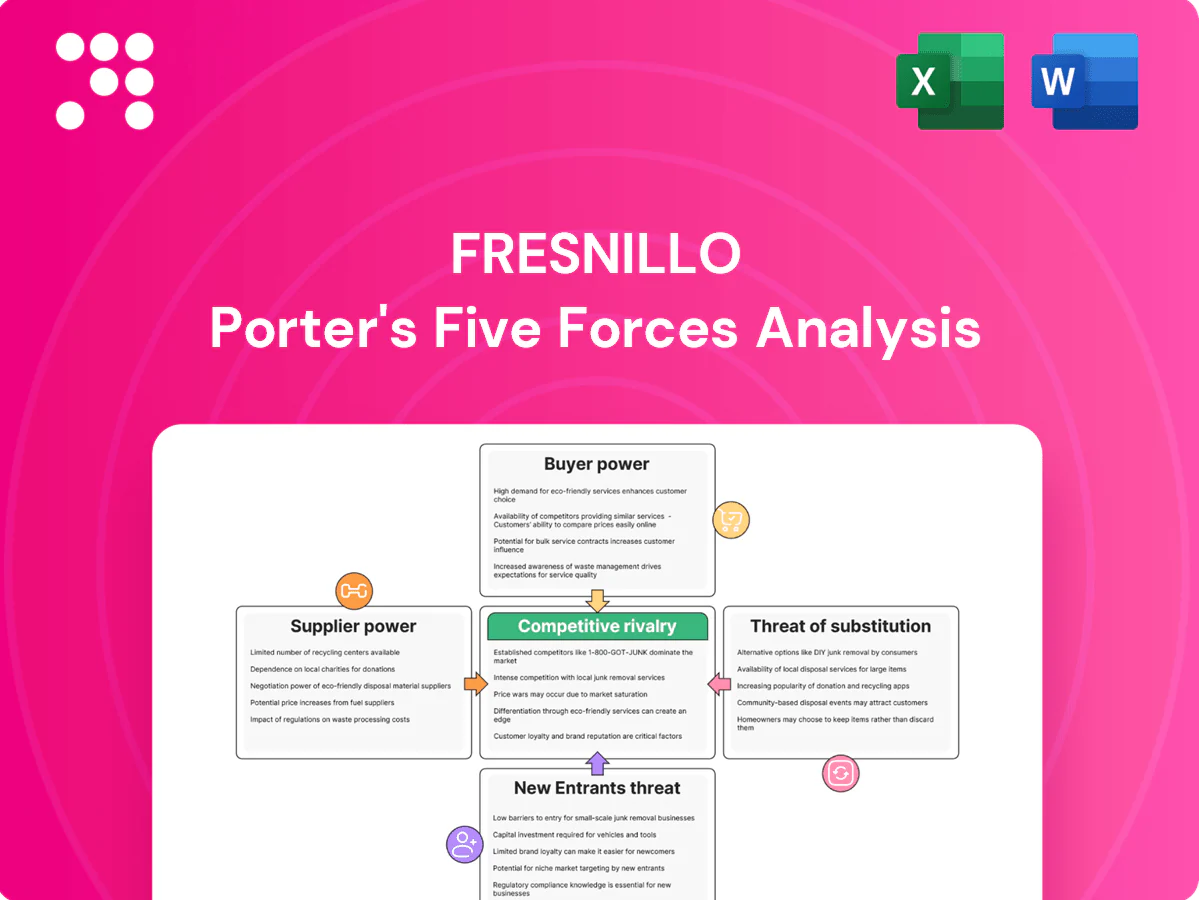
Fresnillo Porter's Five Forces Analysis

A Must-Have Tool for Decision-Makers
Fresnillo operates in a capital‑intensive, commodity‑driven silver and gold mining sector where price volatility and regulatory risk heighten competitive pressure. Supplier influence is moderate due to specialized equipment and energy costs, while buyer power is limited by commodity pricing mechanisms; substitutes are minimal but rivalry among established miners is intense. Entry barriers are high, protecting incumbents yet exposing them to cyclical demand shifts. This brief snapshot only scratches the surface. Unlock the full Porter's Five Forces Analysis to explore Fresnillo’s competitive dynamics, market pressures, and strategic advantages in detail.
Suppliers Bargaining Power

Critical input concentration
Explosives, cyanide, grinding media and specialty reagents are sourced from a narrow set of global suppliers (typically 3–5 key manufacturers), giving suppliers pricing leverage and periodic availability tightness; OEMs for drills, loaders and haul trucks (Caterpillar, Komatsu, others) have spare-part lead times often 12–26 weeks, pressuring costs and uptime, while Fresnillo uses diversified sourcing and inventory buffers to partly mitigate these risks.
Energy and fuel dependence
Diesel and electricity are major cost drivers for Fresnillo’s underground and open-pit operations, with energy representing up to 25% of mining operating costs in the sector. Volatile energy markets and intermittent grid reliability in key Mexican mining regions have material impacts on margins and production continuity. Long-term power contracts and on-site generation/PPAs deployed by miners can materially reduce exposure to spot price swings. Fuel hedging mitigates price volatility but cannot eliminate operational risk from outages or supply disruptions.

Skilled labor and contractors
Specialized mining talent, maintenance crews and drilling/engineering contractors are scarce in several Mexican districts, increasing suppliers’ bargaining power. Tight local labor markets and strong union dynamics can push up wage demands and contractual terms. Company-run training pipelines and local workforce development programs reduce dependency on external specialists. Multi-year service agreements (typically 3–5 years) help stabilize availability and costs.

Water, land, and community access
Access to water rights, land easements and community permissions is critical and highly localized for Fresnillo; ejidos account for roughly half of Mexico’s rural land, concentrating bargaining power. Communities and landholders can materially delay projects and add costs through negotiations or legal actions. Strong social license and benefit-sharing lower disruption risk, while 2024 regulatory scrutiny on water use pushed compliance and monitoring costs up by about 10% in the Mexican mining sector.
- Local concentration: ejidos ~50% of rural land
- Delay/cost risk: community leverage high
- Mitigation: social license, benefit-sharing
- 2024 impact: water compliance ~+10% costs
Logistics and smelting interfaces
Logistics, port access and smelter/refinery slots are chokepoints for Fresnillo, with 2024 smelter utilization near 90% increasing counterparty leverage on concentrates and strict impurity penalty regimes. Multi-offtake options and blending reduce penalties and improve payable terms, while insurance and secure logistics are critical for doré shipments to limit theft and loss.
- Chokepoints: ports, transport, smelters
- 2024 smelter utilization ~90%
- Blending/multi-offtake lowers penalties
- Insurance/secure logistics vital for doré
Tight suppliers (3-5), 12-26 wk spare-part lead times, energy ~25% squeezes margins
Supplier concentration (explosives/reagents/OEMs) is tight (3–5 key firms), giving pricing leverage and availability risk; spare-part lead times 12–26 weeks raise downtime costs. Energy and fuel drive ~25% of operating costs, with volatility materially affecting margins. Water/community rights and smelter/logistics chokepoints increase local bargaining power and delay risk; 2024 water compliance rose costs ~+10%.
| Metric | 2024 |
|---|---|
| Key suppliers | 3–5 |
| Spare-part lead time | 12–26 wks |
| Energy cost share | ~25% |
| Smelter utilization | ~90% |
| Water compliance impact | +10% cost |
What is included in the product
 Detailed Word Document
Analyzes five competitive forces shaping Fresnillo’s profitability—rivalry, supplier and buyer power, threats from substitutes and new entrants—highlighting industry data and strategic implications. Tailored for Fresnillo, it identifies disruptive threats, entry barriers and pricing influences for use in reports, investor decks or business plans.

 Customizable Excel Spreadsheet
One-sheet Fresnillo Porter’s Five Forces summary—clarifies competitive pressures across mining, suppliers, buyers, substitutes and entrants so decision-makers quickly identify relief strategies and prioritize actions for margins and risk mitigation.
Customers Bargaining Power

Commodity price transparency
Silver and gold are traded to global LBMA/LME benchmarks, so buyers cannot unilaterally set base prices in 2024, constraining direct bargaining power. Buyers’ real leverage concentrates on treatment/refining charges, penalties and payment terms rather than spot price. Transparent benchmarks in 2024 limit unilateral pricing shifts, though quality differentials still permit negotiation on TCRCs and deductions.
Smelter/refinery concentration
Concentrate buyers and precious‑metals refiners remain concentrated among a few global players—PAMP, Metalor, Valcambi, Umicore and DOWA dominate LBMA Good Delivery refining flows—allowing them to exert pressure on terms, TCRCs and impurity penalties. Such concentration can raise processing charges and stricter penalties for high‑impurity doré, but Fresnillo’s diversified offtake and multiple reputable refiner options improve optionality and help mitigate buyer leverage.

Product differentiation limits
Metals are largely undifferentiated, so buyers can shift suppliers based on quality and logistics, pressuring prices and contract terms. Fresnillo, as the world's largest primary silver producer in 2024, leverages scale, consistent specs and reliable delivery to secure better terms and lower transaction costs. Strong ESG and provenance credentials allow modest premiums, while forward contracts and offtake agreements lock volumes and curb opportunistic buyer switching.

Contract and credit terms
Contract and credit terms—payment schedules, quotational periods and allocation of credit risk—are primary levers buyers use to press margins; in 2024 Fresnillo’s stronger balance sheet and improved delivery reliability tightened buyers’ room to demand concessions. Prepayment or offtake financing structures in 2024 increasingly tied buyers to suppliers, and periods of market tightness shifted standard terms toward sellers.
- Payment terms: shorter tenor in 2024 favored Fresnillo
- Quotational periods: indexed pricing reduced buyer flexibility
- Credit risk: net-cash position end-2024 strengthened negotiating power
End-demand cyclicality
- 2024 silver avg price: ~$25/oz
- Industrial demand: ~45% of total
- Hedging/diversification reduce cashflow volatility
Leverage to TCRCs/terms; silver $25/oz, industrial 45%
Buyers cannot set LBMA/LME base prices in 2024; leverage focuses on TCRCs, penalties and payment terms, not spot pricing.
Refiner/concentrate buyers are concentrated (PAMP, Metalor, Valcambi, Umicore, DOWA), but Fresnillo’s scale and offtake optionality limit pressure.
Silver avg ~$25/oz in 2024; industrial demand ~45%; Fresnillo’s net-cash position and hedging reduce buyer bargaining room.
| Metric | 2024 |
|---|---|
| Silver average price | ~$25/oz |
| Industrial demand | ~45% |
| Major refiners | PAMP, Metalor, Valcambi, Umicore, DOWA |
| Fresnillo position | Largest primary silver producer; net-cash strengthened |
Preview the Actual Deliverable
Fresnillo Porter's Five Forces Analysis
This preview is the exact Porter’s Five Forces analysis of Fresnillo you’ll receive after purchase—no placeholders or excerpts. It contains the full competitive assessment, supplier and buyer power, threat of substitutes and new entrants, and rivalry insights. The delivered file is fully formatted and ready for immediate download and use.

A Must-Have Tool for Decision-Makers
Fresnillo operates in a capital‑intensive, commodity‑driven silver and gold mining sector where price volatility and regulatory risk heighten competitive pressure. Supplier influence is moderate due to specialized equipment and energy costs, while buyer power is limited by commodity pricing mechanisms; substitutes are minimal but rivalry among established miners is intense. Entry barriers are high, protecting incumbents yet exposing them to cyclical demand shifts. This brief snapshot only scratches the surface. Unlock the full Porter's Five Forces Analysis to explore Fresnillo’s competitive dynamics, market pressures, and strategic advantages in detail.
Suppliers Bargaining Power
Critical input concentration
Explosives, cyanide, grinding media and specialty reagents are sourced from a narrow set of global suppliers (typically 3–5 key manufacturers), giving suppliers pricing leverage and periodic availability tightness; OEMs for drills, loaders and haul trucks (Caterpillar, Komatsu, others) have spare-part lead times often 12–26 weeks, pressuring costs and uptime, while Fresnillo uses diversified sourcing and inventory buffers to partly mitigate these risks.
Energy and fuel dependence
Diesel and electricity are major cost drivers for Fresnillo’s underground and open-pit operations, with energy representing up to 25% of mining operating costs in the sector. Volatile energy markets and intermittent grid reliability in key Mexican mining regions have material impacts on margins and production continuity. Long-term power contracts and on-site generation/PPAs deployed by miners can materially reduce exposure to spot price swings. Fuel hedging mitigates price volatility but cannot eliminate operational risk from outages or supply disruptions.
Skilled labor and contractors
Specialized mining talent, maintenance crews and drilling/engineering contractors are scarce in several Mexican districts, increasing suppliers’ bargaining power. Tight local labor markets and strong union dynamics can push up wage demands and contractual terms. Company-run training pipelines and local workforce development programs reduce dependency on external specialists. Multi-year service agreements (typically 3–5 years) help stabilize availability and costs.
Water, land, and community access
Access to water rights, land easements and community permissions is critical and highly localized for Fresnillo; ejidos account for roughly half of Mexico’s rural land, concentrating bargaining power. Communities and landholders can materially delay projects and add costs through negotiations or legal actions. Strong social license and benefit-sharing lower disruption risk, while 2024 regulatory scrutiny on water use pushed compliance and monitoring costs up by about 10% in the Mexican mining sector.
- Local concentration: ejidos ~50% of rural land
- Delay/cost risk: community leverage high
- Mitigation: social license, benefit-sharing
- 2024 impact: water compliance ~+10% costs
Logistics and smelting interfaces
Logistics, port access and smelter/refinery slots are chokepoints for Fresnillo, with 2024 smelter utilization near 90% increasing counterparty leverage on concentrates and strict impurity penalty regimes. Multi-offtake options and blending reduce penalties and improve payable terms, while insurance and secure logistics are critical for doré shipments to limit theft and loss.
- Chokepoints: ports, transport, smelters
- 2024 smelter utilization ~90%
- Blending/multi-offtake lowers penalties
- Insurance/secure logistics vital for doré
Tight suppliers (3-5), 12-26 wk spare-part lead times, energy ~25% squeezes margins
Supplier concentration (explosives/reagents/OEMs) is tight (3–5 key firms), giving pricing leverage and availability risk; spare-part lead times 12–26 weeks raise downtime costs. Energy and fuel drive ~25% of operating costs, with volatility materially affecting margins. Water/community rights and smelter/logistics chokepoints increase local bargaining power and delay risk; 2024 water compliance rose costs ~+10%.
| Metric | 2024 |
|---|---|
| Key suppliers | 3–5 |
| Spare-part lead time | 12–26 wks |
| Energy cost share | ~25% |
| Smelter utilization | ~90% |
| Water compliance impact | +10% cost |
What is included in the product
Detailed Word Document
Analyzes five competitive forces shaping Fresnillo’s profitability—rivalry, supplier and buyer power, threats from substitutes and new entrants—highlighting industry data and strategic implications. Tailored for Fresnillo, it identifies disruptive threats, entry barriers and pricing influences for use in reports, investor decks or business plans.
Customizable Excel Spreadsheet
One-sheet Fresnillo Porter’s Five Forces summary—clarifies competitive pressures across mining, suppliers, buyers, substitutes and entrants so decision-makers quickly identify relief strategies and prioritize actions for margins and risk mitigation.
Customers Bargaining Power
Commodity price transparency
Silver and gold are traded to global LBMA/LME benchmarks, so buyers cannot unilaterally set base prices in 2024, constraining direct bargaining power. Buyers’ real leverage concentrates on treatment/refining charges, penalties and payment terms rather than spot price. Transparent benchmarks in 2024 limit unilateral pricing shifts, though quality differentials still permit negotiation on TCRCs and deductions.
Smelter/refinery concentration
Concentrate buyers and precious‑metals refiners remain concentrated among a few global players—PAMP, Metalor, Valcambi, Umicore and DOWA dominate LBMA Good Delivery refining flows—allowing them to exert pressure on terms, TCRCs and impurity penalties. Such concentration can raise processing charges and stricter penalties for high‑impurity doré, but Fresnillo’s diversified offtake and multiple reputable refiner options improve optionality and help mitigate buyer leverage.
Product differentiation limits
Metals are largely undifferentiated, so buyers can shift suppliers based on quality and logistics, pressuring prices and contract terms. Fresnillo, as the world's largest primary silver producer in 2024, leverages scale, consistent specs and reliable delivery to secure better terms and lower transaction costs. Strong ESG and provenance credentials allow modest premiums, while forward contracts and offtake agreements lock volumes and curb opportunistic buyer switching.
Contract and credit terms
Contract and credit terms—payment schedules, quotational periods and allocation of credit risk—are primary levers buyers use to press margins; in 2024 Fresnillo’s stronger balance sheet and improved delivery reliability tightened buyers’ room to demand concessions. Prepayment or offtake financing structures in 2024 increasingly tied buyers to suppliers, and periods of market tightness shifted standard terms toward sellers.
- Payment terms: shorter tenor in 2024 favored Fresnillo
- Quotational periods: indexed pricing reduced buyer flexibility
- Credit risk: net-cash position end-2024 strengthened negotiating power
End-demand cyclicality
- 2024 silver avg price: ~$25/oz
- Industrial demand: ~45% of total
- Hedging/diversification reduce cashflow volatility
Leverage to TCRCs/terms; silver $25/oz, industrial 45%
Buyers cannot set LBMA/LME base prices in 2024; leverage focuses on TCRCs, penalties and payment terms, not spot pricing.
Refiner/concentrate buyers are concentrated (PAMP, Metalor, Valcambi, Umicore, DOWA), but Fresnillo’s scale and offtake optionality limit pressure.
Silver avg ~$25/oz in 2024; industrial demand ~45%; Fresnillo’s net-cash position and hedging reduce buyer bargaining room.
| Metric | 2024 |
|---|---|
| Silver average price | ~$25/oz |
| Industrial demand | ~45% |
| Major refiners | PAMP, Metalor, Valcambi, Umicore, DOWA |
| Fresnillo position | Largest primary silver producer; net-cash strengthened |
Preview the Actual Deliverable
Fresnillo Porter's Five Forces Analysis
This preview is the exact Porter’s Five Forces analysis of Fresnillo you’ll receive after purchase—no placeholders or excerpts. It contains the full competitive assessment, supplier and buyer power, threat of substitutes and new entrants, and rivalry insights. The delivered file is fully formatted and ready for immediate download and use.
Description
A Must-Have Tool for Decision-Makers
Fresnillo operates in a capital‑intensive, commodity‑driven silver and gold mining sector where price volatility and regulatory risk heighten competitive pressure. Supplier influence is moderate due to specialized equipment and energy costs, while buyer power is limited by commodity pricing mechanisms; substitutes are minimal but rivalry among established miners is intense. Entry barriers are high, protecting incumbents yet exposing them to cyclical demand shifts. This brief snapshot only scratches the surface. Unlock the full Porter's Five Forces Analysis to explore Fresnillo’s competitive dynamics, market pressures, and strategic advantages in detail.
Suppliers Bargaining Power
Critical input concentration
Explosives, cyanide, grinding media and specialty reagents are sourced from a narrow set of global suppliers (typically 3–5 key manufacturers), giving suppliers pricing leverage and periodic availability tightness; OEMs for drills, loaders and haul trucks (Caterpillar, Komatsu, others) have spare-part lead times often 12–26 weeks, pressuring costs and uptime, while Fresnillo uses diversified sourcing and inventory buffers to partly mitigate these risks.
Energy and fuel dependence
Diesel and electricity are major cost drivers for Fresnillo’s underground and open-pit operations, with energy representing up to 25% of mining operating costs in the sector. Volatile energy markets and intermittent grid reliability in key Mexican mining regions have material impacts on margins and production continuity. Long-term power contracts and on-site generation/PPAs deployed by miners can materially reduce exposure to spot price swings. Fuel hedging mitigates price volatility but cannot eliminate operational risk from outages or supply disruptions.
Skilled labor and contractors
Specialized mining talent, maintenance crews and drilling/engineering contractors are scarce in several Mexican districts, increasing suppliers’ bargaining power. Tight local labor markets and strong union dynamics can push up wage demands and contractual terms. Company-run training pipelines and local workforce development programs reduce dependency on external specialists. Multi-year service agreements (typically 3–5 years) help stabilize availability and costs.
Water, land, and community access
Access to water rights, land easements and community permissions is critical and highly localized for Fresnillo; ejidos account for roughly half of Mexico’s rural land, concentrating bargaining power. Communities and landholders can materially delay projects and add costs through negotiations or legal actions. Strong social license and benefit-sharing lower disruption risk, while 2024 regulatory scrutiny on water use pushed compliance and monitoring costs up by about 10% in the Mexican mining sector.
- Local concentration: ejidos ~50% of rural land
- Delay/cost risk: community leverage high
- Mitigation: social license, benefit-sharing
- 2024 impact: water compliance ~+10% costs
Logistics and smelting interfaces
Logistics, port access and smelter/refinery slots are chokepoints for Fresnillo, with 2024 smelter utilization near 90% increasing counterparty leverage on concentrates and strict impurity penalty regimes. Multi-offtake options and blending reduce penalties and improve payable terms, while insurance and secure logistics are critical for doré shipments to limit theft and loss.
- Chokepoints: ports, transport, smelters
- 2024 smelter utilization ~90%
- Blending/multi-offtake lowers penalties
- Insurance/secure logistics vital for doré
Tight suppliers (3-5), 12-26 wk spare-part lead times, energy ~25% squeezes margins
Supplier concentration (explosives/reagents/OEMs) is tight (3–5 key firms), giving pricing leverage and availability risk; spare-part lead times 12–26 weeks raise downtime costs. Energy and fuel drive ~25% of operating costs, with volatility materially affecting margins. Water/community rights and smelter/logistics chokepoints increase local bargaining power and delay risk; 2024 water compliance rose costs ~+10%.
| Metric | 2024 |
|---|---|
| Key suppliers | 3–5 |
| Spare-part lead time | 12–26 wks |
| Energy cost share | ~25% |
| Smelter utilization | ~90% |
| Water compliance impact | +10% cost |
What is included in the product
Detailed Word Document
Analyzes five competitive forces shaping Fresnillo’s profitability—rivalry, supplier and buyer power, threats from substitutes and new entrants—highlighting industry data and strategic implications. Tailored for Fresnillo, it identifies disruptive threats, entry barriers and pricing influences for use in reports, investor decks or business plans.
Customizable Excel Spreadsheet
One-sheet Fresnillo Porter’s Five Forces summary—clarifies competitive pressures across mining, suppliers, buyers, substitutes and entrants so decision-makers quickly identify relief strategies and prioritize actions for margins and risk mitigation.
Customers Bargaining Power
Commodity price transparency
Silver and gold are traded to global LBMA/LME benchmarks, so buyers cannot unilaterally set base prices in 2024, constraining direct bargaining power. Buyers’ real leverage concentrates on treatment/refining charges, penalties and payment terms rather than spot price. Transparent benchmarks in 2024 limit unilateral pricing shifts, though quality differentials still permit negotiation on TCRCs and deductions.
Smelter/refinery concentration
Concentrate buyers and precious‑metals refiners remain concentrated among a few global players—PAMP, Metalor, Valcambi, Umicore and DOWA dominate LBMA Good Delivery refining flows—allowing them to exert pressure on terms, TCRCs and impurity penalties. Such concentration can raise processing charges and stricter penalties for high‑impurity doré, but Fresnillo’s diversified offtake and multiple reputable refiner options improve optionality and help mitigate buyer leverage.
Product differentiation limits
Metals are largely undifferentiated, so buyers can shift suppliers based on quality and logistics, pressuring prices and contract terms. Fresnillo, as the world's largest primary silver producer in 2024, leverages scale, consistent specs and reliable delivery to secure better terms and lower transaction costs. Strong ESG and provenance credentials allow modest premiums, while forward contracts and offtake agreements lock volumes and curb opportunistic buyer switching.
Contract and credit terms
Contract and credit terms—payment schedules, quotational periods and allocation of credit risk—are primary levers buyers use to press margins; in 2024 Fresnillo’s stronger balance sheet and improved delivery reliability tightened buyers’ room to demand concessions. Prepayment or offtake financing structures in 2024 increasingly tied buyers to suppliers, and periods of market tightness shifted standard terms toward sellers.
- Payment terms: shorter tenor in 2024 favored Fresnillo
- Quotational periods: indexed pricing reduced buyer flexibility
- Credit risk: net-cash position end-2024 strengthened negotiating power
End-demand cyclicality
- 2024 silver avg price: ~$25/oz
- Industrial demand: ~45% of total
- Hedging/diversification reduce cashflow volatility
Leverage to TCRCs/terms; silver $25/oz, industrial 45%
Buyers cannot set LBMA/LME base prices in 2024; leverage focuses on TCRCs, penalties and payment terms, not spot pricing.
Refiner/concentrate buyers are concentrated (PAMP, Metalor, Valcambi, Umicore, DOWA), but Fresnillo’s scale and offtake optionality limit pressure.
Silver avg ~$25/oz in 2024; industrial demand ~45%; Fresnillo’s net-cash position and hedging reduce buyer bargaining room.
| Metric | 2024 |
|---|---|
| Silver average price | ~$25/oz |
| Industrial demand | ~45% |
| Major refiners | PAMP, Metalor, Valcambi, Umicore, DOWA |
| Fresnillo position | Largest primary silver producer; net-cash strengthened |
Preview the Actual Deliverable
Fresnillo Porter's Five Forces Analysis
This preview is the exact Porter’s Five Forces analysis of Fresnillo you’ll receive after purchase—no placeholders or excerpts. It contains the full competitive assessment, supplier and buyer power, threat of substitutes and new entrants, and rivalry insights. The delivered file is fully formatted and ready for immediate download and use.











