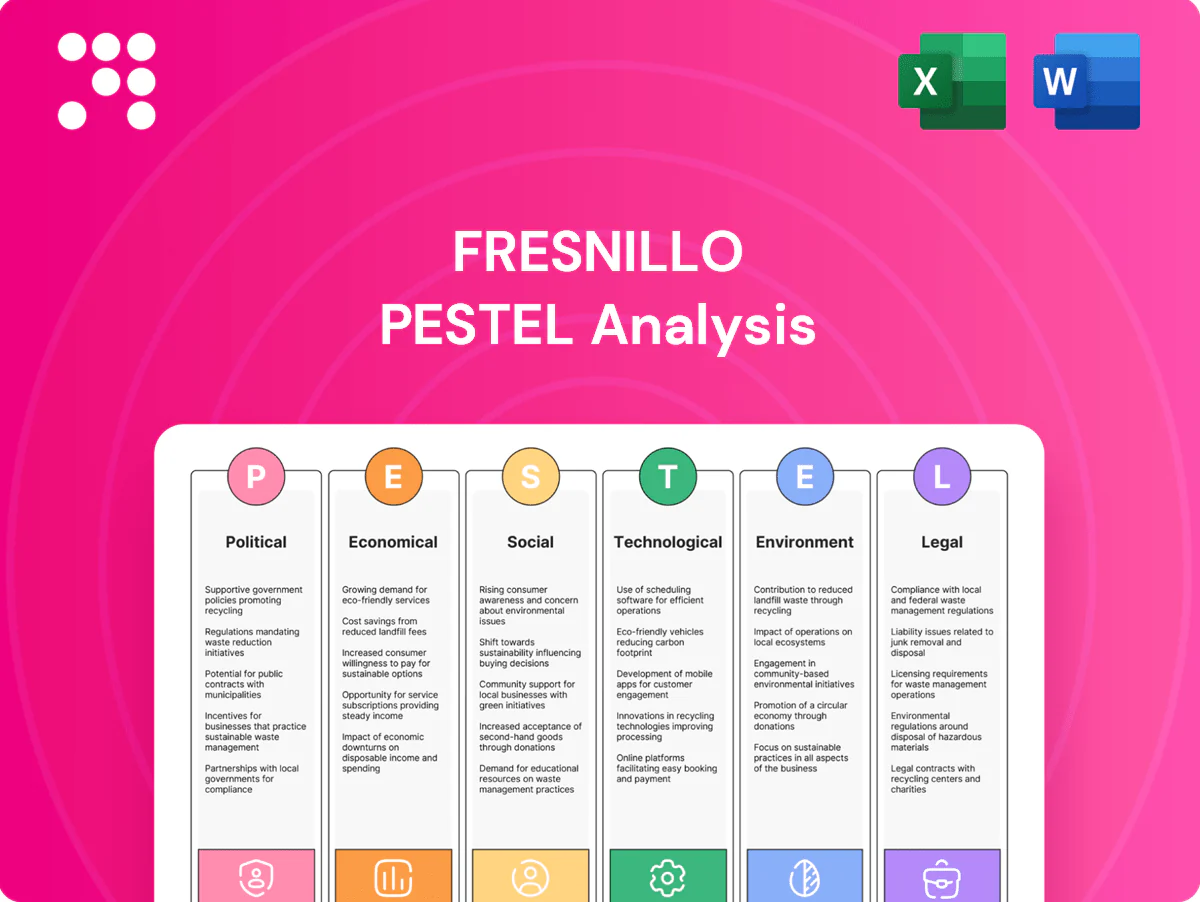
Fresnillo PESTLE Analysis

Plan Smarter. Present Sharper. Compete Stronger.
Discover how political shifts, commodity cycles, and environmental regulation are reshaping Fresnillo’s prospects in our concise PESTLE snapshot—insights designed to power smarter investment and strategy decisions. This summary highlights key external risks and opportunities; the full PESTLE delivers detailed evidence, implications, and tactical recommendations. Buy the complete analysis now to unlock actionable intelligence for your next move.
Political factors

Mexican federal policy stability
Fresnillo’s operations hinge on continuity in Mexico’s mining policy, fiscal stance and incentives, since mineral concessions in Mexico can be granted for terms up to 50 years. Shifts in federal priorities after the Dec 1, 2024 administration change have already tightened permitting timelines and increased compliance scrutiny. Stable policy is critical for multi-decade mine plans and capex scheduling. Political turnover raises measurable risks of delays and added compliance burdens.
Resource nationalism risk
Resource nationalism risk could push calls for higher state take or local-content rules that lift operating costs and squeeze Fresnillo plc, the world’s largest primary silver producer; renegotiated royalties or tighter export controls would materially alter project economics and capital allocation. Clear, ongoing engagement with federal and state authorities helps mitigate abrupt policy shifts, while operating across multiple Mexican states spreads political exposure and reduces single-jurisdiction concentration risk.

State-level governance variability
Permits, land access and security support for Fresnillo operations vary across Mexico's 32 states and local municipalities, with environmental and zoning approvals often taking 6–24 months. Strong local relationships in key regions such as Zacatecas and Durango ease access to infrastructure and social licences. Changes from 2024 state elections have reset some local expectations and agreements. Proactive community liaisons maintain operational continuity and reduce disruption risk.

Public security and crime
Organized crime in some Mexican regions raises logistics and personnel safety costs for Fresnillo, with periodic disruptions to concentrate transport and reduced contractor availability; the company therefore increases coordination with federal and local authorities and relies on vetted supply chains. Insurance and contingency planning partially offset exposure but do not eliminate operational risk.
- Logistics costs up due to security
- Concentrate transport disruptions
- Contractor availability constrained
- Coordination with authorities essential
- Insurance/contingency mitigate but not remove risk
Trade and foreign relations
USMCA, in force since 1 July 2020, maintains trade continuity with the US and Canada, shaping Fresnillo’s equipment imports and sales routes; global trade norms and supply-chain rules of origin affect procurement timing and cost. Tariffs or sanctions on reagents and machinery would raise capex and opex and could delay projects, while stable cross-border flows support maintenance and expansion timelines; diplomatic shifts influence international financing appetite for Mexican mining.
- USMCA effective 1 July 2020
- Sanctions/tariffs risk raises capex/opex
- Stable cross-border flows aid timelines
- Diplomatic shifts alter financing appetite
Policy shift raises permitting, royalty and security risks for Mexican silver miner
Fresnillo faces policy continuity risk after the Dec 1, 2024 administration change; mineral concessions remain up to 50 years but permitting and compliance scrutiny have tightened, raising delay risk. Resource nationalism, local-content and royalty talks could raise costs. Security elevates logistics and insurance expenses. USMCA (effective 1 Jul 2020) preserves trade routes.
| Metric | Value |
|---|---|
| Concession term | Up to 50 years |
| Permitting | 6–24 months |
| Admin change | Dec 1, 2024 |
| USMCA | Effective 1 Jul 2020 |
What is included in the product
 Detailed Word Document
Explores how Political, Economic, Social, Technological, Environmental and Legal forces specifically affect Fresnillo’s mining operations and value chain, with data-backed trends, regionally grounded risks/opportunities and forward-looking implications to guide executives, investors and strategists in scenario planning and capital allocation.

 Customizable Excel Spreadsheet
A concise, visually segmented PESTLE summary of Fresnillo that highlights regulatory, environmental, and commodity risks for quick inclusion in presentations and team briefs, editable for local context and easily shared across departments.
Economic factors

Silver and gold price volatility
Fresnillo, the world’s largest primary silver producer, has revenue highly sensitive to silver and gold cycles as metals traded near $30/oz for silver and $2,350/oz for gold in mid-2025. Macro rates, inflation and safe-haven flows remain primary drivers of these swings, which can move revenues by double-digit percentages. The group uses hedging and flexible mine plans to cushion downturns, while upside prices accelerate payback periods and boost exploration and development spend.
Exchange rate MXN vs USD
Fresnillo's costs are largely in MXN while most revenues are USD-linked, creating a natural hedge that benefited EBITDA when the peso traded around 17.6 MXN per USD in June 2025. Peso depreciation lowers unit costs in USD terms, improving margins on metal sales. However, sharp MXN swings complicate budgeting and wage negotiations, so active currency risk management is used to support margin stability.

Input cost inflation
Energy, steel, explosives and reagents are key drivers of Fresnillo’s all-in sustaining costs, with global supply-chain tightness raising lead times and upward price pressure. Long-term procurement contracts and on-site reagent blending/local sourcing help dampen volatility. Sustained productivity gains and cost control are required to offset input-cost creep and protect operating cash flow.

Capital availability and rates
By-product credits (Pb/Zn)
Pb and Zn LME prices (zinc ~US$3,200/t, lead ~US$2,100/t in 2024) materially reduce Fresnillo’s net cash costs via by-product credits; swings in construction and manufacturing demand drive these prices. Diversified base‑metal credits help cushion earnings when silver softens, while smelter terms and treatment charges can offset part of those credits.
- By-product credits: lower net cash costs
- Drivers: construction/manufacturing cycles
- 2024 prices: zinc ~US$3,200/t; lead ~US$2,100/t
- Risks: smelter terms & treatment charges
Policy shift raises permitting, royalty and security risks for Mexican silver miner
Fresnillo’s revenue and capex sensitivity tracks silver ~$30/oz and gold ~$2,350/oz (mid‑2025), with metal cycles and safe‑haven flows driving double‑digit EBITDA swings. MXN ~17.6/USD (June 2025) gives a natural USD hedge, lowering USD unit costs when peso weakens. Input costs (energy, reagents) and base‑metal credits (Zn ~$3,200/t, Pb ~$2,100/t in 2024) materially affect all‑in sustaining costs.
| Metric | Value |
|---|---|
| Silver | $30/oz |
| Gold | $2,350/oz |
| MXN/USD | 17.6 |
| Zinc | $3,200/t |
| Lead | $2,100/t |
Preview the Actual Deliverable
Fresnillo PESTLE Analysis
The preview shown here is the exact Fresnillo PESTLE Analysis document you’ll receive after purchase—fully formatted, professionally structured, and ready to use. The content, layout, and data visible are identical to the downloadable file. No placeholders or surprises—this is the finished product delivered instantly after payment.

Plan Smarter. Present Sharper. Compete Stronger.
Discover how political shifts, commodity cycles, and environmental regulation are reshaping Fresnillo’s prospects in our concise PESTLE snapshot—insights designed to power smarter investment and strategy decisions. This summary highlights key external risks and opportunities; the full PESTLE delivers detailed evidence, implications, and tactical recommendations. Buy the complete analysis now to unlock actionable intelligence for your next move.
Political factors
Mexican federal policy stability
Fresnillo’s operations hinge on continuity in Mexico’s mining policy, fiscal stance and incentives, since mineral concessions in Mexico can be granted for terms up to 50 years. Shifts in federal priorities after the Dec 1, 2024 administration change have already tightened permitting timelines and increased compliance scrutiny. Stable policy is critical for multi-decade mine plans and capex scheduling. Political turnover raises measurable risks of delays and added compliance burdens.
Resource nationalism risk
Resource nationalism risk could push calls for higher state take or local-content rules that lift operating costs and squeeze Fresnillo plc, the world’s largest primary silver producer; renegotiated royalties or tighter export controls would materially alter project economics and capital allocation. Clear, ongoing engagement with federal and state authorities helps mitigate abrupt policy shifts, while operating across multiple Mexican states spreads political exposure and reduces single-jurisdiction concentration risk.
State-level governance variability
Permits, land access and security support for Fresnillo operations vary across Mexico's 32 states and local municipalities, with environmental and zoning approvals often taking 6–24 months. Strong local relationships in key regions such as Zacatecas and Durango ease access to infrastructure and social licences. Changes from 2024 state elections have reset some local expectations and agreements. Proactive community liaisons maintain operational continuity and reduce disruption risk.
Public security and crime
Organized crime in some Mexican regions raises logistics and personnel safety costs for Fresnillo, with periodic disruptions to concentrate transport and reduced contractor availability; the company therefore increases coordination with federal and local authorities and relies on vetted supply chains. Insurance and contingency planning partially offset exposure but do not eliminate operational risk.
- Logistics costs up due to security
- Concentrate transport disruptions
- Contractor availability constrained
- Coordination with authorities essential
- Insurance/contingency mitigate but not remove risk
Trade and foreign relations
USMCA, in force since 1 July 2020, maintains trade continuity with the US and Canada, shaping Fresnillo’s equipment imports and sales routes; global trade norms and supply-chain rules of origin affect procurement timing and cost. Tariffs or sanctions on reagents and machinery would raise capex and opex and could delay projects, while stable cross-border flows support maintenance and expansion timelines; diplomatic shifts influence international financing appetite for Mexican mining.
- USMCA effective 1 July 2020
- Sanctions/tariffs risk raises capex/opex
- Stable cross-border flows aid timelines
- Diplomatic shifts alter financing appetite
Policy shift raises permitting, royalty and security risks for Mexican silver miner
Fresnillo faces policy continuity risk after the Dec 1, 2024 administration change; mineral concessions remain up to 50 years but permitting and compliance scrutiny have tightened, raising delay risk. Resource nationalism, local-content and royalty talks could raise costs. Security elevates logistics and insurance expenses. USMCA (effective 1 Jul 2020) preserves trade routes.
| Metric | Value |
|---|---|
| Concession term | Up to 50 years |
| Permitting | 6–24 months |
| Admin change | Dec 1, 2024 |
| USMCA | Effective 1 Jul 2020 |
What is included in the product
Detailed Word Document
Explores how Political, Economic, Social, Technological, Environmental and Legal forces specifically affect Fresnillo’s mining operations and value chain, with data-backed trends, regionally grounded risks/opportunities and forward-looking implications to guide executives, investors and strategists in scenario planning and capital allocation.
Customizable Excel Spreadsheet
A concise, visually segmented PESTLE summary of Fresnillo that highlights regulatory, environmental, and commodity risks for quick inclusion in presentations and team briefs, editable for local context and easily shared across departments.
Economic factors
Silver and gold price volatility
Fresnillo, the world’s largest primary silver producer, has revenue highly sensitive to silver and gold cycles as metals traded near $30/oz for silver and $2,350/oz for gold in mid-2025. Macro rates, inflation and safe-haven flows remain primary drivers of these swings, which can move revenues by double-digit percentages. The group uses hedging and flexible mine plans to cushion downturns, while upside prices accelerate payback periods and boost exploration and development spend.
Exchange rate MXN vs USD
Fresnillo's costs are largely in MXN while most revenues are USD-linked, creating a natural hedge that benefited EBITDA when the peso traded around 17.6 MXN per USD in June 2025. Peso depreciation lowers unit costs in USD terms, improving margins on metal sales. However, sharp MXN swings complicate budgeting and wage negotiations, so active currency risk management is used to support margin stability.
Input cost inflation
Energy, steel, explosives and reagents are key drivers of Fresnillo’s all-in sustaining costs, with global supply-chain tightness raising lead times and upward price pressure. Long-term procurement contracts and on-site reagent blending/local sourcing help dampen volatility. Sustained productivity gains and cost control are required to offset input-cost creep and protect operating cash flow.
Capital availability and rates
By-product credits (Pb/Zn)
Pb and Zn LME prices (zinc ~US$3,200/t, lead ~US$2,100/t in 2024) materially reduce Fresnillo’s net cash costs via by-product credits; swings in construction and manufacturing demand drive these prices. Diversified base‑metal credits help cushion earnings when silver softens, while smelter terms and treatment charges can offset part of those credits.
- By-product credits: lower net cash costs
- Drivers: construction/manufacturing cycles
- 2024 prices: zinc ~US$3,200/t; lead ~US$2,100/t
- Risks: smelter terms & treatment charges
Policy shift raises permitting, royalty and security risks for Mexican silver miner
Fresnillo’s revenue and capex sensitivity tracks silver ~$30/oz and gold ~$2,350/oz (mid‑2025), with metal cycles and safe‑haven flows driving double‑digit EBITDA swings. MXN ~17.6/USD (June 2025) gives a natural USD hedge, lowering USD unit costs when peso weakens. Input costs (energy, reagents) and base‑metal credits (Zn ~$3,200/t, Pb ~$2,100/t in 2024) materially affect all‑in sustaining costs.
| Metric | Value |
|---|---|
| Silver | $30/oz |
| Gold | $2,350/oz |
| MXN/USD | 17.6 |
| Zinc | $3,200/t |
| Lead | $2,100/t |
Preview the Actual Deliverable
Fresnillo PESTLE Analysis
The preview shown here is the exact Fresnillo PESTLE Analysis document you’ll receive after purchase—fully formatted, professionally structured, and ready to use. The content, layout, and data visible are identical to the downloadable file. No placeholders or surprises—this is the finished product delivered instantly after payment.
Description
Plan Smarter. Present Sharper. Compete Stronger.
Discover how political shifts, commodity cycles, and environmental regulation are reshaping Fresnillo’s prospects in our concise PESTLE snapshot—insights designed to power smarter investment and strategy decisions. This summary highlights key external risks and opportunities; the full PESTLE delivers detailed evidence, implications, and tactical recommendations. Buy the complete analysis now to unlock actionable intelligence for your next move.
Political factors
Mexican federal policy stability
Fresnillo’s operations hinge on continuity in Mexico’s mining policy, fiscal stance and incentives, since mineral concessions in Mexico can be granted for terms up to 50 years. Shifts in federal priorities after the Dec 1, 2024 administration change have already tightened permitting timelines and increased compliance scrutiny. Stable policy is critical for multi-decade mine plans and capex scheduling. Political turnover raises measurable risks of delays and added compliance burdens.
Resource nationalism risk
Resource nationalism risk could push calls for higher state take or local-content rules that lift operating costs and squeeze Fresnillo plc, the world’s largest primary silver producer; renegotiated royalties or tighter export controls would materially alter project economics and capital allocation. Clear, ongoing engagement with federal and state authorities helps mitigate abrupt policy shifts, while operating across multiple Mexican states spreads political exposure and reduces single-jurisdiction concentration risk.
State-level governance variability
Permits, land access and security support for Fresnillo operations vary across Mexico's 32 states and local municipalities, with environmental and zoning approvals often taking 6–24 months. Strong local relationships in key regions such as Zacatecas and Durango ease access to infrastructure and social licences. Changes from 2024 state elections have reset some local expectations and agreements. Proactive community liaisons maintain operational continuity and reduce disruption risk.
Public security and crime
Organized crime in some Mexican regions raises logistics and personnel safety costs for Fresnillo, with periodic disruptions to concentrate transport and reduced contractor availability; the company therefore increases coordination with federal and local authorities and relies on vetted supply chains. Insurance and contingency planning partially offset exposure but do not eliminate operational risk.
- Logistics costs up due to security
- Concentrate transport disruptions
- Contractor availability constrained
- Coordination with authorities essential
- Insurance/contingency mitigate but not remove risk
Trade and foreign relations
USMCA, in force since 1 July 2020, maintains trade continuity with the US and Canada, shaping Fresnillo’s equipment imports and sales routes; global trade norms and supply-chain rules of origin affect procurement timing and cost. Tariffs or sanctions on reagents and machinery would raise capex and opex and could delay projects, while stable cross-border flows support maintenance and expansion timelines; diplomatic shifts influence international financing appetite for Mexican mining.
- USMCA effective 1 July 2020
- Sanctions/tariffs risk raises capex/opex
- Stable cross-border flows aid timelines
- Diplomatic shifts alter financing appetite
Policy shift raises permitting, royalty and security risks for Mexican silver miner
Fresnillo faces policy continuity risk after the Dec 1, 2024 administration change; mineral concessions remain up to 50 years but permitting and compliance scrutiny have tightened, raising delay risk. Resource nationalism, local-content and royalty talks could raise costs. Security elevates logistics and insurance expenses. USMCA (effective 1 Jul 2020) preserves trade routes.
| Metric | Value |
|---|---|
| Concession term | Up to 50 years |
| Permitting | 6–24 months |
| Admin change | Dec 1, 2024 |
| USMCA | Effective 1 Jul 2020 |
What is included in the product
Detailed Word Document
Explores how Political, Economic, Social, Technological, Environmental and Legal forces specifically affect Fresnillo’s mining operations and value chain, with data-backed trends, regionally grounded risks/opportunities and forward-looking implications to guide executives, investors and strategists in scenario planning and capital allocation.
Customizable Excel Spreadsheet
A concise, visually segmented PESTLE summary of Fresnillo that highlights regulatory, environmental, and commodity risks for quick inclusion in presentations and team briefs, editable for local context and easily shared across departments.
Economic factors
Silver and gold price volatility
Fresnillo, the world’s largest primary silver producer, has revenue highly sensitive to silver and gold cycles as metals traded near $30/oz for silver and $2,350/oz for gold in mid-2025. Macro rates, inflation and safe-haven flows remain primary drivers of these swings, which can move revenues by double-digit percentages. The group uses hedging and flexible mine plans to cushion downturns, while upside prices accelerate payback periods and boost exploration and development spend.
Exchange rate MXN vs USD
Fresnillo's costs are largely in MXN while most revenues are USD-linked, creating a natural hedge that benefited EBITDA when the peso traded around 17.6 MXN per USD in June 2025. Peso depreciation lowers unit costs in USD terms, improving margins on metal sales. However, sharp MXN swings complicate budgeting and wage negotiations, so active currency risk management is used to support margin stability.
Input cost inflation
Energy, steel, explosives and reagents are key drivers of Fresnillo’s all-in sustaining costs, with global supply-chain tightness raising lead times and upward price pressure. Long-term procurement contracts and on-site reagent blending/local sourcing help dampen volatility. Sustained productivity gains and cost control are required to offset input-cost creep and protect operating cash flow.
Capital availability and rates
By-product credits (Pb/Zn)
Pb and Zn LME prices (zinc ~US$3,200/t, lead ~US$2,100/t in 2024) materially reduce Fresnillo’s net cash costs via by-product credits; swings in construction and manufacturing demand drive these prices. Diversified base‑metal credits help cushion earnings when silver softens, while smelter terms and treatment charges can offset part of those credits.
- By-product credits: lower net cash costs
- Drivers: construction/manufacturing cycles
- 2024 prices: zinc ~US$3,200/t; lead ~US$2,100/t
- Risks: smelter terms & treatment charges
Policy shift raises permitting, royalty and security risks for Mexican silver miner
Fresnillo’s revenue and capex sensitivity tracks silver ~$30/oz and gold ~$2,350/oz (mid‑2025), with metal cycles and safe‑haven flows driving double‑digit EBITDA swings. MXN ~17.6/USD (June 2025) gives a natural USD hedge, lowering USD unit costs when peso weakens. Input costs (energy, reagents) and base‑metal credits (Zn ~$3,200/t, Pb ~$2,100/t in 2024) materially affect all‑in sustaining costs.
| Metric | Value |
|---|---|
| Silver | $30/oz |
| Gold | $2,350/oz |
| MXN/USD | 17.6 |
| Zinc | $3,200/t |
| Lead | $2,100/t |
Preview the Actual Deliverable
Fresnillo PESTLE Analysis
The preview shown here is the exact Fresnillo PESTLE Analysis document you’ll receive after purchase—fully formatted, professionally structured, and ready to use. The content, layout, and data visible are identical to the downloadable file. No placeholders or surprises—this is the finished product delivered instantly after payment.











