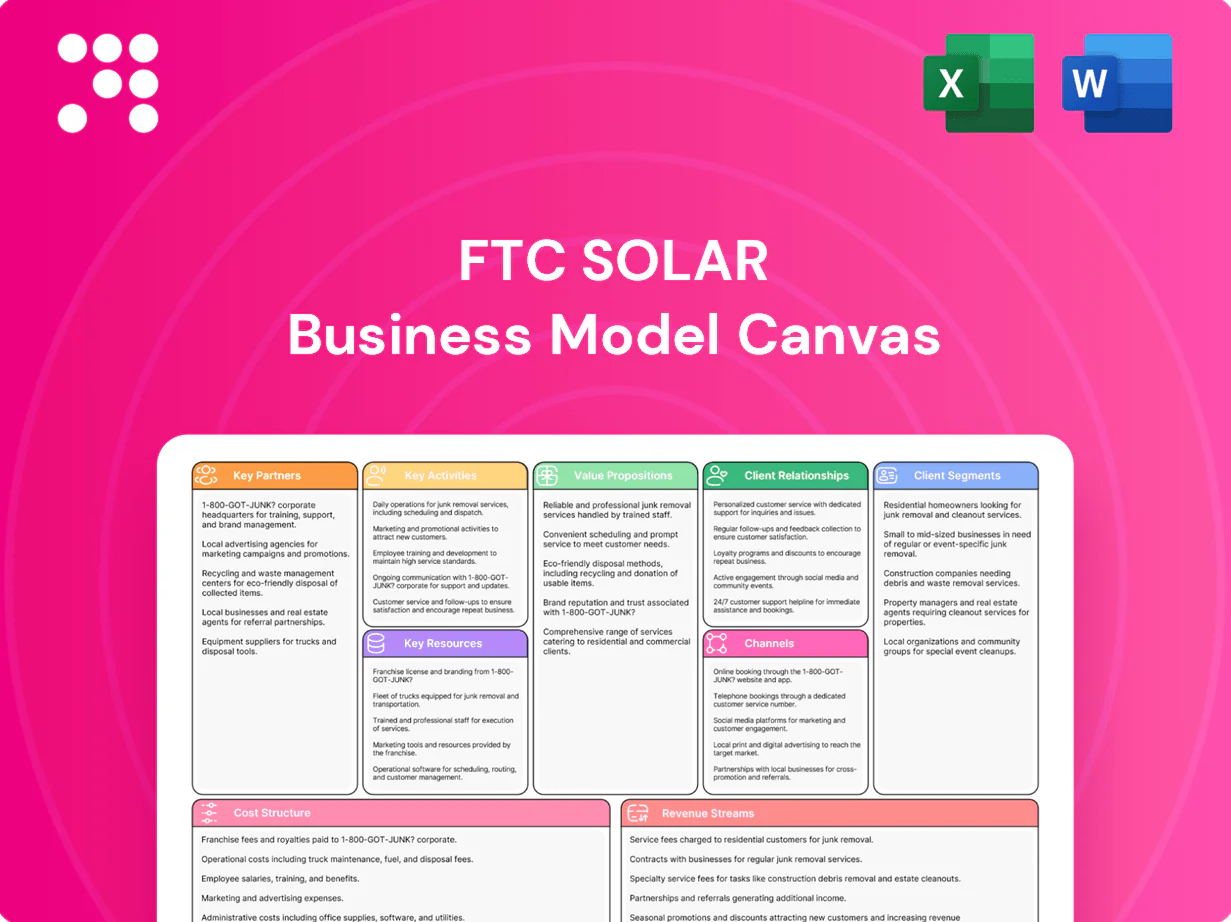
FTC Solar Business Model Canvas

Unlock the Business Model Canvas for utility-scale solar: key value props, customers, revenue
Unlock the full strategic blueprint behind FTC Solar with our Business Model Canvas—three concise sections preview key value propositions, customer segments, and revenue drivers. This downloadable, editable canvas reveals partnerships, cost structure, and scalability levers to inform decisions. Purchase the complete file for a section-by-section playbook investors and strategists can act on.
Partnerships

EPCs and Utility-Scale Developers
Partner with engineering, procurement, and construction firms and utility-scale developers to specify Voyager trackers early and integrate them into 100+ MW plant designs in 2024, aligning technology selection and site layouts. These partners drive layout decisions and procurement, reducing design cycles and installation risks through coordinated engineering. Joint bids with EPCs and developers improve win rates and enhance project bankability by presenting unified technical and commercial proposals.
Component and Materials Suppliers
Secure strategic suppliers for steel structures, torque tubes, bearings, motors, controllers and PV mounting hardware through multi-sourcing and VMI programs to stabilize costs and maintain >95% on-time parts availability. Co-engineering with suppliers simplifies assembly and boosts reliability, shortening installation cycles. Long-term agreements (typically 3–5 years) hedge commodity volatility and lock quality and pricing.

Software, SCADA, and Inverter OEMs
Integrating FTC Solar tracker control software with plant SCADA, inverters, and weather stations enables optimized tracking and yield gains; API partnerships use standards like IEC 61850 and IEC 62351 (and NERC CIP in North America) to ensure interoperability and cybersecurity. Joint OEM testing has been shown in vendor case studies to cut commissioning time and early faults by up to 40%. Co-marketing with inverter and SCADA OEMs expands access to utility-scale customers, where single bids often exceed $50m per project.

Financiers and Insurance/Banks
Engage lenders, tax equity and insurers to validate performance assumptions and O&M costs; bankability studies and third-party certifications de-risk adoption and support financing. In 2024 global solar project financing topped $200B, increasing lender scrutiny and demand for guarantees. Performance guarantees aligned with financing terms unlock more projects and relationships accelerate due diligence and deal closures.
- lenders / tax equity / insurers
- bankability studies & certification
- performance guarantees = finance-ready
- accelerated due diligence & closures
Installation and O&M Service Partners
Build networks of certified installers and maintenance providers across regions to localize service delivery and reduce logistics overhead; standardized training and tooling have been shown to cut installation times by up to 20% and warranty issues by similar margins in industry studies (2024).
Local partners reduce travel costs and response times—industry O&M benchmarks in 2024 report up to 35% faster fault response—and shared service data improves reliability and enables predictive maintenance, lowering unplanned downtime and O&M spend.
- Certified installer network: regionalized coverage
- Training & tooling: ~20% faster installs (2024)
- Local partners: ~35% faster response (2024)
- Shared data: enables predictive maintenance, cuts unplanned downtime
Embed 100+ MW trackers; tie suppliers 3-5y; tap $200B finance
Align with EPCs/developers to embed Voyager trackers in 100+ MW designs and joint bids to boost bankability. Lock strategic suppliers via 3–5y contracts to sustain >95% on-time parts. Leverage lenders/tax equity—2024 global solar financing ~$200B—and certified installers to cut installs ~20% and response ~35%.
| Partner | Role | 2024 metric |
|---|---|---|
| EPCs/Developers | Design & bids | 100+ MW projects |
| Suppliers | Parts & VMI | >95% on-time |
| Financiers/Installers | Funding & O&M | $200B finance; installs -20%/response -35% |
What is included in the product
 Detailed Word Document
A comprehensive pre-written business model tailored to FTC Solar’s strategy, detailing nine BMC blocks—customer segments, channels, value propositions, revenue streams, key partners, activities, resources, cost structure, and customer relationships. Includes competitive advantages, SWOT-linked insights, and a polished narrative for presentations, funding, and strategic decision-making.

 Customizable Excel Spreadsheet
High-level view of FTC Solar’s business model with editable cells, relieving the pain of scattered strategic details by consolidating value proposition, partners, cost structure, and revenue streams into one shareable snapshot for fast collaboration and decision-making.
Activities

Tracker and Control System R&D
Design and iterate Voyager tracker mechanics, drives, and control algorithms with closed-loop feedback and firmware updates to optimize tracking precision. Validate designs via wind tunnel, structural fatigue, and reliability testing to IEC standards and field stress tests. Enhance resilience and stow strategies to reduce downtime and deliver measurable energy-yield gains in deployments. File and maintain multiple U.S. and international patents through 2024 to protect innovations and cost advantages.
Project Engineering and Layout Optimization
Provide site-specific engineering including pile and foundation design and tracker row layouts, using advanced software to model shading, terrain, and albedo to capture portions of the 10–25% yield uplift single-axis trackers deliver (NREL). Coordinate tightly with EPCs on civil and electrical interfaces to minimize rework and reduce BOS. Deliver stamped engineering drawings and complete as-built documentation for permitting and O&M handoff.

Supply Chain, Manufacturing, and Quality Control
In 2024 FTC Solar sources raw materials and manages fabrication partners while overseeing factory QA/QC via PPAP and ISO 9001-aligned procedures and full component traceability. Logistics and kitting are optimized for rapid on-site assembly, with continuous supplier performance monitoring and structured cost-reduction programs.

Commissioning, Training, and Support
Deploy dedicated field teams to supervise installation, commissioning, and acceptance testing, with EPC and owner training on installation and O&M procedures; troubleshoot SCADA and inverter integration and establish service SLAs backed by remote monitoring targeting 99% availability and rapid fault detection.
- Field supervision
- EPC & owner training
- SCADA/inverter troubleshooting
- SLA & remote monitoring (99% availability)
Fleet Monitoring and Software Updates
Fleet monitoring collects operational data to refine algorithms and predict failures, with predictive maintenance shown to cut downtime 20–30% in industry studies; remote firmware pushes improve tracker performance and yield amid 2024 global PV additions near 430 GW. Anomaly and environmental analysis feeds product design and customer reports to optimize O&M costs.
- Data-driven failure prediction
- Over-the-air firmware updates
- Anomaly + environmental analytics
- Design and customer feedback loop
Fleet telemetry enables OTA updates and predictive maintenance, driving 10-25% yield on 430 GW
Design, test, and patent Voyager trackers; site engineering and stamped drawings; manage fabrication, logistics, field install, commissioning, SLAs and 99% availability; fleet telemetry enables OTA updates and predictive maintenance tied to 2024 PV additions ~430 GW and 10–25% tracker yield uplift.
| Metric | 2024 Value |
|---|---|
| Global PV additions | ~430 GW |
| Tracker yield uplift | 10–25% |
| Availability SLA | 99% |
Full Version Awaits
Business Model Canvas
The FTC Solar Business Model Canvas you’re previewing is the actual deliverable, not a mockup. When you purchase, you’ll receive this same complete document—fully formatted and editable—in Word and Excel. No placeholders, no surprises; what you see is what you’ll download and use.

Unlock the Business Model Canvas for utility-scale solar: key value props, customers, revenue
Unlock the full strategic blueprint behind FTC Solar with our Business Model Canvas—three concise sections preview key value propositions, customer segments, and revenue drivers. This downloadable, editable canvas reveals partnerships, cost structure, and scalability levers to inform decisions. Purchase the complete file for a section-by-section playbook investors and strategists can act on.
Partnerships
EPCs and Utility-Scale Developers
Partner with engineering, procurement, and construction firms and utility-scale developers to specify Voyager trackers early and integrate them into 100+ MW plant designs in 2024, aligning technology selection and site layouts. These partners drive layout decisions and procurement, reducing design cycles and installation risks through coordinated engineering. Joint bids with EPCs and developers improve win rates and enhance project bankability by presenting unified technical and commercial proposals.
Component and Materials Suppliers
Secure strategic suppliers for steel structures, torque tubes, bearings, motors, controllers and PV mounting hardware through multi-sourcing and VMI programs to stabilize costs and maintain >95% on-time parts availability. Co-engineering with suppliers simplifies assembly and boosts reliability, shortening installation cycles. Long-term agreements (typically 3–5 years) hedge commodity volatility and lock quality and pricing.
Software, SCADA, and Inverter OEMs
Integrating FTC Solar tracker control software with plant SCADA, inverters, and weather stations enables optimized tracking and yield gains; API partnerships use standards like IEC 61850 and IEC 62351 (and NERC CIP in North America) to ensure interoperability and cybersecurity. Joint OEM testing has been shown in vendor case studies to cut commissioning time and early faults by up to 40%. Co-marketing with inverter and SCADA OEMs expands access to utility-scale customers, where single bids often exceed $50m per project.
Financiers and Insurance/Banks
Engage lenders, tax equity and insurers to validate performance assumptions and O&M costs; bankability studies and third-party certifications de-risk adoption and support financing. In 2024 global solar project financing topped $200B, increasing lender scrutiny and demand for guarantees. Performance guarantees aligned with financing terms unlock more projects and relationships accelerate due diligence and deal closures.
- lenders / tax equity / insurers
- bankability studies & certification
- performance guarantees = finance-ready
- accelerated due diligence & closures
Installation and O&M Service Partners
Build networks of certified installers and maintenance providers across regions to localize service delivery and reduce logistics overhead; standardized training and tooling have been shown to cut installation times by up to 20% and warranty issues by similar margins in industry studies (2024).
Local partners reduce travel costs and response times—industry O&M benchmarks in 2024 report up to 35% faster fault response—and shared service data improves reliability and enables predictive maintenance, lowering unplanned downtime and O&M spend.
- Certified installer network: regionalized coverage
- Training & tooling: ~20% faster installs (2024)
- Local partners: ~35% faster response (2024)
- Shared data: enables predictive maintenance, cuts unplanned downtime
Embed 100+ MW trackers; tie suppliers 3-5y; tap $200B finance
Align with EPCs/developers to embed Voyager trackers in 100+ MW designs and joint bids to boost bankability. Lock strategic suppliers via 3–5y contracts to sustain >95% on-time parts. Leverage lenders/tax equity—2024 global solar financing ~$200B—and certified installers to cut installs ~20% and response ~35%.
| Partner | Role | 2024 metric |
|---|---|---|
| EPCs/Developers | Design & bids | 100+ MW projects |
| Suppliers | Parts & VMI | >95% on-time |
| Financiers/Installers | Funding & O&M | $200B finance; installs -20%/response -35% |
What is included in the product
Detailed Word Document
A comprehensive pre-written business model tailored to FTC Solar’s strategy, detailing nine BMC blocks—customer segments, channels, value propositions, revenue streams, key partners, activities, resources, cost structure, and customer relationships. Includes competitive advantages, SWOT-linked insights, and a polished narrative for presentations, funding, and strategic decision-making.
Customizable Excel Spreadsheet
High-level view of FTC Solar’s business model with editable cells, relieving the pain of scattered strategic details by consolidating value proposition, partners, cost structure, and revenue streams into one shareable snapshot for fast collaboration and decision-making.
Activities
Tracker and Control System R&D
Design and iterate Voyager tracker mechanics, drives, and control algorithms with closed-loop feedback and firmware updates to optimize tracking precision. Validate designs via wind tunnel, structural fatigue, and reliability testing to IEC standards and field stress tests. Enhance resilience and stow strategies to reduce downtime and deliver measurable energy-yield gains in deployments. File and maintain multiple U.S. and international patents through 2024 to protect innovations and cost advantages.
Project Engineering and Layout Optimization
Provide site-specific engineering including pile and foundation design and tracker row layouts, using advanced software to model shading, terrain, and albedo to capture portions of the 10–25% yield uplift single-axis trackers deliver (NREL). Coordinate tightly with EPCs on civil and electrical interfaces to minimize rework and reduce BOS. Deliver stamped engineering drawings and complete as-built documentation for permitting and O&M handoff.
Supply Chain, Manufacturing, and Quality Control
In 2024 FTC Solar sources raw materials and manages fabrication partners while overseeing factory QA/QC via PPAP and ISO 9001-aligned procedures and full component traceability. Logistics and kitting are optimized for rapid on-site assembly, with continuous supplier performance monitoring and structured cost-reduction programs.
Commissioning, Training, and Support
Deploy dedicated field teams to supervise installation, commissioning, and acceptance testing, with EPC and owner training on installation and O&M procedures; troubleshoot SCADA and inverter integration and establish service SLAs backed by remote monitoring targeting 99% availability and rapid fault detection.
- Field supervision
- EPC & owner training
- SCADA/inverter troubleshooting
- SLA & remote monitoring (99% availability)
Fleet Monitoring and Software Updates
Fleet monitoring collects operational data to refine algorithms and predict failures, with predictive maintenance shown to cut downtime 20–30% in industry studies; remote firmware pushes improve tracker performance and yield amid 2024 global PV additions near 430 GW. Anomaly and environmental analysis feeds product design and customer reports to optimize O&M costs.
- Data-driven failure prediction
- Over-the-air firmware updates
- Anomaly + environmental analytics
- Design and customer feedback loop
Fleet telemetry enables OTA updates and predictive maintenance, driving 10-25% yield on 430 GW
Design, test, and patent Voyager trackers; site engineering and stamped drawings; manage fabrication, logistics, field install, commissioning, SLAs and 99% availability; fleet telemetry enables OTA updates and predictive maintenance tied to 2024 PV additions ~430 GW and 10–25% tracker yield uplift.
| Metric | 2024 Value |
|---|---|
| Global PV additions | ~430 GW |
| Tracker yield uplift | 10–25% |
| Availability SLA | 99% |
Full Version Awaits
Business Model Canvas
The FTC Solar Business Model Canvas you’re previewing is the actual deliverable, not a mockup. When you purchase, you’ll receive this same complete document—fully formatted and editable—in Word and Excel. No placeholders, no surprises; what you see is what you’ll download and use.
Description
Unlock the Business Model Canvas for utility-scale solar: key value props, customers, revenue
Unlock the full strategic blueprint behind FTC Solar with our Business Model Canvas—three concise sections preview key value propositions, customer segments, and revenue drivers. This downloadable, editable canvas reveals partnerships, cost structure, and scalability levers to inform decisions. Purchase the complete file for a section-by-section playbook investors and strategists can act on.
Partnerships
EPCs and Utility-Scale Developers
Partner with engineering, procurement, and construction firms and utility-scale developers to specify Voyager trackers early and integrate them into 100+ MW plant designs in 2024, aligning technology selection and site layouts. These partners drive layout decisions and procurement, reducing design cycles and installation risks through coordinated engineering. Joint bids with EPCs and developers improve win rates and enhance project bankability by presenting unified technical and commercial proposals.
Component and Materials Suppliers
Secure strategic suppliers for steel structures, torque tubes, bearings, motors, controllers and PV mounting hardware through multi-sourcing and VMI programs to stabilize costs and maintain >95% on-time parts availability. Co-engineering with suppliers simplifies assembly and boosts reliability, shortening installation cycles. Long-term agreements (typically 3–5 years) hedge commodity volatility and lock quality and pricing.
Software, SCADA, and Inverter OEMs
Integrating FTC Solar tracker control software with plant SCADA, inverters, and weather stations enables optimized tracking and yield gains; API partnerships use standards like IEC 61850 and IEC 62351 (and NERC CIP in North America) to ensure interoperability and cybersecurity. Joint OEM testing has been shown in vendor case studies to cut commissioning time and early faults by up to 40%. Co-marketing with inverter and SCADA OEMs expands access to utility-scale customers, where single bids often exceed $50m per project.
Financiers and Insurance/Banks
Engage lenders, tax equity and insurers to validate performance assumptions and O&M costs; bankability studies and third-party certifications de-risk adoption and support financing. In 2024 global solar project financing topped $200B, increasing lender scrutiny and demand for guarantees. Performance guarantees aligned with financing terms unlock more projects and relationships accelerate due diligence and deal closures.
- lenders / tax equity / insurers
- bankability studies & certification
- performance guarantees = finance-ready
- accelerated due diligence & closures
Installation and O&M Service Partners
Build networks of certified installers and maintenance providers across regions to localize service delivery and reduce logistics overhead; standardized training and tooling have been shown to cut installation times by up to 20% and warranty issues by similar margins in industry studies (2024).
Local partners reduce travel costs and response times—industry O&M benchmarks in 2024 report up to 35% faster fault response—and shared service data improves reliability and enables predictive maintenance, lowering unplanned downtime and O&M spend.
- Certified installer network: regionalized coverage
- Training & tooling: ~20% faster installs (2024)
- Local partners: ~35% faster response (2024)
- Shared data: enables predictive maintenance, cuts unplanned downtime
Embed 100+ MW trackers; tie suppliers 3-5y; tap $200B finance
Align with EPCs/developers to embed Voyager trackers in 100+ MW designs and joint bids to boost bankability. Lock strategic suppliers via 3–5y contracts to sustain >95% on-time parts. Leverage lenders/tax equity—2024 global solar financing ~$200B—and certified installers to cut installs ~20% and response ~35%.
| Partner | Role | 2024 metric |
|---|---|---|
| EPCs/Developers | Design & bids | 100+ MW projects |
| Suppliers | Parts & VMI | >95% on-time |
| Financiers/Installers | Funding & O&M | $200B finance; installs -20%/response -35% |
What is included in the product
Detailed Word Document
A comprehensive pre-written business model tailored to FTC Solar’s strategy, detailing nine BMC blocks—customer segments, channels, value propositions, revenue streams, key partners, activities, resources, cost structure, and customer relationships. Includes competitive advantages, SWOT-linked insights, and a polished narrative for presentations, funding, and strategic decision-making.
Customizable Excel Spreadsheet
High-level view of FTC Solar’s business model with editable cells, relieving the pain of scattered strategic details by consolidating value proposition, partners, cost structure, and revenue streams into one shareable snapshot for fast collaboration and decision-making.
Activities
Tracker and Control System R&D
Design and iterate Voyager tracker mechanics, drives, and control algorithms with closed-loop feedback and firmware updates to optimize tracking precision. Validate designs via wind tunnel, structural fatigue, and reliability testing to IEC standards and field stress tests. Enhance resilience and stow strategies to reduce downtime and deliver measurable energy-yield gains in deployments. File and maintain multiple U.S. and international patents through 2024 to protect innovations and cost advantages.
Project Engineering and Layout Optimization
Provide site-specific engineering including pile and foundation design and tracker row layouts, using advanced software to model shading, terrain, and albedo to capture portions of the 10–25% yield uplift single-axis trackers deliver (NREL). Coordinate tightly with EPCs on civil and electrical interfaces to minimize rework and reduce BOS. Deliver stamped engineering drawings and complete as-built documentation for permitting and O&M handoff.
Supply Chain, Manufacturing, and Quality Control
In 2024 FTC Solar sources raw materials and manages fabrication partners while overseeing factory QA/QC via PPAP and ISO 9001-aligned procedures and full component traceability. Logistics and kitting are optimized for rapid on-site assembly, with continuous supplier performance monitoring and structured cost-reduction programs.
Commissioning, Training, and Support
Deploy dedicated field teams to supervise installation, commissioning, and acceptance testing, with EPC and owner training on installation and O&M procedures; troubleshoot SCADA and inverter integration and establish service SLAs backed by remote monitoring targeting 99% availability and rapid fault detection.
- Field supervision
- EPC & owner training
- SCADA/inverter troubleshooting
- SLA & remote monitoring (99% availability)
Fleet Monitoring and Software Updates
Fleet monitoring collects operational data to refine algorithms and predict failures, with predictive maintenance shown to cut downtime 20–30% in industry studies; remote firmware pushes improve tracker performance and yield amid 2024 global PV additions near 430 GW. Anomaly and environmental analysis feeds product design and customer reports to optimize O&M costs.
- Data-driven failure prediction
- Over-the-air firmware updates
- Anomaly + environmental analytics
- Design and customer feedback loop
Fleet telemetry enables OTA updates and predictive maintenance, driving 10-25% yield on 430 GW
Design, test, and patent Voyager trackers; site engineering and stamped drawings; manage fabrication, logistics, field install, commissioning, SLAs and 99% availability; fleet telemetry enables OTA updates and predictive maintenance tied to 2024 PV additions ~430 GW and 10–25% tracker yield uplift.
| Metric | 2024 Value |
|---|---|
| Global PV additions | ~430 GW |
| Tracker yield uplift | 10–25% |
| Availability SLA | 99% |
Full Version Awaits
Business Model Canvas
The FTC Solar Business Model Canvas you’re previewing is the actual deliverable, not a mockup. When you purchase, you’ll receive this same complete document—fully formatted and editable—in Word and Excel. No placeholders, no surprises; what you see is what you’ll download and use.











