fuboTV Porter's Five Forces Analysis

Elevate Your Analysis with the Complete Porter's Five Forces Analysis
fuboTV faces intense competitive rivalry from major streaming platforms and sports-rights bidders, while content suppliers and rights holders exert significant influence over costs. Buyer power is rising as consumers demand flexible, cheaper bundles and substitutes proliferate. This brief snapshot only scratches the surface — unlock the full Porter's Five Forces Analysis for a force-by-force strategic breakdown tailored to fuboTV.
Suppliers Bargaining Power

Exclusive sports rights holders
FuboTV depends on leagues and federations that sell scarce, time-bound live rights, giving licensors leverage to demand high fees, minimum guarantees, bundling and carriage terms. Fubo reported $1.03 billion revenue in 2023, highlighting how rights costs shape its economics. Failure to secure marquee rights immediately erodes subscriber value and churn risk. Intense bidding for 2024 rights markets further raises supplier bargaining power.
Network programmers and channel groups
Major groups such as Disney, Comcast, Warner Bros. Discovery and Paramount bundle must-have sports, news and entertainment channels, giving them outsized leverage over FuboTV; with roughly 1.2 million paid subscribers mid-2024, blackout-driven churn forces Fubo to concede on affiliate fees and channel placement. Most-favored-nation clauses in carriage deals further limit FuboTVs pricing flexibility.

Distribution platforms and app stores
Gatekeepers like Roku (~70M active accounts in 2024), Amazon Fire TV, Apple and Google control discovery, billing and rev-share, directly shaping fuboTVs acquisition costs and churn. Apple/Google commissions range 15–30% for subscriptions, and placement/promotion terms raise CAC materially. Sudden policy shifts or fee hikes (eg a 15% cut on subs) can compress margins and EBITDA unexpectedly.

CDN, cloud, and ad-tech vendors
High-availability live streaming for fuboTV relies on third-party CDNs, cloud compute, DRM and SSAI stacks; CDN SLAs (typically 99.9–99.99%) and cloud egress costs drive QoS and unit economics. Major cloud egress pricing (AWS ~0.09 USD/GB for first 10 TB in 2024) materially affects margins at scale. Limited alternative capacity during peak sports events elevates switching costs and outage risk.
- CDN SLA: 99.9–99.99% availability
- AWS egress: ~0.09 USD/GB (first 10 TB, 2024)
- SSAI/DRM stack = critical path for QoS; switching costly during peaks
Payment processors and device OEMs
Payment processors and device OEMs can impose 15–30% app-store or payment fees (Apple/Google policy in 2024), and smart-TV/ISP platforms often grant pre-installs or co-marketing only for favorable economics, advantaging rivals or extracting rent.
Billing friction from platform rules raises involuntary churn and compresses LTV for fuboTV by increasing cancellations and payment failures.
- Fees: Apple/Google 15–30% (2024)
- Pre-installs: conditional on economics
- Billing friction: higher involuntary churn, lower LTV
Supplier power tightens margins: $1.03B, ~1.2M subs, 15–30% app fees
FuboTV faces high supplier power: leagues and bundles drive expensive, time-bound rights that pressure margins (2023 revenue $1.03B) and churn risk; ~1.2M paid subs mid-2024 constrain bargaining. Platform gatekeepers charge 15–30% fees; CDN/cloud costs (CDN SLA 99.9–99.99%, AWS egress ~$0.09/GB) raise unit economics and switching barriers.
| Metric | Value |
|---|---|
| 2023 revenue | $1.03B |
| Paid subs mid-2024 | ~1.2M |
| App fees | 15–30% |
| AWS egress | $0.09/GB |
| CDN SLA | 99.9–99.99% |
What is included in the product
 Detailed Word Document
Concise Porter's Five Forces assessment of fuboTV that uncovers competitive intensity, buyer/supplier power, threat of substitutes and new entrants, and pinpoints disruptive forces and strategic defenses to protect market share.

 Customizable Excel Spreadsheet
One-sheet Porter's Five Forces for fuboTV that instantly highlights competitive pressures and relief strategies—clean layout, editable inputs, and a ready-to-use spider chart for fast boardroom decisions.
Customers Bargaining Power

Low switching costs for subscribers
Low switching costs let subscribers cancel monthly and re-subscribe elsewhere within minutes, and trial offers, seasonal viewing and promo-hopping amplified churn pressure in 2024. Industry estimates placed average monthly streaming churn near 3% in 2024, forcing FuboTV to sustain aggressive pricing, promotional spend and continual feature rollouts. This dynamic elevates customer bargaining power and compresses margins.
Price transparency and comparison
Competing vMVPDs publish clear channel lists and prices, making side-by-side value comparisons straightforward; fuboTV's base plan was listed at 74.99/month in 2024, heightening price sensitivity. Aggregator sites and social media accelerate deal awareness, often surfacing promos within hours. Buyers leverage transparency to negotiate discounts or simply pause service during off-season, increasing churn pressure on fuboTV.

Multi-homing and content fragmentation
Many viewers multi-home to chase leagues or shows, with marquee events often split across apps so buyers allocate monthly budgets dynamically; fuboTV must defend share by bundling exclusive rights or superior UX. fuboTV reported roughly 1.56 million paid subscribers and $1.02 billion revenue in 2023, highlighting pressure to convert stacked users into loyal customers. Differentiated bundles, better discovery and lower churn are essential to retain spend.

Quality and reliability expectations
Live sports demand sub-second latency, minimal buffering and robust DVR; failures during marquee games trigger immediate cancellations and refunds, hitting Fubo's revenue and retention. Outages during key events have historically caused spikes in churn and social media backlash; Fubo reported over 1 million subscribers in 2024, amplifying customer leverage. Buyers exert strong voice via reviews, social escalation and rapid subscription switching, raising bargaining power.
- Latency: sub-second expectation
- Subscribers: over 1 million (2024)
- Impact: outages → immediate cancellations/refunds
- Customer power: reviews + social escalation
Segment diversity and elasticity
Hardcore sports fans tolerate higher prices, while casual viewers remain price-sensitive; fuboTV reported roughly 1.1 million subscribers in 2024, highlighting a small but dedicated base versus a larger elastic audience. Regional sports needs vary by market and team allegiance, raising churn risk where rights are absent. Buyer heterogeneity complicates packaging and tiered pricing.
Low switching costs, ~3% churn, 1.05M subs boost churn
Low switching costs, ~3% avg monthly churn (2024), and transparent vMVPD pricing ($74.99 base plan in 2024) amplify customer leverage, forcing promos and feature rollouts. Over 1.05M paid subscribers (2024) increases visibility of outages and social backlash, raising cancellation risk. Buyer heterogeneity (hardcore vs casual) complicates bundling and compresses margins.
| Metric | 2024 | Impact |
|---|---|---|
| Paid subscribers | 1.05M | Higher churn visibility |
| Avg monthly churn | ~3% | Revenue pressure |
| Base plan | $74.99 | Price sensitivity |
What You See Is What You Get
fuboTV Porter's Five Forces Analysis
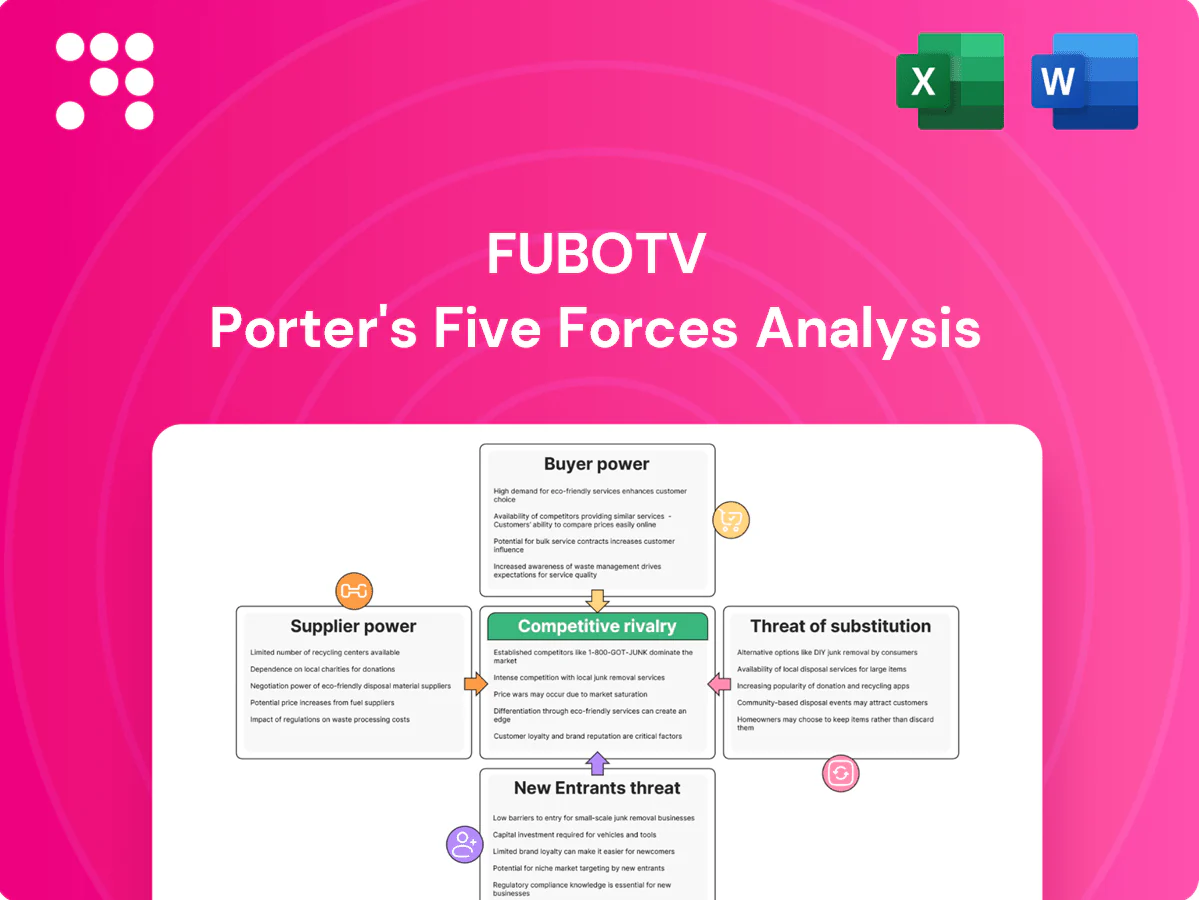
This preview shows the exact fuboTV Porter's Five Forces Analysis you'll receive immediately after purchase—fully formatted and ready for use. It contains the complete assessment of competitive rivalry, bargaining power of buyers and suppliers, and the threats of new entrants and substitutes, plus strategic implications. No placeholders or samples; instant download upon payment.

Elevate Your Analysis with the Complete Porter's Five Forces Analysis
fuboTV faces intense competitive rivalry from major streaming platforms and sports-rights bidders, while content suppliers and rights holders exert significant influence over costs. Buyer power is rising as consumers demand flexible, cheaper bundles and substitutes proliferate. This brief snapshot only scratches the surface — unlock the full Porter's Five Forces Analysis for a force-by-force strategic breakdown tailored to fuboTV.
Suppliers Bargaining Power
Exclusive sports rights holders
FuboTV depends on leagues and federations that sell scarce, time-bound live rights, giving licensors leverage to demand high fees, minimum guarantees, bundling and carriage terms. Fubo reported $1.03 billion revenue in 2023, highlighting how rights costs shape its economics. Failure to secure marquee rights immediately erodes subscriber value and churn risk. Intense bidding for 2024 rights markets further raises supplier bargaining power.
Network programmers and channel groups
Major groups such as Disney, Comcast, Warner Bros. Discovery and Paramount bundle must-have sports, news and entertainment channels, giving them outsized leverage over FuboTV; with roughly 1.2 million paid subscribers mid-2024, blackout-driven churn forces Fubo to concede on affiliate fees and channel placement. Most-favored-nation clauses in carriage deals further limit FuboTVs pricing flexibility.
Distribution platforms and app stores
Gatekeepers like Roku (~70M active accounts in 2024), Amazon Fire TV, Apple and Google control discovery, billing and rev-share, directly shaping fuboTVs acquisition costs and churn. Apple/Google commissions range 15–30% for subscriptions, and placement/promotion terms raise CAC materially. Sudden policy shifts or fee hikes (eg a 15% cut on subs) can compress margins and EBITDA unexpectedly.
CDN, cloud, and ad-tech vendors
High-availability live streaming for fuboTV relies on third-party CDNs, cloud compute, DRM and SSAI stacks; CDN SLAs (typically 99.9–99.99%) and cloud egress costs drive QoS and unit economics. Major cloud egress pricing (AWS ~0.09 USD/GB for first 10 TB in 2024) materially affects margins at scale. Limited alternative capacity during peak sports events elevates switching costs and outage risk.
- CDN SLA: 99.9–99.99% availability
- AWS egress: ~0.09 USD/GB (first 10 TB, 2024)
- SSAI/DRM stack = critical path for QoS; switching costly during peaks
Payment processors and device OEMs
Payment processors and device OEMs can impose 15–30% app-store or payment fees (Apple/Google policy in 2024), and smart-TV/ISP platforms often grant pre-installs or co-marketing only for favorable economics, advantaging rivals or extracting rent.
Billing friction from platform rules raises involuntary churn and compresses LTV for fuboTV by increasing cancellations and payment failures.
- Fees: Apple/Google 15–30% (2024)
- Pre-installs: conditional on economics
- Billing friction: higher involuntary churn, lower LTV
Supplier power tightens margins: $1.03B, ~1.2M subs, 15–30% app fees
FuboTV faces high supplier power: leagues and bundles drive expensive, time-bound rights that pressure margins (2023 revenue $1.03B) and churn risk; ~1.2M paid subs mid-2024 constrain bargaining. Platform gatekeepers charge 15–30% fees; CDN/cloud costs (CDN SLA 99.9–99.99%, AWS egress ~$0.09/GB) raise unit economics and switching barriers.
| Metric | Value |
|---|---|
| 2023 revenue | $1.03B |
| Paid subs mid-2024 | ~1.2M |
| App fees | 15–30% |
| AWS egress | $0.09/GB |
| CDN SLA | 99.9–99.99% |
What is included in the product
Detailed Word Document
Concise Porter's Five Forces assessment of fuboTV that uncovers competitive intensity, buyer/supplier power, threat of substitutes and new entrants, and pinpoints disruptive forces and strategic defenses to protect market share.
Customizable Excel Spreadsheet
One-sheet Porter's Five Forces for fuboTV that instantly highlights competitive pressures and relief strategies—clean layout, editable inputs, and a ready-to-use spider chart for fast boardroom decisions.
Customers Bargaining Power
Low switching costs for subscribers
Low switching costs let subscribers cancel monthly and re-subscribe elsewhere within minutes, and trial offers, seasonal viewing and promo-hopping amplified churn pressure in 2024. Industry estimates placed average monthly streaming churn near 3% in 2024, forcing FuboTV to sustain aggressive pricing, promotional spend and continual feature rollouts. This dynamic elevates customer bargaining power and compresses margins.
Price transparency and comparison
Competing vMVPDs publish clear channel lists and prices, making side-by-side value comparisons straightforward; fuboTV's base plan was listed at 74.99/month in 2024, heightening price sensitivity. Aggregator sites and social media accelerate deal awareness, often surfacing promos within hours. Buyers leverage transparency to negotiate discounts or simply pause service during off-season, increasing churn pressure on fuboTV.
Multi-homing and content fragmentation
Many viewers multi-home to chase leagues or shows, with marquee events often split across apps so buyers allocate monthly budgets dynamically; fuboTV must defend share by bundling exclusive rights or superior UX. fuboTV reported roughly 1.56 million paid subscribers and $1.02 billion revenue in 2023, highlighting pressure to convert stacked users into loyal customers. Differentiated bundles, better discovery and lower churn are essential to retain spend.
Quality and reliability expectations
Live sports demand sub-second latency, minimal buffering and robust DVR; failures during marquee games trigger immediate cancellations and refunds, hitting Fubo's revenue and retention. Outages during key events have historically caused spikes in churn and social media backlash; Fubo reported over 1 million subscribers in 2024, amplifying customer leverage. Buyers exert strong voice via reviews, social escalation and rapid subscription switching, raising bargaining power.
- Latency: sub-second expectation
- Subscribers: over 1 million (2024)
- Impact: outages → immediate cancellations/refunds
- Customer power: reviews + social escalation
Segment diversity and elasticity
Hardcore sports fans tolerate higher prices, while casual viewers remain price-sensitive; fuboTV reported roughly 1.1 million subscribers in 2024, highlighting a small but dedicated base versus a larger elastic audience. Regional sports needs vary by market and team allegiance, raising churn risk where rights are absent. Buyer heterogeneity complicates packaging and tiered pricing.
Low switching costs, ~3% churn, 1.05M subs boost churn
Low switching costs, ~3% avg monthly churn (2024), and transparent vMVPD pricing ($74.99 base plan in 2024) amplify customer leverage, forcing promos and feature rollouts. Over 1.05M paid subscribers (2024) increases visibility of outages and social backlash, raising cancellation risk. Buyer heterogeneity (hardcore vs casual) complicates bundling and compresses margins.
| Metric | 2024 | Impact |
|---|---|---|
| Paid subscribers | 1.05M | Higher churn visibility |
| Avg monthly churn | ~3% | Revenue pressure |
| Base plan | $74.99 | Price sensitivity |
What You See Is What You Get
fuboTV Porter's Five Forces Analysis
This preview shows the exact fuboTV Porter's Five Forces Analysis you'll receive immediately after purchase—fully formatted and ready for use. It contains the complete assessment of competitive rivalry, bargaining power of buyers and suppliers, and the threats of new entrants and substitutes, plus strategic implications. No placeholders or samples; instant download upon payment.
Original: $10.00
-65%$10.00
$3.50Description
Elevate Your Analysis with the Complete Porter's Five Forces Analysis
fuboTV faces intense competitive rivalry from major streaming platforms and sports-rights bidders, while content suppliers and rights holders exert significant influence over costs. Buyer power is rising as consumers demand flexible, cheaper bundles and substitutes proliferate. This brief snapshot only scratches the surface — unlock the full Porter's Five Forces Analysis for a force-by-force strategic breakdown tailored to fuboTV.
Suppliers Bargaining Power
Exclusive sports rights holders
FuboTV depends on leagues and federations that sell scarce, time-bound live rights, giving licensors leverage to demand high fees, minimum guarantees, bundling and carriage terms. Fubo reported $1.03 billion revenue in 2023, highlighting how rights costs shape its economics. Failure to secure marquee rights immediately erodes subscriber value and churn risk. Intense bidding for 2024 rights markets further raises supplier bargaining power.
Network programmers and channel groups
Major groups such as Disney, Comcast, Warner Bros. Discovery and Paramount bundle must-have sports, news and entertainment channels, giving them outsized leverage over FuboTV; with roughly 1.2 million paid subscribers mid-2024, blackout-driven churn forces Fubo to concede on affiliate fees and channel placement. Most-favored-nation clauses in carriage deals further limit FuboTVs pricing flexibility.
Distribution platforms and app stores
Gatekeepers like Roku (~70M active accounts in 2024), Amazon Fire TV, Apple and Google control discovery, billing and rev-share, directly shaping fuboTVs acquisition costs and churn. Apple/Google commissions range 15–30% for subscriptions, and placement/promotion terms raise CAC materially. Sudden policy shifts or fee hikes (eg a 15% cut on subs) can compress margins and EBITDA unexpectedly.
CDN, cloud, and ad-tech vendors
High-availability live streaming for fuboTV relies on third-party CDNs, cloud compute, DRM and SSAI stacks; CDN SLAs (typically 99.9–99.99%) and cloud egress costs drive QoS and unit economics. Major cloud egress pricing (AWS ~0.09 USD/GB for first 10 TB in 2024) materially affects margins at scale. Limited alternative capacity during peak sports events elevates switching costs and outage risk.
- CDN SLA: 99.9–99.99% availability
- AWS egress: ~0.09 USD/GB (first 10 TB, 2024)
- SSAI/DRM stack = critical path for QoS; switching costly during peaks
Payment processors and device OEMs
Payment processors and device OEMs can impose 15–30% app-store or payment fees (Apple/Google policy in 2024), and smart-TV/ISP platforms often grant pre-installs or co-marketing only for favorable economics, advantaging rivals or extracting rent.
Billing friction from platform rules raises involuntary churn and compresses LTV for fuboTV by increasing cancellations and payment failures.
- Fees: Apple/Google 15–30% (2024)
- Pre-installs: conditional on economics
- Billing friction: higher involuntary churn, lower LTV
Supplier power tightens margins: $1.03B, ~1.2M subs, 15–30% app fees
FuboTV faces high supplier power: leagues and bundles drive expensive, time-bound rights that pressure margins (2023 revenue $1.03B) and churn risk; ~1.2M paid subs mid-2024 constrain bargaining. Platform gatekeepers charge 15–30% fees; CDN/cloud costs (CDN SLA 99.9–99.99%, AWS egress ~$0.09/GB) raise unit economics and switching barriers.
| Metric | Value |
|---|---|
| 2023 revenue | $1.03B |
| Paid subs mid-2024 | ~1.2M |
| App fees | 15–30% |
| AWS egress | $0.09/GB |
| CDN SLA | 99.9–99.99% |
What is included in the product
Detailed Word Document
Concise Porter's Five Forces assessment of fuboTV that uncovers competitive intensity, buyer/supplier power, threat of substitutes and new entrants, and pinpoints disruptive forces and strategic defenses to protect market share.
Customizable Excel Spreadsheet
One-sheet Porter's Five Forces for fuboTV that instantly highlights competitive pressures and relief strategies—clean layout, editable inputs, and a ready-to-use spider chart for fast boardroom decisions.
Customers Bargaining Power
Low switching costs for subscribers
Low switching costs let subscribers cancel monthly and re-subscribe elsewhere within minutes, and trial offers, seasonal viewing and promo-hopping amplified churn pressure in 2024. Industry estimates placed average monthly streaming churn near 3% in 2024, forcing FuboTV to sustain aggressive pricing, promotional spend and continual feature rollouts. This dynamic elevates customer bargaining power and compresses margins.
Price transparency and comparison
Competing vMVPDs publish clear channel lists and prices, making side-by-side value comparisons straightforward; fuboTV's base plan was listed at 74.99/month in 2024, heightening price sensitivity. Aggregator sites and social media accelerate deal awareness, often surfacing promos within hours. Buyers leverage transparency to negotiate discounts or simply pause service during off-season, increasing churn pressure on fuboTV.
Multi-homing and content fragmentation
Many viewers multi-home to chase leagues or shows, with marquee events often split across apps so buyers allocate monthly budgets dynamically; fuboTV must defend share by bundling exclusive rights or superior UX. fuboTV reported roughly 1.56 million paid subscribers and $1.02 billion revenue in 2023, highlighting pressure to convert stacked users into loyal customers. Differentiated bundles, better discovery and lower churn are essential to retain spend.
Quality and reliability expectations
Live sports demand sub-second latency, minimal buffering and robust DVR; failures during marquee games trigger immediate cancellations and refunds, hitting Fubo's revenue and retention. Outages during key events have historically caused spikes in churn and social media backlash; Fubo reported over 1 million subscribers in 2024, amplifying customer leverage. Buyers exert strong voice via reviews, social escalation and rapid subscription switching, raising bargaining power.
- Latency: sub-second expectation
- Subscribers: over 1 million (2024)
- Impact: outages → immediate cancellations/refunds
- Customer power: reviews + social escalation
Segment diversity and elasticity
Hardcore sports fans tolerate higher prices, while casual viewers remain price-sensitive; fuboTV reported roughly 1.1 million subscribers in 2024, highlighting a small but dedicated base versus a larger elastic audience. Regional sports needs vary by market and team allegiance, raising churn risk where rights are absent. Buyer heterogeneity complicates packaging and tiered pricing.
Low switching costs, ~3% churn, 1.05M subs boost churn
Low switching costs, ~3% avg monthly churn (2024), and transparent vMVPD pricing ($74.99 base plan in 2024) amplify customer leverage, forcing promos and feature rollouts. Over 1.05M paid subscribers (2024) increases visibility of outages and social backlash, raising cancellation risk. Buyer heterogeneity (hardcore vs casual) complicates bundling and compresses margins.
| Metric | 2024 | Impact |
|---|---|---|
| Paid subscribers | 1.05M | Higher churn visibility |
| Avg monthly churn | ~3% | Revenue pressure |
| Base plan | $74.99 | Price sensitivity |
What You See Is What You Get
fuboTV Porter's Five Forces Analysis
This preview shows the exact fuboTV Porter's Five Forces Analysis you'll receive immediately after purchase—fully formatted and ready for use. It contains the complete assessment of competitive rivalry, bargaining power of buyers and suppliers, and the threats of new entrants and substitutes, plus strategic implications. No placeholders or samples; instant download upon payment.











