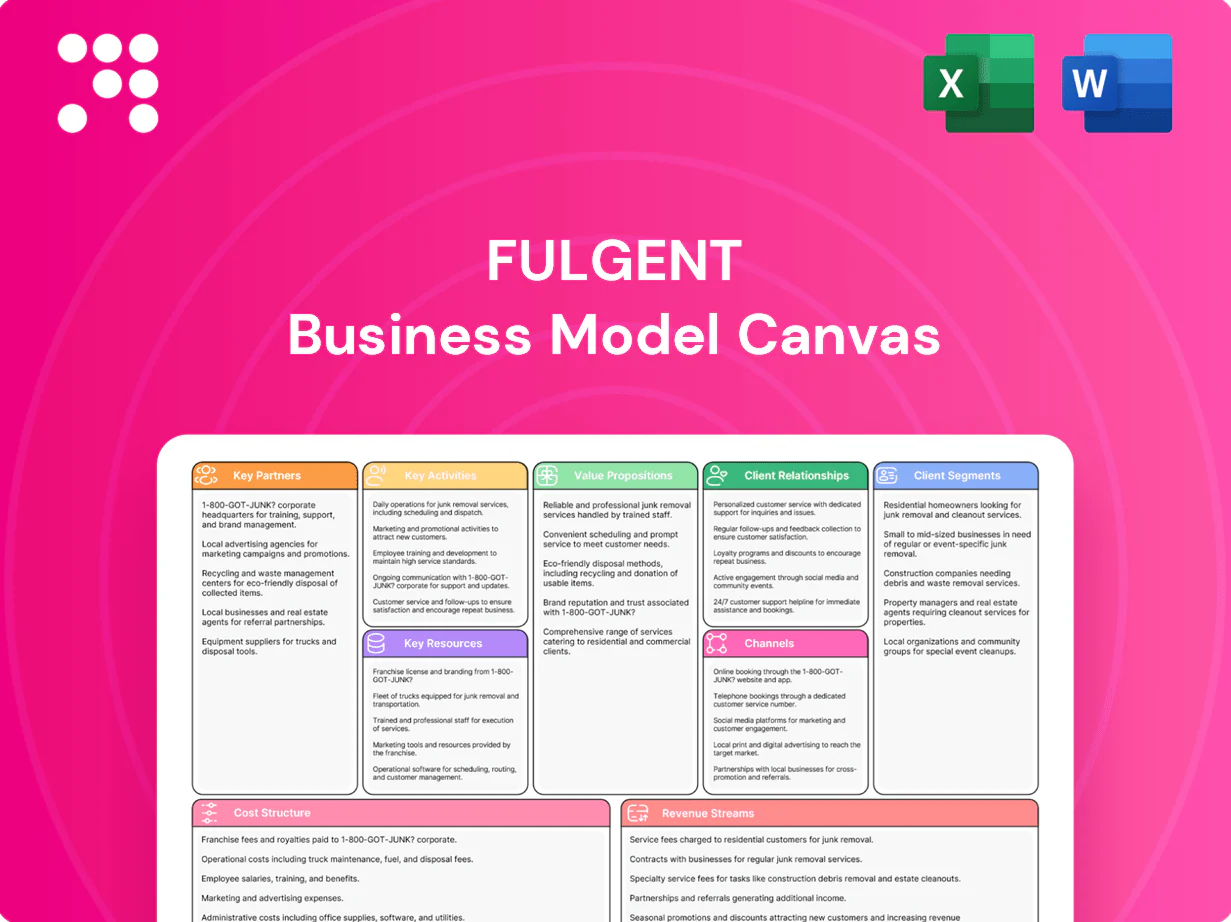
Fulgent Business Model Canvas

Unlock the Business Model Canvas: strategic playbook for investors, founders, and advisors
Unlock Fulgent’s strategic playbook with the full Business Model Canvas—detailing value propositions, customer segments, key partners, revenue streams, and cost drivers. Ideal for investors, consultants, and founders, this editable Word/Excel file turns research into actionable strategy; download now to benchmark, plan, and scale with clarity.
Partnerships

Hospital and health system alliances
Collaborations with hospitals and health systems secure steady sample inflows and enable integrated care pathways by embedding Fulgent workflows into clinical order and reporting systems. Embedded lab workflows reduce friction for ordering and accelerate result delivery to electronic health records. Co-development of testing protocols ensures alignment with clinical standards, while joint outcome studies support reimbursement and inclusion in clinical guidelines.
Academic and research institutions
Partnerships with academic and research institutions supply assay innovation and validation cohorts, giving Fulgent access to rare disease populations across roughly 7,000 known rare conditions, ~80% of which are genetic. Peer‑reviewed publications from these collaborations boost clinical adoption, while grant‑backed studies (NIH FY2024 appropriation ~50 billion) lower R&D risk and cost.

Sequencing and technology vendors
Relationships with leading NGS platform providers (Illumina holds roughly 70% of the short‑read market) secure cutting‑edge instruments and volume pricing for Fulgent. Co‑optimization of assays and workflows measurably improves accuracy, throughput and TAT across high‑volume pipelines. Joint roadmaps with vendors ensure scalability and reliability while preferred support agreements minimize instrument downtime.

Pharma and biotech for companion diagnostics
Co-development with pharma and biotech links Fulgent's tests to targeted therapies, enabling joint submission pathways and co-marketing with drug launches.
Biomarker discovery and validation partnerships expand Fulgent's test menus and support regulatory-grade evidence generation for new indications.
Companion diagnostic approvals open new clinical markets and payer pathways, while sponsored testing programs accelerate oncologist adoption and real-world uptake.
- Co-development: therapy alignment
- Biomarkers: menu expansion
- CDx approvals: market access
- Sponsored testing: faster clinician adoption
Payers and healthcare networks
Contracts with payers and networks secure coverage and predictable reimbursement, expanding patient access for Fulgent's genomic tests.
Data sharing aligns medical policies by integrating real-world evidence into payer guidelines, while value dossiers quantify clinical and economic benefits for coverage decisions.
Streamlined prior authorization workflows reduce approval time and accelerate ordering and test utilization.
- Coverage & reimbursement
- Medical policy alignment
- Value dossiers: clinical + economic
- Faster prior authorization
Hospital EHR integrations secure samples; academic assays cover 7,000 rare diseases (80% genetic)
Hospital integrations embed Fulgent workflows into EHRs to secure steady sample inflows; academic partnerships supply assay validation across ~7,000 rare diseases, ~80% genetic; vendor ties with Illumina (roughly 70% short‑read market) secure instruments and volume pricing; payer contracts and value dossiers drive coverage and faster prior authorization.
| Partnership | Key metric | 2024 figure |
|---|---|---|
| Academic/research | Rare disease coverage | ~7,000 conditions; ~80% genetic |
| NGS vendors | Market share (short‑read) | Illumina ~70% |
| Federal R&D funding | NIH appropriation FY2024 | ~$50 billion |
What is included in the product
 Detailed Word Document
A comprehensive, pre-written Business Model Canvas tailored to Fulgent’s strategy, organized into the 9 classic BMC blocks with full narrative, insights, and competitive advantage analysis. Ideal for presentations, funding discussions, and decision-making, it links SWOT findings to each block and supports validation using real company data.

 Customizable Excel Spreadsheet
High-level, editable Business Model Canvas for Fulgent that condenses strategy into a one-page snapshot, saving hours on formatting and enabling teams to quickly identify core components and adapt the model for boards, comparisons, or fast deliverables.
Activities

Assay development and validation
Designing targeted panels for rare disease, oncology, reproductive and infectious use cases, Fulgent prioritizes breadth and clinical relevance while leveraging sequencing costs near USD 600–1,000 per genome (2024) to optimize economics. Analytical and clinical validation follows CLIA, CAP and FDA-aligned standards with performance targets typically exceeding 99% sensitivity for SNVs and high reproducibility. Continuous iteration adds new genes and biomarkers quarterly to capture emerging evidence. Detailed validation dossiers and health‑economic documentation support payer coverage and guideline inclusion.
High-throughput sequencing operations
High-throughput sequencing operations at Fulgent cover sample accessioning, automated extraction, library prep, and multiplexed NGS runs to support clinical panels and large-scale screens. Automation drives scale and consistency, enabling throughput reported in 2024 alongside corporate revenue of $486.5 million. Rigorous QC protocols aim to keep reruns minimal and TAT optimized to meet clinical turnaround targets.

Bioinformatics and interpretation
As of 2024 Fulgent operates proprietary pipelines for variant calling, annotation, and classification that feed a curated clinical knowledgebase to improve actionability. The team continuously curates evidence and reclassifies variants to reduce uncertain findings and increase diagnostic yield. Clinician-facing reports translate complex results into clear, actionable insights. A rules engine and models are regularly updated to reflect new guidelines and literature.

Regulatory, quality, and data security
Fulgent maintains CLIA/CAP accreditation with mandatory ongoing proficiency testing, strict SOP governance and continuous audit readiness; labs use documented change control and quarterly internal audits. Data protection aligns with HIPAA and GDPR standards through encryption, access controls and incident response; risk management includes formalized post-market surveillance and CAPA workflows to address quality or safety signals.
- CLIA/CAP: ongoing proficiency testing, audit readiness
- SOP governance: version control, internal audits
- Data security: HIPAA/GDPR-aligned encryption & IR
- Risk & post-market: surveillance, CAPA
Commercial enablement and provider education
Onboarding clinicians and health systems via streamlined workflows and EMR-integrated ordering increases test adoption; medical affairs drive KOL engagement to validate clinical utility and influence guidelines. Dedicated coding, billing and reimbursement support reduces denials and accelerates payment cycles. Robust digital tools and developer-facing APIs enable seamless ordering, reporting and EHR integration.
- Onboarding: clinician and system integration
- Medical affairs: KOL development
- Billing: coding & reimbursement support
- Digital: APIs & EHR integrations
Clinically focused NGS panels — >99% SNV sensitivity, optimized TAT
Fulgent designs clinically focused NGS panels (rare disease, oncology, infectious) leveraging genome costs ~USD 600–1,000 (2024) to balance breadth and margins; validations follow CLIA/CAP/FDA-aligned standards with >99% SNV sensitivity and quarterly panel updates. High-throughput automated labs support 2024 revenue USD 486.5M and optimized TAT; pipelines, QC, and payer support drive adoption.
| Metric | 2024 |
|---|---|
| Revenue | USD 486.5M |
| Genome cost | USD 600–1,000 |
| SNV sensitivity | >99% |
Preview Before You Purchase
Business Model Canvas
The Fulgent Business Model Canvas you’re previewing is the exact document you’ll receive after purchase; it’s not a mockup or sample. When you buy, you’ll get this same fully formatted, ready-to-edit file in Word and Excel formats. No surprises—what you see is the final deliverable, complete and downloadable.

Unlock the Business Model Canvas: strategic playbook for investors, founders, and advisors
Unlock Fulgent’s strategic playbook with the full Business Model Canvas—detailing value propositions, customer segments, key partners, revenue streams, and cost drivers. Ideal for investors, consultants, and founders, this editable Word/Excel file turns research into actionable strategy; download now to benchmark, plan, and scale with clarity.
Partnerships
Hospital and health system alliances
Collaborations with hospitals and health systems secure steady sample inflows and enable integrated care pathways by embedding Fulgent workflows into clinical order and reporting systems. Embedded lab workflows reduce friction for ordering and accelerate result delivery to electronic health records. Co-development of testing protocols ensures alignment with clinical standards, while joint outcome studies support reimbursement and inclusion in clinical guidelines.
Academic and research institutions
Partnerships with academic and research institutions supply assay innovation and validation cohorts, giving Fulgent access to rare disease populations across roughly 7,000 known rare conditions, ~80% of which are genetic. Peer‑reviewed publications from these collaborations boost clinical adoption, while grant‑backed studies (NIH FY2024 appropriation ~50 billion) lower R&D risk and cost.
Sequencing and technology vendors
Relationships with leading NGS platform providers (Illumina holds roughly 70% of the short‑read market) secure cutting‑edge instruments and volume pricing for Fulgent. Co‑optimization of assays and workflows measurably improves accuracy, throughput and TAT across high‑volume pipelines. Joint roadmaps with vendors ensure scalability and reliability while preferred support agreements minimize instrument downtime.
Pharma and biotech for companion diagnostics
Co-development with pharma and biotech links Fulgent's tests to targeted therapies, enabling joint submission pathways and co-marketing with drug launches.
Biomarker discovery and validation partnerships expand Fulgent's test menus and support regulatory-grade evidence generation for new indications.
Companion diagnostic approvals open new clinical markets and payer pathways, while sponsored testing programs accelerate oncologist adoption and real-world uptake.
- Co-development: therapy alignment
- Biomarkers: menu expansion
- CDx approvals: market access
- Sponsored testing: faster clinician adoption
Payers and healthcare networks
Contracts with payers and networks secure coverage and predictable reimbursement, expanding patient access for Fulgent's genomic tests.
Data sharing aligns medical policies by integrating real-world evidence into payer guidelines, while value dossiers quantify clinical and economic benefits for coverage decisions.
Streamlined prior authorization workflows reduce approval time and accelerate ordering and test utilization.
- Coverage & reimbursement
- Medical policy alignment
- Value dossiers: clinical + economic
- Faster prior authorization
Hospital EHR integrations secure samples; academic assays cover 7,000 rare diseases (80% genetic)
Hospital integrations embed Fulgent workflows into EHRs to secure steady sample inflows; academic partnerships supply assay validation across ~7,000 rare diseases, ~80% genetic; vendor ties with Illumina (roughly 70% short‑read market) secure instruments and volume pricing; payer contracts and value dossiers drive coverage and faster prior authorization.
| Partnership | Key metric | 2024 figure |
|---|---|---|
| Academic/research | Rare disease coverage | ~7,000 conditions; ~80% genetic |
| NGS vendors | Market share (short‑read) | Illumina ~70% |
| Federal R&D funding | NIH appropriation FY2024 | ~$50 billion |
What is included in the product
Detailed Word Document
A comprehensive, pre-written Business Model Canvas tailored to Fulgent’s strategy, organized into the 9 classic BMC blocks with full narrative, insights, and competitive advantage analysis. Ideal for presentations, funding discussions, and decision-making, it links SWOT findings to each block and supports validation using real company data.
Customizable Excel Spreadsheet
High-level, editable Business Model Canvas for Fulgent that condenses strategy into a one-page snapshot, saving hours on formatting and enabling teams to quickly identify core components and adapt the model for boards, comparisons, or fast deliverables.
Activities
Assay development and validation
Designing targeted panels for rare disease, oncology, reproductive and infectious use cases, Fulgent prioritizes breadth and clinical relevance while leveraging sequencing costs near USD 600–1,000 per genome (2024) to optimize economics. Analytical and clinical validation follows CLIA, CAP and FDA-aligned standards with performance targets typically exceeding 99% sensitivity for SNVs and high reproducibility. Continuous iteration adds new genes and biomarkers quarterly to capture emerging evidence. Detailed validation dossiers and health‑economic documentation support payer coverage and guideline inclusion.
High-throughput sequencing operations
High-throughput sequencing operations at Fulgent cover sample accessioning, automated extraction, library prep, and multiplexed NGS runs to support clinical panels and large-scale screens. Automation drives scale and consistency, enabling throughput reported in 2024 alongside corporate revenue of $486.5 million. Rigorous QC protocols aim to keep reruns minimal and TAT optimized to meet clinical turnaround targets.
Bioinformatics and interpretation
As of 2024 Fulgent operates proprietary pipelines for variant calling, annotation, and classification that feed a curated clinical knowledgebase to improve actionability. The team continuously curates evidence and reclassifies variants to reduce uncertain findings and increase diagnostic yield. Clinician-facing reports translate complex results into clear, actionable insights. A rules engine and models are regularly updated to reflect new guidelines and literature.
Regulatory, quality, and data security
Fulgent maintains CLIA/CAP accreditation with mandatory ongoing proficiency testing, strict SOP governance and continuous audit readiness; labs use documented change control and quarterly internal audits. Data protection aligns with HIPAA and GDPR standards through encryption, access controls and incident response; risk management includes formalized post-market surveillance and CAPA workflows to address quality or safety signals.
- CLIA/CAP: ongoing proficiency testing, audit readiness
- SOP governance: version control, internal audits
- Data security: HIPAA/GDPR-aligned encryption & IR
- Risk & post-market: surveillance, CAPA
Commercial enablement and provider education
Onboarding clinicians and health systems via streamlined workflows and EMR-integrated ordering increases test adoption; medical affairs drive KOL engagement to validate clinical utility and influence guidelines. Dedicated coding, billing and reimbursement support reduces denials and accelerates payment cycles. Robust digital tools and developer-facing APIs enable seamless ordering, reporting and EHR integration.
- Onboarding: clinician and system integration
- Medical affairs: KOL development
- Billing: coding & reimbursement support
- Digital: APIs & EHR integrations
Clinically focused NGS panels — >99% SNV sensitivity, optimized TAT
Fulgent designs clinically focused NGS panels (rare disease, oncology, infectious) leveraging genome costs ~USD 600–1,000 (2024) to balance breadth and margins; validations follow CLIA/CAP/FDA-aligned standards with >99% SNV sensitivity and quarterly panel updates. High-throughput automated labs support 2024 revenue USD 486.5M and optimized TAT; pipelines, QC, and payer support drive adoption.
| Metric | 2024 |
|---|---|
| Revenue | USD 486.5M |
| Genome cost | USD 600–1,000 |
| SNV sensitivity | >99% |
Preview Before You Purchase
Business Model Canvas
The Fulgent Business Model Canvas you’re previewing is the exact document you’ll receive after purchase; it’s not a mockup or sample. When you buy, you’ll get this same fully formatted, ready-to-edit file in Word and Excel formats. No surprises—what you see is the final deliverable, complete and downloadable.
Original: $10.00
-65%$10.00
$3.50Description
Unlock the Business Model Canvas: strategic playbook for investors, founders, and advisors
Unlock Fulgent’s strategic playbook with the full Business Model Canvas—detailing value propositions, customer segments, key partners, revenue streams, and cost drivers. Ideal for investors, consultants, and founders, this editable Word/Excel file turns research into actionable strategy; download now to benchmark, plan, and scale with clarity.
Partnerships
Hospital and health system alliances
Collaborations with hospitals and health systems secure steady sample inflows and enable integrated care pathways by embedding Fulgent workflows into clinical order and reporting systems. Embedded lab workflows reduce friction for ordering and accelerate result delivery to electronic health records. Co-development of testing protocols ensures alignment with clinical standards, while joint outcome studies support reimbursement and inclusion in clinical guidelines.
Academic and research institutions
Partnerships with academic and research institutions supply assay innovation and validation cohorts, giving Fulgent access to rare disease populations across roughly 7,000 known rare conditions, ~80% of which are genetic. Peer‑reviewed publications from these collaborations boost clinical adoption, while grant‑backed studies (NIH FY2024 appropriation ~50 billion) lower R&D risk and cost.
Sequencing and technology vendors
Relationships with leading NGS platform providers (Illumina holds roughly 70% of the short‑read market) secure cutting‑edge instruments and volume pricing for Fulgent. Co‑optimization of assays and workflows measurably improves accuracy, throughput and TAT across high‑volume pipelines. Joint roadmaps with vendors ensure scalability and reliability while preferred support agreements minimize instrument downtime.
Pharma and biotech for companion diagnostics
Co-development with pharma and biotech links Fulgent's tests to targeted therapies, enabling joint submission pathways and co-marketing with drug launches.
Biomarker discovery and validation partnerships expand Fulgent's test menus and support regulatory-grade evidence generation for new indications.
Companion diagnostic approvals open new clinical markets and payer pathways, while sponsored testing programs accelerate oncologist adoption and real-world uptake.
- Co-development: therapy alignment
- Biomarkers: menu expansion
- CDx approvals: market access
- Sponsored testing: faster clinician adoption
Payers and healthcare networks
Contracts with payers and networks secure coverage and predictable reimbursement, expanding patient access for Fulgent's genomic tests.
Data sharing aligns medical policies by integrating real-world evidence into payer guidelines, while value dossiers quantify clinical and economic benefits for coverage decisions.
Streamlined prior authorization workflows reduce approval time and accelerate ordering and test utilization.
- Coverage & reimbursement
- Medical policy alignment
- Value dossiers: clinical + economic
- Faster prior authorization
Hospital EHR integrations secure samples; academic assays cover 7,000 rare diseases (80% genetic)
Hospital integrations embed Fulgent workflows into EHRs to secure steady sample inflows; academic partnerships supply assay validation across ~7,000 rare diseases, ~80% genetic; vendor ties with Illumina (roughly 70% short‑read market) secure instruments and volume pricing; payer contracts and value dossiers drive coverage and faster prior authorization.
| Partnership | Key metric | 2024 figure |
|---|---|---|
| Academic/research | Rare disease coverage | ~7,000 conditions; ~80% genetic |
| NGS vendors | Market share (short‑read) | Illumina ~70% |
| Federal R&D funding | NIH appropriation FY2024 | ~$50 billion |
What is included in the product
Detailed Word Document
A comprehensive, pre-written Business Model Canvas tailored to Fulgent’s strategy, organized into the 9 classic BMC blocks with full narrative, insights, and competitive advantage analysis. Ideal for presentations, funding discussions, and decision-making, it links SWOT findings to each block and supports validation using real company data.
Customizable Excel Spreadsheet
High-level, editable Business Model Canvas for Fulgent that condenses strategy into a one-page snapshot, saving hours on formatting and enabling teams to quickly identify core components and adapt the model for boards, comparisons, or fast deliverables.
Activities
Assay development and validation
Designing targeted panels for rare disease, oncology, reproductive and infectious use cases, Fulgent prioritizes breadth and clinical relevance while leveraging sequencing costs near USD 600–1,000 per genome (2024) to optimize economics. Analytical and clinical validation follows CLIA, CAP and FDA-aligned standards with performance targets typically exceeding 99% sensitivity for SNVs and high reproducibility. Continuous iteration adds new genes and biomarkers quarterly to capture emerging evidence. Detailed validation dossiers and health‑economic documentation support payer coverage and guideline inclusion.
High-throughput sequencing operations
High-throughput sequencing operations at Fulgent cover sample accessioning, automated extraction, library prep, and multiplexed NGS runs to support clinical panels and large-scale screens. Automation drives scale and consistency, enabling throughput reported in 2024 alongside corporate revenue of $486.5 million. Rigorous QC protocols aim to keep reruns minimal and TAT optimized to meet clinical turnaround targets.
Bioinformatics and interpretation
As of 2024 Fulgent operates proprietary pipelines for variant calling, annotation, and classification that feed a curated clinical knowledgebase to improve actionability. The team continuously curates evidence and reclassifies variants to reduce uncertain findings and increase diagnostic yield. Clinician-facing reports translate complex results into clear, actionable insights. A rules engine and models are regularly updated to reflect new guidelines and literature.
Regulatory, quality, and data security
Fulgent maintains CLIA/CAP accreditation with mandatory ongoing proficiency testing, strict SOP governance and continuous audit readiness; labs use documented change control and quarterly internal audits. Data protection aligns with HIPAA and GDPR standards through encryption, access controls and incident response; risk management includes formalized post-market surveillance and CAPA workflows to address quality or safety signals.
- CLIA/CAP: ongoing proficiency testing, audit readiness
- SOP governance: version control, internal audits
- Data security: HIPAA/GDPR-aligned encryption & IR
- Risk & post-market: surveillance, CAPA
Commercial enablement and provider education
Onboarding clinicians and health systems via streamlined workflows and EMR-integrated ordering increases test adoption; medical affairs drive KOL engagement to validate clinical utility and influence guidelines. Dedicated coding, billing and reimbursement support reduces denials and accelerates payment cycles. Robust digital tools and developer-facing APIs enable seamless ordering, reporting and EHR integration.
- Onboarding: clinician and system integration
- Medical affairs: KOL development
- Billing: coding & reimbursement support
- Digital: APIs & EHR integrations
Clinically focused NGS panels — >99% SNV sensitivity, optimized TAT
Fulgent designs clinically focused NGS panels (rare disease, oncology, infectious) leveraging genome costs ~USD 600–1,000 (2024) to balance breadth and margins; validations follow CLIA/CAP/FDA-aligned standards with >99% SNV sensitivity and quarterly panel updates. High-throughput automated labs support 2024 revenue USD 486.5M and optimized TAT; pipelines, QC, and payer support drive adoption.
| Metric | 2024 |
|---|---|
| Revenue | USD 486.5M |
| Genome cost | USD 600–1,000 |
| SNV sensitivity | >99% |
Preview Before You Purchase
Business Model Canvas
The Fulgent Business Model Canvas you’re previewing is the exact document you’ll receive after purchase; it’s not a mockup or sample. When you buy, you’ll get this same fully formatted, ready-to-edit file in Word and Excel formats. No surprises—what you see is the final deliverable, complete and downloadable.











