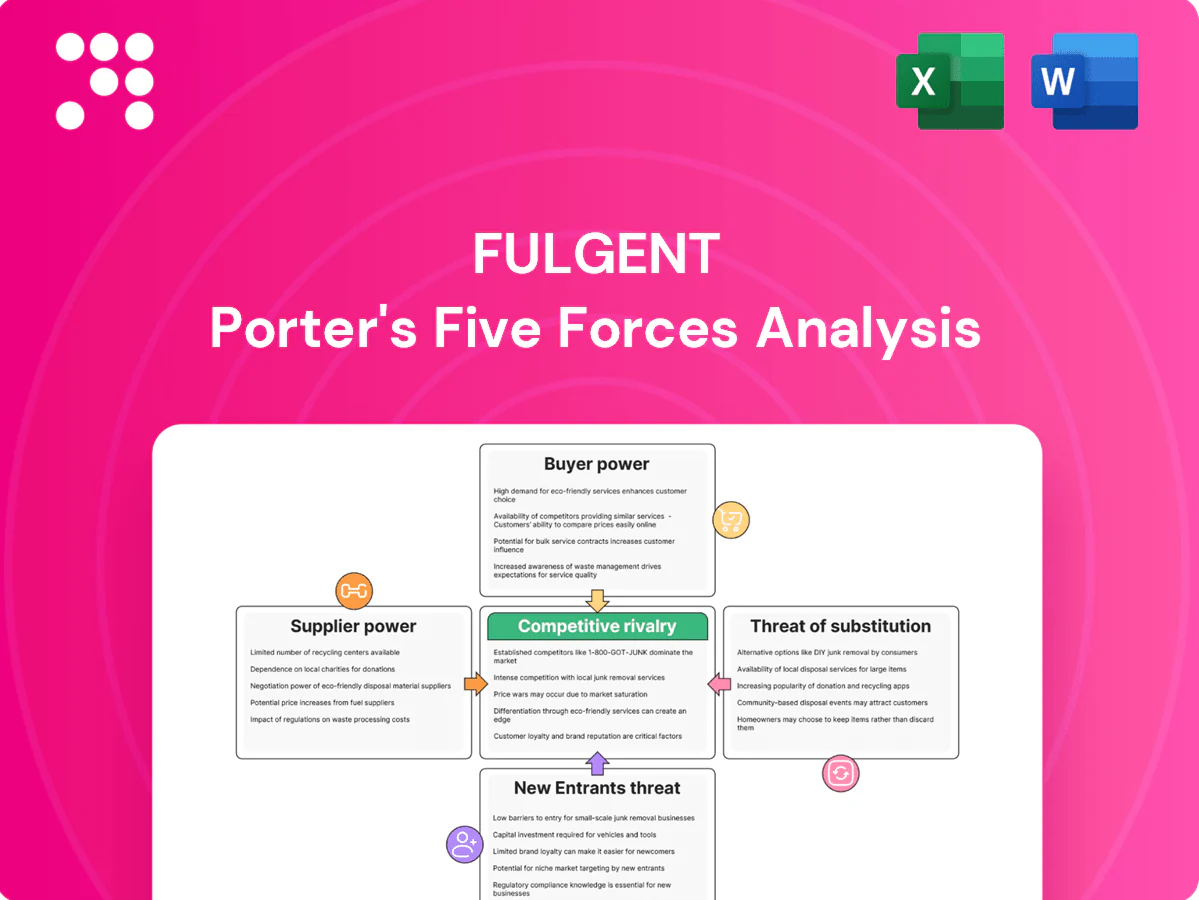
Fulgent Porter's Five Forces Analysis

Elevate Your Analysis with the Complete Porter's Five Forces Analysis
Fulgent's Porter’s Five Forces snapshot highlights intense competitive rivalry in diagnostics, moderate supplier power, strong buyer influence, and evolving threats from new entrants and substitutes as technology lowers barriers. This brief preview teases strategic implications. Unlock the full Porter's Five Forces Analysis to explore Fulgent’s competitive dynamics, market pressures, and strategic advantages in detail.
Suppliers Bargaining Power

Concentrated sequencing platform vendors
Next-generation sequencers are dominated by a few firms—Illumina, Thermo Fisher and BGI—with Illumina holding roughly two-thirds (≈66%) of the short-read market in 2024, concentrating supplier power. Switching platforms is costly due to validation, workflows and training, enabling vendors to set pricing, upgrade cadence and consumables lock-in. Long-term contracts and multi-vendor sourcing reduce, but do not remove, this leverage.
Proprietary reagents and consumables
Proprietary reagents and consumables anchor platform ecosystems for Fulgent, making supplier disruptions critical; 2024 industry reports showed reagent price volatility and intermittent supply shocks—sometimes spiking costs by as much as 30%—that can lengthen turnaround times and compress margins. Bulk purchasing and tighter inventory practices mitigate risk but cold-chain and short shelf-life limit buffer stock to weeks. Co-development deals secure supply but increase supplier dependency and contractual exposure.

Cloud and bioinformatics infrastructure
Scalable compute, storage and analytics for genomics depend on AWS/Azure/GCP (2024 market shares ~32%/23%/11%), creating supplier concentration. Egress fees (~$0.09/GB) and specialized GPU demand (GPU instances 3–5x CPU cost) induce cost stickiness. Core algorithmic IP is internal, but pipelines use third-party toolchains and databases, while compliance and data residency rules significantly narrow vendor choice.

Clinical-grade reference databases
Clinical-grade reference databases boost clinical validity; ClinVar held >1.6M variant assertions in 2024. Proprietary sources (HGMD Pro ~USD2–5k/yr) and subscription annotations raise supplier leverage and costs. Ancestry skew (>60% European in gnomAD 2024) necessitates supplemental partnerships; external curation cycles can delay updates.
- Access improves clinical validity
- Subscription/proprietary sources increase costs
- Ancestry gaps require partnerships
- Dependence on curation delays updates
Specimen collection and logistics
Specimen collection kit components and carrier performance directly affect sample integrity and throughput, with the global cold chain market surpassing 300 billion USD in 2024, highlighting logistics' strategic weight. Temperature-control materials and swab suppliers can bottleneck capacity, while fuel surcharges and route disruptions push up cost-to-serve and turnaround times. Diversified carriers and validated alternate kit parts reduce single-point failure risk and protect margins.
- Cold chain market 2024 >300B USD
- Fuel surcharges drive variable costs
- Alternate kit parts lower supply risk
- Multiple carriers improve resilience
Supplier leverage: short-read leader ≈66%
Supplier power is high: Illumina ≈66% short-read share (2024), reagent price shocks up to +30% and cold-chain market >300B USD (2024) concentrate leverage; cloud (AWS/Azure/GCP ~32/23/11%) and proprietary annotations (ClinVar >1.6M assertions) further limit alternatives, raising costs and switching barriers.
| Supplier Area | 2024 Metric | Impact |
|---|---|---|
| Sequencers | Illumina ≈66% | Pricing power |
| Cloud | AWS/Azure/GCP ~32/23/11% | Cost stickiness |
| Reagents/Cold chain | Price spikes ≤30%; market >$300B | Margin risk |
What is included in the product
 Detailed Word Document
Tailored Porter’s Five Forces analysis for Fulgent that uncovers competitive intensity, buyer/supplier power, threat of substitutes and entrants, and identifies disruptive trends and regulatory risks shaping its profitability and strategic positioning.

 Customizable Excel Spreadsheet
Fulgent's Porter's Five Forces condenses competitive pressure into a single, customizable one-sheet with radar visuals—instantly adaptable to new data or scenarios and ready to drop into pitch decks or Excel dashboards for fast, boardroom-ready decisions.
Customers Bargaining Power

Health systems and reference labs
Large health systems and reference labs concentrate buying power—by 2024 roughly two-thirds of U.S. hospitals belonged to multi-hospital systems—allowing aggregate volume discounts and demands for integration, custom reports and SLAs that raise switching costs while extracting price concessions. Consolidation across systems amplifies leverage across test menus; securing exclusive or preferred status can stabilize volumes but typically compresses margins and forces price and service concessions.
Physicians and oncology practices
2024 surveys show prescribers drive test choice by clinical utility, guideline inclusion and turnaround time, valuing robust evidence and support services; education and easy ordering increase loyalty but physicians will switch if alternatives demonstrate superior performance. Peer adoption and KOL endorsements remain key demand drivers, shaping ordering patterns across oncology practices.

Payers and reimbursement gatekeepers
Coverage decisions and prior authorization rules in 2024 continue to dictate realized pricing for Fulgent’s tests, with CMS MolDx and major commercial payers tightening criteria and reimbursement pathways. Payers push for lower rates, narrower indications, and outcomes evidence to limit spend. Lack of coverage shifts costs to patients and materially dampens demand. Demonstrating clinical utility and cost-effectiveness is essential to negotiate favorable policies.

Pharma and biopharma partners
Pharma/biopharma sponsors drive strong bargaining power: companion diagnostics and trial testing secure high-value contracts and, with over 60 FDA-cleared/approved CDx by 2024, sponsors frequently demand bespoke assays, timelines and data rights that raise project complexity and margin pressure. Competitive bidding among labs gives sponsors price leverage, while long-term CDx partnerships can lock recurring revenue but require co-investment and regulatory commitments from both parties.
- High-value CDx deals
- Over 60 FDA CDx approvals (2024)
- Sponsors demand bespoke assays/data rights
- Bidding drives price leverage
- Long-term CDx = locked revenue + co-investment
Direct-to-consumer and patient-paid segments
Direct-to-consumer and patient-paid segments show high price elasticity when patients self-pay; the DTC genetic testing market was about $2.2 billion in 2023 and remains cost-sensitive as out-of-pocket buyers prioritize convenience, branding and data privacy. Transparent pricing and financing options expand access but raise price sensitivity as comparison shopping rises; regulatory clarity on DTC medical claims (FDA guidance updates through 2024) shapes demand and consumer expectations.
- Price elasticity high for self-pay patients
- 2023 DTC genetic testing market ≈ $2.2B
- Convenience, branding, data privacy drive choice
- Transparent pricing/financing expand access yet increase sensitivity
- 2024 regulatory clarity on DTC claims influences demand
Consolidation and tighter coverage squeeze CDx pricing as sponsors and DTC push back
Large health systems concentrate buying power—by 2024 ~66% of U.S. hospitals in multi-hospital systems—driving volume discounts, integration demands and higher switching costs that compress margins.
Payers and coverage rules (CMS MolDx + commercial) tightened in 2024, forcing narrower indications and lower realized prices absent strong utility evidence.
Sponsors (60+ FDA CDx by 2024) and price-sensitive DTC patients ($2.2B market 2023) exert opposing leverage: high-value CDx deals raise revenue but increase negotiation complexity.
| Metric | Value |
|---|---|
| Hospitals in systems (2024) | ~66% |
| FDA CDx approvals (2024) | 60+ |
| DTC genetic market (2023) | $2.2B |
Preview the Actual Deliverable
Fulgent Porter's Five Forces Analysis
This preview shows the exact Fulgent Porter’s Five Forces Analysis you'll receive immediately after purchase—no surprises, no placeholders. The document displayed is the final, fully formatted file ready for download and use the moment you buy. You're looking at the actual deliverable; upon payment you’ll get instant access to this same analysis.

Elevate Your Analysis with the Complete Porter's Five Forces Analysis
Fulgent's Porter’s Five Forces snapshot highlights intense competitive rivalry in diagnostics, moderate supplier power, strong buyer influence, and evolving threats from new entrants and substitutes as technology lowers barriers. This brief preview teases strategic implications. Unlock the full Porter's Five Forces Analysis to explore Fulgent’s competitive dynamics, market pressures, and strategic advantages in detail.
Suppliers Bargaining Power
Concentrated sequencing platform vendors
Next-generation sequencers are dominated by a few firms—Illumina, Thermo Fisher and BGI—with Illumina holding roughly two-thirds (≈66%) of the short-read market in 2024, concentrating supplier power. Switching platforms is costly due to validation, workflows and training, enabling vendors to set pricing, upgrade cadence and consumables lock-in. Long-term contracts and multi-vendor sourcing reduce, but do not remove, this leverage.
Proprietary reagents and consumables
Proprietary reagents and consumables anchor platform ecosystems for Fulgent, making supplier disruptions critical; 2024 industry reports showed reagent price volatility and intermittent supply shocks—sometimes spiking costs by as much as 30%—that can lengthen turnaround times and compress margins. Bulk purchasing and tighter inventory practices mitigate risk but cold-chain and short shelf-life limit buffer stock to weeks. Co-development deals secure supply but increase supplier dependency and contractual exposure.
Cloud and bioinformatics infrastructure
Scalable compute, storage and analytics for genomics depend on AWS/Azure/GCP (2024 market shares ~32%/23%/11%), creating supplier concentration. Egress fees (~$0.09/GB) and specialized GPU demand (GPU instances 3–5x CPU cost) induce cost stickiness. Core algorithmic IP is internal, but pipelines use third-party toolchains and databases, while compliance and data residency rules significantly narrow vendor choice.
Clinical-grade reference databases
Clinical-grade reference databases boost clinical validity; ClinVar held >1.6M variant assertions in 2024. Proprietary sources (HGMD Pro ~USD2–5k/yr) and subscription annotations raise supplier leverage and costs. Ancestry skew (>60% European in gnomAD 2024) necessitates supplemental partnerships; external curation cycles can delay updates.
- Access improves clinical validity
- Subscription/proprietary sources increase costs
- Ancestry gaps require partnerships
- Dependence on curation delays updates
Specimen collection and logistics
Specimen collection kit components and carrier performance directly affect sample integrity and throughput, with the global cold chain market surpassing 300 billion USD in 2024, highlighting logistics' strategic weight. Temperature-control materials and swab suppliers can bottleneck capacity, while fuel surcharges and route disruptions push up cost-to-serve and turnaround times. Diversified carriers and validated alternate kit parts reduce single-point failure risk and protect margins.
- Cold chain market 2024 >300B USD
- Fuel surcharges drive variable costs
- Alternate kit parts lower supply risk
- Multiple carriers improve resilience
Supplier leverage: short-read leader ≈66%
Supplier power is high: Illumina ≈66% short-read share (2024), reagent price shocks up to +30% and cold-chain market >300B USD (2024) concentrate leverage; cloud (AWS/Azure/GCP ~32/23/11%) and proprietary annotations (ClinVar >1.6M assertions) further limit alternatives, raising costs and switching barriers.
| Supplier Area | 2024 Metric | Impact |
|---|---|---|
| Sequencers | Illumina ≈66% | Pricing power |
| Cloud | AWS/Azure/GCP ~32/23/11% | Cost stickiness |
| Reagents/Cold chain | Price spikes ≤30%; market >$300B | Margin risk |
What is included in the product
Detailed Word Document
Tailored Porter’s Five Forces analysis for Fulgent that uncovers competitive intensity, buyer/supplier power, threat of substitutes and entrants, and identifies disruptive trends and regulatory risks shaping its profitability and strategic positioning.
Customizable Excel Spreadsheet
Fulgent's Porter's Five Forces condenses competitive pressure into a single, customizable one-sheet with radar visuals—instantly adaptable to new data or scenarios and ready to drop into pitch decks or Excel dashboards for fast, boardroom-ready decisions.
Customers Bargaining Power
Health systems and reference labs
Large health systems and reference labs concentrate buying power—by 2024 roughly two-thirds of U.S. hospitals belonged to multi-hospital systems—allowing aggregate volume discounts and demands for integration, custom reports and SLAs that raise switching costs while extracting price concessions. Consolidation across systems amplifies leverage across test menus; securing exclusive or preferred status can stabilize volumes but typically compresses margins and forces price and service concessions.
Physicians and oncology practices
2024 surveys show prescribers drive test choice by clinical utility, guideline inclusion and turnaround time, valuing robust evidence and support services; education and easy ordering increase loyalty but physicians will switch if alternatives demonstrate superior performance. Peer adoption and KOL endorsements remain key demand drivers, shaping ordering patterns across oncology practices.
Payers and reimbursement gatekeepers
Coverage decisions and prior authorization rules in 2024 continue to dictate realized pricing for Fulgent’s tests, with CMS MolDx and major commercial payers tightening criteria and reimbursement pathways. Payers push for lower rates, narrower indications, and outcomes evidence to limit spend. Lack of coverage shifts costs to patients and materially dampens demand. Demonstrating clinical utility and cost-effectiveness is essential to negotiate favorable policies.
Pharma and biopharma partners
Pharma/biopharma sponsors drive strong bargaining power: companion diagnostics and trial testing secure high-value contracts and, with over 60 FDA-cleared/approved CDx by 2024, sponsors frequently demand bespoke assays, timelines and data rights that raise project complexity and margin pressure. Competitive bidding among labs gives sponsors price leverage, while long-term CDx partnerships can lock recurring revenue but require co-investment and regulatory commitments from both parties.
- High-value CDx deals
- Over 60 FDA CDx approvals (2024)
- Sponsors demand bespoke assays/data rights
- Bidding drives price leverage
- Long-term CDx = locked revenue + co-investment
Direct-to-consumer and patient-paid segments
Direct-to-consumer and patient-paid segments show high price elasticity when patients self-pay; the DTC genetic testing market was about $2.2 billion in 2023 and remains cost-sensitive as out-of-pocket buyers prioritize convenience, branding and data privacy. Transparent pricing and financing options expand access but raise price sensitivity as comparison shopping rises; regulatory clarity on DTC medical claims (FDA guidance updates through 2024) shapes demand and consumer expectations.
- Price elasticity high for self-pay patients
- 2023 DTC genetic testing market ≈ $2.2B
- Convenience, branding, data privacy drive choice
- Transparent pricing/financing expand access yet increase sensitivity
- 2024 regulatory clarity on DTC claims influences demand
Consolidation and tighter coverage squeeze CDx pricing as sponsors and DTC push back
Large health systems concentrate buying power—by 2024 ~66% of U.S. hospitals in multi-hospital systems—driving volume discounts, integration demands and higher switching costs that compress margins.
Payers and coverage rules (CMS MolDx + commercial) tightened in 2024, forcing narrower indications and lower realized prices absent strong utility evidence.
Sponsors (60+ FDA CDx by 2024) and price-sensitive DTC patients ($2.2B market 2023) exert opposing leverage: high-value CDx deals raise revenue but increase negotiation complexity.
| Metric | Value |
|---|---|
| Hospitals in systems (2024) | ~66% |
| FDA CDx approvals (2024) | 60+ |
| DTC genetic market (2023) | $2.2B |
Preview the Actual Deliverable
Fulgent Porter's Five Forces Analysis
This preview shows the exact Fulgent Porter’s Five Forces Analysis you'll receive immediately after purchase—no surprises, no placeholders. The document displayed is the final, fully formatted file ready for download and use the moment you buy. You're looking at the actual deliverable; upon payment you’ll get instant access to this same analysis.
Description
Elevate Your Analysis with the Complete Porter's Five Forces Analysis
Fulgent's Porter’s Five Forces snapshot highlights intense competitive rivalry in diagnostics, moderate supplier power, strong buyer influence, and evolving threats from new entrants and substitutes as technology lowers barriers. This brief preview teases strategic implications. Unlock the full Porter's Five Forces Analysis to explore Fulgent’s competitive dynamics, market pressures, and strategic advantages in detail.
Suppliers Bargaining Power
Concentrated sequencing platform vendors
Next-generation sequencers are dominated by a few firms—Illumina, Thermo Fisher and BGI—with Illumina holding roughly two-thirds (≈66%) of the short-read market in 2024, concentrating supplier power. Switching platforms is costly due to validation, workflows and training, enabling vendors to set pricing, upgrade cadence and consumables lock-in. Long-term contracts and multi-vendor sourcing reduce, but do not remove, this leverage.
Proprietary reagents and consumables
Proprietary reagents and consumables anchor platform ecosystems for Fulgent, making supplier disruptions critical; 2024 industry reports showed reagent price volatility and intermittent supply shocks—sometimes spiking costs by as much as 30%—that can lengthen turnaround times and compress margins. Bulk purchasing and tighter inventory practices mitigate risk but cold-chain and short shelf-life limit buffer stock to weeks. Co-development deals secure supply but increase supplier dependency and contractual exposure.
Cloud and bioinformatics infrastructure
Scalable compute, storage and analytics for genomics depend on AWS/Azure/GCP (2024 market shares ~32%/23%/11%), creating supplier concentration. Egress fees (~$0.09/GB) and specialized GPU demand (GPU instances 3–5x CPU cost) induce cost stickiness. Core algorithmic IP is internal, but pipelines use third-party toolchains and databases, while compliance and data residency rules significantly narrow vendor choice.
Clinical-grade reference databases
Clinical-grade reference databases boost clinical validity; ClinVar held >1.6M variant assertions in 2024. Proprietary sources (HGMD Pro ~USD2–5k/yr) and subscription annotations raise supplier leverage and costs. Ancestry skew (>60% European in gnomAD 2024) necessitates supplemental partnerships; external curation cycles can delay updates.
- Access improves clinical validity
- Subscription/proprietary sources increase costs
- Ancestry gaps require partnerships
- Dependence on curation delays updates
Specimen collection and logistics
Specimen collection kit components and carrier performance directly affect sample integrity and throughput, with the global cold chain market surpassing 300 billion USD in 2024, highlighting logistics' strategic weight. Temperature-control materials and swab suppliers can bottleneck capacity, while fuel surcharges and route disruptions push up cost-to-serve and turnaround times. Diversified carriers and validated alternate kit parts reduce single-point failure risk and protect margins.
- Cold chain market 2024 >300B USD
- Fuel surcharges drive variable costs
- Alternate kit parts lower supply risk
- Multiple carriers improve resilience
Supplier leverage: short-read leader ≈66%
Supplier power is high: Illumina ≈66% short-read share (2024), reagent price shocks up to +30% and cold-chain market >300B USD (2024) concentrate leverage; cloud (AWS/Azure/GCP ~32/23/11%) and proprietary annotations (ClinVar >1.6M assertions) further limit alternatives, raising costs and switching barriers.
| Supplier Area | 2024 Metric | Impact |
|---|---|---|
| Sequencers | Illumina ≈66% | Pricing power |
| Cloud | AWS/Azure/GCP ~32/23/11% | Cost stickiness |
| Reagents/Cold chain | Price spikes ≤30%; market >$300B | Margin risk |
What is included in the product
Detailed Word Document
Tailored Porter’s Five Forces analysis for Fulgent that uncovers competitive intensity, buyer/supplier power, threat of substitutes and entrants, and identifies disruptive trends and regulatory risks shaping its profitability and strategic positioning.
Customizable Excel Spreadsheet
Fulgent's Porter's Five Forces condenses competitive pressure into a single, customizable one-sheet with radar visuals—instantly adaptable to new data or scenarios and ready to drop into pitch decks or Excel dashboards for fast, boardroom-ready decisions.
Customers Bargaining Power
Health systems and reference labs
Large health systems and reference labs concentrate buying power—by 2024 roughly two-thirds of U.S. hospitals belonged to multi-hospital systems—allowing aggregate volume discounts and demands for integration, custom reports and SLAs that raise switching costs while extracting price concessions. Consolidation across systems amplifies leverage across test menus; securing exclusive or preferred status can stabilize volumes but typically compresses margins and forces price and service concessions.
Physicians and oncology practices
2024 surveys show prescribers drive test choice by clinical utility, guideline inclusion and turnaround time, valuing robust evidence and support services; education and easy ordering increase loyalty but physicians will switch if alternatives demonstrate superior performance. Peer adoption and KOL endorsements remain key demand drivers, shaping ordering patterns across oncology practices.
Payers and reimbursement gatekeepers
Coverage decisions and prior authorization rules in 2024 continue to dictate realized pricing for Fulgent’s tests, with CMS MolDx and major commercial payers tightening criteria and reimbursement pathways. Payers push for lower rates, narrower indications, and outcomes evidence to limit spend. Lack of coverage shifts costs to patients and materially dampens demand. Demonstrating clinical utility and cost-effectiveness is essential to negotiate favorable policies.
Pharma and biopharma partners
Pharma/biopharma sponsors drive strong bargaining power: companion diagnostics and trial testing secure high-value contracts and, with over 60 FDA-cleared/approved CDx by 2024, sponsors frequently demand bespoke assays, timelines and data rights that raise project complexity and margin pressure. Competitive bidding among labs gives sponsors price leverage, while long-term CDx partnerships can lock recurring revenue but require co-investment and regulatory commitments from both parties.
- High-value CDx deals
- Over 60 FDA CDx approvals (2024)
- Sponsors demand bespoke assays/data rights
- Bidding drives price leverage
- Long-term CDx = locked revenue + co-investment
Direct-to-consumer and patient-paid segments
Direct-to-consumer and patient-paid segments show high price elasticity when patients self-pay; the DTC genetic testing market was about $2.2 billion in 2023 and remains cost-sensitive as out-of-pocket buyers prioritize convenience, branding and data privacy. Transparent pricing and financing options expand access but raise price sensitivity as comparison shopping rises; regulatory clarity on DTC medical claims (FDA guidance updates through 2024) shapes demand and consumer expectations.
- Price elasticity high for self-pay patients
- 2023 DTC genetic testing market ≈ $2.2B
- Convenience, branding, data privacy drive choice
- Transparent pricing/financing expand access yet increase sensitivity
- 2024 regulatory clarity on DTC claims influences demand
Consolidation and tighter coverage squeeze CDx pricing as sponsors and DTC push back
Large health systems concentrate buying power—by 2024 ~66% of U.S. hospitals in multi-hospital systems—driving volume discounts, integration demands and higher switching costs that compress margins.
Payers and coverage rules (CMS MolDx + commercial) tightened in 2024, forcing narrower indications and lower realized prices absent strong utility evidence.
Sponsors (60+ FDA CDx by 2024) and price-sensitive DTC patients ($2.2B market 2023) exert opposing leverage: high-value CDx deals raise revenue but increase negotiation complexity.
| Metric | Value |
|---|---|
| Hospitals in systems (2024) | ~66% |
| FDA CDx approvals (2024) | 60+ |
| DTC genetic market (2023) | $2.2B |
Preview the Actual Deliverable
Fulgent Porter's Five Forces Analysis
This preview shows the exact Fulgent Porter’s Five Forces Analysis you'll receive immediately after purchase—no surprises, no placeholders. The document displayed is the final, fully formatted file ready for download and use the moment you buy. You're looking at the actual deliverable; upon payment you’ll get instant access to this same analysis.











