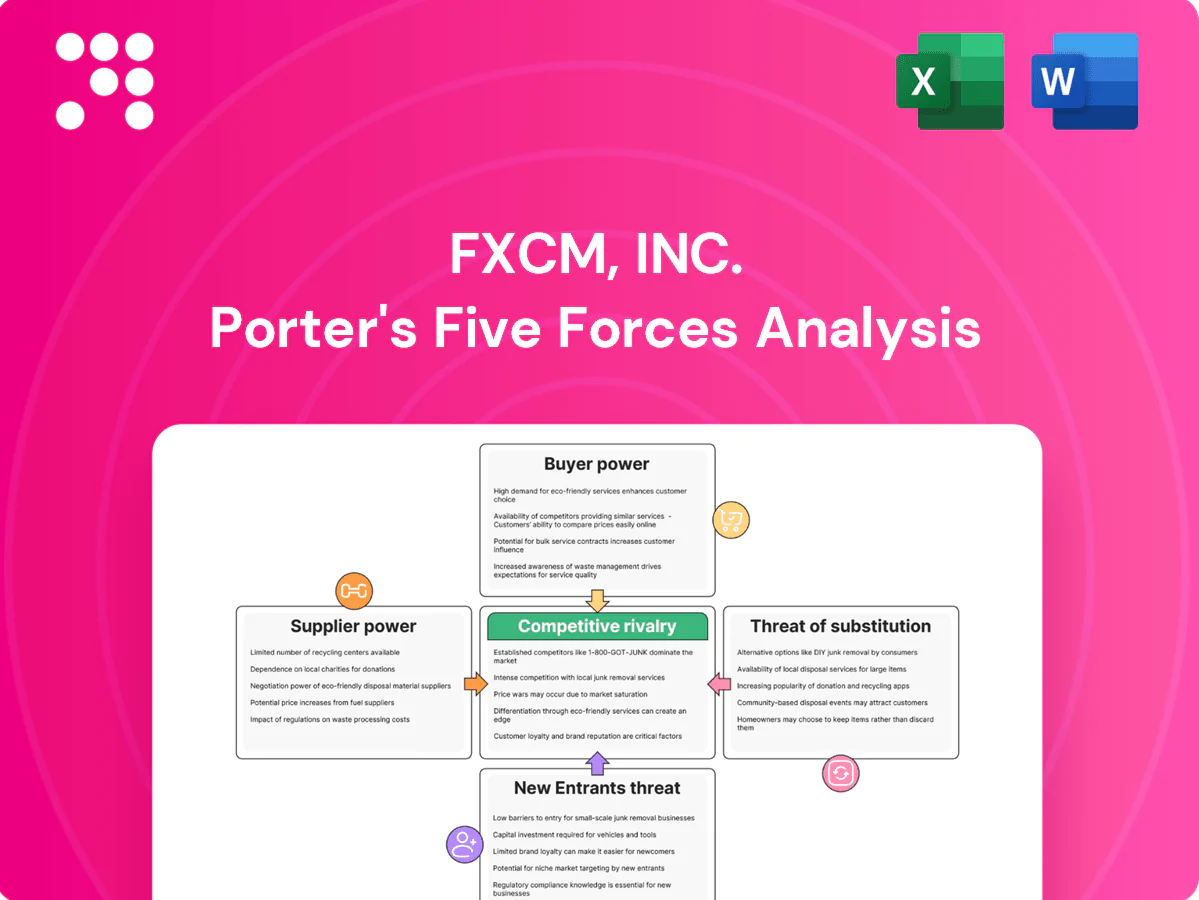
FXCM, Inc. Porter's Five Forces Analysis

A Must-Have Tool for Decision-Makers
FXCM, Inc. faces intense competitive pressures from established brokers, evolving regulatory costs, and technological substitutes that compress margins and raise client acquisition costs. Buyer power and platform differentiation are pivotal to sustaining revenue and market share. This brief snapshot only scratches the surface. Unlock the full Porter's Five Forces Analysis to explore FXCM, Inc.’s competitive dynamics, market pressures, and strategic advantages in detail.
Suppliers Bargaining Power

Concentrated liquidity providers
FXCM depends on a limited pool of Tier‑1 banks and prime brokers for FX/CFD liquidity, a concentration that in 2024 increases supplier leverage over pricing, margin requirements and platform access. Any withdrawal or tightening by these LPs can quickly raise execution costs and slippage for clients. Diversifying LP relationships and deploying smart‑order routing reduce, but cannot fully eliminate, this supplier power.
Technology and data dependencies
Core platforms, market data feeds and connectivity vendors are critical inputs for FXCM given the global FX market's $7.5 trillion daily turnover (BIS 2022), and market data/terminal fees (Bloomberg ~ $24k/year) that scale to multi‑million dollars for firms. Vendor switching is costly—integrations, certifications and client retraining often take months and can incur six‑figure implementation costs. Outages or fee hikes directly harm client experience and compress unit economics. Building in‑house tech reduces vendor dependence but raises fixed costs and operational complexity.

Clearing, prime services, and credit
Prime-of-prime and credit providers set collateral and margin that directly limit client leverage, and in 2024 renegotiations during market stress shifted bargaining power to these suppliers, tightening access to liquidity. Tighter credit conditions compress volumes and widen spreads, reducing FXCM trading revenue and client activity. FXCM’s resilience is strengthened by maintaining multiple credit lines and a strong balance sheet as disclosed in its 2024 filings.

Payments, custody, and on/off-ramps
Payments, custody, and on/off-ramps give suppliers measurable leverage over FXCM: card/ACH fees typically run ~0.5–3.5% while crypto rails cut settlement from 2–3 business days to minutes, affecting client UX and churn. Fee schedules, KYC/limits and banks' de‑risking force rerouting, raising operational costs and latency. Supporting multi-rail and localized methods trims single-supplier exposure and preserves liquidity.
- Payment fees: ~0.5–3.5%
- Bank settlement: 2–3 days vs crypto: minutes
- De‑risking increases routing complexity and costs
- Multi-rail/localization reduces supplier concentration
Regulatory infrastructure providers
Regulatory infrastructure providers (compliance tech, KYC/AML vendors, surveillance tools) exert high supplier power for FXCM because global operation mandates these systems; the global regtech market was estimated at $12.3 billion in 2024, driving vendor-led pricing and upgrade schedules that can force rapid, costly compliance spending.
- Vendor concentration raises switching costs
- Regulatory changes force vendor-timed upgrades
- In-house builds shift opex to capex and delay time-to-market
Supplier power high — concentrated LPs raise spreads & margins; market data ~$24k/yr
Supplier power is high: concentrated Tier‑1 LPs and prime brokers tightened liquidity in 2024, raising spreads and margin demands. Critical vendors (market data ~$24k/yr terminal, regtech market $12.3B 2024) impose high switching costs and outage risk. Multi‑rail payments (card fees 0.5–3.5%, crypto settlement minutes vs 2–3 days banks) mitigate but do not eliminate supplier leverage.
| Supplier | Impact | 2024 metric |
|---|---|---|
| LPs/Prime | Liquidity/margins | Concentrated |
| Market data/Vendors | Costs/switching | $24k/yr terminal |
| Payments | Fees/settlement | 0.5–3.5% / mins vs 2–3d |
What is included in the product
 Detailed Word Document
Tailored Porter's Five Forces analysis for FXCM, Inc. revealing competitive intensity, buyer and supplier influence, threats from substitutes and new entrants, and strategic levers to protect market share and margins.

 Customizable Excel Spreadsheet
A concise Porter's Five Forces snapshot for FXCM—quickly highlights competitive rivalry, regulatory risk, buyer/supplier leverage and new-entrant threats so you can target mitigation, prioritize strategic moves, and communicate risk clearly in decks.
Customers Bargaining Power

Price-sensitive, multi-homing traders
Clients use real-time price feeds to compare spreads/commissions and commonly maintain accounts at multiple brokers, amplifying buyer power via very low switching costs. With global FX turnover around $7.5 trillion daily (BIS 2022) and retail under 1%, tight spreads have become table stakes that compress margins, forcing FXCM to differentiate through execution quality, latency, slippage control and advanced trading tools.
Demand for execution and transparency
Latency, fill quality and slippage directly hit client P&L, making buyers highly demanding; in a market with $7.5 trillion average daily FX turnover (BIS 2022), small execution deficits scale quickly. Clients now rigorously audit order routing, conflict-of-interest declarations and re-quote policies. Superior analytics and granular trade reporting lower perceived counterparty risk, while any execution lapse rapidly triggers client attrition.

Value-added tools and education expectations
Advanced charting, APIs, algos and structured education are now expected by retail FX customers, and platforms that shorten learning curves and speed strategy deployment capture higher lifetime value; with global FX turnover at about 7.5 trillion USD/day per BIS (2022), even small shifts matter. Meeting these demands raises FXCMs ongoing service and development costs, but bundling tools with pricing can materially improve retention and revenue per active account.

Leverage and product breadth
Traders push for higher leverage and wide product sets (FX, indices, commodities, crypto), but regulatory caps—ESMA retail limits 30:1 for major FX, 20:1 for non‑majors and 2:1 for crypto, and US CFTC limits up to 50:1 for major FX—drive clients to shop cross‑border; some offshore firms offer up to 500:1. Delivering breadth forces brokers like FXCM to add liquidity providers and tighten risk management, while buyers exploit inter‑broker differences to negotiate fees and spreads.
- Reg caps: ESMA 30:1/20:1/2:1, CFTC 50:1
- Offshore leverage often up to 500:1
- Requires more LPs and stricter risk controls
Institutional client sophistication
Institutional clients negotiate bespoke pricing, APIs and liquidity; their high volumes drive bargaining power over spreads and rebates and they routinely demand SLAs and premium support. The BIS reported global FX turnover at 7.5 trillion USD daily in 2022, underscoring institutional scale; losing a few large accounts can materially hit FXCM revenues.
- High-volume clients: bespoke pricing/API/liquidity
- Power over spreads and rebate terms
- Demand SLAs & premium support
- Concentration risk: few accounts can materially affect revenue
Traders' bargaining power tightens spreads as leverage rules and offshore rates steer flows
Clients wield strong bargaining power: low switching costs and real-time price comparison force FXCM to compete on spreads, execution and tools; global FX turnover was 7.5 trillion USD/day (BIS 2022) while retail is under 1%. Regulatory leverage caps (ESMA 30:1/20:1/2:1, CFTC 50:1) and offshore up to 500:1 shift flows and raise negotiation pressure.
| Metric | Value |
|---|---|
| Global FX turnover (BIS 2022) | 7.5 trillion USD/day |
| Retail share | <1% |
| ESMA leverage | 30:1/20:1/2:1 |
| CFTC leverage | 50:1 |
| Offshore leverage | up to 500:1 |
Preview the Actual Deliverable
FXCM, Inc. Porter's Five Forces Analysis
This preview shows the exact FXCM, Inc. Porter's Five Forces Analysis you'll receive immediately after purchase—no surprises, no placeholders. The report delivers a concise assessment of competitive rivalry, buyer and supplier power, threat of new entrants and substitutes tailored to FXCM's business model and market dynamics. It's the final, professionally formatted document ready for instant download and use.

A Must-Have Tool for Decision-Makers
FXCM, Inc. faces intense competitive pressures from established brokers, evolving regulatory costs, and technological substitutes that compress margins and raise client acquisition costs. Buyer power and platform differentiation are pivotal to sustaining revenue and market share. This brief snapshot only scratches the surface. Unlock the full Porter's Five Forces Analysis to explore FXCM, Inc.’s competitive dynamics, market pressures, and strategic advantages in detail.
Suppliers Bargaining Power
Concentrated liquidity providers
FXCM depends on a limited pool of Tier‑1 banks and prime brokers for FX/CFD liquidity, a concentration that in 2024 increases supplier leverage over pricing, margin requirements and platform access. Any withdrawal or tightening by these LPs can quickly raise execution costs and slippage for clients. Diversifying LP relationships and deploying smart‑order routing reduce, but cannot fully eliminate, this supplier power.
Technology and data dependencies
Core platforms, market data feeds and connectivity vendors are critical inputs for FXCM given the global FX market's $7.5 trillion daily turnover (BIS 2022), and market data/terminal fees (Bloomberg ~ $24k/year) that scale to multi‑million dollars for firms. Vendor switching is costly—integrations, certifications and client retraining often take months and can incur six‑figure implementation costs. Outages or fee hikes directly harm client experience and compress unit economics. Building in‑house tech reduces vendor dependence but raises fixed costs and operational complexity.
Clearing, prime services, and credit
Prime-of-prime and credit providers set collateral and margin that directly limit client leverage, and in 2024 renegotiations during market stress shifted bargaining power to these suppliers, tightening access to liquidity. Tighter credit conditions compress volumes and widen spreads, reducing FXCM trading revenue and client activity. FXCM’s resilience is strengthened by maintaining multiple credit lines and a strong balance sheet as disclosed in its 2024 filings.
Payments, custody, and on/off-ramps
Payments, custody, and on/off-ramps give suppliers measurable leverage over FXCM: card/ACH fees typically run ~0.5–3.5% while crypto rails cut settlement from 2–3 business days to minutes, affecting client UX and churn. Fee schedules, KYC/limits and banks' de‑risking force rerouting, raising operational costs and latency. Supporting multi-rail and localized methods trims single-supplier exposure and preserves liquidity.
- Payment fees: ~0.5–3.5%
- Bank settlement: 2–3 days vs crypto: minutes
- De‑risking increases routing complexity and costs
- Multi-rail/localization reduces supplier concentration
Regulatory infrastructure providers
Regulatory infrastructure providers (compliance tech, KYC/AML vendors, surveillance tools) exert high supplier power for FXCM because global operation mandates these systems; the global regtech market was estimated at $12.3 billion in 2024, driving vendor-led pricing and upgrade schedules that can force rapid, costly compliance spending.
- Vendor concentration raises switching costs
- Regulatory changes force vendor-timed upgrades
- In-house builds shift opex to capex and delay time-to-market
Supplier power high — concentrated LPs raise spreads & margins; market data ~$24k/yr
Supplier power is high: concentrated Tier‑1 LPs and prime brokers tightened liquidity in 2024, raising spreads and margin demands. Critical vendors (market data ~$24k/yr terminal, regtech market $12.3B 2024) impose high switching costs and outage risk. Multi‑rail payments (card fees 0.5–3.5%, crypto settlement minutes vs 2–3 days banks) mitigate but do not eliminate supplier leverage.
| Supplier | Impact | 2024 metric |
|---|---|---|
| LPs/Prime | Liquidity/margins | Concentrated |
| Market data/Vendors | Costs/switching | $24k/yr terminal |
| Payments | Fees/settlement | 0.5–3.5% / mins vs 2–3d |
What is included in the product
Detailed Word Document
Tailored Porter's Five Forces analysis for FXCM, Inc. revealing competitive intensity, buyer and supplier influence, threats from substitutes and new entrants, and strategic levers to protect market share and margins.
Customizable Excel Spreadsheet
A concise Porter's Five Forces snapshot for FXCM—quickly highlights competitive rivalry, regulatory risk, buyer/supplier leverage and new-entrant threats so you can target mitigation, prioritize strategic moves, and communicate risk clearly in decks.
Customers Bargaining Power
Price-sensitive, multi-homing traders
Clients use real-time price feeds to compare spreads/commissions and commonly maintain accounts at multiple brokers, amplifying buyer power via very low switching costs. With global FX turnover around $7.5 trillion daily (BIS 2022) and retail under 1%, tight spreads have become table stakes that compress margins, forcing FXCM to differentiate through execution quality, latency, slippage control and advanced trading tools.
Demand for execution and transparency
Latency, fill quality and slippage directly hit client P&L, making buyers highly demanding; in a market with $7.5 trillion average daily FX turnover (BIS 2022), small execution deficits scale quickly. Clients now rigorously audit order routing, conflict-of-interest declarations and re-quote policies. Superior analytics and granular trade reporting lower perceived counterparty risk, while any execution lapse rapidly triggers client attrition.
Value-added tools and education expectations
Advanced charting, APIs, algos and structured education are now expected by retail FX customers, and platforms that shorten learning curves and speed strategy deployment capture higher lifetime value; with global FX turnover at about 7.5 trillion USD/day per BIS (2022), even small shifts matter. Meeting these demands raises FXCMs ongoing service and development costs, but bundling tools with pricing can materially improve retention and revenue per active account.
Leverage and product breadth
Traders push for higher leverage and wide product sets (FX, indices, commodities, crypto), but regulatory caps—ESMA retail limits 30:1 for major FX, 20:1 for non‑majors and 2:1 for crypto, and US CFTC limits up to 50:1 for major FX—drive clients to shop cross‑border; some offshore firms offer up to 500:1. Delivering breadth forces brokers like FXCM to add liquidity providers and tighten risk management, while buyers exploit inter‑broker differences to negotiate fees and spreads.
- Reg caps: ESMA 30:1/20:1/2:1, CFTC 50:1
- Offshore leverage often up to 500:1
- Requires more LPs and stricter risk controls
Institutional client sophistication
Institutional clients negotiate bespoke pricing, APIs and liquidity; their high volumes drive bargaining power over spreads and rebates and they routinely demand SLAs and premium support. The BIS reported global FX turnover at 7.5 trillion USD daily in 2022, underscoring institutional scale; losing a few large accounts can materially hit FXCM revenues.
- High-volume clients: bespoke pricing/API/liquidity
- Power over spreads and rebate terms
- Demand SLAs & premium support
- Concentration risk: few accounts can materially affect revenue
Traders' bargaining power tightens spreads as leverage rules and offshore rates steer flows
Clients wield strong bargaining power: low switching costs and real-time price comparison force FXCM to compete on spreads, execution and tools; global FX turnover was 7.5 trillion USD/day (BIS 2022) while retail is under 1%. Regulatory leverage caps (ESMA 30:1/20:1/2:1, CFTC 50:1) and offshore up to 500:1 shift flows and raise negotiation pressure.
| Metric | Value |
|---|---|
| Global FX turnover (BIS 2022) | 7.5 trillion USD/day |
| Retail share | <1% |
| ESMA leverage | 30:1/20:1/2:1 |
| CFTC leverage | 50:1 |
| Offshore leverage | up to 500:1 |
Preview the Actual Deliverable
FXCM, Inc. Porter's Five Forces Analysis
This preview shows the exact FXCM, Inc. Porter's Five Forces Analysis you'll receive immediately after purchase—no surprises, no placeholders. The report delivers a concise assessment of competitive rivalry, buyer and supplier power, threat of new entrants and substitutes tailored to FXCM's business model and market dynamics. It's the final, professionally formatted document ready for instant download and use.
Description
A Must-Have Tool for Decision-Makers
FXCM, Inc. faces intense competitive pressures from established brokers, evolving regulatory costs, and technological substitutes that compress margins and raise client acquisition costs. Buyer power and platform differentiation are pivotal to sustaining revenue and market share. This brief snapshot only scratches the surface. Unlock the full Porter's Five Forces Analysis to explore FXCM, Inc.’s competitive dynamics, market pressures, and strategic advantages in detail.
Suppliers Bargaining Power
Concentrated liquidity providers
FXCM depends on a limited pool of Tier‑1 banks and prime brokers for FX/CFD liquidity, a concentration that in 2024 increases supplier leverage over pricing, margin requirements and platform access. Any withdrawal or tightening by these LPs can quickly raise execution costs and slippage for clients. Diversifying LP relationships and deploying smart‑order routing reduce, but cannot fully eliminate, this supplier power.
Technology and data dependencies
Core platforms, market data feeds and connectivity vendors are critical inputs for FXCM given the global FX market's $7.5 trillion daily turnover (BIS 2022), and market data/terminal fees (Bloomberg ~ $24k/year) that scale to multi‑million dollars for firms. Vendor switching is costly—integrations, certifications and client retraining often take months and can incur six‑figure implementation costs. Outages or fee hikes directly harm client experience and compress unit economics. Building in‑house tech reduces vendor dependence but raises fixed costs and operational complexity.
Clearing, prime services, and credit
Prime-of-prime and credit providers set collateral and margin that directly limit client leverage, and in 2024 renegotiations during market stress shifted bargaining power to these suppliers, tightening access to liquidity. Tighter credit conditions compress volumes and widen spreads, reducing FXCM trading revenue and client activity. FXCM’s resilience is strengthened by maintaining multiple credit lines and a strong balance sheet as disclosed in its 2024 filings.
Payments, custody, and on/off-ramps
Payments, custody, and on/off-ramps give suppliers measurable leverage over FXCM: card/ACH fees typically run ~0.5–3.5% while crypto rails cut settlement from 2–3 business days to minutes, affecting client UX and churn. Fee schedules, KYC/limits and banks' de‑risking force rerouting, raising operational costs and latency. Supporting multi-rail and localized methods trims single-supplier exposure and preserves liquidity.
- Payment fees: ~0.5–3.5%
- Bank settlement: 2–3 days vs crypto: minutes
- De‑risking increases routing complexity and costs
- Multi-rail/localization reduces supplier concentration
Regulatory infrastructure providers
Regulatory infrastructure providers (compliance tech, KYC/AML vendors, surveillance tools) exert high supplier power for FXCM because global operation mandates these systems; the global regtech market was estimated at $12.3 billion in 2024, driving vendor-led pricing and upgrade schedules that can force rapid, costly compliance spending.
- Vendor concentration raises switching costs
- Regulatory changes force vendor-timed upgrades
- In-house builds shift opex to capex and delay time-to-market
Supplier power high — concentrated LPs raise spreads & margins; market data ~$24k/yr
Supplier power is high: concentrated Tier‑1 LPs and prime brokers tightened liquidity in 2024, raising spreads and margin demands. Critical vendors (market data ~$24k/yr terminal, regtech market $12.3B 2024) impose high switching costs and outage risk. Multi‑rail payments (card fees 0.5–3.5%, crypto settlement minutes vs 2–3 days banks) mitigate but do not eliminate supplier leverage.
| Supplier | Impact | 2024 metric |
|---|---|---|
| LPs/Prime | Liquidity/margins | Concentrated |
| Market data/Vendors | Costs/switching | $24k/yr terminal |
| Payments | Fees/settlement | 0.5–3.5% / mins vs 2–3d |
What is included in the product
Detailed Word Document
Tailored Porter's Five Forces analysis for FXCM, Inc. revealing competitive intensity, buyer and supplier influence, threats from substitutes and new entrants, and strategic levers to protect market share and margins.
Customizable Excel Spreadsheet
A concise Porter's Five Forces snapshot for FXCM—quickly highlights competitive rivalry, regulatory risk, buyer/supplier leverage and new-entrant threats so you can target mitigation, prioritize strategic moves, and communicate risk clearly in decks.
Customers Bargaining Power
Price-sensitive, multi-homing traders
Clients use real-time price feeds to compare spreads/commissions and commonly maintain accounts at multiple brokers, amplifying buyer power via very low switching costs. With global FX turnover around $7.5 trillion daily (BIS 2022) and retail under 1%, tight spreads have become table stakes that compress margins, forcing FXCM to differentiate through execution quality, latency, slippage control and advanced trading tools.
Demand for execution and transparency
Latency, fill quality and slippage directly hit client P&L, making buyers highly demanding; in a market with $7.5 trillion average daily FX turnover (BIS 2022), small execution deficits scale quickly. Clients now rigorously audit order routing, conflict-of-interest declarations and re-quote policies. Superior analytics and granular trade reporting lower perceived counterparty risk, while any execution lapse rapidly triggers client attrition.
Value-added tools and education expectations
Advanced charting, APIs, algos and structured education are now expected by retail FX customers, and platforms that shorten learning curves and speed strategy deployment capture higher lifetime value; with global FX turnover at about 7.5 trillion USD/day per BIS (2022), even small shifts matter. Meeting these demands raises FXCMs ongoing service and development costs, but bundling tools with pricing can materially improve retention and revenue per active account.
Leverage and product breadth
Traders push for higher leverage and wide product sets (FX, indices, commodities, crypto), but regulatory caps—ESMA retail limits 30:1 for major FX, 20:1 for non‑majors and 2:1 for crypto, and US CFTC limits up to 50:1 for major FX—drive clients to shop cross‑border; some offshore firms offer up to 500:1. Delivering breadth forces brokers like FXCM to add liquidity providers and tighten risk management, while buyers exploit inter‑broker differences to negotiate fees and spreads.
- Reg caps: ESMA 30:1/20:1/2:1, CFTC 50:1
- Offshore leverage often up to 500:1
- Requires more LPs and stricter risk controls
Institutional client sophistication
Institutional clients negotiate bespoke pricing, APIs and liquidity; their high volumes drive bargaining power over spreads and rebates and they routinely demand SLAs and premium support. The BIS reported global FX turnover at 7.5 trillion USD daily in 2022, underscoring institutional scale; losing a few large accounts can materially hit FXCM revenues.
- High-volume clients: bespoke pricing/API/liquidity
- Power over spreads and rebate terms
- Demand SLAs & premium support
- Concentration risk: few accounts can materially affect revenue
Traders' bargaining power tightens spreads as leverage rules and offshore rates steer flows
Clients wield strong bargaining power: low switching costs and real-time price comparison force FXCM to compete on spreads, execution and tools; global FX turnover was 7.5 trillion USD/day (BIS 2022) while retail is under 1%. Regulatory leverage caps (ESMA 30:1/20:1/2:1, CFTC 50:1) and offshore up to 500:1 shift flows and raise negotiation pressure.
| Metric | Value |
|---|---|
| Global FX turnover (BIS 2022) | 7.5 trillion USD/day |
| Retail share | <1% |
| ESMA leverage | 30:1/20:1/2:1 |
| CFTC leverage | 50:1 |
| Offshore leverage | up to 500:1 |
Preview the Actual Deliverable
FXCM, Inc. Porter's Five Forces Analysis
This preview shows the exact FXCM, Inc. Porter's Five Forces Analysis you'll receive immediately after purchase—no surprises, no placeholders. The report delivers a concise assessment of competitive rivalry, buyer and supplier power, threat of new entrants and substitutes tailored to FXCM's business model and market dynamics. It's the final, professionally formatted document ready for instant download and use.











