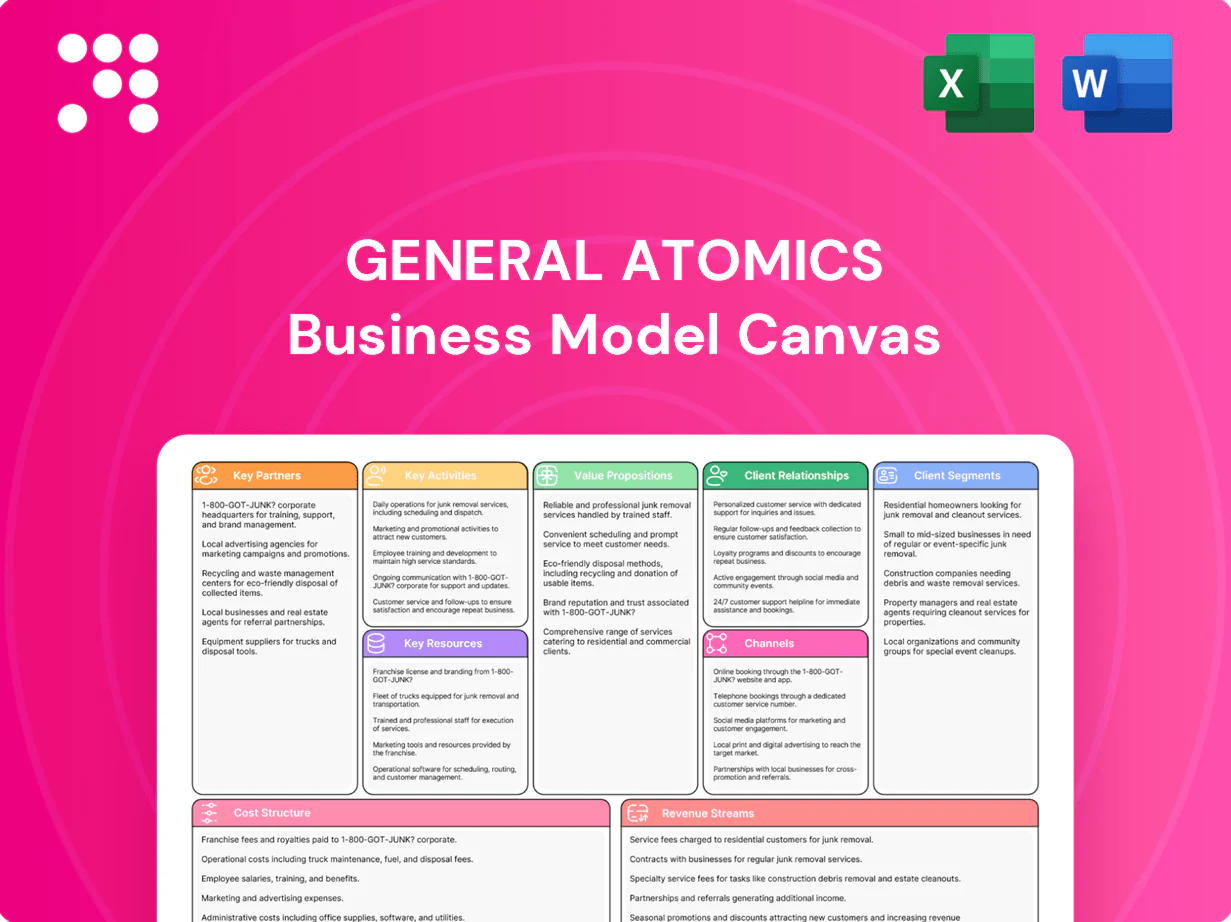
General Atomics Business Model Canvas

Business Model Canvas: Strategic Blueprint for a Defense and Energy Systems Leader
Unlock the full strategic blueprint behind General Atomics’s business model with a concise, actionable Business Model Canvas that maps value propositions, key partners, and revenue streams. Learn how the company scales in defense and energy markets, pinpoints risks, and exploits growth opportunities. Ideal for investors, consultants, and strategists. Purchase the complete, editable canvas to power your analysis and presentations.
Partnerships

U.S. Department of Defense and Intelligence Agencies
U.S. Department of Defense and intelligence agencies are General Atomics Aeronautical Systems primary procurement and development partners for MQ-9 UAS, sensors, and electromagnetic systems; MQ-9 production by GA-ASI underpins U.S. fleet needs. FY2024 defense spending was $858 billion, supporting multi-year procurements and joint roadmaps. Classified collaboration enables next‑gen capabilities, and milestone performance drives follow‑on awards.
Allied Ministries of Defense via FMS and Direct Commercial Sales
Allied ministries via FMS and direct commercial sales give General Atomics scale and interoperability, with MQ-9 family in service with over 10 allied customers as of 2024. FMS and direct channels deliver multibillion-dollar contracts that reduce approval risk and shorten delivery timelines. Offset and localization agreements create local supply chains and tech transfer, deepening ties. Coalition requirements drive platform variants and bundled training packages.

Component and Subsystem Suppliers (Avionics, Sensors, Propulsion)
Tier-1 and specialty vendors supply critical avionics, sensors and propulsion hardware and materials for General Atomics systems, supporting programs within the broader US defense market funded at about $858 billion in 2024. Dual-sourcing and long-lead coordination are used to mitigate supply risk and maintain production cadence. Co-engineering with suppliers improves SWaP and system reliability while quality systems and ITAR controls (administered by DDTC) are tightly managed.

Universities, National Labs, and Research Consortia
Universities, national labs, and consortia drive GA R&D across fusion, fission, materials, and AI/autonomy, supplying talent, testbeds, and grant access that accelerate innovation; DOE fusion funding rose to about $1.3B in FY2024, enlarging collaborative pipelines. IP frameworks protect core inventions while allowing publication; joint proposals unlock non-dilutive federal and DOE grant funding.
- Partners: UCSD, national labs, consortia
- 2024 DOE fusion funding: ≈ $1.3B
- Benefits: talent, testbeds, grants, IP protection
Energy Utilities, Regulators, and Standards Bodies
Collaboration with energy utilities, regulators, and standards bodies accelerates deployment of advanced nuclear and grid technologies by aligning grid integration and safety requirements; regulatory engagement de‑risks licensing pathways and shortens approval timelines. Standards participation ensures interoperability and safety, while pilot projects—part of a global wave as about 60 reactors were under construction in 2024—validate commercial cases.
DoD-led RPAS co-development; $858B defense budget, more than 10 allied operators
U.S. DoD/intel are primary customers and co-developers for MQ-9 and EM systems, supported by FY2024 US defense spending of $858B. Allied FMS/direct sales (MQ-9 in service with >10 partners) and supplier co-engineering secure scale and resilience. Universities, national labs and DOE (fusion funding ≈ $1.3B in 2024) provide R&D, talent and testbeds; utilities/regulators de‑risk deployment.
| Partner | 2024 metric |
|---|---|
| DoD/intel | $858B defense budget |
| Allied customers | >10 MQ-9 operators |
| DOE/labs/universities | $1.3B fusion funding |
What is included in the product
 Detailed Word Document
A concise, pre-built Business Model Canvas for General Atomics detailing customer segments, channels, value propositions, revenue streams, key resources and partners, plus risks and competitive advantages—ready for presentations and strategic analysis.

 Customizable Excel Spreadsheet
High-level, editable one-page canvas that distills General Atomics’ complex defense and energy portfolio into core components, saving hours of structuring and enabling fast comparison, collaboration, and executive-ready insights for strategy or boardroom use.
Activities

R&D in UAS, Sensors, and Autonomy
Continuous R&D advances airframes, sensors, edge computing and AI for contested environments and swarming; General Atomics leverages model-based engineering to compress development cycles via parallel simulation and integration. In 2024 the global military UAV market is estimated at $24.1B, driving investment in cyber-hardening embedded from design to meet DoD resilience requirements. Operational testbeds sustain iterative upgrades.
Advanced Nuclear and Fusion Development
General Atomics designs, experiments, and prototypes fission and fusion systems targeting demonstration TRLs of 6–8, with fusion plasmas exceeding 100 million °C and 14.1 MeV neutron environments for materials testing. Materials science and plasma physics drive performance gains while safety analysis and licensing preparation proceed in parallel. Demonstrations align with global projects (ITER 500 MW design) to validate commercial readiness.

Manufacturing, Integration, and Testing
Manufacturing centers execute build-to-print and build-to-spec across unmanned aircraft systems and electromagnetic systems, maintaining traceability and configuration control.
Hardware-in-the-loop and environmental testing regimes validate performance and mission readiness before deployment.
Supply orchestration focuses on long-lead components while lean manufacturing and continuous improvement practices raise throughput and product quality.

Lifecycle Support, Training, and Upgrades
Lifecycle support at General Atomics sustains MQ-9 and other fleets through depot-level maintenance, spares provisioning, and retrofit programs, keeping platforms mission-ready worldwide. Field service representatives deploy globally to support operations and rapid field repairs. Comprehensive training, simulators, and doctrine integration raise crew effectiveness, while spiral upgrades and retrofit blocks extend platform life and capability.
- Depot maintenance and spares
- Global field service reps
- Training, simulators, doctrine
- Spiral upgrades/retrofits
Compliance, Export Control, and Program Management
Compliance with ITAR/EAR, cybersecurity, and safety are mission-critical; IBM reports the 2024 average data breach cost was $4.45M, driving investments in secure data handling and cleared facilities. Earned value and risk management govern delivery and stakeholder reporting sustains trust across DoD and commercial programs.
- 2024 avg breach cost: $4.45M (IBM)
- Cleared facilities protect classified programs
- EVMS and risk management govern delivery
UAV swarms, cyber-hardening and lifecycle support drive a $24.1B defense market
R&D advances UAV airframes, sensors, edge AI and swarming; 2024 military UAV market $24.1B drives cyber-hardening and model-based engineering. Nuclear programs push fusion/fission demos TRL 6–8 with >100M°C plasmas for materials testing. Depot maintenance, global field service, EVMS and secure cleared facilities sustain lifecycle support and compliance (2024 breach avg $4.45M).
| Metric | 2024 Value |
|---|---|
| UAV market | $24.1B |
| Avg breach cost | $4.45M |
| Fusion plasma temp | >100M°C |
Full Document Unlocks After Purchase
Business Model Canvas
The document you're previewing is the exact General Atomics Business Model Canvas you'll receive after purchase. This is not a mockup—it's the live deliverable, fully structured and complete. After buying, you'll instantly download the same editable file in Word and Excel.

Business Model Canvas: Strategic Blueprint for a Defense and Energy Systems Leader
Unlock the full strategic blueprint behind General Atomics’s business model with a concise, actionable Business Model Canvas that maps value propositions, key partners, and revenue streams. Learn how the company scales in defense and energy markets, pinpoints risks, and exploits growth opportunities. Ideal for investors, consultants, and strategists. Purchase the complete, editable canvas to power your analysis and presentations.
Partnerships
U.S. Department of Defense and Intelligence Agencies
U.S. Department of Defense and intelligence agencies are General Atomics Aeronautical Systems primary procurement and development partners for MQ-9 UAS, sensors, and electromagnetic systems; MQ-9 production by GA-ASI underpins U.S. fleet needs. FY2024 defense spending was $858 billion, supporting multi-year procurements and joint roadmaps. Classified collaboration enables next‑gen capabilities, and milestone performance drives follow‑on awards.
Allied Ministries of Defense via FMS and Direct Commercial Sales
Allied ministries via FMS and direct commercial sales give General Atomics scale and interoperability, with MQ-9 family in service with over 10 allied customers as of 2024. FMS and direct channels deliver multibillion-dollar contracts that reduce approval risk and shorten delivery timelines. Offset and localization agreements create local supply chains and tech transfer, deepening ties. Coalition requirements drive platform variants and bundled training packages.
Component and Subsystem Suppliers (Avionics, Sensors, Propulsion)
Tier-1 and specialty vendors supply critical avionics, sensors and propulsion hardware and materials for General Atomics systems, supporting programs within the broader US defense market funded at about $858 billion in 2024. Dual-sourcing and long-lead coordination are used to mitigate supply risk and maintain production cadence. Co-engineering with suppliers improves SWaP and system reliability while quality systems and ITAR controls (administered by DDTC) are tightly managed.
Universities, National Labs, and Research Consortia
Universities, national labs, and consortia drive GA R&D across fusion, fission, materials, and AI/autonomy, supplying talent, testbeds, and grant access that accelerate innovation; DOE fusion funding rose to about $1.3B in FY2024, enlarging collaborative pipelines. IP frameworks protect core inventions while allowing publication; joint proposals unlock non-dilutive federal and DOE grant funding.
- Partners: UCSD, national labs, consortia
- 2024 DOE fusion funding: ≈ $1.3B
- Benefits: talent, testbeds, grants, IP protection
Energy Utilities, Regulators, and Standards Bodies
Collaboration with energy utilities, regulators, and standards bodies accelerates deployment of advanced nuclear and grid technologies by aligning grid integration and safety requirements; regulatory engagement de‑risks licensing pathways and shortens approval timelines. Standards participation ensures interoperability and safety, while pilot projects—part of a global wave as about 60 reactors were under construction in 2024—validate commercial cases.
DoD-led RPAS co-development; $858B defense budget, more than 10 allied operators
U.S. DoD/intel are primary customers and co-developers for MQ-9 and EM systems, supported by FY2024 US defense spending of $858B. Allied FMS/direct sales (MQ-9 in service with >10 partners) and supplier co-engineering secure scale and resilience. Universities, national labs and DOE (fusion funding ≈ $1.3B in 2024) provide R&D, talent and testbeds; utilities/regulators de‑risk deployment.
| Partner | 2024 metric |
|---|---|
| DoD/intel | $858B defense budget |
| Allied customers | >10 MQ-9 operators |
| DOE/labs/universities | $1.3B fusion funding |
What is included in the product
Detailed Word Document
A concise, pre-built Business Model Canvas for General Atomics detailing customer segments, channels, value propositions, revenue streams, key resources and partners, plus risks and competitive advantages—ready for presentations and strategic analysis.
Customizable Excel Spreadsheet
High-level, editable one-page canvas that distills General Atomics’ complex defense and energy portfolio into core components, saving hours of structuring and enabling fast comparison, collaboration, and executive-ready insights for strategy or boardroom use.
Activities
R&D in UAS, Sensors, and Autonomy
Continuous R&D advances airframes, sensors, edge computing and AI for contested environments and swarming; General Atomics leverages model-based engineering to compress development cycles via parallel simulation and integration. In 2024 the global military UAV market is estimated at $24.1B, driving investment in cyber-hardening embedded from design to meet DoD resilience requirements. Operational testbeds sustain iterative upgrades.
Advanced Nuclear and Fusion Development
General Atomics designs, experiments, and prototypes fission and fusion systems targeting demonstration TRLs of 6–8, with fusion plasmas exceeding 100 million °C and 14.1 MeV neutron environments for materials testing. Materials science and plasma physics drive performance gains while safety analysis and licensing preparation proceed in parallel. Demonstrations align with global projects (ITER 500 MW design) to validate commercial readiness.
Manufacturing, Integration, and Testing
Manufacturing centers execute build-to-print and build-to-spec across unmanned aircraft systems and electromagnetic systems, maintaining traceability and configuration control.
Hardware-in-the-loop and environmental testing regimes validate performance and mission readiness before deployment.
Supply orchestration focuses on long-lead components while lean manufacturing and continuous improvement practices raise throughput and product quality.
Lifecycle Support, Training, and Upgrades
Lifecycle support at General Atomics sustains MQ-9 and other fleets through depot-level maintenance, spares provisioning, and retrofit programs, keeping platforms mission-ready worldwide. Field service representatives deploy globally to support operations and rapid field repairs. Comprehensive training, simulators, and doctrine integration raise crew effectiveness, while spiral upgrades and retrofit blocks extend platform life and capability.
- Depot maintenance and spares
- Global field service reps
- Training, simulators, doctrine
- Spiral upgrades/retrofits
Compliance, Export Control, and Program Management
Compliance with ITAR/EAR, cybersecurity, and safety are mission-critical; IBM reports the 2024 average data breach cost was $4.45M, driving investments in secure data handling and cleared facilities. Earned value and risk management govern delivery and stakeholder reporting sustains trust across DoD and commercial programs.
- 2024 avg breach cost: $4.45M (IBM)
- Cleared facilities protect classified programs
- EVMS and risk management govern delivery
UAV swarms, cyber-hardening and lifecycle support drive a $24.1B defense market
R&D advances UAV airframes, sensors, edge AI and swarming; 2024 military UAV market $24.1B drives cyber-hardening and model-based engineering. Nuclear programs push fusion/fission demos TRL 6–8 with >100M°C plasmas for materials testing. Depot maintenance, global field service, EVMS and secure cleared facilities sustain lifecycle support and compliance (2024 breach avg $4.45M).
| Metric | 2024 Value |
|---|---|
| UAV market | $24.1B |
| Avg breach cost | $4.45M |
| Fusion plasma temp | >100M°C |
Full Document Unlocks After Purchase
Business Model Canvas
The document you're previewing is the exact General Atomics Business Model Canvas you'll receive after purchase. This is not a mockup—it's the live deliverable, fully structured and complete. After buying, you'll instantly download the same editable file in Word and Excel.
Description
Business Model Canvas: Strategic Blueprint for a Defense and Energy Systems Leader
Unlock the full strategic blueprint behind General Atomics’s business model with a concise, actionable Business Model Canvas that maps value propositions, key partners, and revenue streams. Learn how the company scales in defense and energy markets, pinpoints risks, and exploits growth opportunities. Ideal for investors, consultants, and strategists. Purchase the complete, editable canvas to power your analysis and presentations.
Partnerships
U.S. Department of Defense and Intelligence Agencies
U.S. Department of Defense and intelligence agencies are General Atomics Aeronautical Systems primary procurement and development partners for MQ-9 UAS, sensors, and electromagnetic systems; MQ-9 production by GA-ASI underpins U.S. fleet needs. FY2024 defense spending was $858 billion, supporting multi-year procurements and joint roadmaps. Classified collaboration enables next‑gen capabilities, and milestone performance drives follow‑on awards.
Allied Ministries of Defense via FMS and Direct Commercial Sales
Allied ministries via FMS and direct commercial sales give General Atomics scale and interoperability, with MQ-9 family in service with over 10 allied customers as of 2024. FMS and direct channels deliver multibillion-dollar contracts that reduce approval risk and shorten delivery timelines. Offset and localization agreements create local supply chains and tech transfer, deepening ties. Coalition requirements drive platform variants and bundled training packages.
Component and Subsystem Suppliers (Avionics, Sensors, Propulsion)
Tier-1 and specialty vendors supply critical avionics, sensors and propulsion hardware and materials for General Atomics systems, supporting programs within the broader US defense market funded at about $858 billion in 2024. Dual-sourcing and long-lead coordination are used to mitigate supply risk and maintain production cadence. Co-engineering with suppliers improves SWaP and system reliability while quality systems and ITAR controls (administered by DDTC) are tightly managed.
Universities, National Labs, and Research Consortia
Universities, national labs, and consortia drive GA R&D across fusion, fission, materials, and AI/autonomy, supplying talent, testbeds, and grant access that accelerate innovation; DOE fusion funding rose to about $1.3B in FY2024, enlarging collaborative pipelines. IP frameworks protect core inventions while allowing publication; joint proposals unlock non-dilutive federal and DOE grant funding.
- Partners: UCSD, national labs, consortia
- 2024 DOE fusion funding: ≈ $1.3B
- Benefits: talent, testbeds, grants, IP protection
Energy Utilities, Regulators, and Standards Bodies
Collaboration with energy utilities, regulators, and standards bodies accelerates deployment of advanced nuclear and grid technologies by aligning grid integration and safety requirements; regulatory engagement de‑risks licensing pathways and shortens approval timelines. Standards participation ensures interoperability and safety, while pilot projects—part of a global wave as about 60 reactors were under construction in 2024—validate commercial cases.
DoD-led RPAS co-development; $858B defense budget, more than 10 allied operators
U.S. DoD/intel are primary customers and co-developers for MQ-9 and EM systems, supported by FY2024 US defense spending of $858B. Allied FMS/direct sales (MQ-9 in service with >10 partners) and supplier co-engineering secure scale and resilience. Universities, national labs and DOE (fusion funding ≈ $1.3B in 2024) provide R&D, talent and testbeds; utilities/regulators de‑risk deployment.
| Partner | 2024 metric |
|---|---|
| DoD/intel | $858B defense budget |
| Allied customers | >10 MQ-9 operators |
| DOE/labs/universities | $1.3B fusion funding |
What is included in the product
Detailed Word Document
A concise, pre-built Business Model Canvas for General Atomics detailing customer segments, channels, value propositions, revenue streams, key resources and partners, plus risks and competitive advantages—ready for presentations and strategic analysis.
Customizable Excel Spreadsheet
High-level, editable one-page canvas that distills General Atomics’ complex defense and energy portfolio into core components, saving hours of structuring and enabling fast comparison, collaboration, and executive-ready insights for strategy or boardroom use.
Activities
R&D in UAS, Sensors, and Autonomy
Continuous R&D advances airframes, sensors, edge computing and AI for contested environments and swarming; General Atomics leverages model-based engineering to compress development cycles via parallel simulation and integration. In 2024 the global military UAV market is estimated at $24.1B, driving investment in cyber-hardening embedded from design to meet DoD resilience requirements. Operational testbeds sustain iterative upgrades.
Advanced Nuclear and Fusion Development
General Atomics designs, experiments, and prototypes fission and fusion systems targeting demonstration TRLs of 6–8, with fusion plasmas exceeding 100 million °C and 14.1 MeV neutron environments for materials testing. Materials science and plasma physics drive performance gains while safety analysis and licensing preparation proceed in parallel. Demonstrations align with global projects (ITER 500 MW design) to validate commercial readiness.
Manufacturing, Integration, and Testing
Manufacturing centers execute build-to-print and build-to-spec across unmanned aircraft systems and electromagnetic systems, maintaining traceability and configuration control.
Hardware-in-the-loop and environmental testing regimes validate performance and mission readiness before deployment.
Supply orchestration focuses on long-lead components while lean manufacturing and continuous improvement practices raise throughput and product quality.
Lifecycle Support, Training, and Upgrades
Lifecycle support at General Atomics sustains MQ-9 and other fleets through depot-level maintenance, spares provisioning, and retrofit programs, keeping platforms mission-ready worldwide. Field service representatives deploy globally to support operations and rapid field repairs. Comprehensive training, simulators, and doctrine integration raise crew effectiveness, while spiral upgrades and retrofit blocks extend platform life and capability.
- Depot maintenance and spares
- Global field service reps
- Training, simulators, doctrine
- Spiral upgrades/retrofits
Compliance, Export Control, and Program Management
Compliance with ITAR/EAR, cybersecurity, and safety are mission-critical; IBM reports the 2024 average data breach cost was $4.45M, driving investments in secure data handling and cleared facilities. Earned value and risk management govern delivery and stakeholder reporting sustains trust across DoD and commercial programs.
- 2024 avg breach cost: $4.45M (IBM)
- Cleared facilities protect classified programs
- EVMS and risk management govern delivery
UAV swarms, cyber-hardening and lifecycle support drive a $24.1B defense market
R&D advances UAV airframes, sensors, edge AI and swarming; 2024 military UAV market $24.1B drives cyber-hardening and model-based engineering. Nuclear programs push fusion/fission demos TRL 6–8 with >100M°C plasmas for materials testing. Depot maintenance, global field service, EVMS and secure cleared facilities sustain lifecycle support and compliance (2024 breach avg $4.45M).
| Metric | 2024 Value |
|---|---|
| UAV market | $24.1B |
| Avg breach cost | $4.45M |
| Fusion plasma temp | >100M°C |
Full Document Unlocks After Purchase
Business Model Canvas
The document you're previewing is the exact General Atomics Business Model Canvas you'll receive after purchase. This is not a mockup—it's the live deliverable, fully structured and complete. After buying, you'll instantly download the same editable file in Word and Excel.











