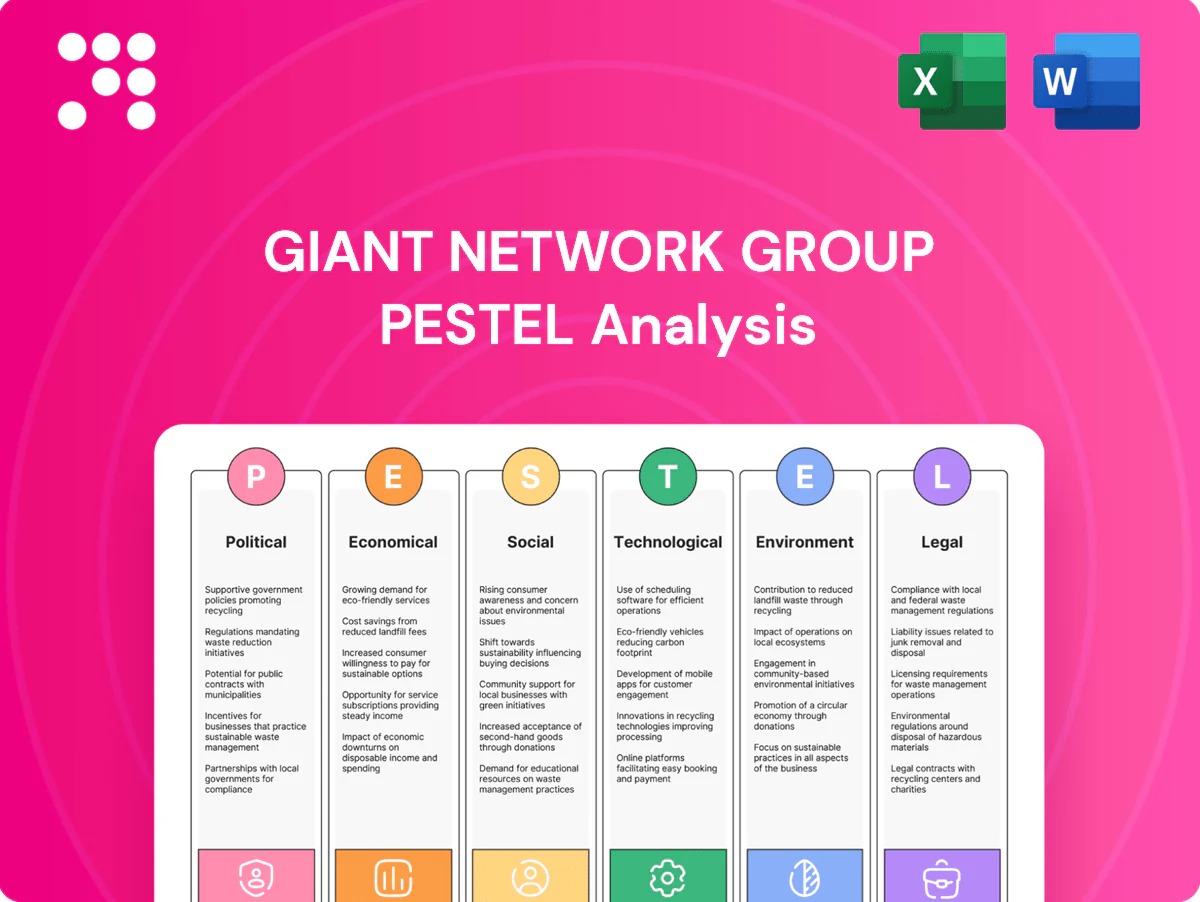
Giant Network Group PESTLE Analysis

Your Shortcut to Market Insight Starts Here
Discover how political shifts, economic trends, social behaviors, technological advances, legal changes, and environmental pressures uniquely affect Giant Network Group. Our concise PESTLE highlights key risks and opportunities in three to five actionable insights. Buy the full analysis for detailed data, scenario maps, and strategic recommendations to guide investment and strategy decisions.
Political factors

Game approvals and content oversight
China’s NPPA controls game licenses, pacing release schedules and monetization design; its mid‑2021 to mid‑2022 approval slowdown demonstrated how freezes can stall launches and revenue ramps. With China’s games market at about $42.6 billion in 2024, delayed approvals materially impact top‑line timing. Strict content rules on violence, history and ideology force narrative and art direction changes, so close compliance planning is critical for pipeline predictability.
Limits on minors and playtime
Since Sept 2021 regulators cap minors at 3 hours of play per week (8–9pm on Fridays, weekends and public holidays), and mandate real-name verification plus anti-addiction controls, compressing ARPU from younger cohorts. Stronger enforcement and tech audits in 2023–25 have further tightened daily engagement metrics. Product roadmaps increasingly target older demographics and deepen single-player content to hedge lost youth spend.

Platform and industry policy signals
Platform pushes for Healthy Gaming (minors limited to 3 hours/week since 2021) and cultural initiatives shape product tone and community governance, favoring safer, domestically aligned IP; China’s gaming market was roughly $48B in 2024. Policy tilt toward high-quality content advantages studios with proven craftsmanship, and subsidies often target culturally aligned projects. Sudden guidance changes have driven sector stock swings up to ~20%, repricing risk and forcing sharper marketing shifts.

Geopolitics and market access
- tags: export-controls
- tags: app-store-risk
- tags: local-publishers
- tags: SEA-MENA-diversification
Government relations and local incentives
Municipal parks and tax incentives boost Giant Network Group’s R&D and talent hubs, leveraging China’s preferential 15% corporate tax for certified high-tech firms and enhanced R&D super-deduction policies (up to 75% extra) to lower effective costs. Participation in cultural projects raises brand visibility and can unlock city-level grants and workspace subsidies. Strong government affairs teams accelerate approvals and compliance, though benefits vary by city and may shift with leadership priorities.
China gaming $48B: youth limits & export rules reshape profits
NPPA license control and strict content rules drive release pacing and creative constraints; China’s gaming market was about $48B in 2024. Minors limited to 3 hours/week since 2021 and stronger 2023–25 enforcement compresses youth ARPU. US export controls (2022–24) and app-store vetting raise compliance costs for overseas publishing. Tax incentives (15% CIT, R&D super-deduction up to 75%) lower effective costs.
| Factor | Key data |
|---|---|
| Market size (2024) | $48B |
| Minor play limit | 3 hrs/week since Sept 2021 |
| Preferential CIT | 15% |
| R&D super-deduction | Up to 75% |
| SEA users | 400–450M |
| MENA ad growth (2024) | >10% |
What is included in the product
 Detailed Word Document
Explores how macro-environmental factors uniquely affect Giant Network Group across Political, Economic, Social, Technological, Environmental and Legal dimensions, with data-backed, region- and industry-specific insights, forward-looking scenarios and ready-to-insert formatting to help executives, investors and strategists identify risks, opportunities and actionable responses.

 Customizable Excel Spreadsheet
Concise, visually segmented PESTLE summary for Giant Network Group that’s easy to drop into presentations, share across teams, and edit with region- or business-specific notes to streamline risk discussions and strategic planning.
Economic factors

Consumer spending cycles
Discretionary entertainment spending closely tracks macro growth and employment; global mobile games revenue approached ~$100B in 2024 and IAPs drive roughly 70% of that. Downturns compress in-app purchase volumes and ad CPMs (CPMs dropped ~15–25% in 2022–23), while targeted live-ops can lift LTV by ~15–30%. Shifting pricing mix toward cosmetics (often 50–70% of spend) versus power items reduces elasticity.
RMB volatility and cross-border revenue
RMB swings (around 7.25–7.35 per USD in H1 2025) directly change translated profits from overseas operations and, with China holding roughly $3.2 trillion in FX reserves, FX policy shifts can be abrupt. Payment processor fees typically run 0.5–3% and standard withholding on repatriated dividends is about 10%, cutting net take rates. Active hedging and matching local cost bases materially reduce currency risk, so regional revenue mix becomes a primary earnings lever.

App store fees and channel margins
App store commissions compress margins — Apple and Google levy 15–30% on most transactions, Steam uses a tiered 30/20/10 split and Epic takes ~12%, while payment processors add ~2–3% fees. Negotiated distribution with OEM stores can secure lower splits and better pricing power. Operating a direct PC platform can cut distributor take rates toward payment-processing levels but shifts costs to infrastructure and operations. Channel mix directly alters CAC and lifetime profitability.

Talent costs and productivity
Outsourcing and modern toolchains can cut cost per feature but add coordination overhead; hit titles let Giant spread fixed development costs over larger live-revenue bases.
Attrition spikes (industry turnover often cited in double digits) risk delaying content cadence and live events.
- Wage inflation: higher hiring costs
- Outsourcing: lower unit cost, higher coordination
- Flagship scale: spreads fixed costs
- Attrition: delays content/events
Portfolio hit-dependence
MMORPGs and GaaS remain hit-driven: the top 1% of mobile/online titles capture over 50% of industry revenue, producing outsized cash flows while new-title success rates stay low and payoff distributions are highly skewed. Sequels, remasters and IP extensions significantly smooth Giant Network Group’s revenue volatility. Data-driven UA and retention loops sustain cohorts and raise LTV/CAC efficiency.
- Hit concentration: top 1% >50% revenue
- High new-title risk, skewed payoffs
- Sequels/remasters smooth cash flows
- Data-driven UA + retention boost LTV
China gaming $48B: youth limits & export rules reshape profits
Consumer spend is cyclical: global mobile games revenue ~100B (2024) with IAP ~70%; downturns cut IAPs and ad CPMs (~15–25% drop in 2022–23). RMB ~7.25–7.35/USD (H1 2025) and China FX reserves ~$3.2T create FX tail risks. App-store take 15–30% plus 2–3% payments; top 1% titles >50% revenue, driving hit-driven economics and wage pressure.
| Metric | Value |
|---|---|
| Mobile revenue (2024) | $100B |
| IAP share | ~70% |
| RMB (H1 2025) | 7.25–7.35/USD |
| FX reserves | $3.2T |
| Top-1% revenue | >50% |
What You See Is What You Get
Giant Network Group PESTLE Analysis
The Giant Network Group PESTLE Analysis shown here is the exact, fully formatted document you’ll receive after purchase. This preview mirrors the final file in content, layout, and structure with no placeholders. Downloadable and ready to use immediately upon checkout.

Your Shortcut to Market Insight Starts Here
Discover how political shifts, economic trends, social behaviors, technological advances, legal changes, and environmental pressures uniquely affect Giant Network Group. Our concise PESTLE highlights key risks and opportunities in three to five actionable insights. Buy the full analysis for detailed data, scenario maps, and strategic recommendations to guide investment and strategy decisions.
Political factors
Game approvals and content oversight
China’s NPPA controls game licenses, pacing release schedules and monetization design; its mid‑2021 to mid‑2022 approval slowdown demonstrated how freezes can stall launches and revenue ramps. With China’s games market at about $42.6 billion in 2024, delayed approvals materially impact top‑line timing. Strict content rules on violence, history and ideology force narrative and art direction changes, so close compliance planning is critical for pipeline predictability.
Limits on minors and playtime
Since Sept 2021 regulators cap minors at 3 hours of play per week (8–9pm on Fridays, weekends and public holidays), and mandate real-name verification plus anti-addiction controls, compressing ARPU from younger cohorts. Stronger enforcement and tech audits in 2023–25 have further tightened daily engagement metrics. Product roadmaps increasingly target older demographics and deepen single-player content to hedge lost youth spend.
Platform and industry policy signals
Platform pushes for Healthy Gaming (minors limited to 3 hours/week since 2021) and cultural initiatives shape product tone and community governance, favoring safer, domestically aligned IP; China’s gaming market was roughly $48B in 2024. Policy tilt toward high-quality content advantages studios with proven craftsmanship, and subsidies often target culturally aligned projects. Sudden guidance changes have driven sector stock swings up to ~20%, repricing risk and forcing sharper marketing shifts.
Geopolitics and market access
- tags: export-controls
- tags: app-store-risk
- tags: local-publishers
- tags: SEA-MENA-diversification
Government relations and local incentives
Municipal parks and tax incentives boost Giant Network Group’s R&D and talent hubs, leveraging China’s preferential 15% corporate tax for certified high-tech firms and enhanced R&D super-deduction policies (up to 75% extra) to lower effective costs. Participation in cultural projects raises brand visibility and can unlock city-level grants and workspace subsidies. Strong government affairs teams accelerate approvals and compliance, though benefits vary by city and may shift with leadership priorities.
China gaming $48B: youth limits & export rules reshape profits
NPPA license control and strict content rules drive release pacing and creative constraints; China’s gaming market was about $48B in 2024. Minors limited to 3 hours/week since 2021 and stronger 2023–25 enforcement compresses youth ARPU. US export controls (2022–24) and app-store vetting raise compliance costs for overseas publishing. Tax incentives (15% CIT, R&D super-deduction up to 75%) lower effective costs.
| Factor | Key data |
|---|---|
| Market size (2024) | $48B |
| Minor play limit | 3 hrs/week since Sept 2021 |
| Preferential CIT | 15% |
| R&D super-deduction | Up to 75% |
| SEA users | 400–450M |
| MENA ad growth (2024) | >10% |
What is included in the product
Detailed Word Document
Explores how macro-environmental factors uniquely affect Giant Network Group across Political, Economic, Social, Technological, Environmental and Legal dimensions, with data-backed, region- and industry-specific insights, forward-looking scenarios and ready-to-insert formatting to help executives, investors and strategists identify risks, opportunities and actionable responses.
Customizable Excel Spreadsheet
Concise, visually segmented PESTLE summary for Giant Network Group that’s easy to drop into presentations, share across teams, and edit with region- or business-specific notes to streamline risk discussions and strategic planning.
Economic factors
Consumer spending cycles
Discretionary entertainment spending closely tracks macro growth and employment; global mobile games revenue approached ~$100B in 2024 and IAPs drive roughly 70% of that. Downturns compress in-app purchase volumes and ad CPMs (CPMs dropped ~15–25% in 2022–23), while targeted live-ops can lift LTV by ~15–30%. Shifting pricing mix toward cosmetics (often 50–70% of spend) versus power items reduces elasticity.
RMB volatility and cross-border revenue
RMB swings (around 7.25–7.35 per USD in H1 2025) directly change translated profits from overseas operations and, with China holding roughly $3.2 trillion in FX reserves, FX policy shifts can be abrupt. Payment processor fees typically run 0.5–3% and standard withholding on repatriated dividends is about 10%, cutting net take rates. Active hedging and matching local cost bases materially reduce currency risk, so regional revenue mix becomes a primary earnings lever.
App store fees and channel margins
App store commissions compress margins — Apple and Google levy 15–30% on most transactions, Steam uses a tiered 30/20/10 split and Epic takes ~12%, while payment processors add ~2–3% fees. Negotiated distribution with OEM stores can secure lower splits and better pricing power. Operating a direct PC platform can cut distributor take rates toward payment-processing levels but shifts costs to infrastructure and operations. Channel mix directly alters CAC and lifetime profitability.
Talent costs and productivity
Outsourcing and modern toolchains can cut cost per feature but add coordination overhead; hit titles let Giant spread fixed development costs over larger live-revenue bases.
Attrition spikes (industry turnover often cited in double digits) risk delaying content cadence and live events.
- Wage inflation: higher hiring costs
- Outsourcing: lower unit cost, higher coordination
- Flagship scale: spreads fixed costs
- Attrition: delays content/events
Portfolio hit-dependence
MMORPGs and GaaS remain hit-driven: the top 1% of mobile/online titles capture over 50% of industry revenue, producing outsized cash flows while new-title success rates stay low and payoff distributions are highly skewed. Sequels, remasters and IP extensions significantly smooth Giant Network Group’s revenue volatility. Data-driven UA and retention loops sustain cohorts and raise LTV/CAC efficiency.
- Hit concentration: top 1% >50% revenue
- High new-title risk, skewed payoffs
- Sequels/remasters smooth cash flows
- Data-driven UA + retention boost LTV
China gaming $48B: youth limits & export rules reshape profits
Consumer spend is cyclical: global mobile games revenue ~100B (2024) with IAP ~70%; downturns cut IAPs and ad CPMs (~15–25% drop in 2022–23). RMB ~7.25–7.35/USD (H1 2025) and China FX reserves ~$3.2T create FX tail risks. App-store take 15–30% plus 2–3% payments; top 1% titles >50% revenue, driving hit-driven economics and wage pressure.
| Metric | Value |
|---|---|
| Mobile revenue (2024) | $100B |
| IAP share | ~70% |
| RMB (H1 2025) | 7.25–7.35/USD |
| FX reserves | $3.2T |
| Top-1% revenue | >50% |
What You See Is What You Get
Giant Network Group PESTLE Analysis
The Giant Network Group PESTLE Analysis shown here is the exact, fully formatted document you’ll receive after purchase. This preview mirrors the final file in content, layout, and structure with no placeholders. Downloadable and ready to use immediately upon checkout.
Original: $10.00
-65%$10.00
$3.50Description
Your Shortcut to Market Insight Starts Here
Discover how political shifts, economic trends, social behaviors, technological advances, legal changes, and environmental pressures uniquely affect Giant Network Group. Our concise PESTLE highlights key risks and opportunities in three to five actionable insights. Buy the full analysis for detailed data, scenario maps, and strategic recommendations to guide investment and strategy decisions.
Political factors
Game approvals and content oversight
China’s NPPA controls game licenses, pacing release schedules and monetization design; its mid‑2021 to mid‑2022 approval slowdown demonstrated how freezes can stall launches and revenue ramps. With China’s games market at about $42.6 billion in 2024, delayed approvals materially impact top‑line timing. Strict content rules on violence, history and ideology force narrative and art direction changes, so close compliance planning is critical for pipeline predictability.
Limits on minors and playtime
Since Sept 2021 regulators cap minors at 3 hours of play per week (8–9pm on Fridays, weekends and public holidays), and mandate real-name verification plus anti-addiction controls, compressing ARPU from younger cohorts. Stronger enforcement and tech audits in 2023–25 have further tightened daily engagement metrics. Product roadmaps increasingly target older demographics and deepen single-player content to hedge lost youth spend.
Platform and industry policy signals
Platform pushes for Healthy Gaming (minors limited to 3 hours/week since 2021) and cultural initiatives shape product tone and community governance, favoring safer, domestically aligned IP; China’s gaming market was roughly $48B in 2024. Policy tilt toward high-quality content advantages studios with proven craftsmanship, and subsidies often target culturally aligned projects. Sudden guidance changes have driven sector stock swings up to ~20%, repricing risk and forcing sharper marketing shifts.
Geopolitics and market access
- tags: export-controls
- tags: app-store-risk
- tags: local-publishers
- tags: SEA-MENA-diversification
Government relations and local incentives
Municipal parks and tax incentives boost Giant Network Group’s R&D and talent hubs, leveraging China’s preferential 15% corporate tax for certified high-tech firms and enhanced R&D super-deduction policies (up to 75% extra) to lower effective costs. Participation in cultural projects raises brand visibility and can unlock city-level grants and workspace subsidies. Strong government affairs teams accelerate approvals and compliance, though benefits vary by city and may shift with leadership priorities.
China gaming $48B: youth limits & export rules reshape profits
NPPA license control and strict content rules drive release pacing and creative constraints; China’s gaming market was about $48B in 2024. Minors limited to 3 hours/week since 2021 and stronger 2023–25 enforcement compresses youth ARPU. US export controls (2022–24) and app-store vetting raise compliance costs for overseas publishing. Tax incentives (15% CIT, R&D super-deduction up to 75%) lower effective costs.
| Factor | Key data |
|---|---|
| Market size (2024) | $48B |
| Minor play limit | 3 hrs/week since Sept 2021 |
| Preferential CIT | 15% |
| R&D super-deduction | Up to 75% |
| SEA users | 400–450M |
| MENA ad growth (2024) | >10% |
What is included in the product
Detailed Word Document
Explores how macro-environmental factors uniquely affect Giant Network Group across Political, Economic, Social, Technological, Environmental and Legal dimensions, with data-backed, region- and industry-specific insights, forward-looking scenarios and ready-to-insert formatting to help executives, investors and strategists identify risks, opportunities and actionable responses.
Customizable Excel Spreadsheet
Concise, visually segmented PESTLE summary for Giant Network Group that’s easy to drop into presentations, share across teams, and edit with region- or business-specific notes to streamline risk discussions and strategic planning.
Economic factors
Consumer spending cycles
Discretionary entertainment spending closely tracks macro growth and employment; global mobile games revenue approached ~$100B in 2024 and IAPs drive roughly 70% of that. Downturns compress in-app purchase volumes and ad CPMs (CPMs dropped ~15–25% in 2022–23), while targeted live-ops can lift LTV by ~15–30%. Shifting pricing mix toward cosmetics (often 50–70% of spend) versus power items reduces elasticity.
RMB volatility and cross-border revenue
RMB swings (around 7.25–7.35 per USD in H1 2025) directly change translated profits from overseas operations and, with China holding roughly $3.2 trillion in FX reserves, FX policy shifts can be abrupt. Payment processor fees typically run 0.5–3% and standard withholding on repatriated dividends is about 10%, cutting net take rates. Active hedging and matching local cost bases materially reduce currency risk, so regional revenue mix becomes a primary earnings lever.
App store fees and channel margins
App store commissions compress margins — Apple and Google levy 15–30% on most transactions, Steam uses a tiered 30/20/10 split and Epic takes ~12%, while payment processors add ~2–3% fees. Negotiated distribution with OEM stores can secure lower splits and better pricing power. Operating a direct PC platform can cut distributor take rates toward payment-processing levels but shifts costs to infrastructure and operations. Channel mix directly alters CAC and lifetime profitability.
Talent costs and productivity
Outsourcing and modern toolchains can cut cost per feature but add coordination overhead; hit titles let Giant spread fixed development costs over larger live-revenue bases.
Attrition spikes (industry turnover often cited in double digits) risk delaying content cadence and live events.
- Wage inflation: higher hiring costs
- Outsourcing: lower unit cost, higher coordination
- Flagship scale: spreads fixed costs
- Attrition: delays content/events
Portfolio hit-dependence
MMORPGs and GaaS remain hit-driven: the top 1% of mobile/online titles capture over 50% of industry revenue, producing outsized cash flows while new-title success rates stay low and payoff distributions are highly skewed. Sequels, remasters and IP extensions significantly smooth Giant Network Group’s revenue volatility. Data-driven UA and retention loops sustain cohorts and raise LTV/CAC efficiency.
- Hit concentration: top 1% >50% revenue
- High new-title risk, skewed payoffs
- Sequels/remasters smooth cash flows
- Data-driven UA + retention boost LTV
China gaming $48B: youth limits & export rules reshape profits
Consumer spend is cyclical: global mobile games revenue ~100B (2024) with IAP ~70%; downturns cut IAPs and ad CPMs (~15–25% drop in 2022–23). RMB ~7.25–7.35/USD (H1 2025) and China FX reserves ~$3.2T create FX tail risks. App-store take 15–30% plus 2–3% payments; top 1% titles >50% revenue, driving hit-driven economics and wage pressure.
| Metric | Value |
|---|---|
| Mobile revenue (2024) | $100B |
| IAP share | ~70% |
| RMB (H1 2025) | 7.25–7.35/USD |
| FX reserves | $3.2T |
| Top-1% revenue | >50% |
What You See Is What You Get
Giant Network Group PESTLE Analysis
The Giant Network Group PESTLE Analysis shown here is the exact, fully formatted document you’ll receive after purchase. This preview mirrors the final file in content, layout, and structure with no placeholders. Downloadable and ready to use immediately upon checkout.











