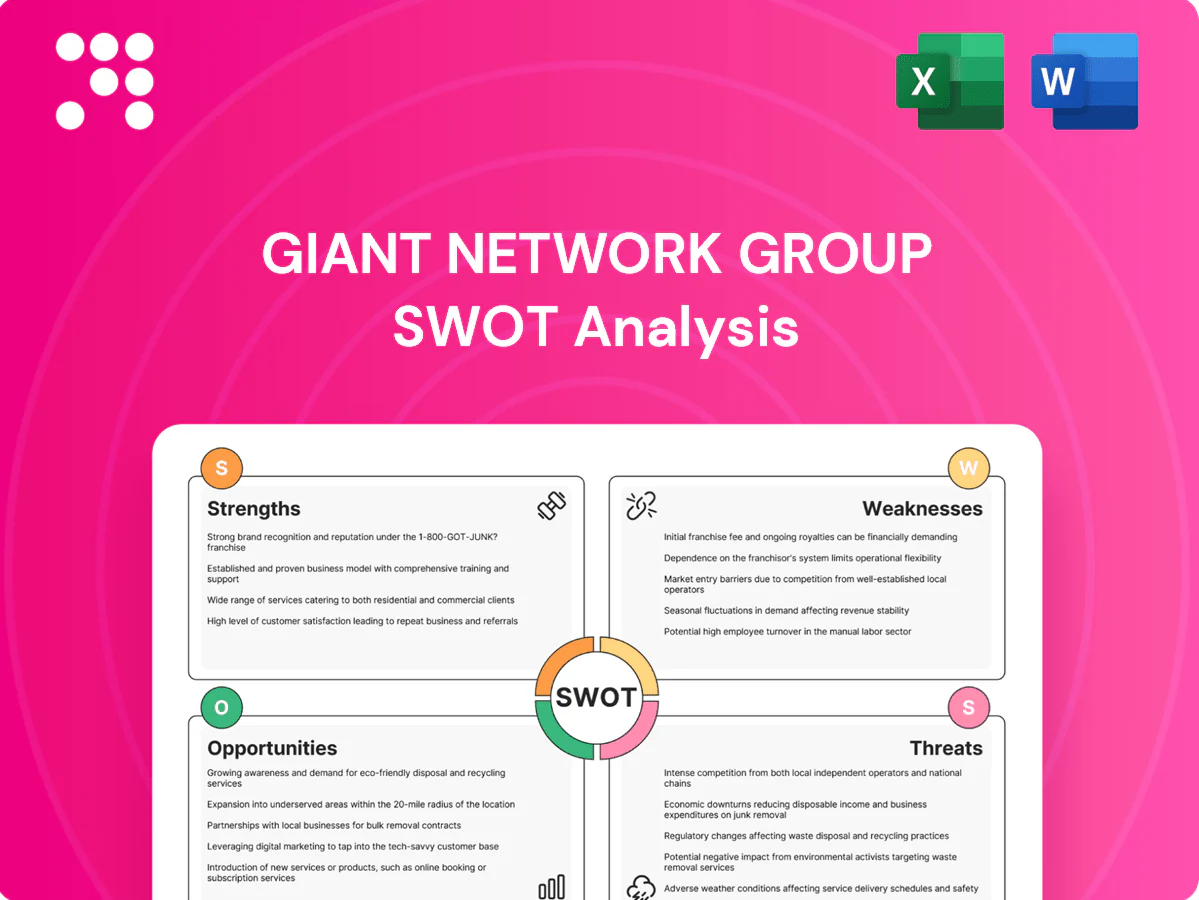
Giant Network Group SWOT Analysis

Elevate Your Analysis with the Complete SWOT Report
Giant Network Group's SWOT reveals strong market reach and tech capabilities, balanced by competitive pressures and regulatory risks, with clear growth levers from partnerships and M&A. Want the full picture? Purchase the complete SWOT analysis for a research-backed, editable report with Word and Excel deliverables—ready for strategy, investment, and presentations.
Strengths

Established MMORPG and mobile expertise
Deep MMORPG and mobile know-how shortens live-ops cycles and improves tuning, supporting stable engagement and monetization design; Newzoo reported mobile game revenue of $93.2B globally in 2023, underscoring market value of optimized live services. This expertise drives consistent quality across new titles and higher retention rates, while competitors face steeper learning curves to match Giant Network Group’s scaling and tuning capabilities.
Integrated development–publishing–operations
Owning development, publishing and ops gives Giant Network Group faster feedback loops from players to dev teams, shortening iteration cycles by weeks and improving feature-market fit. Coordinated marketing, distribution and live-ops lift LTV—industry studies show live-ops can boost LTV roughly 20–35%—while integrated channels can reduce CAC by ~20–30%. Capturing margins across the stack cuts third‑party fees and reduces platform dependency risk.

Scaled online gaming platform
Scaled online platform enables cross-promotion, unified payments and user-data visibility, lowering launch risk for new titles and bolstering portfolio resilience. Network effects and community features improve retention and monetization. First-party distribution cuts dependence on third-party store fees commonly ranging 15–30%.

Data-driven live-ops and monetization
Giant’s data-driven live-ops enable frequent content drops and events, supporting retention in a market where mobile games represented ~52% of global games revenue in 2024 (~$100B). Analytics steer dynamic pricing, personalization and churn prevention, while continuous A/B testing (often yielding conversion uplifts ~10–15%) tightens funnels to sustain ARPU and extend product lifecycles.
- Frequent events: faster updates
- Analytics: pricing, personalization, churn
- A/B testing: +10–15% conversion
- Result: sustained ARPU, longer lifecycles
Brand recognition in China
Giant Network Group’s strong brand recognition in China (listed on SZSE: 002558) enhances user trust and strengthens partner negotiations, aiding distribution and IP deals. It improves talent attraction in a competitive market, lowering recruitment friction for development teams. Legacy franchises such as ZT Online seed initial user bases for new launches and help reduce marketing spend per install.
- Reputation: boosts partner leverage
- Talent: eases hiring in China
- Franchises: seed users for new titles
- Marketing: lowers CPI and spend
Live‑ops optimization: boost LTV 20–35%, cut CAC 20–30% in $100B mobile market
Deep MMORPG and mobile expertise accelerates live‑ops cycles and retention; mobile revenue ~100B in 2024 validates optimized live services. Vertical ownership (dev+publish+ops) shortens feedback loops, raising LTV ~20–35% and lowering CAC ~20–30%. Data-driven A/B testing delivers +10–15% conversion, cutting churn and extending ARPU.
| Metric | Value |
|---|---|
| Global mobile games revenue (2024) | $100B |
| LTV uplift (live‑ops) | 20–35% |
| Conversion uplift (A/B) | 10–15% |
| Store fee reduction (1st‑party) | 15–30% |
What is included in the product
 Detailed Word Document
Delivers a strategic overview of Giant Network Group’s internal and external business factors, outlining strengths, weaknesses, opportunities and threats to map market strengths, operational gaps and risks that shape its competitive position and growth prospects.

 Customizable Excel Spreadsheet
Delivers a concise, visual SWOT matrix for Giant Network Group to quickly identify strategic pain points and prioritize corrective actions across units.
Weaknesses

Genre concentration in MMORPGs
Heavy reliance on MMORPGs leaves Giant Network Group exposed to taste shifts as consumer demand pivots; AAA RPG development now commonly exceeds $100m and 3–5 year timelines, amplifying per-title failure risk. Casual/mobile segments grew to roughly half of global games revenue in 2023–24, suggesting portfolio diversification may lag.
Regulatory exposure in China
Licensing, content and the NPPA playtime limits (minors capped at 3 hours/week since 2021) can delay launches and constrain monetization for Giant Network. Policy shifts in China have been rapid and hard to forecast, forcing frequent product reworks and market pauses. Compliance increases operating costs and friction, and domestic regulatory constraints can cap scale even where consumer demand remains strong.

High content and live-ops intensity
MMORPGs require relentless content — weekly or monthly updates — which strains teams and pushed fixed development and live-ops costs up to 30% of annual budgets in mid/large studios. Live-ops missteps can drive churn spikes reported as high as 20–25%, and repeated events produce content fatigue that erodes event ROI over successive cycles.

Platform dependency outside first-party
Platform dependency outside first-party constrains Giant Network Group: mobile distribution still relies on third-party stores for reach, with iOS and Android commanding over 99% of global mobile OS share (2024). App store fees (up to 30%, 15% for small developers) and limited API/feature access can squeeze margins and reduce CRM control. Algorithmic visibility is unpredictable and negotiating leverage varies sharply by title performance and download/revenue metrics.
- Fees: up to 30% (Apple/Google)
- OS market share: >99% (iOS+Android, 2024)
- Visibility: algorithm-driven, variable
- Leverage: tied to downloads/revenue
Internationalization capability gap
Giant Network Group lacks proven internationalization capability: localization, culturalization and global publishing require different product roadmaps and partners than domestic playbooks, and user acquisition economics and community management vary sharply by region. Without stronger overseas ops scale becomes slower and riskier, and core IP may need adaptation to broaden appeal beyond China; global mobile games still drive roughly half of industry revenue.
- Localization complexity
- Regional UA/community variance
- Slower riskier scale overseas
- IP adaptation required
AAA RPGs >$100m, 50% mobile, live-ops & regs squeeze margins
Heavy dependence on MMORPGs raises per-title failure risk as AAA RPGs exceed $100m and 3–5 year cycles; casual/mobile now ~50% of global games revenue (2023–24). Regulatory shifts (minors 3 hrs/week cap since 2021) and compliance inflate costs; live-ops can be 30% of budgets with churn spikes of 20–25%. App-store fees up to 30% and iOS+Android >99% OS share (2024) constrain margins and global reach.
| Metric | Value |
|---|---|
| AAA dev cost | >$100m |
| Casual/mobile share | ~50% (2023–24) |
| Live-ops cost | ~30% budgets |
| Churn spike | 20–25% |
| App fees | up to 30% |
Preview the Actual Deliverable
Giant Network Group SWOT Analysis
This is the actual Giant Network Group SWOT analysis document you’ll receive upon purchase—no surprises, just professional quality. The preview below is taken directly from the full report you'll get, and the complete, editable version becomes available after checkout. You’re viewing a live excerpt of the final file, ready to download once you buy.

Elevate Your Analysis with the Complete SWOT Report
Giant Network Group's SWOT reveals strong market reach and tech capabilities, balanced by competitive pressures and regulatory risks, with clear growth levers from partnerships and M&A. Want the full picture? Purchase the complete SWOT analysis for a research-backed, editable report with Word and Excel deliverables—ready for strategy, investment, and presentations.
Strengths
Established MMORPG and mobile expertise
Deep MMORPG and mobile know-how shortens live-ops cycles and improves tuning, supporting stable engagement and monetization design; Newzoo reported mobile game revenue of $93.2B globally in 2023, underscoring market value of optimized live services. This expertise drives consistent quality across new titles and higher retention rates, while competitors face steeper learning curves to match Giant Network Group’s scaling and tuning capabilities.
Integrated development–publishing–operations
Owning development, publishing and ops gives Giant Network Group faster feedback loops from players to dev teams, shortening iteration cycles by weeks and improving feature-market fit. Coordinated marketing, distribution and live-ops lift LTV—industry studies show live-ops can boost LTV roughly 20–35%—while integrated channels can reduce CAC by ~20–30%. Capturing margins across the stack cuts third‑party fees and reduces platform dependency risk.
Scaled online gaming platform
Scaled online platform enables cross-promotion, unified payments and user-data visibility, lowering launch risk for new titles and bolstering portfolio resilience. Network effects and community features improve retention and monetization. First-party distribution cuts dependence on third-party store fees commonly ranging 15–30%.
Data-driven live-ops and monetization
Giant’s data-driven live-ops enable frequent content drops and events, supporting retention in a market where mobile games represented ~52% of global games revenue in 2024 (~$100B). Analytics steer dynamic pricing, personalization and churn prevention, while continuous A/B testing (often yielding conversion uplifts ~10–15%) tightens funnels to sustain ARPU and extend product lifecycles.
- Frequent events: faster updates
- Analytics: pricing, personalization, churn
- A/B testing: +10–15% conversion
- Result: sustained ARPU, longer lifecycles
Brand recognition in China
Giant Network Group’s strong brand recognition in China (listed on SZSE: 002558) enhances user trust and strengthens partner negotiations, aiding distribution and IP deals. It improves talent attraction in a competitive market, lowering recruitment friction for development teams. Legacy franchises such as ZT Online seed initial user bases for new launches and help reduce marketing spend per install.
- Reputation: boosts partner leverage
- Talent: eases hiring in China
- Franchises: seed users for new titles
- Marketing: lowers CPI and spend
Live‑ops optimization: boost LTV 20–35%, cut CAC 20–30% in $100B mobile market
Deep MMORPG and mobile expertise accelerates live‑ops cycles and retention; mobile revenue ~100B in 2024 validates optimized live services. Vertical ownership (dev+publish+ops) shortens feedback loops, raising LTV ~20–35% and lowering CAC ~20–30%. Data-driven A/B testing delivers +10–15% conversion, cutting churn and extending ARPU.
| Metric | Value |
|---|---|
| Global mobile games revenue (2024) | $100B |
| LTV uplift (live‑ops) | 20–35% |
| Conversion uplift (A/B) | 10–15% |
| Store fee reduction (1st‑party) | 15–30% |
What is included in the product
Detailed Word Document
Delivers a strategic overview of Giant Network Group’s internal and external business factors, outlining strengths, weaknesses, opportunities and threats to map market strengths, operational gaps and risks that shape its competitive position and growth prospects.
Customizable Excel Spreadsheet
Delivers a concise, visual SWOT matrix for Giant Network Group to quickly identify strategic pain points and prioritize corrective actions across units.
Weaknesses
Genre concentration in MMORPGs
Heavy reliance on MMORPGs leaves Giant Network Group exposed to taste shifts as consumer demand pivots; AAA RPG development now commonly exceeds $100m and 3–5 year timelines, amplifying per-title failure risk. Casual/mobile segments grew to roughly half of global games revenue in 2023–24, suggesting portfolio diversification may lag.
Regulatory exposure in China
Licensing, content and the NPPA playtime limits (minors capped at 3 hours/week since 2021) can delay launches and constrain monetization for Giant Network. Policy shifts in China have been rapid and hard to forecast, forcing frequent product reworks and market pauses. Compliance increases operating costs and friction, and domestic regulatory constraints can cap scale even where consumer demand remains strong.
High content and live-ops intensity
MMORPGs require relentless content — weekly or monthly updates — which strains teams and pushed fixed development and live-ops costs up to 30% of annual budgets in mid/large studios. Live-ops missteps can drive churn spikes reported as high as 20–25%, and repeated events produce content fatigue that erodes event ROI over successive cycles.
Platform dependency outside first-party
Platform dependency outside first-party constrains Giant Network Group: mobile distribution still relies on third-party stores for reach, with iOS and Android commanding over 99% of global mobile OS share (2024). App store fees (up to 30%, 15% for small developers) and limited API/feature access can squeeze margins and reduce CRM control. Algorithmic visibility is unpredictable and negotiating leverage varies sharply by title performance and download/revenue metrics.
- Fees: up to 30% (Apple/Google)
- OS market share: >99% (iOS+Android, 2024)
- Visibility: algorithm-driven, variable
- Leverage: tied to downloads/revenue
Internationalization capability gap
Giant Network Group lacks proven internationalization capability: localization, culturalization and global publishing require different product roadmaps and partners than domestic playbooks, and user acquisition economics and community management vary sharply by region. Without stronger overseas ops scale becomes slower and riskier, and core IP may need adaptation to broaden appeal beyond China; global mobile games still drive roughly half of industry revenue.
- Localization complexity
- Regional UA/community variance
- Slower riskier scale overseas
- IP adaptation required
AAA RPGs >$100m, 50% mobile, live-ops & regs squeeze margins
Heavy dependence on MMORPGs raises per-title failure risk as AAA RPGs exceed $100m and 3–5 year cycles; casual/mobile now ~50% of global games revenue (2023–24). Regulatory shifts (minors 3 hrs/week cap since 2021) and compliance inflate costs; live-ops can be 30% of budgets with churn spikes of 20–25%. App-store fees up to 30% and iOS+Android >99% OS share (2024) constrain margins and global reach.
| Metric | Value |
|---|---|
| AAA dev cost | >$100m |
| Casual/mobile share | ~50% (2023–24) |
| Live-ops cost | ~30% budgets |
| Churn spike | 20–25% |
| App fees | up to 30% |
Preview the Actual Deliverable
Giant Network Group SWOT Analysis
This is the actual Giant Network Group SWOT analysis document you’ll receive upon purchase—no surprises, just professional quality. The preview below is taken directly from the full report you'll get, and the complete, editable version becomes available after checkout. You’re viewing a live excerpt of the final file, ready to download once you buy.
Original: $10.00
-65%$10.00
$3.50Description
Elevate Your Analysis with the Complete SWOT Report
Giant Network Group's SWOT reveals strong market reach and tech capabilities, balanced by competitive pressures and regulatory risks, with clear growth levers from partnerships and M&A. Want the full picture? Purchase the complete SWOT analysis for a research-backed, editable report with Word and Excel deliverables—ready for strategy, investment, and presentations.
Strengths
Established MMORPG and mobile expertise
Deep MMORPG and mobile know-how shortens live-ops cycles and improves tuning, supporting stable engagement and monetization design; Newzoo reported mobile game revenue of $93.2B globally in 2023, underscoring market value of optimized live services. This expertise drives consistent quality across new titles and higher retention rates, while competitors face steeper learning curves to match Giant Network Group’s scaling and tuning capabilities.
Integrated development–publishing–operations
Owning development, publishing and ops gives Giant Network Group faster feedback loops from players to dev teams, shortening iteration cycles by weeks and improving feature-market fit. Coordinated marketing, distribution and live-ops lift LTV—industry studies show live-ops can boost LTV roughly 20–35%—while integrated channels can reduce CAC by ~20–30%. Capturing margins across the stack cuts third‑party fees and reduces platform dependency risk.
Scaled online gaming platform
Scaled online platform enables cross-promotion, unified payments and user-data visibility, lowering launch risk for new titles and bolstering portfolio resilience. Network effects and community features improve retention and monetization. First-party distribution cuts dependence on third-party store fees commonly ranging 15–30%.
Data-driven live-ops and monetization
Giant’s data-driven live-ops enable frequent content drops and events, supporting retention in a market where mobile games represented ~52% of global games revenue in 2024 (~$100B). Analytics steer dynamic pricing, personalization and churn prevention, while continuous A/B testing (often yielding conversion uplifts ~10–15%) tightens funnels to sustain ARPU and extend product lifecycles.
- Frequent events: faster updates
- Analytics: pricing, personalization, churn
- A/B testing: +10–15% conversion
- Result: sustained ARPU, longer lifecycles
Brand recognition in China
Giant Network Group’s strong brand recognition in China (listed on SZSE: 002558) enhances user trust and strengthens partner negotiations, aiding distribution and IP deals. It improves talent attraction in a competitive market, lowering recruitment friction for development teams. Legacy franchises such as ZT Online seed initial user bases for new launches and help reduce marketing spend per install.
- Reputation: boosts partner leverage
- Talent: eases hiring in China
- Franchises: seed users for new titles
- Marketing: lowers CPI and spend
Live‑ops optimization: boost LTV 20–35%, cut CAC 20–30% in $100B mobile market
Deep MMORPG and mobile expertise accelerates live‑ops cycles and retention; mobile revenue ~100B in 2024 validates optimized live services. Vertical ownership (dev+publish+ops) shortens feedback loops, raising LTV ~20–35% and lowering CAC ~20–30%. Data-driven A/B testing delivers +10–15% conversion, cutting churn and extending ARPU.
| Metric | Value |
|---|---|
| Global mobile games revenue (2024) | $100B |
| LTV uplift (live‑ops) | 20–35% |
| Conversion uplift (A/B) | 10–15% |
| Store fee reduction (1st‑party) | 15–30% |
What is included in the product
Detailed Word Document
Delivers a strategic overview of Giant Network Group’s internal and external business factors, outlining strengths, weaknesses, opportunities and threats to map market strengths, operational gaps and risks that shape its competitive position and growth prospects.
Customizable Excel Spreadsheet
Delivers a concise, visual SWOT matrix for Giant Network Group to quickly identify strategic pain points and prioritize corrective actions across units.
Weaknesses
Genre concentration in MMORPGs
Heavy reliance on MMORPGs leaves Giant Network Group exposed to taste shifts as consumer demand pivots; AAA RPG development now commonly exceeds $100m and 3–5 year timelines, amplifying per-title failure risk. Casual/mobile segments grew to roughly half of global games revenue in 2023–24, suggesting portfolio diversification may lag.
Regulatory exposure in China
Licensing, content and the NPPA playtime limits (minors capped at 3 hours/week since 2021) can delay launches and constrain monetization for Giant Network. Policy shifts in China have been rapid and hard to forecast, forcing frequent product reworks and market pauses. Compliance increases operating costs and friction, and domestic regulatory constraints can cap scale even where consumer demand remains strong.
High content and live-ops intensity
MMORPGs require relentless content — weekly or monthly updates — which strains teams and pushed fixed development and live-ops costs up to 30% of annual budgets in mid/large studios. Live-ops missteps can drive churn spikes reported as high as 20–25%, and repeated events produce content fatigue that erodes event ROI over successive cycles.
Platform dependency outside first-party
Platform dependency outside first-party constrains Giant Network Group: mobile distribution still relies on third-party stores for reach, with iOS and Android commanding over 99% of global mobile OS share (2024). App store fees (up to 30%, 15% for small developers) and limited API/feature access can squeeze margins and reduce CRM control. Algorithmic visibility is unpredictable and negotiating leverage varies sharply by title performance and download/revenue metrics.
- Fees: up to 30% (Apple/Google)
- OS market share: >99% (iOS+Android, 2024)
- Visibility: algorithm-driven, variable
- Leverage: tied to downloads/revenue
Internationalization capability gap
Giant Network Group lacks proven internationalization capability: localization, culturalization and global publishing require different product roadmaps and partners than domestic playbooks, and user acquisition economics and community management vary sharply by region. Without stronger overseas ops scale becomes slower and riskier, and core IP may need adaptation to broaden appeal beyond China; global mobile games still drive roughly half of industry revenue.
- Localization complexity
- Regional UA/community variance
- Slower riskier scale overseas
- IP adaptation required
AAA RPGs >$100m, 50% mobile, live-ops & regs squeeze margins
Heavy dependence on MMORPGs raises per-title failure risk as AAA RPGs exceed $100m and 3–5 year cycles; casual/mobile now ~50% of global games revenue (2023–24). Regulatory shifts (minors 3 hrs/week cap since 2021) and compliance inflate costs; live-ops can be 30% of budgets with churn spikes of 20–25%. App-store fees up to 30% and iOS+Android >99% OS share (2024) constrain margins and global reach.
| Metric | Value |
|---|---|
| AAA dev cost | >$100m |
| Casual/mobile share | ~50% (2023–24) |
| Live-ops cost | ~30% budgets |
| Churn spike | 20–25% |
| App fees | up to 30% |
Preview the Actual Deliverable
Giant Network Group SWOT Analysis
This is the actual Giant Network Group SWOT analysis document you’ll receive upon purchase—no surprises, just professional quality. The preview below is taken directly from the full report you'll get, and the complete, editable version becomes available after checkout. You’re viewing a live excerpt of the final file, ready to download once you buy.











