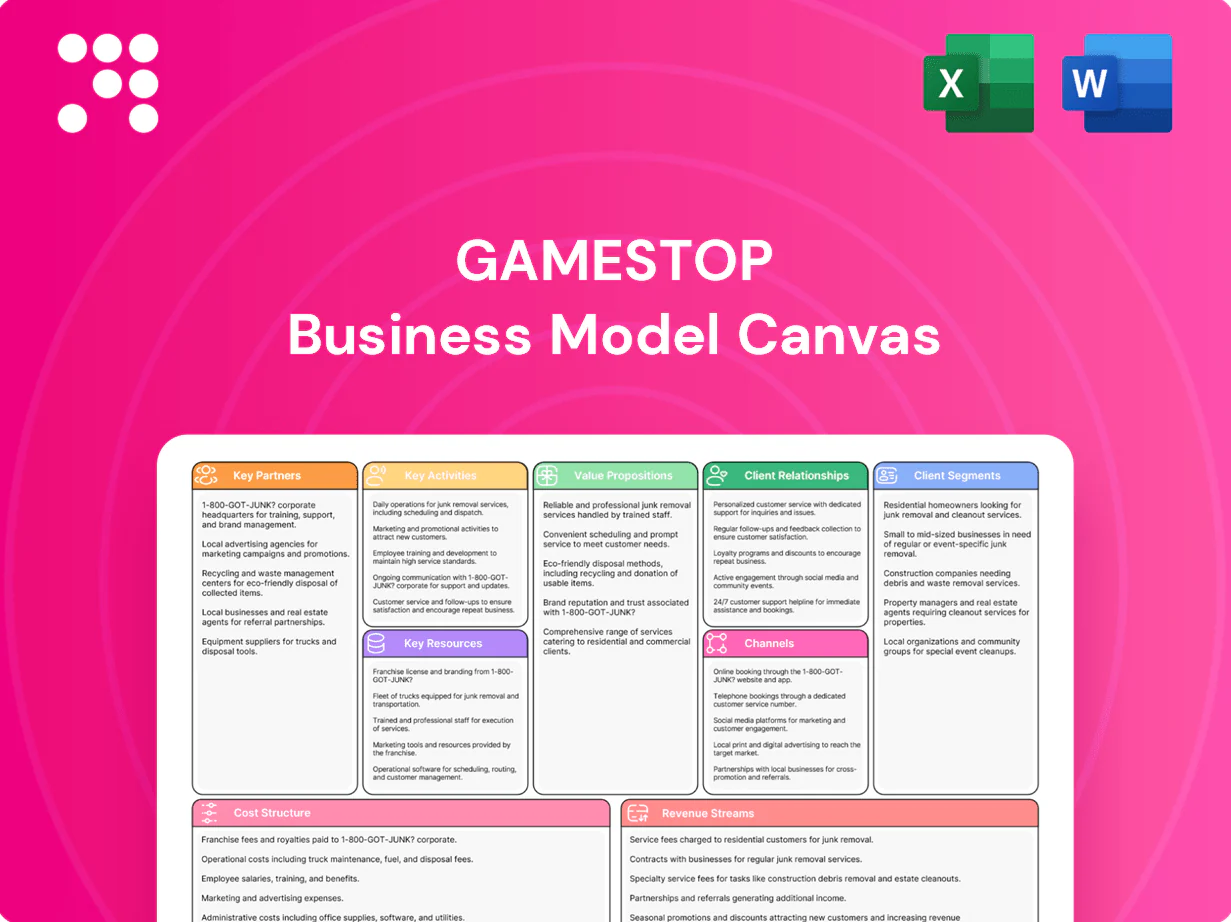
GameStop Business Model Canvas

Business Model Canvas for a Leading Video Game Retailer: Value, Customers, Revenue
Explore GameStop’s strategic layout in our Business Model Canvas: concise value propositions, customer segments, revenue streams and partnerships mapped for clear insight. This snapshot reveals growth levers and risk points—download the full, editable Canvas to use in investor decks, benchmarking, or strategy workshops.
Partnerships

Console makers & publishers
Partnering with Sony, Microsoft and Nintendo — platforms with combined console lifecycles exceeding 200 million units by 2024 — and major publishers secures hardware and software allocation. These ties enable exclusive editions, pre-order bonuses and launch events that drive traffic. Strong supplier relationships stabilize supply across GameStop’s roughly 4,000 stores. Co-marketing lowers customer acquisition costs by sharing promotional spend.
Distributors & logistics providers
Wholesale distributors and 3PLs keep inventory flowing to GameStop’s retail footprint—over 4,000 stores worldwide—ensuring regional replenishment and lower unit costs through scale buying. Reliable logistics drive launch-day availability and handle reverse logistics for trade-ins, supporting high sell-through on release windows. Flexible 3PL fulfillment smooths seasonal surges and reduces lead times.

Digital platforms & gift card networks
Partnerships with platform holders for digital codes, subscriptions, and wallet cards expand GameStop’s offer breadth by enabling third-party distribution of keys and wallet top-ups without platform ownership. Gift card networks extend reach into non-core retail and lever GameStop’s ≈3,000-store footprint (2024) to access new buyers. These deals monetize digital demand and capture impulse purchases at checkout, aligning with the broader $185B U.S. gift card channel in 2024.

Collectibles & accessories brands
Alliances with licensed collectibles and peripheral makers drive higher-margin categories, with exclusive SKUs differentiating GameStop’s assortment from mass merchants and reducing price competition. Co-branded releases enhance fandom and frequency of store visits, while formal supply agreements stabilize replenishment for evergreen items and improve inventory turns.
- High-margin licensed collectibles
- Exclusive SKUs for differentiation
- Co-branded drops to boost repeat visits
- Supply agreements for steady replenishment
Trade-in refurbishers & recycling
In 2024 certified refurbishers help GameStop process, grade and resell pre-owned devices, improving throughput and return-to-shelf speed. Responsible recycling programs reduce electronic waste and strengthen brand goodwill with sustainability-minded consumers. Efficient refurbishment raises margins on used hardware while data-driven grading standards preserve resale value and consumer trust.
- certified refurb partners: grading & resale
- recycling: waste reduction & goodwill
- efficiency: higher margins on used hardware
- data-driven grading: consistent consumer trust
Platform partnerships, launch-day retail in 4,000 stores and access to $185B gift market
Strategic ties with Sony, Microsoft and Nintendo (combined console lifecycles >200M units by 2024) plus publishers secure launches, exclusives and store traffic. Distributors/3PLs and ~4,000 stores enable launch-day availability and lower unit costs. Gift-card and digital-code deals tap the $185B US gift-card channel (2024) and expand digital revenue.
| Partner | Metric (2024) |
|---|---|
| Platform holders | >200M consoles |
| Stores/3PL | ~4,000 stores |
| Gift cards | $185B US channel |
What is included in the product
 Detailed Word Document
A concise Business Model Canvas for GameStop detailing customer segments, value propositions, channels, revenue streams, key activities, partners, resources, cost structure and customer relationships, with SWOT-linked insights and competitive advantages—ready for presentations and investor discussions.

 Customizable Excel Spreadsheet
High-level view of GameStop’s evolving retail-to-digital strategy with editable cells, relieving the pain of fragmented strategy tracking and rapid pivot planning for teams and investors.
Activities

Merchandising & assortment
Curation across new, pre-owned, digital and collectibles balances demand and margin, supporting GameStop’s omnichannel mix after FY2023 net sales of about $6.1 billion. Regional planning aligns inventory to local tastes across approximately 4,400 stores (2024), reducing markdowns. Aggressive vendor negotiations secure allocations and exclusives, while dynamic pricing optimization improves sell-through and profitability.
Trade-in operations
Buying, testing, grading, and reselling pre-owned products forms GameStop’s core trade-in loop, executed across roughly 3,000 stores in 2024 to feed its retail and online channels. Clear value guides and fast appraisals—often same-day in-store or instant via the app—boost conversion and customer lifetime value. Efficient turnaround targets high inventory velocity to shorten hold times and improve cash flow. Transaction and pricing data drive offer algorithms to protect gross margin.

Omnichannel retailing
Omnichannel retailing links GameStop’s online platform with its network of over 4,000 stores to enable BOPIS, ship-from-store and returns-anywhere fulfillment, improving convenience and speed. Unified inventory visibility across channels reduces stockouts and markdowns. Consistent cross-channel promotions increase purchase confidence while consolidated customer data powers targeted marketing and improved service.

Community & launch events
Midnight launches, tournaments, and loyalty activations drive foot traffic and engagement, creating upsell windows for accessories and extended warranties while social and email amplify reach at low cost; loyalty members typically spend materially more, with industry studies citing ~20% higher spend per member.
Customer support & loyalty
Educating customers on new releases, compatibility, and upgrade paths cuts mismatches and return rates while steering higher-margin upsells; GameStop’s PowerUp Rewards exceeded 60 million members by 2024, enabling personalized outreach that boosts repeat visits. Proactive support for pre-orders and shortages manages expectations and reduces churn; strong post-sale service raises customer lifetime value and accessory/repair revenue.
- PowerUp Rewards >60M members (2024)
- Education reduces returns and increases upgrades
- Pre-order support limits cancellations
- Post-sale service increases lifetime value
Omnichannel curation drives velocity — $6.1B, ≈4,400 stores
Curation across new, pre-owned, digital and collectibles supports omnichannel after FY2023 net sales of $6.1B.
Trade-in loop (≈3,000 stores in 2024) buys, grades and resells pre-owned to boost inventory velocity.
Omnichannel (≈4,400 stores) enables BOPIS, ship-from-store and unified inventory; PowerUp Rewards >60M drives repeat spend.
| Metric | 2024 |
|---|---|
| Net sales | $6.1B |
| Stores | ≈4,400 |
| Trade-in stores | ≈3,000 |
| PowerUp Rewards | >60M |
What You See Is What You Get
Business Model Canvas
The GameStop Business Model Canvas shown here is the exact document you’ll receive—this preview is not a mockup but a direct extract from the final file. Upon purchase you’ll instantly download the complete, ready-to-edit Business Model Canvas in Word and Excel formats. No placeholders, no surprises—ready for presentation or analysis.

Business Model Canvas for a Leading Video Game Retailer: Value, Customers, Revenue
Explore GameStop’s strategic layout in our Business Model Canvas: concise value propositions, customer segments, revenue streams and partnerships mapped for clear insight. This snapshot reveals growth levers and risk points—download the full, editable Canvas to use in investor decks, benchmarking, or strategy workshops.
Partnerships
Console makers & publishers
Partnering with Sony, Microsoft and Nintendo — platforms with combined console lifecycles exceeding 200 million units by 2024 — and major publishers secures hardware and software allocation. These ties enable exclusive editions, pre-order bonuses and launch events that drive traffic. Strong supplier relationships stabilize supply across GameStop’s roughly 4,000 stores. Co-marketing lowers customer acquisition costs by sharing promotional spend.
Distributors & logistics providers
Wholesale distributors and 3PLs keep inventory flowing to GameStop’s retail footprint—over 4,000 stores worldwide—ensuring regional replenishment and lower unit costs through scale buying. Reliable logistics drive launch-day availability and handle reverse logistics for trade-ins, supporting high sell-through on release windows. Flexible 3PL fulfillment smooths seasonal surges and reduces lead times.
Digital platforms & gift card networks
Partnerships with platform holders for digital codes, subscriptions, and wallet cards expand GameStop’s offer breadth by enabling third-party distribution of keys and wallet top-ups without platform ownership. Gift card networks extend reach into non-core retail and lever GameStop’s ≈3,000-store footprint (2024) to access new buyers. These deals monetize digital demand and capture impulse purchases at checkout, aligning with the broader $185B U.S. gift card channel in 2024.
Collectibles & accessories brands
Alliances with licensed collectibles and peripheral makers drive higher-margin categories, with exclusive SKUs differentiating GameStop’s assortment from mass merchants and reducing price competition. Co-branded releases enhance fandom and frequency of store visits, while formal supply agreements stabilize replenishment for evergreen items and improve inventory turns.
- High-margin licensed collectibles
- Exclusive SKUs for differentiation
- Co-branded drops to boost repeat visits
- Supply agreements for steady replenishment
Trade-in refurbishers & recycling
In 2024 certified refurbishers help GameStop process, grade and resell pre-owned devices, improving throughput and return-to-shelf speed. Responsible recycling programs reduce electronic waste and strengthen brand goodwill with sustainability-minded consumers. Efficient refurbishment raises margins on used hardware while data-driven grading standards preserve resale value and consumer trust.
- certified refurb partners: grading & resale
- recycling: waste reduction & goodwill
- efficiency: higher margins on used hardware
- data-driven grading: consistent consumer trust
Platform partnerships, launch-day retail in 4,000 stores and access to $185B gift market
Strategic ties with Sony, Microsoft and Nintendo (combined console lifecycles >200M units by 2024) plus publishers secure launches, exclusives and store traffic. Distributors/3PLs and ~4,000 stores enable launch-day availability and lower unit costs. Gift-card and digital-code deals tap the $185B US gift-card channel (2024) and expand digital revenue.
| Partner | Metric (2024) |
|---|---|
| Platform holders | >200M consoles |
| Stores/3PL | ~4,000 stores |
| Gift cards | $185B US channel |
What is included in the product
Detailed Word Document
A concise Business Model Canvas for GameStop detailing customer segments, value propositions, channels, revenue streams, key activities, partners, resources, cost structure and customer relationships, with SWOT-linked insights and competitive advantages—ready for presentations and investor discussions.
Customizable Excel Spreadsheet
High-level view of GameStop’s evolving retail-to-digital strategy with editable cells, relieving the pain of fragmented strategy tracking and rapid pivot planning for teams and investors.
Activities
Merchandising & assortment
Curation across new, pre-owned, digital and collectibles balances demand and margin, supporting GameStop’s omnichannel mix after FY2023 net sales of about $6.1 billion. Regional planning aligns inventory to local tastes across approximately 4,400 stores (2024), reducing markdowns. Aggressive vendor negotiations secure allocations and exclusives, while dynamic pricing optimization improves sell-through and profitability.
Trade-in operations
Buying, testing, grading, and reselling pre-owned products forms GameStop’s core trade-in loop, executed across roughly 3,000 stores in 2024 to feed its retail and online channels. Clear value guides and fast appraisals—often same-day in-store or instant via the app—boost conversion and customer lifetime value. Efficient turnaround targets high inventory velocity to shorten hold times and improve cash flow. Transaction and pricing data drive offer algorithms to protect gross margin.
Omnichannel retailing
Omnichannel retailing links GameStop’s online platform with its network of over 4,000 stores to enable BOPIS, ship-from-store and returns-anywhere fulfillment, improving convenience and speed. Unified inventory visibility across channels reduces stockouts and markdowns. Consistent cross-channel promotions increase purchase confidence while consolidated customer data powers targeted marketing and improved service.
Community & launch events
Midnight launches, tournaments, and loyalty activations drive foot traffic and engagement, creating upsell windows for accessories and extended warranties while social and email amplify reach at low cost; loyalty members typically spend materially more, with industry studies citing ~20% higher spend per member.
Customer support & loyalty
Educating customers on new releases, compatibility, and upgrade paths cuts mismatches and return rates while steering higher-margin upsells; GameStop’s PowerUp Rewards exceeded 60 million members by 2024, enabling personalized outreach that boosts repeat visits. Proactive support for pre-orders and shortages manages expectations and reduces churn; strong post-sale service raises customer lifetime value and accessory/repair revenue.
- PowerUp Rewards >60M members (2024)
- Education reduces returns and increases upgrades
- Pre-order support limits cancellations
- Post-sale service increases lifetime value
Omnichannel curation drives velocity — $6.1B, ≈4,400 stores
Curation across new, pre-owned, digital and collectibles supports omnichannel after FY2023 net sales of $6.1B.
Trade-in loop (≈3,000 stores in 2024) buys, grades and resells pre-owned to boost inventory velocity.
Omnichannel (≈4,400 stores) enables BOPIS, ship-from-store and unified inventory; PowerUp Rewards >60M drives repeat spend.
| Metric | 2024 |
|---|---|
| Net sales | $6.1B |
| Stores | ≈4,400 |
| Trade-in stores | ≈3,000 |
| PowerUp Rewards | >60M |
What You See Is What You Get
Business Model Canvas
The GameStop Business Model Canvas shown here is the exact document you’ll receive—this preview is not a mockup but a direct extract from the final file. Upon purchase you’ll instantly download the complete, ready-to-edit Business Model Canvas in Word and Excel formats. No placeholders, no surprises—ready for presentation or analysis.
Original: $10.00
-65%$10.00
$3.50Description
Business Model Canvas for a Leading Video Game Retailer: Value, Customers, Revenue
Explore GameStop’s strategic layout in our Business Model Canvas: concise value propositions, customer segments, revenue streams and partnerships mapped for clear insight. This snapshot reveals growth levers and risk points—download the full, editable Canvas to use in investor decks, benchmarking, or strategy workshops.
Partnerships
Console makers & publishers
Partnering with Sony, Microsoft and Nintendo — platforms with combined console lifecycles exceeding 200 million units by 2024 — and major publishers secures hardware and software allocation. These ties enable exclusive editions, pre-order bonuses and launch events that drive traffic. Strong supplier relationships stabilize supply across GameStop’s roughly 4,000 stores. Co-marketing lowers customer acquisition costs by sharing promotional spend.
Distributors & logistics providers
Wholesale distributors and 3PLs keep inventory flowing to GameStop’s retail footprint—over 4,000 stores worldwide—ensuring regional replenishment and lower unit costs through scale buying. Reliable logistics drive launch-day availability and handle reverse logistics for trade-ins, supporting high sell-through on release windows. Flexible 3PL fulfillment smooths seasonal surges and reduces lead times.
Digital platforms & gift card networks
Partnerships with platform holders for digital codes, subscriptions, and wallet cards expand GameStop’s offer breadth by enabling third-party distribution of keys and wallet top-ups without platform ownership. Gift card networks extend reach into non-core retail and lever GameStop’s ≈3,000-store footprint (2024) to access new buyers. These deals monetize digital demand and capture impulse purchases at checkout, aligning with the broader $185B U.S. gift card channel in 2024.
Collectibles & accessories brands
Alliances with licensed collectibles and peripheral makers drive higher-margin categories, with exclusive SKUs differentiating GameStop’s assortment from mass merchants and reducing price competition. Co-branded releases enhance fandom and frequency of store visits, while formal supply agreements stabilize replenishment for evergreen items and improve inventory turns.
- High-margin licensed collectibles
- Exclusive SKUs for differentiation
- Co-branded drops to boost repeat visits
- Supply agreements for steady replenishment
Trade-in refurbishers & recycling
In 2024 certified refurbishers help GameStop process, grade and resell pre-owned devices, improving throughput and return-to-shelf speed. Responsible recycling programs reduce electronic waste and strengthen brand goodwill with sustainability-minded consumers. Efficient refurbishment raises margins on used hardware while data-driven grading standards preserve resale value and consumer trust.
- certified refurb partners: grading & resale
- recycling: waste reduction & goodwill
- efficiency: higher margins on used hardware
- data-driven grading: consistent consumer trust
Platform partnerships, launch-day retail in 4,000 stores and access to $185B gift market
Strategic ties with Sony, Microsoft and Nintendo (combined console lifecycles >200M units by 2024) plus publishers secure launches, exclusives and store traffic. Distributors/3PLs and ~4,000 stores enable launch-day availability and lower unit costs. Gift-card and digital-code deals tap the $185B US gift-card channel (2024) and expand digital revenue.
| Partner | Metric (2024) |
|---|---|
| Platform holders | >200M consoles |
| Stores/3PL | ~4,000 stores |
| Gift cards | $185B US channel |
What is included in the product
Detailed Word Document
A concise Business Model Canvas for GameStop detailing customer segments, value propositions, channels, revenue streams, key activities, partners, resources, cost structure and customer relationships, with SWOT-linked insights and competitive advantages—ready for presentations and investor discussions.
Customizable Excel Spreadsheet
High-level view of GameStop’s evolving retail-to-digital strategy with editable cells, relieving the pain of fragmented strategy tracking and rapid pivot planning for teams and investors.
Activities
Merchandising & assortment
Curation across new, pre-owned, digital and collectibles balances demand and margin, supporting GameStop’s omnichannel mix after FY2023 net sales of about $6.1 billion. Regional planning aligns inventory to local tastes across approximately 4,400 stores (2024), reducing markdowns. Aggressive vendor negotiations secure allocations and exclusives, while dynamic pricing optimization improves sell-through and profitability.
Trade-in operations
Buying, testing, grading, and reselling pre-owned products forms GameStop’s core trade-in loop, executed across roughly 3,000 stores in 2024 to feed its retail and online channels. Clear value guides and fast appraisals—often same-day in-store or instant via the app—boost conversion and customer lifetime value. Efficient turnaround targets high inventory velocity to shorten hold times and improve cash flow. Transaction and pricing data drive offer algorithms to protect gross margin.
Omnichannel retailing
Omnichannel retailing links GameStop’s online platform with its network of over 4,000 stores to enable BOPIS, ship-from-store and returns-anywhere fulfillment, improving convenience and speed. Unified inventory visibility across channels reduces stockouts and markdowns. Consistent cross-channel promotions increase purchase confidence while consolidated customer data powers targeted marketing and improved service.
Community & launch events
Midnight launches, tournaments, and loyalty activations drive foot traffic and engagement, creating upsell windows for accessories and extended warranties while social and email amplify reach at low cost; loyalty members typically spend materially more, with industry studies citing ~20% higher spend per member.
Customer support & loyalty
Educating customers on new releases, compatibility, and upgrade paths cuts mismatches and return rates while steering higher-margin upsells; GameStop’s PowerUp Rewards exceeded 60 million members by 2024, enabling personalized outreach that boosts repeat visits. Proactive support for pre-orders and shortages manages expectations and reduces churn; strong post-sale service raises customer lifetime value and accessory/repair revenue.
- PowerUp Rewards >60M members (2024)
- Education reduces returns and increases upgrades
- Pre-order support limits cancellations
- Post-sale service increases lifetime value
Omnichannel curation drives velocity — $6.1B, ≈4,400 stores
Curation across new, pre-owned, digital and collectibles supports omnichannel after FY2023 net sales of $6.1B.
Trade-in loop (≈3,000 stores in 2024) buys, grades and resells pre-owned to boost inventory velocity.
Omnichannel (≈4,400 stores) enables BOPIS, ship-from-store and unified inventory; PowerUp Rewards >60M drives repeat spend.
| Metric | 2024 |
|---|---|
| Net sales | $6.1B |
| Stores | ≈4,400 |
| Trade-in stores | ≈3,000 |
| PowerUp Rewards | >60M |
What You See Is What You Get
Business Model Canvas
The GameStop Business Model Canvas shown here is the exact document you’ll receive—this preview is not a mockup but a direct extract from the final file. Upon purchase you’ll instantly download the complete, ready-to-edit Business Model Canvas in Word and Excel formats. No placeholders, no surprises—ready for presentation or analysis.











