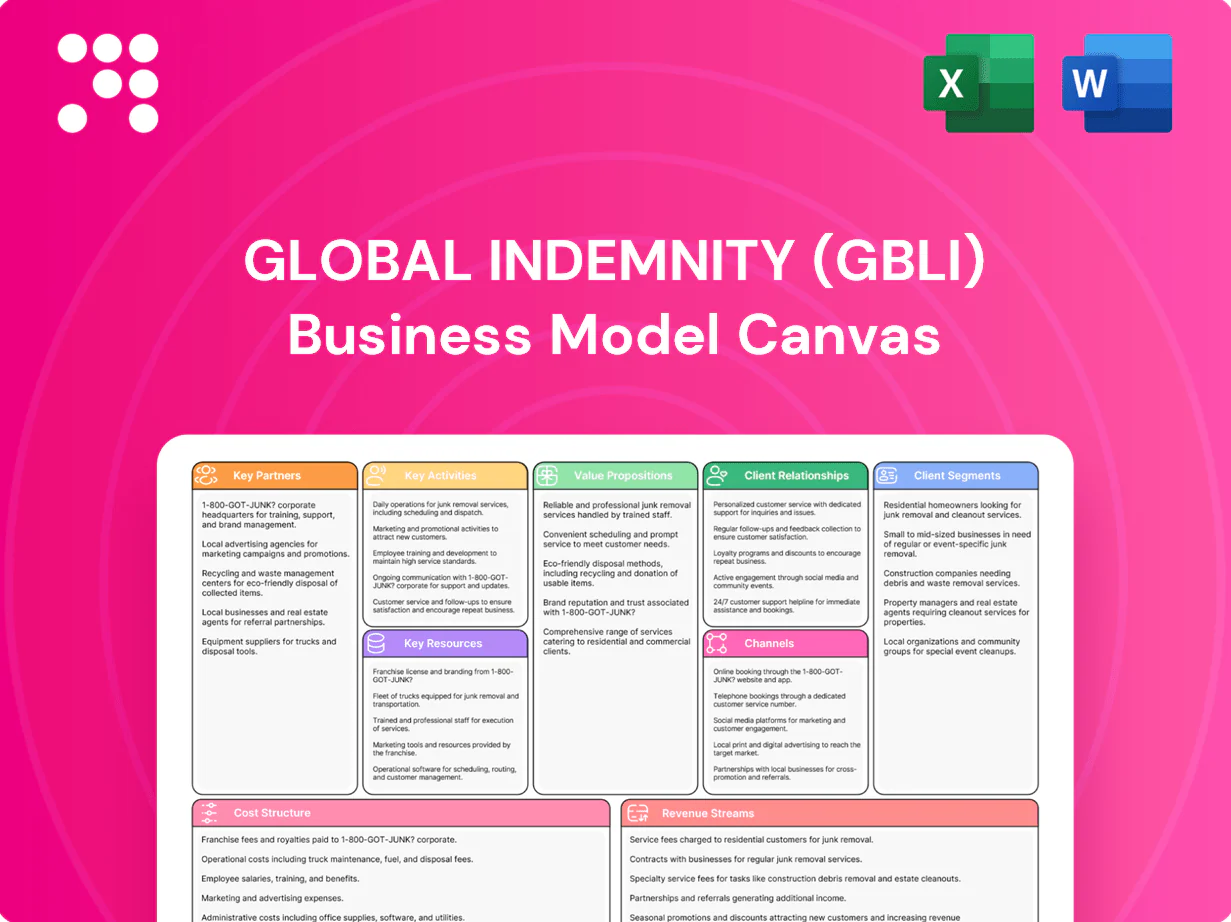
Global Indemnity (GBLI) Business Model Canvas

Insurer Business Model Canvas: Underwriting focus, diversified distribution, disciplined capital
Explore Global Indemnity (GBLI)’s Business Model Canvas to see how underwriting focus, diversified distribution, and disciplined capital allocation drive profitable growth. This concise snapshot reveals key value propositions, revenue streams, and partnerships. Want the complete, editable canvas with strategic insights and financial implications? Purchase the full Business Model Canvas to apply GBLI’s playbook to your analysis or planning.
Partnerships

Reinsurers and retrocession
Partnering with top-tier reinsurers stabilizes GBLI earnings and shields capital against large losses and catastrophes, tapping into a reinsurance sector with over $600 billion of capital in 2024. Structured treaties—quota share and excess-of-loss—provide capacity for niche and E&S risks while transferring peak-loss volatility. Long-term treaties improve pricing, broaden coverage terms and speed claims recoveries, and counterparty diversification reduces concentration risk.
Independent agents and brokers
Independent agents and brokers are core GBLI distribution partners, placing business and supplying local market insight; in 2024 agents accounted for about 63% of U.S. commercial P&C placements, supporting targeted underwriting. Broker relationships drive submission flow and quality deal screening, raising hit rates; co-marketing and training boosted product fit and improved hit ratios by an estimated 12% in 2024. Service-level agreements standardize responsiveness and support retention.

Wholesale brokers and MGAs
Wholesale brokers extend GBLI into E&S and specialized classes, tapping distribution that drove industry surplus lines growth; by 2024 MGAs accounted for roughly 25% of U.S. specialty premiums, expanding addressable markets. MGAs and program administrators deliver niche underwriting and efficient bind authority, accelerating deployment and loss selection. Performance‑based agreements tie compensation to underwriting profitability, while data‑sharing improves pricing precision and portfolio steering.

Claims administrators and repair networks
In 2024 GBLI expanded use of third-party administrators and preferred repair vendors to scale claims handling and accelerate cycle times, reducing leakage and indemnity spend while maintaining service levels. Vendor analytics feed continuous improvement and quality controls protect customer satisfaction and loss outcomes.
- TPAs boost scale/speed
- Networks cut leakage & cycle time
- Quality controls safeguard satisfaction
- Vendor analytics drive improvement
Data/tech providers and cat-modelers
External cat-models and datasets enrich GBLI underwriting, pricing and accumulation control, with 2024 industry adoption of third-party models reported above 60%. Catastrophe modeling supports capacity allocation and reinsurance purchasing by reducing peak-loss uncertainty. API integrations can cut quote-to-bind time by up to 50% while automating compliance. Partnerships accelerate digital portal capabilities and distribution.
- Models: third-party cat & exposure data
- Reinsurance: capacity allocation
- APIs: faster quoting/binding
Reinsurance backs stability as agents, MGAs and APIs accelerate pricing and risk control
Reinsurers (~$600B capital in 2024) stabilize earnings and transfer peak-loss volatility. Independent agents placed ~63% of U.S. commercial P&C in 2024; MGAs/surplus lines ~25%. TPAs/APIs cut cycle times and leakage (APIs can halve quote-to-bind); >60% adoption of third‑party cat models in 2024 improved accumulation control.
| Partner | 2024 Metric | Impact |
|---|---|---|
| Reinsurers | $600B capital | Stability |
| Agents/Brokers | 63% placements | Distribution |
| MGAs/TPAs | 25%/APIs −50% | Scale & speed |
| Cat models | >60% adoption | Pricing/accumulation |
What is included in the product
 Detailed Word Document
A comprehensive Business Model Canvas for Global Indemnity (GBLI) detailing customer segments, value propositions, channels, revenue and cost structures across the 9 BMC blocks, reflecting real-world insurance operations and strategic priorities; includes competitive advantages, linked SWOT analysis, and investor-ready narratives for presentations and strategic decision-making.

 Customizable Excel Spreadsheet
High-level view of Global Indemnity's business model with editable cells to quickly pinpoint underwriting, distribution, and capital-allocation pain points for faster decision-making.
Activities

Specialty underwriting
Specialty underwriting at Global Indemnity focuses on disciplined risk selection and pricing across commercial auto, farm/ranch, E&S and niche lines, tailoring terms, endorsements, and deductibles to non-standard exposures. Portfolio steering adjusts class mix, geography and limit profiles to control volatility and protect surplus. Continuous appetite calibration uses quarterly loss trend analysis and underwriting result metrics; in 2024 the U.S. E&S market exceeded $90 billion in direct premiums.
Claims management
Fast, fair adjudication reduces loss and LAE exposure by shortening cycle times and limiting reserve creep. Robust fraud detection and subrogation programs, addressing part of the estimated $40 billion annual U.S. insurance fraud burden (NICB 2024), boost recoveries and lower net losses. Specialized litigation management for complex and E&S claims contains defense spend while feedback loops feed underwriting and risk engineering for portfolio refinement.

Reinsurance and capital management
Design treaties to optimize volatility and ROE, targeting a 12–15% ROE through layered quota-share and excess-of-loss structures; reinsurers and cedents commonly stress 1-in-100 and 1-in-250 PMLs for capital planning. Monitor aggregates and PMLs by peril and region using modeled exposures and exceedance probability curves to limit accumulation risk. Allocate capital across programs and lines based on risk-adjusted return and economic capital, and manage counterparties with minimum A- ratings and collateral/credit support to protect recoverables.

Distribution enablement
Distribution enablement drives broker training, co-selling and appetite communication to lift hit ratios ~15% in 2024; digital submissions and an underwriting workbench target 30% faster turntimes; service SLAs and proactive renewal strategies aim to improve retention and reduce lapses by ~10%; targeted marketing expands producer relationships and new-producer growth ~12%.
- Broker training & co-selling: increase hit ratio ~15%
- Digital submissions: -30% turntime
- SLAs & renewals: -10% lapse
- Marketing: +12% producer growth
Compliance and risk governance
Compliance and risk governance at Global Indemnity covers quarterly regulatory filings, licensing across all 50 US states and rate/rule/form management via centralized filing workflows; strong internal controls span underwriting, claims and finance with SOX-style reconciliations. ERM continuously monitors concentration and emerging risks, including cyber exposures, while cybersecurity and data-privacy programs align with GDPR/HIPAA standards.
- Quarterly filings
- Licensing: 50 states
- Rate/rule/form management
- Internal controls: underwriting/claims/finance
- ERM: concentration & emerging risks
- Cybersecurity & data privacy (GDPR/HIPAA)
Specialty underwriting: E&S focus, faster claims, target 12–15% ROE
Specialty underwriting targets disciplined risk selection across commercial auto, farm/ranch and E&S (U.S. E&S ~$90B direct premiums in 2024) with portfolio steering to limit volatility. Claims focus on fast adjudication, fraud recovery (U.S. insurance fraud est. $40B 2024) and litigation control. Reinsurance and capital allocation aim for 12–15% ROE; distribution boosts hit ratios ~15% and -30% turntimes.
| Activity | 2024 Metric | Target |
|---|---|---|
| E&S premiums | $90B | - |
| Fraud burden | $40B | - |
| ROE | - | 12–15% |
| Turntime | -30% | - |
| Hit ratio | +15% | - |
Full Version Awaits
Business Model Canvas
The Global Indemnity (GBLI) Business Model Canvas you’re previewing is the actual deliverable, not a mockup. It’s the same document you’ll receive upon purchase, complete and editable. When you buy, you’ll instantly download this exact file—formatted and ready to use in Word and Excel.

Insurer Business Model Canvas: Underwriting focus, diversified distribution, disciplined capital
Explore Global Indemnity (GBLI)’s Business Model Canvas to see how underwriting focus, diversified distribution, and disciplined capital allocation drive profitable growth. This concise snapshot reveals key value propositions, revenue streams, and partnerships. Want the complete, editable canvas with strategic insights and financial implications? Purchase the full Business Model Canvas to apply GBLI’s playbook to your analysis or planning.
Partnerships
Reinsurers and retrocession
Partnering with top-tier reinsurers stabilizes GBLI earnings and shields capital against large losses and catastrophes, tapping into a reinsurance sector with over $600 billion of capital in 2024. Structured treaties—quota share and excess-of-loss—provide capacity for niche and E&S risks while transferring peak-loss volatility. Long-term treaties improve pricing, broaden coverage terms and speed claims recoveries, and counterparty diversification reduces concentration risk.
Independent agents and brokers
Independent agents and brokers are core GBLI distribution partners, placing business and supplying local market insight; in 2024 agents accounted for about 63% of U.S. commercial P&C placements, supporting targeted underwriting. Broker relationships drive submission flow and quality deal screening, raising hit rates; co-marketing and training boosted product fit and improved hit ratios by an estimated 12% in 2024. Service-level agreements standardize responsiveness and support retention.
Wholesale brokers and MGAs
Wholesale brokers extend GBLI into E&S and specialized classes, tapping distribution that drove industry surplus lines growth; by 2024 MGAs accounted for roughly 25% of U.S. specialty premiums, expanding addressable markets. MGAs and program administrators deliver niche underwriting and efficient bind authority, accelerating deployment and loss selection. Performance‑based agreements tie compensation to underwriting profitability, while data‑sharing improves pricing precision and portfolio steering.
Claims administrators and repair networks
In 2024 GBLI expanded use of third-party administrators and preferred repair vendors to scale claims handling and accelerate cycle times, reducing leakage and indemnity spend while maintaining service levels. Vendor analytics feed continuous improvement and quality controls protect customer satisfaction and loss outcomes.
- TPAs boost scale/speed
- Networks cut leakage & cycle time
- Quality controls safeguard satisfaction
- Vendor analytics drive improvement
Data/tech providers and cat-modelers
External cat-models and datasets enrich GBLI underwriting, pricing and accumulation control, with 2024 industry adoption of third-party models reported above 60%. Catastrophe modeling supports capacity allocation and reinsurance purchasing by reducing peak-loss uncertainty. API integrations can cut quote-to-bind time by up to 50% while automating compliance. Partnerships accelerate digital portal capabilities and distribution.
- Models: third-party cat & exposure data
- Reinsurance: capacity allocation
- APIs: faster quoting/binding
Reinsurance backs stability as agents, MGAs and APIs accelerate pricing and risk control
Reinsurers (~$600B capital in 2024) stabilize earnings and transfer peak-loss volatility. Independent agents placed ~63% of U.S. commercial P&C in 2024; MGAs/surplus lines ~25%. TPAs/APIs cut cycle times and leakage (APIs can halve quote-to-bind); >60% adoption of third‑party cat models in 2024 improved accumulation control.
| Partner | 2024 Metric | Impact |
|---|---|---|
| Reinsurers | $600B capital | Stability |
| Agents/Brokers | 63% placements | Distribution |
| MGAs/TPAs | 25%/APIs −50% | Scale & speed |
| Cat models | >60% adoption | Pricing/accumulation |
What is included in the product
Detailed Word Document
A comprehensive Business Model Canvas for Global Indemnity (GBLI) detailing customer segments, value propositions, channels, revenue and cost structures across the 9 BMC blocks, reflecting real-world insurance operations and strategic priorities; includes competitive advantages, linked SWOT analysis, and investor-ready narratives for presentations and strategic decision-making.
Customizable Excel Spreadsheet
High-level view of Global Indemnity's business model with editable cells to quickly pinpoint underwriting, distribution, and capital-allocation pain points for faster decision-making.
Activities
Specialty underwriting
Specialty underwriting at Global Indemnity focuses on disciplined risk selection and pricing across commercial auto, farm/ranch, E&S and niche lines, tailoring terms, endorsements, and deductibles to non-standard exposures. Portfolio steering adjusts class mix, geography and limit profiles to control volatility and protect surplus. Continuous appetite calibration uses quarterly loss trend analysis and underwriting result metrics; in 2024 the U.S. E&S market exceeded $90 billion in direct premiums.
Claims management
Fast, fair adjudication reduces loss and LAE exposure by shortening cycle times and limiting reserve creep. Robust fraud detection and subrogation programs, addressing part of the estimated $40 billion annual U.S. insurance fraud burden (NICB 2024), boost recoveries and lower net losses. Specialized litigation management for complex and E&S claims contains defense spend while feedback loops feed underwriting and risk engineering for portfolio refinement.
Reinsurance and capital management
Design treaties to optimize volatility and ROE, targeting a 12–15% ROE through layered quota-share and excess-of-loss structures; reinsurers and cedents commonly stress 1-in-100 and 1-in-250 PMLs for capital planning. Monitor aggregates and PMLs by peril and region using modeled exposures and exceedance probability curves to limit accumulation risk. Allocate capital across programs and lines based on risk-adjusted return and economic capital, and manage counterparties with minimum A- ratings and collateral/credit support to protect recoverables.
Distribution enablement
Distribution enablement drives broker training, co-selling and appetite communication to lift hit ratios ~15% in 2024; digital submissions and an underwriting workbench target 30% faster turntimes; service SLAs and proactive renewal strategies aim to improve retention and reduce lapses by ~10%; targeted marketing expands producer relationships and new-producer growth ~12%.
- Broker training & co-selling: increase hit ratio ~15%
- Digital submissions: -30% turntime
- SLAs & renewals: -10% lapse
- Marketing: +12% producer growth
Compliance and risk governance
Compliance and risk governance at Global Indemnity covers quarterly regulatory filings, licensing across all 50 US states and rate/rule/form management via centralized filing workflows; strong internal controls span underwriting, claims and finance with SOX-style reconciliations. ERM continuously monitors concentration and emerging risks, including cyber exposures, while cybersecurity and data-privacy programs align with GDPR/HIPAA standards.
- Quarterly filings
- Licensing: 50 states
- Rate/rule/form management
- Internal controls: underwriting/claims/finance
- ERM: concentration & emerging risks
- Cybersecurity & data privacy (GDPR/HIPAA)
Specialty underwriting: E&S focus, faster claims, target 12–15% ROE
Specialty underwriting targets disciplined risk selection across commercial auto, farm/ranch and E&S (U.S. E&S ~$90B direct premiums in 2024) with portfolio steering to limit volatility. Claims focus on fast adjudication, fraud recovery (U.S. insurance fraud est. $40B 2024) and litigation control. Reinsurance and capital allocation aim for 12–15% ROE; distribution boosts hit ratios ~15% and -30% turntimes.
| Activity | 2024 Metric | Target |
|---|---|---|
| E&S premiums | $90B | - |
| Fraud burden | $40B | - |
| ROE | - | 12–15% |
| Turntime | -30% | - |
| Hit ratio | +15% | - |
Full Version Awaits
Business Model Canvas
The Global Indemnity (GBLI) Business Model Canvas you’re previewing is the actual deliverable, not a mockup. It’s the same document you’ll receive upon purchase, complete and editable. When you buy, you’ll instantly download this exact file—formatted and ready to use in Word and Excel.
Original: $10.00
-65%$10.00
$3.50Description
Insurer Business Model Canvas: Underwriting focus, diversified distribution, disciplined capital
Explore Global Indemnity (GBLI)’s Business Model Canvas to see how underwriting focus, diversified distribution, and disciplined capital allocation drive profitable growth. This concise snapshot reveals key value propositions, revenue streams, and partnerships. Want the complete, editable canvas with strategic insights and financial implications? Purchase the full Business Model Canvas to apply GBLI’s playbook to your analysis or planning.
Partnerships
Reinsurers and retrocession
Partnering with top-tier reinsurers stabilizes GBLI earnings and shields capital against large losses and catastrophes, tapping into a reinsurance sector with over $600 billion of capital in 2024. Structured treaties—quota share and excess-of-loss—provide capacity for niche and E&S risks while transferring peak-loss volatility. Long-term treaties improve pricing, broaden coverage terms and speed claims recoveries, and counterparty diversification reduces concentration risk.
Independent agents and brokers
Independent agents and brokers are core GBLI distribution partners, placing business and supplying local market insight; in 2024 agents accounted for about 63% of U.S. commercial P&C placements, supporting targeted underwriting. Broker relationships drive submission flow and quality deal screening, raising hit rates; co-marketing and training boosted product fit and improved hit ratios by an estimated 12% in 2024. Service-level agreements standardize responsiveness and support retention.
Wholesale brokers and MGAs
Wholesale brokers extend GBLI into E&S and specialized classes, tapping distribution that drove industry surplus lines growth; by 2024 MGAs accounted for roughly 25% of U.S. specialty premiums, expanding addressable markets. MGAs and program administrators deliver niche underwriting and efficient bind authority, accelerating deployment and loss selection. Performance‑based agreements tie compensation to underwriting profitability, while data‑sharing improves pricing precision and portfolio steering.
Claims administrators and repair networks
In 2024 GBLI expanded use of third-party administrators and preferred repair vendors to scale claims handling and accelerate cycle times, reducing leakage and indemnity spend while maintaining service levels. Vendor analytics feed continuous improvement and quality controls protect customer satisfaction and loss outcomes.
- TPAs boost scale/speed
- Networks cut leakage & cycle time
- Quality controls safeguard satisfaction
- Vendor analytics drive improvement
Data/tech providers and cat-modelers
External cat-models and datasets enrich GBLI underwriting, pricing and accumulation control, with 2024 industry adoption of third-party models reported above 60%. Catastrophe modeling supports capacity allocation and reinsurance purchasing by reducing peak-loss uncertainty. API integrations can cut quote-to-bind time by up to 50% while automating compliance. Partnerships accelerate digital portal capabilities and distribution.
- Models: third-party cat & exposure data
- Reinsurance: capacity allocation
- APIs: faster quoting/binding
Reinsurance backs stability as agents, MGAs and APIs accelerate pricing and risk control
Reinsurers (~$600B capital in 2024) stabilize earnings and transfer peak-loss volatility. Independent agents placed ~63% of U.S. commercial P&C in 2024; MGAs/surplus lines ~25%. TPAs/APIs cut cycle times and leakage (APIs can halve quote-to-bind); >60% adoption of third‑party cat models in 2024 improved accumulation control.
| Partner | 2024 Metric | Impact |
|---|---|---|
| Reinsurers | $600B capital | Stability |
| Agents/Brokers | 63% placements | Distribution |
| MGAs/TPAs | 25%/APIs −50% | Scale & speed |
| Cat models | >60% adoption | Pricing/accumulation |
What is included in the product
Detailed Word Document
A comprehensive Business Model Canvas for Global Indemnity (GBLI) detailing customer segments, value propositions, channels, revenue and cost structures across the 9 BMC blocks, reflecting real-world insurance operations and strategic priorities; includes competitive advantages, linked SWOT analysis, and investor-ready narratives for presentations and strategic decision-making.
Customizable Excel Spreadsheet
High-level view of Global Indemnity's business model with editable cells to quickly pinpoint underwriting, distribution, and capital-allocation pain points for faster decision-making.
Activities
Specialty underwriting
Specialty underwriting at Global Indemnity focuses on disciplined risk selection and pricing across commercial auto, farm/ranch, E&S and niche lines, tailoring terms, endorsements, and deductibles to non-standard exposures. Portfolio steering adjusts class mix, geography and limit profiles to control volatility and protect surplus. Continuous appetite calibration uses quarterly loss trend analysis and underwriting result metrics; in 2024 the U.S. E&S market exceeded $90 billion in direct premiums.
Claims management
Fast, fair adjudication reduces loss and LAE exposure by shortening cycle times and limiting reserve creep. Robust fraud detection and subrogation programs, addressing part of the estimated $40 billion annual U.S. insurance fraud burden (NICB 2024), boost recoveries and lower net losses. Specialized litigation management for complex and E&S claims contains defense spend while feedback loops feed underwriting and risk engineering for portfolio refinement.
Reinsurance and capital management
Design treaties to optimize volatility and ROE, targeting a 12–15% ROE through layered quota-share and excess-of-loss structures; reinsurers and cedents commonly stress 1-in-100 and 1-in-250 PMLs for capital planning. Monitor aggregates and PMLs by peril and region using modeled exposures and exceedance probability curves to limit accumulation risk. Allocate capital across programs and lines based on risk-adjusted return and economic capital, and manage counterparties with minimum A- ratings and collateral/credit support to protect recoverables.
Distribution enablement
Distribution enablement drives broker training, co-selling and appetite communication to lift hit ratios ~15% in 2024; digital submissions and an underwriting workbench target 30% faster turntimes; service SLAs and proactive renewal strategies aim to improve retention and reduce lapses by ~10%; targeted marketing expands producer relationships and new-producer growth ~12%.
- Broker training & co-selling: increase hit ratio ~15%
- Digital submissions: -30% turntime
- SLAs & renewals: -10% lapse
- Marketing: +12% producer growth
Compliance and risk governance
Compliance and risk governance at Global Indemnity covers quarterly regulatory filings, licensing across all 50 US states and rate/rule/form management via centralized filing workflows; strong internal controls span underwriting, claims and finance with SOX-style reconciliations. ERM continuously monitors concentration and emerging risks, including cyber exposures, while cybersecurity and data-privacy programs align with GDPR/HIPAA standards.
- Quarterly filings
- Licensing: 50 states
- Rate/rule/form management
- Internal controls: underwriting/claims/finance
- ERM: concentration & emerging risks
- Cybersecurity & data privacy (GDPR/HIPAA)
Specialty underwriting: E&S focus, faster claims, target 12–15% ROE
Specialty underwriting targets disciplined risk selection across commercial auto, farm/ranch and E&S (U.S. E&S ~$90B direct premiums in 2024) with portfolio steering to limit volatility. Claims focus on fast adjudication, fraud recovery (U.S. insurance fraud est. $40B 2024) and litigation control. Reinsurance and capital allocation aim for 12–15% ROE; distribution boosts hit ratios ~15% and -30% turntimes.
| Activity | 2024 Metric | Target |
|---|---|---|
| E&S premiums | $90B | - |
| Fraud burden | $40B | - |
| ROE | - | 12–15% |
| Turntime | -30% | - |
| Hit ratio | +15% | - |
Full Version Awaits
Business Model Canvas
The Global Indemnity (GBLI) Business Model Canvas you’re previewing is the actual deliverable, not a mockup. It’s the same document you’ll receive upon purchase, complete and editable. When you buy, you’ll instantly download this exact file—formatted and ready to use in Word and Excel.











