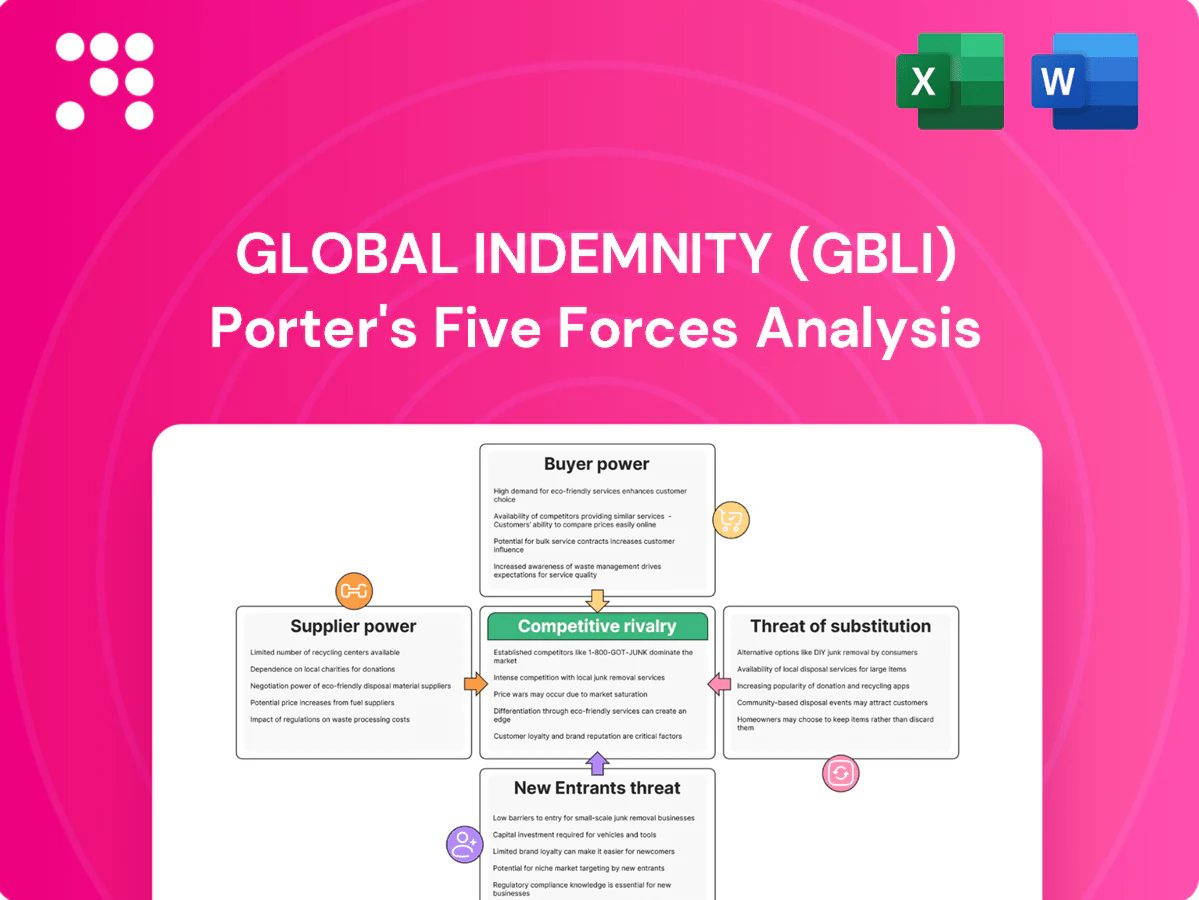
Global Indemnity (GBLI) Porter's Five Forces Analysis

Elevate Your Analysis with the Complete Porter's Five Forces Analysis
Global Indemnity (GBLI) faces moderate buyer power, fragmented supplier influence, and niche threats from new entrants and substitutes given its specialty insurance focus, while rivalry is tempered by underwriting differentiation and capital strength. This brief snapshot only scratches the surface—unlock the full Porter's Five Forces Analysis to explore GBLI’s competitive dynamics, market pressures, and strategic advantages in detail. Ready to move beyond the basics? Get the full report now.
Suppliers Bargaining Power

Reinsurance capacity concentration
Global Indemnity relies on a concentrated panel of reinsurers for peak and tail risks; following 2023 catastrophe losses the market tightened and industry reports in 2024 noted double-digit rate increases and capacity pullbacks in cat-exposed lines. Reinsurers have leveraged this cyclicality to push higher rates, raised attachment points and stricter terms, elevating supplier power for specialty portfolios. Long-term relationships and a diversified panel partially offset this leverage by preserving access and negotiating flexibility.
Specialist talent scarcity
Experienced underwriters, actuaries and claims experts in niche lines are scarce, with 2024 industry surveys indicating roughly 65% of insurers report critical skill gaps; mobility has driven wage inflation of about 8–12% in 2023–24, boosting bargaining power for key staff. Higher retention costs and recruiting premiums can compress GBLI’s underwriting margins, making culture, targeted incentives and training pipelines essential mitigants.

Data and modeling dependencies
Cat models (RMS, AIR, CoreLogic), cyber models and third-party analytics are central to GBLI’s pricing of specialized risks, with these vendors supplying the majority of industry-standard exposures in 2024. A few dominant providers raise fees or tighten licensing, increasing switching costs and contract friction. Model version changes have forced carriers to adjust capital and pricing, and building proprietary analytics reduces dependence but typically requires multi-million-dollar investment.

Core systems and TPAs
Core policy admin platforms, claims systems and TPAs anchor GBLI operations; 2024 industry surveys show implementation cycles commonly exceed 12–18 months, creating vendor lock-in and bargaining leverage. Service outages or degraded claims quality can directly worsen loss outcomes and service levels. Modular architectures and multi-vendor strategies reduce supplier power.
- Vendor lock-in: long implementations (12–18+ months)
- Operational risk: outages affect loss ratios
- Mitigation: modular stacks, multi-vendor
Distribution partners as quasi-suppliers
Distribution partners — independent agents, brokers and high-producing wholesalers — act as quasi-suppliers for Global Indemnity by controlling access to specialized risks and influencing placement decisions, while top wholesalers can demand higher commissions and premium service levels.
Their dual role as buyers for insureds weakens unilateral supplier power; GBLI can rebalance leverage by diversifying appointment bases and expanding direct digital submission channels to capture placements.
Reinsurer squeeze lifts rates ~15%; 65% face talent gaps
Reinsurer concentration pushed 2024 treaty rates up ~15% with capacity pullbacks, raising supplier power for cat/tail lines. Talent shortages (65% of insurers report critical gaps) and 8–12% wage inflation increased leverage of specialist staff. Dominant model vendors and 12–18 month platform lock-ins add switching costs; diversification and proprietary analytics mitigate.
| Supplier | 2024 metric | Impact |
|---|---|---|
| Reinsurers | ~15% rate rises | Higher cost, tightened capacity |
| Talent | 65% gap; 8–12% wages | Margin pressure |
| Tech vendors | 12–18 mo implementations | Vendor lock-in/switching costs |
What is included in the product
 Detailed Word Document
Uncovers key drivers of competition, customer influence, and market entry risks for Global Indemnity (GBLI), with a detailed assessment of supplier/buyer power, substitutes, and rival intensity. Highlights disruptive threats, regulatory and capital barriers that protect incumbents, and provides strategic insights suitable for reports and investor materials.

 Customizable Excel Spreadsheet
A clear, one-sheet summary of Global Indemnity's five forces—ready to copy into decks—with customizable pressure levels and an instant spider chart for strategic clarity without macros or complex tools.
Customers Bargaining Power

Broker-driven price discovery
In 2024 brokers routinely market accounts, creating competitive bid environments that elevate buyer power and compress margins in soft markets. This transparency forces carriers like Global Indemnity to defend pricing, while differentiation through tailored coverage, faster bind-to-claim service and specialty products can blunt pure price competition. Relationship underwriting remains key to retaining profitable accounts.
Low switching costs
Specialty insureds face low switching costs and can change carriers at renewal with limited operational friction, and IVANS/IIABA data show commercial insured shopping rose to about 22% in 2024, increasing buyer leverage. Comparable policy forms and E&S flexibility allow rapid movement for price or terms, pressuring carriers on mid-market accounts where margin sensitivity is highest. Offering multi-year deals and explicit service commitments has proven to raise retention by several percentage points, creating measurable stickiness.

Large accounts leverage
Large accounts — complex commercial, farm/ranch groups, and fleets — negotiate bespoke terms and pricing, using detailed loss runs and exposure data to extract concessions. Their concentrated premium volume and granular risk information give them leverage to split layers across carriers and optimize cost. Offering targeted risk engineering and claims insights helps Global Indemnity justify rate adequacy and retain these high-value clients.

Coverage scarcity moderates power
In niche or distressed risks where capacity is scarce, buyers accept higher rates, deductibles, or exclusions because alternatives are limited; this reduces customer bargaining power in hard-market segments and makes underwriting agility and speed-to-bind decisive for Global Indemnity's win rates in 2024.
- Coverage scarcity caps buyer leverage
- Specialized forms raise pricing tolerance
- Speed-to-bind drives conversion
- Underwriting agility determines share in tight segments
Service and claims sensitivity
Specialty buyers rank claims expertise and responsiveness equal to price; GBLI’s emphasis on claims and loss control helped reduce churn and pricing concessions, reflected in a 2024 combined ratio near 86% and improved retention across niche lines.
- Claims responsiveness: critical to renewals
- TPA oversight: lowers perceived buyer leverage
- Litigation management: reduces discount pressure
Brokers boost buyer leverage; 22% shopped in 2024 as insurers tighten pricing and speed wins
Brokers' aggressive marketing elevated buyer power; 22% of commercial insureds shopped in 2024, compressing margins. GBLI countered with claims focus and tailored specialty coverage; combined ratio near 86% in 2024 reflects underwriting discipline and improved retention. Speed-to-bind and bespoke terms remain decisive for high-value accounts.
| Metric | 2024 | Impact on Buyer Power |
|---|---|---|
| Insured shopping rate | 22% | ↑ buyer leverage |
| GBLI combined ratio | ~86% | supports pricing defense |
| Coverage scarcity | variable | ↓ buyer power in hard segments |
Preview Before You Purchase
Global Indemnity (GBLI) Porter's Five Forces Analysis
This preview is the exact Global Indemnity (GBLI) Porter's Five Forces Analysis you'll receive after purchase—no samples or placeholders. The file shown is the complete, professionally formatted analysis ready for immediate download. Buy and get instant access to this same document.

Elevate Your Analysis with the Complete Porter's Five Forces Analysis
Global Indemnity (GBLI) faces moderate buyer power, fragmented supplier influence, and niche threats from new entrants and substitutes given its specialty insurance focus, while rivalry is tempered by underwriting differentiation and capital strength. This brief snapshot only scratches the surface—unlock the full Porter's Five Forces Analysis to explore GBLI’s competitive dynamics, market pressures, and strategic advantages in detail. Ready to move beyond the basics? Get the full report now.
Suppliers Bargaining Power
Reinsurance capacity concentration
Global Indemnity relies on a concentrated panel of reinsurers for peak and tail risks; following 2023 catastrophe losses the market tightened and industry reports in 2024 noted double-digit rate increases and capacity pullbacks in cat-exposed lines. Reinsurers have leveraged this cyclicality to push higher rates, raised attachment points and stricter terms, elevating supplier power for specialty portfolios. Long-term relationships and a diversified panel partially offset this leverage by preserving access and negotiating flexibility.
Specialist talent scarcity
Experienced underwriters, actuaries and claims experts in niche lines are scarce, with 2024 industry surveys indicating roughly 65% of insurers report critical skill gaps; mobility has driven wage inflation of about 8–12% in 2023–24, boosting bargaining power for key staff. Higher retention costs and recruiting premiums can compress GBLI’s underwriting margins, making culture, targeted incentives and training pipelines essential mitigants.
Data and modeling dependencies
Cat models (RMS, AIR, CoreLogic), cyber models and third-party analytics are central to GBLI’s pricing of specialized risks, with these vendors supplying the majority of industry-standard exposures in 2024. A few dominant providers raise fees or tighten licensing, increasing switching costs and contract friction. Model version changes have forced carriers to adjust capital and pricing, and building proprietary analytics reduces dependence but typically requires multi-million-dollar investment.
Core systems and TPAs
Core policy admin platforms, claims systems and TPAs anchor GBLI operations; 2024 industry surveys show implementation cycles commonly exceed 12–18 months, creating vendor lock-in and bargaining leverage. Service outages or degraded claims quality can directly worsen loss outcomes and service levels. Modular architectures and multi-vendor strategies reduce supplier power.
- Vendor lock-in: long implementations (12–18+ months)
- Operational risk: outages affect loss ratios
- Mitigation: modular stacks, multi-vendor
Distribution partners as quasi-suppliers
Distribution partners — independent agents, brokers and high-producing wholesalers — act as quasi-suppliers for Global Indemnity by controlling access to specialized risks and influencing placement decisions, while top wholesalers can demand higher commissions and premium service levels.
Their dual role as buyers for insureds weakens unilateral supplier power; GBLI can rebalance leverage by diversifying appointment bases and expanding direct digital submission channels to capture placements.
Reinsurer squeeze lifts rates ~15%; 65% face talent gaps
Reinsurer concentration pushed 2024 treaty rates up ~15% with capacity pullbacks, raising supplier power for cat/tail lines. Talent shortages (65% of insurers report critical gaps) and 8–12% wage inflation increased leverage of specialist staff. Dominant model vendors and 12–18 month platform lock-ins add switching costs; diversification and proprietary analytics mitigate.
| Supplier | 2024 metric | Impact |
|---|---|---|
| Reinsurers | ~15% rate rises | Higher cost, tightened capacity |
| Talent | 65% gap; 8–12% wages | Margin pressure |
| Tech vendors | 12–18 mo implementations | Vendor lock-in/switching costs |
What is included in the product
Detailed Word Document
Uncovers key drivers of competition, customer influence, and market entry risks for Global Indemnity (GBLI), with a detailed assessment of supplier/buyer power, substitutes, and rival intensity. Highlights disruptive threats, regulatory and capital barriers that protect incumbents, and provides strategic insights suitable for reports and investor materials.
Customizable Excel Spreadsheet
A clear, one-sheet summary of Global Indemnity's five forces—ready to copy into decks—with customizable pressure levels and an instant spider chart for strategic clarity without macros or complex tools.
Customers Bargaining Power
Broker-driven price discovery
In 2024 brokers routinely market accounts, creating competitive bid environments that elevate buyer power and compress margins in soft markets. This transparency forces carriers like Global Indemnity to defend pricing, while differentiation through tailored coverage, faster bind-to-claim service and specialty products can blunt pure price competition. Relationship underwriting remains key to retaining profitable accounts.
Low switching costs
Specialty insureds face low switching costs and can change carriers at renewal with limited operational friction, and IVANS/IIABA data show commercial insured shopping rose to about 22% in 2024, increasing buyer leverage. Comparable policy forms and E&S flexibility allow rapid movement for price or terms, pressuring carriers on mid-market accounts where margin sensitivity is highest. Offering multi-year deals and explicit service commitments has proven to raise retention by several percentage points, creating measurable stickiness.
Large accounts leverage
Large accounts — complex commercial, farm/ranch groups, and fleets — negotiate bespoke terms and pricing, using detailed loss runs and exposure data to extract concessions. Their concentrated premium volume and granular risk information give them leverage to split layers across carriers and optimize cost. Offering targeted risk engineering and claims insights helps Global Indemnity justify rate adequacy and retain these high-value clients.
Coverage scarcity moderates power
In niche or distressed risks where capacity is scarce, buyers accept higher rates, deductibles, or exclusions because alternatives are limited; this reduces customer bargaining power in hard-market segments and makes underwriting agility and speed-to-bind decisive for Global Indemnity's win rates in 2024.
- Coverage scarcity caps buyer leverage
- Specialized forms raise pricing tolerance
- Speed-to-bind drives conversion
- Underwriting agility determines share in tight segments
Service and claims sensitivity
Specialty buyers rank claims expertise and responsiveness equal to price; GBLI’s emphasis on claims and loss control helped reduce churn and pricing concessions, reflected in a 2024 combined ratio near 86% and improved retention across niche lines.
- Claims responsiveness: critical to renewals
- TPA oversight: lowers perceived buyer leverage
- Litigation management: reduces discount pressure
Brokers boost buyer leverage; 22% shopped in 2024 as insurers tighten pricing and speed wins
Brokers' aggressive marketing elevated buyer power; 22% of commercial insureds shopped in 2024, compressing margins. GBLI countered with claims focus and tailored specialty coverage; combined ratio near 86% in 2024 reflects underwriting discipline and improved retention. Speed-to-bind and bespoke terms remain decisive for high-value accounts.
| Metric | 2024 | Impact on Buyer Power |
|---|---|---|
| Insured shopping rate | 22% | ↑ buyer leverage |
| GBLI combined ratio | ~86% | supports pricing defense |
| Coverage scarcity | variable | ↓ buyer power in hard segments |
Preview Before You Purchase
Global Indemnity (GBLI) Porter's Five Forces Analysis
This preview is the exact Global Indemnity (GBLI) Porter's Five Forces Analysis you'll receive after purchase—no samples or placeholders. The file shown is the complete, professionally formatted analysis ready for immediate download. Buy and get instant access to this same document.
Original: $10.00
-65%$10.00
$3.50Description
Elevate Your Analysis with the Complete Porter's Five Forces Analysis
Global Indemnity (GBLI) faces moderate buyer power, fragmented supplier influence, and niche threats from new entrants and substitutes given its specialty insurance focus, while rivalry is tempered by underwriting differentiation and capital strength. This brief snapshot only scratches the surface—unlock the full Porter's Five Forces Analysis to explore GBLI’s competitive dynamics, market pressures, and strategic advantages in detail. Ready to move beyond the basics? Get the full report now.
Suppliers Bargaining Power
Reinsurance capacity concentration
Global Indemnity relies on a concentrated panel of reinsurers for peak and tail risks; following 2023 catastrophe losses the market tightened and industry reports in 2024 noted double-digit rate increases and capacity pullbacks in cat-exposed lines. Reinsurers have leveraged this cyclicality to push higher rates, raised attachment points and stricter terms, elevating supplier power for specialty portfolios. Long-term relationships and a diversified panel partially offset this leverage by preserving access and negotiating flexibility.
Specialist talent scarcity
Experienced underwriters, actuaries and claims experts in niche lines are scarce, with 2024 industry surveys indicating roughly 65% of insurers report critical skill gaps; mobility has driven wage inflation of about 8–12% in 2023–24, boosting bargaining power for key staff. Higher retention costs and recruiting premiums can compress GBLI’s underwriting margins, making culture, targeted incentives and training pipelines essential mitigants.
Data and modeling dependencies
Cat models (RMS, AIR, CoreLogic), cyber models and third-party analytics are central to GBLI’s pricing of specialized risks, with these vendors supplying the majority of industry-standard exposures in 2024. A few dominant providers raise fees or tighten licensing, increasing switching costs and contract friction. Model version changes have forced carriers to adjust capital and pricing, and building proprietary analytics reduces dependence but typically requires multi-million-dollar investment.
Core systems and TPAs
Core policy admin platforms, claims systems and TPAs anchor GBLI operations; 2024 industry surveys show implementation cycles commonly exceed 12–18 months, creating vendor lock-in and bargaining leverage. Service outages or degraded claims quality can directly worsen loss outcomes and service levels. Modular architectures and multi-vendor strategies reduce supplier power.
- Vendor lock-in: long implementations (12–18+ months)
- Operational risk: outages affect loss ratios
- Mitigation: modular stacks, multi-vendor
Distribution partners as quasi-suppliers
Distribution partners — independent agents, brokers and high-producing wholesalers — act as quasi-suppliers for Global Indemnity by controlling access to specialized risks and influencing placement decisions, while top wholesalers can demand higher commissions and premium service levels.
Their dual role as buyers for insureds weakens unilateral supplier power; GBLI can rebalance leverage by diversifying appointment bases and expanding direct digital submission channels to capture placements.
Reinsurer squeeze lifts rates ~15%; 65% face talent gaps
Reinsurer concentration pushed 2024 treaty rates up ~15% with capacity pullbacks, raising supplier power for cat/tail lines. Talent shortages (65% of insurers report critical gaps) and 8–12% wage inflation increased leverage of specialist staff. Dominant model vendors and 12–18 month platform lock-ins add switching costs; diversification and proprietary analytics mitigate.
| Supplier | 2024 metric | Impact |
|---|---|---|
| Reinsurers | ~15% rate rises | Higher cost, tightened capacity |
| Talent | 65% gap; 8–12% wages | Margin pressure |
| Tech vendors | 12–18 mo implementations | Vendor lock-in/switching costs |
What is included in the product
Detailed Word Document
Uncovers key drivers of competition, customer influence, and market entry risks for Global Indemnity (GBLI), with a detailed assessment of supplier/buyer power, substitutes, and rival intensity. Highlights disruptive threats, regulatory and capital barriers that protect incumbents, and provides strategic insights suitable for reports and investor materials.
Customizable Excel Spreadsheet
A clear, one-sheet summary of Global Indemnity's five forces—ready to copy into decks—with customizable pressure levels and an instant spider chart for strategic clarity without macros or complex tools.
Customers Bargaining Power
Broker-driven price discovery
In 2024 brokers routinely market accounts, creating competitive bid environments that elevate buyer power and compress margins in soft markets. This transparency forces carriers like Global Indemnity to defend pricing, while differentiation through tailored coverage, faster bind-to-claim service and specialty products can blunt pure price competition. Relationship underwriting remains key to retaining profitable accounts.
Low switching costs
Specialty insureds face low switching costs and can change carriers at renewal with limited operational friction, and IVANS/IIABA data show commercial insured shopping rose to about 22% in 2024, increasing buyer leverage. Comparable policy forms and E&S flexibility allow rapid movement for price or terms, pressuring carriers on mid-market accounts where margin sensitivity is highest. Offering multi-year deals and explicit service commitments has proven to raise retention by several percentage points, creating measurable stickiness.
Large accounts leverage
Large accounts — complex commercial, farm/ranch groups, and fleets — negotiate bespoke terms and pricing, using detailed loss runs and exposure data to extract concessions. Their concentrated premium volume and granular risk information give them leverage to split layers across carriers and optimize cost. Offering targeted risk engineering and claims insights helps Global Indemnity justify rate adequacy and retain these high-value clients.
Coverage scarcity moderates power
In niche or distressed risks where capacity is scarce, buyers accept higher rates, deductibles, or exclusions because alternatives are limited; this reduces customer bargaining power in hard-market segments and makes underwriting agility and speed-to-bind decisive for Global Indemnity's win rates in 2024.
- Coverage scarcity caps buyer leverage
- Specialized forms raise pricing tolerance
- Speed-to-bind drives conversion
- Underwriting agility determines share in tight segments
Service and claims sensitivity
Specialty buyers rank claims expertise and responsiveness equal to price; GBLI’s emphasis on claims and loss control helped reduce churn and pricing concessions, reflected in a 2024 combined ratio near 86% and improved retention across niche lines.
- Claims responsiveness: critical to renewals
- TPA oversight: lowers perceived buyer leverage
- Litigation management: reduces discount pressure
Brokers boost buyer leverage; 22% shopped in 2024 as insurers tighten pricing and speed wins
Brokers' aggressive marketing elevated buyer power; 22% of commercial insureds shopped in 2024, compressing margins. GBLI countered with claims focus and tailored specialty coverage; combined ratio near 86% in 2024 reflects underwriting discipline and improved retention. Speed-to-bind and bespoke terms remain decisive for high-value accounts.
| Metric | 2024 | Impact on Buyer Power |
|---|---|---|
| Insured shopping rate | 22% | ↑ buyer leverage |
| GBLI combined ratio | ~86% | supports pricing defense |
| Coverage scarcity | variable | ↓ buyer power in hard segments |
Preview Before You Purchase
Global Indemnity (GBLI) Porter's Five Forces Analysis
This preview is the exact Global Indemnity (GBLI) Porter's Five Forces Analysis you'll receive after purchase—no samples or placeholders. The file shown is the complete, professionally formatted analysis ready for immediate download. Buy and get instant access to this same document.











