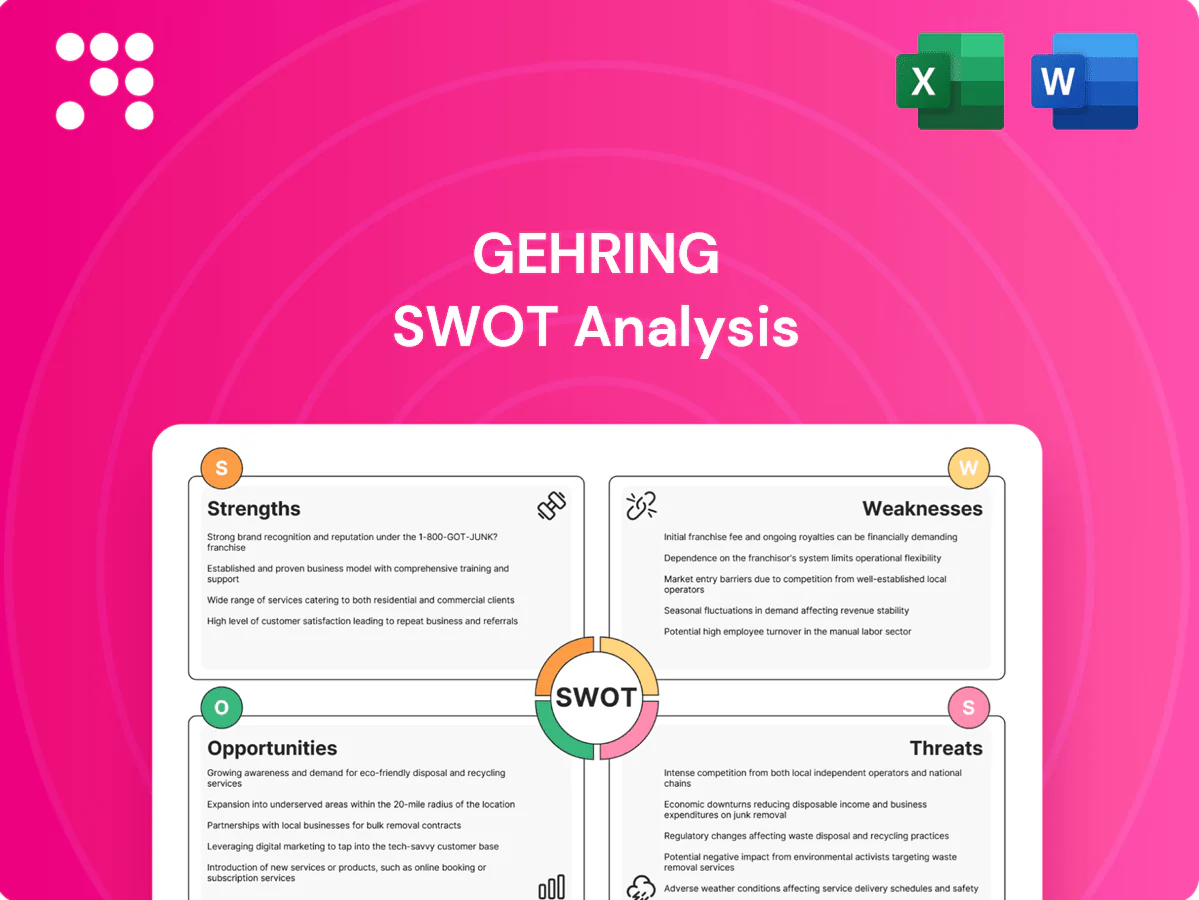
Gehring SWOT Analysis

Dive Deeper Into the Company’s Strategic Blueprint
Our Gehring SWOT Analysis distills the company’s core strengths, competitive risks, and growth opportunities into a concise, actionable framework that empowers investors and strategists. Backed by market data and expert interpretation, the report highlights strategic levers and potential vulnerabilities you need to know. Purchase the full SWOT to get a professionally formatted, editable report and Excel tools for planning, pitching, and decision-making.
Strengths

Honing tech leadership
Deep specialization in precision honing gives Gehring process know-how and credibility, routinely achieving tolerances in the single-digit micrometer range (1–9 µm) required by engine and hydraulic OEMs. Proven ability to hit these tight specs builds customer trust in critical applications and drives high repeat business. This leadership supports premium pricing and creates barriers to entry for generalist machine builders.
Integrated machines, tools, automation
Offering machines, tooling and automation as a package simplifies vendor management and reduced supplier count by up to 40% in OEM supply chains, while system-level optimization can improve cycle time, quality and OEE by as much as 20–30% (McKinsey benchmarking). Bundling raises switching costs and can lift share of wallet, with aftermarket consumables and upgrades often delivering 15–25% recurring lifecycle revenue.

Global service and process support
Worldwide process development, training, and after-sales support keep production uptime high by enabling rapid troubleshooting and preventive maintenance. Close application engineering shortens customer ramp-up and cuts scrap through tailored setups and process transfers. Strong global service increases customer satisfaction and retention while creating recurring, high-margin revenue streams for Gehring.

Quality and reliability in critical parts
Gehring’s honing and finishing solutions focus on components where durability and efficiency are critical, delivering proven reliability that reduces total cost of ownership for OEMs and Tier-1 suppliers. Reference installations across automotive and industrial clients provide strong proof points, facilitating smoother entry into regulated industries.
- Durability-led design
- Lower TCO for OEMs/Tier-1s
- Reference installations = credibility
- Eases access to regulated sectors
Customization and engineering depth
Custom solutions align precisely with customer geometries and materials, enabling Gehring to deliver gear finishing and honing systems tailored to specific part tolerances and metallurgies.
Engineering depth supports complex multi-station and automated cells, increasing differentiation versus standard machines and protecting margins in demanding, high-precision applications.
- Custom alignment to part geometry and material
- Complex multi-station and automated cells
- Higher differentiation versus standard equipment
- Margin protection in demanding applications
Deep 1–9 µm honing: 20–30% OEE lift and supplier cuts up to 40%
Deep 1–9 µm honing expertise drives premium pricing, repeat business and barriers to entry. Bundled machines, tooling and automation cut supplier count up to 40% and can improve cycle time/OEE 20–30%, while aftermarket/upgrades deliver 15–25% recurring lifecycle revenue. Global service and custom multi-station engineering boost uptime and protect margins in regulated OEM markets.
| Metric | Value |
|---|---|
| Honing tolerance | 1–9 µm |
| Supplier count reduction | up to 40% |
| Cycle time / OEE gain | 20–30% |
| Recurring lifecycle revenue | 15–25% |
What is included in the product
 Detailed Word Document
Delivers a strategic overview of Gehring’s internal and external business factors, outlining strengths, weaknesses, opportunities, and threats to assess competitive position and future risks.

 Customizable Excel Spreadsheet
Provides a concise Gehring-specific SWOT matrix for rapid strategy alignment and clear prioritization of actions to relieve decision-making bottlenecks.
Weaknesses

ICE exposure concentration
Gehring's historical focus on engine components leaves a large share of revenue tied to internal combustion engine cycles. Electrification accelerated: electric vehicles reached about 14% of global new car sales in 2023 and roughly 22% in Europe in 2024 (IEA/ACEA), cutting long‑term ICE demand. This creates structural headwinds in core segments. Repositioning the portfolio requires multi‑year timelines and multi‑million‑euro investments.
High capex sales cyclicality
Machine tool demand for Gehring is highly sensitive to macro and auto capex cycles; with Gehring reporting group revenue near €290m in 2023, customer deferrals can materially elongate sales cycles. Revenue volatility from cycle swings compresses utilization and margins, with order book fluctuations often exceeding 20% year-on-year. This makes accurate forecasting and capacity planning notably harder, increasing working capital strain.

Customization lengthens lead times
Engineering-to-order extends Gehring project durations—commonly to 6–12 months—raising complexity and deterring customers with urgent needs; long lead times can reduce order conversion. Higher WIP ties up an estimated 15–25% of working capital in comparable manufacturers, while scope changes frequently drive 10–20% cost overruns, pressuring margins.

Niche market breadth limits scale
Precision honing is a highly specialized subset of metalworking focused on surface finish and geometric accuracy, meaning Gehring competes in a narrower addressable market than broad machining toolmakers; this limits volume-driven growth and makes widespread scale economies harder to realize. Large OEMs and Tier 1 buyers can pressure pricing and contract terms, testing Gehring’s pricing power and margin resilience. Niche focus also raises exposure to cyclical demand swings in automotive and aerospace segments.
- Market breadth: niche vs general machining
- Scale limits: harder to achieve high-volume cost reductions
- Pricing risk: large buyers can exert downward pressure
After-sales resource intensity
Global after-sales for Gehring requires highly skilled technicians and complex parts logistics, driving fixed costs for staffing, training and travel. Peaks in demand can overload field capacity, leading to longer response times and variable service quality. This resource intensity reduces margin stability and complicates scaling across regions.
- Skilled technicians requirement
- Staffing, training and travel = fixed costs
- Demand peaks strain field capacity
- Variability hurts response times and quality
ICE-focused supplier faces decline as EU EVs ~22% (2024); multi-€m repositioning needed
Gehring's ICE-centric portfolio faces structural decline as EVs hit ~22% EU new sales in 2024, pressuring honed-engine demand; multi‑million‑euro, multi‑year repositioning needed.
Revenue (~€290m in 2023) and order‑book swings >20% amplify margin volatility; ETO lead times (6–12m) tie up ~15–25% working capital.
After‑sales require high‑skilled techs, raising fixed costs and limiting regional scale.
| Metric | Value |
|---|---|
| 2023 revenue | €290m |
| EU EV share (2024) | ~22% |
| Order‑book volatility | >20% |
| WIP tied | 15–25% |
| Lead time | 6–12 months |
Preview the Actual Deliverable
Gehring SWOT Analysis
This is the actual Gehring SWOT Analysis document you’ll receive upon purchase—no surprises, just professional quality. The preview below is taken directly from the full report, and the complete, editable file becomes available after checkout. Buy now to unlock the entire in-depth version.

Dive Deeper Into the Company’s Strategic Blueprint
Our Gehring SWOT Analysis distills the company’s core strengths, competitive risks, and growth opportunities into a concise, actionable framework that empowers investors and strategists. Backed by market data and expert interpretation, the report highlights strategic levers and potential vulnerabilities you need to know. Purchase the full SWOT to get a professionally formatted, editable report and Excel tools for planning, pitching, and decision-making.
Strengths
Honing tech leadership
Deep specialization in precision honing gives Gehring process know-how and credibility, routinely achieving tolerances in the single-digit micrometer range (1–9 µm) required by engine and hydraulic OEMs. Proven ability to hit these tight specs builds customer trust in critical applications and drives high repeat business. This leadership supports premium pricing and creates barriers to entry for generalist machine builders.
Integrated machines, tools, automation
Offering machines, tooling and automation as a package simplifies vendor management and reduced supplier count by up to 40% in OEM supply chains, while system-level optimization can improve cycle time, quality and OEE by as much as 20–30% (McKinsey benchmarking). Bundling raises switching costs and can lift share of wallet, with aftermarket consumables and upgrades often delivering 15–25% recurring lifecycle revenue.
Global service and process support
Worldwide process development, training, and after-sales support keep production uptime high by enabling rapid troubleshooting and preventive maintenance. Close application engineering shortens customer ramp-up and cuts scrap through tailored setups and process transfers. Strong global service increases customer satisfaction and retention while creating recurring, high-margin revenue streams for Gehring.
Quality and reliability in critical parts
Gehring’s honing and finishing solutions focus on components where durability and efficiency are critical, delivering proven reliability that reduces total cost of ownership for OEMs and Tier-1 suppliers. Reference installations across automotive and industrial clients provide strong proof points, facilitating smoother entry into regulated industries.
- Durability-led design
- Lower TCO for OEMs/Tier-1s
- Reference installations = credibility
- Eases access to regulated sectors
Customization and engineering depth
Custom solutions align precisely with customer geometries and materials, enabling Gehring to deliver gear finishing and honing systems tailored to specific part tolerances and metallurgies.
Engineering depth supports complex multi-station and automated cells, increasing differentiation versus standard machines and protecting margins in demanding, high-precision applications.
- Custom alignment to part geometry and material
- Complex multi-station and automated cells
- Higher differentiation versus standard equipment
- Margin protection in demanding applications
Deep 1–9 µm honing: 20–30% OEE lift and supplier cuts up to 40%
Deep 1–9 µm honing expertise drives premium pricing, repeat business and barriers to entry. Bundled machines, tooling and automation cut supplier count up to 40% and can improve cycle time/OEE 20–30%, while aftermarket/upgrades deliver 15–25% recurring lifecycle revenue. Global service and custom multi-station engineering boost uptime and protect margins in regulated OEM markets.
| Metric | Value |
|---|---|
| Honing tolerance | 1–9 µm |
| Supplier count reduction | up to 40% |
| Cycle time / OEE gain | 20–30% |
| Recurring lifecycle revenue | 15–25% |
What is included in the product
Detailed Word Document
Delivers a strategic overview of Gehring’s internal and external business factors, outlining strengths, weaknesses, opportunities, and threats to assess competitive position and future risks.
Customizable Excel Spreadsheet
Provides a concise Gehring-specific SWOT matrix for rapid strategy alignment and clear prioritization of actions to relieve decision-making bottlenecks.
Weaknesses
ICE exposure concentration
Gehring's historical focus on engine components leaves a large share of revenue tied to internal combustion engine cycles. Electrification accelerated: electric vehicles reached about 14% of global new car sales in 2023 and roughly 22% in Europe in 2024 (IEA/ACEA), cutting long‑term ICE demand. This creates structural headwinds in core segments. Repositioning the portfolio requires multi‑year timelines and multi‑million‑euro investments.
High capex sales cyclicality
Machine tool demand for Gehring is highly sensitive to macro and auto capex cycles; with Gehring reporting group revenue near €290m in 2023, customer deferrals can materially elongate sales cycles. Revenue volatility from cycle swings compresses utilization and margins, with order book fluctuations often exceeding 20% year-on-year. This makes accurate forecasting and capacity planning notably harder, increasing working capital strain.
Customization lengthens lead times
Engineering-to-order extends Gehring project durations—commonly to 6–12 months—raising complexity and deterring customers with urgent needs; long lead times can reduce order conversion. Higher WIP ties up an estimated 15–25% of working capital in comparable manufacturers, while scope changes frequently drive 10–20% cost overruns, pressuring margins.
Niche market breadth limits scale
Precision honing is a highly specialized subset of metalworking focused on surface finish and geometric accuracy, meaning Gehring competes in a narrower addressable market than broad machining toolmakers; this limits volume-driven growth and makes widespread scale economies harder to realize. Large OEMs and Tier 1 buyers can pressure pricing and contract terms, testing Gehring’s pricing power and margin resilience. Niche focus also raises exposure to cyclical demand swings in automotive and aerospace segments.
- Market breadth: niche vs general machining
- Scale limits: harder to achieve high-volume cost reductions
- Pricing risk: large buyers can exert downward pressure
After-sales resource intensity
Global after-sales for Gehring requires highly skilled technicians and complex parts logistics, driving fixed costs for staffing, training and travel. Peaks in demand can overload field capacity, leading to longer response times and variable service quality. This resource intensity reduces margin stability and complicates scaling across regions.
- Skilled technicians requirement
- Staffing, training and travel = fixed costs
- Demand peaks strain field capacity
- Variability hurts response times and quality
ICE-focused supplier faces decline as EU EVs ~22% (2024); multi-€m repositioning needed
Gehring's ICE-centric portfolio faces structural decline as EVs hit ~22% EU new sales in 2024, pressuring honed-engine demand; multi‑million‑euro, multi‑year repositioning needed.
Revenue (~€290m in 2023) and order‑book swings >20% amplify margin volatility; ETO lead times (6–12m) tie up ~15–25% working capital.
After‑sales require high‑skilled techs, raising fixed costs and limiting regional scale.
| Metric | Value |
|---|---|
| 2023 revenue | €290m |
| EU EV share (2024) | ~22% |
| Order‑book volatility | >20% |
| WIP tied | 15–25% |
| Lead time | 6–12 months |
Preview the Actual Deliverable
Gehring SWOT Analysis
This is the actual Gehring SWOT Analysis document you’ll receive upon purchase—no surprises, just professional quality. The preview below is taken directly from the full report, and the complete, editable file becomes available after checkout. Buy now to unlock the entire in-depth version.
Description
Dive Deeper Into the Company’s Strategic Blueprint
Our Gehring SWOT Analysis distills the company’s core strengths, competitive risks, and growth opportunities into a concise, actionable framework that empowers investors and strategists. Backed by market data and expert interpretation, the report highlights strategic levers and potential vulnerabilities you need to know. Purchase the full SWOT to get a professionally formatted, editable report and Excel tools for planning, pitching, and decision-making.
Strengths
Honing tech leadership
Deep specialization in precision honing gives Gehring process know-how and credibility, routinely achieving tolerances in the single-digit micrometer range (1–9 µm) required by engine and hydraulic OEMs. Proven ability to hit these tight specs builds customer trust in critical applications and drives high repeat business. This leadership supports premium pricing and creates barriers to entry for generalist machine builders.
Integrated machines, tools, automation
Offering machines, tooling and automation as a package simplifies vendor management and reduced supplier count by up to 40% in OEM supply chains, while system-level optimization can improve cycle time, quality and OEE by as much as 20–30% (McKinsey benchmarking). Bundling raises switching costs and can lift share of wallet, with aftermarket consumables and upgrades often delivering 15–25% recurring lifecycle revenue.
Global service and process support
Worldwide process development, training, and after-sales support keep production uptime high by enabling rapid troubleshooting and preventive maintenance. Close application engineering shortens customer ramp-up and cuts scrap through tailored setups and process transfers. Strong global service increases customer satisfaction and retention while creating recurring, high-margin revenue streams for Gehring.
Quality and reliability in critical parts
Gehring’s honing and finishing solutions focus on components where durability and efficiency are critical, delivering proven reliability that reduces total cost of ownership for OEMs and Tier-1 suppliers. Reference installations across automotive and industrial clients provide strong proof points, facilitating smoother entry into regulated industries.
- Durability-led design
- Lower TCO for OEMs/Tier-1s
- Reference installations = credibility
- Eases access to regulated sectors
Customization and engineering depth
Custom solutions align precisely with customer geometries and materials, enabling Gehring to deliver gear finishing and honing systems tailored to specific part tolerances and metallurgies.
Engineering depth supports complex multi-station and automated cells, increasing differentiation versus standard machines and protecting margins in demanding, high-precision applications.
- Custom alignment to part geometry and material
- Complex multi-station and automated cells
- Higher differentiation versus standard equipment
- Margin protection in demanding applications
Deep 1–9 µm honing: 20–30% OEE lift and supplier cuts up to 40%
Deep 1–9 µm honing expertise drives premium pricing, repeat business and barriers to entry. Bundled machines, tooling and automation cut supplier count up to 40% and can improve cycle time/OEE 20–30%, while aftermarket/upgrades deliver 15–25% recurring lifecycle revenue. Global service and custom multi-station engineering boost uptime and protect margins in regulated OEM markets.
| Metric | Value |
|---|---|
| Honing tolerance | 1–9 µm |
| Supplier count reduction | up to 40% |
| Cycle time / OEE gain | 20–30% |
| Recurring lifecycle revenue | 15–25% |
What is included in the product
Detailed Word Document
Delivers a strategic overview of Gehring’s internal and external business factors, outlining strengths, weaknesses, opportunities, and threats to assess competitive position and future risks.
Customizable Excel Spreadsheet
Provides a concise Gehring-specific SWOT matrix for rapid strategy alignment and clear prioritization of actions to relieve decision-making bottlenecks.
Weaknesses
ICE exposure concentration
Gehring's historical focus on engine components leaves a large share of revenue tied to internal combustion engine cycles. Electrification accelerated: electric vehicles reached about 14% of global new car sales in 2023 and roughly 22% in Europe in 2024 (IEA/ACEA), cutting long‑term ICE demand. This creates structural headwinds in core segments. Repositioning the portfolio requires multi‑year timelines and multi‑million‑euro investments.
High capex sales cyclicality
Machine tool demand for Gehring is highly sensitive to macro and auto capex cycles; with Gehring reporting group revenue near €290m in 2023, customer deferrals can materially elongate sales cycles. Revenue volatility from cycle swings compresses utilization and margins, with order book fluctuations often exceeding 20% year-on-year. This makes accurate forecasting and capacity planning notably harder, increasing working capital strain.
Customization lengthens lead times
Engineering-to-order extends Gehring project durations—commonly to 6–12 months—raising complexity and deterring customers with urgent needs; long lead times can reduce order conversion. Higher WIP ties up an estimated 15–25% of working capital in comparable manufacturers, while scope changes frequently drive 10–20% cost overruns, pressuring margins.
Niche market breadth limits scale
Precision honing is a highly specialized subset of metalworking focused on surface finish and geometric accuracy, meaning Gehring competes in a narrower addressable market than broad machining toolmakers; this limits volume-driven growth and makes widespread scale economies harder to realize. Large OEMs and Tier 1 buyers can pressure pricing and contract terms, testing Gehring’s pricing power and margin resilience. Niche focus also raises exposure to cyclical demand swings in automotive and aerospace segments.
- Market breadth: niche vs general machining
- Scale limits: harder to achieve high-volume cost reductions
- Pricing risk: large buyers can exert downward pressure
After-sales resource intensity
Global after-sales for Gehring requires highly skilled technicians and complex parts logistics, driving fixed costs for staffing, training and travel. Peaks in demand can overload field capacity, leading to longer response times and variable service quality. This resource intensity reduces margin stability and complicates scaling across regions.
- Skilled technicians requirement
- Staffing, training and travel = fixed costs
- Demand peaks strain field capacity
- Variability hurts response times and quality
ICE-focused supplier faces decline as EU EVs ~22% (2024); multi-€m repositioning needed
Gehring's ICE-centric portfolio faces structural decline as EVs hit ~22% EU new sales in 2024, pressuring honed-engine demand; multi‑million‑euro, multi‑year repositioning needed.
Revenue (~€290m in 2023) and order‑book swings >20% amplify margin volatility; ETO lead times (6–12m) tie up ~15–25% working capital.
After‑sales require high‑skilled techs, raising fixed costs and limiting regional scale.
| Metric | Value |
|---|---|
| 2023 revenue | €290m |
| EU EV share (2024) | ~22% |
| Order‑book volatility | >20% |
| WIP tied | 15–25% |
| Lead time | 6–12 months |
Preview the Actual Deliverable
Gehring SWOT Analysis
This is the actual Gehring SWOT Analysis document you’ll receive upon purchase—no surprises, just professional quality. The preview below is taken directly from the full report, and the complete, editable file becomes available after checkout. Buy now to unlock the entire in-depth version.











